ECO mode FIAT FULLBACK 2016 1.G Workshop Manual
[x] Cancel search | Manufacturer: FIAT, Model Year: 2016, Model line: FULLBACK, Model: FIAT FULLBACK 2016 1.GPages: 312, PDF Size: 13.67 MB
Page 147 of 312
Keyless operation key reminder
If the operation mode is in OFF and the
driver’s door is opened with the keyless
operation key in the key slot, the
warning lamp will blink and the outer
buzzer sounds for approximately
3 seconds and the inner buzzer sounds
for approximately 1 minute to remind
you to remove the key.
WARNING
203)Never run the engine in a closed or
poorly ventilated area any longer than is
needed to move your vehicle in or out of
the area. Carbon monoxide gases are
odourless and can be fatal.204)Do not operate the engine switch
while driving except in an emergency. If the
engine is stopped while driving, the brake
servomechanism will cease to function and
braking efficiency will deteriorate. Also, the
power steering system will not function and
it will require greater manual effort to
operate the steering. This could result in a
serious accident.
IMPORTANT
79)Release the ignition key as soon as the
engine starts to avoid damaging the starter
motor.
80)Never attempt to start the engine by
pushing or pulling the vehicle.
81)Do not run the engine at high rpm or
drive the vehicle at high speed until the
engine has had a chance to warm up.
82)If your vehicle is equipped with a
turbocharger, do not stop the engine
immediately after high-speed or uphill
driving. First allow the engine to idle to give
the turbocharger a chance to cool down.
83)It is advisable not to demand maximum
performance from your vehicle (e.g.
excessive acceleration, long distances at
high speeds, excessively intense braking,
etc.) during the initial period of use.
84)A quick burst on the accelerator before
turning off the engine serves absolutely no
practical purpose; it wastes fuel and is
especially damaging to turbocharged
engines.
TURBOCHARGER
OPERATION
(where provided)
Turbocharger
85) 86)
The turbocharger increases engine
power by pushing large amounts of air
into the engine’s cylinders. The finned
parts inside the turbocharger turn at
extremely high speeds and are
subjected to extremely high
temperatures. They are lubricated and
cooled by engine oil. If the engine oil is
not replaced at the specified intervals,
the bearings may seize or emit
abnormal noise.
1. Air compressor 2. Compressed air
3. Cylinder 4. Turbo fin 5. Turbine
6. Exhaust gas
230AHA103505
4
5
6
1
2
3
231AA0020860
145
Page 149 of 312
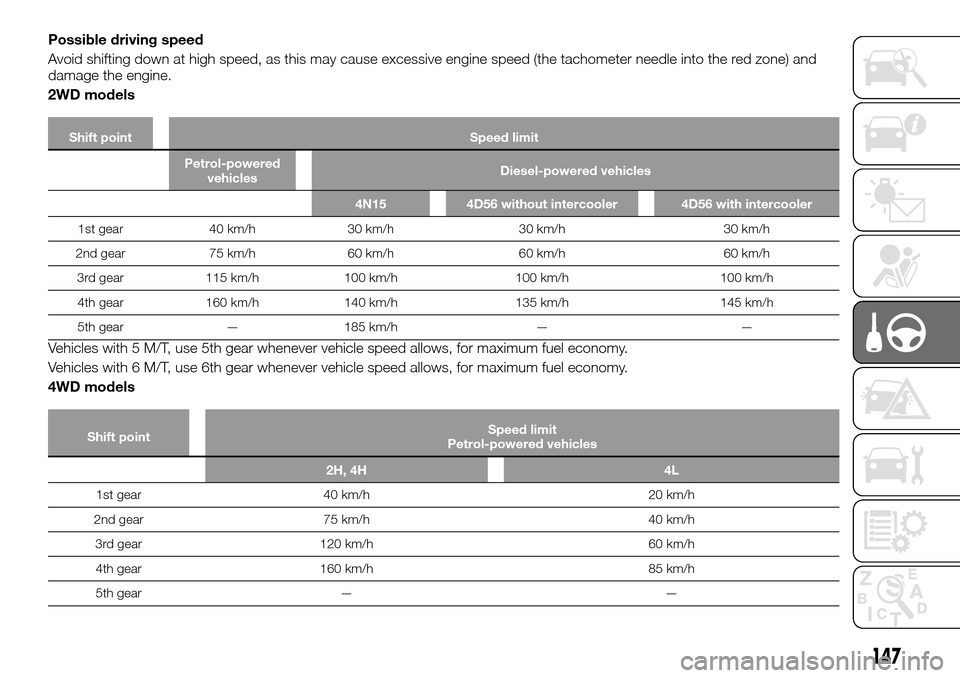
Possible driving speed
Avoid shifting down at high speed, as this may cause excessive engine speed (the tachometer needle into the red zone) and
damage the engine.
2WD models
Shift point Speed limit
Petrol-powered
vehiclesDiesel-powered vehicles
4N15 4D56 without intercooler 4D56 with intercooler
1st gear 40 km/h 30 km/h 30 km/h 30 km/h
2nd gear 75 km/h 60 km/h 60 km/h 60 km/h
3rd gear 115 km/h 100 km/h 100 km/h 100 km/h
4th gear 160 km/h 140 km/h 135 km/h 145 km/h
5th gear — 185 km/h — —
Vehicles with 5 M/T, use 5th gear whenever vehicle speed allows, for maximum fuel economy.
Vehicles with 6 M/T, use 6th gear whenever vehicle speed allows, for maximum fuel economy.
4WD models
Shift pointSpeed limit
Petrol-powered vehicles
2H, 4H 4L
1st gear 40 km/h 20 km/h
2nd gear 75 km/h 40 km/h
3rd gear 120 km/h 60 km/h
4th gear 160 km/h 85 km/h
5th gear — —
147
Page 151 of 312
AUTOMATIC
TRANSMISSION
SPORT MODE 5A/T
(where provided)
During running-in period or immediately
after reconnection of the battery cable,
there may be a case where gear shifts
are not made smoothly. This does not
indicate a faulty transmission. Gear
shifts will become smooth after the
transmission has been shifted several
times by the electronic control system.
Selector lever operation
The transmission has 5 forward gears
and 1 reverse gear.
The individual gears are selected
automatically, depending on the speed
of the vehicle and the position of the
accelerator pedal.
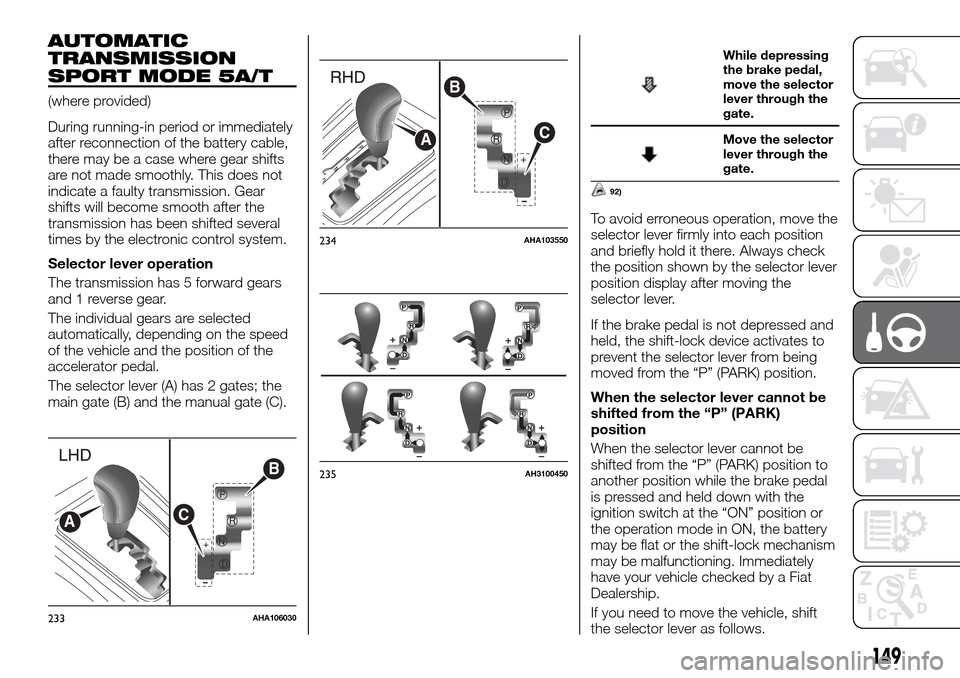
The selector lever (A) has 2 gates; the
main gate (B) and the manual gate (C).
While depressing
the brake pedal,
move the selector
lever through the
gate.
Move the selector
lever through the
gate.
92)
To avoid erroneous operation, move the
selector lever firmly into each position
and briefly hold it there. Always check
the position shown by the selector lever
position display after moving the
selector lever.
If the brake pedal is not depressed and
held, the shift-lock device activates to
prevent the selector lever from being
moved from the “P” (PARK) position.
When the selector lever cannot be
shifted from the “P” (PARK)
position
When the selector lever cannot be
shifted from the “P” (PARK) position to
another position while the brake pedal
is pressed and held down with the
ignition switch at the “ON” position or
the operation mode in ON, the battery
may be flat or the shift-lock mechanism
may be malfunctioning. Immediately
have your vehicle checked by a Fiat
Dealership.
If you need to move the vehicle, shift
the selector lever as follows.
+
P
R
N
D
B
CA
233AHA106030
+
B
C
A
234AHA103550
235AH3100450
149
Page 153 of 312
Selector lever positions
“P” PARK
This position locks the transmission to
prevent the vehicle from moving. The
engine can be started in this position.
“R” REVERSE
This position is to back up.
93)
“N” NEUTRAL
At this position the transmission is
disengaged. It is the same as the
neutral position on a manual
transmission, and should only be used
when the vehicle is stationary for an
extended length of time during driving,
such as in a traffic jam.
94) 95) 96)
“D” DRIVE
This position is used for most city and
highway driving. The transmission will
automatically change its gear
depending on road and driving
conditions.
97)
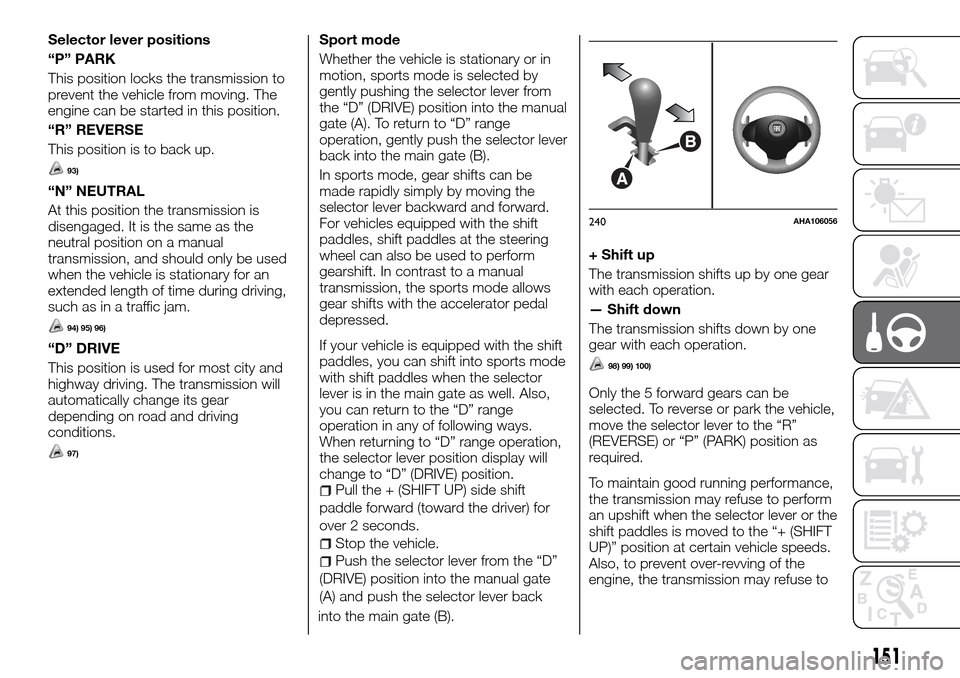
Sport mode
Whether the vehicle is stationary or in
motion, sports mode is selected by
gently pushing the selector lever from
the “D” (DRIVE) position into the manual
gate (A). To return to “D” range
operation, gently push the selector lever
back into the main gate (B).
In sports mode, gear shifts can be
made rapidly simply by moving the
selector lever backward and forward.
For vehicles equipped with the shift
paddles, shift paddles at the steering
wheel can also be used to perform
gearshift. In contrast to a manual
transmission, the sports mode allows
gear shifts with the accelerator pedal
depressed.
If your vehicle is equipped with the shift
paddles, you can shift into sports mode
with shift paddles when the selector
lever is in the main gate as well. Also,
you can return to the “D” range
operation in any of following ways.
When returning to “D” range operation,
the selector lever position display will
change to “D” (DRIVE) position.
Pull the + (SHIFT UP) side shift
paddle forward (toward the driver) for
over 2 seconds.
Stop the vehicle.
Push the selector lever from the “D”
(DRIVE) position into the manual gate
(A) and push the selector lever back
into the main gate (B).
+ Shift up
The transmission shifts up by one gear
with each operation.
— Shift down
The transmission shifts down by one
gear with each operation.
98) 99) 100)
Only the 5 forward gears can be
selected. To reverse or park the vehicle,
move the selector lever to the “R”
(REVERSE) or “P” (PARK) position as
required.
To maintain good running performance,
the transmission may refuse to perform
an upshift when the selector lever or the
shift paddles is moved to the “+ (SHIFT
UP)” position at certain vehicle speeds.
Also, to prevent over-revving of the
engine, the transmission may refuse to
B
A
240AHA106056
151
Page 154 of 312
perform a downshift when the selector
lever or the shift paddles is moved to
the “— (SHIFT DOWN)” position at
certain vehicle speeds.
Downward shifts are made
automatically when the vehicle slows
down. When the vehicle stops, 1st gear
is automatically selected.
When driving away on a slippery road,
push the selector lever forward into the
“+ (SHIFT UP)” position. This cause the
transmission to shift into the 2nd gear
which is better for smooth driving away
on a slippery road. Push the selector
lever to the “— (SHIFT DOWN)” side to
shift back to the 1st gear.
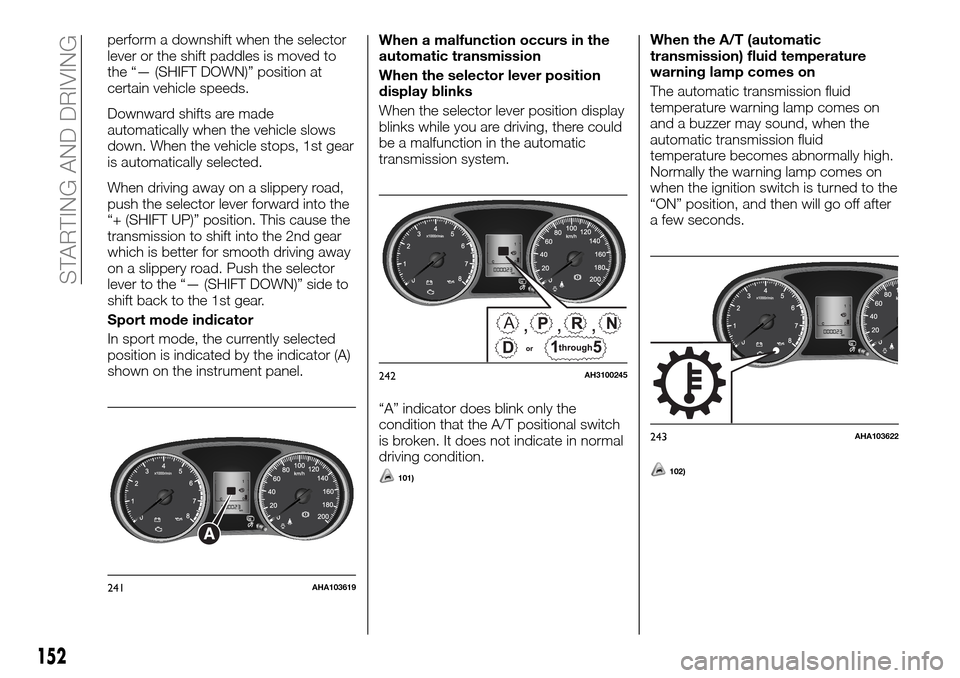
Sport mode indicator
In sport mode, the currently selected
position is indicated by the indicator (A)
shown on the instrument panel.When a malfunction occurs in the
automatic transmission
When the selector lever position
display blinks
When the selector lever position display
blinks while you are driving, there could
be a malfunction in the automatic
transmission system.
“A” indicator does blink only the
condition that the A/T positional switch
is broken. It does not indicate in normal
driving condition.
101)
When the A/T (automatic
transmission) fluid temperature
warning lamp comes on
The automatic transmission fluid
temperature warning lamp comes on
and a buzzer may sound, when the
automatic transmission fluid
temperature becomes abnormally high.
Normally the warning lamp comes on
when the ignition switch is turned to the
“ON” position, and then will go off after
a few seconds.
102)
A
241AHA103619
,,,A
242AH3100245
243AHA103622
152
STARTING AND DRIVING
Page 156 of 312
100)For vehicles equipped with the shift
paddles, do not use the left- and right-hand
shift paddles at the same time. Doing so
could cause a shift of gear ratio that you do
not expect.
101)If the selector lever position display
blinks while you are driving, it is likely that a
safety device is operating because of a
malfunction in the automatic transmission.
Have the vehicle inspected by a Fiat
Dealership as soon as possible.
102)If the lamp comes on, reduce the
engine speed and stop the vehicle in a safe
area. Then set the selector lever to “P”
(PARK) position and idle the engine until the
warning lamp goes off. When the warning
lamp goes off, resume normal driving. If the
warning lamp does not go off, we
recommend you to have your vehicle
inspected.
103)Before selecting a gear with the
engine running and the vehicle stationary,
fully depress the brake pedal to prevent the
vehicle from creeping. The vehicle will begin
to move as soon as the gear is engaged,
especially when the engine speed is high,
at fast idle or with the air conditioner
operating, the brakes should only be
released when you are ready to drive away.
104)Depress the brake pedal with the right
foot at all times. Using the left foot could
cause driver movement delay in case of an
emergency.
105)To prevent sudden acceleration, never
race the engine when shifting from the “P”
(PARK) or “N” (NEUTRAL) position.
106)Operating the accelerator pedal while
the other foot is resting on the brake pedal
will affect braking efficiency and may cause
premature wear of brake pads.107)Use the selector lever in the correct
shift position in accordance with driving
conditions. Never coast downhill backward
with the selector lever in the {“D” (DRIVE) or
sports mode} or coast forward with the
selector lever in the “R” (REVERSE)
position. The engine may stop and the
unexpected increase in brake pedal effort
and steering wheel weight could lead to an
accident.
108)Do not race the engine with brake
pedal pressed when the vehicle is
stationary. This can damage the A/T. Also,
when you depress the accelerator pedal
while holding down the brake pedal with
the selector lever in the “P” (PARK), “N”
(NEUTRAL) or “D” (DRIVE) position, the
engine revolutions may not rise as high as
when performing the same operation with
the selector lever in the “N” (NEUTRAL)
position.
109)Never hold the vehicle stationary on a
hill using the accelerator pedal (without
using the brake pedal). Always apply the
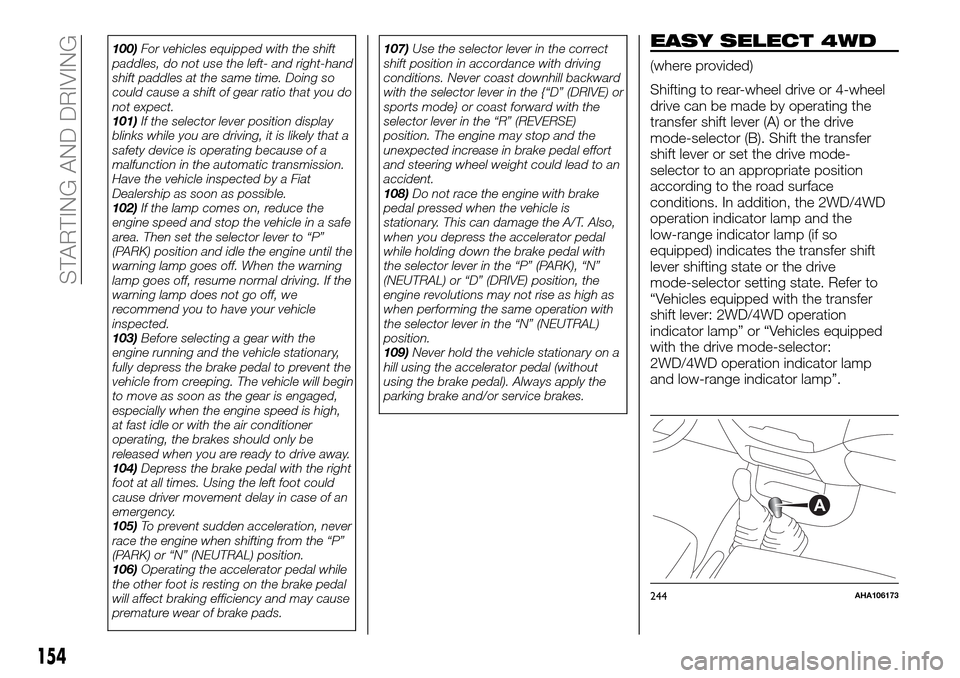
parking brake and/or service brakes.EASY SELECT 4WD
(where provided)
Shifting to rear-wheel drive or 4-wheel
drive can be made by operating the
transfer shift lever (A) or the drive
mode-selector (B). Shift the transfer
shift lever or set the drive mode-
selector to an appropriate position
according to the road surface
conditions. In addition, the 2WD/4WD
operation indicator lamp and the
low-range indicator lamp (if so
equipped) indicates the transfer shift
lever shifting state or the drive
mode-selector setting state. Refer to
“Vehicles equipped with the transfer
shift lever: 2WD/4WD operation
indicator lamp” or “Vehicles equipped
with the drive mode-selector:
2WD/4WD operation indicator lamp
and low-range indicator lamp”.
A
244AHA106173
154
STARTING AND DRIVING
Page 164 of 312
209)If a problem is detected in the transfer
system, a safety device will activate. The
2WD/4WD operation indicator blinks (twice
per second), and transfer shifting will
become impossible. Park your vehicle in a
safe place, turn off the engine for a few
moments. Restart the engine. The lamp
should resume normal operation. If the
lamp continue to blink, have the vehicle
checked by a Fiat Dealership as soon as
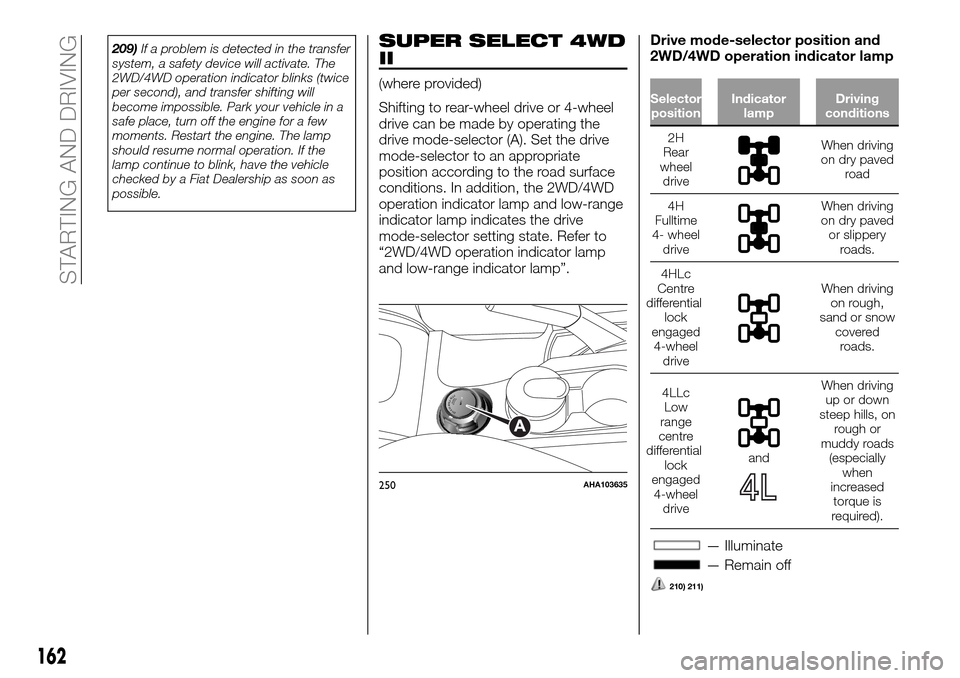
possible.SUPER SELECT 4WD
II
(where provided)
Shifting to rear-wheel drive or 4-wheel
drive can be made by operating the
drive mode-selector (A). Set the drive
mode-selector to an appropriate
position according to the road surface
conditions. In addition, the 2WD/4WD
operation indicator lamp and low-range
indicator lamp indicates the drive
mode-selector setting state. Refer to
“2WD/4WD operation indicator lamp
and low-range indicator lamp”.Drive mode-selector position and
2WD/4WD operation indicator lampSelector
positionIndicator
lampDriving
conditions
2H
Rear
wheel
driveWhen driving
on dry paved
road
4H
Fulltime
4- wheel
drive
When driving
on dry paved
or slippery
roads.
4HLc
Centre
differential
lock
engaged
4-wheel
drive
When driving
on rough,
sand or snow
covered
roads.
4LLc
Low
range
centre
differential
lock
engaged
4-wheel
drive
and
When driving
up or down
steep hills, on
rough or
muddy roads
(especially
when
increased
torque is
required).
— Illuminate
— Remain off
210) 211)
250AHA103635
162
STARTING AND DRIVING
Page 168 of 312
WARNING
210)The “4LLc” range gives maximum
torque for low-speed driving on steep
slopes, as well as sandy, muddy, and other
difficult surfaces. On vehicles with
automatic transmission, do not exceed
speeds of approximately 70 km/h in “4LLc”
range.
211)Do not drive your vehicle in the
“4HLc” or “4LLc” position on dry paved
roads and highways. Doing so may result
in excessive tyre wear, increased fuel
consumption, and possible noise
generation. It may also increase the
differential oil temperature, which may
damage the drive system. Further, the drive
train will be subjected to excessive loading,
resulting in oil leakage, component seizure,
or other serious problems. On dry paved
roads and highways, drive the vehicle in
“2H” or “4H” only.212)Do not operate the drive
mode-selector while the rear wheels of the
vehicle are slipping on snow or ice.
213)If a problem is detected in the transfer
system, a safety device will activate. The
front and rear wheel lamps will go out, the
centre differential lock lamp will blink rapidly
(twice per second), and transfer shifting will
become impossible. Park your vehicle in a
safe place, turn off the engine for a few
moments. Restart the engine. The lamp
should resume normal operation. If the
lamps continue to blink, have the vehicle
checked by a Fiat Dealership as soon as
possible.
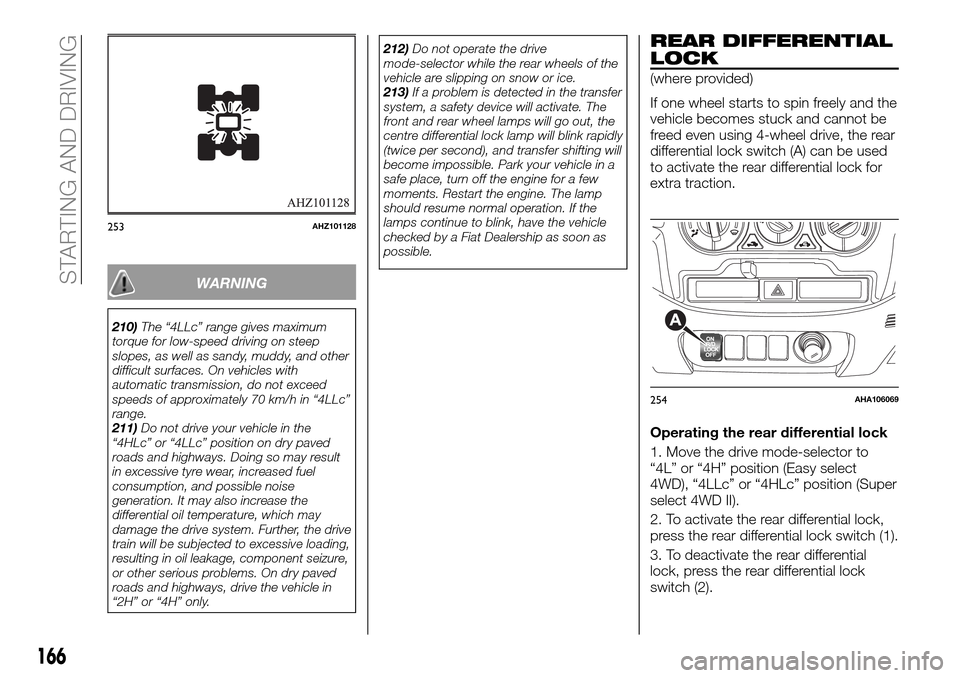
REAR DIFFERENTIAL
LOCK
(where provided)
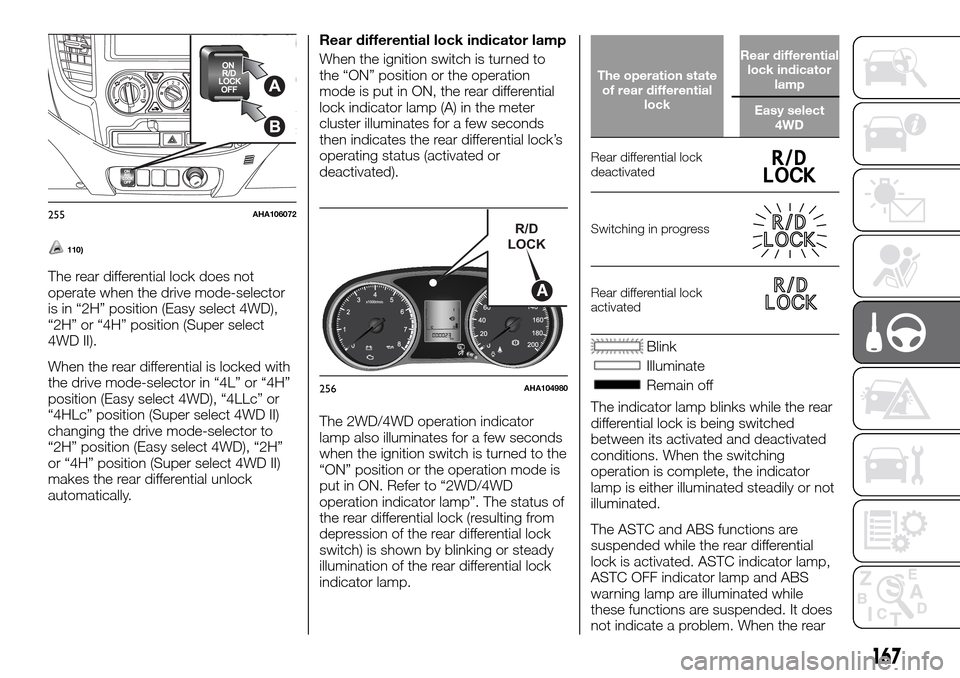
If one wheel starts to spin freely and the
vehicle becomes stuck and cannot be
freed even using 4-wheel drive, the rear
differential lock switch (A) can be used
to activate the rear differential lock for
extra traction.
Operating the rear differential lock
1. Move the drive mode-selector to
“4L” or “4H” position (Easy select
4WD), “4LLc” or “4HLc” position (Super
select 4WD II).
2. To activate the rear differential lock,
press the rear differential lock switch (1).
3. To deactivate the rear differential
lock, press the rear differential lock
switch (2).
253AHZ101128
254AHA106069
166
STARTING AND DRIVING
Page 169 of 312
110)
The rear differential lock does not
operate when the drive mode-selector
is in “2H” position (Easy select 4WD),
“2H” or “4H” position (Super select
4WD II).
When the rear differential is locked with
the drive mode-selector in “4L” or “4H”
position (Easy select 4WD), “4LLc” or
“4HLc” position (Super select 4WD II)
changing the drive mode-selector to
“2H” position (Easy select 4WD), “2H”
or “4H” position (Super select 4WD II)
makes the rear differential unlock
automatically.Rear differential lock indicator lamp
When the ignition switch is turned to
the “ON” position or the operation
mode is put in ON, the rear differential
lock indicator lamp (A) in the meter
cluster illuminates for a few seconds
then indicates the rear differential lock’s
operating status (activated or
deactivated).
The 2WD/4WD operation indicator
lamp also illuminates for a few seconds
when the ignition switch is turned to the
“ON” position or the operation mode is
put in ON. Refer to “2WD/4WD
operation indicator lamp”. The status of
the rear differential lock (resulting from
depression of the rear differential lock
switch) is shown by blinking or steady
illumination of the rear differential lock
indicator lamp.
The operation state
of rear differential
lockRear differential
lock indicator
lamp
Easy select
4WD
Rear differential lock
deactivated
Switching in progress
Rear differential lock
activated
Blink
Illuminate
Remain off
The indicator lamp blinks while the rear
differential lock is being switched
between its activated and deactivated
conditions. When the switching
operation is complete, the indicator
lamp is either illuminated steadily or not
illuminated.
The ASTC and ABS functions are
suspended while the rear differential
lock is activated. ASTC indicator lamp,
ASTC OFF indicator lamp and ABS
warning lamp are illuminated while
these functions are suspended. It does
not indicate a problem. When the rear
255AHA106072R/D
LOCK
A
256AHA104980
167
Page 172 of 312
112)Use the rear differential lock only as an
emergency measure when the vehicle is
stuck and cannot be freed with the drive
mode-selector in “4L” or “4H” position
(Easy select 4WD) or in “4LLc” or “4HLc”
position (Super select 4WD II). Deactivate
the rear differential lock immediately after
using it.4 WHEEL DRIVE
OPERATION
By selecting 4-wheel drive, both axles
of the vehicle are rigidly connected with
each other. This improves the traction
characteristics. When turning sharp
corners or moving forward and
backward repeatedly, however, the
drive line is stressed, which is felt as a
braking effect. A 4-wheel drive vehicle
can accelerate more quickly and
smoothly.
However, note that the braking distance
is not shorter than that of a rear-wheel
drive vehicle.
When using 4-wheel drive on rough
roads (snow, mud, sand, etc.), it is
important to operate the vehicle
correctly.
The driving posture should be more
upright and closer to the wheel than
usual; adjust the seat to a good
position for easy steering and pedal
operation. Be sure to wear the seat belt
After driving on rough roads, check
each part of the vehicle and wash it
thoroughly with water. Refer to the
“Vehicle care” section and “Inspection
and maintenance following rough road
operation”.Driving on dry paved road and
highway
Select “2H” position (Easy select 4WD),
“2H” or “4H” position (Super select
4WD II) to drive on the dry paved road.
Especially on dry highway, never select
the “4H” or “4L” position (Easy select
4WD), “4HLc” or “4LLc” position (Super
select 4WD II).
113)
Driving on snowy or icy roads
Set the drive mode-selector to “4H”
position (Easy select 4WD), “4H” or
“4HLc” position in accordance with the
road conditions (Super select 4WD II)
and then gradually depress the
accelerator pedal for a smooth start.
Keep the pressure on the accelerator
pedal as constant as possible, and
drive at low speed. The use of snow
tyres and/or tyre chains is
recommended.
Maintain a safe distance between
vehicles, avoid sudden braking, and
use engine braking (downshifting).
114)
170
STARTING AND DRIVING