Temp FIAT FULLBACK 2016 1.G Repair Manual
[x] Cancel search | Manufacturer: FIAT, Model Year: 2016, Model line: FULLBACK, Model: FIAT FULLBACK 2016 1.GPages: 312, PDF Size: 13.67 MB
Page 189 of 312
ENGINE
OVERHEATING
When the engine is overheating,will
blink. If this occurs, take the following
corrective measures:
1. Stop the vehicle in a safe place.
2. Check whether steam is coming from
the engine compartment.
If steam does not come from the engine
compartment: with the engine still
running, raise the bonnet to ventilate
the engine compartment.
If steam is coming from the engine
compartment: stop the engine, and
when the steam stops, raise the bonnet
to ventilate the engine compartment.
Restart the engine.
248) 249) 250)
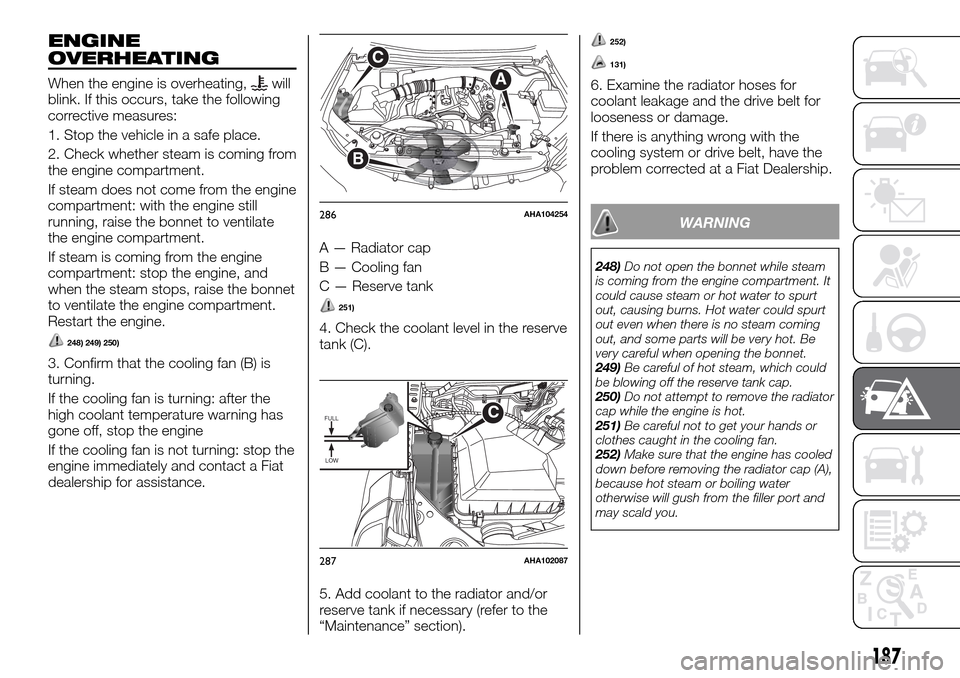
3. Confirm that the cooling fan (B) is
turning.
If the cooling fan is turning: after the
high coolant temperature warning has
gone off, stop the engine
If the cooling fan is not turning: stop the
engine immediately and contact a Fiat
dealership for assistance.A — Radiator cap
B — Cooling fan
C — Reserve tank
251)
4. Check the coolant level in the reserve
tank (C).
5. Add coolant to the radiator and/or
reserve tank if necessary (refer to the
“Maintenance” section).
252)
131)
6. Examine the radiator hoses for
coolant leakage and the drive belt for
looseness or damage.
If there is anything wrong with the
cooling system or drive belt, have the
problem corrected at a Fiat Dealership.
WARNING
248)Do not open the bonnet while steam
is coming from the engine compartment. It
could cause steam or hot water to spurt
out, causing burns. Hot water could spurt
out even when there is no steam coming
out, and some parts will be very hot. Be
very careful when opening the bonnet.
249)Be careful of hot steam, which could
be blowing off the reserve tank cap.
250)Do not attempt to remove the radiator
cap while the engine is hot.
251)Be careful not to get your hands or
clothes caught in the cooling fan.
252)Make sure that the engine has cooled
down before removing the radiator cap (A),
because hot steam or boiling water
otherwise will gush from the filler port and
may scald you.
A
C
B
286AHA104254
FULL
LOW
C
287AHA102087
187
Page 199 of 312
8. Turn the wheel nuts clockwise by
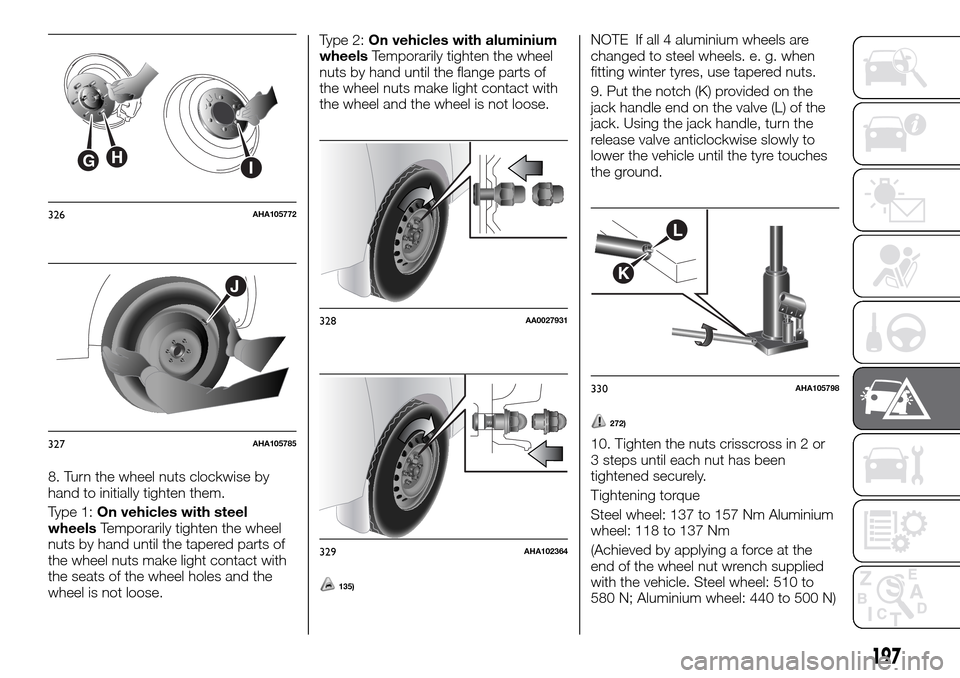
hand to initially tighten them.
Type 1:On vehicles with steel
wheelsTemporarily tighten the wheel
nuts by hand until the tapered parts of
the wheel nuts make light contact with
the seats of the wheel holes and the
wheel is not loose.Type 2:On vehicles with aluminium
wheelsTemporarily tighten the wheel
nuts by hand until the flange parts of
the wheel nuts make light contact with
the wheel and the wheel is not loose.
135)
NOTE If all 4 aluminium wheels are
changed to steel wheels. e. g. when
fitting winter tyres, use tapered nuts.
9. Put the notch (K) provided on the
jack handle end on the valve (L) of the
jack. Using the jack handle, turn the
release valve anticlockwise slowly to
lower the vehicle until the tyre touches
the ground.
272)
10. Tighten the nuts crisscross in 2 or
3 steps until each nut has been
tightened securely.
Tightening torque
Steel wheel: 137 to 157 Nm Aluminium
wheel: 118 to 137 Nm
(Achieved by applying a force at the
end of the wheel nut wrench supplied
with the vehicle. Steel wheel: 510 to
580 N; Aluminium wheel: 440 to 500 N)
GHI
326AHA105772
J
327AHA105785
328AA0027931
329AHA102364
L
K
330AHA105798
197
Page 203 of 312
TOWING
If your vehicle needs to be towed
If towing is necessary, we recommend
you to have it done by your Fiat
Dealership or a commercial tow truck
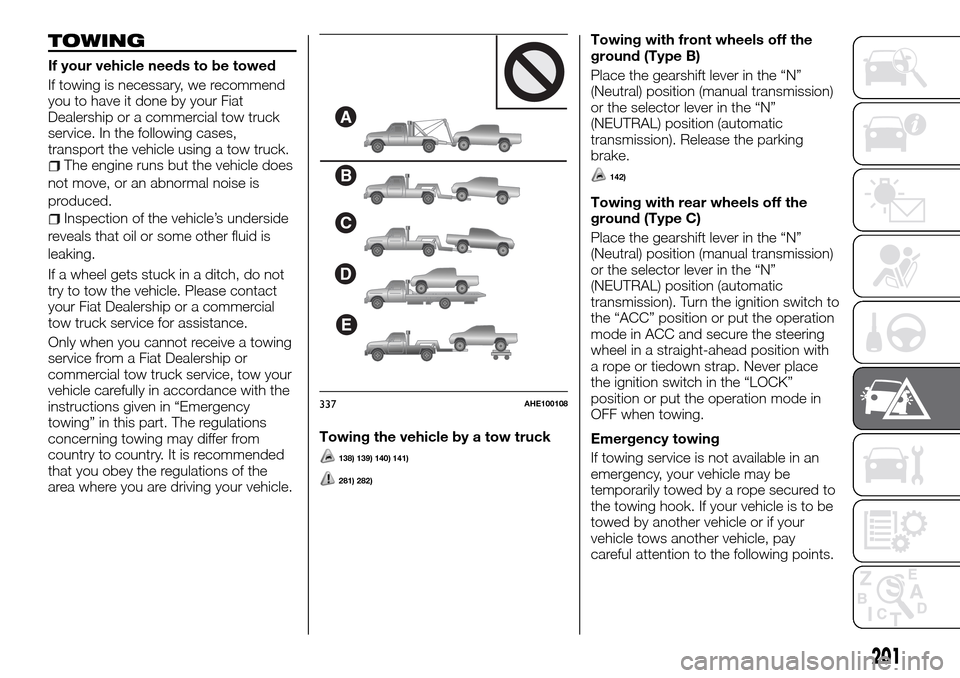
service. In the following cases,
transport the vehicle using a tow truck.
The engine runs but the vehicle does
not move, or an abnormal noise is
produced.
Inspection of the vehicle’s underside
reveals that oil or some other fluid is
leaking.
If a wheel gets stuck in a ditch, do not
try to tow the vehicle. Please contact
your Fiat Dealership or a commercial
tow truck service for assistance.
Only when you cannot receive a towing
service from a Fiat Dealership or
commercial tow truck service, tow your
vehicle carefully in accordance with the
instructions given in “Emergency
towing” in this part. The regulations
concerning towing may differ from
country to country. It is recommended
that you obey the regulations of the
area where you are driving your vehicle.Towing the vehicle by a tow truck
138) 139) 140) 141)
281) 282)
Towing with front wheels off the
ground (Type B)
Place the gearshift lever in the “N”
(Neutral) position (manual transmission)
or the selector lever in the “N”
(NEUTRAL) position (automatic
transmission). Release the parking
brake.
142)
Towing with rear wheels off the
ground (Type C)
Place the gearshift lever in the “N”
(Neutral) position (manual transmission)
or the selector lever in the “N”
(NEUTRAL) position (automatic
transmission). Turn the ignition switch to
the “ACC” position or put the operation
mode in ACC and secure the steering
wheel in a straight-ahead position with
a rope or tiedown strap. Never place
the ignition switch in the “LOCK”
position or put the operation mode in
OFF when towing.
Emergency towing
If towing service is not available in an
emergency, your vehicle may be
temporarily towed by a rope secured to
the towing hook. If your vehicle is to be
towed by another vehicle or if your
vehicle tows another vehicle, pay
careful attention to the following points.
B
C
D
E
A
337AHE100108
201
Page 206 of 312
142)Never tow an automatic transmission
vehicle with the front wheels up (and the
rear wheels on the ground) (Type B) when
the automatic transmission fluid level is low.
This may cause serious and expensive
damage to the transmission.
143)When the engine is not running, the
brake booster and power steering pump do
not operate. This means higher brake
depression force and higher steering effort
are required. Therefore, vehicle operation is
very difficult.
144)Do not leave the ignition switch in the
“LOCK” position or the operation mode in
OFF. The steering wheel will lock, causing
loss of control.
145)On vehicles with super select 4WD II,
when you are going to tow another vehicle,
set the drive mode-selector to “4H”
position. Selecting “2H” drive may increase
the differential oil temperature, resulting in
possible damage to the driving system.
Further, the drive train will be subjected to
excessive loading possibly leading to oil
leakage, component seizure, or other
serious faults.OPERATION UNDER
ADVERSE DRIVING
CONDITIONS
On a flooded road
Avoid flooded roads. Water could enter
the brake discs, resulting in temporarily
ineffective brakes. In such cases, lightly
depress the brake pedal to see if the
brakes operate properly. If they do not,
lightly depress the pedal several times
while driving in order to dry the brake
pads.
When driving in rain or on a road with
many puddles a layer of water may
form between the tyres and the road
surface. This reduces a tyre’s frictional
resistance on the road, resulting in loss
of steering stability and braking
capability.
To cope with this, observe the following
items:
(a) Drive your vehicle at a slow speed.
(b) Do not drive on worn tyres.
(c) Always maintain the specified tyre
inflation pressures.On a snow-covered or frozen road
When driving on a snow-covered or
frozen road, it is recommended that you
use snow tyres or snow traction device
(tyre chains). Refer to the “Snow tyres”
and “Snow traction device (tyre chains)”
sections.
Avoid high-speed operation, sudden
acceleration, abrupt brake application
and sharp cornering.
Depressing the brake pedal during
travel on snowy or icy roads may cause
tyre slippage and skidding. When
traction between the tyres and the road
is reduced the wheels may skid and the
vehicle cannot readily be brought to a
stop by conventional braking
techniques. Braking will differ,
depending upon whether you have
anti-lock brake system (ABS). If you do
have ABS, brake by pressing the brake
pedal hard, and keeping it pressed. If
you do not have ABS, pump the brake
pedal with short rapid jabs, each time
fully applying and fully releasing for
greatest effect.
Allow extra distance between your
vehicle and the vehicle in front of you,
and avoid sudden braking.
Accumulation of ice on the braking
system can cause the wheels to lock.
Pull away from a standstill slowly after
confirming safety around the vehicle.
292)
204
IN CASE OF EMERGENCY
Page 207 of 312
On a bumpy or rutted road
Drive as slow as possible when driving
on bumpy or rutted roads.
146)
WARNING
292)Do not press the accelerator pedal
rapidly. If the wheels break free of the ice,
the vehicle could suddenly start moving
and possibly cause an accident.
IMPORTANT
146)The impact on tyres and/or wheels
when driving on a bumpy or rutted road
can damage the tyre and/or wheel.
FUSIBLE LINKS
The fusible links will melt to prevent a
fire if a large current attempts to flow
through certain electrical systems. In
case of a melted fuse link, we
recommend you to have your vehicle
inspected. For the fusible links, please
refer to “Passenger compartment fuse
location table” and “Engine
compartment fuse location table”.
293)
WARNING
293)Fusible links must not be replaced by
any other device. Failing to fit the correct
fusible link may result in fire in the vehicle,
property destruction and serious or fatal
injuries at any time.
FUSES
Fuse block location
To prevent damage to the electrical
system due to short-circuiting or
overloading, each individual circuit is
provided with a fuse. There are fuse
blocks in the passenger compartment
and in the engine compartment.
Passenger compartment (LHD
vehicles)
The fuse blocks in the passenger
compartment are located behind the
fuse lid in front of the driver’s seat at the
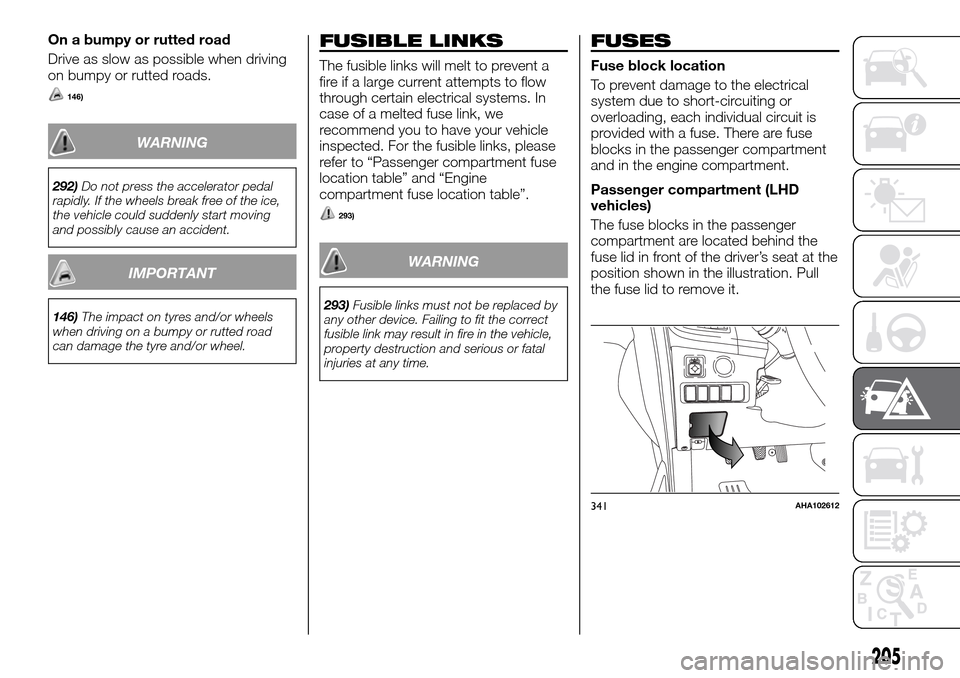
position shown in the illustration. Pull
the fuse lid to remove it.
R L
341AHA102612
205
Page 242 of 312
PERIODIC CHECKS
Before long journeys, check and, if
necessary, restore:
engine coolant level;
brake fluid level;
windscreen washer fluid level;
operation of lighting system
(headlamps, direction indicators, hazard
warning lights, etc.);
tyre inflation pressure and condition;
tyre alignment;
operation of screen washer/wiper
system and positioning/wear of
windscreen/rear window wiper blades.
To ensure that the vehicle is always
efficient and well maintained, it is
advisable to make sure that you carry
out the above operations regularly
(approximately every 1000 km and
every 3000 km for checking and
topping up engine oil is advisable).
DEMANDING
VEHICLE USE
If the vehicle is mostly used in one of
the following conditions:
towing a trailer or caravan;
dusty roads;
short, repeated journeys (less than
7-8 km) at sub-zero outside
temperatures;
engine often idling or driving long
distances at low speeds or long periods
of inactivity;
the following checks must be carried
out more often than indicated in the
Scheduled Servicing Plan:
check front disc brake pad
conditions and wear;
check cleanliness of bonnet and
boot locks, cleanliness and lubrication
of linkage;
visually inspect conditions of: engine,
gearbox, transmission, pipes and hoses
(exhaust - fuel system - brakes) and
rubber elements (boots - sleeves -
bushes - etc.);
check battery charge and battery
fluid level (electrolyte);
visually inspect condition of the
accessory drive belts;
check and, if necessary, change
engine oil and replace oil filter;
check and, if necessary, replace
pollen filter.
240
SERVICING AND MAINTENANCE
Page 249 of 312
ENGINE COOLANT
To check the coolant level
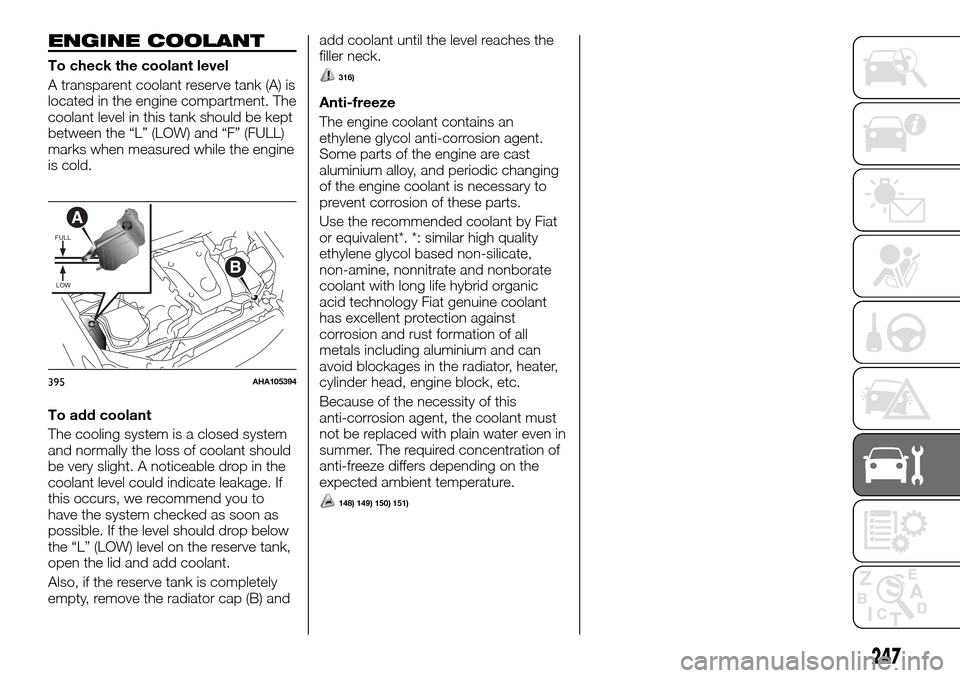
A transparent coolant reserve tank (A) is
located in the engine compartment. The
coolant level in this tank should be kept
between the “L” (LOW) and “F” (FULL)
marks when measured while the engine
is cold.
To add coolant
The cooling system is a closed system
and normally the loss of coolant should
be very slight. A noticeable drop in the
coolant level could indicate leakage. If
this occurs, we recommend you to
have the system checked as soon as
possible. If the level should drop below
the “L” (LOW) level on the reserve tank,
open the lid and add coolant.
Also, if the reserve tank is completely
empty, remove the radiator cap (B) andadd coolant until the level reaches the
filler neck.316)
Anti-freeze
The engine coolant contains an
ethylene glycol anti-corrosion agent.
Some parts of the engine are cast
aluminium alloy, and periodic changing
of the engine coolant is necessary to
prevent corrosion of these parts.
Use the recommended coolant by Fiat
or equivalent*. *: similar high quality
ethylene glycol based non-silicate,
non-amine, nonnitrate and nonborate
coolant with long life hybrid organic
acid technology Fiat genuine coolant
has excellent protection against
corrosion and rust formation of all
metals including aluminium and can
avoid blockages in the radiator, heater,
cylinder head, engine block, etc.
Because of the necessity of this
anti-corrosion agent, the coolant must
not be replaced with plain water even in
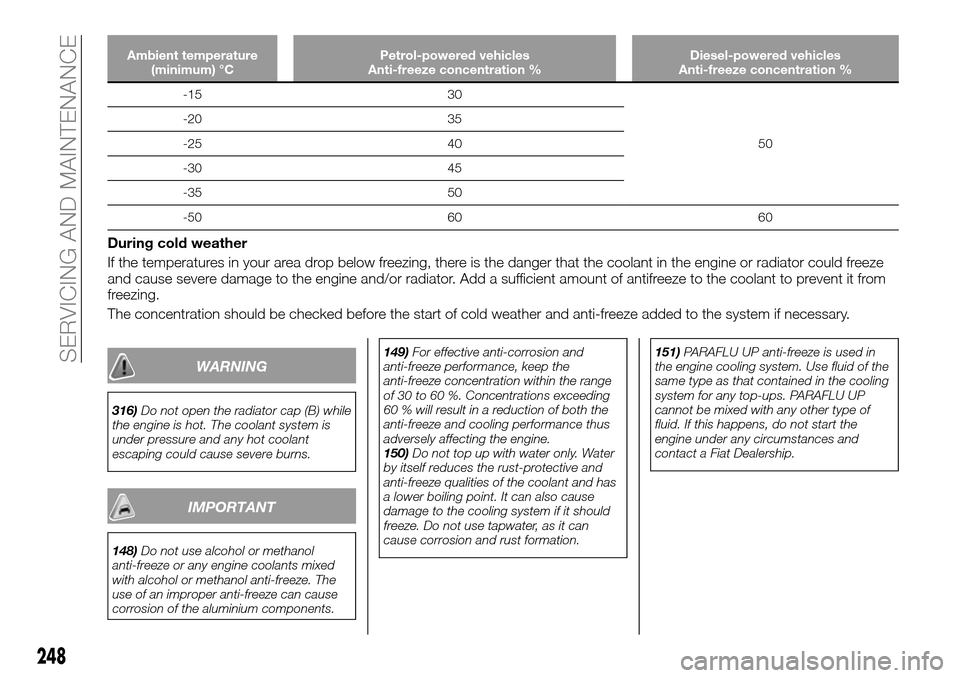
summer. The required concentration of
anti-freeze differs depending on the
expected ambient temperature.
148) 149) 150) 151)
FULL
LOW
A
B
395AHA105394
247
Page 250 of 312
Ambient temperature
(minimum) °CPetrol-powered vehicles
Anti-freeze concentration %Diesel-powered vehicles
Anti-freeze concentration %
-15 30
50 -20 35
-25 40
-30 45
-35 50
-50 60 60
During cold weather
If the temperatures in your area drop below freezing, there is the danger that the coolant in the engine or radiator could freeze
and cause severe damage to the engine and/or radiator. Add a sufficient amount of antifreeze to the coolant to prevent it from
freezing.
The concentration should be checked before the start of cold weather and anti-freeze added to the system if necessary.
WARNING
316)Do not open the radiator cap (B) while
the engine is hot. The coolant system is
under pressure and any hot coolant
escaping could cause severe burns.
IMPORTANT
148)Do not use alcohol or methanol
anti-freeze or any engine coolants mixed
with alcohol or methanol anti-freeze. The
use of an improper anti-freeze can cause
corrosion of the aluminium components.149)For effective anti-corrosion and
anti-freeze performance, keep the
anti-freeze concentration within the range
of 30 to 60 %. Concentrations exceeding
60 % will result in a reduction of both the
anti-freeze and cooling performance thus
adversely affecting the engine.
150)Do not top up with water only. Water
by itself reduces the rust-protective and
anti-freeze qualities of the coolant and has
a lower boiling point. It can also cause
damage to the cooling system if it should
freeze. Do not use tapwater, as it can
cause corrosion and rust formation.151)PARAFLU UP anti-freeze is used in
the engine cooling system. Use fluid of the
same type as that contained in the cooling
system for any top-ups. PARAFLU UP
cannot be mixed with any other type of
fluid. If this happens, do not start the
engine under any circumstances and
contact a Fiat Dealership.
248
SERVICING AND MAINTENANCE
Page 251 of 312
WASHER FLUID
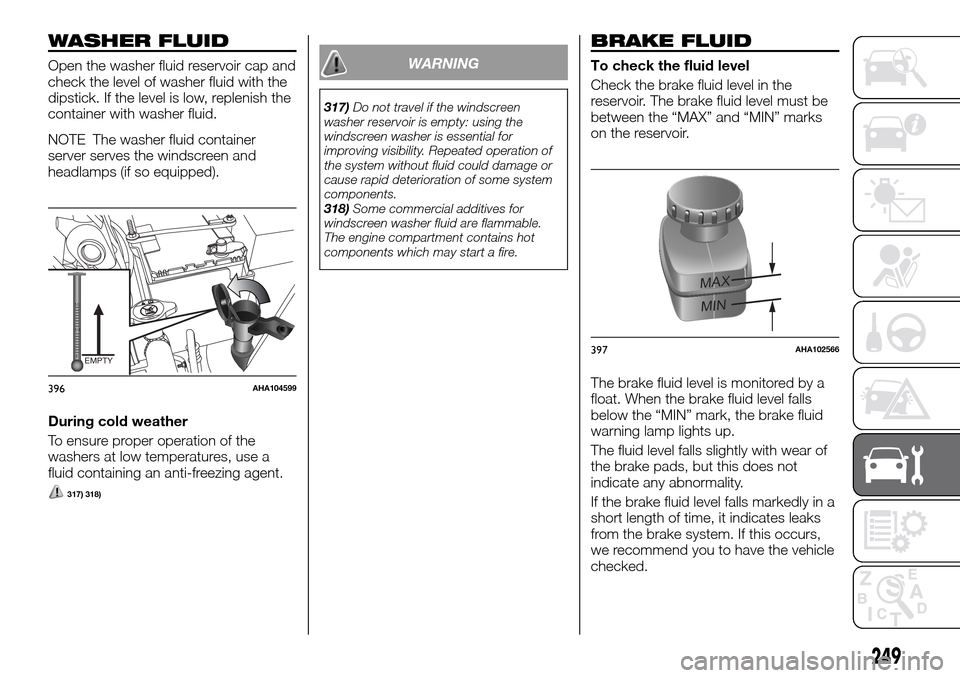
Open the washer fluid reservoir cap and
check the level of washer fluid with the
dipstick. If the level is low, replenish the
container with washer fluid.
NOTE The washer fluid container
server serves the windscreen and
headlamps (if so equipped).
During cold weather
To ensure proper operation of the
washers at low temperatures, use a
fluid containing an anti-freezing agent.
317) 318)
WARNING
317)Do not travel if the windscreen
washer reservoir is empty: using the
windscreen washer is essential for
improving visibility. Repeated operation of
the system without fluid could damage or
cause rapid deterioration of some system
components.
318)Some commercial additives for
windscreen washer fluid are flammable.
The engine compartment contains hot
components which may start a fire.
BRAKE FLUID
To check the fluid level
Check the brake fluid level in the
reservoir. The brake fluid level must be
between the “MAX” and “MIN” marks
on the reservoir.
The brake fluid level is monitored by a
float. When the brake fluid level falls
below the “MIN” mark, the brake fluid
warning lamp lights up.
The fluid level falls slightly with wear of
the brake pads, but this does not
indicate any abnormality.
If the brake fluid level falls markedly in a
short length of time, it indicates leaks
from the brake system. If this occurs,
we recommend you to have the vehicle
checked.
108kPa
EMPTYE 1/4 1/2
396AHA104599
MAX
MIN
397AHA102566
249
Page 254 of 312
BATTERY
155) 156)
4)
The condition of the battery is very
important for quick starting of the
engine and proper functioning of the
vehicle’s electrical system. Regular
inspection and care are especially
important in cold weather.
Battery precautions
325) 326) 327) 328) 329) 330) 331) 332) 333) 334) 335)
Checking battery electrolyte level
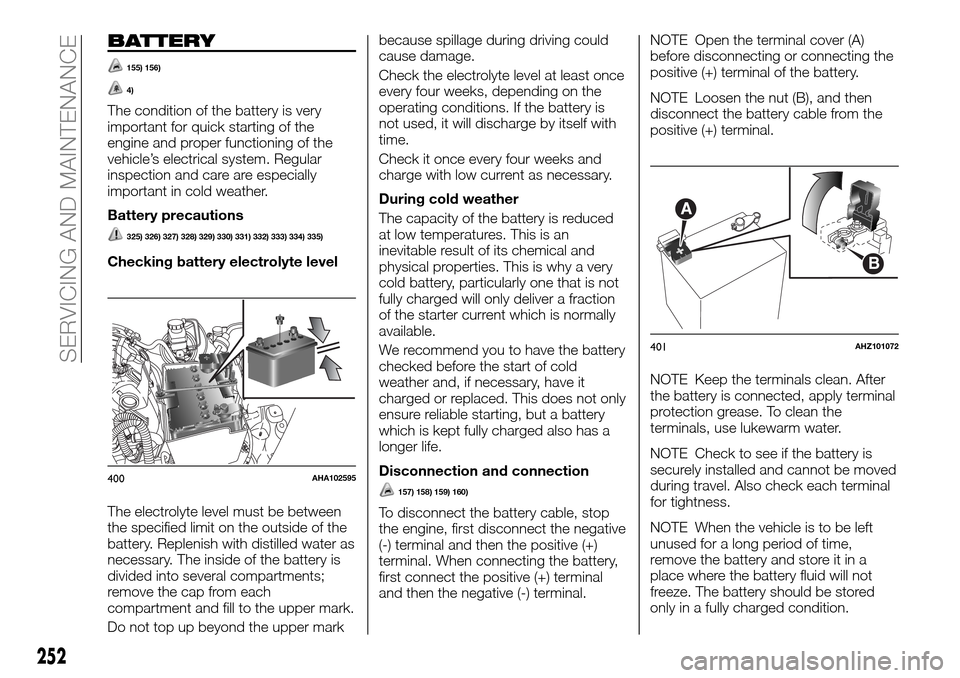
The electrolyte level must be between
the specified limit on the outside of the
battery. Replenish with distilled water as
necessary. The inside of the battery is
divided into several compartments;
remove the cap from each
compartment and fill to the upper mark.
Do not top up beyond the upper markbecause spillage during driving could
cause damage.
Check the electrolyte level at least once
every four weeks, depending on the
operating conditions. If the battery is
not used, it will discharge by itself with
time.
Check it once every four weeks and
charge with low current as necessary.
During cold weather
The capacity of the battery is reduced
at low temperatures. This is an
inevitable result of its chemical and
physical properties. This is why a very
cold battery, particularly one that is not
fully charged will only deliver a fraction
of the starter current which is normally
available.
We recommend you to have the battery
checked before the start of cold
weather and, if necessary, have it
charged or replaced. This does not only
ensure reliable starting, but a battery
which is kept fully charged also has a
longer life.
Disconnection and connection
157) 158) 159) 160)
To disconnect the battery cable, stop
the engine, first disconnect the negative
(-) terminal and then the positive (+)
terminal. When connecting the battery,
first connect the positive (+) terminal
and then the negative (-) terminal.NOTE Open the terminal cover (A)
before disconnecting or connecting the
positive (+) terminal of the battery.
NOTE Loosen the nut (B), and then
disconnect the battery cable from the
positive (+) terminal.
NOTE Keep the terminals clean. After
the battery is connected, apply terminal
protection grease. To clean the
terminals, use lukewarm water.
NOTE Check to see if the battery is
securely installed and cannot be moved
during travel. Also check each terminal
for tightness.
NOTE When the vehicle is to be left
unused for a long period of time,
remove the battery and store it in a
place where the battery fluid will not
freeze. The battery should be stored
only in a fully charged condition.
400AHA102595
A
B
401AHZ101072
252
SERVICING AND MAINTENANCE