Temp FIAT FULLBACK 2016 1.G Manual PDF
[x] Cancel search | Manufacturer: FIAT, Model Year: 2016, Model line: FULLBACK, Model: FIAT FULLBACK 2016 1.GPages: 312, PDF Size: 13.67 MB
Page 255 of 312
WARNING
325)Keep sparks, cigarettes, and flames
away from the battery because the battery
could explode.
326)The battery electrolyte is extremely
caustic. Do not allow it to come in contact
with your eyes, skin, clothing, or the
painted surfaces of the vehicle. Spilt
electrolyte should be flushed immediately
with ample amounts of water. Irritation to
eyes or skin from contact with electrolyte
requires immediate medical attention.
327)Ventilate when charging or using the
battery in an enclosed space.
328)Always wear protective eye goggles
when working near the battery.
329)Keep it out of reach of children.
330)When you handle the battery, carefully
observe the following cautions for safety.
331)Keep sparks, cigarettes, and flames
away from the battery because the battery
could explode. Also, do not short-circuit
the battery terminals. Doing so could
create sparks.
332)Always wear protective eye goggles
when working near the battery. Battery
electrolyte contains sulphuric acid, so
getting it in your eyes is dangerous.
333)Battery electrolyte contains sulphuric
acid, so you must wear gloves and eye
protection when handling the battery. If
battery electrolyte gets in your eyes or on
your skin, rinse it away with clean water
and immediately see a doctor. If you
accidentally swallow battery electrolyte,
immediately see a doctor. If battery
electrolyte splashes on your clothing or on
the vehicle, rinse it off with lots of water.334)The battery emits highly explosive
hydrogen gas. Ventilate when charging the
battery in an enclosed space.
335)Using the battery with insufficient fluid
irreparably damages the battery and may
cause an explosion.
IMPORTANT
155)Do not bring the nearby parts, the
plastic parts and so on into contact with
sulphuric acid (battery electrolyte) which
may crack, stain or discolour them. If they
are in contact, wipe off with soft cloth,
chamois or the like and an aqueous
solution of neutral detergent then
immediately rinse the affected parts with
plenty of water.
156)If the vehicle must remain unused for
a long time at a very low temperature,
remove the battery and take it to a warm
place, to avoid freezing.
157)Never disconnect the battery when
the ignition switch or the operation mode is
in the “ON” position; doing so could
damage the vehicle’s electrical
components.
158)Never short-circuit the battery. This
could cause it to overheat and be
damaged.
159)If the battery is to be quick-charged,
first disconnect the battery cables.
160)In order to prevent a short circuit, be
sure to disconnect the negative (-) terminal
first.
IMPORTANT
4)Batteries contain substances which are
very dangerous for the environment. For
battery replacement, contact a Fiat
Dealership.
253
Page 258 of 312
CLEANING THE
INTERIOR OF YOUR
VEHICLE
After cleaning the interior of your vehicle
with water, cleaner or similar, wipe and
dry in a shady, well-ventilated area.
To clean the inside of the rear window,
always use a soft cloth and wipe the
window glass along the demister heater
element so as not to cause damage.
338)
162)
Plastic, fabric and flocked parts
1. Lightly wipe these off with a soft
cloth soaked in a mild soap and water
solution.
2. Dip cloth in fresh water and wring it
out well. Using this cloth, wipe off the
detergent thoroughly.
Do not use cleaners, conditioners, and
protectants containing silicones or wax.
Such products, when applied to the
instrument panels or other parts, may
cause reflections on the windscreen
and obscure vision. Also, if such
products get on the switches of the
electrical accessories, it may lead to
failure of these accessories.
Upholstery
1. To maintain the value of your new
vehicle, handle the upholstery carefully
and keep the interior clean. Use a
vacuum cleaner and brush to clean theseats. If stained, synthetic leather
should be cleaned with an appropriate
cleaner. Cloth fabrics can be cleaned
with either upholstery cleaner or a mild
soap and water solution.
2. Clean the carpeting with a vacuum
cleaner and remove any stains with
carpet cleaner. Oil and grease can be
removed by lightly dabbing with a clean
colourfast cloth and stain remover.
Genuine leather
1. To clean, lightly wipe the leather with
a soft cloth soaked in a mild soap and
water solution.
2. Dip cloth in fresh water and wring it
out well. Using this cloth, wipe off the
detergent thoroughly.
3. Apply leather protecting agent to the
genuine leather surface.
If genuine leather is wet with water or is
washed in water, wipe off water as
quickly as possible with a dry, soft
cloth. If left damp, mildew may grow.
Organic solvents such as benzine,
kerosene, alcohol and petrol, acid or
alkaline solvents may discolour the
genuine leather surface. Be sure to use
neutral detergents.
Remove dirty patches or oil substances
quickly as they can stain genuine
leather.
The genuine leather surface may
harden and shrink if it is exposed todirect rays of the sun for long hours.
When your vehicle is parked, place it in
the shade as much as possible.
When the temperature of the vehicle
interior rises in summer, vinyl products
left on the genuine leather seat may
deteriorate and stick to the seat.
WARNING
338)Never use flammable products, such
as petrol ether or rectified petrol to clean
the inside of the car. The electrostatic
charges which are generated by rubbing
during the cleaning operation may cause a
fire.
IMPORTANT
162)Do not use organic substances
(solvents, benzine, kerosene, alcohol,
petrol, etc.) or alkaline or acidic solutions.
These chemicals can cause discolouring,
staining or cracking of the surface. If you
use cleaners or polishing agents, make
sure their ingredients do not include the
substances mentioned above.
256
SERVICING AND MAINTENANCE
Page 260 of 312
Window glass
The window glass can normally be
cleaned using only a sponge and water.
Glass cleaner can be used to remove
oil, grease, insect carcasses, etc. After
washing the glass, wipe it dry with a
clean, dry, soft cloth. Never use a cloth
that is used for cleaning a painted
surface to clean a window. Wax from
the painted surface could get on the
glass and lower glass transparency and
visibility.
To clean the inside of the rear window,
always use a soft cloth and wipe the
window glass along the demister heater
element so as not to cause damage.
Wiper blades
Use a soft cloth and glass cleaner to
remove grease, insect carcasses, etc.,
from the wiper blades. Replace the
wiper blades when they no longer wipe
properly.
Engine compartment
Clean the engine compartment at the
beginning and end of winter. Pay
particular attention to flanges, crevices
and peripheral parts where dust
containing road chemicals and other
corrosive materials might collect.
If salt and other chemicals are used on
the roads in your area, clean the engine
compartment at least every three
months.Never spray or splash water on the
electrical components in the engine
compartment, as this may cause
damage.
Do not bring the nearby parts, the
plastic parts and so on into contact
with sulphuric acid (battery electrolyte)
which may crack, stain or discolour
them.
If they are in contact, wipe off with soft
cloth, chamois or the like and an
aqueous solution of neutral detergent
then immediately rinse the affected
parts with plenty of water.
IMPORTANT
163)Avoid washing with rollers and/or
brushes in washing stations. Wash the
vehicle only by hand using neutral pH
detergents; dry it with a wet chamois
leather. Abrasive products and/or polishes
should not be used for cleaning the car.
Bird droppings must be washed off
immediately and thoroughly as the acid
they contain is particularly aggressive.
Avoid (if at all possible) parking the vehicle
under trees; remove vegetable resins
immediately as, when dried, it may only be
possible to remove them with abrasive
products and/or polishes, which is highly
inadvisable as they could alter the typical
opaqueness of the paint. Do not use pure
windscreen washer fluid for cleaning the
front windscreen and rear window; dilute it
min. 50% with water. Only use pure screen
washer fluid when strictly necessary due to
outside temperature conditions.164)When washing the under side of your
vehicle or wheel, be careful not to injure
your hands.
165)If your vehicle has rain sensor wipers,
place the wiper switch lever in the “OFF”
position to deactivate the rain sensor
before washing the vehicle. Otherwise, the
wipers will operate in the presence of water
spray on the windscreen and may get
damaged as a result.
166)Refrain from excessively using a car
wash as its brushes may scratch the paint
surface, causing it to lose its gloss.
Scratches will be especially visible on
darker coloured vehicles.
167)Never spray or splash water on the
electrical components in the engine
compartment. Doing so could have an
adverse effect on the engine startability.
Exercise caution also when washing the
underbody; be careful not to spray water
into the engine compartment.
168)Some types of hot water washing
equipment apply high pressure and heat to
the vehicle. They may cause heat distortion
and damage to the vehicle resin parts and
may result in flooding of the vehicle interior.
Therefore maintain a good distance of
approx. 70 cm or more between the vehicle
body and the washing nozzle. Also, when
washing around the door glass, hold the
nozzle at a distance of more than 70 cm
and at right angles to the glass surface.
258
SERVICING AND MAINTENANCE
Page 265 of 312
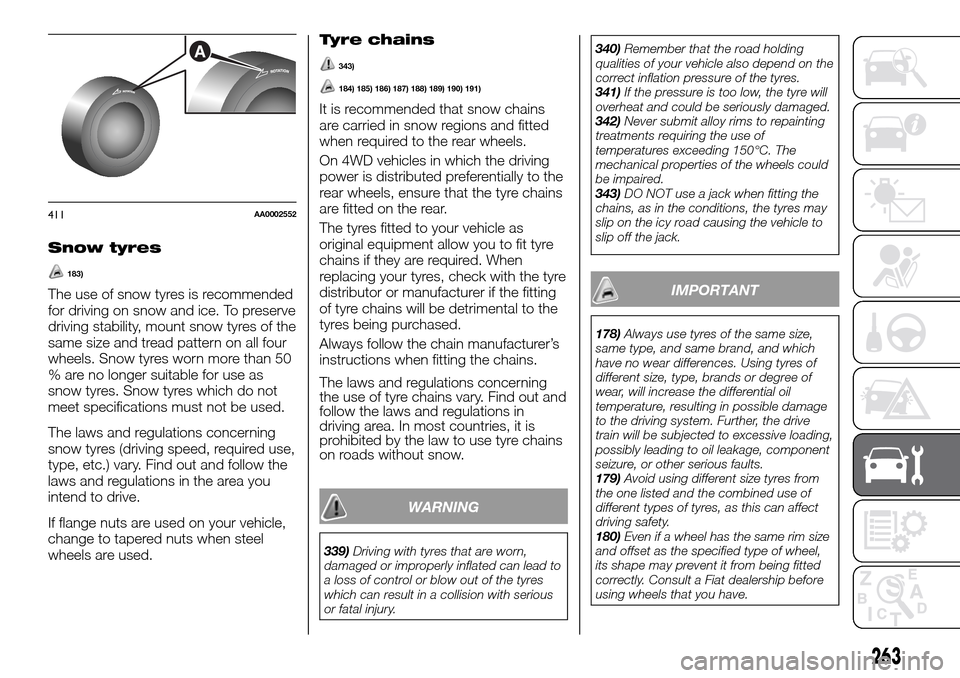
Snow tyres
183)
The use of snow tyres is recommended
for driving on snow and ice. To preserve
driving stability, mount snow tyres of the
same size and tread pattern on all four
wheels. Snow tyres worn more than 50
% are no longer suitable for use as
snow tyres. Snow tyres which do not
meet specifications must not be used.
The laws and regulations concerning
snow tyres (driving speed, required use,
type, etc.) vary. Find out and follow the
laws and regulations in the area you
intend to drive.
If flange nuts are used on your vehicle,
change to tapered nuts when steel
wheels are used.
Tyre chains
343)
184) 185) 186) 187) 188) 189) 190) 191)
It is recommended that snow chains
are carried in snow regions and fitted
when required to the rear wheels.
On 4WD vehicles in which the driving
power is distributed preferentially to the
rear wheels, ensure that the tyre chains
are fitted on the rear.
The tyres fitted to your vehicle as
original equipment allow you to fit tyre
chains if they are required. When
replacing your tyres, check with the tyre
distributor or manufacturer if the fitting
of tyre chains will be detrimental to the
tyres being purchased.
Always follow the chain manufacturer’s
instructions when fitting the chains.
The laws and regulations concerning
the use of tyre chains vary. Find out and
follow the laws and regulations in
driving area. In most countries, it is
prohibited by the law to use tyre chains
on roads without snow.
WARNING
339)Driving with tyres that are worn,
damaged or improperly inflated can lead to
a loss of control or blow out of the tyres
which can result in a collision with serious
or fatal injury.340)Remember that the road holding
qualities of your vehicle also depend on the
correct inflation pressure of the tyres.
341)If the pressure is too low, the tyre will
overheat and could be seriously damaged.
342)Never submit alloy rims to repainting
treatments requiring the use of
temperatures exceeding 150°C. The
mechanical properties of the wheels could
be impaired.
343)DO NOT use a jack when fitting the
chains, as in the conditions, the tyres may
slip on the icy road causing the vehicle to
slip off the jack.
IMPORTANT
178)Always use tyres of the same size,
same type, and same brand, and which
have no wear differences. Using tyres of
different size, type, brands or degree of
wear, will increase the differential oil
temperature, resulting in possible damage
to the driving system. Further, the drive
train will be subjected to excessive loading,
possibly leading to oil leakage, component
seizure, or other serious faults.
179)Avoid using different size tyres from
the one listed and the combined use of
different types of tyres, as this can affect
driving safety.
180)Even if a wheel has the same rim size
and offset as the specified type of wheel,
its shape may prevent it from being fitted
correctly. Consult a Fiat dealership before
using wheels that you have.
A
411AA0002552
263
Page 283 of 312
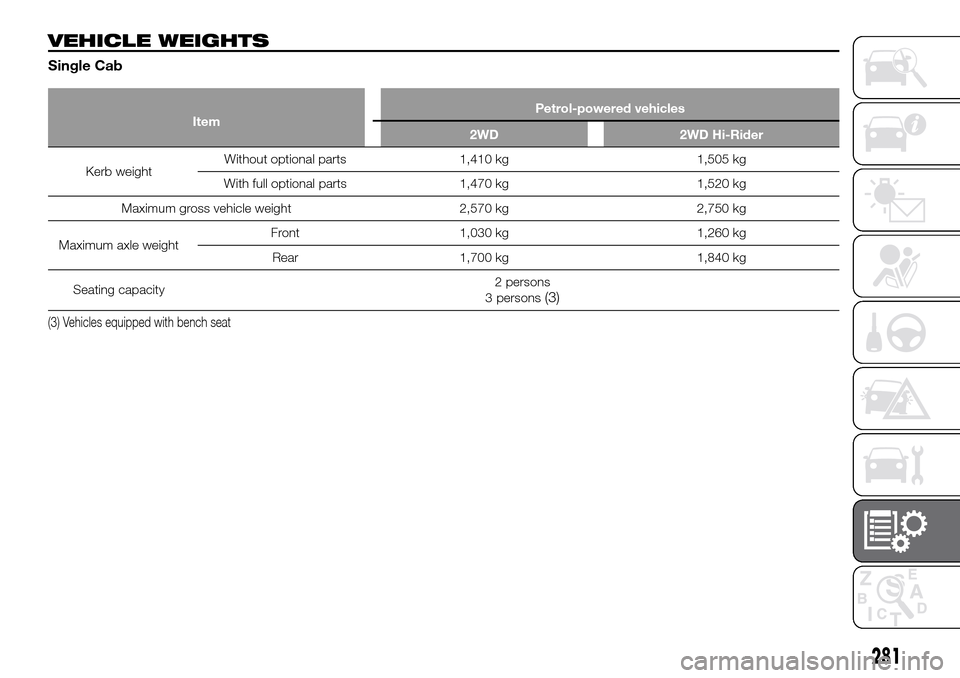
VEHICLE WEIGHTS
Single Cab
ItemPetrol-powered vehicles
2WD 2WD Hi-Rider
Kerb weightWithout optional parts 1,410 kg 1,505 kg
With full optional parts 1,470 kg 1,520 kg
Maximum gross vehicle weight 2,570 kg 2,750 kg
Maximum axle weightFront 1,030 kg 1,260 kg
Rear 1,700 kg 1,840 kg
Seating capacity2 persons
3 persons
(3)
(3) Vehicles equipped with bench seat
281