maintenance FIAT FULLBACK 2017 Owner handbook (in English)
[x] Cancel search | Manufacturer: FIAT, Model Year: 2017, Model line: FULLBACK, Model: FIAT FULLBACK 2017Pages: 312, PDF Size: 12.31 MB
Page 263 of 312
GENERAL
MAINTENANCE
Fuel, engine coolant, oil and
exhaust gas leakage
Look under the body of your vehicle to
check for fuel, engine coolant, oil and
exhaust gas leaks.
Exterior and interior lamp operation
Operate the combination lamp switch
to check that all lamps are functioning
properly. If the lamps do not illuminate,
the probable cause is a blown fuse or
defective lamp bulb. Check the fuses
first. If there is no blown fuses, check
the lamp bulbs. For information
regarding the inspection and
replacement of the fuses and the bulbs,
refer to “Fuses” and “Replacement of
lamp bulbs”.
Meter, gauge and indicator/
warning lamps operation
Start the engine to check the operation
of all instruments, gauges, and indicator
and warning lamps. If there is anything
wrong, we recommend you to have
your vehicle inspected.
Hinges and latches lubrication
Check all latches and hinges, and, if
necessary, have them lubricated.
VEHICLE CARE
PRECAUTIONS
384)
197)
5)
In order to maintain the value of your
vehicle, it is necessary to perform
regular maintenance using the proper
procedures.
Always maintain your vehicle in
compliance with any environmental
pollution control regulations.
Carefully select the materials used for
washing, etc., to be sure that they do
not contain corrosives. If in doubt, we
recommend you to consult a specialist
for the selection of these materials.
WARNING
384)Cleaning products can be dangerous.
Always follow the instructions of the
cleaning product supplier.
IMPORTANT
197)To avoid damage, never use the
following to clean your vehicle: Petrol; Paint
Thinner; Benzine; Kerosene; Turpentine;
Naphtha; Lacquer Thinner; Carbon
Tetrachloride; Nail Polish Remover;
Acetone.
IMPORTANT
5)Detergents pollute the environment. Only
wash your vehicle in areas equipped to
collect and treat wastewater from this type
of activity.
261
Page 264 of 312
CLEANING THE
INTERIOR OF YOUR
VEHICLE
After cleaning the interior of your vehicle
with water, cleaner or similar, wipe and
dry in a shady, well-ventilated area.
NOTE If your vehicle has the demister
heater element of the rear window, to
clean the inside of the rear window,
always use a soft cloth and wipe the
window glass along the demister heater
element so as not to cause damage.
385) 386)
198)
Plastic, fabric and flocked parts
1. Lightly wipe these off with a soft
cloth soaked in a mild soap and water
solution.
2. Dip cloth in fresh water and wring it
out well. Using this cloth, wipe off the
detergent thoroughly.
NOTE Do not use cleaners,
conditioners, and protectants
containing silicones or wax. Such
products, when applied to the
instrument panels or other parts, may
cause reflections on the windscreen
and obscure vision. Also, if such
products get on the switches of the
electrical accessories, it may lead to
failure of these accessories.NOTE Do not use synthetic fiber or dry
cloth. They can cause discolouring or
damaging the surface.
NOTE Do not place a deodorizer on
the instrument panel or near lamps and
instruments. The ingredients for
deodorizer can cause discolouring or
cracking.
Upholstery
1. To maintain the value of your new
vehicle, handle the upholstery carefully
and keep the interior clean. Use a
vacuum cleaner and brush to clean the
seats. If stained, synthetic leather
should be cleaned with an appropriate
cleaner. Cloth fabrics can be cleaned
with either upholstery cleaner or a mild
soap and water solution.
2. Clean the carpeting with a vacuum
cleaner and remove any stains with
carpet cleaner. Oil and grease can be
removed by lightly dabbing with a clean
colourfast cloth and stain remover.
Genuine leather
1. To clean, lightly wipe the leather with
a soft cloth soaked in a mild soap and
water solution.
2. Dip cloth in fresh water and wring it
out well. Using this cloth, wipe off the
detergent thoroughly.
3. Apply leather protecting agent to the
genuine leather surface.NOTE If genuine leather is wet with
water or is washed in water, wipe off
water as quickly as possible with a dry,
soft cloth. If left damp, mildew may
grow.
NOTE Organic solvents such as
benzine, kerosene, alcohol and petrol,
acid or alkaline solvents may discolour
the genuine leather surface. Be sure to
use neutral detergents.
NOTE Remove oil substances quickly
as they can stain genuine leather.
NOTE The genuine leather surface may
harden and shrink if it is exposed to
direct rays of the sun for long hours.
When your vehicle is parked, place it in
the shade as much as possible.
NOTE When the temperature of the
vehicle interior rises in summer, vinyl
products left on the genuine leather
seat may deteriorate and stick to the
seat.
WARNING
385)Do not keep aerosol cans in the
vehicle: they might explode. Aerosol cans
must not be exposed to a temperature
exceeding 50°C. When the vehicle is
exposed to sunlight, the internal
temperature can greatly exceed this value.
262
SERVICING AND MAINTENANCE
Page 266 of 312
Polishing
The vehicle should only be polished if
the paintwork has become stained or
lost its lustre. Do not polish parts with a
mat coating and the plastic bumpers.
Doing so could cause stains or damage
the finish.
Cleaning plastic parts
Use a sponge or chamois leather. If a
car wax adheres on a grey or black
rough surface of the bumper, moulding
or lamps, the surface becomes white.
In such a case, wipe it off using
lukewarm water and soft cloth or
chamois leather.
208) 209)
Chrome parts
In order to prevent spots and corrosion
of chrome parts, wash with water, dry
thoroughly, and apply a special
protective coating. This should be done
more frequently in winter.
Aluminium wheels (if so equipped)
Remove dirt using a sponge while
sprinkling water on the wheel.Use
neutral detergent on any dirt that
cannot be removed easily with
water. Rinse off the neutral
detergent after washing the
wheel.Dry the wheel thoroughly
using a chamois leather or a soft
cloth.
210) 211) 212) 213)
Window glass
The window glass can normally be
cleaned using only a sponge and water.
Glass cleaner can be used to remove
oil, grease, insect carcasses, etc. After
washing the glass, wipe it dry with a
clean, dry, soft cloth. Never use a cloth
that is used for cleaning a painted
surface to clean a window. Wax from
the painted surface could get on the
glass and lower glass transparency and
visibility.
NOTE To clean the inside of the rear
window, always use a soft cloth and
wipe the window glass along the
demister heater element so as not to
cause damage.
NOTE Do not use pure windscreen
washer fluid for cleaning the front
windscreen and rear screen; dilute it by
at least 50% in water.
Wiper blades
Use a soft cloth and glass cleaner to
remove grease, insect carcasses, etc.,
from the wiper blades. Replace the
wiper blades when they no longer wipe
properly.
Engine compartment
Clean the engine compartment at the
beginning and end of winter. Pay
particular attention to flanges, crevices
and peripheral parts where dust
containing road chemicals and other
corrosive materials might collect.If salt and other chemicals are used on
the roads in your area, clean the engine
compartment at least every three
months.
Never spray or splash water on the
electrical components in the engine
compartment, as this may cause
damage.
Do not bring the nearby parts, the
plastic parts and so on into contact
with sulphuric acid (battery electrolyte)
which may crack, stain or discolour
them.
If they are in contact, wipe off with soft
cloth, chamois or the like and an
aqueous solution of neutral detergent
then immediately rinse the affected
parts with plenty of water.
Versions with tonneau cover
Hand washing is recommended for the
tonneau cover; modern automatic
washing systems equipped with soft
brushes which do not apply excessive
pressure with specific products may be
used.
Never use high-pressure washing
systems. If a water jet is used, direct
away from the edges of the fabric and
the rear window to prevent water
infiltration.
264
SERVICING AND MAINTENANCE
Page 268 of 312
203)Never spray or splash water on the
electrical components in the engine
compartment. Doing so could have an
adverse effect on the engine startability.
Exercise caution also when washing the
underbody; be careful not to spray water
into the engine compartment.
204)Some types of hot water washing
equipment apply high pressure and heat to
the vehicle. They may cause heat distortion
and damage to the vehicle resin parts and
may result in flooding of the vehicle interior.
Therefore maintain a good distance of
approx. 70 cm or more between the vehicle
body and the washing nozzle. Also, when
washing around the door glass, hold the
nozzle at a distance of more than 70 cm
and at right angles to the glass surface.
205)After washing the vehicle, drive the
vehicle slowly while lightly depressing the
brake pedal several times in order to dry
out the brakes. Leaving the brakes wet
could result in reduced braking
performance. Also, there is a possibility that
they could freeze up or become inoperative
due to rust, rendering the vehicle unable to
move.206)Using an automatic car wash, pay
attention to the following items, referring to
the operation manual or consulting a car
wash operator. If the following procedure is
not followed, it could result in damage to
your vehicle: 1 – the outside rear view
mirrors are retracted.2–Ifyour vehicle is
equipped with the pillar antenna, it can be
retracted. If your vehicle is equipped with
the roof antenna, it can be removed. 3 –
The wiper arms are secured in place with
tape.4–Ifyour vehicle has rain sensor
wipers, place the wiper switch lever in the
“OFF” position to deactivate the rain
sensor.
207)Waxes containing high abrasive
compounds should not be used.
208)Do not use a scrubbing brush or other
hard tools as they may damage the plastic
part surface.
209)Do not bring the plastic parts into
contact with petrol, light oil, brake fluids,
engine oils, greases, paint thinners and
sulphuric acid (battery electrolyte) which
may crack, stain or discolour the plastic
parts. If they touch the plastic parts, wipe
them off with soft cloth, chamois or the like
and an aqueous solution of neutral
detergent then immediately rinse the
affected parts with water.
210)Do not use a brush or other hard
implement on the wheels. Doing so could
scratch the wheels.
211)Do not use any cleaner that contains
an abrasive substance or is acidic or
alkaline. Doing so could cause the coating
on the wheels to peel or become
discoloured or stained.
212)Do not directly apply hot water using a
steam cleaner or by any other means.213)Contact with seawater and road
deicer can cause corrosion. Rinse off such
substances as soon as possible.
IMPORTANT
6)Detergents pollute the environment. Only
wash your vehicle in areas equipped to
collect and treat waste water from this type
of activity.
266
SERVICING AND MAINTENANCE
Page 270 of 312
Wheel condition
388) 389) 390)
214)
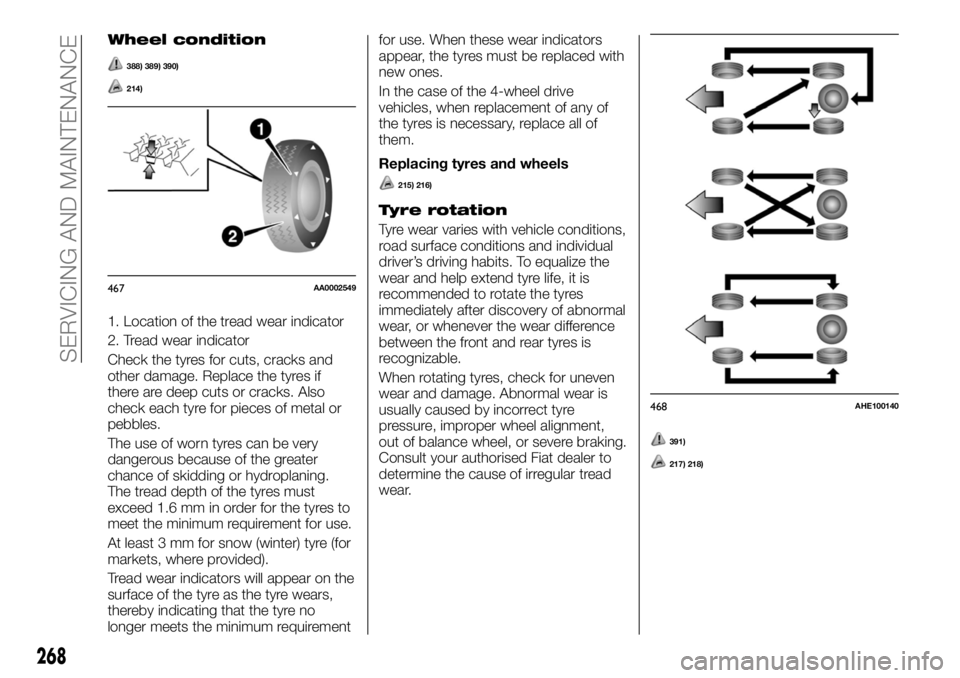
1. Location of the tread wear indicator
2. Tread wear indicator
Check the tyres for cuts, cracks and
other damage. Replace the tyres if
there are deep cuts or cracks. Also
check each tyre for pieces of metal or
pebbles.
The use of worn tyres can be very
dangerous because of the greater
chance of skidding or hydroplaning.
The tread depth of the tyres must
exceed 1.6 mm in order for the tyres to
meet the minimum requirement for use.
At least 3 mm for snow (winter) tyre (for
markets, where provided).
Tread wear indicators will appear on the
surface of the tyre as the tyre wears,
thereby indicating that the tyre no
longer meets the minimum requirementfor use. When these wear indicators
appear, the tyres must be replaced with
new ones.
In the case of the 4-wheel drive
vehicles, when replacement of any of
the tyres is necessary, replace all of
them.
Replacing tyres and wheels
215) 216)
Tyre rotation
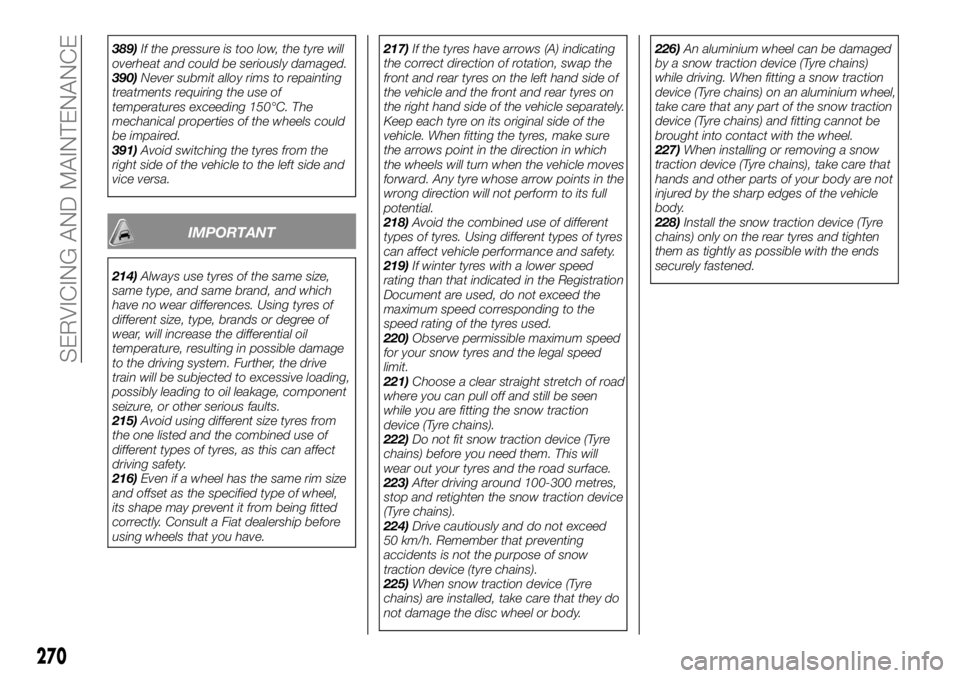
Tyre wear varies with vehicle conditions,
road surface conditions and individual
driver’s driving habits. To equalize the
wear and help extend tyre life, it is
recommended to rotate the tyres
immediately after discovery of abnormal
wear, or whenever the wear difference
between the front and rear tyres is
recognizable.
When rotating tyres, check for uneven
wear and damage. Abnormal wear is
usually caused by incorrect tyre
pressure, improper wheel alignment,
out of balance wheel, or severe braking.
Consult your authorised Fiat dealer to
determine the cause of irregular tread
wear.
391)
217) 218)
467AA0002549
468AHE100140
268
SERVICING AND MAINTENANCE
Page 272 of 312
389)If the pressure is too low, the tyre will
overheat and could be seriously damaged.
390)Never submit alloy rims to repainting
treatments requiring the use of
temperatures exceeding 150°C. The
mechanical properties of the wheels could
be impaired.
391)Avoid switching the tyres from the
right side of the vehicle to the left side and
vice versa.
IMPORTANT
214)Always use tyres of the same size,
same type, and same brand, and which
have no wear differences. Using tyres of
different size, type, brands or degree of
wear, will increase the differential oil
temperature, resulting in possible damage
to the driving system. Further, the drive
train will be subjected to excessive loading,
possibly leading to oil leakage, component
seizure, or other serious faults.
215)Avoid using different size tyres from
the one listed and the combined use of
different types of tyres, as this can affect
driving safety.
216)Even if a wheel has the same rim size
and offset as the specified type of wheel,
its shape may prevent it from being fitted
correctly. Consult a Fiat dealership before
using wheels that you have.217)If the tyres have arrows (A) indicating
the correct direction of rotation, swap the
front and rear tyres on the left hand side of
the vehicle and the front and rear tyres on
the right hand side of the vehicle separately.
Keep each tyre on its original side of the
vehicle. When fitting the tyres, make sure
the arrows point in the direction in which
the wheels will turn when the vehicle moves
forward. Any tyre whose arrow points in the
wrong direction will not perform to its full
potential.
218)Avoid the combined use of different
types of tyres. Using different types of tyres
can affect vehicle performance and safety.
219)If winter tyres with a lower speed
rating than that indicated in the Registration
Document are used, do not exceed the
maximum speed corresponding to the
speed rating of the tyres used.
220)Observe permissible maximum speed
for your snow tyres and the legal speed
limit.
221)Choose a clear straight stretch of road
where you can pull off and still be seen
while you are fitting the snow traction
device (Tyre chains).
222)Do not fit snow traction device (Tyre
chains) before you need them. This will
wear out your tyres and the road surface.
223)After driving around 100-300 metres,
stop and retighten the snow traction device
(Tyre chains).
224)Drive cautiously and do not exceed
50 km/h. Remember that preventing
accidents is not the purpose of snow
traction device (tyre chains).
225)When snow traction device (Tyre
chains) are installed, take care that they do
not damage the disc wheel or body.226)An aluminium wheel can be damaged
by a snow traction device (Tyre chains)
while driving. When fitting a snow traction
device (Tyre chains) on an aluminium wheel,
take care that any part of the snow traction
device (Tyre chains) and fitting cannot be
brought into contact with the wheel.
227)When installing or removing a snow
traction device (Tyre chains), take care that
hands and other parts of your body are not
injured by the sharp edges of the vehicle
body.
228)Install the snow traction device (Tyre
chains) only on the rear tyres and tighten
them as tightly as possible with the ends
securely fastened.
270
SERVICING AND MAINTENANCE
Page 302 of 312
Mopar Vehicle Protectionoffers a series of service contracts that are designed to give all our customers the
pleasure of driving their vehicle without any hitch's and concerns.
Our product portfolio consists of a wide and flexible range of extended warranty and maintenance plans
endorsed by FCA. Each with a series of different coverage tiers, in terms of durability and mileage, built to
accommodate you’re driving needs.
Service contracts are made by experts that know every part of your vehicle, and commit themselves
to maintain it in tip top conditions. Our knowledge and passion is tailored around designing
products that promises all our drivers “worry-free driving”.
Only with Mopar Vehicle Protection you are ensured that all service operations are performed
by highly qualified and specialized technicians in authorized FCA repair facilities, using the right tools,
equipment and only original parts, all over Europe.
Check which Service Contract plans are available on your market today and choose the
Service Contract that suits your driving habits best.
Ask your local dealer for further information.
MAINTAIN YOUR VEHICLE IN
TIP TOP CONDITIONS WITH
Page 309 of 312
INDEX
4Wheel drive operation........178
Accessory socket............80
Active safety systems..........137
Air conditioning system.........56
Air purifier..................68
Ashtray....................79
Assist grip..................83
Automatic climate control air
conditioner................61
Automatic transmission.........159
Auxiliary driving system.........141
Battery..................258
Bleeding the fuel system........211
Bottle holder................82
Brake fluid.................255
Cargo area.................75
Cargo loads.................75
Catalytic converter.........72,252
Central Door Locks............28
Checking levels..............251
Child restraint...............113
Child restraint system..........116
Child-protection rear doors (Double
cab)....................30
Cigarette lighter..............79
Cleaning the exterior of your vehicle
.263Cleaning the interior of your vehicle .262
Clutch fluid................256
Coat hook..................83
Combination headlamps and
dipper switch..............44
Convenient hook.............83
Cruise control...............183
Cup holder.................82
Dead lock system............29
Demanding vehicle use.........250
Diesel particulate filter..........72
Digital clock.................80
Doors.....................27
Driving, alcohol and drugs.......145
Easy select 4WD............164
Economical driving...........144
Electric window control.........70
Electrical system.............288
Electronic immobilizer..........13
Emergency starting...........209
Emission..................296
Engine compartment...........74
Engine coolant..............253
Engine oil.................252
Engine overheating...........210
Engine specifications..........274
Engine switch...............25
Era Glonass................204
External Lights...............44
Fluids and Lubricants.........293
Fog lamp switch..............48
Force limiter................112
Front seats.................33
Fuel consumption............296
Fuel selection................84
Fuses....................227
Fusible links................227
General maintenance.........261
Graphical index...............9
Handling of 4 wheel drive vehicles.181
Hazard warning flasher switch.....47
Head restraints...............36
Headlamp levelling switch........46
Heater/Manual air conditioning.....58
High Load System.............75
Horn switch.................40
How to change a tyre..........216
If the vehicle breaks down.......208
Ignition switch...............24
Important operation tips for the air
conditioning...............67
Inside rear view mirror..........40
Instruments.................90
Interior features..............78
Interior lamps................50
ISOFIX positions.............116
Key number tag..............13
Keyless Entry System...........14
Page 311 of 312
We really know your car because we invented, designed and built it: we really know every single detail.
At Fiat Service authorised workshopsyou can find technicians directly trained by us,
offering quality and professionalism for all service operations.
Fiat workshops are always close to you for the regular servicing operations, season checks
and practical recommendations by our experts.
With Original Parts distributed by MOPAR
®, you maintain the reliability, comfort
and performance features that you bought your new car for over time.
Always ask for Genuine Parts for the components used on our cars; we recommend them because
they come from our steady commitment in research and development of highly innovative technologies.
For all these reasons: rely on Genuine Parts, because they are the only ones designed
by FCA for your car.
SAFETY:
BRAKING SYSTEMENVIRONMENT: PARTICULATE FILTERS,
CLIMATE CONTROL MAINTENANCECOMFORT: SUSPENSION
AND WINDSCREEN WIPERS PERFORMANCE: SPARK PLUGS,
INJECTORS AND BATTERIESLINEACCESSORI
ROOF RACK BARS, WHEEL RIMS
WHY CHOOSING
GENUINE PARTS