low FIAT FULLBACK 2018 Owner handbook (in English)
[x] Cancel search | Manufacturer: FIAT, Model Year: 2018, Model line: FULLBACK, Model: FIAT FULLBACK 2018Pages: 316, PDF Size: 10.52 MB
Page 134 of 316
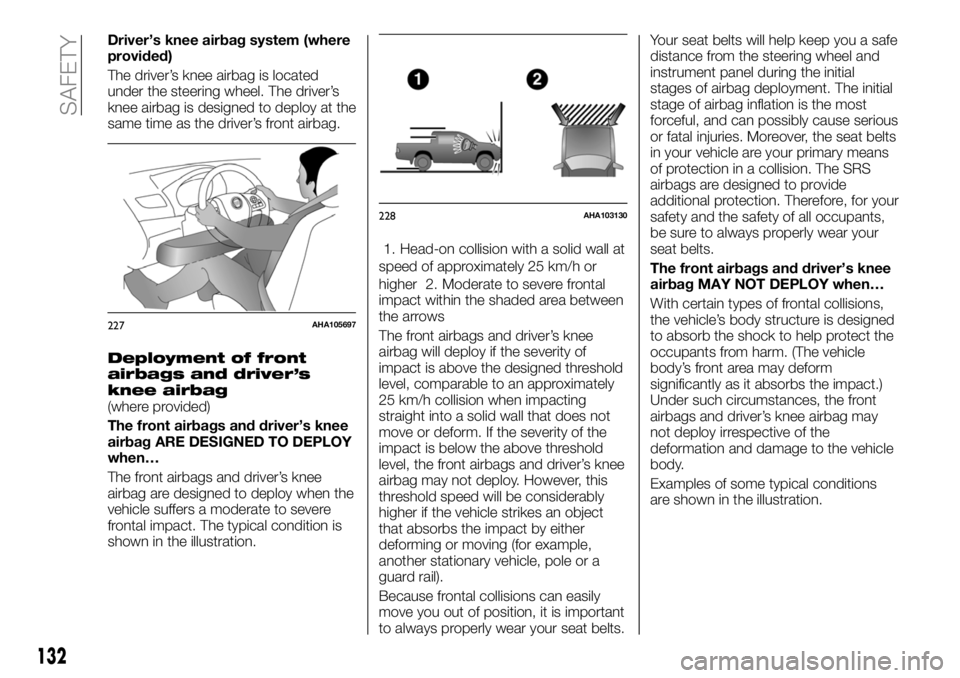
Driver’s knee airbag system (where
provided)
The driver’s knee airbag is located
under the steering wheel. The driver’s
knee airbag is designed to deploy at the
same time as the driver’s front airbag.
Deployment of front
airbags and driver’s
knee airbag
(where provided)
The front airbags and driver’s knee
airbag ARE DESIGNED TO DEPLOY
when…
The front airbags and driver’s knee
airbag are designed to deploy when the
vehicle suffers a moderate to severe
frontal impact. The typical condition is
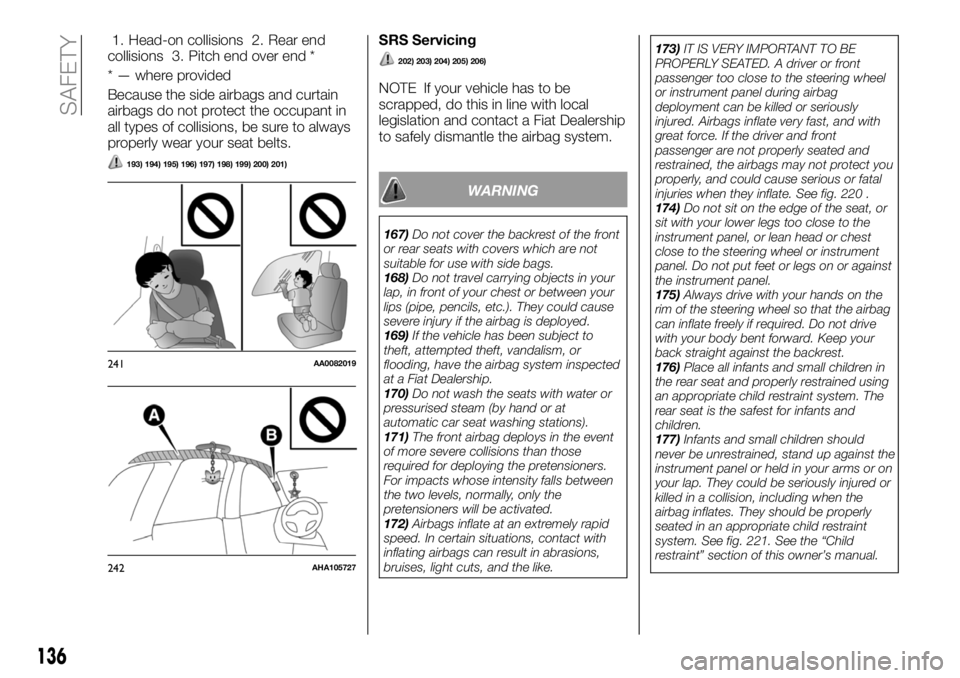
shown in the illustration.1. Head-on collision with a solid wall at
speed of approximately 25 km/h or
higher 2. Moderate to severe frontal
impact within the shaded area between
the arrows
The front airbags and driver’s knee
airbag will deploy if the severity of
impact is above the designed threshold
level, comparable to an approximately
25 km/h collision when impacting
straight into a solid wall that does not
move or deform. If the severity of the
impact is below the above threshold
level, the front airbags and driver’s knee
airbag may not deploy. However, this
threshold speed will be considerably
higher if the vehicle strikes an object
that absorbs the impact by either
deforming or moving (for example,
another stationary vehicle, pole or a
guard rail).
Because frontal collisions can easily
move you out of position, it is important
to always properly wear your seat belts.Your seat belts will help keep you a safe
distance from the steering wheel and
instrument panel during the initial
stages of airbag deployment. The initial
stage of airbag inflation is the most
forceful, and can possibly cause serious
or fatal injuries. Moreover, the seat belts
in your vehicle are your primary means
of protection in a collision. The SRS
airbags are designed to provide
additional protection. Therefore, for your
safety and the safety of all occupants,
be sure to always properly wear your
seat belts.
The front airbags and driver’s knee
airbag MAY NOT DEPLOY when…
With certain types of frontal collisions,
the vehicle’s body structure is designed
to absorb the shock to help protect the
occupants from harm. (The vehicle
body’s front area may deform
significantly as it absorbs the impact.)
Under such circumstances, the front
airbags and driver’s knee airbag may
not deploy irrespective of the
deformation and damage to the vehicle
body.
Examples of some typical conditions
are shown in the illustration.
227AHA105697
228AHA103130
132
SAFETY
Page 138 of 316
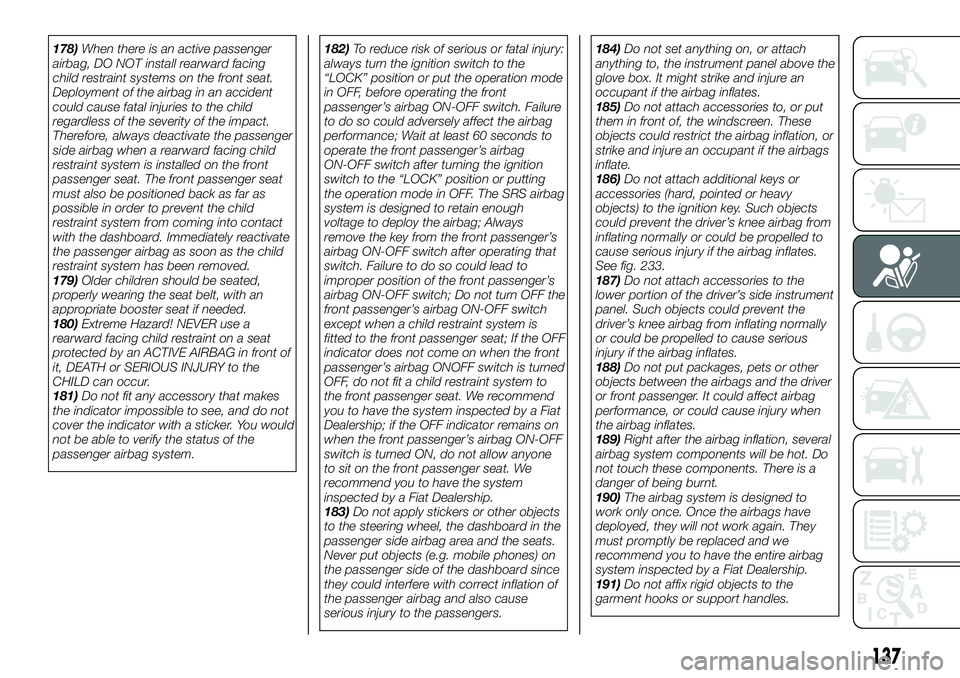
1. Head-on collisions 2. Rear end
collisions 3. Pitch end over end *
* — where provided
Because the side airbags and curtain
airbags do not protect the occupant in
all types of collisions, be sure to always
properly wear your seat belts.
193) 194) 195) 196) 197) 198) 199) 200) 201)
SRS Servicing
202) 203) 204) 205) 206)
NOTE If your vehicle has to be
scrapped, do this in line with local
legislation and contact a Fiat Dealership
to safely dismantle the airbag system.
WARNING
167)Do not cover the backrest of the front
or rear seats with covers which are not
suitable for use with side bags.
168)Do not travel carrying objects in your
lap, in front of your chest or between your
lips (pipe, pencils, etc.). They could cause
severe injury if the airbag is deployed.
169)If the vehicle has been subject to
theft, attempted theft, vandalism, or
flooding, have the airbag system inspected
at a Fiat Dealership.
170)Do not wash the seats with water or
pressurised steam (by hand or at
automatic car seat washing stations).
171)The front airbag deploys in the event
of more severe collisions than those
required for deploying the pretensioners.
For impacts whose intensity falls between
the two levels, normally, only the
pretensioners will be activated.
172)Airbags inflate at an extremely rapid
speed. In certain situations, contact with
inflating airbags can result in abrasions,
bruises, light cuts, and the like.173)IT IS VERY IMPORTANT TO BE
PROPERLY SEATED. A driver or front
passenger too close to the steering wheel
or instrument panel during airbag
deployment can be killed or seriously
injured. Airbags inflate very fast, and with
great force. If the driver and front
passenger are not properly seated and
restrained, the airbags may not protect you
properly, and could cause serious or fatal
injuries when they inflate. See fig. 220 .
174)Do not sit on the edge of the seat, or
sit with your lower legs too close to the
instrument panel, or lean head or chest
close to the steering wheel or instrument
panel. Do not put feet or legs on or against
the instrument panel.
175)Always drive with your hands on the
rim of the steering wheel so that the airbag
can inflate freely if required. Do not drive
with your body bent forward. Keep your
back straight against the backrest.
176)Place all infants and small children in
the rear seat and properly restrained using
an appropriate child restraint system. The
rear seat is the safest for infants and
children.
177)Infants and small children should
never be unrestrained, stand up against the
instrument panel or held in your arms or on
your lap. They could be seriously injured or
killed in a collision, including when the
airbag inflates. They should be properly
seated in an appropriate child restraint
system. See fig. 221. See the “Child
restraint” section of this owner’s manual.
241AA0082019
242AHA105727
136
SAFETY
Page 139 of 316
178)When there is an active passenger
airbag, DO NOT install rearward facing
child restraint systems on the front seat.
Deployment of the airbag in an accident
could cause fatal injuries to the child
regardless of the severity of the impact.
Therefore, always deactivate the passenger
side airbag when a rearward facing child
restraint system is installed on the front
passenger seat. The front passenger seat
must also be positioned back as far as
possible in order to prevent the child
restraint system from coming into contact
with the dashboard. Immediately reactivate
the passenger airbag as soon as the child
restraint system has been removed.
179)Older children should be seated,
properly wearing the seat belt, with an
appropriate booster seat if needed.
180)Extreme Hazard! NEVER use a
rearward facing child restraint on a seat
protected by an ACTIVE AIRBAG in front of
it, DEATH or SERIOUS INJURY to the
CHILD can occur.
181)Do not fit any accessory that makes
the indicator impossible to see, and do not
cover the indicator with a sticker. You would
not be able to verify the status of the
passenger airbag system.182)To reduce risk of serious or fatal injury:
always turn the ignition switch to the
“LOCK” position or put the operation mode
in OFF, before operating the front
passenger’s airbag ON-OFF switch. Failure
to do so could adversely affect the airbag
performance; Wait at least 60 seconds to
operate the front passenger’s airbag
ON-OFF switch after turning the ignition
switch to the “LOCK” position or putting
the operation mode in OFF. The SRS airbag
system is designed to retain enough
voltage to deploy the airbag; Always
remove the key from the front passenger’s
airbag ON-OFF switch after operating that
switch. Failure to do so could lead to
improper position of the front passenger’s
airbag ON-OFF switch; Do not turn OFF the
front passenger’s airbag ON-OFF switch
except when a child restraint system is
fitted to the front passenger seat; If the OFF
indicator does not come on when the front
passenger’s airbag ONOFF switch is turned
OFF, do not fit a child restraint system to
the front passenger seat. We recommend
you to have the system inspected by a Fiat
Dealership; if the OFF indicator remains on
when the front passenger’s airbag ON-OFF
switch is turned ON, do not allow anyone
to sit on the front passenger seat. We
recommend you to have the system
inspected by a Fiat Dealership.
183)Do not apply stickers or other objects
to the steering wheel, the dashboard in the
passenger side airbag area and the seats.
Never put objects (e.g. mobile phones) on
the passenger side of the dashboard since
they could interfere with correct inflation of
the passenger airbag and also cause
serious injury to the passengers.184)Do not set anything on, or attach
anything to, the instrument panel above the
glove box. It might strike and injure an
occupant if the airbag inflates.
185)Do not attach accessories to, or put
them in front of, the windscreen. These
objects could restrict the airbag inflation, or
strike and injure an occupant if the airbags
inflate.
186)Do not attach additional keys or
accessories (hard, pointed or heavy
objects) to the ignition key. Such objects
could prevent the driver’s knee airbag from
inflating normally or could be propelled to
cause serious injury if the airbag inflates.
See fig. 233.
187)Do not attach accessories to the
lower portion of the driver’s side instrument
panel. Such objects could prevent the
driver’s knee airbag from inflating normally
or could be propelled to cause serious
injury if the airbag inflates.
188)Do not put packages, pets or other
objects between the airbags and the driver
or front passenger. It could affect airbag
performance, or could cause injury when
the airbag inflates.
189)Right after the airbag inflation, several
airbag system components will be hot. Do
not touch these components. There is a
danger of being burnt.
190)The airbag system is designed to
work only once. Once the airbags have
deployed, they will not work again. They
must promptly be replaced and we
recommend you to have the entire airbag
system inspected by a Fiat Dealership.
191)Do not affix rigid objects to the
garment hooks or support handles.
137
Page 140 of 316
192)Do not rest your head, arms or
elbows on the door, windows or the area in
which the Window bag is located to avoid
possible injury during airbag inflation.
193)The airbag does not replace seat belts
but increases their efficiency. Furthermore,
since front airbags are not deployed in
low-speed frontal impacts, side impacts,
rear shunts or roll-overs, the passengers
are protected only by the seat belts which
must therefore be fastened at all times.
194)The side airbags and curtain airbags
are designed to supplement the driver and
passenger seat belts in certain side
impacts. Seat belts should always be worn
properly, and the driver and passenger
should sit well back and upright without
leaning against the window or door.
195)The side airbag and curtain airbag
inflate with great force. The driver and
passenger should not put their arms out
the window, and should not lean against
the door, in order to reduce risk of serious
or possible fatal injury from the deploying
side airbag and curtain airbag.
196)Do not allow any rear seat occupant
to hold onto the seatback of either front
seat, in order to reduce risk of injury from
the deploying side airbag. Special care
should be taken with children.
197)Do not place any objects near or in
front of the seatback of either front seat.
They could interfere with proper side airbag
inflation, and also could cause injury if
thrown free by side airbag deployment.
198)Do not install seat covers on seats
with side airbags. Do not re-cover seats
that have side airbags. This could interfere
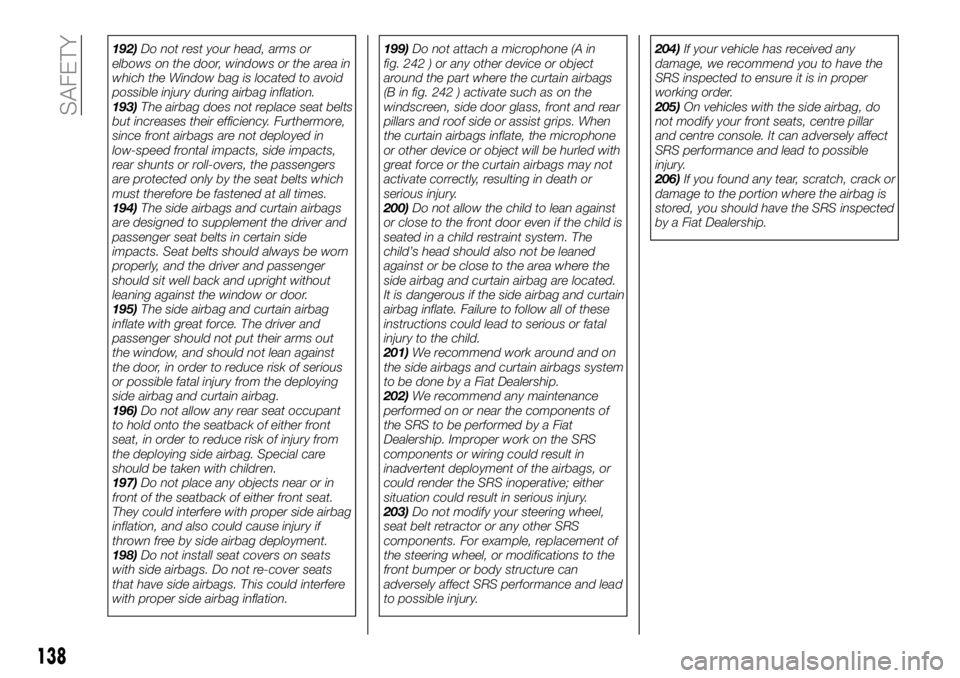
with proper side airbag inflation.199)Do not attach a microphone (A in
fig. 242 ) or any other device or object
around the part where the curtain airbags
(B in fig. 242 ) activate such as on the
windscreen, side door glass, front and rear
pillars and roof side or assist grips. When
the curtain airbags inflate, the microphone
or other device or object will be hurled with
great force or the curtain airbags may not
activate correctly, resulting in death or
serious injury.
200)Do not allow the child to lean against
or close to the front door even if the child is
seated in a child restraint system. The
child’s head should also not be leaned
against or be close to the area where the
side airbag and curtain airbag are located.
It is dangerous if the side airbag and curtain
airbag inflate. Failure to follow all of these
instructions could lead to serious or fatal
injury to the child.
201)We recommend work around and on
the side airbags and curtain airbags system
to be done by a Fiat Dealership.
202)We recommend any maintenance
performed on or near the components of
the SRS to be performed by a Fiat
Dealership. Improper work on the SRS
components or wiring could result in
inadvertent deployment of the airbags, or
could render the SRS inoperative; either
situation could result in serious injury.
203)Do not modify your steering wheel,
seat belt retractor or any other SRS
components. For example, replacement of
the steering wheel, or modifications to the
front bumper or body structure can
adversely affect SRS performance and lead
to possible injury.204)If your vehicle has received any
damage, we recommend you to have the
SRS inspected to ensure it is in proper
working order.
205)On vehicles with the side airbag, do
not modify your front seats, centre pillar
and centre console. It can adversely affect
SRS performance and lead to possible
injury.
206)If you found any tear, scratch, crack or
damage to the portion where the airbag is
stored, you should have the SRS inspected
by a Fiat Dealership.
138
SAFETY
Page 141 of 316
ACTIVE SAFETY
SYSTEMS
Brake assist system (where
provided)
The brake assist system is a device
assisting drivers who cannot depress
the brake pedal firmly such as in
emergency stop situations and provides
greater braking force.
If the brake pedal is depressed
suddenly, the brakes will be applied
with more force than usual.
207)
NOTE Once the brake assist system is
operational, it maintains great braking
force even if the brake pedal is lightly
released. To stop its operation,
completely remove your foot from the
brake pedal.
NOTE When the brake assist system is
in use while driving, you may feel the
brake pedal attempt to resist, the pedal
moves in small motions in conjunction
with the operation noise, or the vehicle
body and the steering wheel vibrate.
This occurs when the brake assist
system is operating normally and does
not indicate faulty operation. Continue
to depress the brake pedal.
NOTE When the Electronic Stability
Control (ESC) indicator lamp is
illuminated, the brake assist system
may not function.Emergency stop signal system
(where provided)
This is a device that reduces the
possibility of rear end collisions by the
rapid and automatic blinking of the
hazard warning lamps to alert vehicles
approaching from behind during
sudden braking. When the emergency
brake system operates, the hazard
warning indicator lamp in the
instrument cluster blinks rapidly at the
same time.
NOTE Activating condition for the
emergency brake system > It activates
when all of the following conditions are
met.
The vehicle speed is approximately
55 km/h or higher.
The brake pedal has been depressed,
and the system judges that it was sudden
braking from the vehicle deceleration and
the operating condition of the anti-lock
brake system (ABS).
Deactivating condition for the
emergency brake system > It
deactivates when one of the following
conditions is met.
The brake pedal is released.
The hazard warning flasher switch is
pressed.
The system judges that it was not
sudden braking from the vehicle
deceleration and the operating
condition of the anti-lock brake system
(ABS).
Anti-lock brake system (ABS)
(where provided)
The anti-lock brake system (ABS) helps
prevent the wheels from locking up
when braking. This helps maintain
vehicle drivability and steering wheel
handling.
Driving hints
Always keep a safe distance from the
vehicle in front of you. Even if your
vehicle is equipped with the ABS, leave
a greater braking distance when:
Driving on gravel or snow-covered
roads.
Driving with tyre chains installed.
Driving on roads where the road
surface is pitted or has other
differences in surface height.
Driving on uneven road surfaces.
Operation of ABS is not restricted
situations where brakes are applied
suddenly. This system may also prevent
the wheels from locking when you drive
over manholes, steel roadwork plates,
road markings, or any uneven road
surface.
When the ABS is in use, you may feel
the brake pedal pulsation and the
vibrations of the vehicle body and
steering wheel. It may also feel as if the
pedal resists being pressed.
In this situation, simply hold the brake
pedal down firmly. Do not pump the
brake, which will result in reduced
braking performance.
139
Page 142 of 316
An operation noise is emitted from the
engine compartment or feel a shock
from the brake pedal when start driving
immediately after starting the engine.
These are normal sound or operation
that the ABS makes when performing a
self-check. It does not indicate a
malfunction.
The ABS can be used after the vehicle
has reached a speed over
approximately 10 km/h. It stops
working when the vehicle slows below
7 km/h.
208) 209) 210) 211) 212) 213) 214) 215) 216)
After driving on icy roads
After driving on snow or icy roads,
remove any snow and ice which may
have be left around the wheels. On
vehicles that have an ABS, be careful
not to damage the wheel speed
sensors (A) or the cables located at
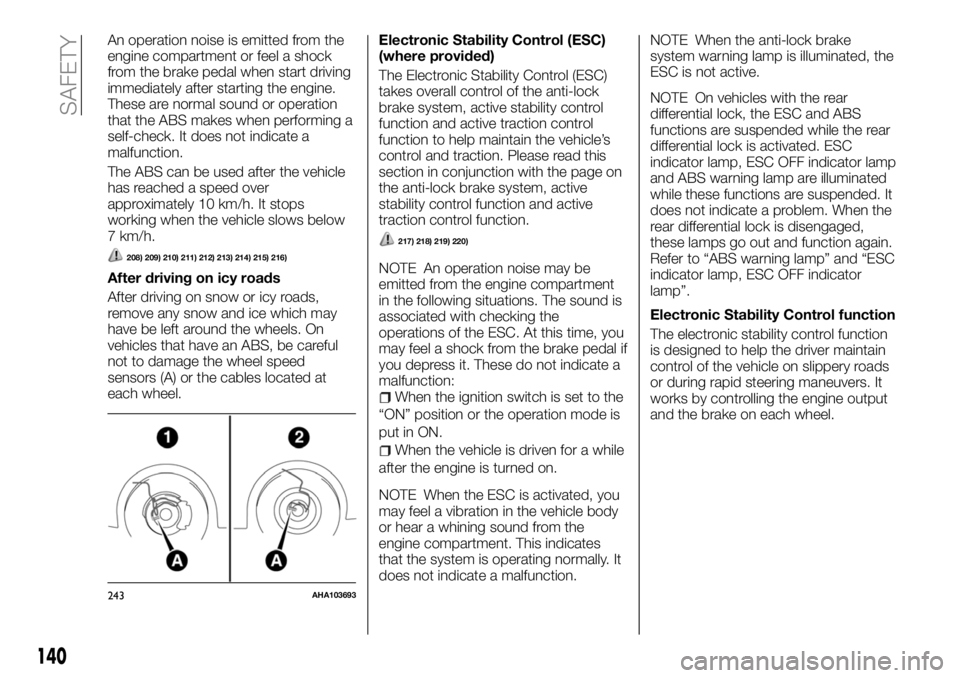
each wheel.Electronic Stability Control (ESC)
(where provided)
The Electronic Stability Control (ESC)
takes overall control of the anti-lock
brake system, active stability control
function and active traction control
function to help maintain the vehicle’s
control and traction. Please read this
section in conjunction with the page on
the anti-lock brake system, active
stability control function and active
traction control function.
217) 218) 219) 220)
NOTE An operation noise may be
emitted from the engine compartment
in the following situations. The sound is
associated with checking the
operations of the ESC. At this time, you
may feel a shock from the brake pedal if
you depress it. These do not indicate a
malfunction:
When the ignition switch is set to the
“ON” position or the operation mode is
put in ON.
When the vehicle is driven for a while
after the engine is turned on.
NOTE When the ESC is activated, you
may feel a vibration in the vehicle body
or hear a whining sound from the
engine compartment. This indicates
that the system is operating normally. It
does not indicate a malfunction.NOTE When the anti-lock brake
system warning lamp is illuminated, the
ESC is not active.
NOTE On vehicles with the rear
differential lock, the ESC and ABS
functions are suspended while the rear
differential lock is activated. ESC
indicator lamp, ESC OFF indicator lamp
and ABS warning lamp are illuminated
while these functions are suspended. It
does not indicate a problem. When the
rear differential lock is disengaged,
these lamps go out and function again.
Refer to “ABS warning lamp” and “ESC
indicator lamp, ESC OFF indicator
lamp”.
Electronic Stability Control function
The electronic stability control function
is designed to help the driver maintain
control of the vehicle on slippery roads
or during rapid steering maneuvers. It
works by controlling the engine output
and the brake on each wheel.
243AHA103693
140
SAFETY
Page 144 of 316
209)To prevent failure of the ABS, be sure
all 4 wheels and tyres are the same size
and the same type.
210)Do not install any aftermarket limited
slip differential (LSD) on your vehicle. The
ABS may stop functioning properly.
211)The ABS exploits the grip available to
the full, but it cannot improve it. Therefore,
you should take great care when driving on
slippery surfaces, without taking
unnecessary risks.
212)When the ABS intervenes and you
notice the brake pedal pulsating, keep the
pedal pushed down and don’t be alarmed.
This will help you to stop in the shortest
distance possible, depending on the road
conditions.
213)If the ABS intervenes, it means you
have almost reached the grip limit between
the tyres and the road surface: slow down
to make sure that you drive in accordance
with the available grip.
214)The ABS cannot overrule the natural
laws of physics, and can’t increase the grip
available according to the condition of the
road.
215)The ABS cannot prevent accidents,
including those due to excessive speed on
corners, driving on low-grip surfaces or
aquaplaning.
216)The capability of the ABS must never
be tested irresponsibly and dangerously, in
such a way as to compromise personal
safety and the safety of others.217)Do not over-rely on the ESC. Even the
ESC cannot prevent the natural laws of
physics from acting on the vehicle. This
system, like any other system, has limits
and cannot help you to maintain traction
and control of the vehicle in all
circumstances. Reckless driving can lead
to accidents. It is the driver’s responsibility
to drive carefully. This means into account
the traffic, road and environmental
conditions.
218)The ESC system cannot prevent
accidents, including those due to excessive
speed on corners, driving on low-grip
surfaces or aquaplaning.
219)Be sure to use the same specified
type and size of tyre on all 4 wheels.
Otherwise, the ESC may not work
correctly.
220)Do not install any aftermarket limited
slip differential (LSD) on your vehicle. The
electronic stability control function may
stop functioning properly.
221)For safety reasons, the “ESC OFF”
switch should only be operated when the
vehicle is stopped.
222)Be sure to keep the electronic stability
control function on while driving in normal
circumstances.
223)When driving a vehicle on a snowy or
icy road, be sure to install snow tyres and
drive the vehicle at moderate speeds.AUXILIARY DRIVING
SYSTEMS
Hill Start Assist (where provided)
The hill start assist makes it easy to
start off on a steep uphill slope by
preventing the vehicle from moving
backwards. It keeps the braking force
for approximately seconds when you
move your foot from the brake pedal to
the accelerator pedal.
81) 82)
224) 225)
To operate
1. Stop the vehicle completely using the
brake pedal.
2. On vehicles equipped with M/T,
place the gearshift lever into the 1st
position. On vehicles equipped with
A/T, place the selector lever into the “D”
position.
NOTE When reversing on an uphill
slope, place the selector lever or
gearshift lever into the “R” position.
3. Release the brake pedal and the hill
start assist will maintain the braking
force applied while stopping for
approximately 2 seconds.
4. Depress the accelerator pedal and
the hill start assist gradually will
decrease the braking force as the
vehicle starts moving.
142
SAFETY
Page 145 of 316
NOTE The hill start assist is activated
when all of the following conditions are
met.
The engine is running (the hill start
assist will not be activated while the
engine is starting or immediately after
the engine is started).
On vehicles equipped with M/T, the
gearshift lever is in the following
position: When starting an uphill slope
forwards > The gearshift lever is in any
position other than “R” (the hill start
assist will operate, even if the gearshift
lever is in the “N” position). When
starting an uphill slope backwards >
The gearshift lever is in the “R” position
(the hill start assist will not operate
when the gearshift lever is in the “N”
position).
On vehicles equipped with A/T, the
selector lever is in any position other
than “P” or “N”.
The vehicle is completely stationary,
with the brake pedal depressed.
The parking brake is released.
NOTE The hill start assist will not
operate if the accelerator pedal is
depressed before the brake pedal is
released.
NOTE The hill start assist also operates
when reversing on an uphill slope.NOTE When the hill start assist is
activated, you may feel the operating
sound. This is a normal result of the hill
start assist operation, and does not
indicate a problem.
Warning indicator
If an abnormal condition occurs in the
system, the indicator lamp
will turn
on.
83) 84)
Power Steering System
The power steering system operates
while the engine is running. It helps
reduce the effort needed to turn the
steering wheel.
The power steering system has
mechanical steering capability in case
the power assist is lost. If the power
assist is lost for some reason, you will
still be able to steer your vehicle, but
you will notice it takes much more effort
to steer. If this happens, have your
vehicle inspected at a Fiat Dealership.
85) 86)
Trailer Stability Assist — TSA
(where provided)
The trailer stability assist system helps
safely running while towing a trailer by
controlling the braking force of each
wheel and engine power in order to
stabilize the motion when detecting the
continuous sway of the vehicle caused
by a trailer.When the trailer stability assist system
operates the brakes, the brake lamp
turns on. About the towing of the trailer,
refer to “Trailer towing”.
87) 88)
NOTE When TSA system operates, the
vehicle body may vibrate and the
operating sounds from the engine
compartment may be heard. These
motions indicate normal operation of
the system, not abnormal operation.
NOTE TSA system operates when the
vehicle speed is about 55 km/h or
higher.
NOTE When TSA system operates, the
ESC operation indicator lamp blinks on
and off.
NOTE When ESC does not work, TSA
system does not operate.
WARNING
224)When facing uphill, do not rely on
using the hill start assist to maintain a
stopped position as an alternative to
depressing the brake pedal. Doing so
could cause an accident.
225)Do not turn the ignition switch to the
“LOCK” or “ACC” position or the operation
mode in ACC or OFF while the hill start
assist is operating. The hill start assist
could stop operating, which could result in
an accident.
143
Page 146 of 316
IMPORTANT
81)Do not overly rely on the hill start assist
to prevent backwards movement of the
vehicle. Under certain circumstances, even
when hill start assist is activated, the
vehicle may move backwards if the brake
pedal is not sufficiently depressed, if the
vehicle is heavily loaded, if the road is very
steep or slippery or if the vehicle tows a
trailer, etc.
82)The hill start assist is not designed to
keep the vehicle stopped in place on uphill
slopes for more than 2 seconds.
83)If the warning is turn on, the hill start
assist will not operate. Start off carefully.
84)Park your vehicle in a safe place and
stop the engine. Restart the engine and
check whether the warning indicator went
out, in which case the hill start assist is
again working normally. If they warning
remains displayed or reappear frequently, it
is not necessary to stop the vehicle
immediately, but the vehicle should be
inspected by a Fiat Dealership.
85)Do not stop the engine while the
vehicle is moving. Stopping the engine
would make the steering wheel extremely
hard to turn, possibly resulting in an
accident.
86)Do not leave the steering wheel turned
all the way in one direction. This can cause
damage to the power steering system.87)Do not over-rely on TSA system. Due to
the slippery road surface, heavy side wind,
inappropriate weight and positioning of
luggage, and/or driving at high speed, TSA
system may fail to secure the stability.
Always drive appropriately in accordance
with the condition of traffic, road surface
condition, weather, and the weight and
positioning of luggage.
88)The trailer stability assist system does
not operate in case as follows: 1 – When
sudden braking and braking while driving
downhill cause an abrupt motion of the
vehicle which makes the vehicle and the
trailer form a dogleg shape. 2 – When a
sideslip occurs by sudden steering.
144
SAFETY
Page 148 of 316
ECONOMICAL
DRIVING
For economical driving, there are some
technical requirements that have to be
met. The prerequisite for low fuel
consumption is a properly adjusted
engine. In order to achieve longer life of
the vehicle and the most economical
operation, we recommend you to have
the vehicle checked at regular intervals
in accordance with the service
standards.
Fuel economy and generation of
exhaust gas and noise are highly
influenced by personal driving habits as
well as the particular operating
conditions. The following points should
be observed in order to minimize wear
of brakes, tyres and engine as well as
to reduce environmental pollution.
Accelerating and decelerating
Drive according to traffic conditions,
and avoid sudden starts, sudden
acceleration, and sudden braking, as
they will increase fuel consumption.
Shifting
Shift only at an appropriate speed and
engine speed. Always use the highest
shift position possible.
The transfer shift lever or the drive
modeselector should be set to “2H”
when driving 4WD vehicles on normal
roads and express ways to obtain best
possible fuel economy.City traffic
Frequent starting and stopping
increases the average fuel
consumption. Use roads with smooth
traffic flow whenever possible. When
driving on congested roads, avoid use
of a low shift position at high engine
speeds.
Idling
The vehicle consumes fuel even during
idling. Avoid extended idling whenever
possible.
Speed
At higher the vehicle speed, more fuel is
consumed. Avoid driving at full speed.
Even a slight release of the accelerator
pedal will save a significant amount of
fuel.
Tyre inflation pressure
Check the tyre inflation pressures at
regular intervals. Low tyre inflation
pressure increases road resistance and
fuel consumption. In addition, low tyre
pressures adversely affect tyre wear
and driving stability.
Cargo loads
Do not drive with unnecessary articles
in the luggage compartment. Especially
during city driving where frequent
starting and stopping is necessary, the
increased weight of the vehicle will
greatly affect fuel consumption. Also
avoid driving with unnecessary luggage
or carriers, etc., on the roof; theincreased air resistance will increase
fuel consumption.
Cold engine starting
Starting of a cold engine consumes
more fuel. Unnecessary fuel
consumption is also caused by keeping
a hot engine running. After the engine is
started, commence driving as soon as
possible.
Cooler or air conditioning
The use of the air conditioner will
increase the fuel consumption.
146
STARTING AND DRIVING