ABS FIAT FULLBACK 2018 Owner handbook (in English)
[x] Cancel search | Manufacturer: FIAT, Model Year: 2018, Model line: FULLBACK, Model: FIAT FULLBACK 2018Pages: 316, PDF Size: 10.52 MB
Page 142 of 316
An operation noise is emitted from the
engine compartment or feel a shock
from the brake pedal when start driving
immediately after starting the engine.
These are normal sound or operation
that the ABS makes when performing a
self-check. It does not indicate a
malfunction.
The ABS can be used after the vehicle
has reached a speed over
approximately 10 km/h. It stops
working when the vehicle slows below
7 km/h.
208) 209) 210) 211) 212) 213) 214) 215) 216)
After driving on icy roads
After driving on snow or icy roads,
remove any snow and ice which may
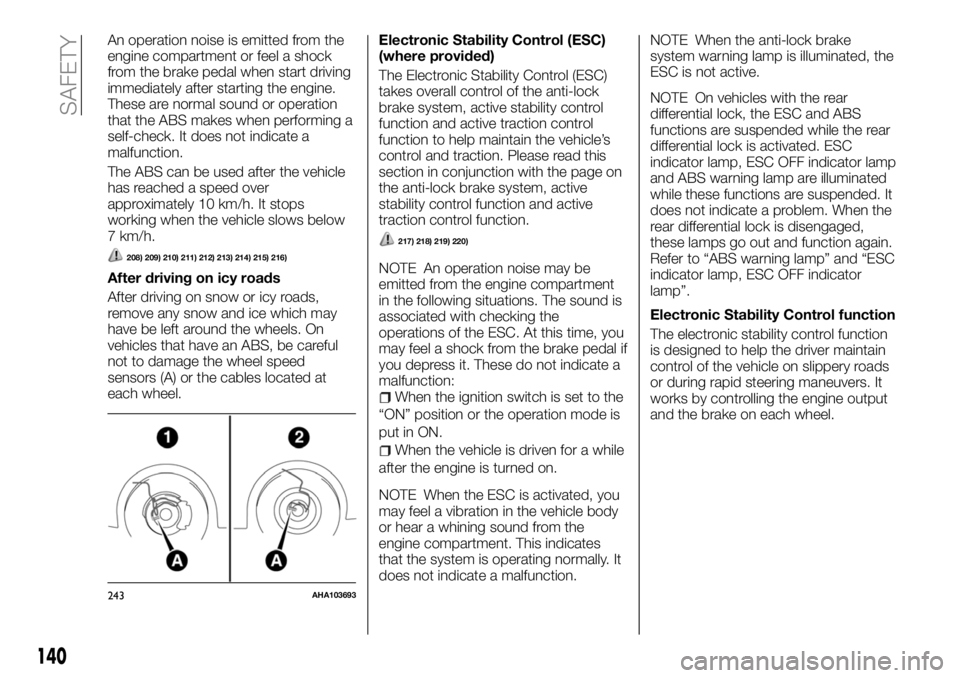
have be left around the wheels. On
vehicles that have an ABS, be careful
not to damage the wheel speed
sensors (A) or the cables located at
each wheel.Electronic Stability Control (ESC)
(where provided)
The Electronic Stability Control (ESC)
takes overall control of the anti-lock
brake system, active stability control
function and active traction control
function to help maintain the vehicle’s
control and traction. Please read this
section in conjunction with the page on
the anti-lock brake system, active
stability control function and active
traction control function.
217) 218) 219) 220)
NOTE An operation noise may be
emitted from the engine compartment
in the following situations. The sound is
associated with checking the
operations of the ESC. At this time, you
may feel a shock from the brake pedal if
you depress it. These do not indicate a
malfunction:
When the ignition switch is set to the
“ON” position or the operation mode is
put in ON.
When the vehicle is driven for a while
after the engine is turned on.
NOTE When the ESC is activated, you
may feel a vibration in the vehicle body
or hear a whining sound from the
engine compartment. This indicates
that the system is operating normally. It
does not indicate a malfunction.NOTE When the anti-lock brake
system warning lamp is illuminated, the
ESC is not active.
NOTE On vehicles with the rear
differential lock, the ESC and ABS
functions are suspended while the rear
differential lock is activated. ESC
indicator lamp, ESC OFF indicator lamp
and ABS warning lamp are illuminated
while these functions are suspended. It
does not indicate a problem. When the
rear differential lock is disengaged,
these lamps go out and function again.
Refer to “ABS warning lamp” and “ESC
indicator lamp, ESC OFF indicator
lamp”.
Electronic Stability Control function
The electronic stability control function
is designed to help the driver maintain
control of the vehicle on slippery roads
or during rapid steering maneuvers. It
works by controlling the engine output
and the brake on each wheel.
243AHA103693
140
SAFETY
Page 143 of 316
NOTE The electronic stability control
function does not operate when the
drive mode-selector is in the “4L”
position (Easy Select 4WD), “4LLc”
position (Super Select 4WD II). When
the active stability control function is
operating with the drive mode-selector
in the “2H” or “4H” position (Easy
Select 4WD), “2H”, “4H” or “4HLc”
position (Super Select 4WD II), setting
the drive modeselector to the “4L”
(Easy Select 4WD), “4LLc” position
(Super Select 4WD II) position makes
the active stability control function
deactivate automatically.
NOTE The electronic stability control
function operates at speeds of about
15 km/h or higher.
NOTE On vehicles with the rear
differential lock, the electronic stability
control function does not operate when
the rear differential lock is activated.
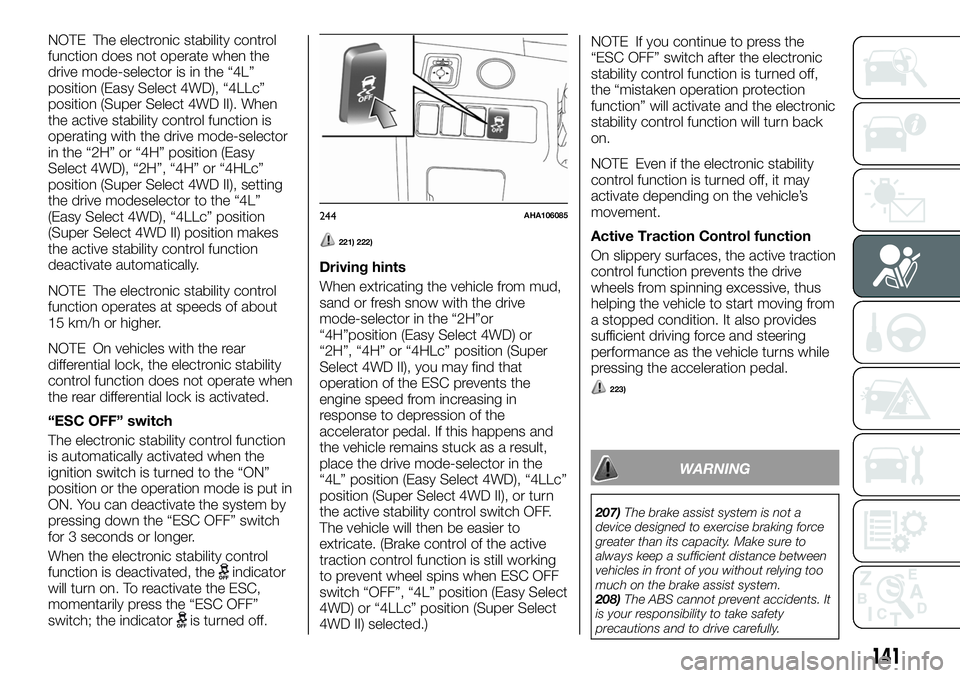
“ESC OFF” switch
The electronic stability control function
is automatically activated when the
ignition switch is turned to the “ON”
position or the operation mode is put in
ON. You can deactivate the system by
pressing down the “ESC OFF” switch
for 3 seconds or longer.
When the electronic stability control
function is deactivated, the
indicator
will turn on. To reactivate the ESC,
momentarily press the “ESC OFF”
switch; the indicator
is turned off.
221) 222)
Driving hints
When extricating the vehicle from mud,
sand or fresh snow with the drive
mode-selector in the “2H”or
“4H”position (Easy Select 4WD) or
“2H”, “4H” or “4HLc” position (Super
Select 4WD II), you may find that
operation of the ESC prevents the
engine speed from increasing in
response to depression of the
accelerator pedal. If this happens and
the vehicle remains stuck as a result,
place the drive mode-selector in the
“4L” position (Easy Select 4WD), “4LLc”
position (Super Select 4WD II), or turn
the active stability control switch OFF.
The vehicle will then be easier to
extricate. (Brake control of the active
traction control function is still working
to prevent wheel spins when ESC OFF
switch “OFF”, “4L” position (Easy Select
4WD) or “4LLc” position (Super Select
4WD II) selected.)NOTE If you continue to press the
“ESC OFF” switch after the electronic
stability control function is turned off,
the “mistaken operation protection
function” will activate and the electronic
stability control function will turn back
on.
NOTE Even if the electronic stability
control function is turned off, it may
activate depending on the vehicle’s
movement.
Active Traction Control function
On slippery surfaces, the active traction
control function prevents the drive
wheels from spinning excessive, thus
helping the vehicle to start moving from
a stopped condition. It also provides
sufficient driving force and steering
performance as the vehicle turns while
pressing the acceleration pedal.
223)
WARNING
207)The brake assist system is not a
device designed to exercise braking force
greater than its capacity. Make sure to
always keep a sufficient distance between
vehicles in front of you without relying too
much on the brake assist system.
208)The ABS cannot prevent accidents. It
is your responsibility to take safety
precautions and to drive carefully.
244AHA106085
141
Page 144 of 316
209)To prevent failure of the ABS, be sure
all 4 wheels and tyres are the same size
and the same type.
210)Do not install any aftermarket limited
slip differential (LSD) on your vehicle. The
ABS may stop functioning properly.
211)The ABS exploits the grip available to
the full, but it cannot improve it. Therefore,
you should take great care when driving on
slippery surfaces, without taking
unnecessary risks.
212)When the ABS intervenes and you
notice the brake pedal pulsating, keep the
pedal pushed down and don’t be alarmed.
This will help you to stop in the shortest
distance possible, depending on the road
conditions.
213)If the ABS intervenes, it means you
have almost reached the grip limit between
the tyres and the road surface: slow down
to make sure that you drive in accordance
with the available grip.
214)The ABS cannot overrule the natural
laws of physics, and can’t increase the grip
available according to the condition of the
road.
215)The ABS cannot prevent accidents,
including those due to excessive speed on
corners, driving on low-grip surfaces or
aquaplaning.
216)The capability of the ABS must never
be tested irresponsibly and dangerously, in
such a way as to compromise personal
safety and the safety of others.217)Do not over-rely on the ESC. Even the
ESC cannot prevent the natural laws of
physics from acting on the vehicle. This
system, like any other system, has limits
and cannot help you to maintain traction
and control of the vehicle in all
circumstances. Reckless driving can lead
to accidents. It is the driver’s responsibility
to drive carefully. This means into account
the traffic, road and environmental
conditions.
218)The ESC system cannot prevent
accidents, including those due to excessive
speed on corners, driving on low-grip
surfaces or aquaplaning.
219)Be sure to use the same specified
type and size of tyre on all 4 wheels.
Otherwise, the ESC may not work
correctly.
220)Do not install any aftermarket limited
slip differential (LSD) on your vehicle. The
electronic stability control function may
stop functioning properly.
221)For safety reasons, the “ESC OFF”
switch should only be operated when the
vehicle is stopped.
222)Be sure to keep the electronic stability
control function on while driving in normal
circumstances.
223)When driving a vehicle on a snowy or
icy road, be sure to install snow tyres and
drive the vehicle at moderate speeds.AUXILIARY DRIVING
SYSTEMS
Hill Start Assist (where provided)
The hill start assist makes it easy to
start off on a steep uphill slope by
preventing the vehicle from moving
backwards. It keeps the braking force
for approximately seconds when you
move your foot from the brake pedal to
the accelerator pedal.
81) 82)
224) 225)
To operate
1. Stop the vehicle completely using the
brake pedal.
2. On vehicles equipped with M/T,
place the gearshift lever into the 1st
position. On vehicles equipped with
A/T, place the selector lever into the “D”
position.
NOTE When reversing on an uphill
slope, place the selector lever or
gearshift lever into the “R” position.
3. Release the brake pedal and the hill
start assist will maintain the braking
force applied while stopping for
approximately 2 seconds.
4. Depress the accelerator pedal and
the hill start assist gradually will
decrease the braking force as the
vehicle starts moving.
142
SAFETY
Page 156 of 316
Fuel injection amount learning
process
To keep exhaust emissions and engine
noise low, the engine very occasionally
performs a learning process for the fuel
injection amount.
The engine sounds slightly different
from usual while the learning process is
taking place. The change in the engine
sound does not indicate a fault.
If the keyless operation key is not
operating properly
Insert the keyless operation key into the
key slot. Starting the engine and
changing the operation mode should be
now possible.
Remove the keyless operation key from
the key slot after starting the engine or
changing the operation mode.NOTE Do not insert into the key slot
anything other than the keyless
operation key. This could cause
damage or a malfunction.
NOTE Remove the object or additional
key from the keyless operation key
before inserting the key into the key
slot. The vehicle may not be able to
receive the registered ID code from the
registered key. Therefore, the engine
may not start and the operation mode
may not change.
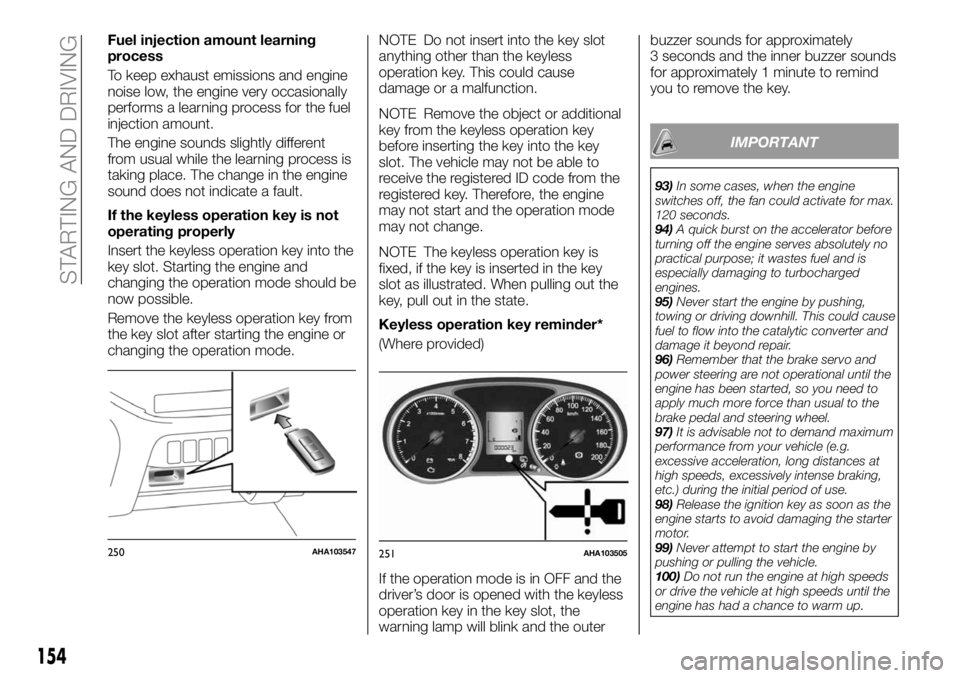
NOTE The keyless operation key is
fixed, if the key is inserted in the key
slot as illustrated. When pulling out the
key, pull out in the state.
Keyless operation key reminder*
(Where provided)
If the operation mode is in OFF and the
driver’s door is opened with the keyless
operation key in the key slot, the
warning lamp will blink and the outerbuzzer sounds for approximately
3 seconds and the inner buzzer sounds
for approximately 1 minute to remind
you to remove the key.
IMPORTANT
93)In some cases, when the engine
switches off, the fan could activate for max.
120 seconds.
94)A quick burst on the accelerator before
turning off the engine serves absolutely no
practical purpose; it wastes fuel and is
especially damaging to turbocharged
engines.
95)Never start the engine by pushing,
towing or driving downhill. This could cause
fuel to flow into the catalytic converter and
damage it beyond repair.
96)Remember that the brake servo and
power steering are not operational until the
engine has been started, so you need to
apply much more force than usual to the
brake pedal and steering wheel.
97)It is advisable not to demand maximum
performance from your vehicle (e.g.
excessive acceleration, long distances at
high speeds, excessively intense braking,
etc.) during the initial period of use.
98)Release the ignition key as soon as the
engine starts to avoid damaging the starter
motor.
99)Never attempt to start the engine by
pushing or pulling the vehicle.
100)Do not run the engine at high speeds
or drive the vehicle at high speeds until the
engine has had a chance to warm up.
250AHA103547251AHA103505
154
STARTING AND DRIVING
Page 157 of 316
101)If your vehicle is equipped with a
turbocharger, do not stop the engine
immediately after high-speed or uphill
driving. First allow the engine to idle to give
the turbocharger a chance to cool down.
102)It is advisable not to demand
maximum performance from your vehicle
(e.g. excessive acceleration, long distances
at high speeds, excessively intense braking,
etc.) during the initial period of use.
103)A quick burst on the accelerator
before turning off the engine serves
absolutely no practical purpose; it wastes
fuel and is especially damaging to
turbocharged engines.
WARNING
231)Never run the engine in a closed or
poorly ventilated area any longer than is
needed to move your vehicle in or out of
the area. Carbon monoxide gases are
odourless and can be fatal.
232)Do not operate the engine switch
while driving except in an emergency. If the
engine is stopped while driving, the brake
servomechanism will cease to function and
braking efficiency will deteriorate. Also, the
power steering system will not function and
it will require greater manual effort to
operate the steering. This could result in a
serious accident.
TURBOCHARGER
OPERATION
(where provided)
Turbocharger
104) 105)
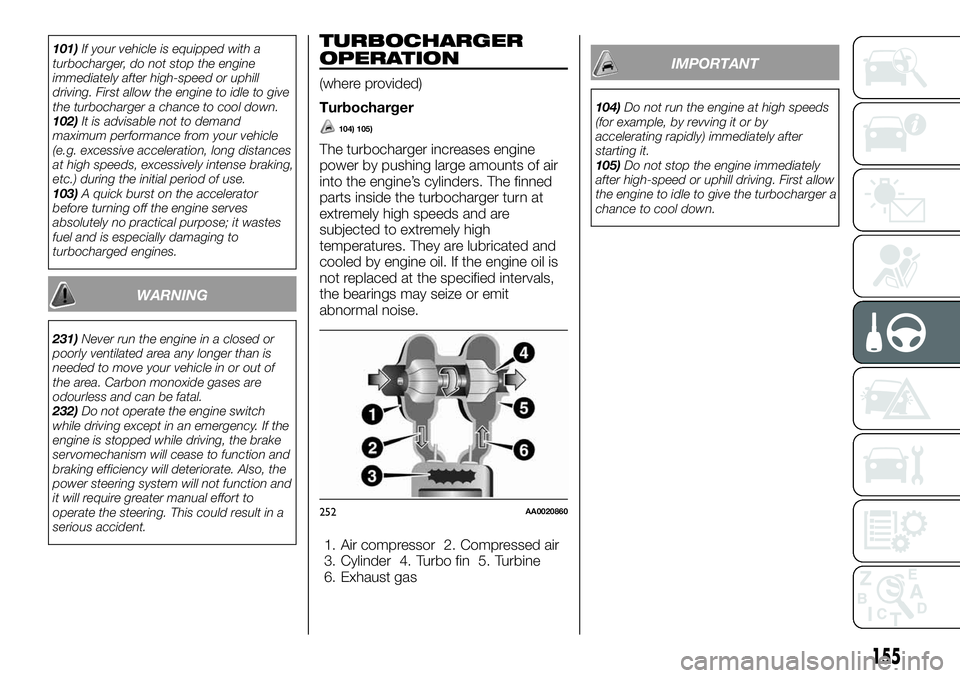
The turbocharger increases engine
power by pushing large amounts of air
into the engine’s cylinders. The finned
parts inside the turbocharger turn at
extremely high speeds and are
subjected to extremely high
temperatures. They are lubricated and
cooled by engine oil. If the engine oil is
not replaced at the specified intervals,
the bearings may seize or emit
abnormal noise.
1. Air compressor 2. Compressed air
3. Cylinder 4. Turbo fin 5. Turbine
6. Exhaust gas
IMPORTANT
104)Do not run the engine at high speeds
(for example, by revving it or by
accelerating rapidly) immediately after
starting it.
105)Do not stop the engine immediately
after high-speed or uphill driving. First allow
the engine to idle to give the turbocharger a
chance to cool down.
252AA0020860
155
Page 181 of 316
The ESC and ABS functions are
suspended while the rear differential
lock is activated. ESC indicator lamp,
ESC OFF indicator lamp and ABS
warning lamp are illuminated while
these functions are suspended. It does
not indicate a problem. When the rear
differential lock is disengaged, these
lamps go out and function again. Refer
to “ABS warning lamp”, “ESC indicator
lamp, ESC OFF indicator lamp”.
If the indicator lamp continues blinking
after the switch has been pressed to
deactivate the rear differential lock, hold
the steering wheel in the straight ahead
position then slowly depress and
release the accelerator pedal several
times.
If the indicator lamp continues blinking
after the switch has been pressed to
activate the rear differential lock, bear in
mind the following instructions:
If the vehicle speed is 12 km/h or
higher, decelerate to a speed of
2.5 km/h or lower. The indicator lamp
will illuminate steadily and the rear
differential lock will be activated.
If the vehicle speed is 12 km/h or lower,
turn the steering wheel from side to
side until the indicator lamp illuminates
steadily. If the vehicle is stuck in soft
ground, make sure the area around the
vehicle is clear then repeatedly attempt
to drive forward and backward. Theindicator lamp will illuminate steadily
and the rear differential lock will be
activated.
142)
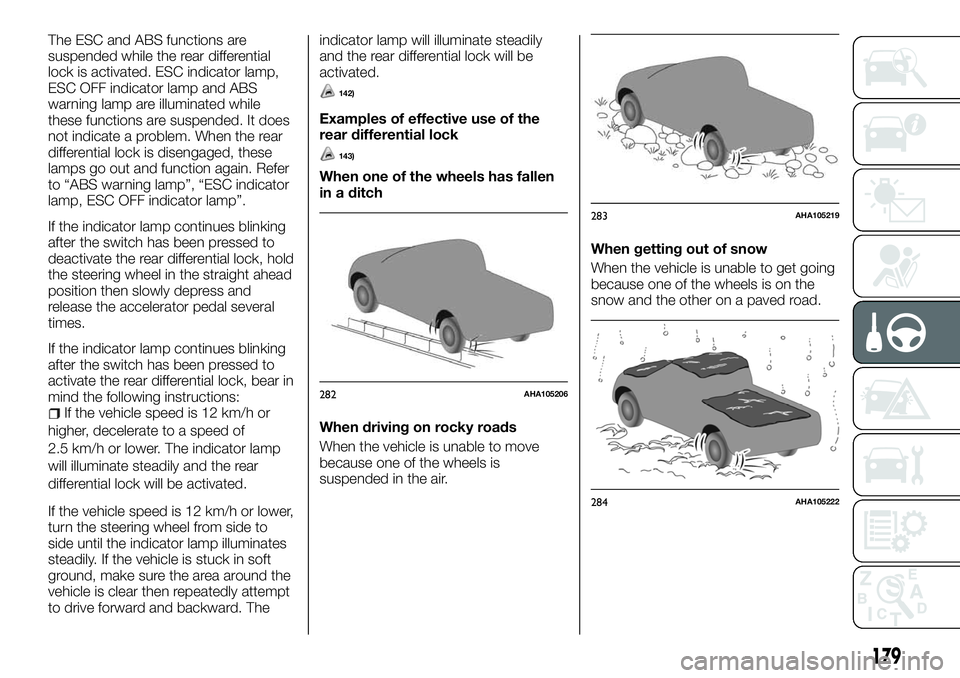
Examples of effective use of the
rear differential lock
143)
When one of the wheels has fallen
in a ditch
When driving on rocky roads
When the vehicle is unable to move
because one of the wheels is
suspended in the air.When getting out of snow
When the vehicle is unable to get going
because one of the wheels is on the
snow and the other on a paved road.
282AHA105206
283AHA105219
284AHA105222
179
Page 184 of 316
pedal as constant as possible, and
drive at low speed.
146) 147)
239)
NOTE Avoid sudden braking,
acceleration, and turning; such
operations could result in the vehicle
becoming stuck.
NOTE If the vehicle becomes stuck in
sandy or muddy roads, it can often be
moved a rocking motion. Move the
selector lever rhythmically between the
“D” (DRIVE) and “R” (REVERSE)
position (with manual transmission,
between 1st and Reverse), while
applying slight pressure to the
accelerator pedal.
NOTE It is recommended to start the
vehicle with parking brake partially, but
not completely, applied by slightly
pulling the parking brake lever. After the
vehicle has become free, do not forget
to release the parking brake.
NOTE If it is necessary to drive in
extremely muddy conditions, the use of
tyre chains is recommended. Because
the extent of muddy conditions is
difficult to judge and the vehicle could
become bogged down very deeply,
operation should be at a low speed. If
possible, get out of the vehicle and
check the conditions ahead before
proceeding.NOTE Driving over roads in coastal
areas or roads on which anti-skid
preparations have been spread can
cause rust on the vehicle; wash the
vehicle thoroughly as soon as possible
after such use.
Climbing sharp grades
Set the drive mode-selector to “4L”
position (Easy Select 4WD), “4LLc”
position (Super Select 4WD II) to
maximize the engine torque.
240) 241)
NOTE Choose as smooth a slope as
possible with few stones or other
obstacles.
NOTE Before attempting to drive up
the slope, walk up it to confirm that the
vehicle can handle the grade.
Descending sharp grades
Set the drive mode-selector to “4L”
position (Easy Select 4WD), “4LLc”
position (Super Select 4WD II), use the
engine brake (downshifting) and
descend slowly.
242)
NOTE When descending a sharp
grade, if the brakes are applied
suddenly because of an obstacle
encountered, control of the vehicle
could be lost. Before descending the
slope, walk down it and confirm the
path.NOTE Before descending a grade, it is
necessary to choose the appropriate
gear. Avoid changing gears or
depressing the clutch while descending
the grade.
NOTE FCA is not responsible to the
operator for any damage or injury
caused or liability incurred by the
improper and negligent operation of a
vehicle. All techniques of vehicle
operation described herein depend on
the skill and experience of the operator
and other participating parties and any
deviation from the recommended
operation instructions above is at their
own risk.
Turning sharp corners
When turning a sharp corner in “4H” or
“4L” position (Easy Select 4WD),
“4HLc” or “4LLc” position (Super Select
4WD II) at low speed, a slight difference
in steering may be experienced similar
to as if the brakes were applied. This is
called tight corner braking and results
from each of the 4 tyres being at a
different distance from the corner.
Crossing a stream
4-wheel drive vehicles are not
necessarily waterproof. If the electrical
circuits become wet, further operation
of the vehicle will be impossible;
therefore, avoid crossing streams
unless absolutely necessary. If crossing
a stream is unavoidable, use the
following procedure:
182
STARTING AND DRIVING
Page 202 of 316
157) 158) 159) 160)
257) 258) 259)
WARNING
257)In the case of indistinct, overlapping
or missing lane demarcation lines, the
system may not assist the driver: in this
case the Driving Advisor will be inactive.
258)The Driving Advisor is not an
automatic driving system and does not
replace the driver in controlling the
trajectory of the car. The driver is personally
responsible for maintaining a sufficient level
of attention to the traffic and road
conditions and for controlling the trajectory
of the car safely.
259)If the camera loses its position due to
a load variation, the system may not work
temporarily to allow the camera to perform
an autocalibration.
IMPORTANT
157)LDW has its performance limitations.
Do not over-rely on the system.
158)LDW is not designed to lessen risks
associated with not looking ahead carefully
(attention drawn to something on the side,
absentmindedness, etc.) or poor visibility
caused by bad weather etc. Keep steering
your vehicle correctly and drive safely.
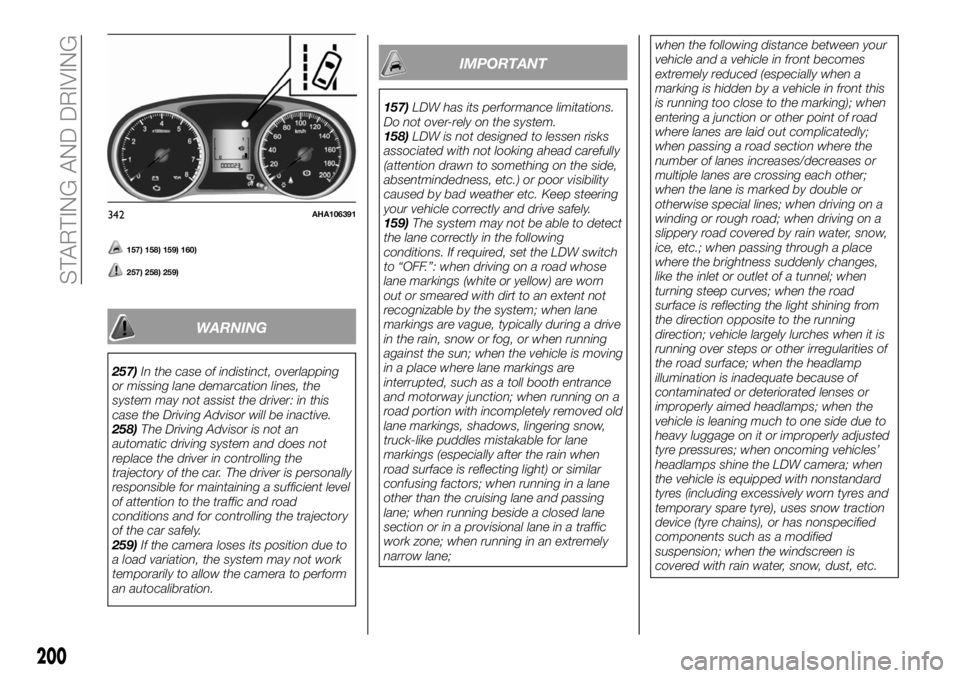
159)The system may not be able to detect
the lane correctly in the following
conditions. If required, set the LDW switch
to “OFF.”: when driving on a road whose
lane markings (white or yellow) are worn
out or smeared with dirt to an extent not
recognizable by the system; when lane
markings are vague, typically during a drive
in the rain, snow or fog, or when running
against the sun; when the vehicle is moving
in a place where lane markings are
interrupted, such as a toll booth entrance
and motorway junction; when running on a
road portion with incompletely removed old
lane markings, shadows, lingering snow,
truck-like puddles mistakable for lane
markings (especially after the rain when
road surface is reflecting light) or similar
confusing factors; when running in a lane
other than the cruising lane and passing
lane; when running beside a closed lane
section or in a provisional lane in a traffic
work zone; when running in an extremely
narrow lane;when the following distance between your
vehicle and a vehicle in front becomes
extremely reduced (especially when a
marking is hidden by a vehicle in front this
is running too close to the marking); when
entering a junction or other point of road
where lanes are laid out complicatedly;
when passing a road section where the
number of lanes increases/decreases or
multiple lanes are crossing each other;
when the lane is marked by double or
otherwise special lines; when driving on a
winding or rough road; when driving on a
slippery road covered by rain water, snow,
ice, etc.; when passing through a place
where the brightness suddenly changes,
like the inlet or outlet of a tunnel; when
turning steep curves; when the road
surface is reflecting the light shining from
the direction opposite to the running
direction; vehicle largely lurches when it is
running over steps or other irregularities of
the road surface; when the headlamp
illumination is inadequate because of
contaminated or deteriorated lenses or
improperly aimed headlamps; when the
vehicle is leaning much to one side due to
heavy luggage on it or improperly adjusted
tyre pressures; when oncoming vehicles’
headlamps shine the LDW camera; when
the vehicle is equipped with nonstandard
tyres (including excessively worn tyres and
temporary spare tyre), uses snow traction
device (tyre chains), or has nonspecified
components such as a modified
suspension; when the windscreen is
covered with rain water, snow, dust, etc.
342AHA106391
200
STARTING AND DRIVING
Page 213 of 316
IF THE OPERATION
MODE CANNOT BE
CHANGED TO OFF
(VEHICLES
EQUIPPED WITH THE
KEYLESS
OPERATION
SYSTEM)
If the operation mode cannot be
changed to OFF, perform the following
procedure.
Move the selector lever to the “P”
(PARK) position, and then change the
operation mode to OFF. (For vehicles
with A/T)
One of the other causes could be
low battery voltage. If this occurs, the
keyless entry system, keyless operation
function, and steering lock will also not
operate. Contact an authorised Fiat
dealership.
EMERGENCY
STARTING
276) 277) 278) 279) 280) 281) 282) 283) 284) 285) 286) 287)
288) 289) 290) 291) 292)
If the engine cannot be started because
the battery is weak or dead, the battery
from another vehicle can be used with
jumper cables to start the engine.
1. Get the vehicles close enough so the
jumper cables can reach, but be sure
the vehicles aren’t touching each other.
2. Turn off all lamps, heater and other
electrical loads.
3. Set the parking brake firmly on each
vehicle. Put an automatic transmission
in “P” (PARK) or a manual transmission
in “N” (Neutral). Stop the engine.
4. Make sure battery electrolyte is at the
proper level. Refer to “Battery”.
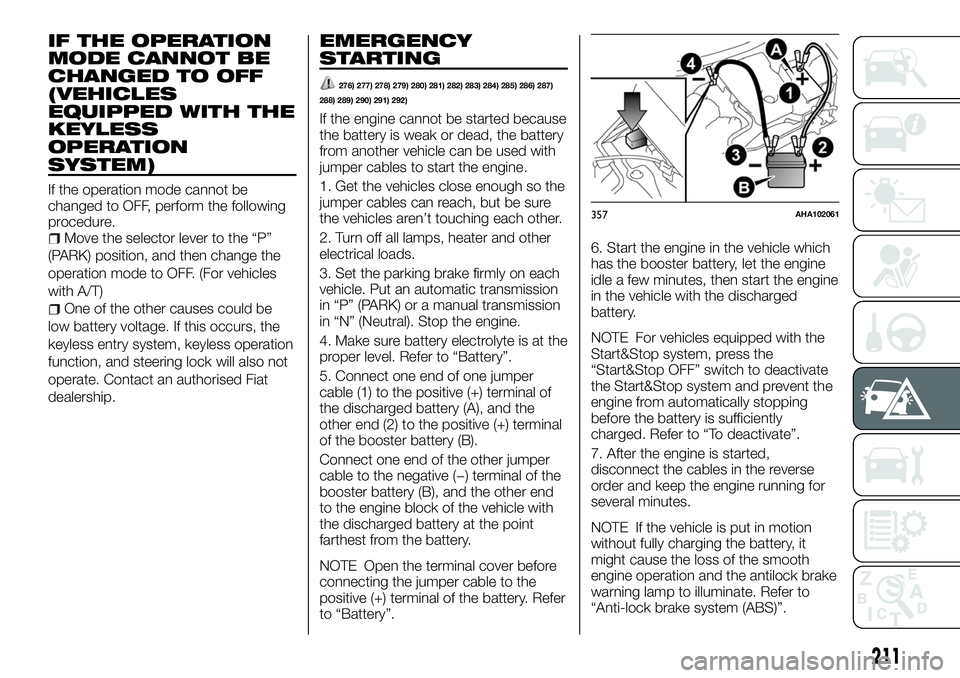
5. Connect one end of one jumper
cable (1) to the positive (+) terminal of
the discharged battery (A), and the
other end (2) to the positive (+) terminal
of the booster battery (B).
Connect one end of the other jumper
cable to the negative (−) terminal of the
booster battery (B), and the other end
to the engine block of the vehicle with
the discharged battery at the point
farthest from the battery.
NOTE Open the terminal cover before
connecting the jumper cable to the
positive (+) terminal of the battery. Refer
to “Battery”.6. Start the engine in the vehicle which
has the booster battery, let the engine
idle a few minutes, then start the engine
in the vehicle with the discharged
battery.
NOTE For vehicles equipped with the
Start&Stop system, press the
“Start&Stop OFF” switch to deactivate
the Start&Stop system and prevent the
engine from automatically stopping
before the battery is sufficiently
charged. Refer to “To deactivate”.
7. After the engine is started,
disconnect the cables in the reverse
order and keep the engine running for
several minutes.
NOTE If the vehicle is put in motion
without fully charging the battery, it
might cause the loss of the smooth
engine operation and the antilock brake
warning lamp to illuminate. Refer to
“Anti-lock brake system (ABS)”.
357AHA102061
211
Page 231 of 316
175)If you tow the vehicles with automatic
transmission with the driving wheels on the
ground (Type B) as illustrated, make sure
that the towing speed and distance given
below are never exceeded, causing
damage to the transmission. Towing speed:
30 km/h Towing distance: 80 km For the
towing speed and the towing distance,
follow the local driving laws and
regulations.
176)On vehicles with manual transmission,
do not tow the vehicle with the rear wheels
on the ground (Type B) as illustrated.
177)Never tow an automatic transmission
vehicle with the front wheels up (and the
rear wheels on the ground) (Type B) when
the automatic transmission fluid level is low.
This may cause serious and expensive
damage to the transmission.
178)When the engine is not running, the
brake booster and power steering pump do
not operate. This means higher brake
depression force and higher steering effort
are required. Therefore, vehicle operation is
very difficult.
179)Do not leave the ignition switch in the
“LOCK” position or the operation mode in
OFF. The steering wheel will lock, causing
loss of control.
180)On vehicles with Super Select 4WD II,
when you are going to tow another vehicle,
set the drive mode-selector to “4H”
position. Selecting “2H” drive may increase
the differential oil temperature, resulting in
possible damage to the driving system.
Further, the drive train will be subjected to
excessive loading possibly leading to oil
leakage, component seizure, or other
serious faults.OPERATION UNDER
ADVERSE DRIVING
CONDITIONS
On a flooded road
Avoid flooded roads. In the event
driving flooded roads, doing so may
cause the following serious damage to
the vehicle.
Engine stalling
Short in electrical components
Engine damage caused by water
immersion
After driving flooded roads, be sure to
have an inspection at a Fiat Dealership
and take the necessary measures or
repair.
On a wet road
When driving in rain or on a road with
many puddles a layer of water may
form between the tyres and the road
surface. This reduces a tyre’s frictional
resistance on the road, resulting in loss
of steering stability and braking
capability.
To cope with this, observe the following
items:
(a) Drive your vehicle at a slow speed.
(b) Do not drive on worn tyres.
(c) Always maintain the specified tyre
inflation pressures.On a snow-covered or frozen road
When driving on a snow-covered or
frozen road, it is recommended that you
use snow tyres or snow traction device
(tyre chains). Refer to the “Snow tyres”
and “Snow traction device (tyre chains)”
sections.
Avoid high-speed operation, sudden
acceleration, abrupt brake application
and sharp cornering.
Depressing the brake pedal during
travel on snowy or icy roads may cause
tyre slippage and skidding. When
traction between the tyres and the road
is reduced the wheels may skid and the
vehicle cannot readily be brought to a
stop by conventional braking
techniques. Braking will differ,
depending upon whether you have
anti-lock brake system (ABS). If you do
have ABS, brake by pressing the brake
pedal hard, and keeping it pressed. If
you do not have ABS, pump the brake
pedal with short rapid jabs, each time
fully applying and fully releasing for
greatest effect.
Allow extra distance between your
vehicle and the vehicle in front of you,
and avoid sudden braking.
Accumulation of ice on the braking
system can cause the wheels to lock.
Pull away from a standstill slowly after
confirming safety around the vehicle.
342)
229