heating FIAT FULLBACK 2018 Owner handbook (in English)
[x] Cancel search | Manufacturer: FIAT, Model Year: 2018, Model line: FULLBACK, Model: FIAT FULLBACK 2018Pages: 316, PDF Size: 10.52 MB
Page 116 of 316
NOTE The pretensioner seat belts will
be activated if the vehicle suffers a
severe impact, even if the seat belts are
not worn.
NOTE The pretensioner seat belts are
designed to work only once. After the
pretensioner seat belts have been
activated, we recommend you to have
them replaced by a Fiat Dealership.
SRS warning lamp
This warning lamp is shared by the SRS
airbags and the pre-tensioner seat
belts. Refer to “SRS warning lamp”.
Force limiter system
In the event of a collision, each force
limiter system will effectively absorb the
load applied to the seat belt so as to
minimize the impact to the passenger.
WARNING
137)Each seat belt must be used by only
one person. Never travel with a child sitting
on the passenger's lap and a single belt to
protect them both. In general, do not place
any objects between the person and the
belt.
138)The pretensioner may be used only
once. After it is triggered, have it replaced
at a Fiat Dealership.139)Removing or otherwise tampering
with pretensioner and seat belt
components is strictly prohibited. Any
intervention on these components must be
performed by qualified and authorised
technicians. Always go to a Fiat Dealership.
140)For maximum safety, keep the
backrest upright, lean back into it and
make sure the seat belt fits closely across
your chest and pelvis. Always fasten the
seat belts for both the front and rear seats!
Travelling without wearing seat belts will
increase the risk of serious injury and even
death in the event of an accident.
141)If the belt has been subjected to high
levels of stress, for example after an
accident, it should be changed completely
together with the attachments, attachment
fixing screws and the pretensioner. In fact,
even if the belt has no visible defects, it
may have lost its resilience.
IMPORTANT
73)To obtain the best results from your
pretensioner seat belt, make sure you have
adjusted your seat correctly and wear your
seat belt properly.
74)Installation of audio equipment or
repairs in the vicinity of the pretensioner
seat belts or floor console must be
performed in line with FCA Italy S.p.A.
guidelines. It is important to do so because
the work could affect the pretensioner
systems.75)If you need to scrap the vehicle, please
consult a Fiat Dealership. It is important to
do so because unexpected activation of
the pretensioner seat belts could cause
injuries.
76)Operations which lead to impacts,
vibrations or localised heating (over 100°C
for a maximum of six hours) in the area
around the pretensioners may damage or
accidentally deploy them. Contact a Fiat
Dealership should intervention be
necessary on these components.
114
SAFETY
Page 154 of 316
STARTING AND
STOPPING THE
ENGINE
231)
93) 94) 95) 96) 97) 98) 99) 100) 101) 102) 103)
Tips for starting
Except for vehicles equipped with
the keyless operation system
Do not operate the starter motor
continuously longer than 10 seconds;
doing so could run down the battery. If
the engine does not start, turn the
ignition switch back to “LOCK”, wait a
few seconds, and then try again. Trying
repeatedly with the starter motor still
turning will damage the starter
mechanism.
For vehicles equipped with the
keyless operation system
The operation mode can be in any
mode to start the engine.
The starter motor will be turning for up
to approximately 15 seconds if the
engine switch is released at once.
Pressing the engine switch again while
the starter motor is still turning will stop
the starter motor. The starter motor will
be turning for up to approximately
30 seconds while the engine switch is
pressed. If the engine does not start,
wait for a while and then attempt to
start the engine again. Trying repeatedly
with the starter motor still turning will
damage the starter mechanism.Starting the engine
Except for vehicles equipped with
the keyless operation system
1. Insert the ignition key and fasten the
seat belt.
2. Make sure the parking brake is
applied.
3. Press and hold the brake pedal
down firmly with your right foot.
4. On vehicles equipped with M/T,
depress the clutch pedal all the way
and place the gearshift lever in the “N”
(Neutral) position. On vehicles equipped
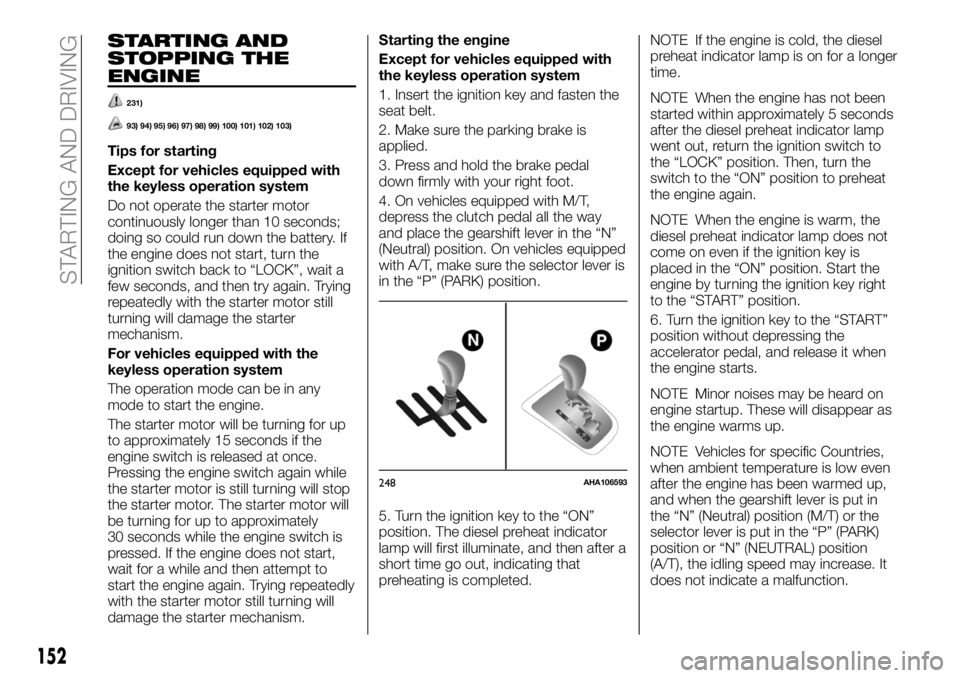
with A/T, make sure the selector lever is
in the “P” (PARK) position.
5. Turn the ignition key to the “ON”
position. The diesel preheat indicator
lamp will first illuminate, and then after a
short time go out, indicating that
preheating is completed.NOTE If the engine is cold, the diesel
preheat indicator lamp is on for a longer
time.
NOTE When the engine has not been
started within approximately 5 seconds
after the diesel preheat indicator lamp
went out, return the ignition switch to
the “LOCK” position. Then, turn the
switch to the “ON” position to preheat
the engine again.
NOTE When the engine is warm, the
diesel preheat indicator lamp does not
come on even if the ignition key is
placed in the “ON” position. Start the
engine by turning the ignition key right
to the “START” position.
6. Turn the ignition key to the “START”
position without depressing the
accelerator pedal, and release it when
the engine starts.
NOTE Minor noises may be heard on
engine startup. These will disappear as
the engine warms up.
NOTE Vehicles for specific Countries,
when ambient temperature is low even
after the engine has been warmed up,
and when the gearshift lever is put in
the “N” (Neutral) position (M/T) or the
selector lever is put in the “P” (PARK)
position or “N” (NEUTRAL) position
(A/T), the idling speed may increase. It
does not indicate a malfunction.
248AHA106593
152
STARTING AND DRIVING
Page 155 of 316
For vehicles equipped with the
keyless operation system
1. Fasten the seat belt.
2. Make sure the parking brake is
applied.
3. Press and hold the brake pedal
down firmly with your right foot.
NOTE When the engine is not started,
it may become hard to depress the
brake pedal and the vehicle may not be
able to detect the pedal operation.
Therefore the engine may not be
started. In such a case, depress the
brake pedal more firmly than usual.
4. On vehicles equipped with M/T,
depress the clutch pedal all the way
and place the gearshift lever in the “N”
(Neutral) position. On vehicles equipped
with A/T, make sure the selector lever is
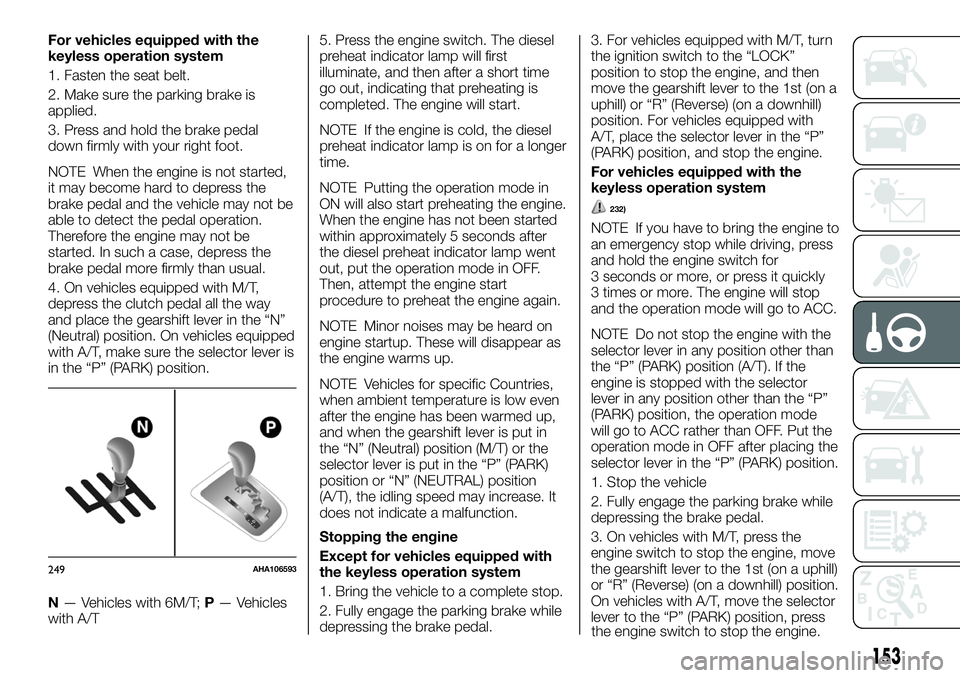
in the “P” (PARK) position.
N— Vehicles with 6M/T;P— Vehicles
with A/T5. Press the engine switch. The diesel
preheat indicator lamp will first
illuminate, and then after a short time
go out, indicating that preheating is
completed. The engine will start.
NOTE If the engine is cold, the diesel
preheat indicator lamp is on for a longer
time.
NOTE Putting the operation mode in
ON will also start preheating the engine.
When the engine has not been started
within approximately 5 seconds after
the diesel preheat indicator lamp went
out, put the operation mode in OFF.
Then, attempt the engine start
procedure to preheat the engine again.
NOTE Minor noises may be heard on
engine startup. These will disappear as
the engine warms up.
NOTE Vehicles for specific Countries,
when ambient temperature is low even
after the engine has been warmed up,
and when the gearshift lever is put in
the “N” (Neutral) position (M/T) or the
selector lever is put in the “P” (PARK)
position or “N” (NEUTRAL) position
(A/T), the idling speed may increase. It
does not indicate a malfunction.
Stopping the engine
Except for vehicles equipped with
the keyless operation system
1. Bring the vehicle to a complete stop.
2. Fully engage the parking brake while
depressing the brake pedal.3. For vehicles equipped with M/T, turn
the ignition switch to the “LOCK”
position to stop the engine, and then
move the gearshift lever to the 1st (on a
uphill) or “R” (Reverse) (on a downhill)
position. For vehicles equipped with
A/T, place the selector lever in the “P”
(PARK) position, and stop the engine.
For vehicles equipped with the
keyless operation system
232)
NOTE If you have to bring the engine to
an emergency stop while driving, press
and hold the engine switch for
3 seconds or more, or press it quickly
3 times or more. The engine will stop
and the operation mode will go to ACC.
NOTE Do not stop the engine with the
selector lever in any position other than
the “P” (PARK) position (A/T). If the
engine is stopped with the selector
lever in any position other than the “P”
(PARK) position, the operation mode
will go to ACC rather than OFF. Put the
operation mode in OFF after placing the
selector lever in the “P” (PARK) position.
1. Stop the vehicle
2. Fully engage the parking brake while
depressing the brake pedal.
3. On vehicles with M/T, press the
engine switch to stop the engine, move
the gearshift lever to the 1st (on a uphill)
or “R” (Reverse) (on a downhill) position.
On vehicles with A/T, move the selector
lever to the “P” (PARK) position, press
249AHA106593
153
the engine switch to stop the engine.
Page 185 of 316
1 – Check depths of a stream and
geographical features before attempting
to cross a stream and ford the stream
where the water is as shallow as
practicable.
2 – Set the drive mode-selector to “4L”
position (Easy Select 4WD), “4LLc”
position (Super Select 4WD II).
3 – Drive slowly at a speed of
approximately 5 km/h to avoid
splashing too much water.
148) 149)
Inspection and maintenance
following rough road operation
After operating the vehicle in rough road
conditions, be sure to perform the
following inspection and maintenance
procedures:
Check that the vehicle has not been
damaged by rocks, gravel, etc.
Carefully wash the vehicle with water.
Drive the vehicle slowly while lightly
depressing the brake pedal in order to
dry out the brakes. If the brakes still do
not function properly, contact a Fiat
Dealership as soon as possible to have
the brakes checked.
Remove the insects, dried grass, etc.
clogging the radiator core and the A/T
oil cooler.
After crossing a stream, be sure to have
the following items inspected at a Fiat
Dealership and take the necessary
measures:
Check the brake system and, if
necessary, have it serviced.
Check the engine, transmission,
transfer, and differential oil or grease
level and turbidity. If the oil or grease is
milky, it indicates water contamination.
Replace it with new oil or grease.
Grease the propeller shaft.
Check the inside of the vehicle. If
ingress of water is found, dry the carpet
etc.
Inspect the headlamps. If the
headlamp bulb is flooded with water,
have the headlamp drained off.
IMPORTANT
144)Selecting “4H” or “4L” position (Easy
Select 4WD), “4HLc” or “4LLc” position
(Super Select 4WD II) to drive on dry paved
road will increase the fuel consumption with
possible noise generation and early tyre
wear. It may also increase the differential oil
temperature, resulting in possible damage
to the driving system. Further, the drive
train will be subjected to excessive loading,
possibly leading to oil leakage, component
seizure, or other serious faults.
145)Avoid sudden braking, sudden
acceleration, and sharp turning; such
operations could cause skidding and
spinouts.146)Do not force the vehicle or drive
recklessly on sandy surfaces. In
comparison with normal road surfaces, the
engine and other drive-system components
are put under excessive strain when driving
on such a surface, and this could lead to
accidents.
147)If any of following conditions occur
while the vehicle is being driven,
immediately park your vehicle in a safe
place and follow these procedures: the
needle in the temperature gauge
approaches the overheating zone. Refer to
“Engine overheating”; automatic
transmission fluid temperature warning
lamp comes on. Refer to “When the A/T
(automatic transmission) fluid temperature
warning lamp comes on”.
148)Never cross a stream where the water
is deep. Do not change gears while
crossing the stream. Frequent crossing of
streams can adversely affect the life span
of the vehicle; we recommend you to take
the necessary measures to prepare,
inspect, and repair the vehicle.
149)After crossing a stream, apply the
brakes to be sure they are functioning
properly. If the brakes are wet and not
functioning properly, dry them out by
driving slowly while lightly depressing the
brake pedal. Inspect each part of the
vehicle carefully.
183
Page 188 of 316
A film of water can be formed on the
brake discs or brake drums and
prevent normal braking after driving in
heavy rain or through large puddles, or
after the vehicle is washed. If this
occurs, dry the brakes out by driving
slowly while lightly depressing the brake
pedal.
When driving downhill
It is important to take advantage of the
engine braking by shifting to a lower
shift position while driving on steep
downhill roads in order to prevent the
brakes from overheating.
247)
Brake pads and linings
Avoid hard braking situations. New
brakes need to be broken-in by
moderate use for the first 200 km.
The disc brakes are provided with a
warning device which emits a shrieking
metallic sound while braking if the brake
pads have reached their wear limit. If
you hear this sound, have the brake
pads replaced.
248) 249)
WARNING
244)Avoid driving habits that cause heavy
braking as it causes brake overheating and
fade.245)Do not turn off the engine while your
vehicle is in motion. If you turn off the
engine while driving, the power assistance
for the braking system will stop working
and your brakes will not work effectively.
246)If the power assist is lost or if either
brake hydraulic system stops working
properly, have your vehicle checked
immediately by an Authorized Dealership.
247)Do not leave any objects near the
brake pedal or let a floor mat slide under it;
doing so could prevent the full pedal stroke
that would be necessary in an emergency.
Make sure that the pedal can be operated
freely at all times. Make sure the floor mat
is securely held in place.
248)Driving with worn brake pads will
make it harder to stop, and can cause an
accident.
249)If the power assist is lost or if either
brake hydraulic system stops working
properly, have your vehicle checked
immediately.
CRUISE CONTROL
(where provided)
Cruise control is an automatic speed
control system that keeps a set speed.
It can be activated at approximately
40 km/h or more.
250) 251)
152) 153) 154)
NOTE Cruise control may not be able
to keep your speed on uphills or
downhills. Your speed may decrease on
a steep uphill. You may use the
accelerator pedal if you want to stay at
your set speed. Your speed may
increase to more than the set speed on
a steep downhill. You have to use the
brake to control your speed. As a
result, the set speed driving is
deactivated.
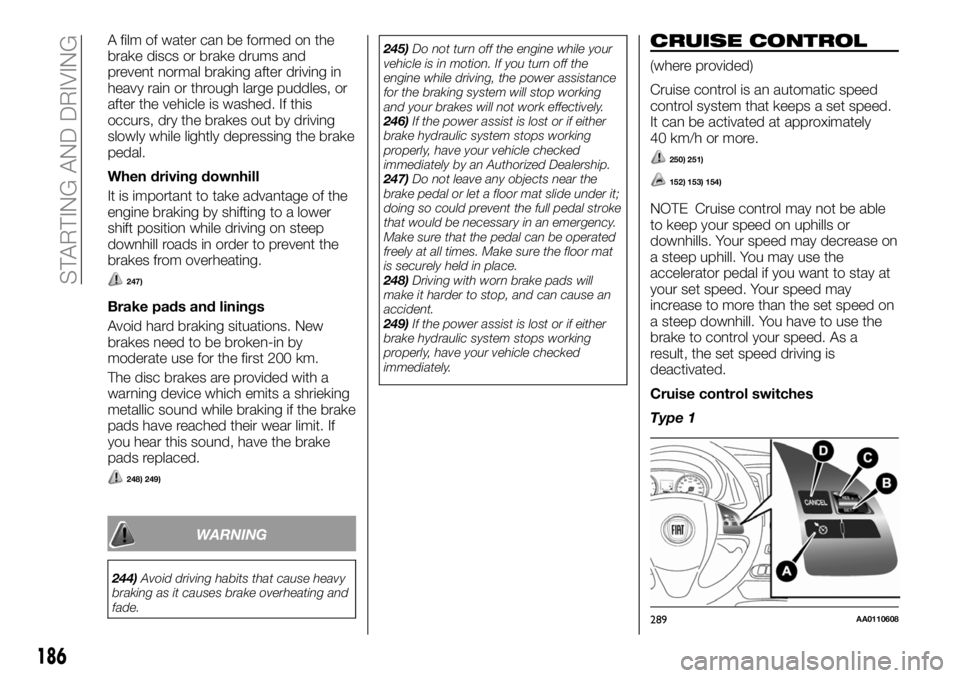
Cruise control switches
Type 1
289AA0110608
186
STARTING AND DRIVING
Page 207 of 316
IN AN EMERGENCY
A punctured tyre or a burnt-out bulb?
At times, a problem may interfere with
our journey.
The pages on emergencies can help
you to deal with critical situations
independently and with calm.
In an emergency we recommend that
you call the freephone number found in
the Warranty Booklet.
It is also possible to call the
00 800 3428 0000 freephone number
to search the nearest Fiat Dealership.ERA GLONASS.............206
IF THE VEHICLE BREAKS DOWN. .210
IF THE OPERATION MODE CANNOT
BE CHANGED TO OFF (VEHICLES
EQUIPPED WITH THE KEYLESS
OPERATION SYSTEM).........211
EMERGENCY STARTING.......211
ENGINE OVERHEATING........212
BLEEDING THE FUEL SYSTEM . . .213
REMOVAL OF WATER FROM THE
FUEL FILTER...............214
TOOLS, JACK AND JACK
HANDLE..................214
HOW TO CHANGE A TYRE.....219
TOWING..................226
OPERATION UNDER ADVERSE
DRIVING CONDITIONS........229
FUSIBLE LINKS.............230
FUSES...................230
REPLACEMENT OF LAMP BULBS .238
205
Page 214 of 316
WARNING
276)To start the engine using jumper
cables from another vehicle, perform the
correct procedures according to the
instruction below. Incorrect procedures
could result in a fire or explosion or
damage to the vehicles.
277)Keep sparks, cigarettes and flames
away from the battery because the battery
may produce an explosion.
278)Do not attempt to start the engine by
pulling or pushing the vehicle. It could
damage your vehicle.
279)Check the other vehicle. It must have
a 12-volt battery. If the other system isn’t
12-volt, shorting can damage both
vehicles.
280)Use the proper cables suitable for the
battery size to prevent overheating of the
cables.
281)Check the jumper cables for damage
and corrosion before use.
282)Always wear protective eye goggles
when working near the battery.
283)Keep the battery out of the reach of
children.
284)Turn off the ignition on both vehicles
beforehand. Make sure that the cables or
your clothes cannot be caught by the fan
or drive belt. Personal injury could result.
285)If electrolyte fluid is not visible, or
appears to be frozen, Do Not Attempt
Jump Starting! A battery might rupture or
explode if the temperature is below the
freezing point or if it is not filled to the
proper level.286)Electrolyte is corrosive diluted
sulphuric acid. If electrolyte (battery acid)
comes into contact with your hands, eyes,
clothes or the painted surface of your
vehicle, it should be thoroughly flushed
with water. If electrolyte gets in your eyes,
flush them with water immediately and
thoroughly, and get prompt medical
attention.
287)Make sure that the connection is
made to the appointed position (shown in
the illustration). If the connection is made
directly to the negative (−) side of the
battery, the inflammable gases generated
from the battery might catch fire and
explode.
288)When connecting the jumper cables,
do not connect the positive (+) cable to the
negative (−) terminal. Otherwise sparks
might cause explosion of the battery.
289)Use care not to get the jumper cable
caught in the cooling fan or other rotating
part in the engine compartment.
290)Keep the engine of the vehicle giving
assistance running.
291)Battery fluid is poisonous and
corrosive: avoid contact with your skin and
eyes. The battery should be charged in a
well ventilated place, away from naked
flames or possible sources of sparks:
danger of explosion and fire.
292)Do not attempt to charge a frozen
battery: it must be thawed first, otherwise it
may explode. If freezing has occurred, the
battery should be checked by skilled
personnel to make sure that the internal
elements are not damaged and that the
body is not cracked, with the risk of leaking
poisonous and corrosive acid.
ENGINE
OVERHEATING
When the engine is overheating,will
blink. If this occurs, take the following
corrective measures:
1. Stop the vehicle in a safe place.
2. Check whether steam is coming from
the engine compartment.
If steam does not come from the engine
compartment: with the engine still
running, raise the bonnet to ventilate
the engine compartment.
NOTE For vehicles equipped with the
Start&Stop system, press the
“Start&Stop OFF” switch to deactivate
the system before stopping the vehicle.
If steam is coming from the engine
compartment: stop the engine, and
when the steam stops, raise the bonnet
to ventilate the engine compartment.
Restart the engine.
293) 294) 295)
3. Confirm that the cooling fan (B) is
turning.
If the cooling fan is turning: after the
high coolant temperature warning has
gone off, stop the engine
If the cooling fan is not turning: stop the
engine immediately and contact a Fiat
dealership for assistance.
212
IN AN EMERGENCY
Page 313 of 316
INDEX
4Wheel drive operation........181
Accessory socket............82
Active safety systems..........139
Air conditioning system.........56
Air purifier..................70
Ashtray....................81
Assist grip..................85
Automatic climate control air
conditioner................63
Automatic transmission.........161
Auxiliary driving system.........142
Battery..................262
Bleeding the fuel system........213
Bottle holder................85
Brake fluid.................259
Capacity.................294
Cargo area.................77
Cargo loads.................77
Catalytic converter............74
Central Door Locks............28
Checking levels..............255
Child restraint...............115
Child restraint system..........118
Child-protection rear doors (Double
cab)....................31
Cigarette lighter..............81
Cleaning the exterior of your vehicle .267Cleaning the interior of your vehicle .266
Clutch fluid................260
Coat hook..................85
Combination headlamps and dipper
switch...................45
Convenient hook.............85
Cruise control...............186
Cup holder.................84
Dead lock system............29
Demanding vehicle use.........254
Diesel particulate filter..........74
Digital clock.................82
Disposal of used battery........303
Doors.....................27
Driving, alcohol and drugs.......147
Easy select 4WD............166
Economical driving...........146
Electric window control.........72
Electrical system.............292
Electronic immobilizer..........13
Emergency starting...........211
Emission..................300
Engine compartment...........76
Engine coolant..............257
Engine oil.................256
Engine overheating...........212
Engine specifications..........278
Engine switch...............25
Era Glonass................206External Lights...............45
Fluids and Lubricants.........297
Fog lamp switch..............48
Force limiter................113
Front seats.................33
Fuel consumption............300
Fuel selection................87
Fuses....................230
Fusible links................230
General maintenance.........265
Graphical index...............9
Handling of 4 wheel drive vehicles .184
Hazard warning flasher switch.....48
Head restraints...............36
Headlamp levelling switch........47
Heater/Manual air conditioning.....60
High Load System.............77
Horn switch.................40
How to change a tyre..........219
If the operation mode cannot be
changed to OFF...........211
If the vehicle breaks down.......210
Ignition switch...............24
Important operation tips for the air
conditioning...............69
Inside rear view mirror..........41
Instruments.................92
Interior features..............80
Interior lamps................51