washer fluid FIAT FULLBACK 2018 Owner handbook (in English)
[x] Cancel search | Manufacturer: FIAT, Model Year: 2018, Model line: FULLBACK, Model: FIAT FULLBACK 2018Pages: 316, PDF Size: 10.52 MB
Page 57 of 316
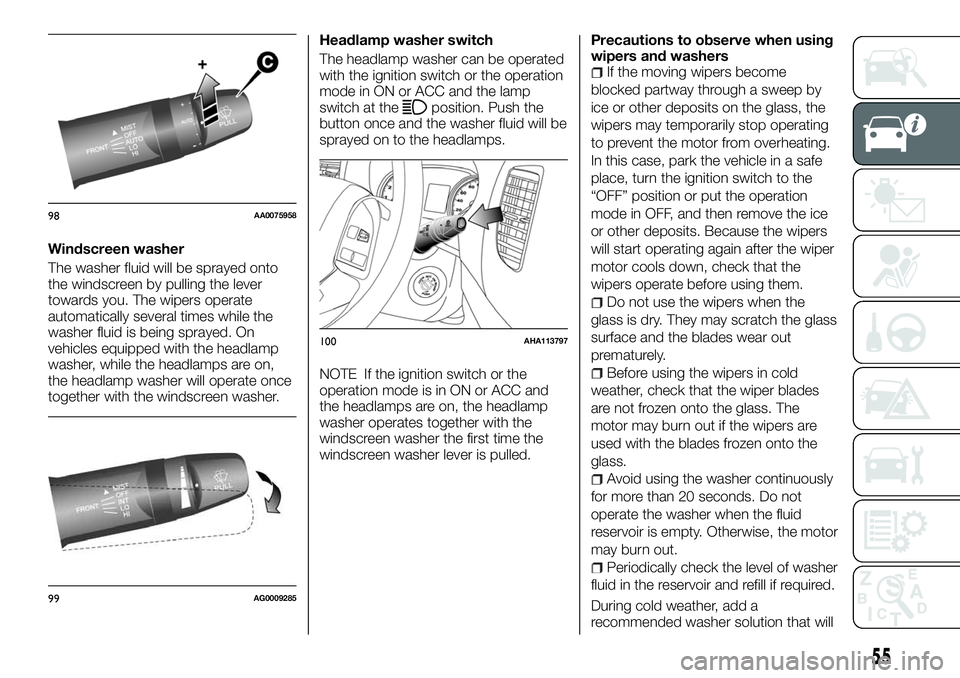
Windscreen washer
The washer fluid will be sprayed onto
the windscreen by pulling the lever
towards you. The wipers operate
automatically several times while the
washer fluid is being sprayed. On
vehicles equipped with the headlamp
washer, while the headlamps are on,
the headlamp washer will operate once
together with the windscreen washer.Headlamp washer switch
The headlamp washer can be operated
with the ignition switch or the operation
mode in ON or ACC and the lamp
switch at the
position. Push the
button once and the washer fluid will be
sprayed on to the headlamps.
NOTE If the ignition switch or the
operation mode is in ON or ACC and
the headlamps are on, the headlamp
washer operates together with the
windscreen washer the first time the
windscreen washer lever is pulled.Precautions to observe when using
wipers and washers
If the moving wipers become
blocked partway through a sweep by
ice or other deposits on the glass, the
wipers may temporarily stop operating
to prevent the motor from overheating.
In this case, park the vehicle in a safe
place, turn the ignition switch to the
“OFF” position or put the operation
mode in OFF, and then remove the ice
or other deposits. Because the wipers
will start operating again after the wiper
motor cools down, check that the
wipers operate before using them.
Do not use the wipers when the
glass is dry. They may scratch the glass
surface and the blades wear out
prematurely.
Before using the wipers in cold
weather, check that the wiper blades
are not frozen onto the glass. The
motor may burn out if the wipers are
used with the blades frozen onto the
glass.
Avoid using the washer continuously
for more than 20 seconds. Do not
operate the washer when the fluid
reservoir is empty. Otherwise, the motor
may burn out.
Periodically check the level of washer
fluid in the reservoir and refill if required.
During cold weather, add a
recommended washer solution that will
98AA0075958
99AG0009285
100AHA113797
55
Page 58 of 316
not freeze in the washer reservoir.
Failure to do so could result in loss of
washer function and frost damage to
the system components.
WARNING
63)Do not use the screen wiper to remove
layers of snow or ice from the windscreen.
In such conditions, the windscreen wiper
may be subjected to excessive stress and
the motor cut-out switch, which prevents
operation for a few seconds, may
intervene. If operation is not restored,
contact a Fiat Dealership.
64)Streaks of water may cause
unnecessary blade movements.
65)If the washer is used in cold weather,
the washer fluid sprayed against the glass
may freeze, which may hinder visibility.
Warm the glass with the defroster or rear
window demister before using the washer.
66)With the ignition switch or the
operation mode in ON and the lever in the
“AUTO” position, the wipers may
automatically operate in the situations
described below. If your hands get
trapped, you could suffer injuries or the
wipers could malfunction. Be sure to turn
the ignition switch to the “LOCK” position
or put the operation mode in OFF, or move
lever to the “OFF” position to deactivate
the rain sensor: when cleaning the outside
surface of the windscreen, if you touch or
wipe with a cloth on top of the rain sensor;
when using an automatic car wash; when a
physical shock is applied to the windscreen
or to the rain sensor.
IMPORTANT
21)Do not activate the rain sensor when
washing the car in an automatic car wash.
AIR CONDITIONING
SYSTEM
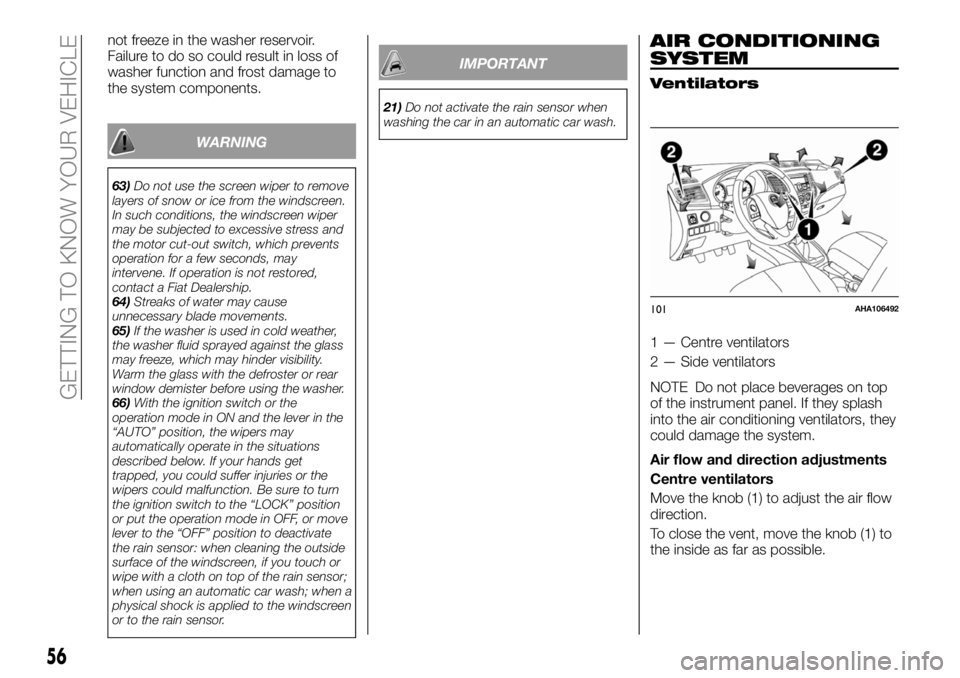
Ventilators
1 — Centre ventilators
2 — Side ventilators
NOTE Do not place beverages on top
of the instrument panel. If they splash
into the air conditioning ventilators, they
could damage the system.
Air flow and direction adjustments
Centre ventilators
Move the knob (1) to adjust the air flow
direction.
To close the vent, move the knob (1) to
the inside as far as possible.
101AHA106492
56
GETTING TO KNOW YOUR VEHICLE
Page 102 of 316
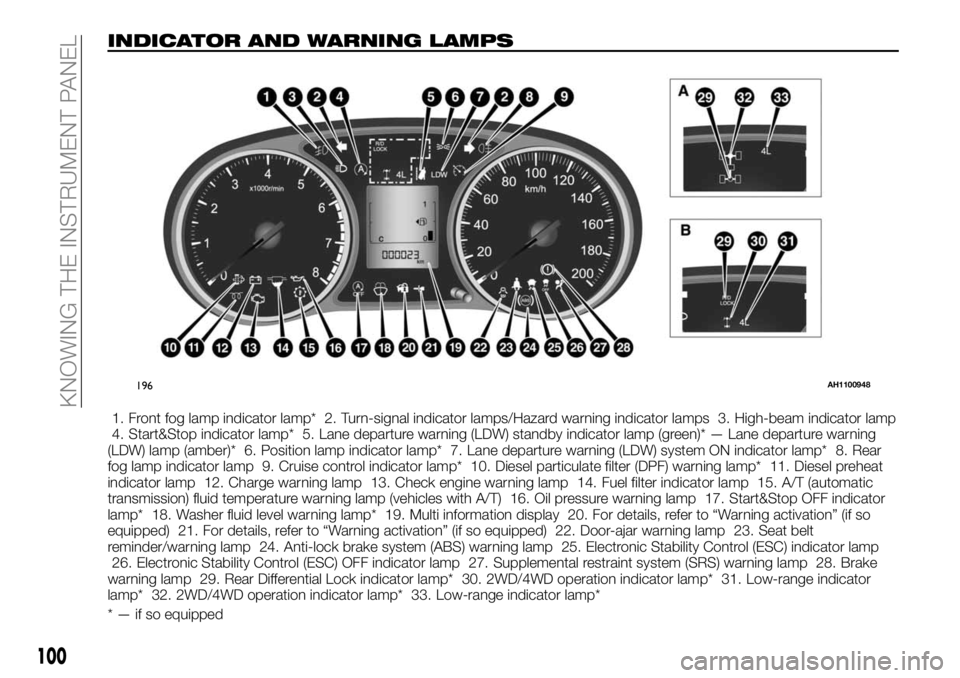
INDICATOR AND WARNING LAMPS
1. Front fog lamp indicator lamp* 2. Turn-signal indicator lamps/Hazard warning indicator lamps 3. High-beam indicator lamp
4. Start&Stop indicator lamp* 5. Lane departure warning (LDW) standby indicator lamp (green)* — Lane departure warning
(LDW) lamp (amber)* 6. Position lamp indicator lamp* 7. Lane departure warning (LDW) system ON indicator lamp* 8. Rear
fog lamp indicator lamp 9. Cruise control indicator lamp* 10. Diesel particulate filter (DPF) warning lamp* 11. Diesel preheat
indicator lamp 12. Charge warning lamp 13. Check engine warning lamp 14. Fuel filter indicator lamp 15. A/T (automatic
transmission) fluid temperature warning lamp (vehicles with A/T) 16. Oil pressure warning lamp 17. Start&Stop OFF indicator
lamp* 18. Washer fluid level warning lamp* 19. Multi information display 20. For details, refer to “Warning activation” (if so
equipped) 21. For details, refer to “Warning activation” (if so equipped) 22. Door-ajar warning lamp 23. Seat belt
reminder/warning lamp 24. Anti-lock brake system (ABS) warning lamp 25. Electronic Stability Control (ESC) indicator lamp
26. Electronic Stability Control (ESC) OFF indicator lamp 27. Supplemental restraint system (SRS) warning lamp 28. Brake
warning lamp 29. Rear Differential Lock indicator lamp* 30. 2WD/4WD operation indicator lamp* 31. Low-range indicator
lamp* 32. 2WD/4WD operation indicator lamp* 33. Low-range indicator lamp*
* — if so equipped
196AH1100948
100
KNOWING THE INSTRUMENT PANEL
Page 107 of 316
Warning lamps What it means
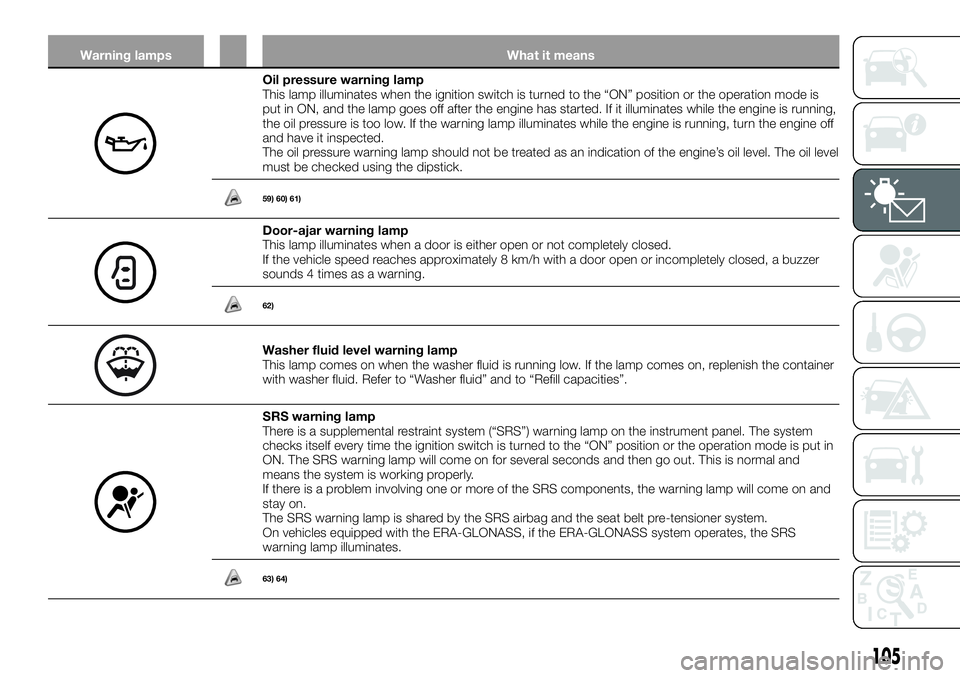
Oil pressure warning lamp
This lamp illuminates when the ignition switch is turned to the “ON” position or the operation mode is
put in ON, and the lamp goes off after the engine has started. If it illuminates while the engine is running,
the oil pressure is too low. If the warning lamp illuminates while the engine is running, turn the engine off
and have it inspected.
The oil pressure warning lamp should not be treated as an indication of the engine’s oil level. The oil level
must be checked using the dipstick.
59) 60) 61)
Door-ajar warning lamp
This lamp illuminates when a door is either open or not completely closed.
If the vehicle speed reaches approximately 8 km/h with a door open or incompletely closed, a buzzer
sounds 4 times as a warning.
62)
Washer fluid level warning lamp
This lamp comes on when the washer fluid is running low. If the lamp comes on, replenish the container
with washer fluid. Refer to “Washer fluid” and to “Refill capacities”.
SRS warning lamp
There is a supplemental restraint system (“SRS”) warning lamp on the instrument panel. The system
checks itself every time the ignition switch is turned to the “ON” position or the operation mode is put in
ON. The SRS warning lamp will come on for several seconds and then go out. This is normal and
means the system is working properly.
If there is a problem involving one or more of the SRS components, the warning lamp will come on and
stay on.
The SRS warning lamp is shared by the SRS airbag and the seat belt pre-tensioner system.
On vehicles equipped with the ERA-GLONASS, if the ERA-GLONASS system operates, the SRS
warning lamp illuminates.
63) 64)
105
Page 249 of 316
SERVICING AND MAINTENANCE
Correct maintenance permits the
performance of the car to be
maintained over time, as well as limited
running costs and safeguarding the
efficiency of the safety systems.
This chapter explains how.SERVICE PRECAUTIONS.......248
SCHEDULED SERVICING PLAN . .249
PERIODIC CHECKS..........254
DEMANDING VEHICLE USE.....254
CHECKING LEVELS..........255
CATALYTIC CONVERTER.......256
ENGINE OIL...............256
ENGINE COOLANT...........257
WASHER FLUID.............259
BRAKE FLUID..............259
CLUTCH FLUID.............260
POWER STEERING FLUID......261
BATTERY.................262
WIPER BLADE REPLACEMENT . . .264
GENERAL MAINTENANCE......265
VEHICLE CARE PRECAUTIONS. . .265
CLEANING THE INTERIOR OF YOUR
VEHICLE.................266
CLEANING THE EXTERIOR OF YOUR
VEHICLE.................267
TYRES...................271
247
Page 256 of 316
PERIODIC CHECKS
Before long journeys, check and, if
necessary, restore:
engine coolant level;
brake fluid level;
windscreen washer fluid level;
operation of lighting system
(headlamps, direction indicators, hazard
warning lights, etc.);
tyre inflation pressure and condition;
tyre alignment;
operation of screen washer/wiper
system and positioning/wear of
windscreen/rear window wiper blades.
To ensure that the vehicle is always
efficient and well maintained, it is
advisable to make sure that you carry
out the above operations regularly
(approximately every 1000 km and
every 3000 km for checking and
topping up engine oil is advisable).
DEMANDING
VEHICLE USE
If the vehicle is mostly used in one of
the following conditions:
towing a trailer or caravan;
dusty roads;
short, repeated journeys (less than
7-8 km) at sub-zero outside
temperatures;
engine often idling or driving long
distances at low speeds or long periods
of inactivity;
the following checks must be carried
out more often than indicated in the
Scheduled Servicing Plan:
check front disc brake pad
conditions and wear;
check cleanliness of bonnet and
boot locks, cleanliness and lubrication
of linkage;
visually inspect conditions of: engine,
gearbox, transmission, pipes and hoses
(exhaust - fuel system - brakes) and
rubber elements (boots - sleeves -
bushes - etc.);
check battery charge and battery
fluid level (electrolyte);
visually inspect condition of the
accessory drive belts;
check and, if necessary, change
engine oil and replace oil filter;
check and, if necessary, replace
pollen filter.
254
SERVICING AND MAINTENANCE
Page 257 of 316
CHECKING LEVELS
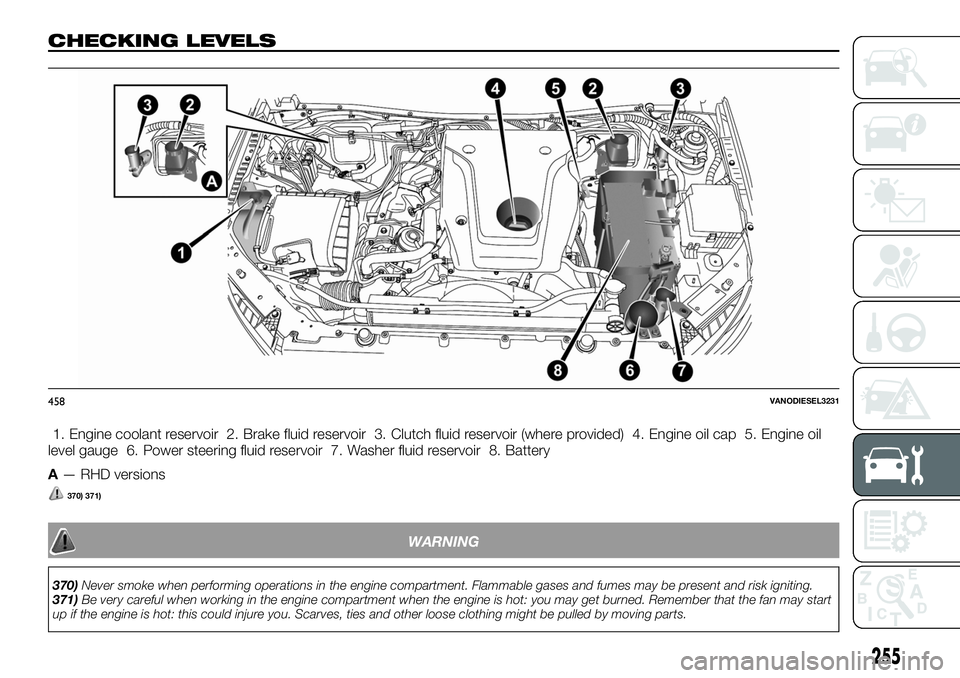
1. Engine coolant reservoir 2. Brake fluid reservoir 3. Clutch fluid reservoir (where provided) 4. Engine oil cap 5. Engine oil
level gauge 6. Power steering fluid reservoir 7. Washer fluid reservoir 8. Battery
A— RHD versions
370) 371)
WARNING
370)Never smoke when performing operations in the engine compartment. Flammable gases and fumes may be present and risk igniting.
371)Be very careful when working in the engine compartment when the engine is hot: you may get burned. Remember that the fan may start
up if the engine is hot: this could injure you. Scarves, ties and other loose clothing might be pulled by moving parts.
458VANODIESEL3231
255
Page 261 of 316
WASHER FLUID
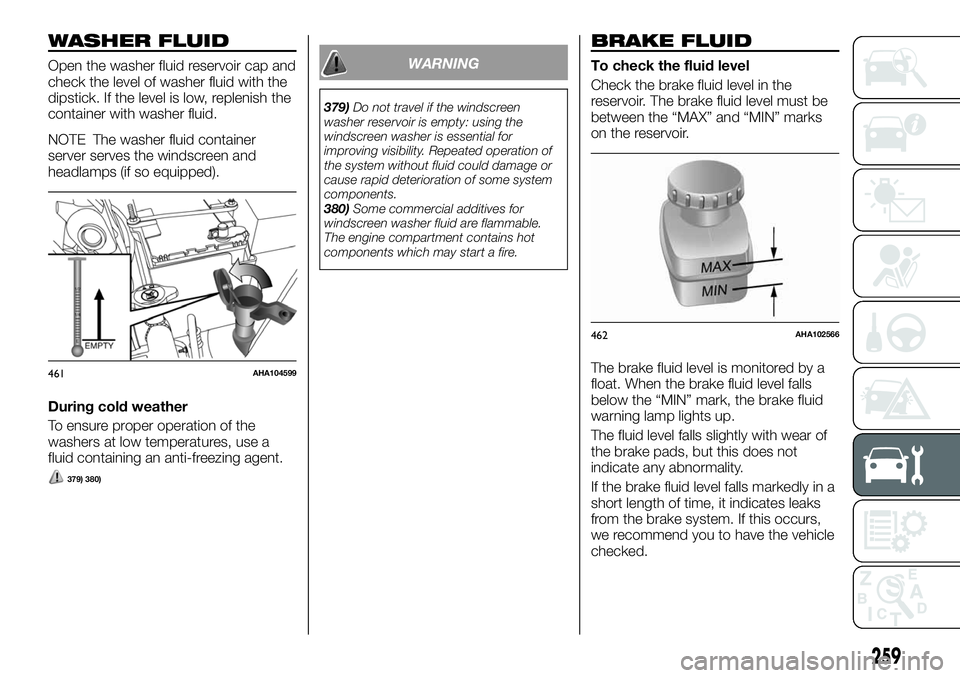
Open the washer fluid reservoir cap and
check the level of washer fluid with the
dipstick. If the level is low, replenish the
container with washer fluid.
NOTE The washer fluid container
server serves the windscreen and
headlamps (if so equipped).
During cold weather
To ensure proper operation of the
washers at low temperatures, use a
fluid containing an anti-freezing agent.
379) 380)
WARNING
379)Do not travel if the windscreen
washer reservoir is empty: using the
windscreen washer is essential for
improving visibility. Repeated operation of
the system without fluid could damage or
cause rapid deterioration of some system
components.
380)Some commercial additives for
windscreen washer fluid are flammable.
The engine compartment contains hot
components which may start a fire.
BRAKE FLUID
To check the fluid level
Check the brake fluid level in the
reservoir. The brake fluid level must be
between the “MAX” and “MIN” marks
on the reservoir.
The brake fluid level is monitored by a
float. When the brake fluid level falls
below the “MIN” mark, the brake fluid
warning lamp lights up.
The fluid level falls slightly with wear of
the brake pads, but this does not
indicate any abnormality.
If the brake fluid level falls markedly in a
short length of time, it indicates leaks
from the brake system. If this occurs,
we recommend you to have the vehicle
checked.
461AHA104599
462AHA102566
259
Page 262 of 316
Fluid type
Use brake fluid conforming to DOT3 or
DOT4. The brake fluid is hygroscopic.
Too much moisture in the brake fluid will
adversely affect the brake system,
reducing the brake performance.
In addition, the brake fluid reservoir is
equipped with a special cap to prevent
the entrance of air, and this cap should
not be removed.
381) 382) 383) 384) 385) 386) 387)
188) 189) 190)
WARNING
381)Take care in handling brake fluid as it
is harmful to the eyes, may irritate your skin
and will damage to painted surfaces. Wipe
up spills immediately. If brake fluid gets on
your hands or in your eyes, flush
immediately with clean water. Follow up
with a doctor as necessary.
382)Some commercial windscreen washer
additives are flammable. The engine
compartment contains hot parts which
could start a fire on contact.
383)Do not travel with the windscreen
washer reservoir empty: the windscreen
washer is essential for improving visibility.
384)The cooling system is pressurised. If
necessary, only replace the plug with
another original one or the operation of the
system may be adversely affected. Do not
remove the reservoir plug when the engine
is hot: risk of burns.385)Use only the specified brake fluid. Do
not mix or add different brand of brake fluid
to prevent chemical reaction. Do not let
any petroleum-based fluid touch, mix with,
or get into the brake fluid. This will damage
the seals.
386)Clean the filler cap before removing
and close the cap securely after
maintenance.
387)Brake fluid is poisonous and highly
corrosive. In the event of accidental
contact, immediately wash the affected
parts with water and mild soap. Then rinse
thoroughly. Call a doctor immediately if
swallowed.
IMPORTANT
188)Keep the reservoir tank cap closed to
prevent the brake fluid from deteriorating
except maintenance.
189)Prevent brake fluid, which is highly
corrosive, from coming into contact with
painted parts. Should it happen,
immediately wash with water.
190)The symbol
, on the brake fluid
container indicates if a brake fluid is
synthetic or mineral-based. Use of mineral
type fluids will damage the special rubber
seals of the braking system beyond repair.
CLUTCH FLUID
(where provided)
To check the fluid level
The clutch fluid in the master cylinder
should be checked when performing
other underhood service. In addition,
the system should be checked for
leakage at the same time.
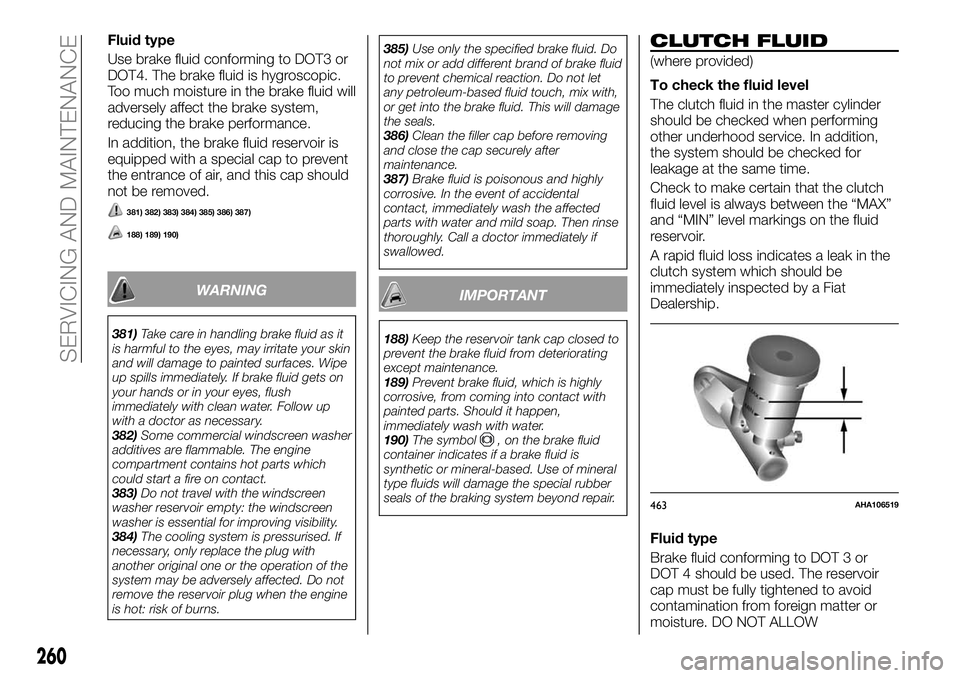
Check to make certain that the clutch
fluid level is always between the “MAX”
and “MIN” level markings on the fluid
reservoir.
A rapid fluid loss indicates a leak in the
clutch system which should be
immediately inspected by a Fiat
Dealership.
Fluid type
Brake fluid conforming to DOT 3 or
DOT 4 should be used. The reservoir
cap must be fully tightened to avoid
contamination from foreign matter or
moisture. DO NOT ALLOW
463AHA106519
260
SERVICING AND MAINTENANCE
Page 271 of 316
40 cm away from the bodywork to
avoid damage or alteration. It should be
remembered that the build up of water
can damage the car over a period of
time.
Wash the bodywork using a low
pressure jet of water.
Use a sponge to wipe a slightly
soapy solution over the bodywork,
frequently rinsing the sponge.
Rinse with plenty of water and dry
with a jet of air or a chamois leather. Dry
the less visible parts with special care,
such as the door frames, bonnet and
the headlight frames, where water may
stagnate more easily. The car should
not be taken to a closed area
immediately, but left outside so that
residual water can evaporate.
Do not wash the car after it has been
parked in the sun.
Exterior plastic parts must be
cleaned in the same way as the rest of
the vehicle.
Where possible, do not park under
trees: the resinous substances that
many species release give the paint a
dull appearance and increase the
possibility of triggering rusting
processes.NOTE Any stains (caused by water) on
the stickers or wrapping can be
removed by dampening the area again
and drying it with a soft, nonabrasive
cloth.
NOTE Bird droppings must be washed
off immediately and thoroughly as the
acid they contain is particularly
aggressive.
NOTE Avoid (if at all possible) parking
the car under trees; remove vegetable
resins immediately as, when dried, it
may only be possible to remove them
with abrasive products and/or polishes,
which is highly inadvisable as they
could alter the paint, the stickers or the
wrapping.
IMPORTANT
202)Avoid washing with rollers and/or
brushes in washing stations. Wash the
vehicle only by hand using neutral pH
detergents; dry it with a wet chamois
leather. Abrasive products and/or polishes
should not be used for cleaning the car.
Bird droppings must be washed off
immediately and thoroughly as the acid
they contain is particularly aggressive.
Avoid (if at all possible) parking the vehicle
under trees; remove vegetable resins
immediately as, when dried, it may only be
possible to remove them with abrasive
products and/or polishes, which is highly
inadvisable as they could alter the typical
opaqueness of the paint. Do not use pure
windscreen washer fluid for cleaning the
front windscreen and rear window; dilute it
min. 50% with water. Only use pure screen
washer fluid when strictly necessary due to
outside temperature conditions.
203)When washing the under side of your
vehicle or wheel, be careful not to injure
your hands.
204)If your vehicle is equipped with the
rear gate spoiler, consult a car wash
operator before using the car wash.
205)If your vehicle has rain sensor wipers,
place the wiper switch lever in the “OFF”
position to deactivate the rain sensor
before washing the vehicle. Otherwise, the
wipers will operate in the presence of water
spray on the windscreen and may get
damaged as a result.
269