warning FIAT FULLBACK 2018 Owner handbook (in English)
[x] Cancel search | Manufacturer: FIAT, Model Year: 2018, Model line: FULLBACK, Model: FIAT FULLBACK 2018Pages: 316, PDF Size: 10.52 MB
Page 110 of 316
57)If the lamp illuminates while the engine
is running, avoid driving at high speeds and
have the system inspected by a Fiat
Dealership as soon as possible. Accelerator
pedal and brake pedal response may be
negatively influenced under these
conditions.
58)If it illuminates while the engine is
running, there is a problem in the charging
system. Immediately park your vehicle in a
safe place and we recommend you to have
it checked.
59)If this lamp illuminates when the engine
oil level is not low, have it inspected.
60)This warning lamp does not indicate
the amount of oil in the crankcase. This
must be determined by checking the oil
level on the dipstick, while the engine is
switched off.
61)If you continue driving with low engine
oil level or with this warning lamp
illuminated, engine seizure may occur.
62)Before moving your vehicle, check that
the warning lamp is OFF.
63)If any of the following conditions occur,
there may be a problem with the SRS
airbags and/or seat belt pre-tensioners,
and they may not function properly in a
collision or may suddenly activate without a
collision: 1 – Even when the ignition switch
or the operation mode is in ON, the SRS
warning lamp does not come on or it
remains on. 2 – The SRS warning lamp
comes on while driving.
64)The SRS airbags and seat belt
pre-tensioners are designed to help reduce
the risk of serious injury or death in certain
collisions. If either of the above conditions
occurs, immediately have your vehicle
checked by a Fiat Dealership.65)Any of the following indicates that the
ABS is not functioning and only the
standard brake system is working. (The
standard brake system is functioning
normally.) If this happens, take your vehicle
to a Fiat Dealership.
66)When the ignition switch is turned to
the “ON” position or the operation mode is
put in ON, the warning lamp does not
come on or it remains on and does not go
off . The warning lamp comes on while
driving.
108
KNOWING THE INSTRUMENT PANEL
Page 113 of 316
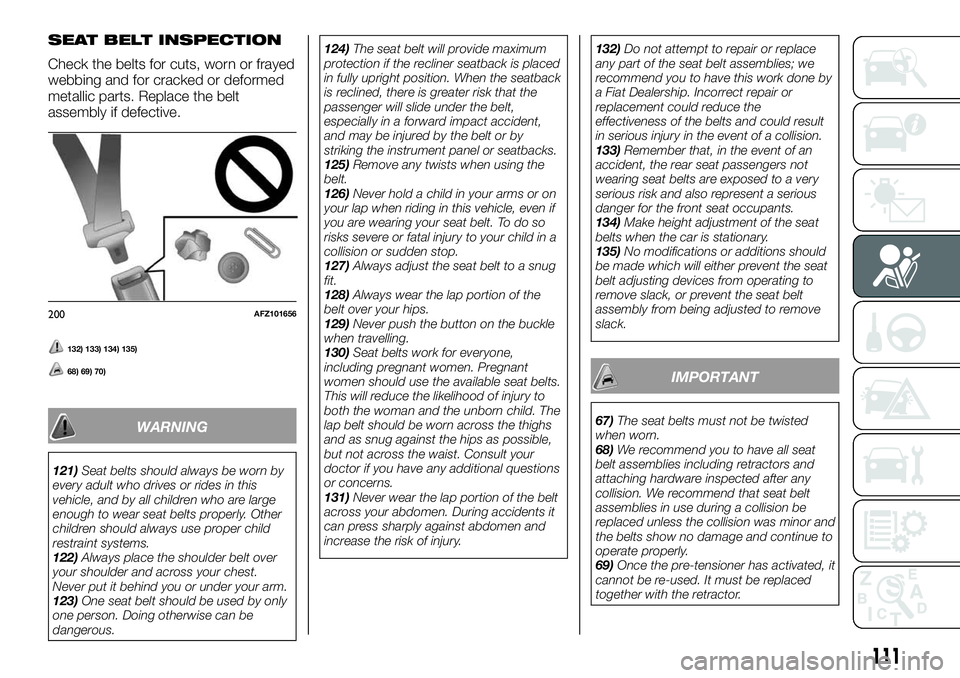
SEAT BELT INSPECTION
Check the belts for cuts, worn or frayed
webbing and for cracked or deformed
metallic parts. Replace the belt
assembly if defective.
132) 133) 134) 135)
68) 69) 70)
WARNING
121)Seat belts should always be worn by
every adult who drives or rides in this
vehicle, and by all children who are large
enough to wear seat belts properly. Other
children should always use proper child
restraint systems.
122)Always place the shoulder belt over
your shoulder and across your chest.
Never put it behind you or under your arm.
123)One seat belt should be used by only
one person. Doing otherwise can be
dangerous.124)The seat belt will provide maximum
protection if the recliner seatback is placed
in fully upright position. When the seatback
is reclined, there is greater risk that the
passenger will slide under the belt,
especially in a forward impact accident,
and may be injured by the belt or by
striking the instrument panel or seatbacks.
125)Remove any twists when using the
belt.
126)Never hold a child in your arms or on
your lap when riding in this vehicle, even if
you are wearing your seat belt. To do so
risks severe or fatal injury to your child in a
collision or sudden stop.
127)Always adjust the seat belt to a snug
fit.
128)Always wear the lap portion of the
belt over your hips.
129)Never push the button on the buckle
when travelling.
130)Seat belts work for everyone,
including pregnant women. Pregnant
women should use the available seat belts.
This will reduce the likelihood of injury to
both the woman and the unborn child. The
lap belt should be worn across the thighs
and as snug against the hips as possible,
but not across the waist. Consult your
doctor if you have any additional questions
or concerns.
131)Never wear the lap portion of the belt
across your abdomen. During accidents it
can press sharply against abdomen and
increase the risk of injury.132)Do not attempt to repair or replace
any part of the seat belt assemblies; we
recommend you to have this work done by
a Fiat Dealership. Incorrect repair or
replacement could reduce the
effectiveness of the belts and could result
in serious injury in the event of a collision.
133)Remember that, in the event of an
accident, the rear seat passengers not
wearing seat belts are exposed to a very
serious risk and also represent a serious
danger for the front seat occupants.
134)Make height adjustment of the seat
belts when the car is stationary.
135)No modifications or additions should
be made which will either prevent the seat
belt adjusting devices from operating to
remove slack, or prevent the seat belt
assembly from being adjusted to remove
slack.
IMPORTANT
67)The seat belts must not be twisted
when worn.
68)We recommend you to have all seat
belt assemblies including retractors and
attaching hardware inspected after any
collision. We recommend that seat belt
assemblies in use during a collision be
replaced unless the collision was minor and
the belts show no damage and continue to
operate properly.
69)Once the pre-tensioner has activated, it
cannot be re-used. It must be replaced
together with the retractor.
200AFZ101656
111
Page 114 of 316
70)Do not insert any foreign objects
(pieces of plastic, paper clips, buttons, etc.)
in the buckle or retractor mechanism
fig. 200. In addition, do not modify, remove,
or install the seat belt. Otherwise, the seat
belt may not be able to provide adequate
protection in a collision or other situation.
71)A dirty belt should be cleaned with
neutral detergent in warm water. After
rinsing in water, let it dry in the shade. Do
not attempt to bleach or re-dye the belts
because this affects their characteristics.SBR SYSTEM
Seat belt reminder
For the driver and the front
passenger’s seat (where provided)
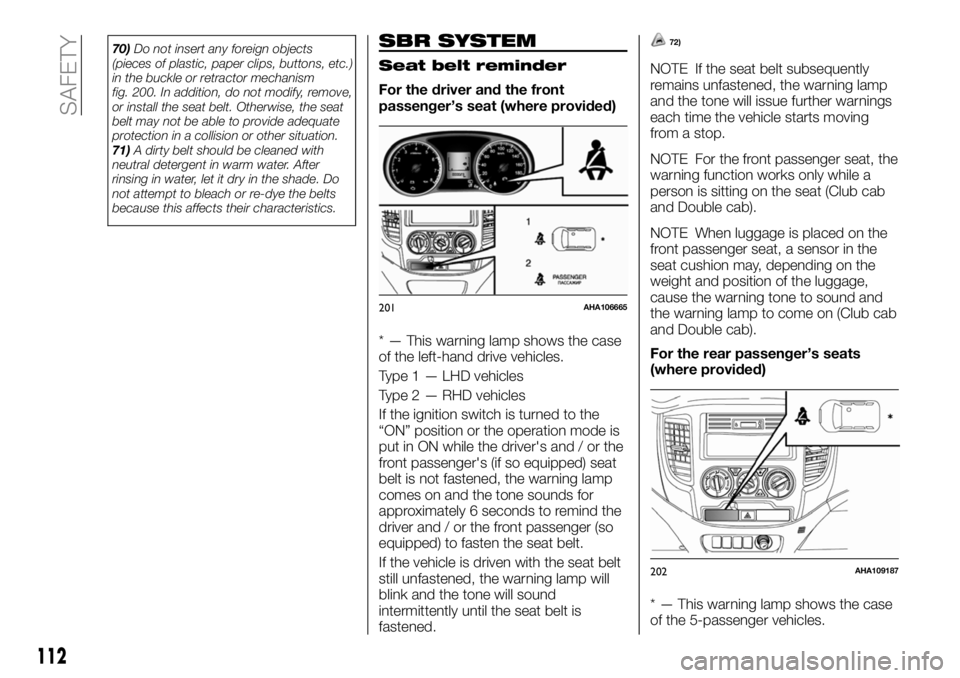
* — This warning lamp shows the case
of the left-hand drive vehicles.
Type 1 — LHD vehicles
Type 2 — RHD vehicles
If the ignition switch is turned to the
“ON” position or the operation mode is
put in ON while the driver's and / or the
front passenger's (if so equipped) seat
belt is not fastened, the warning lamp
comes on and the tone sounds for
approximately 6 seconds to remind the
driver and / or the front passenger (so
equipped) to fasten the seat belt.
If the vehicle is driven with the seat belt
still unfastened, the warning lamp will
blink and the tone will sound
intermittently until the seat belt is
fastened.
72)
NOTE If the seat belt subsequently
remains unfastened, the warning lamp
and the tone will issue further warnings
each time the vehicle starts moving
from a stop.
NOTE For the front passenger seat, the
warning function works only while a
person is sitting on the seat (Club cab
and Double cab).
NOTE When luggage is placed on the
front passenger seat, a sensor in the
seat cushion may, depending on the
weight and position of the luggage,
cause the warning tone to sound and
the warning lamp to come on (Club cab
and Double cab).
For the rear passenger’s seats
(where provided)
* — This warning lamp shows the case
of the 5-passenger vehicles.
201AHA106665
202AHA109187
112
SAFETY
Page 115 of 316
If the ignition switch is turned to the
“ON” position or the operation mode is
put in ON while a seat belt is not
fastened, the warning lamp comes on
for approximately 30 seconds to remind
the rear passenger to fasten the seat
belt.
If the vehicle is driven with the seat belt
still unfastened, the warning lamps
come on for approximately another
30 seconds. (This illumination happens
only the first time the vehicle starts
moving with the seat belt still
unfastened.)
The warning lamps go off when the
seat belt is fastened.
NOTE The warning lamp comes on
even if no one is sitting on the rear
seats.
NOTE If a seat belt is unfastened while
the vehicle is being driven, the tone
sounds for approximately 1 second and
the warning lamp comes on for
approximately 30 seconds. At the same
time, the warning lamp for the seat
where the seat belt is not fastened
comes on.
NOTE If the seat belts are initially
fastened but a seat belt is unfastened
while the vehicle is stationary and the
vehicle is then driven with the seat belt
still unfastened, the warning lamp
comes on again for approximately
30 seconds.Adjustable seat belt anchor (front
seats of Club cab and Double cab)
The seat belt anchor height can be
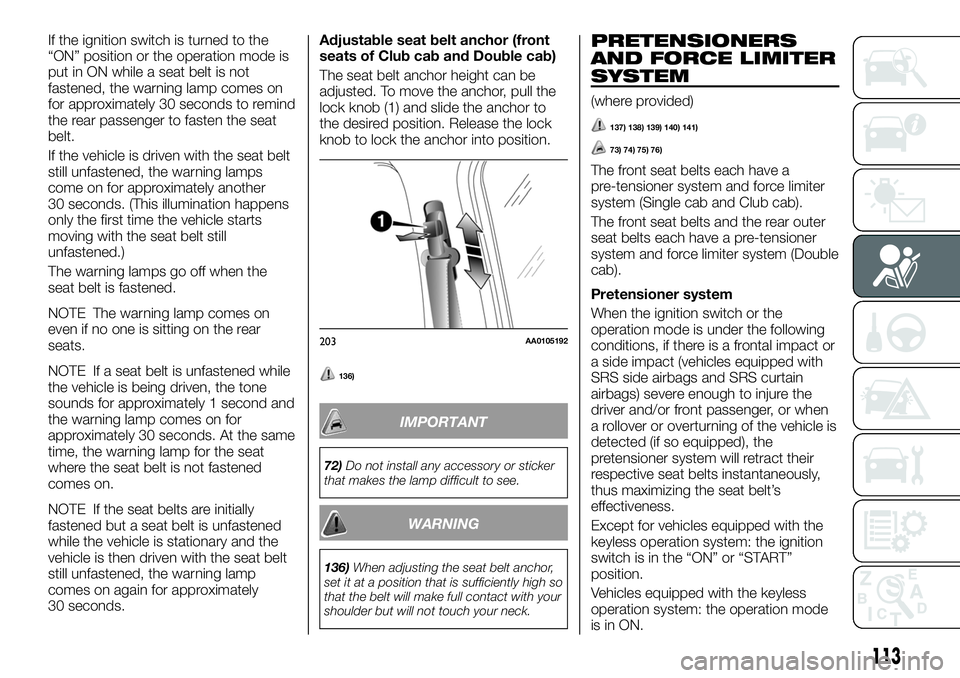
adjusted. To move the anchor, pull the
lock knob (1) and slide the anchor to
the desired position. Release the lock
knob to lock the anchor into position.
136)
IMPORTANT
72)Do not install any accessory or sticker
that makes the lamp difficult to see.
WARNING
136)When adjusting the seat belt anchor,
set it at a position that is sufficiently high so
that the belt will make full contact with your
shoulder but will not touch your neck.
PRETENSIONERS
AND FORCE LIMITER
SYSTEM
(where provided)
137) 138) 139) 140) 141)
73) 74) 75) 76)
The front seat belts each have a
pre-tensioner system and force limiter
system (Single cab and Club cab).
The front seat belts and the rear outer
seat belts each have a pre-tensioner
system and force limiter system (Double
cab).
Pretensioner system
When the ignition switch or the
operation mode is under the following
conditions, if there is a frontal impact or
a side impact (vehicles equipped with
SRS side airbags and SRS curtain
airbags) severe enough to injure the
driver and/or front passenger, or when
a rollover or overturning of the vehicle is
detected (if so equipped), the
pretensioner system will retract their
respective seat belts instantaneously,
thus maximizing the seat belt’s
effectiveness.
Except for vehicles equipped with the
keyless operation system: the ignition
switch is in the “ON” or “START”
position.
Vehicles equipped with the keyless
operation system: the operation mode
is in ON.
203AA0105192
113
Page 116 of 316
NOTE The pretensioner seat belts will
be activated if the vehicle suffers a
severe impact, even if the seat belts are
not worn.
NOTE The pretensioner seat belts are
designed to work only once. After the
pretensioner seat belts have been
activated, we recommend you to have
them replaced by a Fiat Dealership.
SRS warning lamp
This warning lamp is shared by the SRS
airbags and the pre-tensioner seat
belts. Refer to “SRS warning lamp”.
Force limiter system
In the event of a collision, each force
limiter system will effectively absorb the
load applied to the seat belt so as to
minimize the impact to the passenger.
WARNING
137)Each seat belt must be used by only
one person. Never travel with a child sitting
on the passenger's lap and a single belt to
protect them both. In general, do not place
any objects between the person and the
belt.
138)The pretensioner may be used only
once. After it is triggered, have it replaced
at a Fiat Dealership.139)Removing or otherwise tampering
with pretensioner and seat belt
components is strictly prohibited. Any
intervention on these components must be
performed by qualified and authorised
technicians. Always go to a Fiat Dealership.
140)For maximum safety, keep the
backrest upright, lean back into it and
make sure the seat belt fits closely across
your chest and pelvis. Always fasten the
seat belts for both the front and rear seats!
Travelling without wearing seat belts will
increase the risk of serious injury and even
death in the event of an accident.
141)If the belt has been subjected to high
levels of stress, for example after an
accident, it should be changed completely
together with the attachments, attachment
fixing screws and the pretensioner. In fact,
even if the belt has no visible defects, it
may have lost its resilience.
IMPORTANT
73)To obtain the best results from your
pretensioner seat belt, make sure you have
adjusted your seat correctly and wear your
seat belt properly.
74)Installation of audio equipment or
repairs in the vicinity of the pretensioner
seat belts or floor console must be
performed in line with FCA Italy S.p.A.
guidelines. It is important to do so because
the work could affect the pretensioner
systems.75)If you need to scrap the vehicle, please
consult a Fiat Dealership. It is important to
do so because unexpected activation of
the pretensioner seat belts could cause
injuries.
76)Operations which lead to impacts,
vibrations or localised heating (over 100°C
for a maximum of six hours) in the area
around the pretensioners may damage or
accidentally deploy them. Contact a Fiat
Dealership should intervention be
necessary on these components.
114
SAFETY
Page 118 of 316
The child restraint system should be
appropriate for your child’s weight and
height and properly fit the vehicle. For a
higher degree of safety THE CHILD
RESTRAINT SYSTEM SHOULD BE
INSTALLED IN THE REAR SEAT.
Before purchasing a child restraint
system, try installing it in the seat to
make sure there is a good fit. Because
of the location of the seat belt buckles
and the shape of the seat cushion, it
may be difficult to securely install some
manufacturer’s child restraint systems.
If the child restraint system can be
pulled forward or to either side easily on
the seat cushion after the seat belt has
been tightened, choose another
manufacturer’s child restraint system.
161) 162) 163)
NOTE Depending on the seating
position in the vehicle and the child
restraint system that you have, the child
restraint can be attached using one of
the following two locations:
Using the lower anchorage in the
rear seat ONLY if the child restraint has
ISOFIX mountings (Double Cab).
Using the seat belt.
Older children
Children who have outgrown the child
restraint system should be seated in the
rear seat and wear combination lap
shoulder belt. The lap portion of the belt
should be snug and positioned low on
the abdomen so that it is below the top
of the hip-bone. Otherwise, the belt
could intrude into the child’s abdomen
during an accident and cause injury.
WARNING
142)When installing a child restraint
system, refer to the instructions provided
by the manufacturer of the restraint
system. Failure to do so can result in
severe or fatal injury to your child.
143)Follow the instructions for positioning,
fitting and removing which the
manufacturer must supply together with
the child restraint system.
144)It is recommended to fit the child
restraint system according to the
instructions, which must be included.145)Do not place a rearward facing cradle
seat on the front seat if the passenger side
airbag is enabled. Deployment of the
airbag in an accident could cause fatal
injuries to the child regardless of the
severity of the impact. It is advisable to
always carry children in a child restraint
system on the rear seat, which is the most
protected position in the event of a
collision. If you need to carry a child on the
front passenger seat in a rearward facing
cradle seat, the passenger side airbags
(front and side bags for chest/ pelvis
protection, for versions/markets, where
provided) must be deactivated using the
setup menu. It is important to check the
dedicated LED on button on the instrument
panel to make sure that they are actually
deactivated. The passenger seat must also
be positioned back as far as possible in
order to avoid the child restraint system
from coming into contact with the
dashboard.
146)Fit the child restraint system only
when the vehicle is stationary.
147)When possible, put children in the
rear seat. Accident statistics indicate that
children of all sizes and ages are safer
when properly restrained in the rear seat
rather than in the front seat (Club cab and
Double cab).
148)Holding a child in your arms is no
substitute for a restraint system. Failure to
use a proper restraint system can result in
severe or fatal injury to your child.
149)Each child restraint device or fixing is
to be used only by one child.
116
SAFETY
Page 130 of 316
To remove
Remove the child restraint system in
accordance with the instructions
provided by the child restraint system’s
manufacturer.
Installing a child restraint system to
a 3-point type seat belt (with
emergency locking mechanism)
Installation
1. Put a child restraint system on the
seat in which you wish to install it and
remove the head restraint from the seat.
Refer to “Head restraints”.
2. When installing a child restraint
system in the front passenger seat,
adjust seat slide to its most rearward
position.
3. Route the belt through the child
restraint according to the child restraint
system manufacturer’s instructions,
then insert the latch plate into the
buckle.
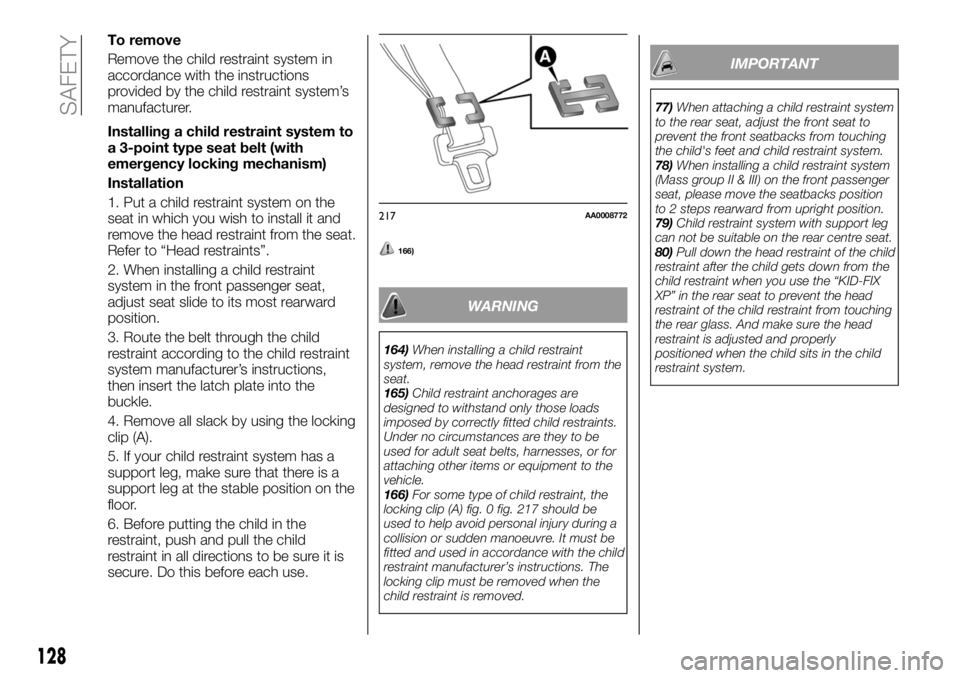
4. Remove all slack by using the locking
clip (A).
5. If your child restraint system has a
support leg, make sure that there is a
support leg at the stable position on the
floor.
6. Before putting the child in the
restraint, push and pull the child
restraint in all directions to be sure it is
secure. Do this before each use.
166)
WARNING
164)When installing a child restraint
system, remove the head restraint from the
seat.
165)Child restraint anchorages are
designed to withstand only those loads
imposed by correctly fitted child restraints.
Under no circumstances are they to be
used for adult seat belts, harnesses, or for
attaching other items or equipment to the
vehicle.
166)For some type of child restraint, the
locking clip (A) fig. 0 fig. 217 should be
used to help avoid personal injury during a
collision or sudden manoeuvre. It must be
fitted and used in accordance with the child
restraint manufacturer’s instructions. The
locking clip must be removed when the
child restraint is removed.
IMPORTANT
77)When attaching a child restraint system
to the rear seat, adjust the front seat to
prevent the front seatbacks from touching
the child's feet and child restraint system.
78)When installing a child restraint system
(Mass group II & III) on the front passenger
seat, please move the seatbacks position
to 2 steps rearward from upright position.
79)Child restraint system with support leg
can not be suitable on the rear centre seat.
80)Pull down the head restraint of the child
restraint after the child gets down from the
child restraint when you use the “KID-FIX
XP” in the rear seat to prevent the head
restraint of the child restraint from touching
the rear glass. And make sure the head
restraint is adjusted and properly
positioned when the child sits in the child
restraint system.
217AA0008772
128
SAFETY
Page 138 of 316
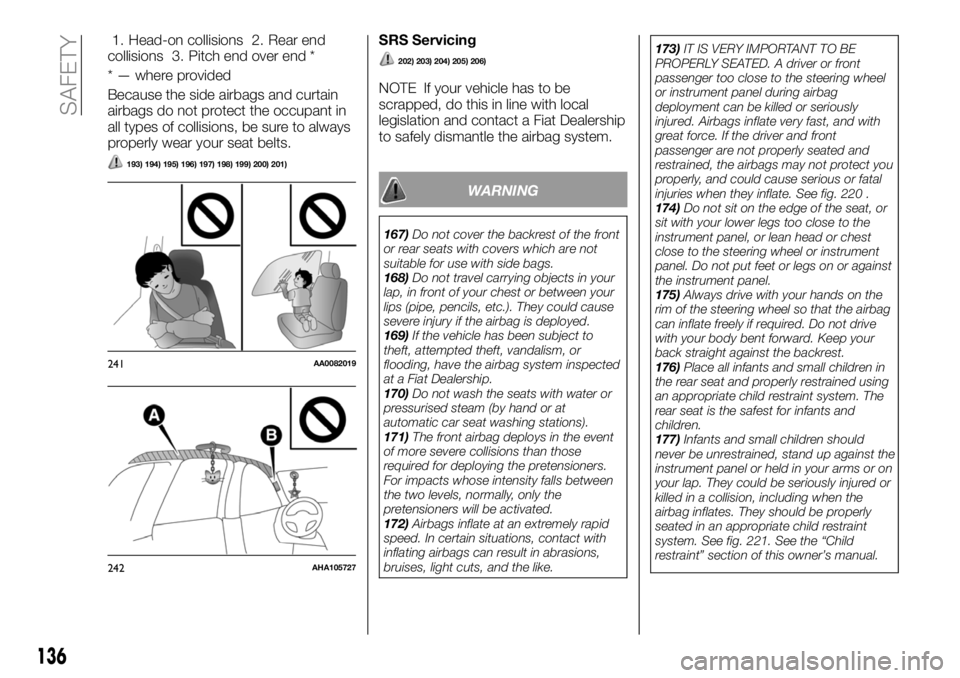
1. Head-on collisions 2. Rear end
collisions 3. Pitch end over end *
* — where provided
Because the side airbags and curtain
airbags do not protect the occupant in
all types of collisions, be sure to always
properly wear your seat belts.
193) 194) 195) 196) 197) 198) 199) 200) 201)
SRS Servicing
202) 203) 204) 205) 206)
NOTE If your vehicle has to be
scrapped, do this in line with local
legislation and contact a Fiat Dealership
to safely dismantle the airbag system.
WARNING
167)Do not cover the backrest of the front
or rear seats with covers which are not
suitable for use with side bags.
168)Do not travel carrying objects in your
lap, in front of your chest or between your
lips (pipe, pencils, etc.). They could cause
severe injury if the airbag is deployed.
169)If the vehicle has been subject to
theft, attempted theft, vandalism, or
flooding, have the airbag system inspected
at a Fiat Dealership.
170)Do not wash the seats with water or
pressurised steam (by hand or at
automatic car seat washing stations).
171)The front airbag deploys in the event
of more severe collisions than those
required for deploying the pretensioners.
For impacts whose intensity falls between
the two levels, normally, only the
pretensioners will be activated.
172)Airbags inflate at an extremely rapid
speed. In certain situations, contact with
inflating airbags can result in abrasions,
bruises, light cuts, and the like.173)IT IS VERY IMPORTANT TO BE
PROPERLY SEATED. A driver or front
passenger too close to the steering wheel
or instrument panel during airbag
deployment can be killed or seriously
injured. Airbags inflate very fast, and with
great force. If the driver and front
passenger are not properly seated and
restrained, the airbags may not protect you
properly, and could cause serious or fatal
injuries when they inflate. See fig. 220 .
174)Do not sit on the edge of the seat, or
sit with your lower legs too close to the
instrument panel, or lean head or chest
close to the steering wheel or instrument
panel. Do not put feet or legs on or against
the instrument panel.
175)Always drive with your hands on the
rim of the steering wheel so that the airbag
can inflate freely if required. Do not drive
with your body bent forward. Keep your
back straight against the backrest.
176)Place all infants and small children in
the rear seat and properly restrained using
an appropriate child restraint system. The
rear seat is the safest for infants and
children.
177)Infants and small children should
never be unrestrained, stand up against the
instrument panel or held in your arms or on
your lap. They could be seriously injured or
killed in a collision, including when the
airbag inflates. They should be properly
seated in an appropriate child restraint
system. See fig. 221. See the “Child
restraint” section of this owner’s manual.
241AA0082019
242AHA105727
136
SAFETY
Page 141 of 316
ACTIVE SAFETY
SYSTEMS
Brake assist system (where
provided)
The brake assist system is a device
assisting drivers who cannot depress
the brake pedal firmly such as in
emergency stop situations and provides
greater braking force.
If the brake pedal is depressed
suddenly, the brakes will be applied
with more force than usual.
207)
NOTE Once the brake assist system is
operational, it maintains great braking
force even if the brake pedal is lightly
released. To stop its operation,
completely remove your foot from the
brake pedal.
NOTE When the brake assist system is
in use while driving, you may feel the
brake pedal attempt to resist, the pedal
moves in small motions in conjunction
with the operation noise, or the vehicle
body and the steering wheel vibrate.
This occurs when the brake assist
system is operating normally and does
not indicate faulty operation. Continue
to depress the brake pedal.
NOTE When the Electronic Stability
Control (ESC) indicator lamp is
illuminated, the brake assist system
may not function.Emergency stop signal system
(where provided)
This is a device that reduces the
possibility of rear end collisions by the
rapid and automatic blinking of the
hazard warning lamps to alert vehicles
approaching from behind during
sudden braking. When the emergency
brake system operates, the hazard
warning indicator lamp in the
instrument cluster blinks rapidly at the
same time.
NOTE Activating condition for the
emergency brake system > It activates
when all of the following conditions are
met.
The vehicle speed is approximately
55 km/h or higher.
The brake pedal has been depressed,
and the system judges that it was sudden
braking from the vehicle deceleration and
the operating condition of the anti-lock
brake system (ABS).
Deactivating condition for the
emergency brake system > It
deactivates when one of the following
conditions is met.
The brake pedal is released.
The hazard warning flasher switch is
pressed.
The system judges that it was not
sudden braking from the vehicle
deceleration and the operating
condition of the anti-lock brake system
(ABS).
Anti-lock brake system (ABS)
(where provided)
The anti-lock brake system (ABS) helps
prevent the wheels from locking up
when braking. This helps maintain
vehicle drivability and steering wheel
handling.
Driving hints
Always keep a safe distance from the
vehicle in front of you. Even if your
vehicle is equipped with the ABS, leave
a greater braking distance when:
Driving on gravel or snow-covered
roads.
Driving with tyre chains installed.
Driving on roads where the road
surface is pitted or has other
differences in surface height.
Driving on uneven road surfaces.
Operation of ABS is not restricted
situations where brakes are applied
suddenly. This system may also prevent
the wheels from locking when you drive
over manholes, steel roadwork plates,
road markings, or any uneven road
surface.
When the ABS is in use, you may feel
the brake pedal pulsation and the
vibrations of the vehicle body and
steering wheel. It may also feel as if the
pedal resists being pressed.
In this situation, simply hold the brake
pedal down firmly. Do not pump the
brake, which will result in reduced
braking performance.
139
Page 142 of 316
An operation noise is emitted from the
engine compartment or feel a shock
from the brake pedal when start driving
immediately after starting the engine.
These are normal sound or operation
that the ABS makes when performing a
self-check. It does not indicate a
malfunction.
The ABS can be used after the vehicle
has reached a speed over
approximately 10 km/h. It stops
working when the vehicle slows below
7 km/h.
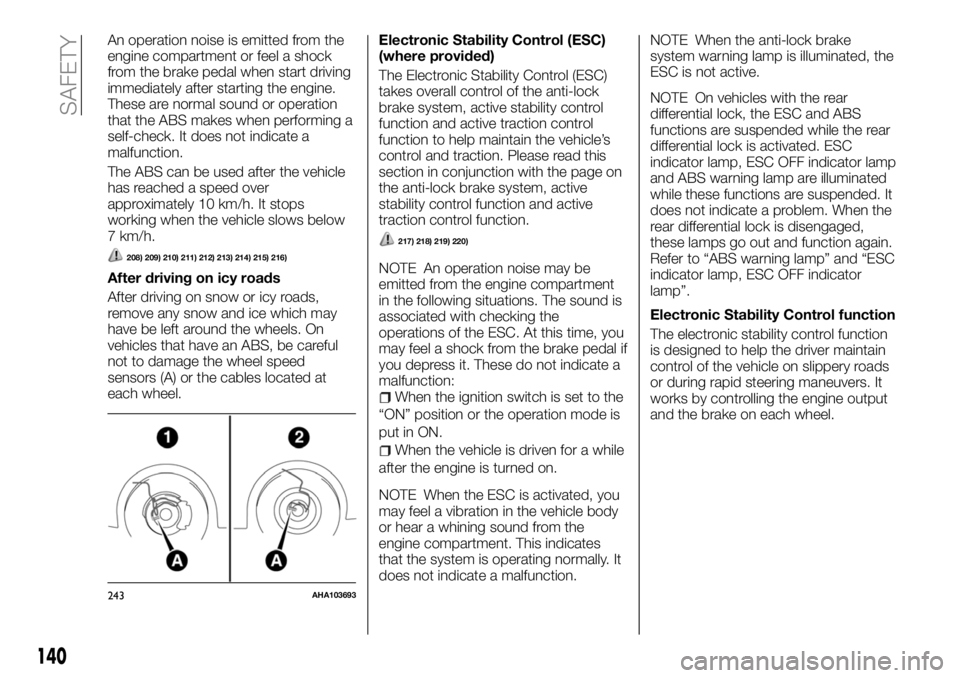
208) 209) 210) 211) 212) 213) 214) 215) 216)
After driving on icy roads
After driving on snow or icy roads,
remove any snow and ice which may
have be left around the wheels. On
vehicles that have an ABS, be careful
not to damage the wheel speed
sensors (A) or the cables located at
each wheel.Electronic Stability Control (ESC)
(where provided)
The Electronic Stability Control (ESC)
takes overall control of the anti-lock
brake system, active stability control
function and active traction control
function to help maintain the vehicle’s
control and traction. Please read this
section in conjunction with the page on
the anti-lock brake system, active
stability control function and active
traction control function.
217) 218) 219) 220)
NOTE An operation noise may be
emitted from the engine compartment
in the following situations. The sound is
associated with checking the
operations of the ESC. At this time, you
may feel a shock from the brake pedal if
you depress it. These do not indicate a
malfunction:
When the ignition switch is set to the
“ON” position or the operation mode is
put in ON.
When the vehicle is driven for a while
after the engine is turned on.
NOTE When the ESC is activated, you
may feel a vibration in the vehicle body
or hear a whining sound from the
engine compartment. This indicates
that the system is operating normally. It
does not indicate a malfunction.NOTE When the anti-lock brake
system warning lamp is illuminated, the
ESC is not active.
NOTE On vehicles with the rear
differential lock, the ESC and ABS
functions are suspended while the rear
differential lock is activated. ESC
indicator lamp, ESC OFF indicator lamp
and ABS warning lamp are illuminated
while these functions are suspended. It
does not indicate a problem. When the
rear differential lock is disengaged,
these lamps go out and function again.
Refer to “ABS warning lamp” and “ESC
indicator lamp, ESC OFF indicator
lamp”.
Electronic Stability Control function
The electronic stability control function
is designed to help the driver maintain
control of the vehicle on slippery roads
or during rapid steering maneuvers. It
works by controlling the engine output
and the brake on each wheel.
243AHA103693
140
SAFETY