oil temperature FIAT FULLBACK 2018 Owner handbook (in English)
[x] Cancel search | Manufacturer: FIAT, Model Year: 2018, Model line: FULLBACK, Model: FIAT FULLBACK 2018Pages: 316, PDF Size: 10.52 MB
Page 77 of 316
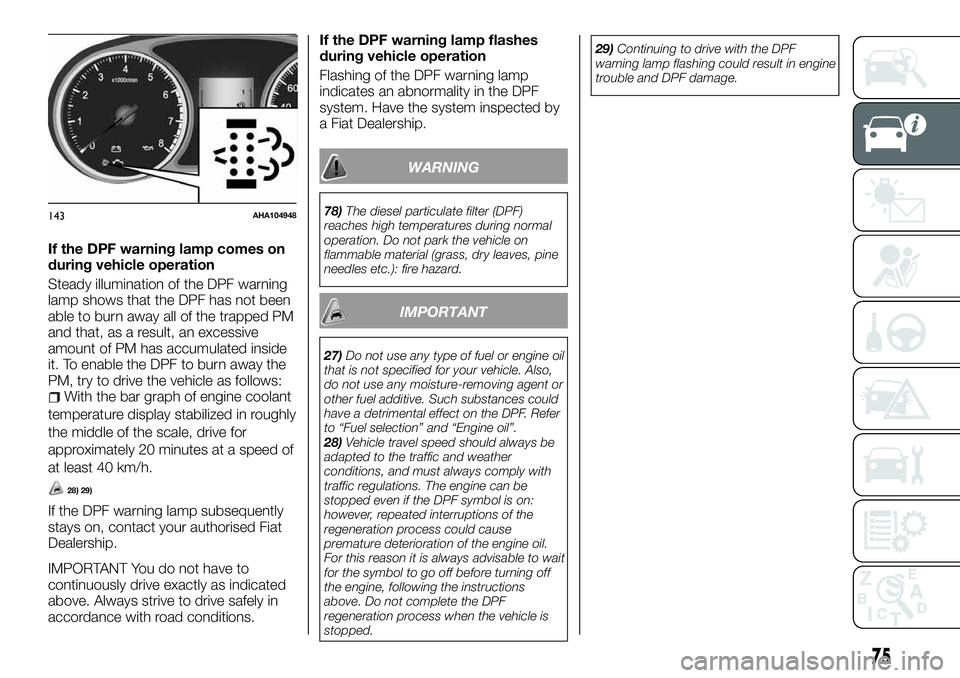
If the DPF warning lamp comes on
during vehicle operation
Steady illumination of the DPF warning
lamp shows that the DPF has not been
able to burn away all of the trapped PM
and that, as a result, an excessive
amount of PM has accumulated inside
it. To enable the DPF to burn away the
PM, try to drive the vehicle as follows:
With the bar graph of engine coolant
temperature display stabilized in roughly
the middle of the scale, drive for
approximately 20 minutes at a speed of
at least 40 km/h.
28) 29)
If the DPF warning lamp subsequently
stays on, contact your authorised Fiat
Dealership.
IMPORTANT You do not have to
continuously drive exactly as indicated
above. Always strive to drive safely in
accordance with road conditions.If the DPF warning lamp flashes
during vehicle operation
Flashing of the DPF warning lamp
indicates an abnormality in the DPF
system. Have the system inspected by
a Fiat Dealership.
WARNING
78)The diesel particulate filter (DPF)
reaches high temperatures during normal
operation. Do not park the vehicle on
flammable material (grass, dry leaves, pine
needles etc.): fire hazard.
IMPORTANT
27)Do not use any type of fuel or engine oil
that is not specified for your vehicle. Also,
do not use any moisture-removing agent or
other fuel additive. Such substances could
have a detrimental effect on the DPF. Refer
to “Fuel selection” and “Engine oil”.
28)Vehicle travel speed should always be
adapted to the traffic and weather
conditions, and must always comply with
traffic regulations. The engine can be
stopped even if the DPF symbol is on:
however, repeated interruptions of the
regeneration process could cause
premature deterioration of the engine oil.
For this reason it is always advisable to wait
for the symbol to go off before turning off
the engine, following the instructions
above. Do not complete the DPF
regeneration process when the vehicle is
stopped.29)Continuing to drive with the DPF
warning lamp flashing could result in engine
trouble and DPF damage.
143AHA104948
75
Page 102 of 316
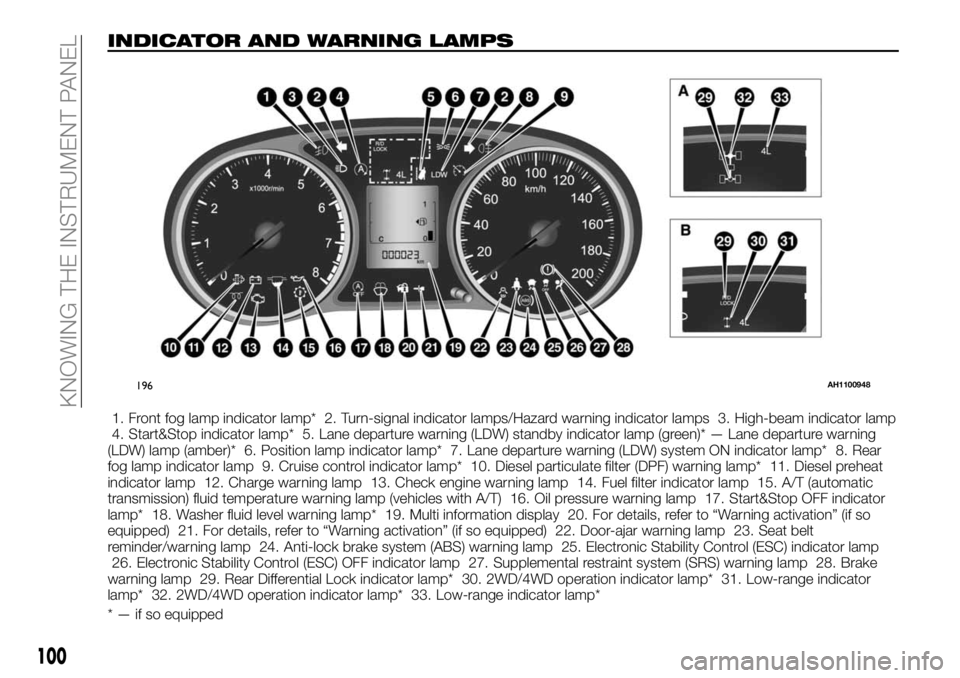
INDICATOR AND WARNING LAMPS
1. Front fog lamp indicator lamp* 2. Turn-signal indicator lamps/Hazard warning indicator lamps 3. High-beam indicator lamp
4. Start&Stop indicator lamp* 5. Lane departure warning (LDW) standby indicator lamp (green)* — Lane departure warning
(LDW) lamp (amber)* 6. Position lamp indicator lamp* 7. Lane departure warning (LDW) system ON indicator lamp* 8. Rear
fog lamp indicator lamp 9. Cruise control indicator lamp* 10. Diesel particulate filter (DPF) warning lamp* 11. Diesel preheat
indicator lamp 12. Charge warning lamp 13. Check engine warning lamp 14. Fuel filter indicator lamp 15. A/T (automatic
transmission) fluid temperature warning lamp (vehicles with A/T) 16. Oil pressure warning lamp 17. Start&Stop OFF indicator
lamp* 18. Washer fluid level warning lamp* 19. Multi information display 20. For details, refer to “Warning activation” (if so
equipped) 21. For details, refer to “Warning activation” (if so equipped) 22. Door-ajar warning lamp 23. Seat belt
reminder/warning lamp 24. Anti-lock brake system (ABS) warning lamp 25. Electronic Stability Control (ESC) indicator lamp
26. Electronic Stability Control (ESC) OFF indicator lamp 27. Supplemental restraint system (SRS) warning lamp 28. Brake
warning lamp 29. Rear Differential Lock indicator lamp* 30. 2WD/4WD operation indicator lamp* 31. Low-range indicator
lamp* 32. 2WD/4WD operation indicator lamp* 33. Low-range indicator lamp*
* — if so equipped
196AH1100948
100
KNOWING THE INSTRUMENT PANEL
Page 157 of 316
101)If your vehicle is equipped with a
turbocharger, do not stop the engine
immediately after high-speed or uphill
driving. First allow the engine to idle to give
the turbocharger a chance to cool down.
102)It is advisable not to demand
maximum performance from your vehicle
(e.g. excessive acceleration, long distances
at high speeds, excessively intense braking,
etc.) during the initial period of use.
103)A quick burst on the accelerator
before turning off the engine serves
absolutely no practical purpose; it wastes
fuel and is especially damaging to
turbocharged engines.
WARNING
231)Never run the engine in a closed or
poorly ventilated area any longer than is
needed to move your vehicle in or out of
the area. Carbon monoxide gases are
odourless and can be fatal.
232)Do not operate the engine switch
while driving except in an emergency. If the
engine is stopped while driving, the brake
servomechanism will cease to function and
braking efficiency will deteriorate. Also, the
power steering system will not function and
it will require greater manual effort to
operate the steering. This could result in a
serious accident.
TURBOCHARGER
OPERATION
(where provided)
Turbocharger
104) 105)
The turbocharger increases engine
power by pushing large amounts of air
into the engine’s cylinders. The finned
parts inside the turbocharger turn at
extremely high speeds and are
subjected to extremely high
temperatures. They are lubricated and
cooled by engine oil. If the engine oil is
not replaced at the specified intervals,
the bearings may seize or emit
abnormal noise.
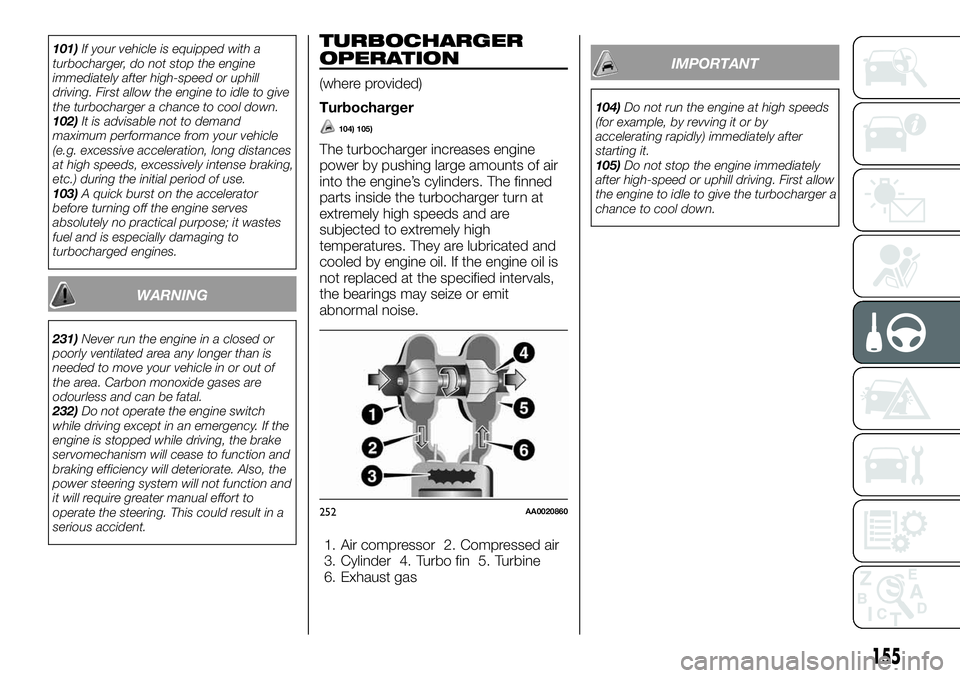
1. Air compressor 2. Compressed air
3. Cylinder 4. Turbo fin 5. Turbine
6. Exhaust gas
IMPORTANT
104)Do not run the engine at high speeds
(for example, by revving it or by
accelerating rapidly) immediately after
starting it.
105)Do not stop the engine immediately
after high-speed or uphill driving. First allow
the engine to idle to give the turbocharger a
chance to cool down.
252AA0020860
155
Page 161 of 316
108)In the following cases, the engine will
restart automatically even if the engine was
stopped by the Start&Stop system. Pay
careful attention, otherwise an unexpected
accident might occur when the engine
restarts.1—Vehicle speed is 3 km/h or
higher when coasting down a slope. 2 —
Brake booster vacuum pressure is low
because the brake pedal is depressed
repeatedly or depressed harder than usual.
3 — Engine coolant temperature is low. 4
— When the air conditioner is operated by
pressing the air conditioning switch. 5 —
When the preset temperature of the air
conditioner is changed significantly. 6 —
When the air conditioner is operated in
AUTO mode where the temperature control
is set to the max. hot or the max. cool (for
vehicles with automatic climate air
conditioning). 7 — When the air conditioner
is ON, the passenger compartment
temperature rises and the air conditioning
compressor operates to lower the
temperature. 8 — Demister switch is
pressed. Refer to “For quick demisting”. 9
— Electric power consumption is high,
such as when the rear window demister or
other electrical components are operating
or the blower speed is set to a high setting.
10 — Battery voltage or battery
performance is low. 11 — Operate the
steering wheel. 12 — Driver’s seat belt is
unfastened. 13 — Driver’s door is opened.MANUAL
TRANSMISSION
(Where provided)
The shift pattern is shown on the
gearshift lever knob. To start off,
depress the clutch pedal all the way
down and shift into 1st or “R” (Reverse)
position. Then operate the gearshift
lever slowly. Afterwards gradually
release the clutch pedal while
depressing the accelerator pedal.
233)
109) 110) 111) 112) 113)
NOTE During cold weather, shifting
may be difficult until the transmission
lubricant has warmed up. This is normal
and not harmful to the transmission.
If it is hard to shift into 1st, depress the
clutch pedal again; the shift will then be
easier to make.
In case of hot weather condition or long
time cruising with high speed, a speed
limitation function may work to restrict
the oil temperature rising of the manual
transmission. After the oil temperature
drops to the appropriate level, the
speed limitation function is cancelled.
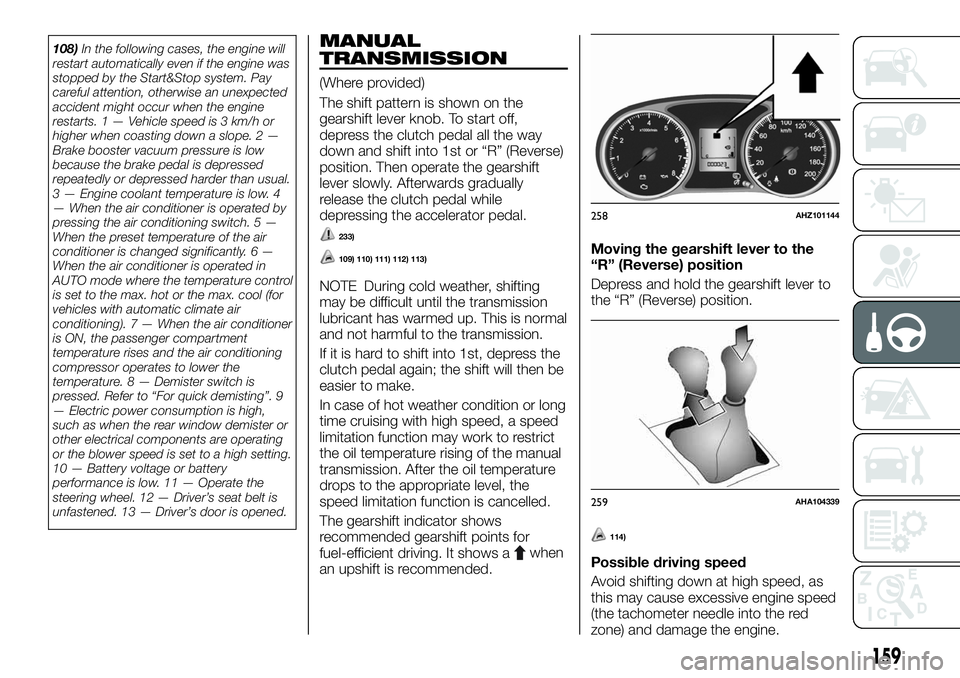
The gearshift indicator shows
recommended gearshift points for
fuel-efficient driving. It shows a
when
an upshift is recommended.Moving the gearshift lever to the
“R” (Reverse) position
Depress and hold the gearshift lever to
the “R” (Reverse) position.
114)
Possible driving speed
Avoid shifting down at high speed, as
this may cause excessive engine speed
(the tachometer needle into the red
zone) and damage the engine.
258AHZ101144
259AHA104339
159
Page 172 of 316
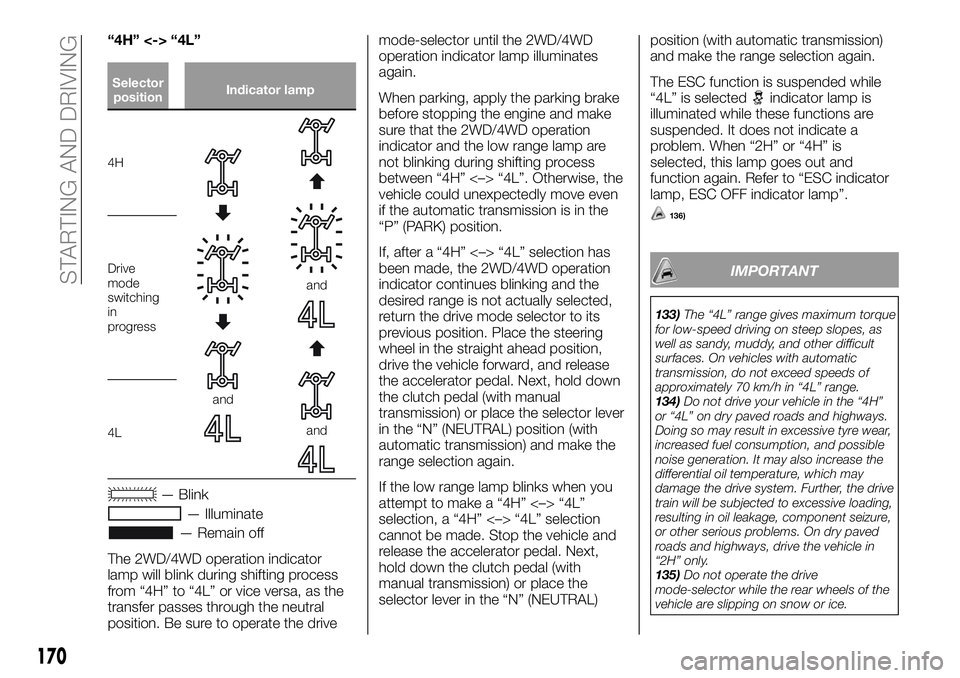
“4H” <-> “4L”
Selector
positionIndicator lamp
4H
and
and
and
Drive
mode
switching
in
progress
4L
— Blink
— Illuminate
— Remain off
The 2WD/4WD operation indicator
lamp will blink during shifting process
from “4H” to “4L” or vice versa, as the
transfer passes through the neutral
position. Be sure to operate the drivemode-selector until the 2WD/4WD
operation indicator lamp illuminates
again.
When parking, apply the parking brake
before stopping the engine and make
sure that the 2WD/4WD operation
indicator and the low range lamp are
not blinking during shifting process
between “4H” <–> “4L”. Otherwise, the
vehicle could unexpectedly move even
if the automatic transmission is in the
“P” (PARK) position.
If, after a “4H” <–> “4L” selection has
been made, the 2WD/4WD operation
indicator continues blinking and the
desired range is not actually selected,
return the drive mode selector to its
previous position. Place the steering
wheel in the straight ahead position,
drive the vehicle forward, and release
the accelerator pedal. Next, hold down
the clutch pedal (with manual
transmission) or place the selector lever
in the “N” (NEUTRAL) position (with
automatic transmission) and make the
range selection again.
If the low range lamp blinks when you
attempt to make a “4H” <–> “4L”
selection, a “4H” <–> “4L” selection
cannot be made. Stop the vehicle and
release the accelerator pedal. Next,
hold down the clutch pedal (with
manual transmission) or place the
selector lever in the “N” (NEUTRAL)position (with automatic transmission)
and make the range selection again.
The ESC function is suspended while
“4L” is selected
indicator lamp is
illuminated while these functions are
suspended. It does not indicate a
problem. When “2H” or “4H” is
selected, this lamp goes out and
function again. Refer to “ESC indicator
lamp, ESC OFF indicator lamp”.
136)
IMPORTANT
133)The “4L” range gives maximum torque
for low-speed driving on steep slopes, as
well as sandy, muddy, and other difficult
surfaces. On vehicles with automatic
transmission, do not exceed speeds of
approximately 70 km/h in “4L” range.
134)Do not drive your vehicle in the “4H”
or “4L” on dry paved roads and highways.
Doing so may result in excessive tyre wear,
increased fuel consumption, and possible
noise generation. It may also increase the
differential oil temperature, which may
damage the drive system. Further, the drive
train will be subjected to excessive loading,
resulting in oil leakage, component seizure,
or other serious problems. On dry paved
roads and highways, drive the vehicle in
“2H” only.
135)Do not operate the drive
mode-selector while the rear wheels of the
vehicle are slipping on snow or ice.
170
STARTING AND DRIVING
Page 179 of 316
NOTE If the low range lamp blinks
when you attempt to make a “4HLc” —
“4LLc” selection, a “4HLc” — “4LLc”
selection cannot be made. Stop the
vehicle and release the accelerator
pedal. Next, hold down the clutch pedal
(with manual transmission) or place the
selector lever in the “N” (NEUTRAL)
position (with automatic transmission)
and make the range selection again.
NOTE The ESC function is suspended
while “4LLc” is selected
indicator
lamp is illuminated while these functions
are suspended. It does not indicate a
problem. When “2H” or “4H” or “4HLc”
is selected, this lamp goes out and
function again. Refer to “ESC indicator
lamp, ESC OFF indicator lamp”.
140)
IMPORTANT
137)The “4LLc” range gives maximum
torque for low-speed driving on steep
slopes, as well as sandy, muddy, and other
difficult surfaces. On vehicles with
automatic transmission, do not exceed
speeds of approximately 70 km/h in “4LLc”
range.
138)Do not drive your vehicle in the
“4HLc” or “4LLc” position on dry paved
roads and highways. Doing so may result in
excessive tyre wear, increased fuel
consumption, and possible noise
generation. It may also increase the
differential oil temperature, which may
damage the drive system. Further, the drive
train will be subjected to excessive loading,
resulting in oil leakage, component seizure,
or other serious problems. On dry paved
roads and highways, drive the vehicle in
“2H” or “4H” only.
139)Do not operate the drive
mode-selector while the rear wheels of the
vehicle are slipping on snow or ice.
140)If a problem is detected in the transfer
system, a safety device will activate. The
front and rear wheel lamps will go out, the
centre differential lock lamp will blink rapidly
(twice per second), and transfer shifting will
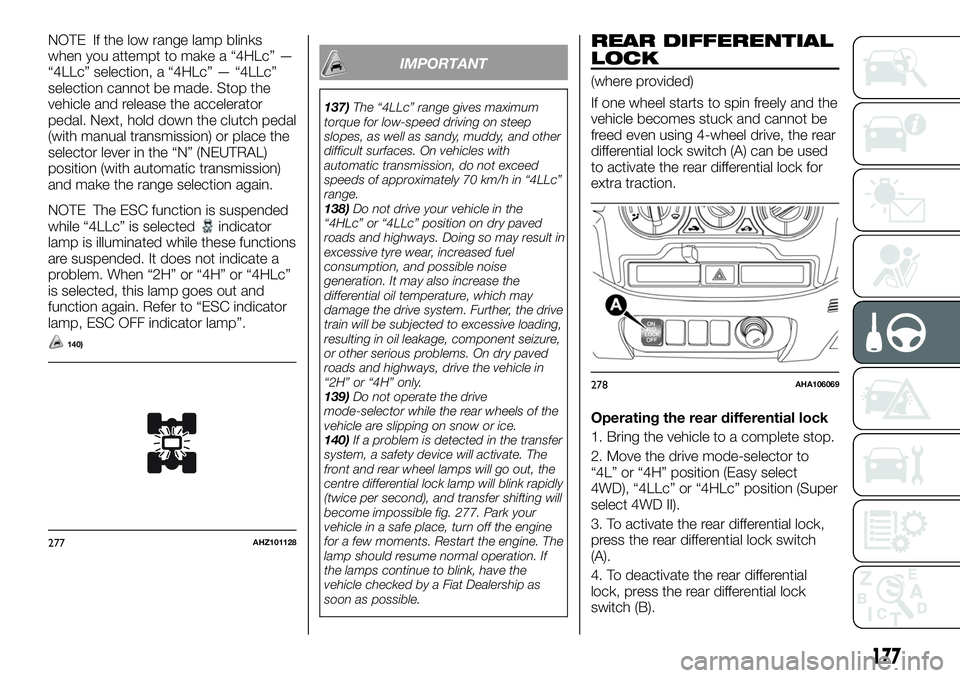
become impossible fig. 277. Park your
vehicle in a safe place, turn off the engine
for a few moments. Restart the engine. The
lamp should resume normal operation. If
the lamps continue to blink, have the
vehicle checked by a Fiat Dealership as
soon as possible.
REAR DIFFERENTIAL
LOCK
(where provided)
If one wheel starts to spin freely and the
vehicle becomes stuck and cannot be
freed even using 4-wheel drive, the rear
differential lock switch (A) can be used
to activate the rear differential lock for
extra traction.
Operating the rear differential lock
1. Bring the vehicle to a complete stop.
2. Move the drive mode-selector to
“4L” or “4H” position (Easy select
4WD), “4LLc” or “4HLc” position (Super
select 4WD II).
3. To activate the rear differential lock,
press the rear differential lock switch
(A).
4. To deactivate the rear differential
lock, press the rear differential lock
switch (B).
277AHZ101128
278AHA106069
177
Page 185 of 316
1 – Check depths of a stream and
geographical features before attempting
to cross a stream and ford the stream
where the water is as shallow as
practicable.
2 – Set the drive mode-selector to “4L”
position (Easy Select 4WD), “4LLc”
position (Super Select 4WD II).
3 – Drive slowly at a speed of
approximately 5 km/h to avoid
splashing too much water.
148) 149)
Inspection and maintenance
following rough road operation
After operating the vehicle in rough road
conditions, be sure to perform the
following inspection and maintenance
procedures:
Check that the vehicle has not been
damaged by rocks, gravel, etc.
Carefully wash the vehicle with water.
Drive the vehicle slowly while lightly
depressing the brake pedal in order to
dry out the brakes. If the brakes still do
not function properly, contact a Fiat
Dealership as soon as possible to have
the brakes checked.
Remove the insects, dried grass, etc.
clogging the radiator core and the A/T
oil cooler.
After crossing a stream, be sure to have
the following items inspected at a Fiat
Dealership and take the necessary
measures:
Check the brake system and, if
necessary, have it serviced.
Check the engine, transmission,
transfer, and differential oil or grease
level and turbidity. If the oil or grease is
milky, it indicates water contamination.
Replace it with new oil or grease.
Grease the propeller shaft.
Check the inside of the vehicle. If
ingress of water is found, dry the carpet
etc.
Inspect the headlamps. If the
headlamp bulb is flooded with water,
have the headlamp drained off.
IMPORTANT
144)Selecting “4H” or “4L” position (Easy
Select 4WD), “4HLc” or “4LLc” position
(Super Select 4WD II) to drive on dry paved
road will increase the fuel consumption with
possible noise generation and early tyre
wear. It may also increase the differential oil
temperature, resulting in possible damage
to the driving system. Further, the drive
train will be subjected to excessive loading,
possibly leading to oil leakage, component
seizure, or other serious faults.
145)Avoid sudden braking, sudden
acceleration, and sharp turning; such
operations could cause skidding and
spinouts.146)Do not force the vehicle or drive
recklessly on sandy surfaces. In
comparison with normal road surfaces, the
engine and other drive-system components
are put under excessive strain when driving
on such a surface, and this could lead to
accidents.
147)If any of following conditions occur
while the vehicle is being driven,
immediately park your vehicle in a safe
place and follow these procedures: the
needle in the temperature gauge
approaches the overheating zone. Refer to
“Engine overheating”; automatic
transmission fluid temperature warning
lamp comes on. Refer to “When the A/T
(automatic transmission) fluid temperature
warning lamp comes on”.
148)Never cross a stream where the water
is deep. Do not change gears while
crossing the stream. Frequent crossing of
streams can adversely affect the life span
of the vehicle; we recommend you to take
the necessary measures to prepare,
inspect, and repair the vehicle.
149)After crossing a stream, apply the
brakes to be sure they are functioning
properly. If the brakes are wet and not
functioning properly, dry them out by
driving slowly while lightly depressing the
brake pedal. Inspect each part of the
vehicle carefully.
183
Page 187 of 316
151)
Jacking up a 4-wheel drive vehicles
243)
Clutch operation
Quick or slight clutch engagement
made while the engine is running at
high speed will cause damage to the
clutch and transmission because the
tractive force is very great. Operate the
pedal slowly and positively.
IMPORTANT
150)Always use tyres of the same size,
same type, and same brand which have no
wear differences. Using the tyres which
differ in size, type, brands or the degree of
wear or the inappropriate tyre inflation
pressure, will increase the differential oil
temperature, resulting in possible damage
to the driving system. Further, the drive
train will be subjected to excessive loading,
possibly leading to oil leakage, component
seizure, or other serious faults.
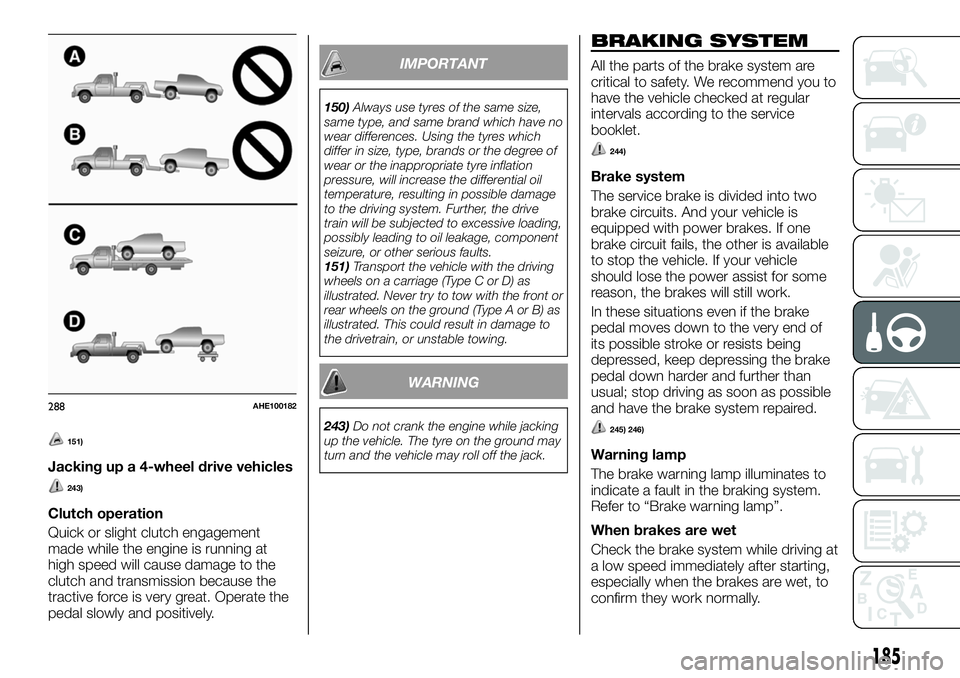
151)Transport the vehicle with the driving
wheels on a carriage (Type C or D) as
illustrated. Never try to tow with the front or
rear wheels on the ground (Type A or B) as
illustrated. This could result in damage to
the drivetrain, or unstable towing.
WARNING
243)Do not crank the engine while jacking
up the vehicle. The tyre on the ground may
turn and the vehicle may roll off the jack.
BRAKING SYSTEM
All the parts of the brake system are
critical to safety. We recommend you to
have the vehicle checked at regular
intervals according to the service
booklet.
244)
Brake system
The service brake is divided into two
brake circuits. And your vehicle is
equipped with power brakes. If one
brake circuit fails, the other is available
to stop the vehicle. If your vehicle
should lose the power assist for some
reason, the brakes will still work.
In these situations even if the brake
pedal moves down to the very end of
its possible stroke or resists being
depressed, keep depressing the brake
pedal down harder and further than
usual; stop driving as soon as possible
and have the brake system repaired.
245) 246)
Warning lamp
The brake warning lamp illuminates to
indicate a fault in the braking system.
Refer to “Brake warning lamp”.
When brakes are wet
Check the brake system while driving at
a low speed immediately after starting,
especially when the brakes are wet, to
confirm they work normally.
288AHE100182
185
Page 204 of 316
the Multi Communication System
(MCS), the Smartphone Link Display
Audio or the DISPLAY AUDIO. When
you move the gearshift lever or the
selector lever to any other position, the
screen will return to its original
indication.
162)
NOTE Because the rear view camera
has a special lens, the lines on the
ground between parking spaces may
not look parallel on the screen.
NOTE In the following situations, the
screen indication may be difficult to see.
There is no abnormality.
Low light (night time)
When the light of the sun or the light
from a vehicle’s headlamps shines
directly into the lens
If a fluorescent light shines directly
into the lens, the screen indication may
be flicker. There is no abnormality.
NOTE If the camera is hot and is then
cooled by rain or a car wash, the lens
can mist up. This phenomenon does
not indicate a malfunction.
NOTE If the atmospheric temperature
is extremely hot or extremely cold, the
rear view camera images may not be
clear. There is no abnormality.NOTE If a radio set is installed near the
camera, the rear view camera images
may cause electrical system
interference and the system may stop
functioning properly.
NOTE It is not possible to fully see
obstacles when the lens is dirty. If the
lens becomes contaminated by water
droplets, snow, mud, or oil, wipe off the
contamination, taking care not to
scratch the lens.
NOTE Please observe the following
cautions. Ignoring them could lead to a
camera malfunction.
Do not subject the camera to
physical shock such as striking it
strongly or throwing a thing.
Do not adhere organic substances,
waxes, oil remover, and glass cleaner to
the camera. If adhered to them,
immediately wipe off.
Do not splash the camera with
boiling water.
Never spray or splash water on the
camera or around it.
Do not disconnect, disassemble or
modify the camera.
Do not scratch the camera, as this
may cause damage to the rear view
camera images.
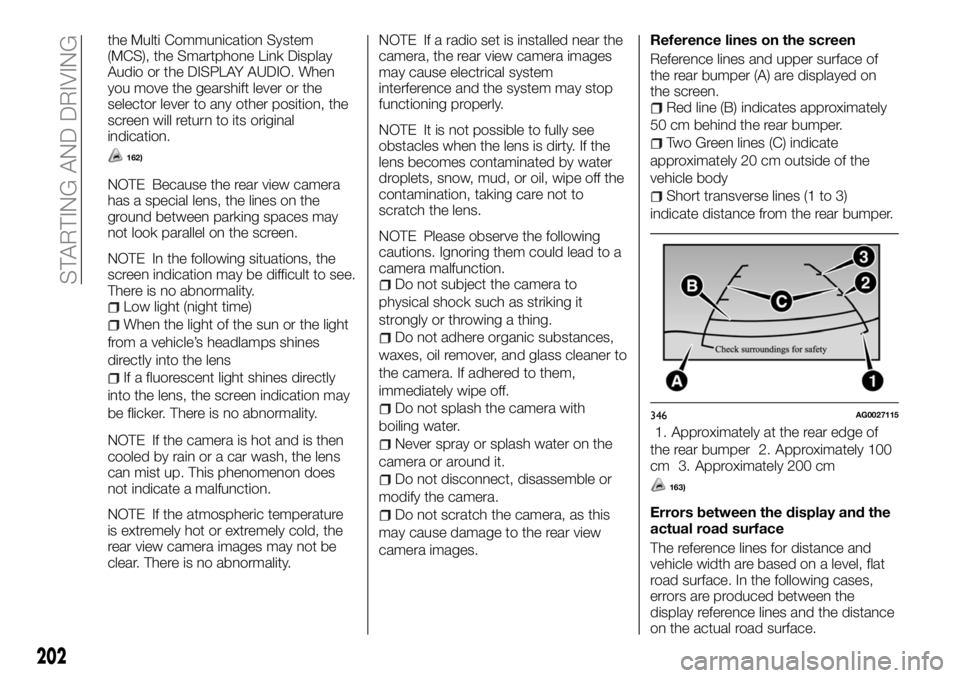
Reference lines on the screen
Reference lines and upper surface of
the rear bumper (A) are displayed on
the screen.
Red line (B) indicates approximately
50 cm behind the rear bumper.
Two Green lines (C) indicate
approximately 20 cm outside of the
vehicle body
Short transverse lines (1 to 3)
indicate distance from the rear bumper.
1. Approximately at the rear edge of
the rear bumper 2. Approximately 100
cm 3. Approximately 200 cm
163)
Errors between the display and the
actual road surface
The reference lines for distance and
vehicle width are based on a level, flat
road surface. In the following cases,
errors are produced between the
display reference lines and the distance
on the actual road surface.
346AG0027115
202
STARTING AND DRIVING
Page 231 of 316
175)If you tow the vehicles with automatic
transmission with the driving wheels on the
ground (Type B) as illustrated, make sure
that the towing speed and distance given
below are never exceeded, causing
damage to the transmission. Towing speed:
30 km/h Towing distance: 80 km For the
towing speed and the towing distance,
follow the local driving laws and
regulations.
176)On vehicles with manual transmission,
do not tow the vehicle with the rear wheels
on the ground (Type B) as illustrated.
177)Never tow an automatic transmission
vehicle with the front wheels up (and the
rear wheels on the ground) (Type B) when
the automatic transmission fluid level is low.
This may cause serious and expensive
damage to the transmission.
178)When the engine is not running, the
brake booster and power steering pump do
not operate. This means higher brake
depression force and higher steering effort
are required. Therefore, vehicle operation is
very difficult.
179)Do not leave the ignition switch in the
“LOCK” position or the operation mode in
OFF. The steering wheel will lock, causing
loss of control.
180)On vehicles with Super Select 4WD II,
when you are going to tow another vehicle,
set the drive mode-selector to “4H”
position. Selecting “2H” drive may increase
the differential oil temperature, resulting in
possible damage to the driving system.
Further, the drive train will be subjected to
excessive loading possibly leading to oil
leakage, component seizure, or other
serious faults.OPERATION UNDER
ADVERSE DRIVING
CONDITIONS
On a flooded road
Avoid flooded roads. In the event
driving flooded roads, doing so may
cause the following serious damage to
the vehicle.
Engine stalling
Short in electrical components
Engine damage caused by water
immersion
After driving flooded roads, be sure to
have an inspection at a Fiat Dealership
and take the necessary measures or
repair.
On a wet road
When driving in rain or on a road with
many puddles a layer of water may
form between the tyres and the road
surface. This reduces a tyre’s frictional
resistance on the road, resulting in loss
of steering stability and braking
capability.
To cope with this, observe the following
items:
(a) Drive your vehicle at a slow speed.
(b) Do not drive on worn tyres.
(c) Always maintain the specified tyre
inflation pressures.On a snow-covered or frozen road
When driving on a snow-covered or
frozen road, it is recommended that you
use snow tyres or snow traction device
(tyre chains). Refer to the “Snow tyres”
and “Snow traction device (tyre chains)”
sections.
Avoid high-speed operation, sudden
acceleration, abrupt brake application
and sharp cornering.
Depressing the brake pedal during
travel on snowy or icy roads may cause
tyre slippage and skidding. When
traction between the tyres and the road
is reduced the wheels may skid and the
vehicle cannot readily be brought to a
stop by conventional braking
techniques. Braking will differ,
depending upon whether you have
anti-lock brake system (ABS). If you do
have ABS, brake by pressing the brake
pedal hard, and keeping it pressed. If
you do not have ABS, pump the brake
pedal with short rapid jabs, each time
fully applying and fully releasing for
greatest effect.
Allow extra distance between your
vehicle and the vehicle in front of you,
and avoid sudden braking.
Accumulation of ice on the braking
system can cause the wheels to lock.
Pull away from a standstill slowly after
confirming safety around the vehicle.
342)
229