ABS FIAT IDEA 2007 1.G User Guide
[x] Cancel search | Manufacturer: FIAT, Model Year: 2007, Model line: IDEA, Model: FIAT IDEA 2007 1.GPages: 314, PDF Size: 4.78 MB
Page 173 of 314
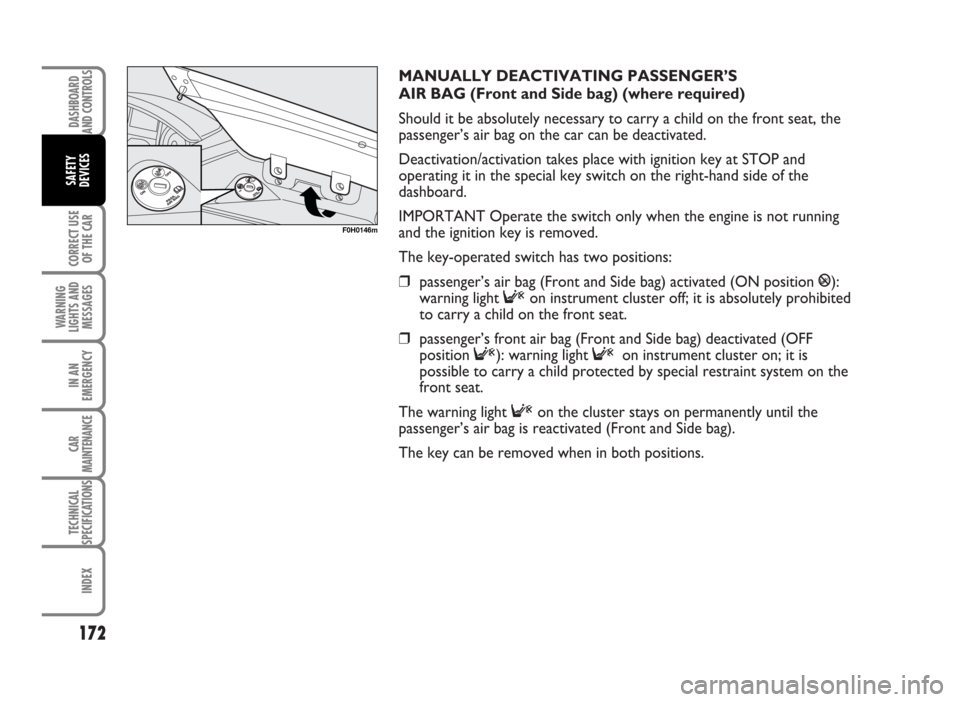
MANUALLY DEACTIVATING PASSENGER’S
AIR BAG (Front and Side bag) (where required)
Should it be absolutely necessary to carry a child on the front seat, the
passenger’s air bag on the car can be deactivated.
Deactivation/activation takes place with ignition key at STOP and
operating it in the special key switch on the right-hand side of the
dashboard.
IMPORTANT Operate the switch only when the engine is not running
and the ignition key is removed.
The key-operated switch has two positions:
❒passenger’s air bag (Front and Side bag) activated (ON position P):
warning light Fon instrument cluster off; it is absolutely prohibited
to carry a child on the front seat.
❒passenger’s front air bag (Front and Side bag) deactivated (OFF
position F): warning light Fon instrument cluster on; it is
possible to carry a child protected by special restraint system on the
front seat.
The warning light Fon the cluster stays on permanently until the
passenger’s air bag is reactivated (Front and Side bag).
The key can be removed when in both positions.
172
CORRECT USE
OF THE CAR
WARNING
LIGHTS AND
MESSAGES
IN AN
EMERGENCY
CAR
MAINTENANCE
TECHNICAL
SPECIFICATIONS
INDEX
DASHBOARD
AND CONTROLS
SAFETY
DEVICES
F0H0146m
Page 179 of 314
ENGINE STARTING
The car is fitted with an electronic engine lock device.
If the engine fails to start, see paragraph “Fiat CODE
system” in section “Dashboard and controls”.
The engine may be noisier than usual during the first
seconds of operation, especially after it has not been
used for a while. This characteristic feature of the
hydraulic tappet system does not compromise
functionality or reliability. The system devised for the
Fiat Idea was designed to limit maintenance
interventions.STARTING PROCEDURE FOR PETROL
VERSIONS
Proceed as follows:
❒Ensure that the handbrake is up;
❒Put the gear lever into neutral;
❒Press the clutch pedal down to the floor without
touching the accelerator;
❒Turn the ignition key to AVV and let it go the
moment the engine starts.
If the engine does not start at the first attempt, return
the ignition key to STOP before repeating starting.
If, when the ignition key is on MAR, warning light
Y
remains lit together with warning light U, turn the
key to STOP and then back to MAR; if the warning
light remains on, try with the other keys provided with
the car.
178
SAFETY
DEVICES
WARNING
LIGHTS AND
MESSAGES
IN AN
EMERGENCY
CAR
MAINTENANCE
TECHNICAL
SPECIFICATIONS
INDEX
DASHBOARD
AND CONTROLS
CORRECT USE
OF THE CAR
We recommend that during the initial period you do not drive to full vehicle performance (e.g.:
excessive acceleration, long journeys at top speed, sharp braking, etc.).
When the engine is switched off never leave the ignition key in the MAR position to prevent
pointless current absorption from draining the battery.
WARNINGRunning the engine in confined areas is extremely dangerous. The engine consumes
oxygen and produces carbon monoxide which is a highly toxic and lethal gas.
Page 181 of 314
HOW TO WARM UP THE ENGINE AFTER IT
HAS JUST STARTED (petrol and Multijet
versions)
Proceed as follows:
❒Drive off slowly, letting the engine turn at medium
revs. Do not accelerate abruptly;
❒Do not drive at full performance for the initial
kilometres. Wait until the coolant temperature
gauge starts moving.
EMERGENCY START-UP
If the instrument panel warning light
Ystays on with
fixed light, the emergency start-up can be performed
by using the CODE card code (see section “In an
emergency”).STOPPING THE ENGINE
Turn the ignition to STOP while the engine is idling.
IMPORTANT After a taxing drive, you should allow
the engine to “catch its breath” before turning it off by
letting it idle to allow the temperature in the engine
compartment to fall.
180
SAFETY
DEVICES
WARNING
LIGHTS AND
MESSAGES
IN AN
EMERGENCY
CAR
MAINTENANCE
TECHNICAL
SPECIFICATIONS
INDEX
DASHBOARD
AND CONTROLS
CORRECT USE
OF THE CAR
Never bump start the engine by pushing, towing or coasting downhill. This could cause fuel to flow
into the catalytic exhaust system and damage it beyond repair.
A quick burst on the accelerator before turning off the engine serves absolutely no practical
purpose, it wastes fuel and is damaging especially to turbocharged engines.
Remember that the servobrake and power steering are not operational until the
engine has been started, therefore much effort than usual is required on the brake
pedal and steering wheel.WARNING
Page 185 of 314
DRIVING STYLE
Starting
Do not warm the engine with the car at a standstill or
at idle or high speed: under these conditions the
engine warms up much more slowly, increasing
electrical consumption and emissions. It is therefore
advisable to move off immediately, slowly, avoiding
high speeds. This way the engine will warm faster.
Unnecessary actions
Avoid accelerating when waiting at traffic lights or
before switching off the engine. This and also double
declutching is absolutely pointless on modern cars and
also increase consumption and pollution.
Gear selection
As soon as the conditions of the traffic and road allow,
use a higher gear. Using a low gear to obtain brilliant
performance increases consumption.
In the same way improper use of a high gear increases
consumption, emissions an engine wear.
Top speed
Fuel consumption considerably increases with speed.
Keep speed as constant as possible, avoid superfluous
braking and accelerating, which cost in terms of both
fuel and emissions. Acceleration
Accelerating violently increasing the revs will greatly
affect consumption and emissions: acceleration should
be gradual and should not exceed the maximum
torque.
CONDITIONS OF USE
Cold starting
Short journeys and frequent cold starts do not allow
the engine to reach optimum operating temperature.
This results in a significant increase in consumption
levels (from +15 to +30% on the urban cycle) and
emission of harmful substances.
Traffic situations and road conditions
Rather high consumption levels are tied to situations
with heavy traffic, for example in queues with frequent
use of the lower gears or in cities with many traffic
lights. Also winding mountain roads and rough road
surfaces adversely affect consumption.
Traffic hold-ups
During prolonged hold-ups (e.g.: level crossings) the
engine should be switched off.
184
SAFETY
DEVICES
WARNING
LIGHTS AND
MESSAGES
IN AN
EMERGENCY
CAR
MAINTENANCE
TECHNICAL
SPECIFICATIONS
INDEX
DASHBOARD
AND CONTROLS
CORRECT USE
OF THE CAR
Page 186 of 314
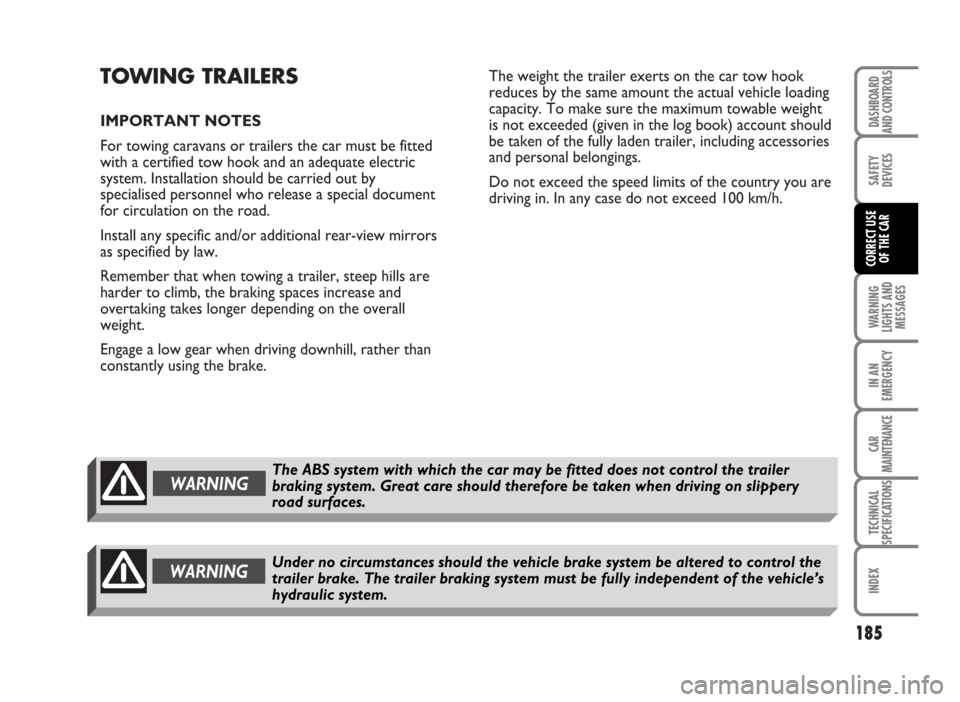
TOWING TRAILERS
IMPORTANT NOTES
For towing caravans or trailers the car must be fitted
with a certified tow hook and an adequate electric
system. Installation should be carried out by
specialised personnel who release a special document
for circulation on the road.
Install any specific and/or additional rear-view mirrors
as specified by law.
Remember that when towing a trailer, steep hills are
harder to climb, the braking spaces increase and
overtaking takes longer depending on the overall
weight.
Engage a low gear when driving downhill, rather than
constantly using the brake.The weight the trailer exerts on the car tow hook
reduces by the same amount the actual vehicle loading
capacity. To make sure the maximum towable weight
is not exceeded (given in the log book) account should
be taken of the fully laden trailer, including accessories
and personal belongings.
Do not exceed the speed limits of the country you are
driving in. In any case do not exceed 100 km/h.
185
SAFETY
DEVICES
WARNING
LIGHTS AND
MESSAGES
IN AN
EMERGENCY
CAR
MAINTENANCE
TECHNICAL
SPECIFICATIONS
INDEX
DASHBOARD
AND CONTROLS
CORRECT USE
OF THE CAR
WARNING
Under no circumstances should the vehicle brake system be altered to control the
trailer brake. The trailer braking system must be fully independent of the vehicle’s
hydraulic system.WARNING
The ABS system with which the car may be fitted does not control the trailer
braking system. Great care should therefore be taken when driving on slippery
road surfaces.
Page 192 of 314
191
SAFETY
DEVICES
CORRECT USE
OF THE CAR
IN AN
EMERGENCY
CAR
MAINTENANCE
TECHNICAL
SPECIFICATIONS
INDEX
DASHBOARD
AND CONTROLS
WARNING
LIGHTS AND
MESSAGES
W W
A A
R R
N N
I I
N N
G G
L L
I I
G G
H H
T T
S S
A A
N N
D D
M M
E E
S S
S S
A A
G G
E E
S S
FUEL CUTOFF SWITCHED ON...................................... 207
CAR PROTECTION SYSTEM FAILURE -
FIAT CODE ............................................................................ 208
“DUALDRIVE” ELECTRIC POWER
STEERING FAILURE............................................................. 209
DIESEL FUEL FILTER SENSOR FAILURE ........................ 209
GLOW PLUG WARMING FAILURE ............................... 209
ABS SYSTEM FAILURE - SYSTEM
UNAVAILABLE ...................................................................... 210
RAIN SENSOR FAILURE..................................................... 210
EBD SYSTEM FAILURE - SYSTEM UNAVAILABLE ...... 211
EXTERNAL LIGHT FAILURE............................................. 212
BRAKE LIGHT FUSE FAILURE .......................................... 214
PARKING SENSOR FAILURE ............................................ 215
ANTIPINCH SYSTEM
FAILURE .................................................................................. 215
AIR BAG FAILURE................................................................ 216
TWILIGHT SENSOR FAILURE.......................................... 217
INJECTION SYSTEM FAILURE ......................................... 217
ENGINE CONTROL SYSTEM FAILURE
(EOBD) .................................................................................... 218
GENERIC FAILURE INDICATION .................................. 219 GENERAL WARNINGS ...................................................... 192
LOW BRAKE FLUID ............................................................ 193
HANDBRAKE ON ............................................................... 193
FRONT PASSENGER AIR BAG DEACTIVATED ......... 194
SEAT BELTS NOT FASTENED ......................................... 194
LOW BATTERY CHARGE................................................. 195
LOW ENGINE OIL PRESSURE ......................................... 195
ENGINE COOLANT FLUID HIGH TEMPERATURE .. 196
INCOMPLETE DOOR LOCKING ................................... 198
“DUALDRIVE” ELECTRIC POWER STEERING
SYSTEM .................................................................................. 198
SPEED LIMIT EXCEEDED ................................................. 199
FUEL RESERVE....................................................................... 199
WATER IN DIESEL FUEL FILTER ..................................... 200
GLOW PLUGS ...................................................................... 201
REAR FOGLIGHTS............................................................... 202
FRONT FOG LIGHTS ......................................................... 202
LEFT-HAND DIRECTION INDICATOR ....................... 203
RIGHT-HAND DIRECTION INDICATOR ................... 203
SIDELIGHTS AND LOW BEAMS ..................................... 204
BRAKE PAD WEAR ........................................................... 204
FOLLOW ME HOME ........................................................... 205
MAIN BEAM HEADLIGHTS............................................... 205
CRUISE CONTROL ............................................................. 206
POSSIBLE PRESENCE OF ICE ON THE ROAD ........... 206
Page 211 of 314
210
SAFETY
DEVICES
CORRECT USE
OF THE CAR
IN AN
EMERGENCY
CAR
MAINTENANCE
TECHNICAL
SPECIFICATIONS
INDEX
DASHBOARD
AND CONTROLS
WARNING
LIGHTS AND
MESSAGES
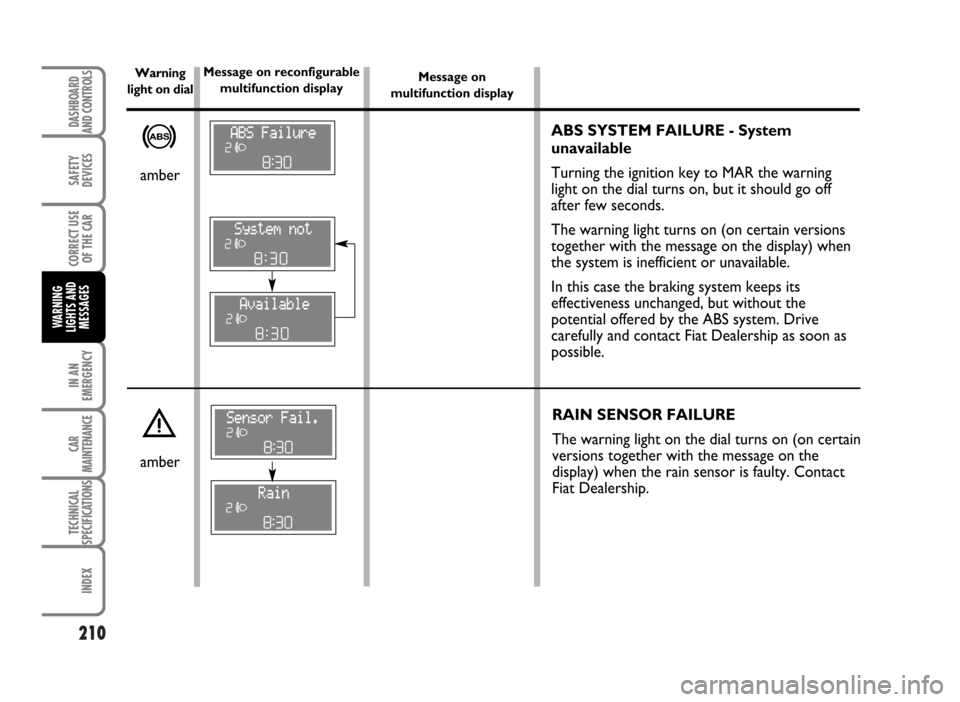
ABS SYSTEM FAILURE - System
unavailable
Turning the ignition key to MAR the warning
light on the dial turns on, but it should go off
after few seconds.
The warning light turns on (on certain versions
together with the message on the display) when
the system is inefficient or unavailable.
In this case the braking system keeps its
effectiveness unchanged, but without the
potential offered by the ABS system. Drive
carefully and contact Fiat Dealership as soon as
possible.
RAIN SENSOR FAILURE
The warning light on the dial turns on (on certain
versions together with the message on the
display) when the rain sensor is faulty. Contact
Fiat Dealership.>
amber
amber
è
Warning
light on dialMessage on reconfigurable
multifunction displayMessage on
multifunction display
Page 242 of 314
241
SAFETY
DEVICES
CORRECT USE
OF THE CAR
WARNING
LIGHTS AND
MESSAGES
CAR
MAINTENANCE
TECHNICAL
SPECIFICATIONS
INDEX
DASHBOARD
AND CONTROLS
IN AN
EMERGENCY
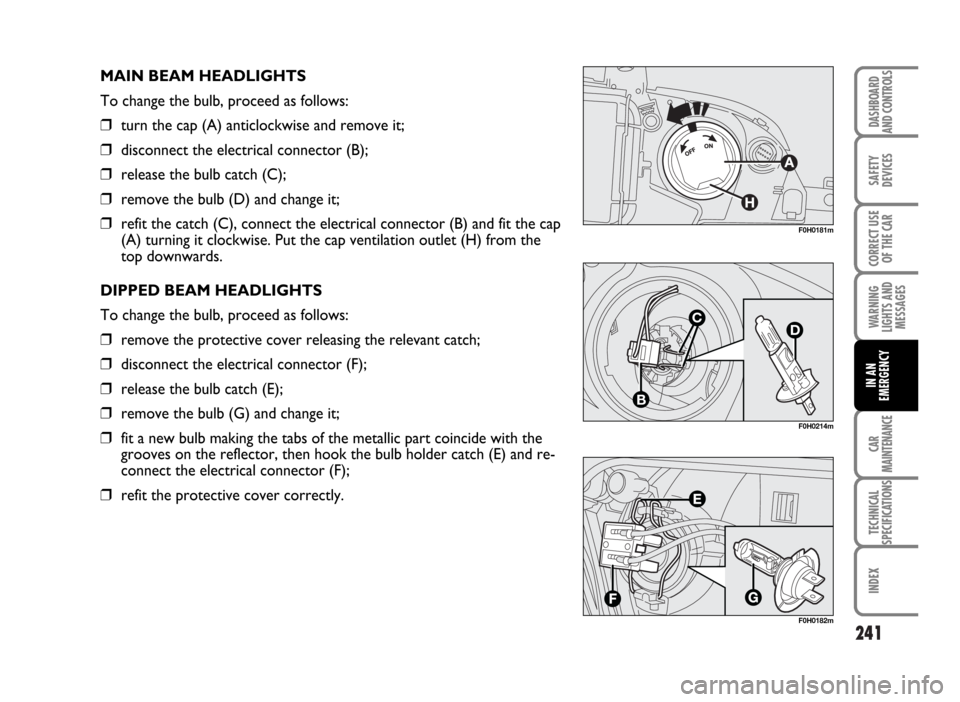
MAIN BEAM HEADLIGHTS
To change the bulb, proceed as follows:
❒turn the cap (A) anticlockwise and remove it;
❒disconnect the electrical connector (B);
❒release the bulb catch (C);
❒remove the bulb (D) and change it;
❒refit the catch (C), connect the electrical connector (B) and fit the cap
(A) turning it clockwise. Put the cap ventilation outlet (H) from the
top downwards.
DIPPED BEAM HEADLIGHTS
To change the bulb, proceed as follows:
❒remove the protective cover releasing the relevant catch;
❒disconnect the electrical connector (F);
❒release the bulb catch (E);
❒remove the bulb (G) and change it;
❒fit a new bulb making the tabs of the metallic part coincide with the
grooves on the reflector, then hook the bulb holder catch (E) and re-
connect the electrical connector (F);
❒refit the protective cover correctly.
F0H0181m
C
B
D
F0H0214m
F0H0182m
Page 245 of 314
244
SAFETY
DEVICES
CORRECT USE
OF THE CAR
WARNING
LIGHTS AND
MESSAGES
CAR
MAINTENANCE
TECHNICAL
SPECIFICATIONS
INDEX
DASHBOARD
AND CONTROLS
IN AN
EMERGENCY
F0H0187m
F0H0188m
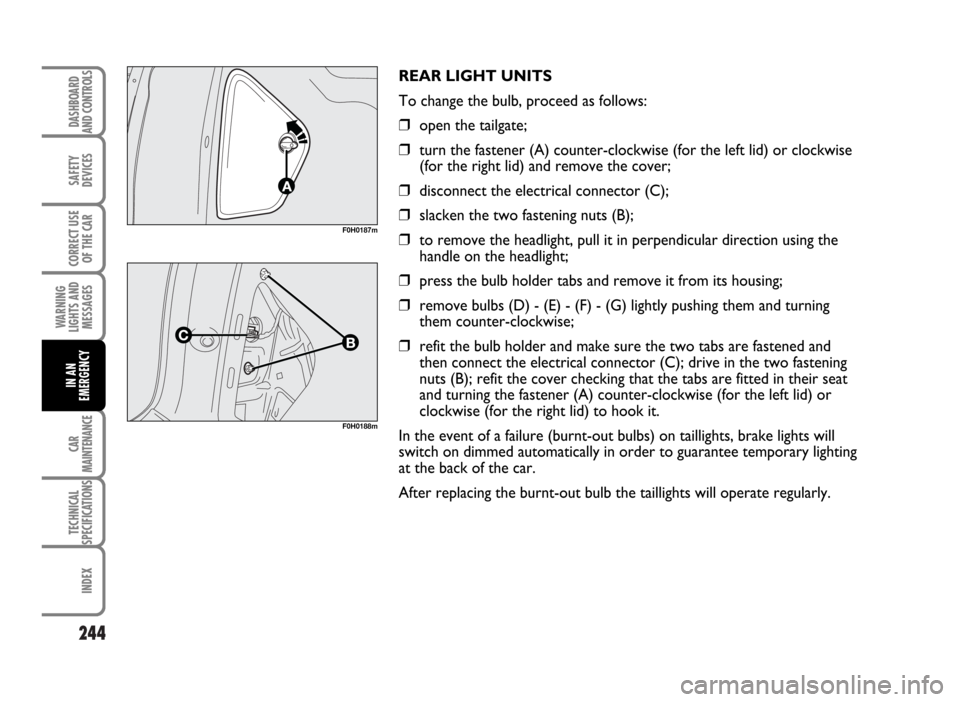
REAR LIGHT UNITS
To change the bulb, proceed as follows:
❒open the tailgate;
❒turn the fastener (A) counter-clockwise (for the left lid) or clockwise
(for the right lid) and remove the cover;
❒disconnect the electrical connector (C);
❒slacken the two fastening nuts (B);
❒to remove the headlight, pull it in perpendicular direction using the
handle on the headlight;
❒press the bulb holder tabs and remove it from its housing;
❒remove bulbs (D) - (E) - (F) - (G) lightly pushing them and turning
them counter-clockwise;
❒refit the bulb holder and make sure the two tabs are fastened and
then connect the electrical connector (C); drive in the two fastening
nuts (B); refit the cover checking that the tabs are fitted in their seat
and turning the fastener (A) counter-clockwise (for the left lid) or
clockwise (for the right lid) to hook it.
In the event of a failure (burnt-out bulbs) on taillights, brake lights will
switch on dimmed automatically in order to guarantee temporary lighting
at the back of the car.
After replacing the burnt-out bulb the taillights will operate regularly.
Page 252 of 314
251
SAFETY
DEVICES
CORRECT USE
OF THE CAR
WARNING
LIGHTS AND
MESSAGES
CAR
MAINTENANCE
TECHNICAL
SPECIFICATIONS
INDEX
DASHBOARD
AND CONTROLS
IN AN
EMERGENCY
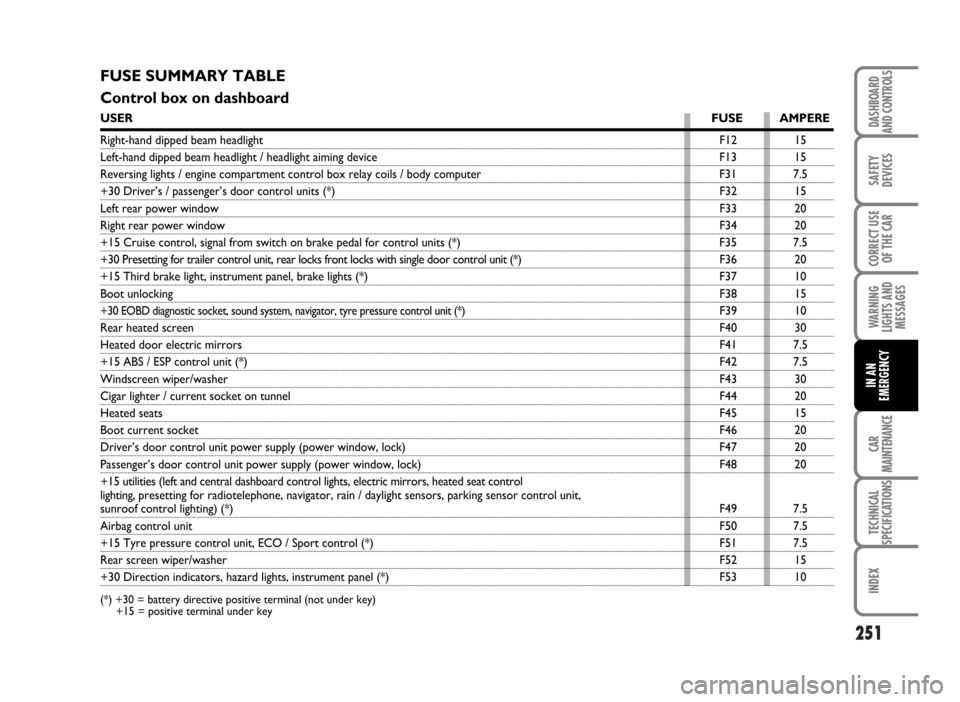
FUSE SUMMARY TABLE
Control box on dashboard
USERFUSE AMPERE
Right-hand dipped beam headlightF12 15
Left-hand dipped beam headlight / headlight aiming device F13 15
Reversing lights / engine compartment control box relay coils / body computer F31 7.5
+30 Driver’s / passenger’s door control units (*)F32 15
Left rear power windowF33 20
Right rear power windowF34 20
+15 Cruise control, signal from switch on brake pedal for control units (*) F35 7.5
+30 Presetting for trailer control unit, rear locks front locks with single door control unit (*) F36 20
+15 Third brake light, instrument panel, brake lights (*) F37 10
Boot unlockingF38 15
+30 EOBD diagnostic socket, sound system, navigator, tyre pressure control unit (*)F39 10
Rear heated screenF40 30
Heated door electric mirrorsF41 7.5
+15 ABS / ESP control unit (*)F42 7.5
Windscreen wiper/washerF43 30
Cigar lighter / current socket on tunnelF44 20
Heated seatsF45 15
Boot current socketF46 20
Driver’s door control unit power supply (power window, lock) F47 20
Passenger’s door control unit power supply (power window, lock) F48 20
+15 utilities (left and central dashboard control lights, electric mirrors, heated seat control
lighting,presetting for radiotelephone, navigator, rain / daylight sensors, parking sensor control unit,
sunroof control lighting) (*)F49 7.5
Airbag control unitF50 7.5
+15 Tyre pressure control unit, ECO / Sport control (*) F51 7.5
Rear screen wiper/washerF52 15
+30 Direction indicators, hazard lights, instrument panel (*) F53 10
(*) +30 = battery directive positive terminal (not under key)
+15 = positive terminal under key