air condition FIAT IDEA 2007 1.G User Guide
[x] Cancel search | Manufacturer: FIAT, Model Year: 2007, Model line: IDEA, Model: FIAT IDEA 2007 1.GPages: 314, PDF Size: 4.78 MB
Page 184 of 314
CONTAINING RUNNING COSTS
Here are some suggestions which may help you to
keep the running costs of your car down and lower
the amount of toxic emissions released into the
atmosphere.
GENERAL CONSIDERATIONS
Car maintenance
Have checks and adjustments carried out in
accordance with the “Service schedule”.
Tyres
Check the pressure of the tyres routinely at an
interval of no more than 4 weeks: if the pressure is
too low, consumption levels increase as resistance to
rolling is higher.
Unnecessary loads
Do not travel with too much luggage stowed in the
boot. The weight of the car (especially when driving in
town) and its trim greatly affects consumption and
stability.Roof rack/ski rack
Remove the roof rack or the ski rack from the roof as
soon as they are no longer used. These accessories
lower air penetration and adversely affect
consumption levels. When needing to carry
particularly voluminous objects, preferably use a
trailer.
Electric devices
Use electric devices only for the amount of time
needed. Rear heated window, additional headlights,
windscreen wipers and heater fan need a considerable
amount of energy, therefore increasing the
requirement of current increases fuel consumption (up
to +25% in the urban cycle).
Climate control
The air conditioner is an additional load which greatly
affects the engine leading to higher consumption (on
average up to +20%). When the temperature outside
the vehicle permits it, use the air vents where possible.
Spoilers
The use of non-certified aerodynamic items may
adversely affect air drag and consumption levels.
183
SAFETY
DEVICES
WARNING
LIGHTS AND
MESSAGES
IN AN
EMERGENCY
CAR
MAINTENANCE
TECHNICAL
SPECIFICATIONS
INDEX
DASHBOARD
AND CONTROLS
CORRECT USE
OF THE CAR
Page 260 of 314
SCHEDULED SERVICING
Correct maintenance is essential for ensuring long car
life under the best conditions.
This is why Fiat has programmed a series of checks
and maintenance operations every 20,000 km.
It is however important to remember that scheduled
servicing does not completely cover all the car’s
requirements: also in the initial period before 20,000
km service coupon and later, between one coupon and
another, ordinary care is still required such as for
example routine check and topping up the level of
fluids, tyre pressure check, etc...
IMPORTANT The Programmed Maintenance coupons
are specified by the Manufacturer. The failure to have
them carried out may invalidate the warranty.
Scheduled Servicing is performed by all Fiat Dealership,
at pre-established times.
If during each operation, in addition to the ones
programmed, the need arises for further replacementsor repairs, these may be carried out only with the
explicit agreement of the Customer.
IMPORTANT You are advised to contact Fiat
Dealership in the event of any minor operating faults,
without waiting for the next service coupon.
If your car is used frequently for towing, the interval
between one service coupon and the other must be
reduced.
259
SAFETY
DEVICES
CORRECT USE
OF THE CAR
WARNING
LIGHTS AND
MESSAGES
IN AN
EMERGENCY
TECHNICAL
SPECIFICATIONS
INDEX
DASHBOARD
AND CONTROLS
CAR
MAINTENANCE
Page 262 of 314
261
SAFETY
DEVICES
CORRECT USE
OF THE CAR
WARNING
LIGHTS AND
MESSAGES
IN AN
EMERGENCY
TECHNICAL
SPECIFICATIONS
INDEX
DASHBOARD
AND CONTROLS
CAR
MAINTENANCE
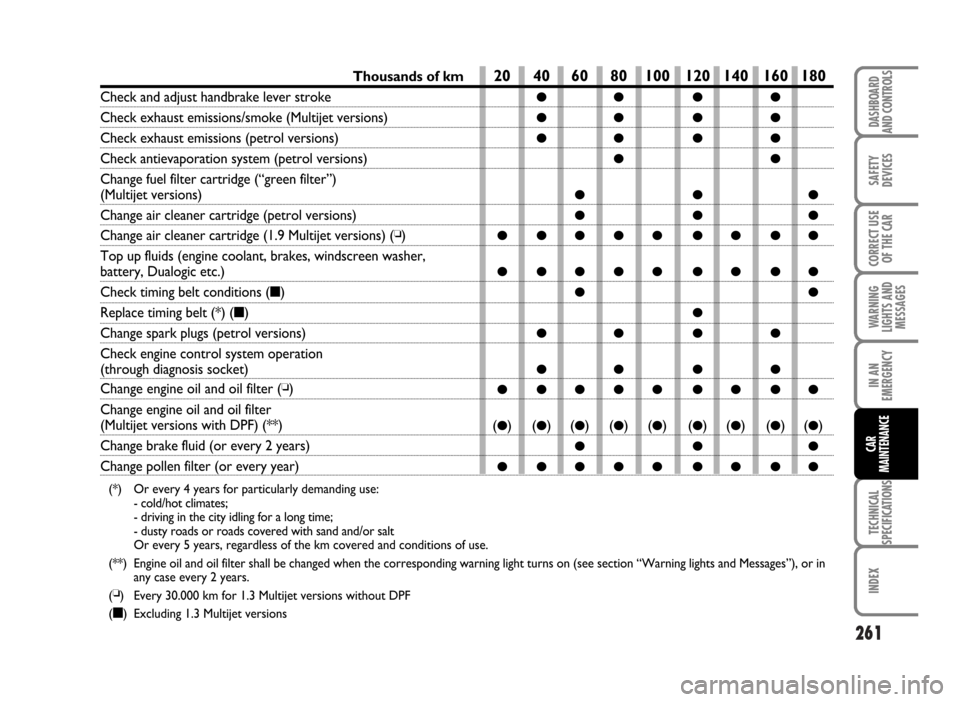
Thousands of km
Check and adjust handbrake lever stroke
Check exhaust emissions/smoke (Multijet versions)
Check exhaust emissions (petrol versions)
Check antievaporation system (petrol versions)
Change fuel filter cartridge (“green filter”)
(Multijet versions)
Change air cleaner cartridge (petrol versions)
Change air cleaner cartridge (1.9 Multijet versions) (❏)
Top up fluids (engine coolant, brakes, windscreen washer,
battery, Dualogic etc.)
Check timing belt conditions (■)
Replace timing belt (*) (■)
Change spark plugs (petrol versions)
Check engine control system operation
(through diagnosis socket)
Change engine oil and oil filter (❏)
Change engine oil and oil filter
(Multijet versions with DPF) (**)
Change brake fluid (or every 2 years)
Change pollen filter (or every year)
(*) Or every 4 years for particularly demanding use:
- cold/hot climates;
- driving in the city idling for a long time;
- dusty roads or roads covered with sand and/or salt
Or every 5 years, regardless of the km covered and conditions of use.
(**) Engine oil and oil filter shall be changed when the corresponding warning light turns on (see section “Warning lights and Messages”), or in
any case every 2 years.
(
❏) Every 30.000 km for 1.3 Multijet versions without DPF
(
■) Excluding 1.3 Multijet versions
20 40 60 80 100 120 140 160 180
●● ● ●
●● ● ●
●● ● ●
●●
●●●
●●●
●●●●● ●●●●
●●●●● ●●●●
●●
●
●● ● ●
●● ● ●
●●●●● ●●●●
(●)(●)(●)(●)(●)(●)(●)(●)(●)
●●●
●●●●● ●●●●
Page 264 of 314
IMPORTANT - Engine oil
Should prevailing use of the car be under one of the
following specially heavy conditions:
❒trailer or caravan towing;
❒dusty roads;
❒short distances (less than 7-8 km) repeated and
with external temperatures below zero;
❒frequently idling engines or long distance low speed
driving (e.g. taxis or door-to-door deliveries) or in
case of a long term inactivity;
replace engine oil more frequently than required on
“Service schedule”.
IMPORTANT - Air cleaner
If the car is used on dusty roads change the air cleaner
more frequently than the indications in the “Service
schedule”.
If in doubt as to how often the engine oil and air
cleaner should be changed according to how you use
the car, contact a Fiat Dealership.IMPORTANT - Pollen filter
If the vehicle is used frequently in dusty or heavily
polluted environments it is advisable to replace the
filtering element more frequently; in particular it
should be replaced if a reduction of the amount of air
admitted to the passenger compartment is noted.
IMPORTANT - Diesel filter
The possibility of topping up with diesel fuel not
complying with EN590 European Norm might make it
necessary to replace the filter more frequently than
indicated in the “Service schedule”.
263
SAFETY
DEVICES
CORRECT USE
OF THE CAR
WARNING
LIGHTS AND
MESSAGES
IN AN
EMERGENCY
TECHNICAL
SPECIFICATIONS
INDEX
DASHBOARD
AND CONTROLS
CAR
MAINTENANCE
Page 274 of 314
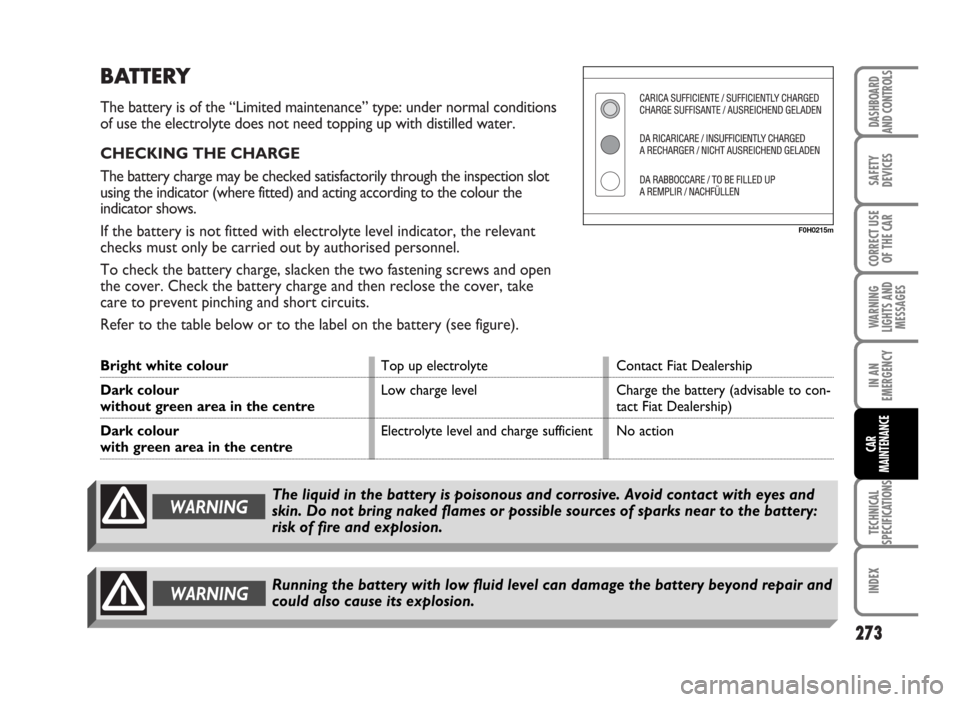
BATTERY
The battery is of the “Limited maintenance” type: under normal conditions
of use the electrolyte does not need topping up with distilled water.
CHECKING THE CHARGE
The battery charge may be checked satisfactorily through the inspection slot
using the indicator (where fitted) and acting according to the colour the
indicator shows.
If the battery is not fitted with electrolyte level indicator, the relevant
checks must only be carried out by authorised personnel.
To check the battery charge, slacken the two fastening screws and open
the cover. Check the battery charge and then reclose the cover, take
care to prevent pinching and short circuits.
Refer to the table below or to the label on the battery (see figure).
273
SAFETY
DEVICES
CORRECT USE
OF THE CAR
WARNING
LIGHTS AND
MESSAGES
IN AN
EMERGENCY
TECHNICAL
SPECIFICATIONS
INDEX
DASHBOARD
AND CONTROLS
CAR
MAINTENANCE
F0H0215m
Bright white colour
Dark colour
without green area in the centre
Dark colour
with green area in the centreTop up electrolyte
Low charge level
Electrolyte level and charge sufficientContact Fiat Dealership
Charge the battery (advisable to con-
tact Fiat Dealership)
No action
WARNING
The liquid in the battery is poisonous and corrosive. Avoid contact with eyes and
skin. Do not bring naked flames or possible sources of sparks near to the battery:
risk of fire and explosion.WARNING
Running the battery with low fluid level can damage the battery beyond repair and
could also cause its explosion.
Page 283 of 314
282
SAFETY
DEVICES
CORRECT USE
OF THE CAR
WARNING
LIGHTS AND
MESSAGES
IN AN
EMERGENCY
TECHNICAL
SPECIFICATIONS
INDEX
DASHBOARD
AND CONTROLS
CAR
MAINTENANCE
BODYWORK
PROTECTION FROM ATMOSPHERIC
AGENTS
The main causes of corrosion are the following:
❒atmospheric pollution;
❒salty air and humidity (coastal areas, or hot humid
climates);
❒seasonal environment conditions.
Not to be underestimated is also the abrasive action
of wind-borne atmospheric dust and sand and mud and
gravel raised by other vehicles.
On your Fiat Idea, Fiat implemented the best
manufacturing technologies to effectively protect the
bodywork against corrosion.
These include:
❒Painting products and systems which give the car
particular resistance to corrosion and abrasion;
❒Use of galvanised (or pretreated) steel sheets, with
high resistance to corrosion;
❒Spraying of plastic parts, with a protective function,
in the more exposed points: underdoor, inner
fender parts, edges, etc.;
❒Use of “open” boxed sections to prevent
condensation and pockets of moisture from
triggering rust inside.BODY AND UNDERBODY
WARRANTY
Your Fiat Idea is covered by warranty against
perforation due to rust of any original element of the
structure or body. For the general terms of this
warranty, refer to “FIAT WARRANTY” booklet.
ADVICE FOR PRESERVING THE
BODYWORK
Paint
Paintwork does not only serve an aestethic purpose,
but also protects the underlying sheet metal.
In the case of deep scrapes or scores, you are advised
to have the necessary touching up carried out
immediately to avoid the formation of rust. Use only
original paint products for touching up (see
“Bodywork paint identification plate” in section
“Technical specification”).
Normal paint maintenance consists in washing at
intervals depending on the conditions and environment
of use. For example, in highly polluted areas, or if the
roads are sprayed with salt, it is wise to wash the car
more frequently.
To correctly wash the car:
❒remove the aerial from the roof to prevent damage
to it if the car is washed in an automatic system;
❒wash the body using a low pressure jet of water;
Page 304 of 314
303
SAFETY
DEVICES
CORRECT USE
OF THE CAR
WARNING
LIGHTS AND
MESSAGES
IN AN
EMERGENCY
CAR
MAINTENANCE
INDEX
DASHBOARD
AND CONTROLS
TECHNICAL
SPECIFICATIONS
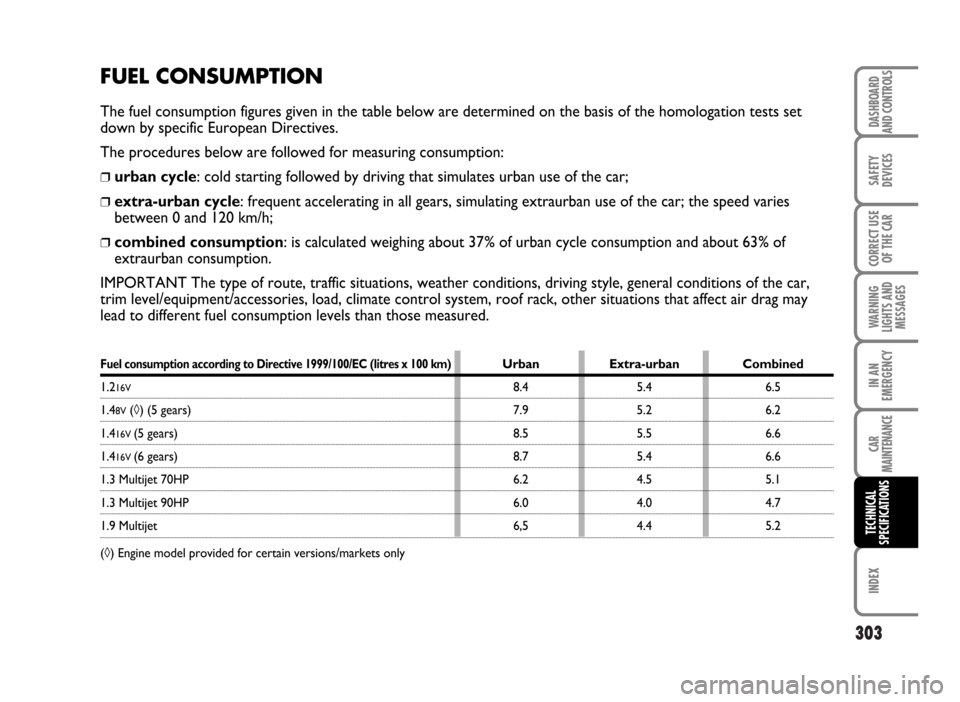
FUEL CONSUMPTION
The fuel consumption figures given in the table below are determined on the basis of the homologation tests set
down by specific European Directives.
The procedures below are followed for measuring consumption:
❒urban cycle: cold starting followed by driving that simulates urban use of the car;
❒extra-urban cycle: frequent accelerating in all gears, simulating extraurban use of the car; the speed varies
between 0 and 120 km/h;
❒combined consumption: is calculated weighing about 37% of urban cycle consumption and about 63% of
extraurban consumption.
IMPORTANT The type of route, traffic situations, weather conditions, driving style, general conditions of the car,
trim level/equipment/accessories, load, climate control system, roof rack, other situations that affect air drag may
lead to different fuel consumption levels than those measured.
Fuel consumption according to Directive 1999/100/EC (litres x 100 km)Urban Extra-urban Combined
1.216V8.4 5.4 6.5
1.48V(◊) (5 gears) 7.9 5.2 6.2
1.416V (5 gears) 8.5 5.5 6.6
1.416V (6 gears) 8.7 5.4 6.6
1.3 Multijet 70HP 6.2 4.5 5.1
1.3 Multijet 90HP 6.0 4.0 4.7
1.9 Multijet 6,5 4.4 5.2
(◊) Engine model provided for certain versions/markets only