fuel FIAT IDEA 2007 1.G User Guide
[x] Cancel search | Manufacturer: FIAT, Model Year: 2007, Model line: IDEA, Model: FIAT IDEA 2007 1.GPages: 314, PDF Size: 4.78 MB
Page 54 of 314
53
SAFETY
DEVICES
CORRECT USE
OF THE CAR
WARNING
LIGHTS AND
MESSAGES
IN AN
EMERGENCY
CAR
MAINTENANCE
TECHNICAL
SPECIFICATIONS
INDEX
DASHBOARD
AND CONTROLS
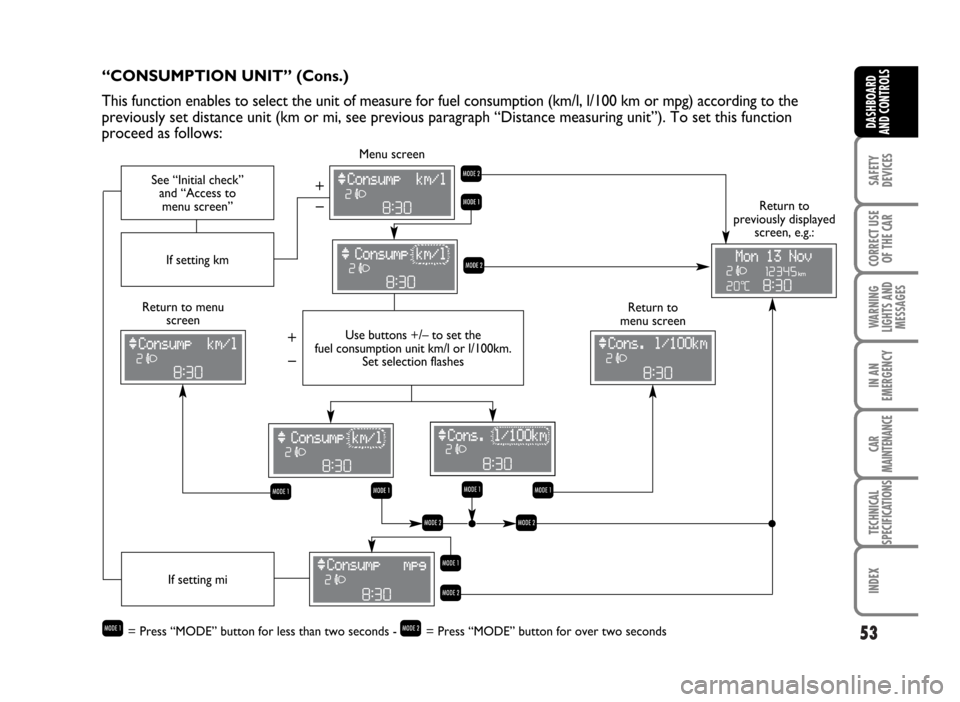
“CONSUMPTION UNIT” (Cons.)
This function enables to select the unit of measure for fuel consumption (km/l, l/100 km or mpg) according to the
previously set distance unit (km or mi, see previous paragraph “Distance measuring unit”). To set this function
proceed as follows:
R
Q
R
Q
RIf setting mi
If setting km
Use buttons +/– to set the
fuel consumption unit km/l or l/100km.
Set selection flashes
Return to
menu screen Return to menu
screen
See “Initial check”
and “Access to
menu screen”
Menu screen
– +
Q
Q
Return to
previously displayed
screen, e.g.:
– +
Q= Press “MODE” button for less than two seconds - R= Press “MODE” button for over two seconds
Q
Q
RR
Page 62 of 314

61
SAFETY
DEVICES
CORRECT USE
OF THE CAR
WARNING
LIGHTS AND
MESSAGES
IN AN
EMERGENCY
CAR
MAINTENANCE
TECHNICAL
SPECIFICATIONS
INDEX
DASHBOARD
AND CONTROLS
TRIP COMPUTER
The “Trip computer” displays information relating to the operating status of the car. This function comprises the
“General trip”, concerning the complete mission of the car and “Trip B”, concerning the partial car mission. The car is
delivered with “Trip B” set to “ON”. This function (as shown in the graph below) is contained within the complete
mission. Both functions are resettable. The “General trip” displays the figures relating to Cruising Range, Travelled
Distance, Average fuel consumption, Current fuel consumption, Average speed, Travel time (driving time). “Trip B”
displays information concerning Travel Distance B, Average fuel consumption B, Average speed B, Travel time B
(driving time). The “Trip B” function can be excluded.
Start of journey procedure (reset)
To start a new journey monitored by the “General Trip”, with the key to MAR, press button
{on right steering
column stalk with mode
&(see paragraph “Display control buttons”).
The reset operation in the presence of the screens concerning the “General trip” makes it possible to reset also the
“Trip B”. The reset operation in the presence of the screens concerning only the “Trip B” makes it possible to reset
only the information associated with this function.
IMPORTANT The “Cruising range” information cannot be reset.
Reset TRIP B
End of partial mission
Start of new partial mission
End of partial mission
Start of new partial mission
Reset TRIP B
End of partial mission
Start of new partial mission Reset GENERAL TRIP
End of complete mission - Start of new missionReset GENERAL TRIP
End of complete mission - Start of new mission
End of partial mission
Start of new partial mission Reset TRIP B
Reset TRIP B
TRIP B
TRIP B
TRIP B GENERAL TRIP˙
˙
˙
˙˙
˙
˙ ˙
%= Press “TRIP” button for less than two seconds - &= Press “TRIP” button for over two seconds
Page 66 of 314

65
SAFETY
DEVICES
CORRECT USE
OF THE CAR
WARNING
LIGHTS AND
MESSAGES
IN AN
EMERGENCY
CAR
MAINTENANCE
TECHNICAL
SPECIFICATIONS
INDEX
DASHBOARD
AND CONTROLS
Cruising range= Shows the distance in km (or mi)
that the car can still cover before needing fuel,
assuming that driving conditions are kept unvaried.
The display will show “- - - -” in the following cases:
❒value for range to empty lower than 50 km or fuel
level below 4 litres; in this event before “- - - -”
the message “Warning, limited range” will be
displayed (this message will be displayed also if not
in TRIP COMPUTER mode);
❒in case of car parked with engine running for a
long period, when the car moves off the range to
empty indication will be displayed again.
Travelled distance= shows the km (or miles)
covered from last reset (*).
Average fuel consumption= shows the average
consumption calculated from last reset (*), this value
can be expressed in l/100 km, km/l or mpg.
Instant consumption= shows the fuel consumption
variation updated every second, it can be expressed in
l/100 km or mpg. In case of car parked with engine
running the display will show “- - - -”. When the car
moves off the instant consumption indication will be
displayed again.
Average speed= shows the average speed of the
car in relation with total time elapsed from last reset
(*) and it can be expressed in km/h or in mph.Travel time= time elapsed from last reset (*).
(*) Reset can be:
– “manual”, reset is performed by the driver by
pressing the relevant button (see paragraph
“Control buttons”)
– “automatic”, reset is performed when the travelled
distance reaches 9999.9 km or when Travel time
reaches 99:59 (99 hours and 59 minutes)
– after reconnecting the battery.
IMPORTANT Lacking information, Trip computer
values are displayed with “- - - -”. When normal
operating condition is reset, calculation of different
units will restart regularly. Values displayed before the
failure will not be reset (*).
IMPORTANT After battery disconnection/connection
certain displayed values are equal to “- - - -” until
significant data for calculation are available.
Page 68 of 314
67
SAFETY
DEVICES
CORRECT USE
OF THE CAR
WARNING
LIGHTS AND
MESSAGES
IN AN
EMERGENCY
CAR
MAINTENANCE
TECHNICAL
SPECIFICATIONS
INDEX
DASHBOARD
AND CONTROLS
If after warning message displaying you smell fuel or see leaks from the fuel
system, do not reset the switch to avoid fire risk.WARNING
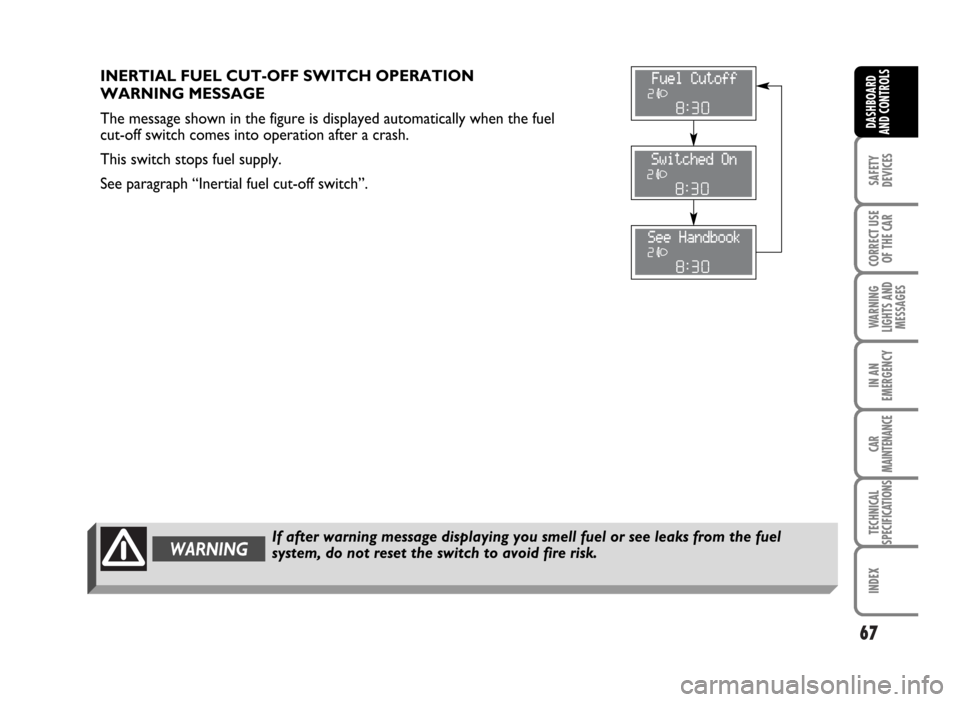
INERTIAL FUEL CUT-OFF SWITCH OPERATION
WARNING MESSAGE
The message shown in the figure is displayed automatically when the fuel
cut-off switch comes into operation after a crash.
This switch stops fuel supply.
See paragraph “Inertial fuel cut-off switch”.
Page 117 of 314
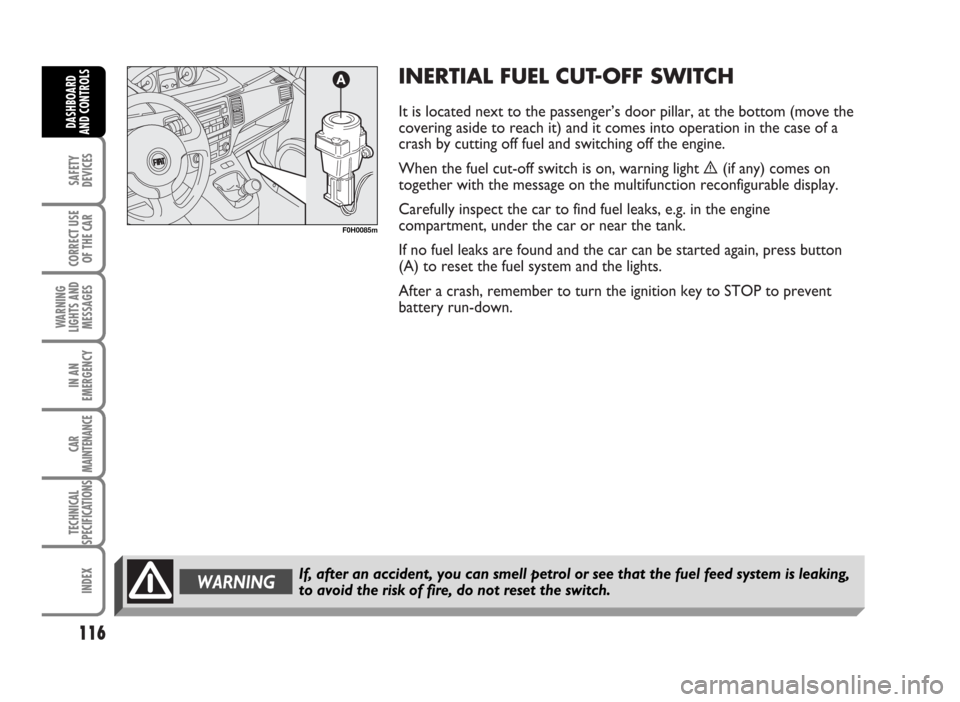
INERTIAL FUEL CUT-OFF SWITCH
It is located next to the passenger’s door pillar, at the bottom (move the
covering aside to reach it) and it comes into operation in the case of a
crash by cutting off fuel and switching off the engine.
When the fuel cut-off switch is on, warning light è(if any) comes on
together with the message on the multifunction reconfigurable display.
Carefully inspect the car to find fuel leaks, e.g. in the engine
compartment, under the car or near the tank.
If no fuel leaks are found and the car can be started again, press button
(A) to reset the fuel system and the lights.
After a crash, remember to turn the ignition key to STOP to prevent
battery run-down.
116
SAFETY
DEVICES
CORRECT USE
OF THE CAR
WARNING
LIGHTS AND
MESSAGES
IN AN
EMERGENCY
CAR
MAINTENANCE
TECHNICAL
SPECIFICATIONS
INDEX
DASHBOARD
AND CONTROLS
WARNINGIf, after an accident, you can smell petrol or see that the fuel feed system is leaking,
to avoid the risk of fire, do not reset the switch.
F0H0085m
Page 149 of 314
AT THE FILLING STATION
PETROL ENGINES
Use only unleaded petrol.
To prevent errors, the diameter of the fuel tank filler
is too small to introduce a lead petrol pump filler. Use
petrol with a rated octane number (R.O.N.) not lower
than 95.
IMPORTANT An inefficient catalyst leads to harmful
exhaust emissions, thus contributing to air pollution.
IMPORTANT Never use leaded petrol, even in small
amount or in an emergency, as this would damage the
catalyst beyond repair.
MULTIJET ENGINES
Operation at low temperatures
If the outside temperature is very low, the diesel
thickens due to the formation of paraffin and could
cause the malfunctioning of the fuel system.In order to avoid these problems, different types of
diesel are distributed according to the season: summer
type, winter type and arctic type (cold, mountain
areas). If refuelling with diesel fuel not suitable for the
current temperature, mix diesel fuel with TUTELA
DIESEL ART additive in the proportions stated on the
can, putting first the antifreeze in the tank and then the
diesel fuel.
If driving or parking the vehicle for a long period in
cold areas/mountains, refuel with the diesel fuel
available at local filling stations.
In this situation you are also recommended to have in
the tank an amount of fuel 50% higher than usable
capacity.
REFUELLING
To guarantee full tank filling, carry out two refuelling
operations after the first click of the fuel delivery gun.
Avoid further topping up operations that could cause
damages to the fuel system.
148
SAFETY
DEVICES
CORRECT USE
OF THE CAR
WARNING
LIGHTS AND
MESSAGES
IN AN
EMERGENCY
CAR
MAINTENANCE
TECHNICAL
SPECIFICATIONS
INDEX
DASHBOARD
AND CONTROLS
The car must only be filled with diesel fuel for motor vehicles, in compliance with European Standard
EN590. The use of other products or mixtures may irreparably damage the engine with invalidation of
the warranty due to the damage caused. In the event of accidentally filling with another type of fuel,
do not start the engine and empty the tank. If the engine has been run even for only a very short time, in addi-
tion to the tank, it is also necessary to drain out the whole fuel circuit.
Page 150 of 314
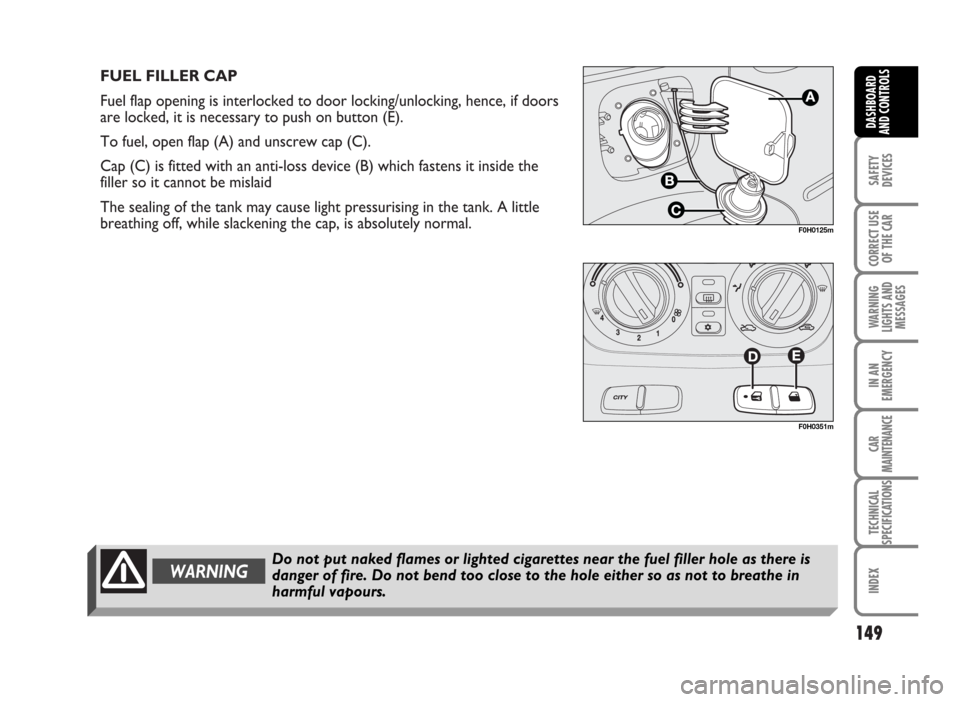
FUEL FILLER CAP
Fuel flap opening is interlocked to door locking/unlocking, hence, if doors
are locked, it is necessary to push on button (E).
To fuel, open flap (A) and unscrew cap (C).
Cap (C) is fitted with an anti-loss device (B) which fastens it inside the
filler so it cannot be mislaid
The sealing of the tank may cause light pressurising in the tank. A little
breathing off, while slackening the cap, is absolutely normal.
149
SAFETY
DEVICES
CORRECT USE
OF THE CAR
WARNING
LIGHTS AND
MESSAGES
IN AN
EMERGENCY
CAR
MAINTENANCE
TECHNICAL
SPECIFICATIONS
INDEX
DASHBOARD
AND CONTROLS
F0H0125m
F0H0351m
Do not put naked flames or lighted cigarettes near the fuel filler hole as there is
danger of fire. Do not bend too close to the hole either so as not to breathe in
harmful vapours.WARNING
Page 151 of 314
PROTECTING THE ENVIRONMENT
The devices for curtailing petrol engine emissions are the following:
❒three-way catalytic converter;
❒Lambda sensor;
❒fuel evaporation system.
In addition, do not let the engine run, even for a test, with one or more spark plugs disconnected.
The devices for curtailing diesel fuel engine emissions are the following:
❒oxidising catalytic converter;
❒exhaust gas recirculation system (E.G.R.).
❒diesel particulate filter (DPF)
DIESEL PARTICULATE FILTER (DPF) (for 1.3 Multijet versions 90 HP)
The Diesel Particulate Filter is a mechanical filter, integral with the exhaust system, that physically traps particulates present
in the exhaust gases of Diesel engines.
The diesel particular filter has been adopted to eliminate almost totally particulates in compliance with current / future
law regulations.
During normal use of the vehicle, the engine control unit records a set of data (e.g.: travel time, type of route, temperatures,
etc.) and it will then calculate how much particulates has been trapped by the filter.
Since this filter physically traps particulates, it shall be cleaned (reclaimed) at regular intervals by burning carbon particles.
Reclaiming procedure is controlled automatically by the engine control unit according to the filter conditions and the
conditions of use of the vehicle.
During reclaiming the following phenomena could take place: idling slight increase, fan activation, slight smoke increase,
high exhaust temperatures. These situations shall not be considered as faults and they do not affect vehicle performance
and environment.
If the dedicated message is displayed, refer to paragraph “Warning lights and messages”.
150
SAFETY
DEVICES
CORRECT USE
OF THE CAR
WARNING
LIGHTS AND
MESSAGES
IN AN
EMERGENCY
CAR
MAINTENANCE
TECHNICAL
SPECIFICATIONS
INDEX
DASHBOARD
AND CONTROLS
During normal service the catalyst reaches high temperatures. Do not therefore
park the car over inflammable materials (grass, dry leaves, pine needles, etc.): fire
hazard.WARNING
Page 181 of 314
HOW TO WARM UP THE ENGINE AFTER IT
HAS JUST STARTED (petrol and Multijet
versions)
Proceed as follows:
❒Drive off slowly, letting the engine turn at medium
revs. Do not accelerate abruptly;
❒Do not drive at full performance for the initial
kilometres. Wait until the coolant temperature
gauge starts moving.
EMERGENCY START-UP
If the instrument panel warning light
Ystays on with
fixed light, the emergency start-up can be performed
by using the CODE card code (see section “In an
emergency”).STOPPING THE ENGINE
Turn the ignition to STOP while the engine is idling.
IMPORTANT After a taxing drive, you should allow
the engine to “catch its breath” before turning it off by
letting it idle to allow the temperature in the engine
compartment to fall.
180
SAFETY
DEVICES
WARNING
LIGHTS AND
MESSAGES
IN AN
EMERGENCY
CAR
MAINTENANCE
TECHNICAL
SPECIFICATIONS
INDEX
DASHBOARD
AND CONTROLS
CORRECT USE
OF THE CAR
Never bump start the engine by pushing, towing or coasting downhill. This could cause fuel to flow
into the catalytic exhaust system and damage it beyond repair.
A quick burst on the accelerator before turning off the engine serves absolutely no practical
purpose, it wastes fuel and is damaging especially to turbocharged engines.
Remember that the servobrake and power steering are not operational until the
engine has been started, therefore much effort than usual is required on the brake
pedal and steering wheel.WARNING
Page 184 of 314
CONTAINING RUNNING COSTS
Here are some suggestions which may help you to
keep the running costs of your car down and lower
the amount of toxic emissions released into the
atmosphere.
GENERAL CONSIDERATIONS
Car maintenance
Have checks and adjustments carried out in
accordance with the “Service schedule”.
Tyres
Check the pressure of the tyres routinely at an
interval of no more than 4 weeks: if the pressure is
too low, consumption levels increase as resistance to
rolling is higher.
Unnecessary loads
Do not travel with too much luggage stowed in the
boot. The weight of the car (especially when driving in
town) and its trim greatly affects consumption and
stability.Roof rack/ski rack
Remove the roof rack or the ski rack from the roof as
soon as they are no longer used. These accessories
lower air penetration and adversely affect
consumption levels. When needing to carry
particularly voluminous objects, preferably use a
trailer.
Electric devices
Use electric devices only for the amount of time
needed. Rear heated window, additional headlights,
windscreen wipers and heater fan need a considerable
amount of energy, therefore increasing the
requirement of current increases fuel consumption (up
to +25% in the urban cycle).
Climate control
The air conditioner is an additional load which greatly
affects the engine leading to higher consumption (on
average up to +20%). When the temperature outside
the vehicle permits it, use the air vents where possible.
Spoilers
The use of non-certified aerodynamic items may
adversely affect air drag and consumption levels.
183
SAFETY
DEVICES
WARNING
LIGHTS AND
MESSAGES
IN AN
EMERGENCY
CAR
MAINTENANCE
TECHNICAL
SPECIFICATIONS
INDEX
DASHBOARD
AND CONTROLS
CORRECT USE
OF THE CAR