brakes FIAT IDEA 2007 1.G Owners Manual
[x] Cancel search | Manufacturer: FIAT, Model Year: 2007, Model line: IDEA, Model: FIAT IDEA 2007 1.GPages: 314, PDF Size: 4.78 MB
Page 139 of 314
138
SAFETY
DEVICES
CORRECT USE
OF THE CAR
WARNING
LIGHTS AND
MESSAGES
IN AN
EMERGENCY
CAR
MAINTENANCE
TECHNICAL
SPECIFICATIONS
INDEX
DASHBOARD
AND CONTROLS
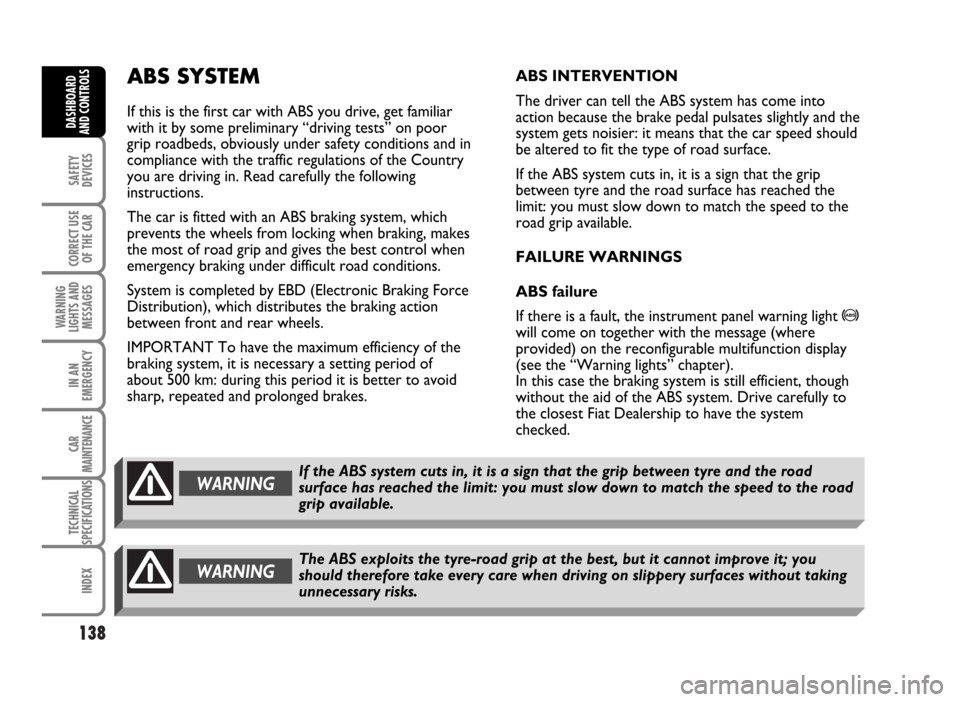
ABS SYSTEM
If this is the first car with ABS you drive, get familiar
with it by some preliminary “driving tests” on poor
grip roadbeds, obviously under safety conditions and in
compliance with the traffic regulations of the Country
you are driving in. Read carefully the following
instructions.
The car is fitted with an ABS braking system, which
prevents the wheels from locking when braking, makes
the most of road grip and gives the best control when
emergency braking under difficult road conditions.
System is completed by EBD (Electronic Braking Force
Distribution), which distributes the braking action
between front and rear wheels.
IMPORTANT To have the maximum efficiency of the
braking system, it is necessary a setting period of
about 500 km: during this period it is better to avoid
sharp, repeated and prolonged brakes.ABS INTERVENTION
The driver can tell the ABS system has come into
action because the brake pedal pulsates slightly and the
system gets noisier: it means that the car speed should
be altered to fit the type of road surface.
If the ABS system cuts in, it is a sign that the grip
between tyre and the road surface has reached the
limit: you must slow down to match the speed to the
road grip available.
FAILURE WARNINGS
ABS failure
If there is a fault, the instrument panel warning light
>
will come on together with the message (where
provided) on the reconfigurable multifunction display
(see the “Warning lights” chapter).
In this case the braking system is still efficient, though
without the aid of the ABS system. Drive carefully to
the closest Fiat Dealership to have the system
checked.
If the ABS system cuts in, it is a sign that the grip between tyre and the road
surface has reached the limit: you must slow down to match the speed to the road
grip available.WARNING
The ABS exploits the tyre-road grip at the best, but it cannot improve it; you
should therefore take every care when driving on slippery surfaces without taking
unnecessary risks.WARNING
Page 148 of 314
FAILURE WARNINGS
See the “Warning lights and messages” chapter.
OPERATION WITH TRAILER
The system is preset for deactivating automatically
when the trailer electric cable plug is fitted into the car
tow hook socket.
Sensors are reactivated when removing the trailer
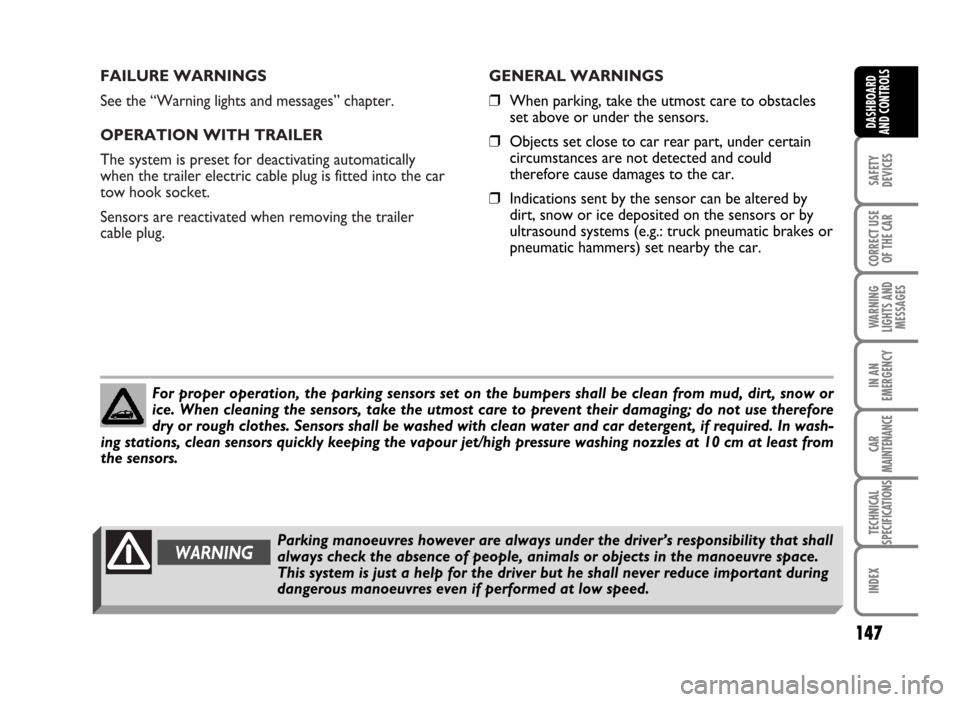
cable plug.GENERAL WARNINGS
❒When parking, take the utmost care to obstacles
set above or under the sensors.
❒Objects set close to car rear part, under certain
circumstances are not detected and could
therefore cause damages to the car.
❒Indications sent by the sensor can be altered by
dirt, snow or ice deposited on the sensors or by
ultrasound systems (e.g.: truck pneumatic brakes or
pneumatic hammers) set nearby the car.
147
SAFETY
DEVICES
CORRECT USE
OF THE CAR
WARNING
LIGHTS AND
MESSAGES
IN AN
EMERGENCY
CAR
MAINTENANCE
TECHNICAL
SPECIFICATIONS
INDEX
DASHBOARD
AND CONTROLS
For proper operation, the parking sensors set on the bumpers shall be clean from mud, dirt, snow or
ice. When cleaning the sensors, take the utmost care to prevent their damaging; do not use therefore
dry or rough clothes. Sensors shall be washed with clean water and car detergent, if required. In wash-
ing stations, clean sensors quickly keeping the vapour jet/high pressure washing nozzles at 10 cm at least from
the sensors.
WARNINGParking manoeuvres however are always under the driver’s responsibility that shall
always check the absence of people, animals or objects in the manoeuvre space.
This system is just a help for the driver but he shall never reduce important during
dangerous manoeuvres even if performed at low speed.
Page 153 of 314
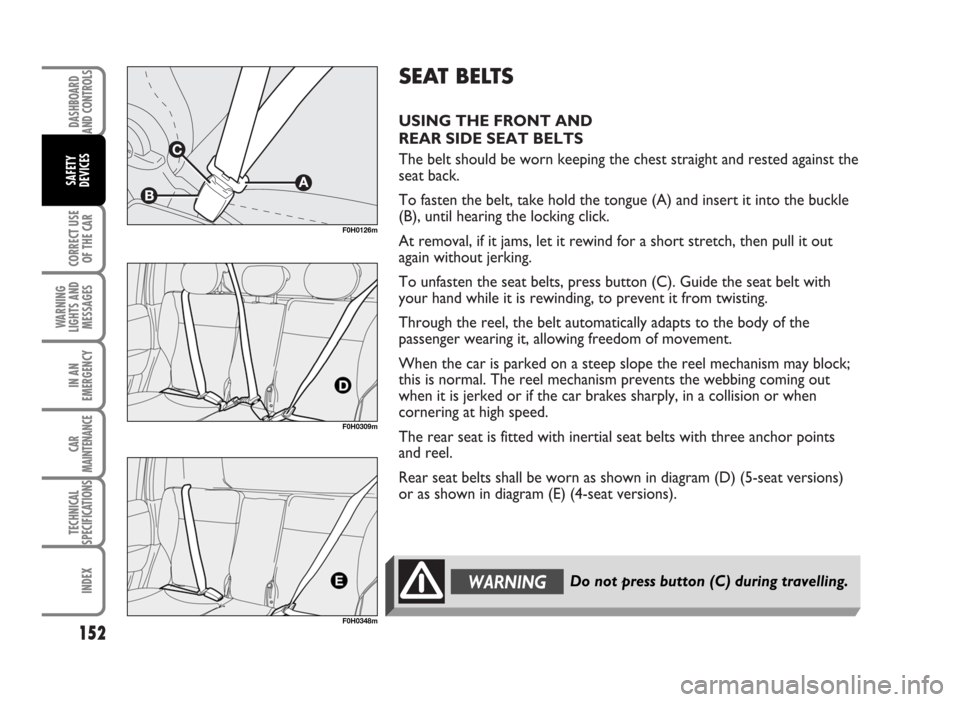
SEAT BELTS
USING THE FRONT AND
REAR SIDE SEAT BELTS
The belt should be worn keeping the chest straight and rested against the
seat back.
To fasten the belt, take hold the tongue (A) and insert it into the buckle
(B), until hearing the locking click.
At removal, if it jams, let it rewind for a short stretch, then pull it out
again without jerking.
To unfasten the seat belts, press button (C). Guide the seat belt with
your hand while it is rewinding, to prevent it from twisting.
Through the reel, the belt automatically adapts to the body of the
passenger wearing it, allowing freedom of movement.
When the car is parked on a steep slope the reel mechanism may block;
this is normal. The reel mechanism prevents the webbing coming out
when it is jerked or if the car brakes sharply, in a collision or when
cornering at high speed.
The rear seat is fitted with inertial seat belts with three anchor points
and reel.
Rear seat belts shall be worn as shown in diagram (D) (5-seat versions)
or as shown in diagram (E) (4-seat versions).
152
CORRECT USE
OF THE CAR
WARNING
LIGHTS AND
MESSAGES
IN AN
EMERGENCY
CAR
MAINTENANCE
TECHNICAL
SPECIFICATIONS
INDEX
DASHBOARD
AND CONTROLS
SAFETY
DEVICES
F0H0126m
WARNINGDo not press button (C) during travelling.
F0H0309m
F0H0348m
Page 261 of 314
260
SAFETY
DEVICES
CORRECT USE
OF THE CAR
WARNING
LIGHTS AND
MESSAGES
IN AN
EMERGENCY
TECHNICAL
SPECIFICATIONS
INDEX
DASHBOARD
AND CONTROLS
CAR
MAINTENANCE
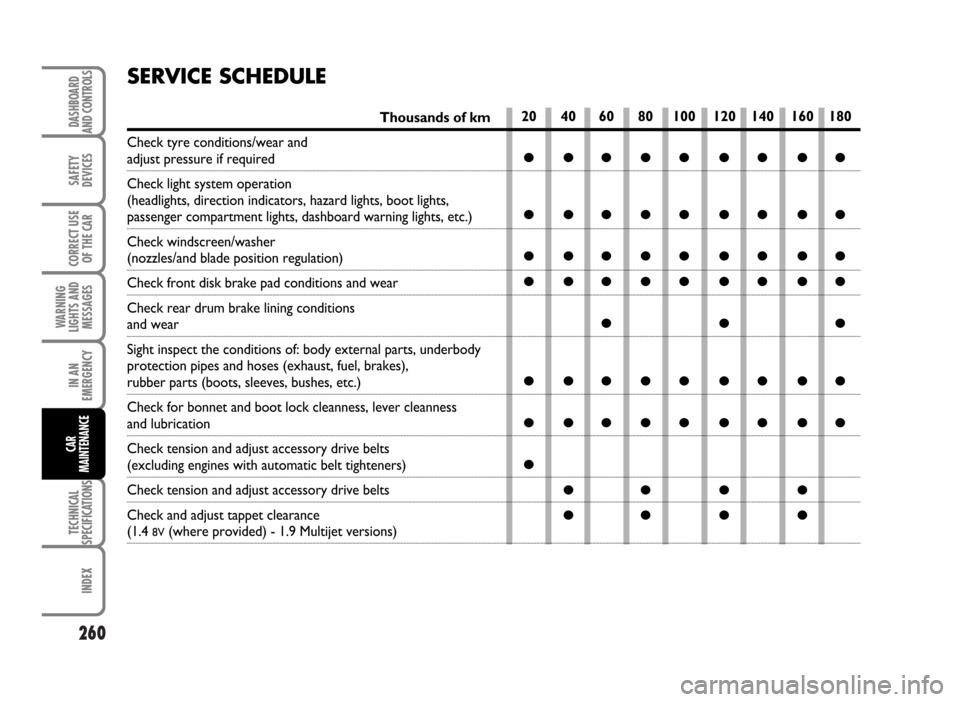
SERVICE SCHEDULE
Thousands of km
Check tyre conditions/wear and
adjust pressure if required
Check light system operation
(headlights, direction indicators, hazard lights, boot lights,
passenger compartment lights, dashboard warning lights, etc.)
Check windscreen/washer
(nozzles/and blade position regulation)
Check front disk brake pad conditions and wear
Check rear drum brake lining conditions
and wear
Sight inspect the conditions of: body external parts, underbody
protection pipes and hoses (exhaust, fuel, brakes),
rubber parts (boots, sleeves, bushes, etc.)
Check for bonnet and boot lock cleanness, lever cleanness
and lubrication
Check tension and adjust accessory drive belts
(excluding engines with automatic belt tighteners)
Check tension and adjust accessory drive belts
Check and adjust tappet clearance
(1.4 8V(where provided) - 1.9 Multijet versions)
20 40 60 80 100 120 140 160 180
●●●●● ●●●●
●●●●● ●●●●
●●●●● ●●●●
●●●●● ●●●●
●●●
●●●●● ●●●●
●●●●● ●●●●
●
●● ● ●
●● ● ●
Page 262 of 314
261
SAFETY
DEVICES
CORRECT USE
OF THE CAR
WARNING
LIGHTS AND
MESSAGES
IN AN
EMERGENCY
TECHNICAL
SPECIFICATIONS
INDEX
DASHBOARD
AND CONTROLS
CAR
MAINTENANCE
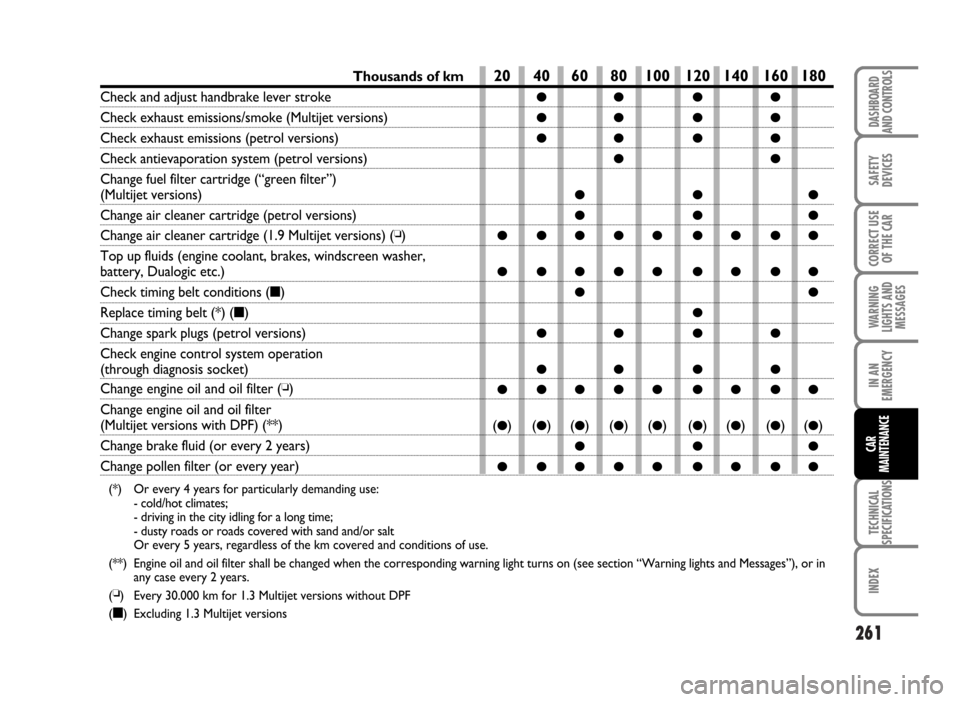
Thousands of km
Check and adjust handbrake lever stroke
Check exhaust emissions/smoke (Multijet versions)
Check exhaust emissions (petrol versions)
Check antievaporation system (petrol versions)
Change fuel filter cartridge (“green filter”)
(Multijet versions)
Change air cleaner cartridge (petrol versions)
Change air cleaner cartridge (1.9 Multijet versions) (❏)
Top up fluids (engine coolant, brakes, windscreen washer,
battery, Dualogic etc.)
Check timing belt conditions (■)
Replace timing belt (*) (■)
Change spark plugs (petrol versions)
Check engine control system operation
(through diagnosis socket)
Change engine oil and oil filter (❏)
Change engine oil and oil filter
(Multijet versions with DPF) (**)
Change brake fluid (or every 2 years)
Change pollen filter (or every year)
(*) Or every 4 years for particularly demanding use:
- cold/hot climates;
- driving in the city idling for a long time;
- dusty roads or roads covered with sand and/or salt
Or every 5 years, regardless of the km covered and conditions of use.
(**) Engine oil and oil filter shall be changed when the corresponding warning light turns on (see section “Warning lights and Messages”), or in
any case every 2 years.
(
❏) Every 30.000 km for 1.3 Multijet versions without DPF
(
■) Excluding 1.3 Multijet versions
20 40 60 80 100 120 140 160 180
●● ● ●
●● ● ●
●● ● ●
●●
●●●
●●●
●●●●● ●●●●
●●●●● ●●●●
●●
●
●● ● ●
●● ● ●
●●●●● ●●●●
(●)(●)(●)(●)(●)(●)(●)(●)(●)
●●●
●●●●● ●●●●
Page 263 of 314
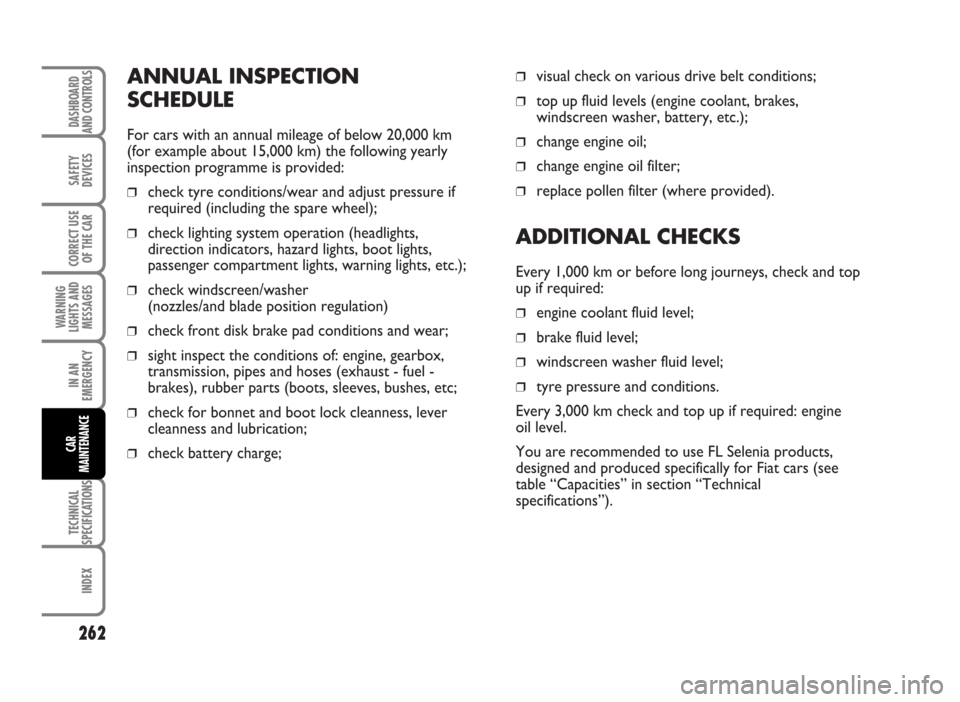
ANNUAL INSPECTION
SCHEDULE
For cars with an annual mileage of below 20,000 km
(for example about 15,000 km) the following yearly
inspection programme is provided:
❒check tyre conditions/wear and adjust pressure if
required (including the spare wheel);
❒check lighting system operation (headlights,
direction indicators, hazard lights, boot lights,
passenger compartment lights, warning lights, etc.);
❒check windscreen/washer
(nozzles/and blade position regulation)
❒check front disk brake pad conditions and wear;
❒sight inspect the conditions of: engine, gearbox,
transmission, pipes and hoses (exhaust - fuel -
brakes), rubber parts (boots, sleeves, bushes, etc;
❒check for bonnet and boot lock cleanness, lever
cleanness and lubrication;
❒check battery charge;
❒visual check on various drive belt conditions;
❒top up fluid levels (engine coolant, brakes,
windscreen washer, battery, etc.);
❒change engine oil;
❒change engine oil filter;
❒replace pollen filter (where provided).
ADDITIONAL CHECKS
Every 1,000 km or before long journeys, check and top
up if required:
❒engine coolant fluid level;
❒brake fluid level;
❒windscreen washer fluid level;
❒tyre pressure and conditions.
Every 3,000 km check and top up if required: engine
oil level.
You are recommended to use FL Selenia products,
designed and produced specifically for Fiat cars (see
table “Capacities” in section “Technical
specifications”).
262
SAFETY
DEVICES
CORRECT USE
OF THE CAR
WARNING
LIGHTS AND
MESSAGES
IN AN
EMERGENCY
TECHNICAL
SPECIFICATIONS
INDEX
DASHBOARD
AND CONTROLS
CAR
MAINTENANCE
Page 287 of 314
286
SAFETY
DEVICES
CORRECT USE
OF THE CAR
WARNING
LIGHTS AND
MESSAGES
IN AN
EMERGENCY
CAR
MAINTENANCE
INDEX
DASHBOARD
AND CONTROLS
TECHNICAL
SPECIFICATIONS
T T
E E
C C
H H
N N
I I
C C
A A
L L
S S
P P
E E
C C
I I
F F
I I
C C
A A
T T
I I
O O
N N
S S
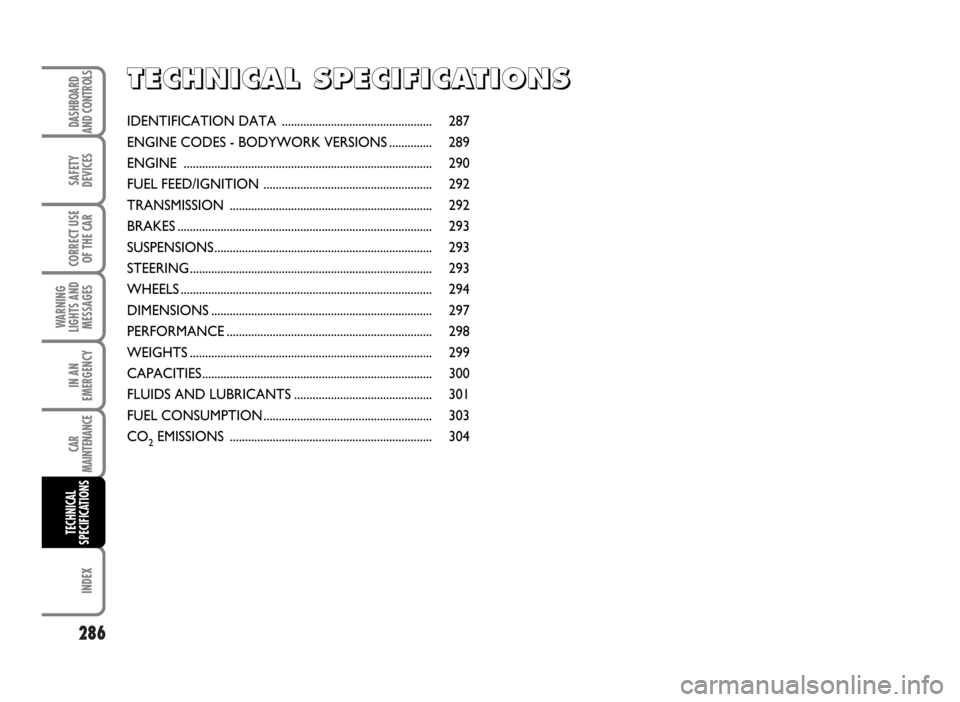
IDENTIFICATION DATA ................................................. 287
ENGINE CODES - BODYWORK VERSIONS .............. 289
ENGINE ................................................................................. 290
FUEL FEED/IGNITION ....................................................... 292
TRANSMISSION .................................................................. 292
BRAKES ................................................................................... 293
SUSPENSIONS ....................................................................... 293
STEERING............................................................................... 293
WHEELS .................................................................................. 294
DIMENSIONS ........................................................................ 297
PERFORMANCE ................................................................... 298
WEIGHTS ............................................................................... 299
CAPACITIES........................................................................... 300
FLUIDS AND LUBRICANTS ............................................. 301
FUEL CONSUMPTION ....................................................... 303
CO
2EMISSIONS .................................................................. 304
Page 294 of 314
293
SAFETY
DEVICES
CORRECT USE
OF THE CAR
WARNING
LIGHTS AND
MESSAGES
IN AN
EMERGENCY
CAR
MAINTENANCE
INDEX
DASHBOARD
AND CONTROLS
TECHNICAL
SPECIFICATIONS
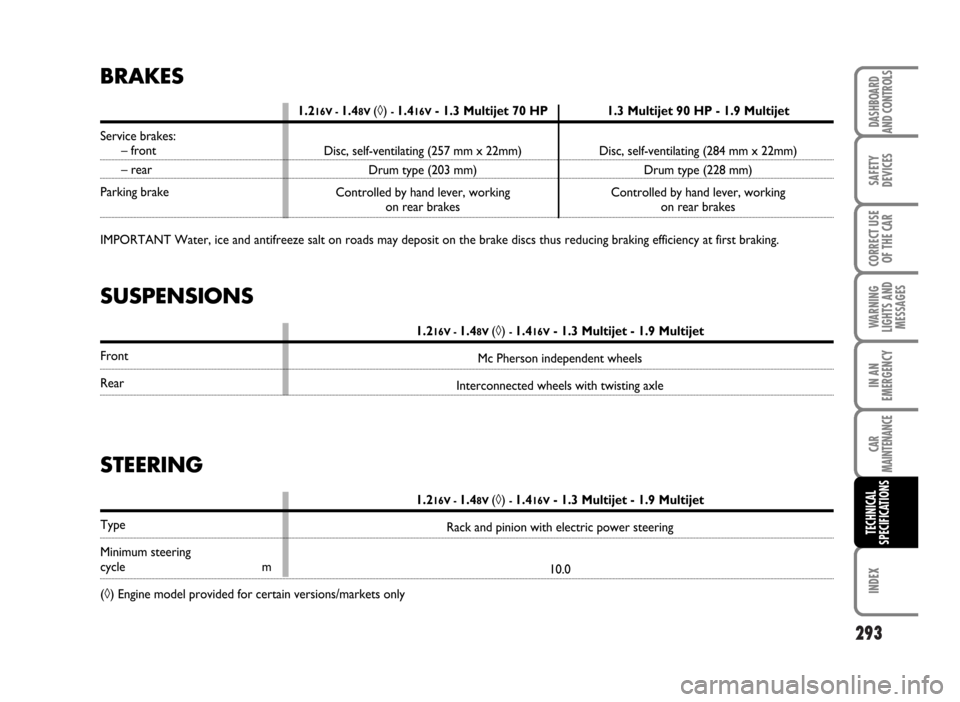
1.216V - 1.48V (◊) - 1.416V- 1.3 Multijet 70 HP
Disc, self-ventilating (257 mm x 22mm)
Drum type (203 mm)
Controlled by hand lever, working
on rear brakes
SUSPENSIONS
Front
Rear1.2
16V - 1.48V (◊) - 1.416V- 1.3 Multijet - 1.9 Multijet
Mc Pherson independent wheels
Interconnected wheels with twisting axle
STEERING
Type
Minimum steering
cycle m
(◊) Engine model provided for certain versions/markets only1.2
16V - 1.48V (◊) - 1.416V- 1.3 Multijet - 1.9 Multijet
Rack and pinion with electric power steering
10.0
1.3 Multijet 90 HP - 1.9 Multijet
Disc, self-ventilating (284 mm x 22mm)
Drum type (228 mm)
Controlled by hand lever, working
on rear brakes
BRAKES
Service brakes:– front
– rear
Parking brake
IMPORTANT Water, ice and antifreeze salt on roads may deposit on the brake discs thus reducing braking efficiency at first braking.
Page 300 of 314
299
SAFETY
DEVICES
CORRECT USE
OF THE CAR
WARNING
LIGHTS AND
MESSAGES
IN AN
EMERGENCY
CAR
MAINTENANCE
INDEX
DASHBOARD
AND CONTROLS
TECHNICAL
SPECIFICATIONS
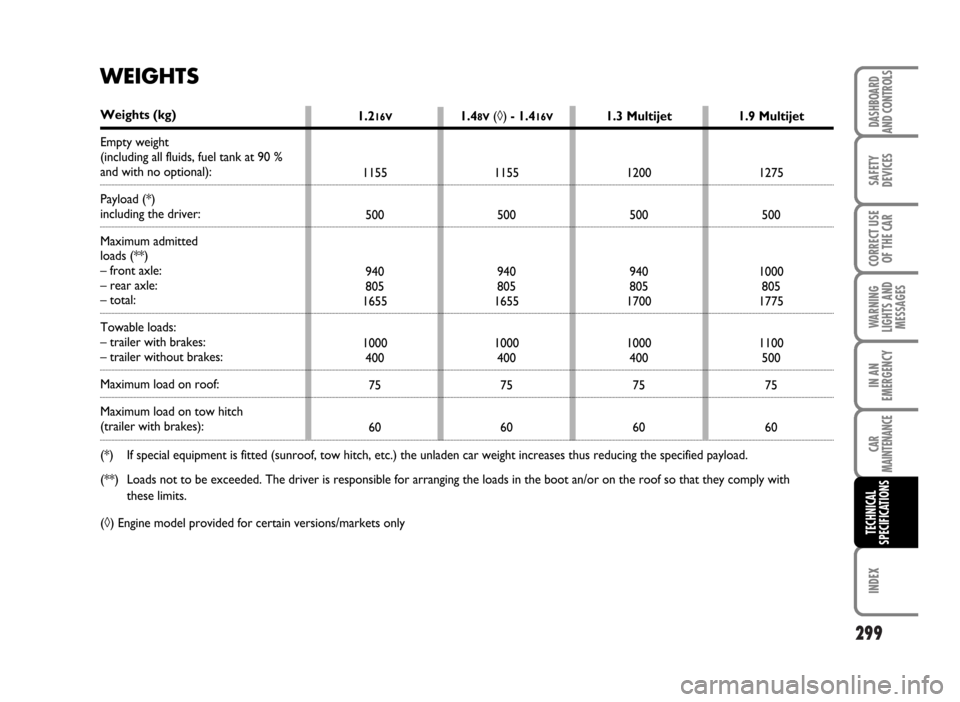
1.216V
1155
500
940
805
1655
1000
400
75
601.4
8V(◊) - 1.416V
1155
500
940
805
1655
1000
400
75
601.3 Multijet
1200
500
940
805
1700
1000
400
75
60
1.9 Multijet
1275
500
1000
805
1775
1100
500
75
60
WEIGHTS
Weights (kg)
Empty weight
(including all fluids, fuel tank at 90 %
and with no optional):
Payload (*)
including the driver:
Maximum admitted
loads (**)
– front axle:
– rear axle:
– total:
Towable loads:
– trailer with brakes:
– trailer without brakes:
Maximum load on roof:
Maximum load on tow hitch
(trailer with brakes):
(*) If special equipment is fitted (sunroof, tow hitch, etc.) the unladen car weight increases thus reducing the specified payload.
(**) Loads not to be exceeded. The driver is responsible for arranging the loads in the boot an/or on the roof so that they comply with
these limits.
(◊) Engine model provided for certain versions/markets only
Page 306 of 314
305
SAFETY
DEVICES
CORRECT USE
OF THE CAR
WARNING
LIGHTS AND
MESSAGES
IN AN
EMERGENCY
CAR
MAINTENANCE
TECHNICAL
SPECIFICATIONS
DASHBOARD
AND CONTROLS
INDEX
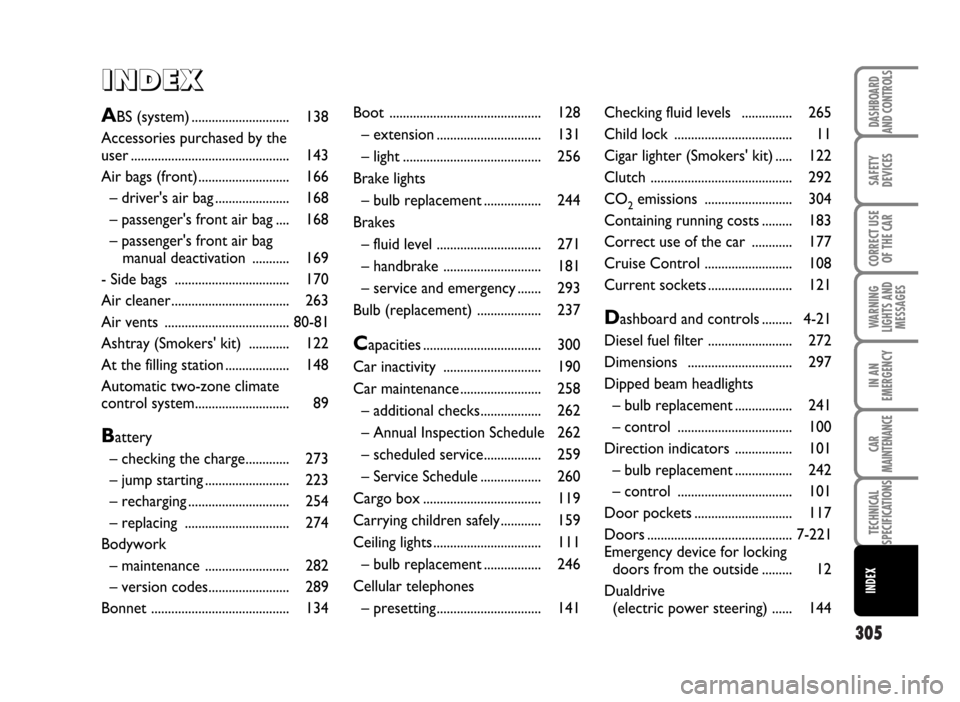
I I
N N
D D
E E
X X
ABS (system) ............................. 138
Accessories purchased by the
user ............................................... 143
Air bags (front)........................... 166
– driver's air bag ...................... 168
– passenger's front air bag .... 168
– passenger's front air bag
manual deactivation ........... 169
- Side bags .................................. 170
Air cleaner................................... 263
Air vents ..................................... 80-81
Ashtray (Smokers' kit) ............ 122
At the filling station ................... 148
Automatic two-zone climate
control system............................ 89
Battery
– checking the charge............. 273
– jump starting ......................... 223
– recharging .............................. 254
– replacing ............................... 274
Bodywork
– maintenance ......................... 282
– version codes........................ 289
Bonnet ......................................... 134Boot ............................................. 128
– extension ............................... 131
– light ......................................... 256
Brake lights
– bulb replacement ................. 244
Brakes
– fluid level ............................... 271
– handbrake ............................. 181
– service and emergency ....... 293
Bulb (replacement) ................... 237
Capacities ................................... 300
Car inactivity ............................. 190
Car maintenance ........................ 258
– additional checks.................. 262
– Annual Inspection Schedule 262
– scheduled service................. 259
– Service Schedule .................. 260
Cargo box ................................... 119
Carrying children safely ............ 159
Ceiling lights ................................ 111
– bulb replacement ................. 246
Cellular telephones
– presetting............................... 141Checking fluid levels ............... 265
Child lock ................................... 11
Cigar lighter (Smokers' kit) ..... 122
Clutch .......................................... 292
CO
2emissions .......................... 304
Containing running costs ......... 183
Correct use of the car ............ 177
Cruise Control .......................... 108
Current sockets ......................... 121
Dashboard and controls ......... 4-21
Diesel fuel filter ......................... 272
Dimensions ............................... 297
Dipped beam headlights
– bulb replacement ................. 241
– control .................................. 100
Direction indicators ................. 101
– bulb replacement ................. 242
– control .................................. 101
Door pockets ............................. 117
Doors ........................................... 7-221
Emergency device for locking
doors from the outside ......... 12
Dualdrive
(electric power steering) ...... 144