clock FIAT IDEA 2008 1.G User Guide
[x] Cancel search | Manufacturer: FIAT, Model Year: 2008, Model line: IDEA, Model: FIAT IDEA 2008 1.GPages: 210, PDF Size: 3.64 MB
Page 50 of 210
49
SAFETY
DEVICES
CORRECT USE
OF THE CAR
WARNING
LIGHTS AND
MESSAGES
IN AN
EMERGENCY
CAR
MAINTENANCE
TECHNICAL
SPECIFICATIONS
INDEX
DASHBOARD
AND CONTROLS
TEMPERATURE ADJUSTMENT
Proceed as follows:
Turn knob B-fig. 64clockwise (pointer
to red sector) to increase temperature or
turn it counter-clockwise to decrease
temperature;
FAN SPEED ADJUSTMENT
Proceed as follows:
❒open completely central (4) and side
(2) fig. 60vents;
❒turn knob B-fig. 64to the blue sec-
tor;
❒set Ato the required speed;
❒set knob Eto «;
❒set knob Fto Úto turn air recir-
culation off.RECIRCULATION
Set knob F-fig. 64to Ú.
This function is particularly useful when
the outside air is heavily polluted (in a traf-
fic jam, tunnel, etc.). However, it is bet-
ter not to use it for long periods, espe-
cially if there are several people in the car
to prevent window steaming up.
IMPORTANT The inside air recirculation
system makes it possible to reach the re-
quired “heating” or “cooling” conditions
faster. Do not use the air recirculation
function on rainy/cold days as it would
considerably increase the possibility of the
windows misting inside.
QUICK HEATING
Proceed as follows:
❒close all dashboard vents;
❒turn knob B-fig. 64to the red sector;
❒turn knob Ato 4 -;
❒turn knob Eto «.QUICK WINDSCREEN AND
FRONT SIDE WINDOW
DEMISTING/DEFROSTING
Proceed as follows:
❒turn knob B-fig. 64to the red sector;
❒turn knob Ato 4 -;
❒turn knob Eto «;
❒set knob Fto Úto turn air recir-
culation off.
After demisting/defrosting, operate the
controls to restore the required comfort.
Preventive demisting procedure
In the event of considerable outside mois-
ture and/or rain and/or considerable dif-
ferences in temperature inside and out-
side the passenger compartment, perform
the following preventive demisting proce-
dure:
❒set knob F-fig. 64 to Úto turn air
recirculation off;
❒turn knob Bto the red sector;
❒turn knob Ato 2;
036-092 idea GB 1 ed 10-07-2008 16:12 Pagina 49
Page 54 of 210
53
SAFETY
DEVICES
CORRECT USE
OF THE CAR
WARNING
LIGHTS AND
MESSAGES
IN AN
EMERGENCY
CAR
MAINTENANCE
TECHNICAL
SPECIFICATIONS
INDEX
DASHBOARD
AND CONTROLS
During fully automatic operation, the on-
ly manual settings required are the fol-
lowing:
❒MONO, to align the air temperature
and distribution set on the passenger’s
side (front or rear) with that on the
driver’s side;
❒…, air recirculation, to keep it al-
ways on or off;
❒-, to speed up demisting/defrosting
of windscreen, front side windows,
rear window and door mirrors;
❒(, to demist/defrost the rear heat-
ed window and the door mirrors.
During completely automatic system op-
eration, the temperatures, air distribution
and the fan speed set can be changed at
any time through the relevant buttons or
knobs: the system will automatically
change its settings to adjust to the new re-
quirements.
During full automatic operation (FULL
AUTO), any change in air distribution
and/or air flow and/or compressor turn-
ing on and/or air recirculation will obtain
FULLdisappearing. In this way functions
will be controlled manually until pressing
the AUTObutton again. The fan speed is
the same for all passenger compartment
areas.With one or more functions engaged man-
ually, the adjustment of the temperature
of the air admitted to the passenger com-
partment continues to be controlled au-
tomatically by the system, except with the
climate control compressor off. In fact, in
this condition, the air admitted to the pas-
senger compartment cannot have a low-
er temperature than the outside air.
CONTROLS
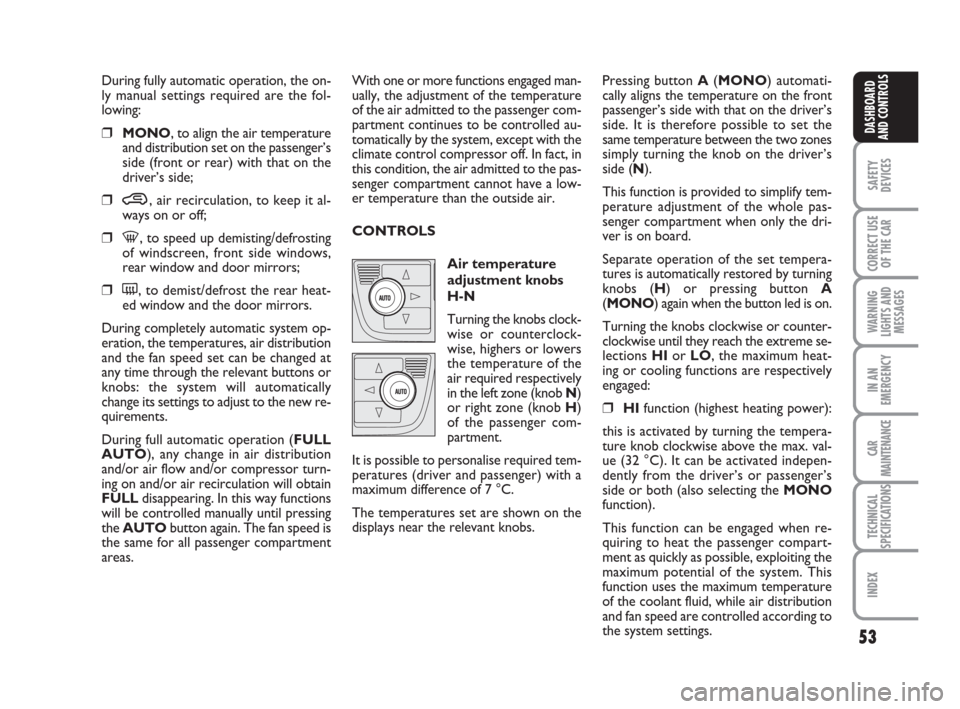
Air temperature
adjustment knobs
H-N
Turning the knobs clock-
wise or counterclock-
wise, highers or lowers
the temperature of the
air required respectively
in the left zone (knob N)
or right zone (knob H)
of the passenger com-
partment.
It is possible to personalise required tem-
peratures (driver and passenger) with a
maximum difference of 7 °C.
The temperatures set are shown on the
displays near the relevant knobs.Pressing button A(MONO) automati-
cally aligns the temperature on the front
passenger’s side with that on the driver’s
side. It is therefore possible to set the
same temperature between the two zones
simply turning the knob on the driver’s
side (N).
This function is provided to simplify tem-
perature adjustment of the whole pas-
senger compartment when only the dri-
ver is on board.
Separate operation of the set tempera-
tures is automatically restored by turning
knobs (H) or pressing button A
(MONO) again when the button led is on.
Turning the knobs clockwise or counter-
clockwise until they reach the extreme se-
lections HIor LO, the maximum heat-
ing or cooling functions are respectively
engaged:
❒HIfunction (highest heating power):
this is activated by turning the tempera-
ture knob clockwise above the max. val-
ue (32 °C). It can be activated indepen-
dently from the driver’s or passenger’s
side or both (also selecting the MONO
function).
This function can be engaged when re-
quiring to heat the passenger compart-
ment as quickly as possible, exploiting the
maximum potential of the system. This
function uses the maximum temperature
of the coolant fluid, while air distribution
and fan speed are controlled according to
the system settings.
036-092 idea GB 1 ed 10-07-2008 16:12 Pagina 53
Page 55 of 210
54
SAFETY
DEVICES
CORRECT USE
OF THE CAR
WARNING
LIGHTS AND
MESSAGES
IN AN
EMERGENCY
CAR
MAINTENANCE
TECHNICAL
SPECIFICATIONS
INDEX
DASHBOARD
AND CONTROLS
More particularly, max. fan speed will not
be immediately engaged if coolant is not
hot enough; this to prevent admitting air
that is not warm enough to the passenger
compartment.
All manual settings are however possible
with this function on.
To switch the function off, simply turn the
temperature knob counterclockwise and
set the required temperature.
❒LOfunction (highest cooling power):
this is activated by turning the tempera-
ture knob counterclockwise below the
min. value (16 °C). It can be activated in-
dependently from the driver’s or passen-
ger’s side or both (also selecting the
MONOfunction).
This function can be engaged when re-
quiring to cool the passenger compart-
ment as quickly as possible, exploiting the
maximum potential of the system. This
function engages inside air recirculation
and climate control compressor, while air
distribution and fan speed are controlled
according to environmental conditions. All manual settings are however possible
with this function on.
To switch the function off, simply turn the
temperature knob clockwise and set the
required temperature.
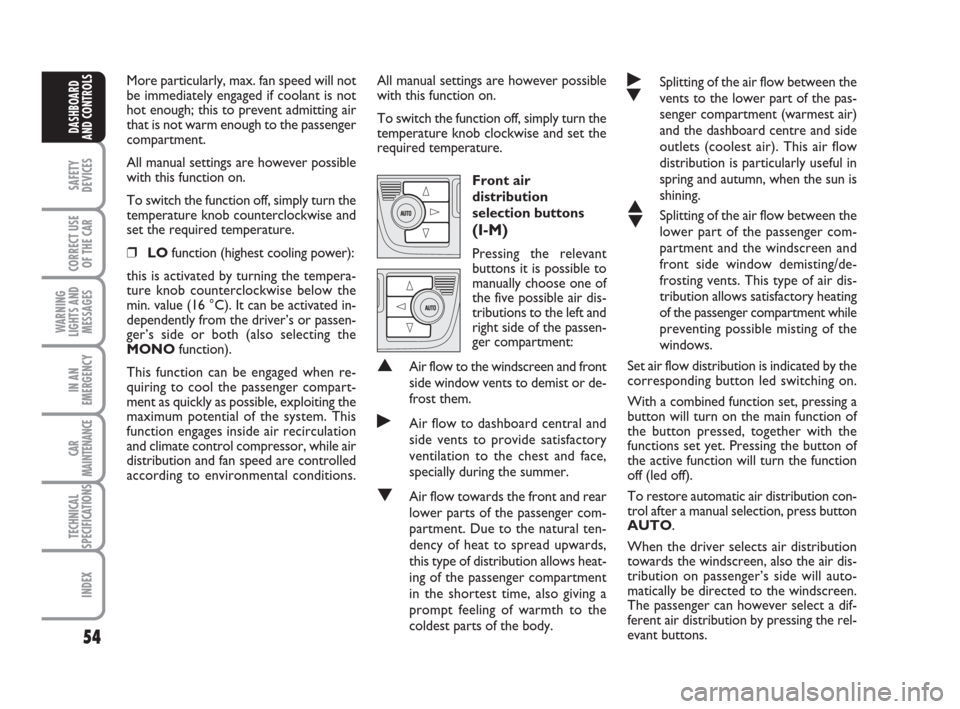
Front air
distribution
selection buttons
(I-M)
Pressing the relevant
buttons it is possible to
manually choose one of
the five possible air dis-
tributions to the left and
right side of the passen-
ger compartment:
▲Air flow to the windscreen and front
side window vents to demist or de-
frost them.
˙Air flow to dashboard central and
side vents to provide satisfactory
ventilation to the chest and face,
specially during the summer.
▼Air flow towards the front and rear
lower parts of the passenger com-
partment. Due to the natural ten-
dency of heat to spread upwards,
this type of distribution allows heat-
ing of the passenger compartment
in the shortest time, also giving a
prompt feeling of warmth to the
coldest parts of the body.
˙
▼Splitting of the air flow between the
vents to the lower part of the pas-
senger compartment (warmest air)
and the dashboard centre and side
outlets (coolest air). This air flow
distribution is particularly useful in
spring and autumn, when the sun is
shining.
▲
▼Splitting of the air flow between the
lower part of the passenger com-
partment and the windscreen and
front side window demisting/de-
frosting vents. This type of air dis-
tribution allows satisfactory heating
of the passenger compartment while
preventing possible misting of the
windows.
Set air flow distribution is indicated by the
corresponding button led switching on.
With a combined function set, pressing a
button will turn on the main function of
the button pressed, together with the
functions set yet. Pressing the button of
the active function will turn the function
off (led off).
To restore automatic air distribution con-
trol after a manual selection, press button
AUTO.
When the driver selects air distribution
towards the windscreen, also the air dis-
tribution on passenger’s side will auto-
matically be directed to the windscreen.
The passenger can however select a dif-
ferent air distribution by pressing the rel-
evant buttons.
036-092 idea GB 1 ed 10-07-2008 16:12 Pagina 54
Page 74 of 210
73
SAFETY
DEVICES
CORRECT USE
OF THE CAR
WARNING
LIGHTS AND
MESSAGES
IN AN
EMERGENCY
CAR
MAINTENANCE
TECHNICAL
SPECIFICATIONS
INDEX
DASHBOARD
AND CONTROLS
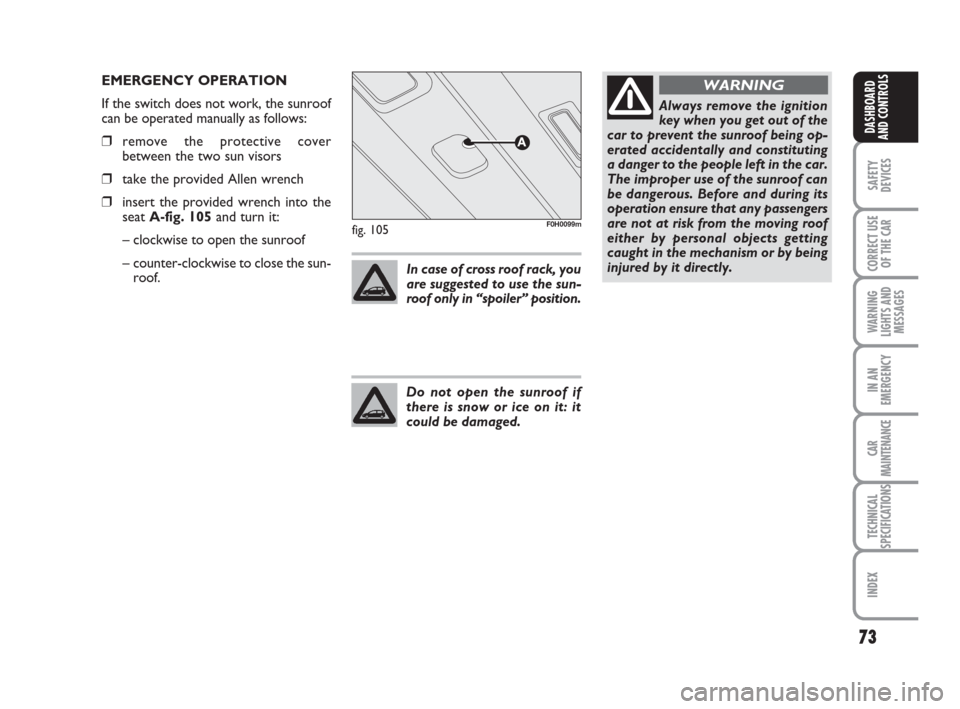
fig. 105F0H0099m
EMERGENCY OPERATION
If the switch does not work, the sunroof
can be operated manually as follows:
❒remove the protective cover
between the two sun visors
❒take the provided Allen wrench
❒insert the provided wrench into the
seat A-fig. 105and turn it:
– clockwise to open the sunroof
– counter-clockwise to close the sun-
roof.In case of cross roof rack, you
are suggested to use the sun-
roof only in “spoiler” position.
Do not open the sunroof if
there is snow or ice on it: it
could be damaged.
Always remove the ignition
key when you get out of the
car to prevent the sunroof being op-
erated accidentally and constituting
a danger to the people left in the car.
The improper use of the sunroof can
be dangerous. Before and during its
operation ensure that any passengers
are not at risk from the moving roof
either by personal objects getting
caught in the mechanism or by being
injured by it directly.
WARNING
036-092 idea GB 1 ed 10-07-2008 16:12 Pagina 73
Page 135 of 210
134
CAR
MAINTENANCE
TECHNICAL
SPECIFICATIONS
INDEX
DASHBOARD
AND CONTROLS
SAFETY
DEVICES
CORRECT USE
OF THE CAR
WARNING
LIGHTS AND
MESSAGES
IN AN
EMERGENCY
DOOR
OPENING/CLOSING
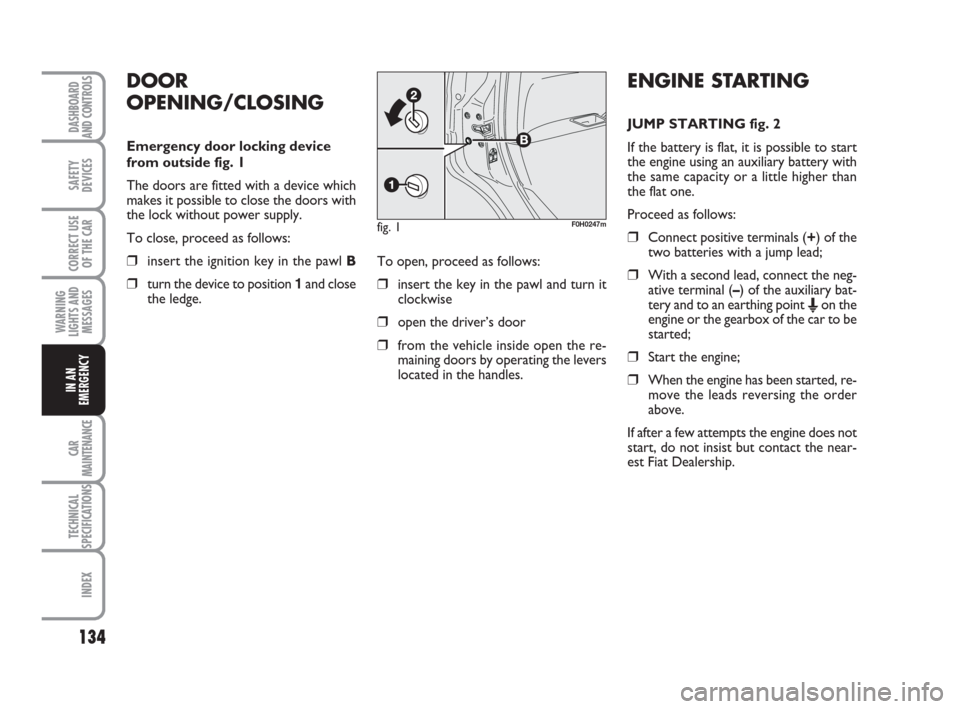
Emergency door locking device
from outside fig. 1
The doors are fitted with a device which
makes it possible to close the doors with
the lock without power supply.
To close, proceed as follows:
❒insert the ignition key in the pawl B
❒turn the device to position 1and close
the ledge.To open, proceed as follows:❒insert the key in the pawl and turn it
clockwise
❒open the driver’s door
❒from the vehicle inside open the re-
maining doors by operating the levers
located in the handles.
fig. 1F0H0247m
ENGINE STARTING
JUMP STARTING fig. 2
If the battery is flat, it is possible to start
the engine using an auxiliary battery with
the same capacity or a little higher than
the flat one.
Proceed as follows:
❒Connect positive terminals (+) of the
two batteries with a jump lead;
❒With a second lead, connect the neg-
ative terminal (–) of the auxiliary bat-
tery and to an earthing point
Eon the
engine or the gearbox of the car to be
started;
❒Start the engine;
❒When the engine has been started, re-
move the leads reversing the order
above.
If after a few attempts the engine does not
start, do not insist but contact the near-
est Fiat Dealership.
133-160 idea GB 1 ed 10-07-2008 8:30 Pagina 134
Page 140 of 210
139
CAR
MAINTENANCE
TECHNICAL
SPECIFICATIONS
INDEX
DASHBOARD
AND CONTROLS
SAFETY
DEVICES
CORRECT USE
OF THE CAR
WARNING
LIGHTS AND
MESSAGES
IN AN
EMERGENCY
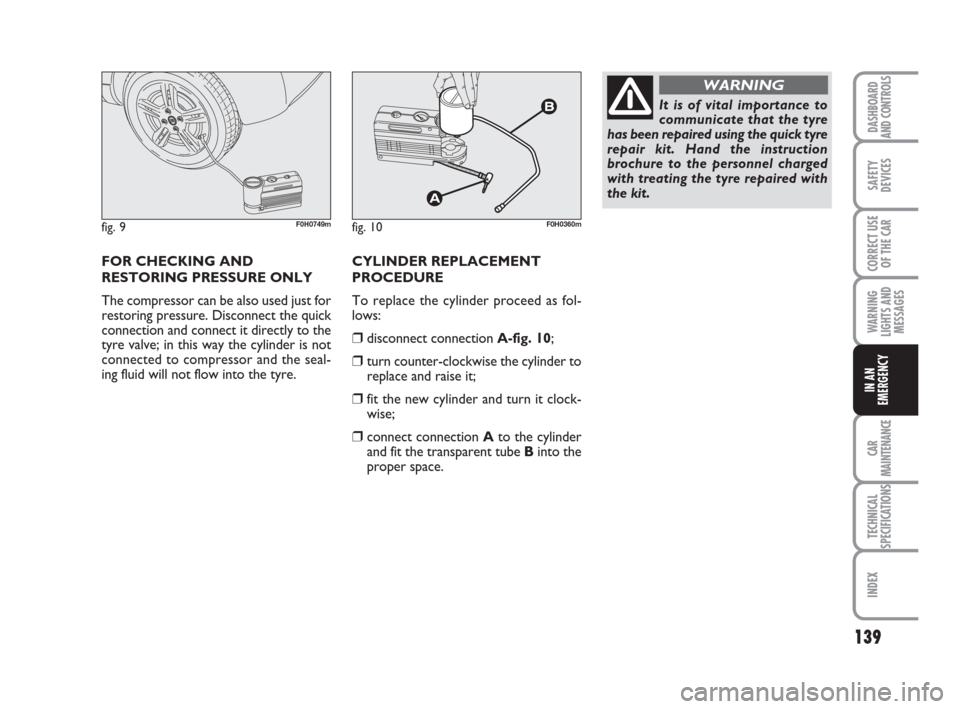
fig. 9F0H0749m
FOR CHECKING AND
RESTORING PRESSURE ONLY
The compressor can be also used just for
restoring pressure. Disconnect the quick
connection and connect it directly to the
tyre valve; in this way the cylinder is not
connected to compressor and the seal-
ing fluid will not flow into the tyre.
fig. 10F0H0360m
CYLINDER REPLACEMENT
PROCEDURE
To replace the cylinder proceed as fol-
lows:
❒disconnect connection A-fig. 10;
❒turn counter-clockwise the cylinder to
replace and raise it;
❒fit the new cylinder and turn it clock-
wise;
❒connect connection Ato the cylinder
and fit the transparent tube Binto the
proper space.
It is of vital importance to
communicate that the tyre
has been repaired using the quick tyre
repair kit. Hand the instruction
brochure to the personnel charged
with treating the tyre repaired with
the kit.
WARNING
133-160 idea GB 1 ed 10-07-2008 8:30 Pagina 139
Page 146 of 210
145
CAR
MAINTENANCE
TECHNICAL
SPECIFICATIONS
INDEX
DASHBOARD
AND CONTROLS
SAFETY
DEVICES
CORRECT USE
OF THE CAR
WARNING
LIGHTS AND
MESSAGES
IN AN
EMERGENCY
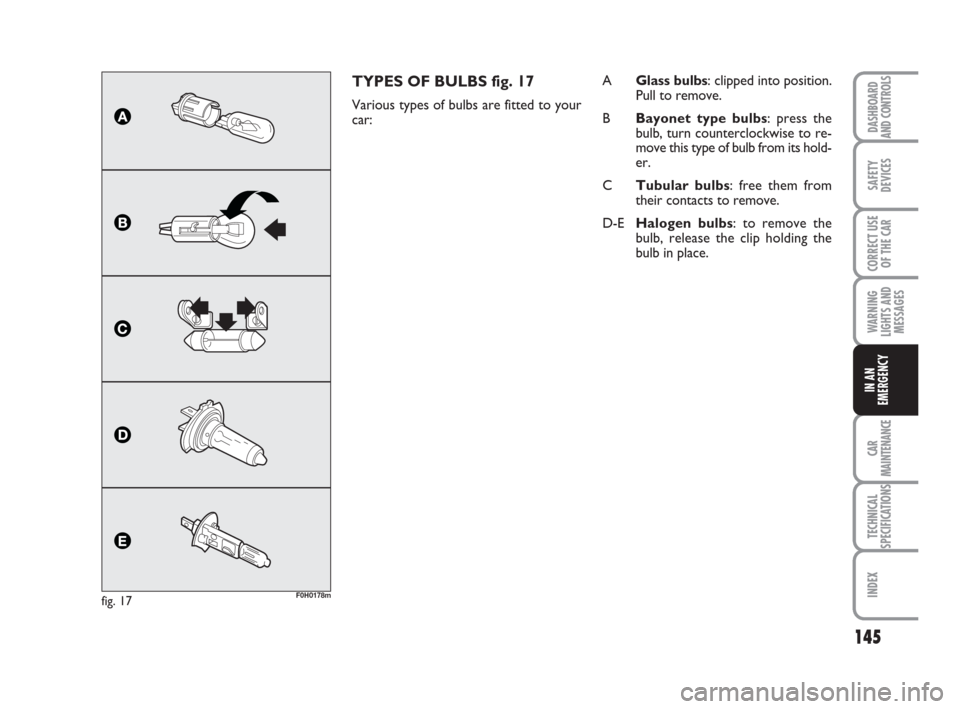
TYPES OF BULBS fig. 17
Various types of bulbs are fitted to your
car:
fig. 17F0H0178m
AGlass bulbs: clipped into position.
Pull to remove.
BBayonet type bulbs: press the
bulb, turn counterclockwise to re-
move this type of bulb from its hold-
er.
CTubular bulbs: free them from
their contacts to remove.
D-EHalogen bulbs: to remove the
bulb, release the clip holding the
bulb in place.
133-160 idea GB 1 ed 10-07-2008 8:30 Pagina 145
Page 148 of 210
147
CAR
MAINTENANCE
TECHNICAL
SPECIFICATIONS
INDEX
DASHBOARD
AND CONTROLS
SAFETY
DEVICES
CORRECT USE
OF THE CAR
WARNING
LIGHTS AND
MESSAGES
IN AN
EMERGENCY
IF AN EXTERIOR LIGHT
BURNS OUT
For the type of bulb and power rating, see
“When needing to change a bulb”.
FRONT LIGHT UNITS
The front light units contain the sidelights,
the dipped beam, main beam, direction in-
dicator and fog light bulbs.
To change the bulbs of the sidelights, low
beams, direction indicators and fog lights
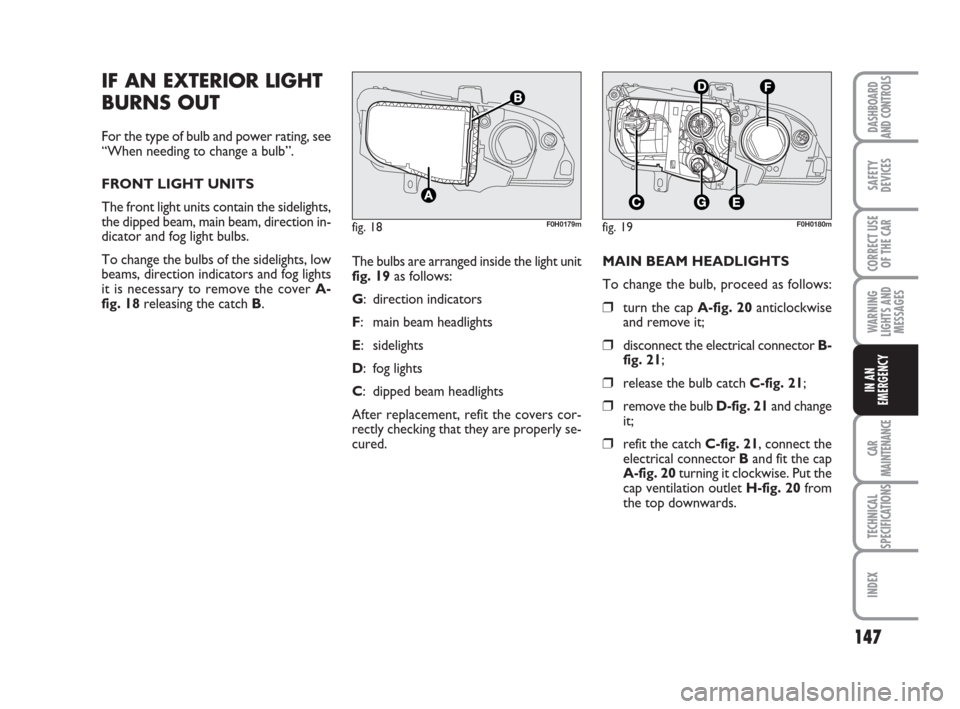
it is necessary to remove the cover A-
fig. 18releasing the catch B.
fig. 18F0H0179mfig. 19F0H0180m
The bulbs are arranged inside the light unit
fig. 19 as follows:
G: direction indicators
F: main beam headlights
E: sidelights
D: fog lights
C: dipped beam headlights
After replacement, refit the covers cor-
rectly checking that they are properly se-
cured.MAIN BEAM HEADLIGHTS
To change the bulb, proceed as follows:
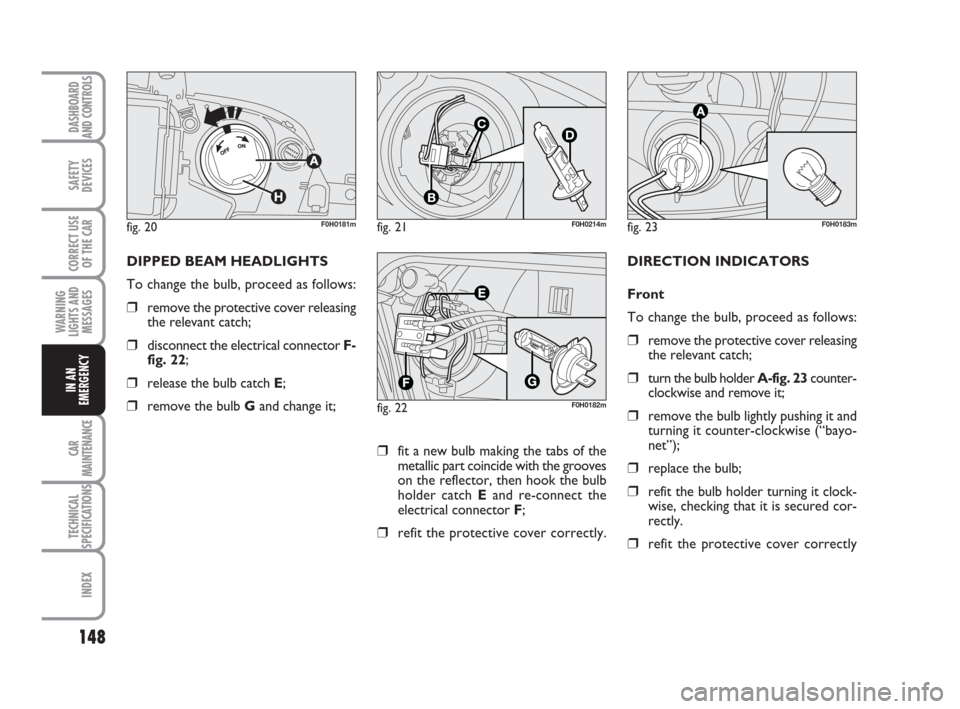
❒turn the cap A-fig. 20anticlockwise
and remove it;
❒disconnect the electrical connector B-
fig. 21;
❒release the bulb catch C-fig. 21;
❒remove the bulb D-fig. 21and change
it;
❒refit the catch C-fig. 21, connect the
electrical connector Band fit the cap
A-fig. 20turning it clockwise. Put the
cap ventilation outlet H-fig. 20from
the top downwards.
133-160 idea GB 1 ed 10-07-2008 8:30 Pagina 147
Page 149 of 210
148
CAR
MAINTENANCE
TECHNICAL
SPECIFICATIONS
INDEX
DASHBOARD
AND CONTROLS
SAFETY
DEVICES
CORRECT USE
OF THE CAR
WARNING
LIGHTS AND
MESSAGES
IN AN
EMERGENCY
fig. 20F0H0181mfig. 21
C
B
D
F0H0214m
fig. 22F0H0182m
DIPPED BEAM HEADLIGHTS
To change the bulb, proceed as follows:
❒remove the protective cover releasing
the relevant catch;
❒disconnect the electrical connector F-
fig. 22;
❒release the bulb catch E;
❒remove the bulb Gand change it;
fig. 23F0H0183m
DIRECTION INDICATORS
Front
To change the bulb, proceed as follows:
❒remove the protective cover releasing
the relevant catch;
❒turn the bulb holder A-fig. 23counter-
clockwise and remove it;
❒remove the bulb lightly pushing it and
turning it counter-clockwise (“bayo-
net”);
❒replace the bulb;
❒refit the bulb holder turning it clock-
wise, checking that it is secured cor-
rectly.
❒refit the protective cover correctly
❒fit a new bulb making the tabs of the
metallic part coincide with the grooves
on the reflector, then hook the bulb
holder catch Eand re-connect the
electrical connector F;
❒refit the protective cover correctly.
133-160 idea GB 1 ed 10-07-2008 8:30 Pagina 148
Page 150 of 210
149
CAR
MAINTENANCE
TECHNICAL
SPECIFICATIONS
INDEX
DASHBOARD
AND CONTROLS
SAFETY
DEVICES
CORRECT USE
OF THE CAR
WARNING
LIGHTS AND
MESSAGES
IN AN
EMERGENCY
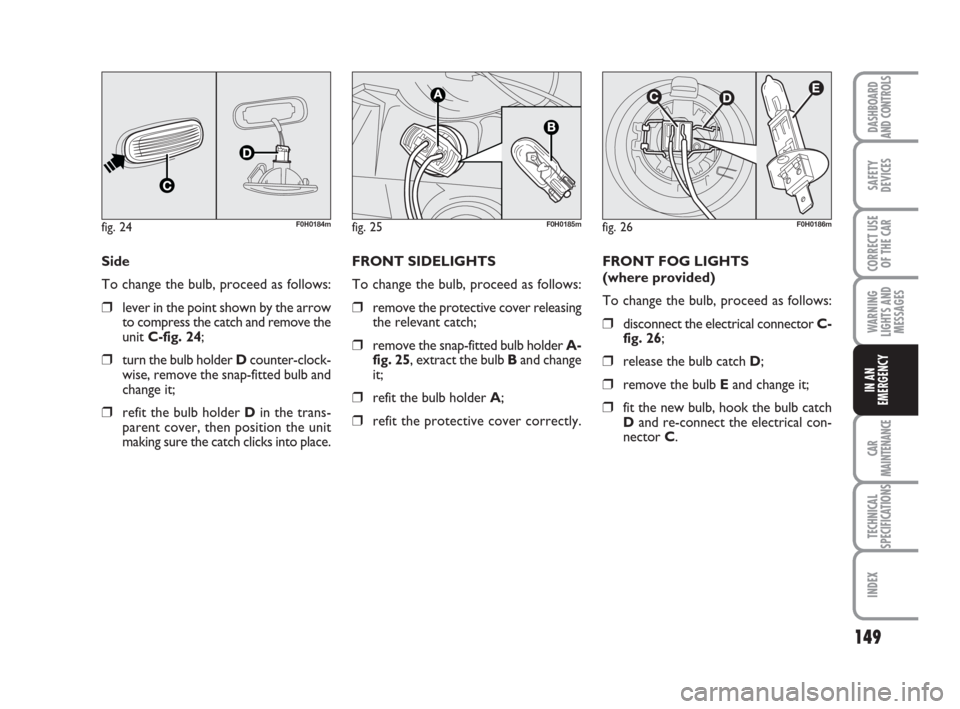
Side
To change the bulb, proceed as follows:
❒lever in the point shown by the arrow
to compress the catch and remove the
unit C-fig. 24;
❒turn the bulb holder Dcounter-clock-
wise, remove the snap-fitted bulb and
change it;
❒refit the bulb holder Din the trans-
parent cover, then position the unit
making sure the catch clicks into place.
fig. 24F0H0184m
FRONT SIDELIGHTS
To change the bulb, proceed as follows:
❒remove the protective cover releasing
the relevant catch;
❒remove the snap-fitted bulb holder A-
fig. 25, extract the bulb Band change
it;
❒refit the bulb holder A;
❒refit the protective cover correctly.FRONT FOG LIGHTS
(where provided)
To change the bulb, proceed as follows:
❒disconnect the electrical connector C-
fig. 26;
❒release the bulb catch D;
❒remove the bulb Eand change it;
❒fit the new bulb, hook the bulb catch
Dand re-connect the electrical con-
nector C.
fig. 25F0H0185mfig. 26F0H0186m
133-160 idea GB 1 ed 10-07-2008 8:30 Pagina 149