brake FIAT IDEA 2008 1.G Owner's Guide
[x] Cancel search | Manufacturer: FIAT, Model Year: 2008, Model line: IDEA, Model: FIAT IDEA 2008 1.GPages: 210, PDF Size: 3.64 MB
Page 161 of 210
160
CAR
MAINTENANCE
TECHNICAL
SPECIFICATIONS
INDEX
DASHBOARD
AND CONTROLS
SAFETY
DEVICES
CORRECT USE
OF THE CAR
WARNING
LIGHTS AND
MESSAGES
IN AN
EMERGENCY
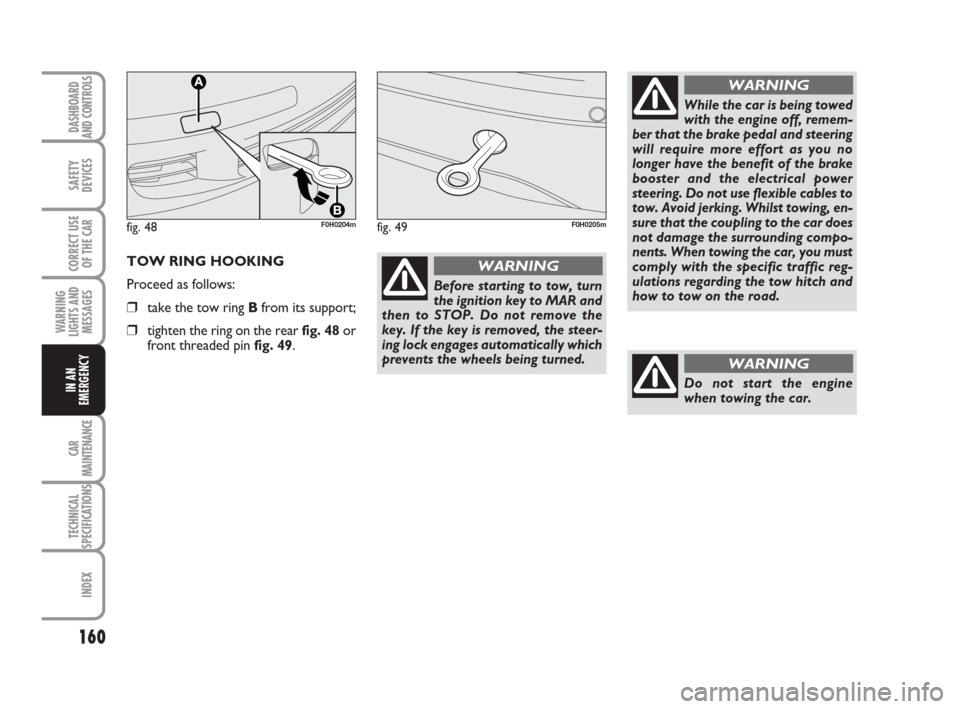
TOW RING HOOKING
Proceed as follows:
❒take the tow ring Bfrom its support;
❒tighten the ring on the rear fig. 48 or
front threaded pin fig. 49.
fig. 48F0H0204mfig. 49F0H0205m
Before starting to tow, turn
the ignition key to MAR and
then to STOP. Do not remove the
key. If the key is removed, the steer-
ing lock engages automatically which
prevents the wheels being turned.
WARNING
While the car is being towed
with the engine off, remem-
ber that the brake pedal and steering
will require more effort as you no
longer have the benefit of the brake
booster and the electrical power
steering. Do not use flexible cables to
tow. Avoid jerking. Whilst towing, en-
sure that the coupling to the car does
not damage the surrounding compo-
nents. When towing the car, you must
comply with the specific traffic reg-
ulations regarding the tow hitch and
how to tow on the road.
WARNING
Do not start the engine
when towing the car.
WARNING
133-160 idea GB 1 ed 10-07-2008 8:30 Pagina 160
Page 164 of 210
163
TECHNICAL
SPECIFICATIONS
INDEX
DASHBOARD
AND CONTROLS
SAFETY
DEVICES
CORRECT USE
OF THE CAR
WARNING
LIGHTS AND
MESSAGES
IN AN
EMERGENCY
CAR
MAINTENANCE
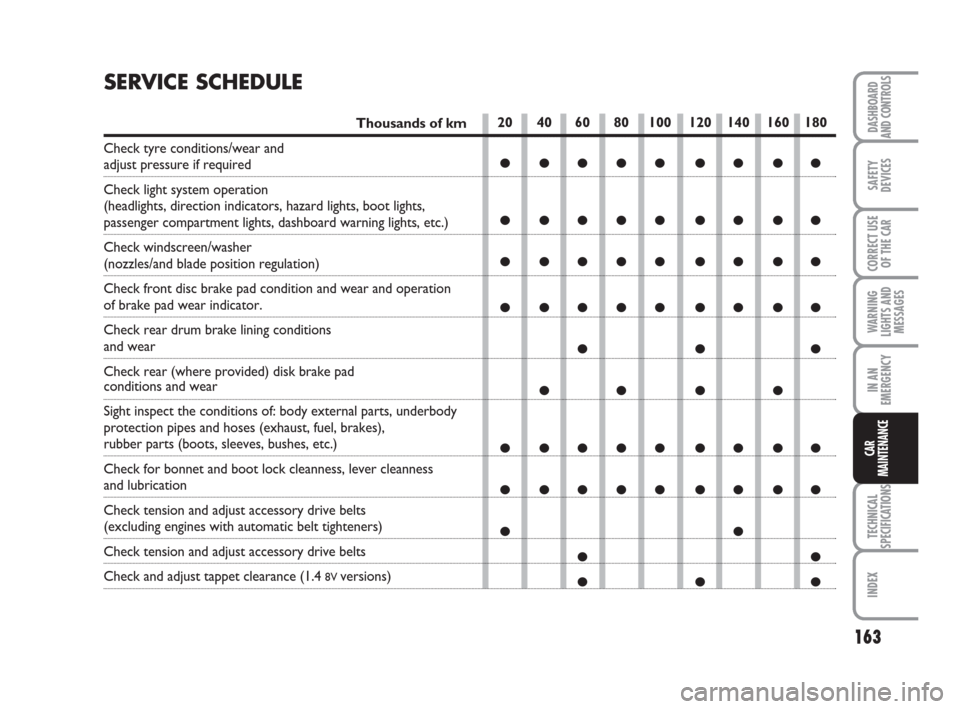
SERVICE SCHEDULE
Thousands of km
Check tyre conditions/wear and
adjust pressure if required
Check light system operation
(headlights, direction indicators, hazard lights, boot lights,
passenger compartment lights, dashboard warning lights, etc.)
Check windscreen/washer
(nozzles/and blade position regulation)
Check front disc brake pad condition and wear and operation
of brake pad wear indicator.
Check rear drum brake lining conditions
and wear
Check rear (where provided) disk brake pad
conditions and wear
Sight inspect the conditions of: body external parts, underbody
protection pipes and hoses (exhaust, fuel, brakes),
rubber parts (boots, sleeves, bushes, etc.)
Check for bonnet and boot lock cleanness, lever cleanness
and lubrication
Check tension and adjust accessory drive belts
(excluding engines with automatic belt tighteners)
Check tension and adjust accessory drive belts
Check and adjust tappet clearance (1.4 8V versions)
20 40 60 80 100 120 140 160 180
●●●●● ●●●●
●●●●● ●●●●
●●●●● ●●●●
●●●●● ●●●●
●●●
●● ● ●
●●●●● ●●●●
●●●●● ●●●●
●●
●●
●●●
161-180 idea GB 1 ed 10-07-2008 8:30 Pagina 163
Page 165 of 210
164
TECHNICAL
SPECIFICATIONS
INDEX
DASHBOARD
AND CONTROLS
SAFETY
DEVICES
CORRECT USE
OF THE CAR
WARNING
LIGHTS AND
MESSAGES
IN AN
EMERGENCY
CAR
MAINTENANCE
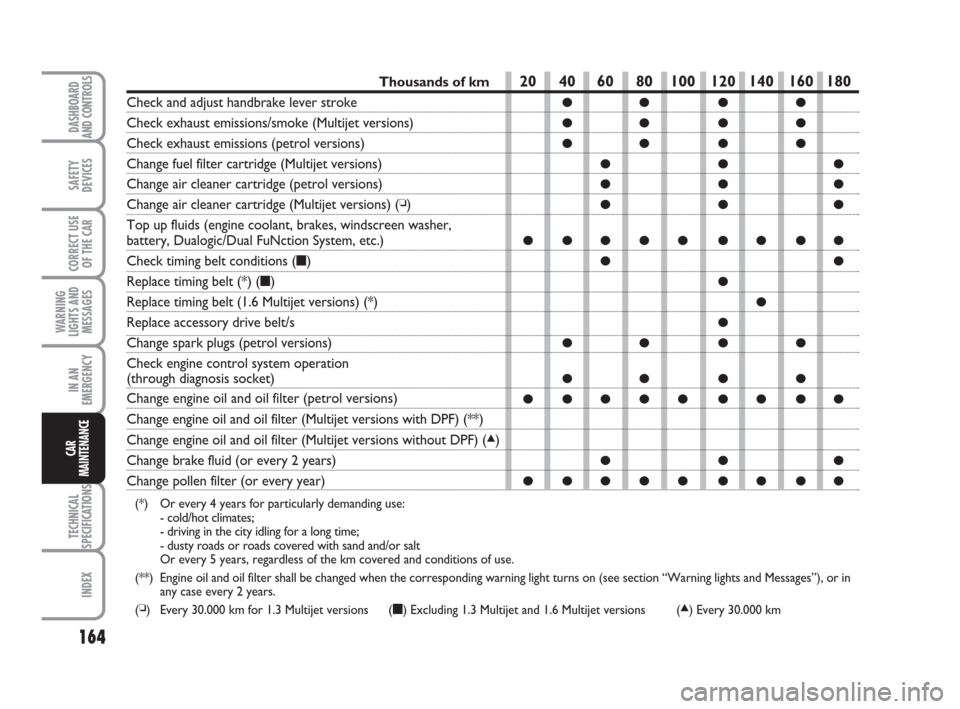
Thousands of km
Check and adjust handbrake lever stroke
Check exhaust emissions/smoke (Multijet versions)
Check exhaust emissions (petrol versions)
Change fuel filter cartridge (Multijet versions)
Change air cleaner cartridge (petrol versions)
Change air cleaner cartridge (Multijet versions) (❏)
Top up fluids (engine coolant, brakes, windscreen washer,
battery, Dualogic/Dual FuNction System, etc.)
Check timing belt conditions (■)
Replace timing belt (*) (■)
Replace timing belt (1.6 Multijet versions) (*)
Replace accessory drive belt/s
Change spark plugs (petrol versions)
Check engine control system operation
(through diagnosis socket)
Change engine oil and oil filter (petrol versions)
Change engine oil and oil filter (Multijet versions with DPF) (**)
Change engine oil and oil filter (Multijet versions without DPF) (▲)
Change brake fluid (or every 2 years)
Change pollen filter (or every year)
(*) Or every 4 years for particularly demanding use:
- cold/hot climates;
- driving in the city idling for a long time;
- dusty roads or roads covered with sand and/or salt
Or every 5 years, regardless of the km covered and conditions of use.
(**) Engine oil and oil filter shall be changed when the corresponding warning light turns on (see section “Warning lights and Messages”), or in
any case every 2 years.
(
❏) Every 30.000 km for 1.3 Multijet versions (■) Excluding 1.3 Multijet and 1.6 Multijet versions (▲) Every 30.000 km
20 40 60 80 100 120 140 160 180
●● ● ●
●● ● ●
●● ● ●
●●●
●●●
●●●
●●●●● ●●●●
●●
●
●
●
●● ● ●
●● ● ●
●●●●● ●●●●
●●●
●●●●● ●●●●
161-180 idea GB 1 ed 10-07-2008 8:30 Pagina 164
Page 166 of 210
165
TECHNICAL
SPECIFICATIONS
INDEX
DASHBOARD
AND CONTROLS
SAFETY
DEVICES
CORRECT USE
OF THE CAR
WARNING
LIGHTS AND
MESSAGES
IN AN
EMERGENCY
CAR
MAINTENANCE
ANNUAL INSPECTION
SCHEDULE
For cars with an annual mileage of below
20,000 km (for example about 15,000 km)
the following yearly inspection programme
is provided:
❒check tyre conditions/wear and adjust
pressure if required (including the
spare wheel);
❒check lighting system operation (head-
lights, direction indicators, hazard
lights, boot lights, passenger compart-
ment lights, warning lights, etc.);
❒check windscreen/washer (nozzles/
and blade position regulation)
❒check front disk brake pad conditions
and wear;
❒sight inspect the conditions of: engine,
gearbox, transmission, pipes and hoses
(exhaust - fuel - brakes), rubber parts
(boots, sleeves, bushes, etc;
❒check for bonnet and boot lock clean-
ness, lever cleanness and lubrication;
❒check battery charge;
❒visual check on various drive belt con-
ditions;
❒top up fluid levels (engine coolant,
brakes, windscreen washer, battery,
etc.);
❒change engine oil;
❒change engine oil filter;
❒replace pollen filter (where provided).
ADDITIONAL CHECKS
Every 1,000 km or before long journeys,
check and top up if required:
❒engine coolant fluid level;
❒brake fluid level;
❒windscreen washer fluid level;
❒tyre pressure and conditions.
Every 3,000 km check and top up if re-
quired: engine oil level.
You are recommended to use FL Selenia
products, designed and produced specifi-
cally for Fiat cars (see table “Capacities”
in section “Technical specifications”).
161-180 idea GB 1 ed 10-07-2008 8:30 Pagina 165
Page 168 of 210
167
TECHNICAL
SPECIFICATIONS
INDEX
DASHBOARD
AND CONTROLS
SAFETY
DEVICES
CORRECT USE
OF THE CAR
WARNING
LIGHTS AND
MESSAGES
IN AN
EMERGENCY
CAR
MAINTENANCE
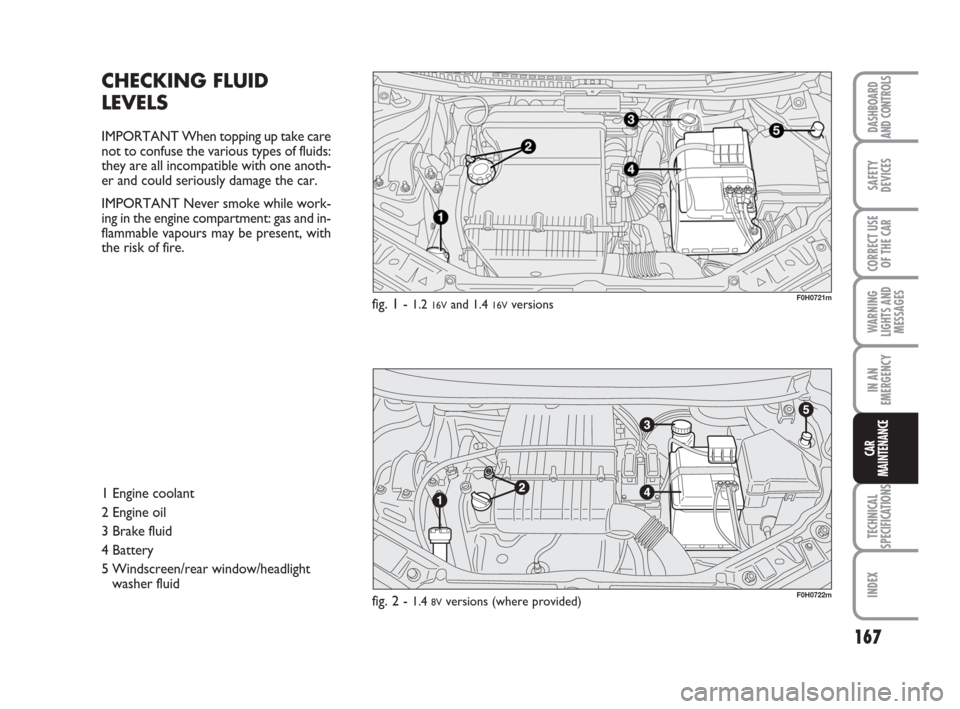
CHECKING FLUID
LEVELS
IMPORTANT When topping up take care
not to confuse the various types of fluids:
they are all incompatible with one anoth-
er and could seriously damage the car.
IMPORTANT Never smoke while work-
ing in the engine compartment: gas and in-
flammable vapours may be present, with
the risk of fire.
F0H0721mfig. 1 - 1.2 16Vand 1.4 16Vversions
F0H0722mfig. 2 - 1.4 8Vversions (where provided)
1 Engine coolant
2 Engine oil
3 Brake fluid
4 Battery
5 Windscreen/rear window/headlight
washer fluid
161-180 idea GB 1 ed 10-07-2008 8:30 Pagina 167
Page 169 of 210
168
TECHNICAL
SPECIFICATIONS
INDEX
DASHBOARD
AND CONTROLS
SAFETY
DEVICES
CORRECT USE
OF THE CAR
WARNING
LIGHTS AND
MESSAGES
IN AN
EMERGENCY
CAR
MAINTENANCE
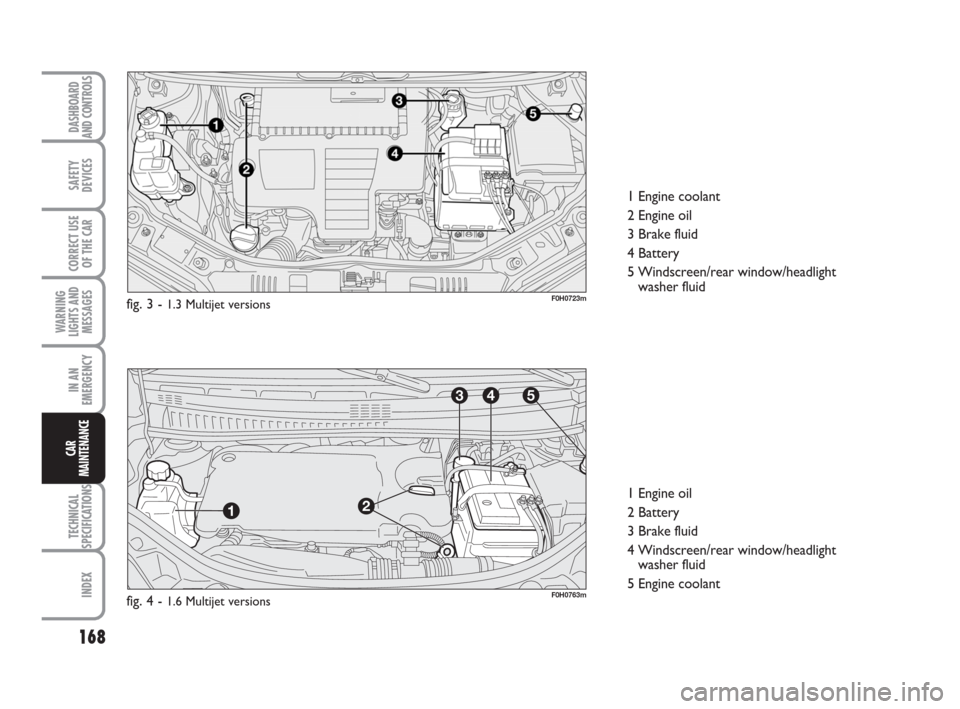
F0H0723mfig. 3 - 1.3 Multijet versions
3
12
45
F0H0763mfig. 4 - 1.6 Multijet versions
1 Engine coolant
2 Engine oil
3 Brake fluid
4 Battery
5 Windscreen/rear window/headlight
washer fluid
1 Engine oil
2 Battery
3 Brake fluid
4 Windscreen/rear window/headlight
washer fluid
5 Engine coolant
161-180 idea GB 1 ed 10-07-2008 8:30 Pagina 168
Page 173 of 210
172
TECHNICAL
SPECIFICATIONS
INDEX
DASHBOARD
AND CONTROLS
SAFETY
DEVICES
CORRECT USE
OF THE CAR
WARNING
LIGHTS AND
MESSAGES
IN AN
EMERGENCY
CAR
MAINTENANCE
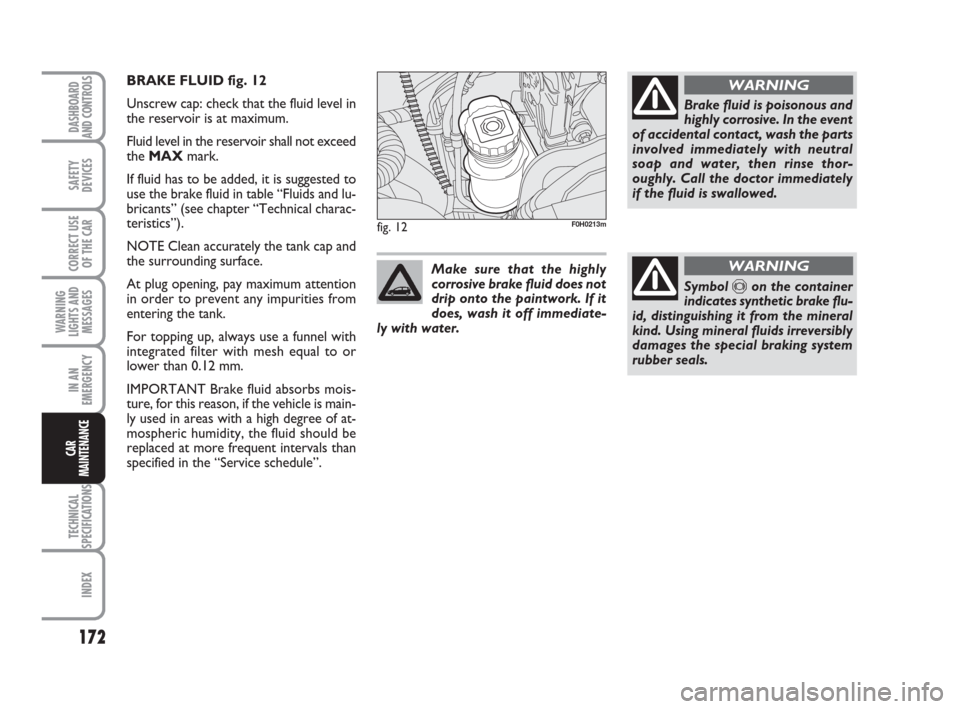
BRAKE FLUID fig. 12
Unscrew cap: check that the fluid level in
the reservoir is at maximum.
Fluid level in the reservoir shall not exceed
the MAXmark.
If fluid has to be added, it is suggested to
use the brake fluid in table “Fluids and lu-
bricants” (see chapter “Technical charac-
teristics”).
NOTE Clean accurately the tank cap and
the surrounding surface.
At plug opening, pay maximum attention
in order to prevent any impurities from
entering the tank.
For topping up, always use a funnel with
integrated filter with mesh equal to or
lower than 0.12 mm.
IMPORTANT Brake fluid absorbs mois-
ture, for this reason, if the vehicle is main-
ly used in areas with a high degree of at-
mospheric humidity, the fluid should be
replaced at more frequent intervals than
specified in the “Service schedule”.
fig. 12F0H0213m
Brake fluid is poisonous and
highly corrosive. In the event
of accidental contact, wash the parts
involved immediately with neutral
soap and water, then rinse thor-
oughly. Call the doctor immediately
if the fluid is swallowed.
WARNING
Symbol πon the container
indicates synthetic brake flu-
id, distinguishing it from the mineral
kind. Using mineral fluids irreversibly
damages the special braking system
rubber seals.
WARNINGMake sure that the highly
corrosive brake fluid does not
drip onto the paintwork. If it
does, wash it off immediate-
ly with water.
161-180 idea GB 1 ed 10-07-2008 8:30 Pagina 172
Page 177 of 210
176
TECHNICAL
SPECIFICATIONS
INDEX
DASHBOARD
AND CONTROLS
SAFETY
DEVICES
CORRECT USE
OF THE CAR
WARNING
LIGHTS AND
MESSAGES
IN AN
EMERGENCY
CAR
MAINTENANCE
RUBBER HOSES
As far as the brake system and fuel rubber
hoses are concerned, carefully follow the
“Service schedule” in this section.
Indeed ozone, high temperatures and pro-
longed lack of fluid in the system may
cause hardening and cracking of the hoses,
with possible leaks. Careful control is
therefore necessary.
WINDSCREEN/
REAR WINDOW
WIPERS
BLADES
Periodically clean the rubber part using
special products; TUTELA PROFES-
SIONAL SC 35 is recommended.
If the rubber blades are bent or worn they
should be replaced. In any case they
should be changed once a year.
A few simple notions can reduce the pos-
sibility of damage to the blades:
❒if the temperature fall below zero,
make sure that ice has not frozen the
rubber against glass. If necessary, thaw
using an antifreeze product;
❒remove any snow from the glass: in ad-
dition to protecting the blades, this
prevents effort on the motor and
overheating;
❒do not operate the windscreen and
rear window wipers on dry glass.
Driving with worn wiper
blades is a serious hazard,
because visibility is reduced in bad
weather.
WARNING
Changing the windscreen wiper
blades fig. 14
Proceed as follows:
❒raise the windscreen wiper arm Aand
position the blade so that it forms an
angle of 90° with the arm;
❒press tab Bof the coupling spring and
remove the blade to be replaced from
the arm A;
❒fit the new blade by inserting the tab
into the special slot in the arm. Make
sure it is properly locked into place.
161-180 idea GB 1 ed 10-07-2008 8:30 Pagina 176
Page 182 of 210
181
INDEX
DASHBOARD
AND CONTROLS
SAFETY
DEVICES
CORRECT USE
OF THE CAR
WARNING
LIGHTS AND
MESSAGES
IN AN
EMERGENCY
CAR
MAINTENANCE
TECHNICAL
SPECIFICATIONS
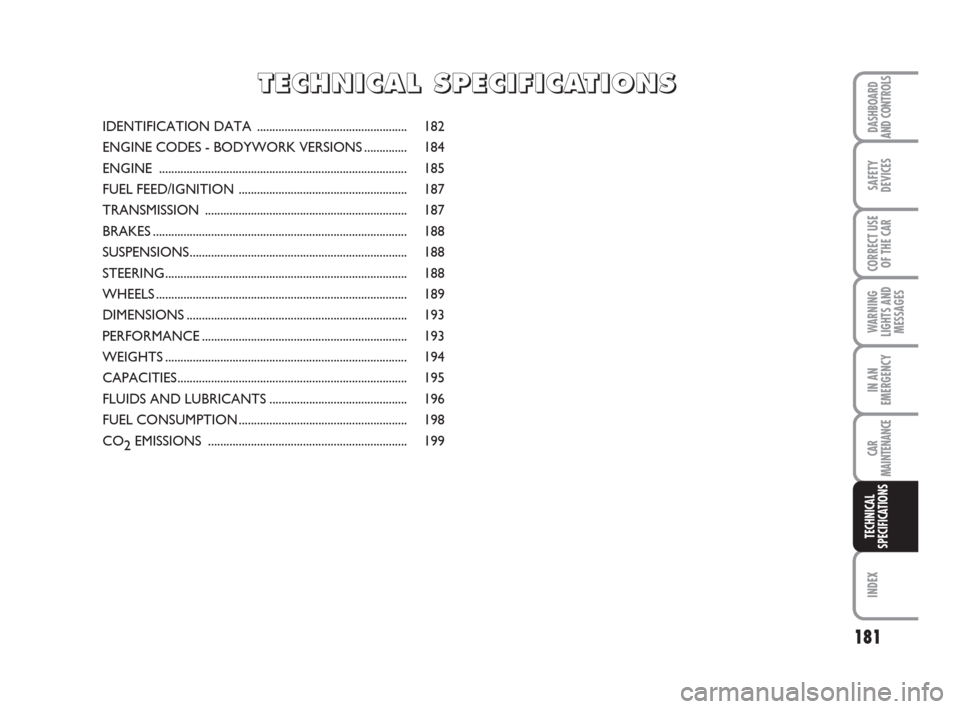
IDENTIFICATION DATA ................................................. 182
ENGINE CODES - BODYWORK VERSIONS .............. 184
ENGINE ................................................................................. 185
FUEL FEED/IGNITION ....................................................... 187
TRANSMISSION .................................................................. 187
BRAKES ................................................................................... 188
SUSPENSIONS ....................................................................... 188
STEERING............................................................................... 188
WHEELS .................................................................................. 189
DIMENSIONS ........................................................................ 193
PERFORMANCE ................................................................... 193
WEIGHTS ............................................................................... 194
CAPACITIES........................................................................... 195
FLUIDS AND LUBRICANTS ............................................. 196
FUEL CONSUMPTION ....................................................... 198
CO
2EMISSIONS ................................................................. 199
TT T
E E
C C
H H
N N
I I
C C
A A
L L
S S
P P
E E
C C
I I
F F
I I
C C
A A
T T
I I
O O
N N
S S
181-199 idea GB 1 ed 13-10-2008 12:12 Pagina 181
Page 189 of 210
188
INDEX
DASHBOARD
AND CONTROLS
SAFETY
DEVICES
CORRECT USE
OF THE CAR
WARNING
LIGHTS AND
MESSAGES
IN AN
EMERGENCY
CAR
MAINTENANCE
TECHNICAL
SPECIFICATIONS
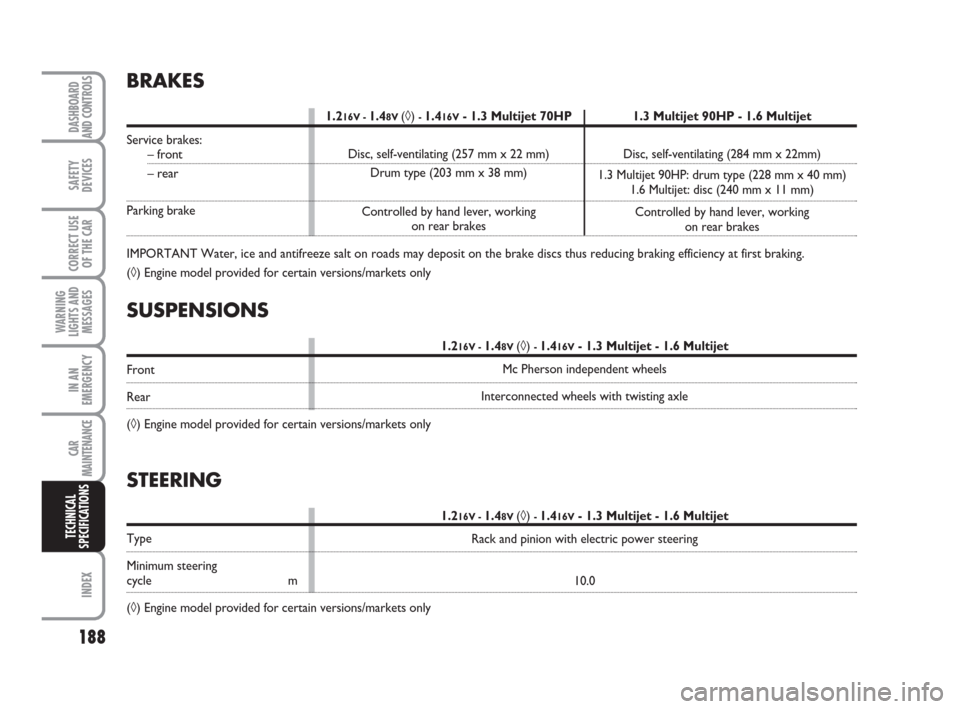
SUSPENSIONS
Front
Rear
(◊) Engine model provided for certain versions/markets only1.2
16V - 1.48V (◊) - 1.416V- 1.3 Multijet - 1.6 Multijet
Mc Pherson independent wheels
Interconnected wheels with twisting axle
STEERING
Type
Minimum steering
cycle m
(◊) Engine model provided for certain versions/markets only1.2
16V - 1.48V (◊) - 1.416V- 1.3 Multijet - 1.6 Multijet
Rack and pinion with electric power steering
10.0
BRAKES
Service brakes:– front
– rear
Parking brake
IMPORTANT Water, ice and antifreeze salt on roads may deposit on the brake discs thus reducing braking efficiency at first braking.
(◊) Engine model provided for certain versions/markets only1.2
16V - 1.48V (◊) - 1.416V- 1.3 Multijet 70HP
Disc, self-ventilating (257 mm x 22 mm)
Drum type (203 mm x 38 mm)
Controlled by hand lever, working
on rear brakes1.3 Multijet 90HP - 1.6 Multijet
Disc, self-ventilating (284 mm x 22mm)
1.3 Multijet 90HP: drum type (228 mm x 40 mm)
1.6 Multijet: disc (240 mm x 11 mm)
Controlled by hand lever, working
on rear brakes
181-199 idea GB 1 ed 13-10-2008 12:12 Pagina 188