change wheel FIAT IDEA 2009 1.G User Guide
[x] Cancel search | Manufacturer: FIAT, Model Year: 2009, Model line: IDEA, Model: FIAT IDEA 2009 1.GPages: 210, PDF Size: 3.62 MB
Page 166 of 210
165
STARTING
AND DRIVING
IN AN
EMERGENCY
TECHNICAL
SPECIFICATIONS
ALPHABETICAL
INDEX
DASHBOARD
AND
CONTROLS
SAFETY
WARNING
LIGHTS AND
MESSAGES
MAINTENANCE
AND CARE
YEARLY INSPECTION
PLAN
The following yearly inspection plan is re-
commended for cars clocking less than
20,000 km a year (e.g. approximately
15.000 km):
❒check tyre conditions/wear and pres-
sure (included spare wheel)
❒check lighting system operation (head-
lights, direction indicators, hazard li-
ghts, boot, passenger compartment,
instrument panel warning lights, etc.)
❒check windscreen wiper/washer
(nozzle direction and blade wear)
❒check front disk brake pad conditions
and wear;
❒visually inspect the conditions of: en-
gine, gearbox, flexible and stiff piping
(exhaust, fuel feed, brakes), rubber
parts (boots, sleeves, bushings, etc.)
❒check cleanness of locks, bonnet and
boot and lever cleanness and lubrica-
tion
❒check battery charge;
❒visually check the various drive belt
conditions;
❒check and top up liquids if required
(engine coolant, brakes, windscreen
washer, battery, etc.)
❒change engine oil;
❒change engine oil filter;
❒change pollen filter (where provided).
ADDITIONAL
INTERVENTIONS
Every 1,000 km or before long journeys,
check and, if necessary, top up:
❒engine coolant fluid level;
❒brake fluid level;
❒windscreen washer fluid level;
❒tyre pressure and conditions.
Every 3,000 km check and, if necessary,
top up: engine oil level.
You are recommended to use FL Selenia
products, designed and produced specifi-
cally for Fiat cars (see table “Capacities”
in section “Technical specifications”).
Page 176 of 210
175
STARTING
AND DRIVING
IN AN
EMERGENCY
TECHNICAL
SPECIFICATIONS
ALPHABETICAL
INDEX
DASHBOARD
AND
CONTROLS
SAFETY
WARNING
LIGHTS AND
MESSAGES
MAINTENANCE
AND CARE
WHEELS AND TYRES
Check the pressure of each tyre, including
the spare wheel, approximately once
every two weeks and before setting off on
a long journey: this check must be perfor-
med with the tyre rested and cold.
It is normal for pressure to increase when
the car is used. For the correct tyre in-
flation pressure, see “Wheels” in “Tech-
nical specifications” section.
Incorrect pressure causes abnormal tyre
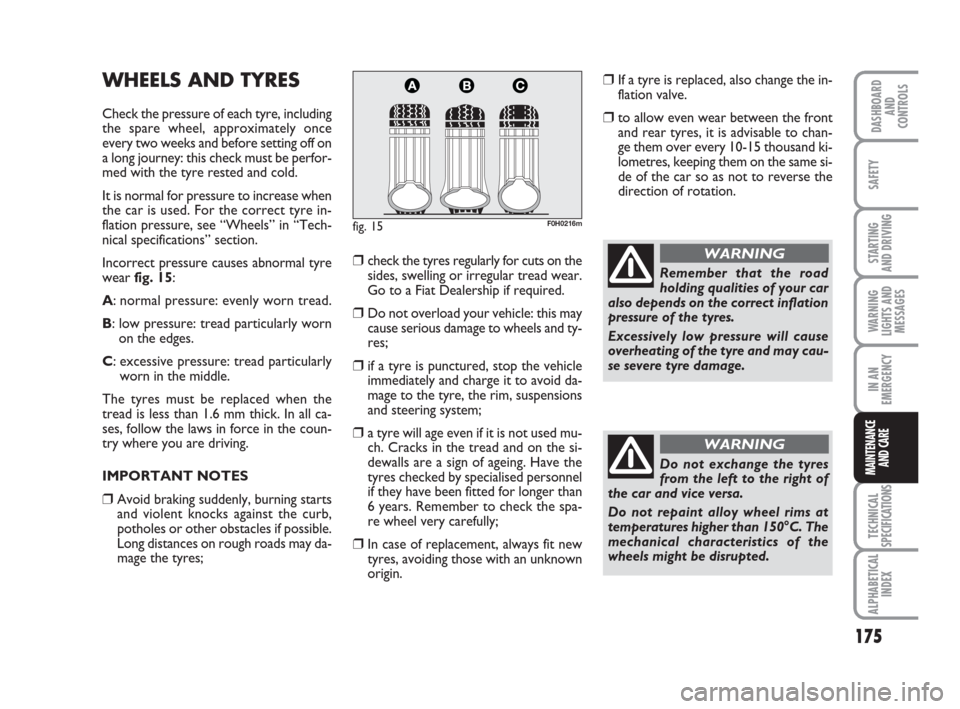
wearfig. 15:
A: normal pressure: evenly worn tread.
B: low pressure: tread particularly worn
on the edges.
C: excessive pressure: tread particularly
worn in the middle.
The tyres must be replaced when the
tread is less than 1.6 mm thick. In all ca-
ses, follow the laws in force in the coun-
try where you are driving.
IMPORTANT NOTES
❒Avoid braking suddenly, burning starts
and violent knocks against the curb,
potholes or other obstacles if possible.
Long distances on rough roads may da-
mage the tyres;
❒check the tyres regularly for cuts on the
sides, swelling or irregular tread wear.
Go to a Fiat Dealership if required.
❒Do not overload your vehicle: this may
cause serious damage to wheels and ty-
res;
❒if a tyre is punctured, stop the vehicle
immediately and charge it to avoid da-
mage to the tyre, the rim, suspensions
and steering system;
❒a tyre will age even if it is not used mu-
ch. Cracks in the tread and on the si-
dewalls are a sign of ageing. Have the
tyres checked by specialised personnel
if they have been fitted for longer than
6 years. Remember to check the spa-
re wheel very carefully;
❒In case of replacement, always fit new
tyres, avoiding those with an unknown
origin.
fig. 15F0H0216m
Remember that the road
holding qualities of your car
also depends on the correct inflation
pressure of the tyres.
Excessively low pressure will cause
overheating of the tyre and may cau-
se severe tyre damage.
WARNING
Do not exchange the tyres
from the left to the right of
the car and vice versa.
Do not repaint alloy wheel rims at
temperatures higher than 150°C. The
mechanical characteristics of the
wheels might be disrupted.
WARNING
❒If a tyre is replaced, also change the in-
flation valve.
❒to allow even wear between the front
and rear tyres, it is advisable to chan-
ge them over every 10-15 thousand ki-
lometres, keeping them on the same si-
de of the car so as not to reverse the
direction of rotation.
Page 209 of 210
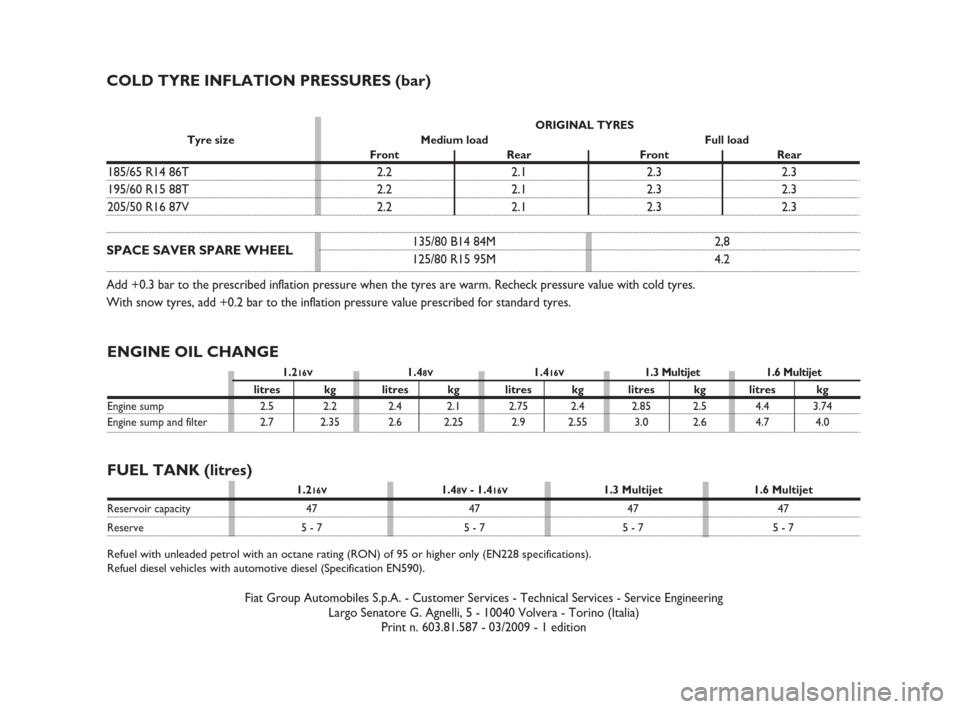
FUEL TANK (litres)
ENGINE OIL CHANGE
Fiat Group Automobiles S.p.A. - Customer Services - Technical Services - Service Engineering
Largo Senatore G. Agnelli, 5 - 10040 Volvera - Torino (Italia)
Print n. 603.81.587 - 03/2009 - 1 edition
COLD TYRE INFLATION PRESSURES (bar)
1.216V1.48V- 1.416V1.3 Multijet 1.6 Multijet
Reservoir capacity 47 47 47 47
Reserve 5 - 7 5 - 7 5 - 7 5 - 7
Refuel with unleaded petrol with an octane rating (RON) of 95 or higher only (EN228 specifications).
Refuel diesel vehicles with automotive diesel (Specification EN590).
1.216V1.48V1.416V1.3 Multijet 1.6 Multijet
litres kg litres kg litres kg litres kg litres kg
Engine sump 2.5 2.2 2.4 2.1 2.75 2.4 2.85 2.5 4.4 3.74
Engine sump and filter 2.7 2.35 2.6 2.25 2.9 2.55 3.0 2.6 4.7 4.0ORIGINAL TYRES
Tyre size Medium load Full load
Front Rear Front Rear
185/65 R14 86T 2.2 2.1 2.3 2.3
195/60 R15 88T 2.2 2.1 2.3 2.3
205/50 R16 87V 2.2 2.1 2.3 2.3
SPACE SAVER SPARE WHEEL135/80 B14 84M 2,8125/80 R15 95M 4.2
Add +0.3 bar to the prescribed inflation pressure when the tyres are warm. Recheck pressure value with cold tyres.
With snow tyres, add +0.2 bar to the inflation pressure value prescribed for standard tyres.