tyre pressure FIAT IDEA 2009 1.G Owners Manual
[x] Cancel search | Manufacturer: FIAT, Model Year: 2009, Model line: IDEA, Model: FIAT IDEA 2009 1.GPages: 210, PDF Size: 3.62 MB
Page 117 of 210
116
WARNING
LIGHTS AND
MESSAGES
IN AN
EMERGENCY
MAINTENANCE
AND CARE
TECHNICAL
SPECIFICATIONS
ALPHABETICAL
INDEX
DASHBOARD
AND
CONTROLS
SAFETY
STARTING
AND DRIVING
CONTAINING
RUNNING COSTS
Here are some suggestions which may
help you to keep the running costs of your
vehicle down and lower the amount of
toxic emissions released into the atmo-
sphere.
GENERAL CONSIDERATIONS
Car maintenance
Have checks and adjustments carried out
in accordance with the “Service schedu-
le”.
Tyres
Check tyre pressure regularly, at least on-
ce every four weeks: excessively low pres-
sure will increase fuel consumption be-
cause rolling resistance will be higher.
Unnecessary loads
Do not travel with an overloaded boot.
Do not travel with too much luggage
stowed in the boot. The weight of the car
(especially when driving in town) and its
trim greatly affects consumption and sta-
bility.Roof rack/ski rack
Remove the roof rack or the ski rack from
the roof after use. These accessories de-
crease aerodynamic penetration of the car
and have a negative effect on consumption.
It is better to use a trailer to transport
particularly bulky objects.
Electrical devices
Use electrical devices only for the amount
of time needed. Rear heated window, ad-
ditional headlights, windscreen wipers and
heater fan need a considerable amount of
energy, therefore increasing the require-
ment of current increases fuel consump-
tion (up to +25% in the urban cycle).
Climate control
The climate control system requires hi-
gher fuel consumption (up to +20% in ave-
rage): use the air vents when the exter-
nal temperature allows to.
Spoilers
The use of non-certified aerodynamic
items may adversely affect air drag and fuel
consumption levels.DRIVING STYLE
Starting
Do not warm the engine up with the car
standing: the engine warms up very slowly
in these conditions, increasing fuel con-
sumption and emissions. It is advisable to
start off immediately and slowly keeping
the engine speed down: the engine will
warm up much faster this way.
Unnecessary actions
Avoid revving up when starting at traffic
lights or before stopping the engine. The
latter action, like doubling the clutch, is un-
necessary and causes increase of con-
sumption and pollution.
Gear selection
Use a higher gear as soon as traffic and
road conditions allow. Using a low gear
for faster acceleration will increase fuel
consumption.
In the same way improper use of a high
gear increases consumption, emissions an
engine wear.
Page 121 of 210
120
WARNING
LIGHTS AND
MESSAGES
IN AN
EMERGENCY
MAINTENANCE
AND CARE
TECHNICAL
SPECIFICATIONS
ALPHABETICAL
INDEX
DASHBOARD
AND
CONTROLS
SAFETY
STARTING
AND DRIVING
SNOW TYRES
Use snow tyres of the same size as the
normal tyres provided with the car.
Fiat Dealership will be happy to provide
advice concerning the most suitable type
of tyre for the customer’s requirements.
For the type of tyre to be used, inflation
pressures and the specifications of snow
tyres, follow the instructions given in pa-
ragraph “Wheels” in section “Technical
specifications”.
The performance of these tyres is consi-
derably reduced when the tread depth is
less than 4 mm. Replace them in this case.
Due to their specific features, the perfor-
mance of snow tyres is much lower than
that of standard tyres in normal conditions
or long motorway stretches. Limit perfor-
mance according the use for which they
were approved.IMPORTANT When snow tyres are used
with a max speed index below the one
that can be reached by the car (increased
by 5%), place a notice in the passenger’s
compartment, plainly in the driver’s view
which states the max permissible speed of
the snow tyres (as per EC Directive).
All four tyres should be the same (brand
and track) to ensure greater safety when
driving and braking and better driveability.
Remember that it is inappropriate to chan-
ge the direction of rotation of tyres.The top speed of a “T” type
snow tyre is 190 km/h. Re-
spect the highway code in all cases.
WARNING
Page 123 of 210
122
WARNING
LIGHTS AND
MESSAGES
IN AN
EMERGENCY
MAINTENANCE
AND CARE
TECHNICAL
SPECIFICATIONS
ALPHABETICAL
INDEX
DASHBOARD
AND
CONTROLS
SAFETY
STARTING
AND DRIVING
STORING THE CAR
If the car is to be left inactive for longer
than a month, the following precautions
should be noted:
❒park the car in covered, dry and if pos-
sible well-ventilated premises;
❒engage a gear;
❒check that the handbrake is not enga-
ged;
❒disconnect the negative battery ter-
minal and check battery charge. Re-
peat this check once every three
months during storage. Recharge the
battery if the indicator is dark and the
middle area is not green;
❒clean and protect the painted parts
using protective wax;
❒clean and protect the shiny metal parts
using special compounds readily avai-
lable;
❒sprinkle talcum powder on the rubber
windscreen and rear window wiper
blades and lift them off the glass;
❒slightly open the windows;
❒cover the car with a fabric or perfo-
rated plastic terrapin. Do not use
compact plastic sheets which do not
allow humidity to evaporate from the
surface of the car.
❒inflate tyres to a pressure of +0,5 bar
above the normal specified pressure
and check it at intervals;
❒if you don’t disconnect the battery
from the electric system, check its
charge every month and recharge it if
the optical indicator shows a dark co-
lour without the central green area;
❒do not drain the engine cooling sy-
stem.
Page 139 of 210
138
STARTING
AND DRIVING
MAINTENANCE
AND CARE
TECHNICAL
SPECIFICATIONS
ALPHABETICAL
INDEX
DASHBOARD
AND
CONTROLS
SAFETY
WARNING
LIGHTS AND
MESSAGES
IN AN
EMERGENCY
fig. 6F0H0357mfig. 7F0H0177mfig. 8F0H0748m
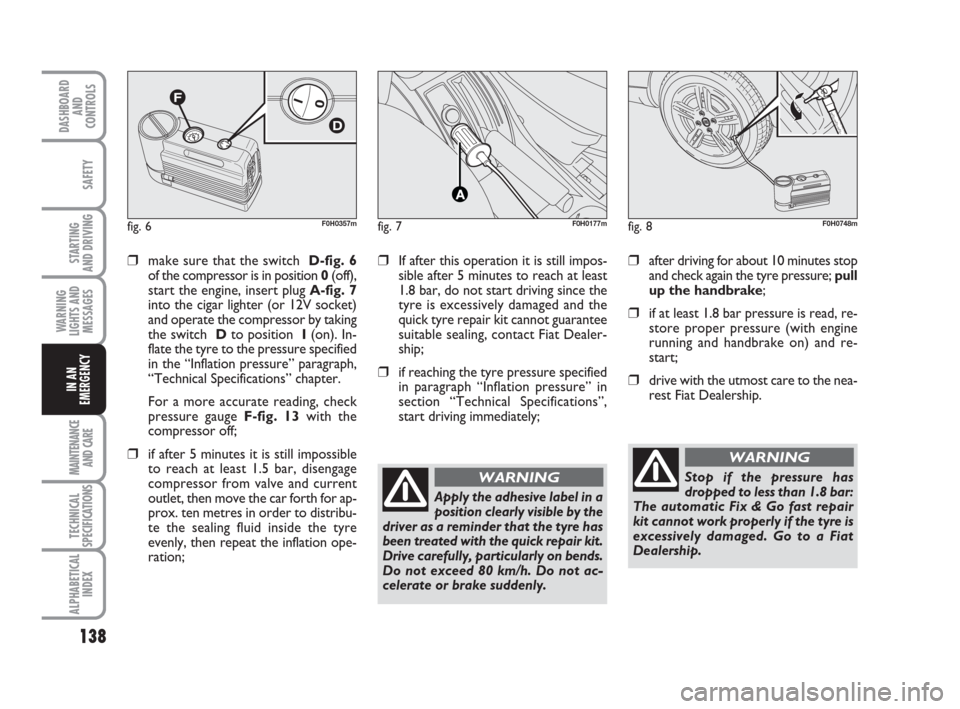
❒make sure that the switch D-fig. 6
of the compressor is in position 0(off),
start the engine, insert plug A-fig. 7
into the cigar lighter (or 12V socket)
and operate the compressor by taking
the switch Dto position I(on). In-
flate the tyre to the pressure specified
in the “Inflation pressure” paragraph,
“Technical Specifications” chapter.
For a more accurate reading, check
pressure gauge F-fig. 13with the
compressor off;
❒if after 5 minutes it is still impossible
to reach at least 1.5 bar, disengage
compressor from valve and current
outlet, then move the car forth for ap-
prox. ten metres in order to distribu-
te the sealing fluid inside the tyre
evenly, then repeat the inflation ope-
ration;
❒If after this operation it is still impos-
sible after 5 minutes to reach at least
1.8 bar, do not start driving since the
tyre is excessively damaged and the
quick tyre repair kit cannot guarantee
suitable sealing, contact Fiat Dealer-
ship;
❒if reaching the tyre pressure specified
in paragraph “Inflation pressure” in
section “Technical Specifications”,
start driving immediately;
Apply the adhesive label in a
position clearly visible by the
driver as a reminder that the tyre has
been treated with the quick repair kit.
Drive carefully, particularly on bends.
Do not exceed 80 km/h. Do not ac-
celerate or brake suddenly.
WARNINGStop if the pressure has
dropped to less than 1.8 bar:
The automatic Fix & Go fast repair
kit cannot work properly if the tyre is
excessively damaged. Go to a Fiat
Dealership.
WARNING
❒after driving for about 10 minutes stop
and check again the tyre pressure; pull
up the handbrake;
❒if at least 1.8 bar pressure is read, re-
store proper pressure (with engine
running and handbrake on) and re-
start;
❒drive with the utmost care to the nea-
rest Fiat Dealership.
Page 140 of 210
139
STARTING
AND DRIVING
MAINTENANCE
AND CARE
TECHNICAL
SPECIFICATIONS
ALPHABETICAL
INDEX
DASHBOARD
AND
CONTROLS
SAFETY
WARNING
LIGHTS AND
MESSAGES
IN AN
EMERGENCY
fig. 9F0H0749m
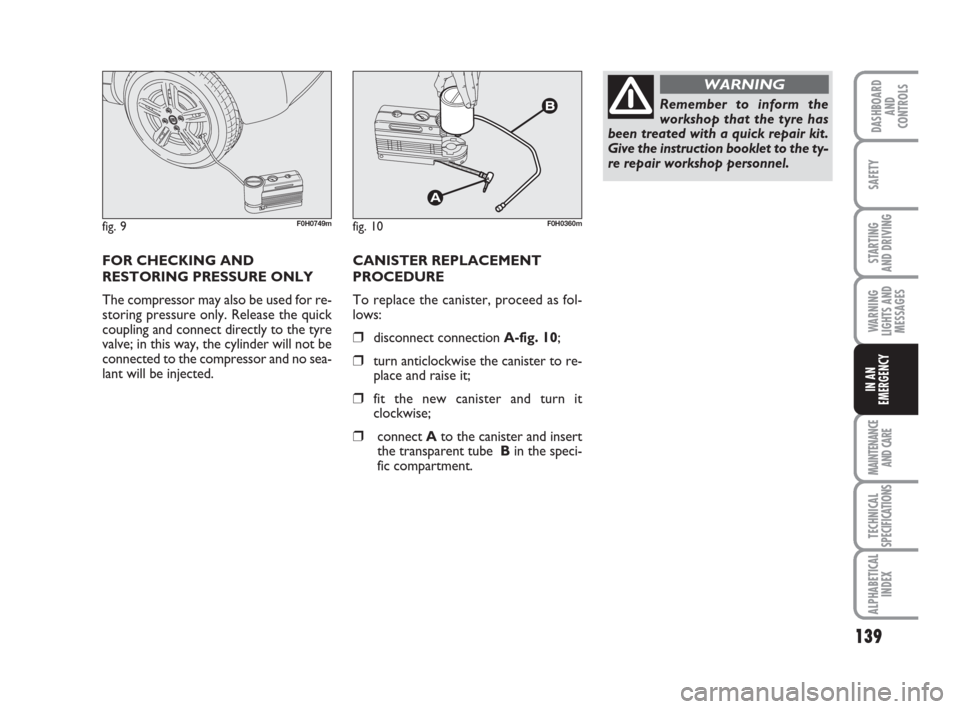
FOR CHECKING AND
RESTORING PRESSURE ONLY
The compressor may also be used for re-
storing pressure only. Release the quick
coupling and connect directly to the tyre
valve; in this way, the cylinder will not be
connected to the compressor and no sea-
lant will be injected.
fig. 10F0H0360m
CANISTER REPLACEMENT
PROCEDURE
To replace the canister, proceed as fol-
lows:
❒disconnect connection A-fig. 10;
❒turn anticlockwise the canister to re-
place and raise it;
❒fit the new canister and turn it
clockwise;
❒connect Ato the canister and insert
the transparent tube Bin the speci-
fic compartment.
Remember to inform the
workshop that the tyre has
been treated with a quick repair kit.
Give the instruction booklet to the ty-
re repair workshop personnel.
WARNING
Page 142 of 210
141
STARTING
AND DRIVING
MAINTENANCE
AND CARE
TECHNICAL
SPECIFICATIONS
ALPHABETICAL
INDEX
DASHBOARD
AND
CONTROLS
SAFETY
WARNING
LIGHTS AND
MESSAGES
IN AN
EMERGENCY
The jack may only be used to
replace wheels on the car
which it equips or other cars of the
same model. Never use the jack for
other purposes, such as lifting other
models of vehicle. Never use the jack
to carry out repairs under the car. In-
correct positioning of the jack may
cause the car to fall. Do not use the
jack for loads higher than those
shown on the label. Snow chains can-
not be fitted on a space saver spare
wheel. Therefore, if a front wheel
(drive wheel) is punctured and you
need to use snow chains, swap with a
rear wheel. In this way, you will ha-
ve two normal wheels on the front on
which you can fit snow chains and
solve the emergency.
WARNING
Incorrect wheel cup assem-
bly may cause it to come off
when the car is travelling. Never tam-
per with the inflation valve. Never in-
troduce tools of any kind between the
rim and the tyre. Check tyre and spa-
ce saver spare wheel pressure regu-
larly referring to the values shown in
the “Technical Specifications” chap-
ter.
WARNINGImportant notes:
❒the jack cannot be repaired: replace
with an original spare part if damaged;
❒no tool other than its cranking devi-
ce may be fitted on the jack.
To change a wheel proceed as follows:
❒stop the car in a position so that it is
not a danger for on-coming traffic and
where you can replace the wheel sa-
fely. The ground must be flat and com-
pact;
❒Turn the engine off and pull up the
handbrake.
❒Engage first gear or reverse;
❒lift the boot mat;
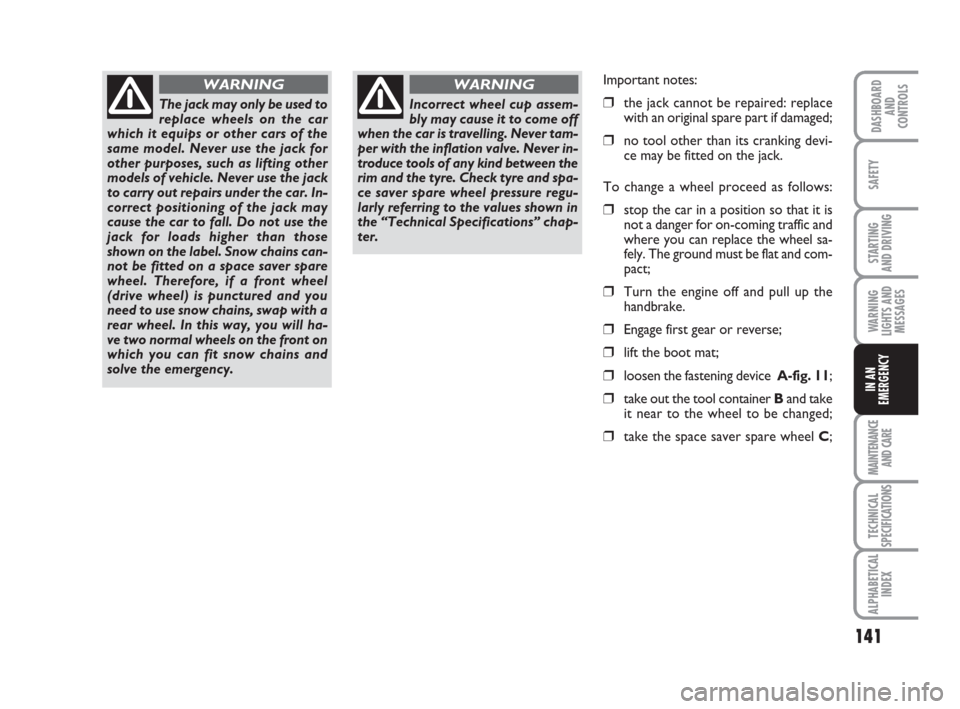
❒loosen the fastening device A-fig. 11;
❒take out the tool container Band take
it near to the wheel to be changed;
❒take the space saver spare wheel C;
Page 157 of 210
156
STARTING
AND DRIVING
MAINTENANCE
AND CARE
TECHNICAL
SPECIFICATIONS
ALPHABETICAL
INDEX
DASHBOARD
AND
CONTROLS
SAFETY
WARNING
LIGHTS AND
MESSAGES
IN AN
EMERGENCY
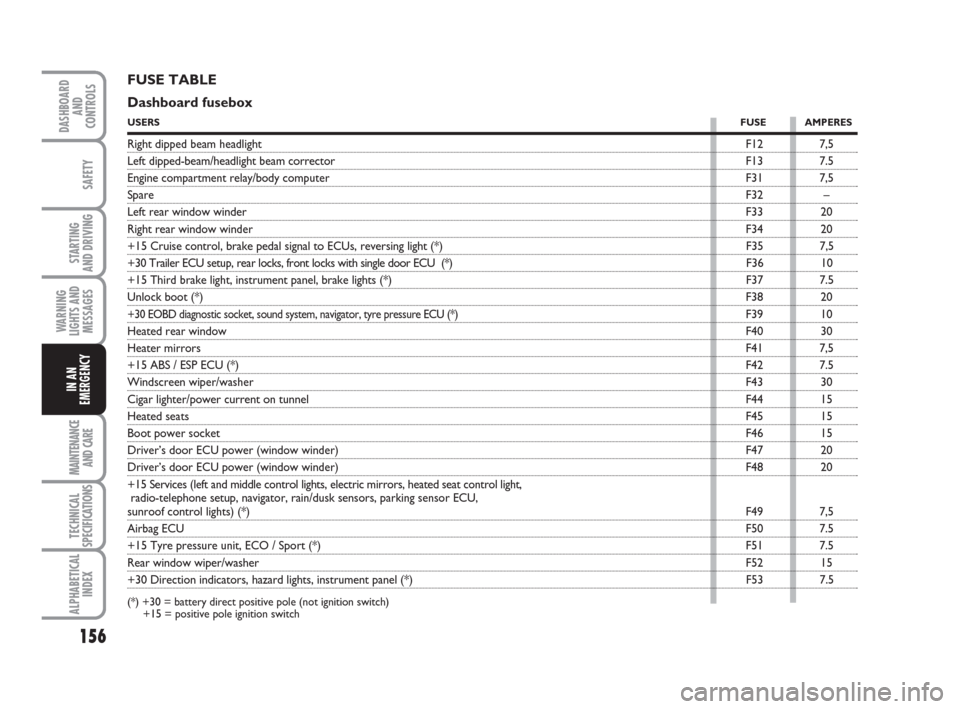
FUSE TABLE
Dashboard fusebox
USERSFUSE AMPERES
Right dipped beam headlightF12 7,5
Left dipped-beam/headlight beam correctorF13 7.5
Engine compartment relay/body computerF31 7,5
SpareF32 –
Left rear window winderF33 20
Right rear window winderF34 20
+15 Cruise control, brake pedal signal to ECUs, reversing light (*) F35 7,5
+30 Trailer ECU setup, rear locks, front locks with single door ECU (*) F36 10
+15 Third brake light, instrument panel, brake lights (*) F37 7.5
Unlock boot (*)F38 20
+30 EOBD diagnostic socket, sound system, navigator, tyre pressure ECU (*)F39 10
Heated rear windowF40 30
Heater mirrorsF41 7,5
+15 ABS / ESP ECU (*)F42 7.5
Windscreen wiper/washerF43 30
Cigar lighter/power current on tunnelF44 15
Heated seatsF45 15
Boot power socketF46 15
Driver’s door ECU power (window winder)F47 20
Driver’s door ECU power (window winder)F48 20
+15 Services (left and middle control lights, electric mirrors, heated seat control light,
radio-telephone setup, navigator, rain/dusk sensors, parking sensor ECU,
sunroof control lights) (*)F49 7,5
Airbag ECUF50 7.5
+15 Tyre pressure unit, ECO / Sport (*)F51 7.5
Rear window wiper/washerF52 15
+30 Direction indicators, hazard lights, instrument panel (*) F53 7.5
(*) +30 = battery direct positive pole (not ignition switch)
+15 = positive pole ignition switch
Page 164 of 210
163
STARTING
AND DRIVING
IN AN
EMERGENCY
TECHNICAL
SPECIFICATIONS
ALPHABETICAL
INDEX
DASHBOARD
AND
CONTROLS
SAFETY
WARNING
LIGHTS AND
MESSAGES
MAINTENANCE
AND CARE
20 40 60 80 100 120 140 160 180
●●●●● ●●●●
●●●●● ●●●●
●●●●● ●●●●
●●●●● ●●●●
●●●
●● ● ●
●●●●● ●●●●
●●●●● ●●●●
●●
●●
●●●
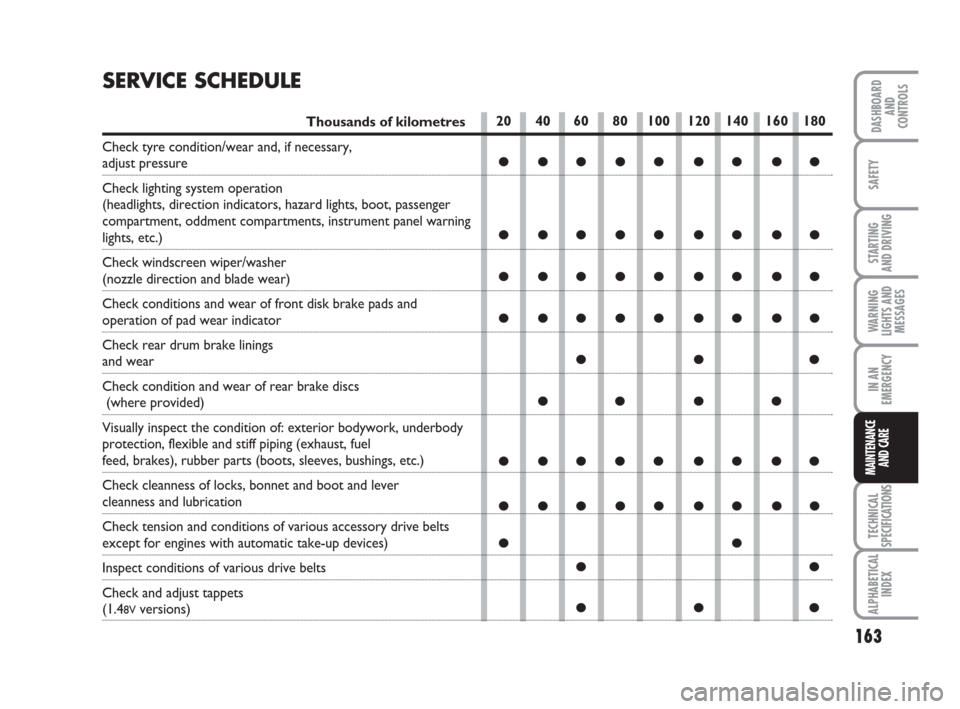
SERVICE SCHEDULE
Thousands of kilometres
Check tyre condition/wear and, if necessary,
adjust pressure
Check lighting system operation
(headlights, direction indicators, hazard lights, boot, passenger
compartment, oddment compartments, instrument panel warning
lights, etc.)
Check windscreen wiper/washer
(nozzle direction and blade wear)
Check conditions and wear of front disk brake pads and
operation of pad wear indicator
Check rear drum brake linings
and wear
Check condition and wear of rear brake discs
(where provided)
Visually inspect the condition of: exterior bodywork, underbody
protection, flexible and stiff piping (exhaust, fuel
feed, brakes), rubber parts (boots, sleeves, bushings, etc.)
Check cleanness of locks, bonnet and boot and lever
cleanness and lubrication
Check tension and conditions of various accessory drive belts
except for engines with automatic take-up devices)
Inspect conditions of various drive belts
Check and adjust tappets
(1.48Vversions)
Page 166 of 210
165
STARTING
AND DRIVING
IN AN
EMERGENCY
TECHNICAL
SPECIFICATIONS
ALPHABETICAL
INDEX
DASHBOARD
AND
CONTROLS
SAFETY
WARNING
LIGHTS AND
MESSAGES
MAINTENANCE
AND CARE
YEARLY INSPECTION
PLAN
The following yearly inspection plan is re-
commended for cars clocking less than
20,000 km a year (e.g. approximately
15.000 km):
❒check tyre conditions/wear and pres-
sure (included spare wheel)
❒check lighting system operation (head-
lights, direction indicators, hazard li-
ghts, boot, passenger compartment,
instrument panel warning lights, etc.)
❒check windscreen wiper/washer
(nozzle direction and blade wear)
❒check front disk brake pad conditions
and wear;
❒visually inspect the conditions of: en-
gine, gearbox, flexible and stiff piping
(exhaust, fuel feed, brakes), rubber
parts (boots, sleeves, bushings, etc.)
❒check cleanness of locks, bonnet and
boot and lever cleanness and lubrica-
tion
❒check battery charge;
❒visually check the various drive belt
conditions;
❒check and top up liquids if required
(engine coolant, brakes, windscreen
washer, battery, etc.)
❒change engine oil;
❒change engine oil filter;
❒change pollen filter (where provided).
ADDITIONAL
INTERVENTIONS
Every 1,000 km or before long journeys,
check and, if necessary, top up:
❒engine coolant fluid level;
❒brake fluid level;
❒windscreen washer fluid level;
❒tyre pressure and conditions.
Every 3,000 km check and, if necessary,
top up: engine oil level.
You are recommended to use FL Selenia
products, designed and produced specifi-
cally for Fiat cars (see table “Capacities”
in section “Technical specifications”).
Page 176 of 210
175
STARTING
AND DRIVING
IN AN
EMERGENCY
TECHNICAL
SPECIFICATIONS
ALPHABETICAL
INDEX
DASHBOARD
AND
CONTROLS
SAFETY
WARNING
LIGHTS AND
MESSAGES
MAINTENANCE
AND CARE
WHEELS AND TYRES
Check the pressure of each tyre, including
the spare wheel, approximately once
every two weeks and before setting off on
a long journey: this check must be perfor-
med with the tyre rested and cold.
It is normal for pressure to increase when
the car is used. For the correct tyre in-
flation pressure, see “Wheels” in “Tech-
nical specifications” section.
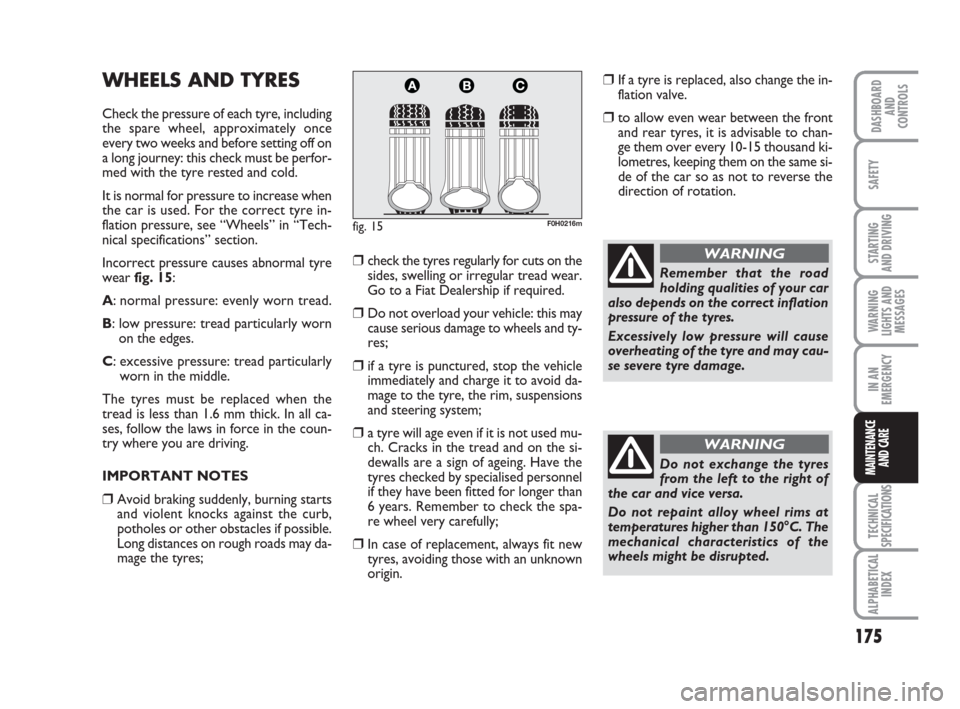
Incorrect pressure causes abnormal tyre
wearfig. 15:
A: normal pressure: evenly worn tread.
B: low pressure: tread particularly worn
on the edges.
C: excessive pressure: tread particularly
worn in the middle.
The tyres must be replaced when the
tread is less than 1.6 mm thick. In all ca-
ses, follow the laws in force in the coun-
try where you are driving.
IMPORTANT NOTES
❒Avoid braking suddenly, burning starts
and violent knocks against the curb,
potholes or other obstacles if possible.
Long distances on rough roads may da-
mage the tyres;
❒check the tyres regularly for cuts on the
sides, swelling or irregular tread wear.
Go to a Fiat Dealership if required.
❒Do not overload your vehicle: this may
cause serious damage to wheels and ty-
res;
❒if a tyre is punctured, stop the vehicle
immediately and charge it to avoid da-
mage to the tyre, the rim, suspensions
and steering system;
❒a tyre will age even if it is not used mu-
ch. Cracks in the tread and on the si-
dewalls are a sign of ageing. Have the
tyres checked by specialised personnel
if they have been fitted for longer than
6 years. Remember to check the spa-
re wheel very carefully;
❒In case of replacement, always fit new
tyres, avoiding those with an unknown
origin.
fig. 15F0H0216m
Remember that the road
holding qualities of your car
also depends on the correct inflation
pressure of the tyres.
Excessively low pressure will cause
overheating of the tyre and may cau-
se severe tyre damage.
WARNING
Do not exchange the tyres
from the left to the right of
the car and vice versa.
Do not repaint alloy wheel rims at
temperatures higher than 150°C. The
mechanical characteristics of the
wheels might be disrupted.
WARNING
❒If a tyre is replaced, also change the in-
flation valve.
❒to allow even wear between the front
and rear tyres, it is advisable to chan-
ge them over every 10-15 thousand ki-
lometres, keeping them on the same si-
de of the car so as not to reverse the
direction of rotation.