fuel FIAT IDEA 2009 1.G Owner's Manual
[x] Cancel search | Manufacturer: FIAT, Model Year: 2009, Model line: IDEA, Model: FIAT IDEA 2009 1.GPages: 210, PDF Size: 3.62 MB
Page 130 of 210
129
STARTING
AND DRIVING
IN AN
EMERGENCY
MAINTENANCE
AND CARE
TECHNICAL
SPECIFICATIONS
ALPHABETICAL
INDEX
DASHBOARD
AND
CONTROLS
SAFETY
WARNING
LIGHTS AND
MESSAGES
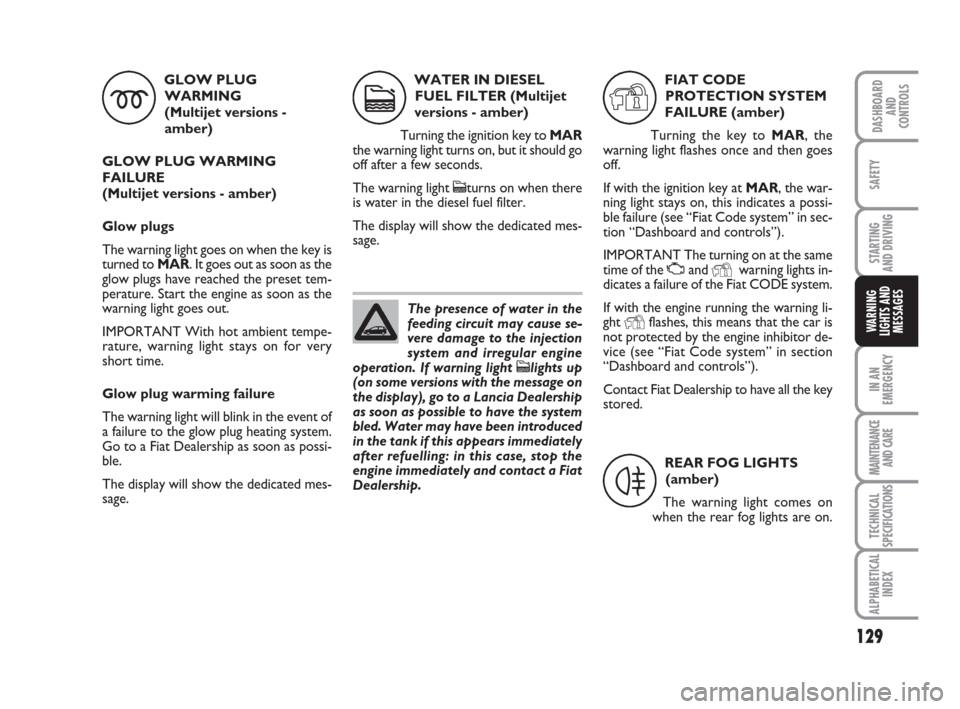
GLOW PLUG
WARMING
(Multijet versions -
amber)
GLOW PLUG WARMING
FAILURE
(Multijet versions - amber)
Glow plugs
The warning light goes on when the key is
turned to MAR. It goes out as soon as the
glow plugs have reached the preset tem-
perature. Start the engine as soon as the
warning light goes out.
IMPORTANT With hot ambient tempe-
rature, warning light stays on for very
short time.
Glow plug warming failure
The warning light will blink in the event of
a failure to the glow plug heating system.
Go to a Fiat Dealership as soon as possi-
ble.
The display will show the dedicated mes-
sage.
m
WATER IN DIESEL
FUEL FILTER (Multijet
versions - amber)
Turning the ignition key to MAR
the warning light turns on, but it should go
off after a few seconds.
The warning light
cturns on when there
is water in the diesel fuel filter.
The display will show the dedicated mes-
sage.
c
FIAT CODE
PROTECTION SYSTEM
FAILURE (amber)
Turning the key to MAR, the
warning light flashes once and then goes
off.
If with the ignition key at MAR, the war-
ning light stays on, this indicates a possi-
ble failure (see “Fiat Code system” in sec-
tion “Dashboard and controls”).
IMPORTANT The turning on at the same
time of the
UandYwarning lights in-
dicates a failure of the Fiat CODE system.
If with the engine running the warning li-
ght
Yflashes, this means that the car is
not protected by the engine inhibitor de-
vice (see “Fiat Code system” in section
“Dashboard and controls”).
Contact Fiat Dealership to have all the key
stored.
Y
REAR FOG LIGHTS
(amber)
The warning light comes on
when the rear fog lights are on.
4
The presence of water in the
feeding circuit may cause se-
vere damage to the injection
system and irregular engine
operation. If warning light
clights up
(on some versions with the message on
the display), go to a Lancia Dealership
as soon as possible to have the system
bled. Water may have been introduced
in the tank if this appears immediately
after refuelling: in this case, stop the
engine immediately and contact a Fiat
Dealership.
Page 131 of 210
130
STARTING
AND DRIVING
IN AN
EMERGENCY
MAINTENANCE
AND CARE
TECHNICAL
SPECIFICATIONS
ALPHABETICAL
INDEX
DASHBOARD
AND
CONTROLS
SAFETY
WARNING
LIGHTS AND
MESSAGES
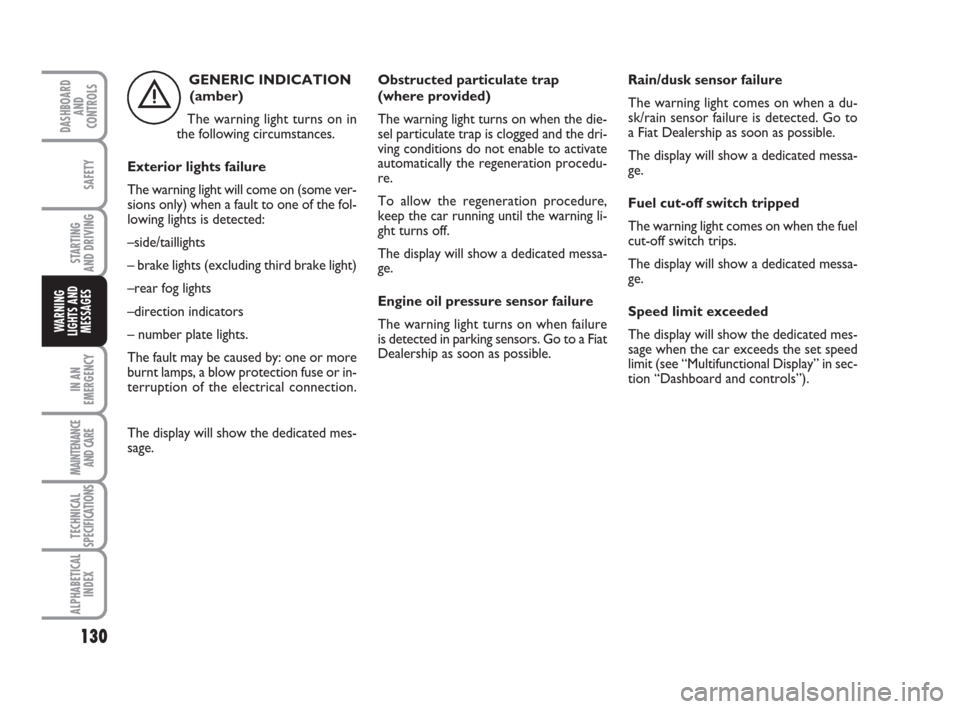
GENERIC INDICATION
(amber)
The warning light turns on in
the following circumstances.
Exterior lights failure
The warning light will come on (some ver-
sions only) when a fault to one of the fol-
lowing lights is detected:
–side/taillights
– brake lights (excluding third brake light)
–rear fog lights
–direction indicators
– number plate lights.
The fault may be caused by: one or more
burnt lamps, a blow protection fuse or in-
terruption of the electrical connection.
The display will show the dedicated mes-
sage.
è
Obstructed particulate trap
(where provided)
The warning light turns on when the die-
sel particulate trap is clogged and the dri-
ving conditions do not enable to activate
automatically the regeneration procedu-
re.
To allow the regeneration procedure,
keep the car running until the warning li-
ght turns off.
The display will show a dedicated messa-
ge.
Engine oil pressure sensor failure
The warning light turns on when failure
is detected in parking sensors. Go to a Fiat
Dealership as soon as possible.Rain/dusk sensor failure
The warning light comes on when a du-
sk/rain sensor failure is detected. Go to
a Fiat Dealership as soon as possible.
The display will show a dedicated messa-
ge.
Fuel cut-off switch tripped
The warning light comes on when the fuel
cut-off switch trips.
The display will show a dedicated messa-
ge.
Speed limit exceeded
The display will show the dedicated mes-
sage when the car exceeds the set speed
limit (see “Multifunctional Display” in sec-
tion “Dashboard and controls”).
Page 133 of 210
132
STARTING
AND DRIVING
IN AN
EMERGENCY
MAINTENANCE
AND CARE
TECHNICAL
SPECIFICATIONS
ALPHABETICAL
INDEX
DASHBOARD
AND
CONTROLS
SAFETY
WARNING
LIGHTS AND
MESSAGES
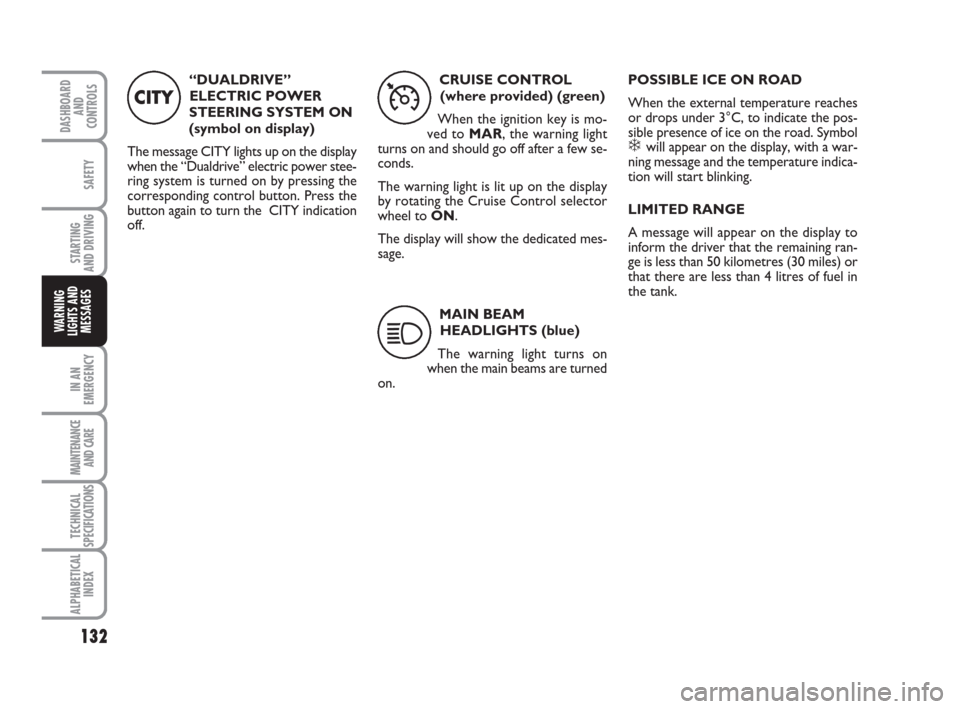
“DUALDRIVE”
ELECTRIC POWER
STEERING SYSTEM ON
(symbol on display)
The message CITY lights up on the display
when the “Dualdrive” electric power stee-
ring system is turned on by pressing the
corresponding control button. Press the
button again to turn the CITY indication
off.
CITY
CRUISE CONTROL
(where provided) (green)
When the ignition key is mo-
ved to MAR, the warning light
turns on and should go off after a few se-
conds.
The warning light is lit up on the display
by rotating the Cruise Control selector
wheel to ON.
The display will show the dedicated mes-
sage.
Ü
MAIN BEAM
HEADLIGHTS (blue)
The warning light turns on
when the main beams are turned
on.
1
POSSIBLE ICE ON ROAD
When the external temperature reaches
or drops under 3°C, to indicate the pos-
sible presence of ice on the road. Symbol
❄ will appear on the display, with a war-
ning message and the temperature indica-
tion will start blinking.
LIMITED RANGE
A message will appear on the display to
inform the driver that the remaining ran-
ge is less than 50 kilometres (30 miles) or
that there are less than 4 litres of fuel in
the tank.
Page 136 of 210
135
STARTING
AND DRIVING
MAINTENANCE
AND CARE
TECHNICAL
SPECIFICATIONS
ALPHABETICAL
INDEX
DASHBOARD
AND
CONTROLS
SAFETY
WARNING
LIGHTS AND
MESSAGES
IN AN
EMERGENCY
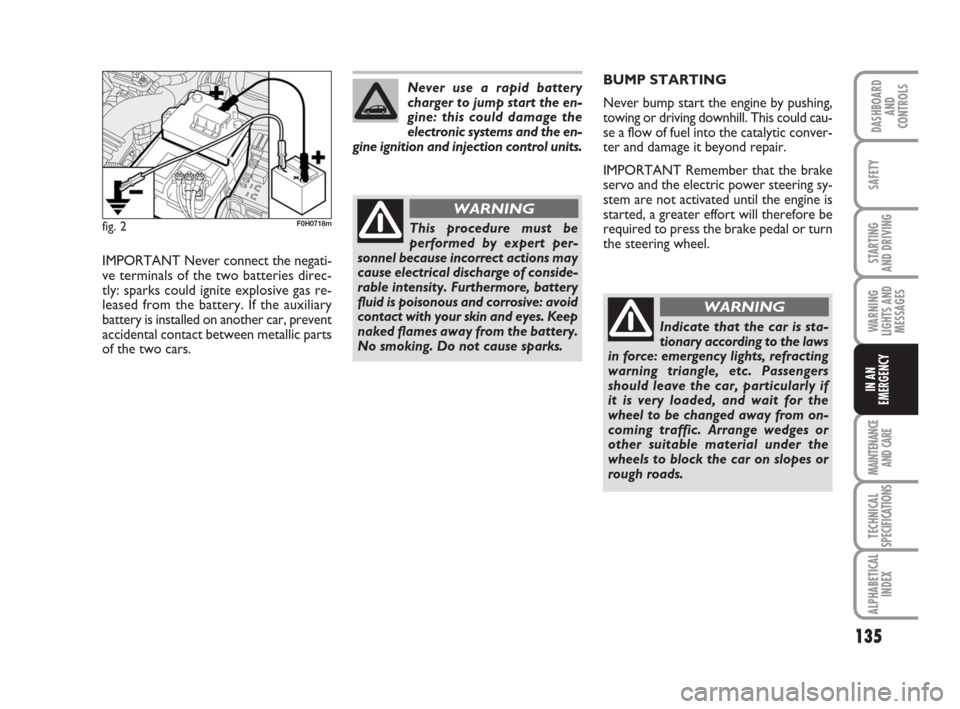
fig. 2F0H0718m
IMPORTANT Never connect the negati-
ve terminals of the two batteries direc-
tly: sparks could ignite explosive gas re-
leased from the battery. If the auxiliary
battery is installed on another car, prevent
accidental contact between metallic parts
of the two cars.
This procedure must be
performed by expert per-
sonnel because incorrect actions may
cause electrical discharge of conside-
rable intensity. Furthermore, battery
fluid is poisonous and corrosive: avoid
contact with your skin and eyes. Keep
naked flames away from the battery.
No smoking. Do not cause sparks.
WARNING
Never use a rapid battery
charger to jump start the en-
gine: this could damage the
electronic systems and the en-
gine ignition and injection control units.BUMP STARTING
Never bump start the engine by pushing,
towing or driving downhill. This could cau-
se a flow of fuel into the catalytic conver-
ter and damage it beyond repair.
IMPORTANT Remember that the brake
servo and the electric power steering sy-
stem are not activated until the engine is
started, a greater effort will therefore be
required to press the brake pedal or turn
the steering wheel.
Indicate that the car is sta-
tionary according to the laws
in force: emergency lights, refracting
warning triangle, etc. Passengers
should leave the car, particularly if
it is very loaded, and wait for the
wheel to be changed away from on-
coming traffic. Arrange wedges or
other suitable material under the
wheels to block the car on slopes or
rough roads.
WARNING
Page 158 of 210
157
STARTING
AND DRIVING
MAINTENANCE
AND CARE
TECHNICAL
SPECIFICATIONS
ALPHABETICAL
INDEX
DASHBOARD
AND
CONTROLS
SAFETY
WARNING
LIGHTS AND
MESSAGES
IN AN
EMERGENCY
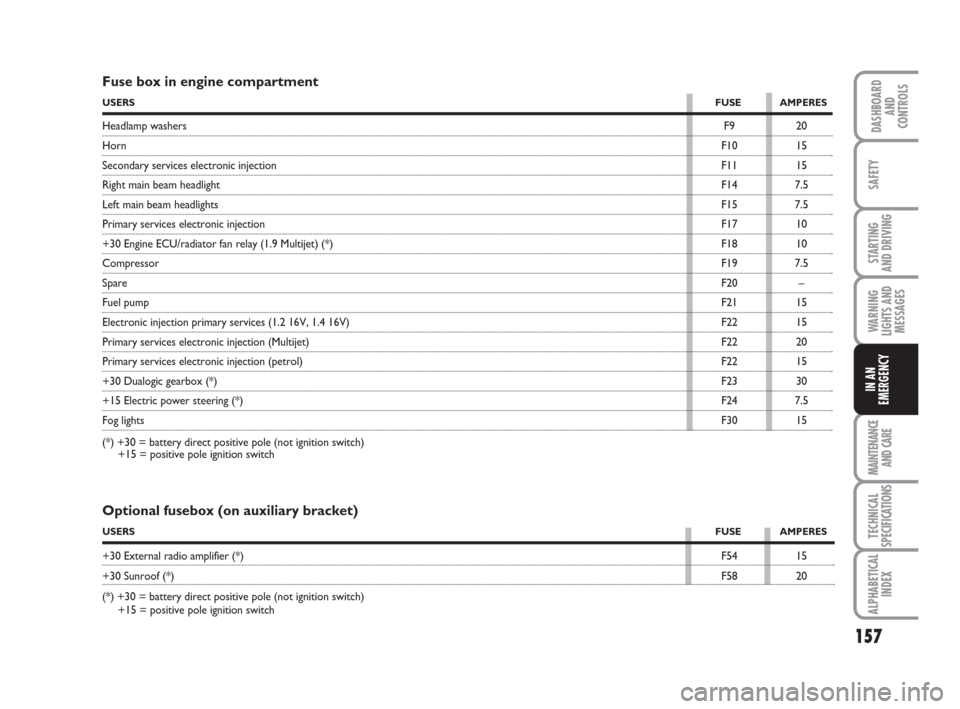
Fuse box in engine compartment
USERSFUSE AMPERES
Headlamp washersF9 20
HornF10 15
Secondary services electronic injectionF11 15
Right main beam headlightF14 7.5
Left main beam headlightsF15 7.5
Primary services electronic injectionF17 10
+30 Engine ECU/radiator fan relay (1.9 Multijet) (*)F18 10
CompressorF19 7.5
SpareF20 –
Fuel pumpF21 15
Electronic injection primary services (1.2 16V, 1.4 16V)F22 15
Primary services electronic injection (Multijet)F22 20
Primary services electronic injection (petrol)F22 15
+30 Dualogic gearbox (*)F23 30
+15 Electric power steering (*)F24 7.5
Fog lightsF30 15
(*) +30 = battery direct positive pole (not ignition switch)
+15 = positive pole ignition switch
Optional fusebox (on auxiliary bracket)
USERSFUSE AMPERES
+30 External radio amplifier (*)F54 15
+30 Sunroof (*)F58 20
(*) +30 = battery direct positive pole (not ignition switch)
+15 = positive pole ignition switch
Page 162 of 210
161
STARTING
AND DRIVING
IN AN
EMERGENCY
TECHNICAL
SPECIFICATIONS
ALPHABETICAL
INDEX
DASHBOARD
AND
CONTROLS
SAFETY
WARNING
LIGHTS AND
MESSAGES
MAINTENANCE
AND CARE
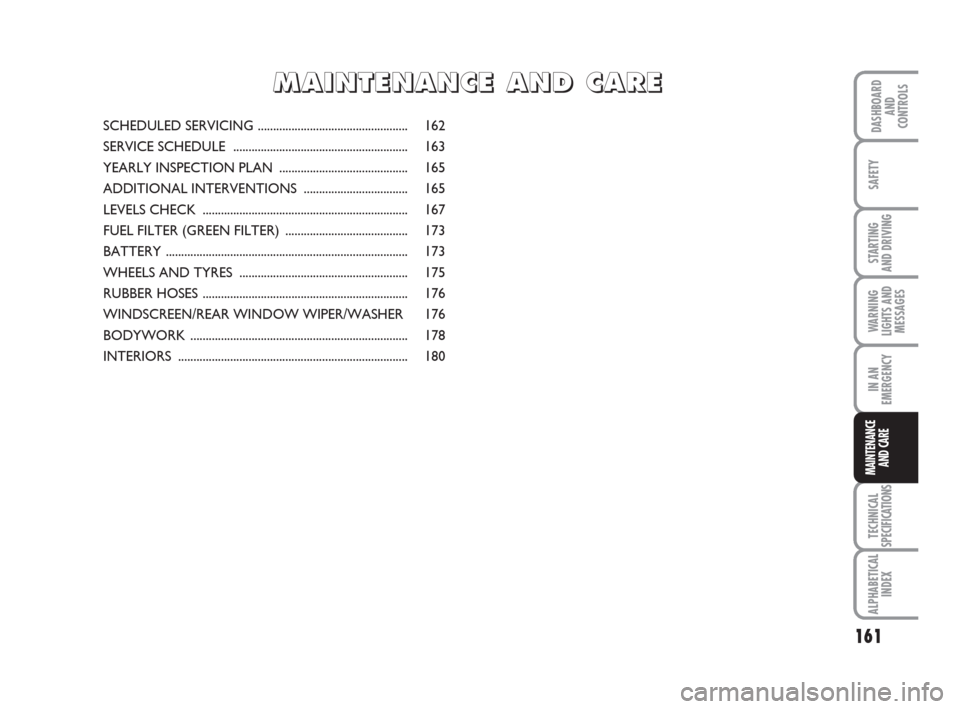
SCHEDULED SERVICING ................................................. 162
SERVICE SCHEDULE ......................................................... 163
YEARLY INSPECTION PLAN .......................................... 165
ADDITIONAL INTERVENTIONS .................................. 165
LEVELS CHECK ................................................................... 167
FUEL FILTER (GREEN FILTER) ........................................ 173
BATTERY ............................................................................... 173
WHEELS AND TYRES ....................................................... 175
RUBBER HOSES ................................................................... 176
WINDSCREEN/REAR WINDOW WIPER/WASHER 176
BODYWORK ....................................................................... 178
INTERIORS ........................................................................... 180
M M
A A
I I
N N
T T
E E
N N
A A
N N
C C
E E
A A
N N
D D
C C
A A
R R
E E
Page 164 of 210
163
STARTING
AND DRIVING
IN AN
EMERGENCY
TECHNICAL
SPECIFICATIONS
ALPHABETICAL
INDEX
DASHBOARD
AND
CONTROLS
SAFETY
WARNING
LIGHTS AND
MESSAGES
MAINTENANCE
AND CARE
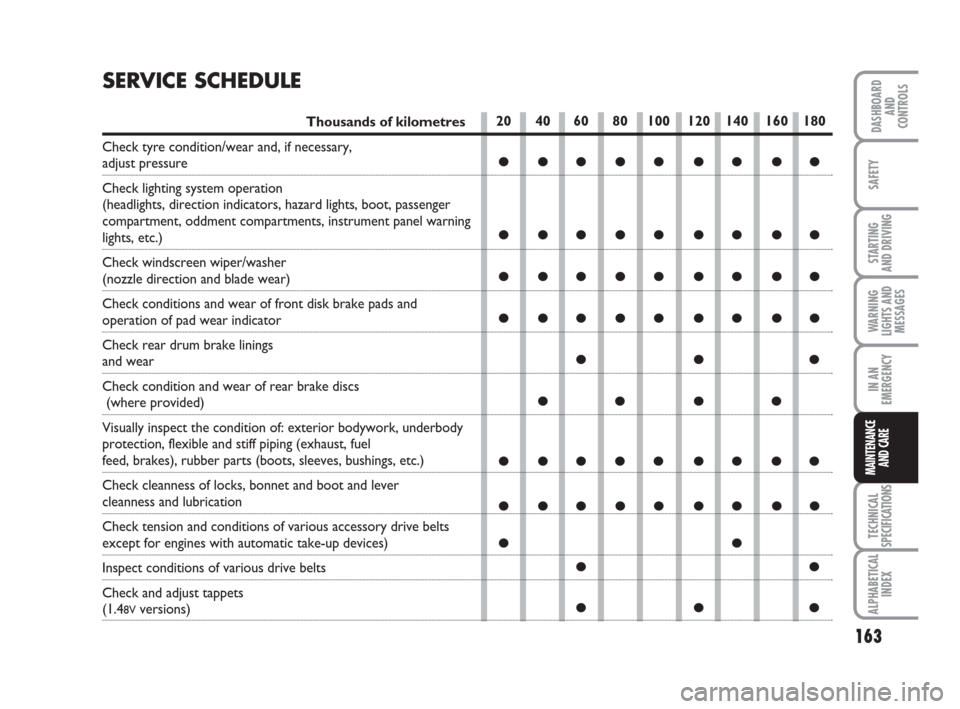
20 40 60 80 100 120 140 160 180
●●●●● ●●●●
●●●●● ●●●●
●●●●● ●●●●
●●●●● ●●●●
●●●
●● ● ●
●●●●● ●●●●
●●●●● ●●●●
●●
●●
●●●
SERVICE SCHEDULE
Thousands of kilometres
Check tyre condition/wear and, if necessary,
adjust pressure
Check lighting system operation
(headlights, direction indicators, hazard lights, boot, passenger
compartment, oddment compartments, instrument panel warning
lights, etc.)
Check windscreen wiper/washer
(nozzle direction and blade wear)
Check conditions and wear of front disk brake pads and
operation of pad wear indicator
Check rear drum brake linings
and wear
Check condition and wear of rear brake discs
(where provided)
Visually inspect the condition of: exterior bodywork, underbody
protection, flexible and stiff piping (exhaust, fuel
feed, brakes), rubber parts (boots, sleeves, bushings, etc.)
Check cleanness of locks, bonnet and boot and lever
cleanness and lubrication
Check tension and conditions of various accessory drive belts
except for engines with automatic take-up devices)
Inspect conditions of various drive belts
Check and adjust tappets
(1.48Vversions)
Page 165 of 210
164
STARTING
AND DRIVING
IN AN
EMERGENCY
TECHNICAL
SPECIFICATIONS
ALPHABETICAL
INDEX
DASHBOARD
AND
CONTROLS
SAFETY
WARNING
LIGHTS AND
MESSAGES
MAINTENANCE
AND CARE
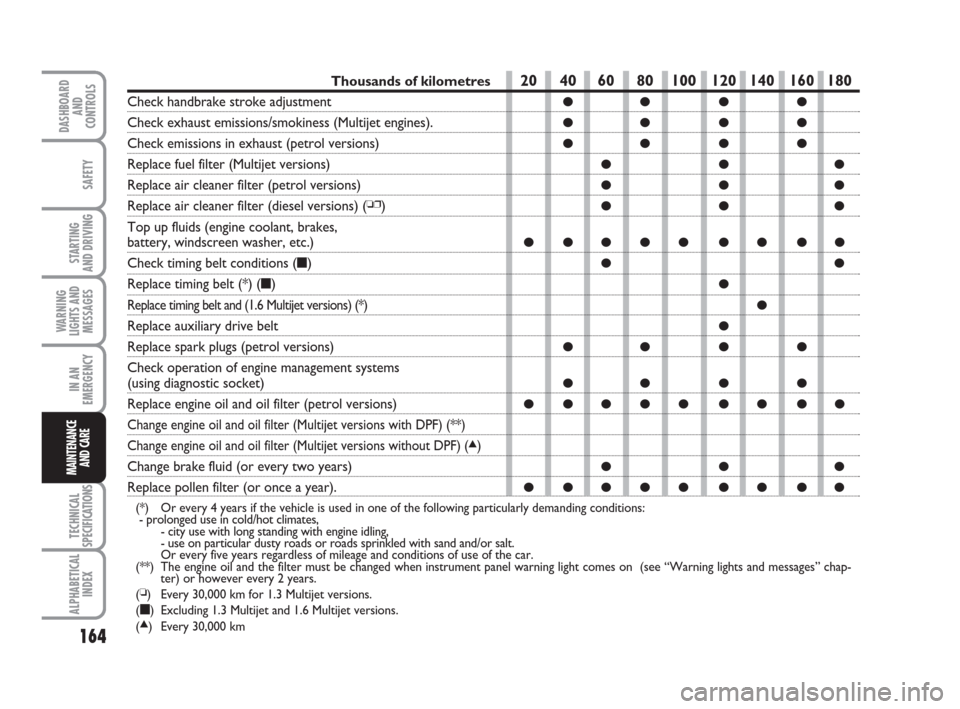
Thousands of kilometres
Check handbrake stroke adjustment
Check exhaust emissions/smokiness (Multijet engines).
Check emissions in exhaust (petrol versions)
Replace fuel filter (Multijet versions)
Replace air cleaner filter (petrol versions)
Replace air cleaner filter (diesel versions) (❏❒)
Top up fluids (engine coolant, brakes,
battery, windscreen washer, etc.)
Check timing belt conditions (■)
Replace timing belt (*) (■)
Replace timing belt and (1.6 Multijet versions) (*)
Replace auxiliary drive belt
Replace spark plugs (petrol versions)
Check operation of engine management systems
(using diagnostic socket)
Replace engine oil and oil filter (petrol versions)
Change engine oil and oil filter (Multijet versions with DPF) (**)
Change engine oil and oil filter (Multijet versions without DPF) (▲)
Change brake fluid (or every two years)
Replace pollen filter (or once a year).
(*) Or every 4 years if the vehicle is used in one of the following particularly demanding conditions:
- prolonged use in cold/hot climates,
- city use with long standing with engine idling,
- use on particular dusty roads or roads sprinkled with sand and/or salt.
Or every five years regardless of mileage and conditions of use of the car.
(**) The engine oil and the filter must be changed when instrument panel warning light comes on (see “Warning lights and messages” chap-
ter) or however every 2 years.
(
❏) Every 30,000 km for 1.3 Multijet versions.
(
■) Excluding 1.3 Multijet and 1.6 Multijet versions.
(▲) Every 30,000 km
20 40 60 80 100 120 140 160 180
●● ● ●
●● ● ●
●● ● ●
●●●
●●●
●●●
●●●●● ●●●●
●●
●
●
●
●● ● ●
●● ● ●
●●●●● ●●●●
●●●
●●●●● ●●●●
Page 166 of 210
165
STARTING
AND DRIVING
IN AN
EMERGENCY
TECHNICAL
SPECIFICATIONS
ALPHABETICAL
INDEX
DASHBOARD
AND
CONTROLS
SAFETY
WARNING
LIGHTS AND
MESSAGES
MAINTENANCE
AND CARE
YEARLY INSPECTION
PLAN
The following yearly inspection plan is re-
commended for cars clocking less than
20,000 km a year (e.g. approximately
15.000 km):
❒check tyre conditions/wear and pres-
sure (included spare wheel)
❒check lighting system operation (head-
lights, direction indicators, hazard li-
ghts, boot, passenger compartment,
instrument panel warning lights, etc.)
❒check windscreen wiper/washer
(nozzle direction and blade wear)
❒check front disk brake pad conditions
and wear;
❒visually inspect the conditions of: en-
gine, gearbox, flexible and stiff piping
(exhaust, fuel feed, brakes), rubber
parts (boots, sleeves, bushings, etc.)
❒check cleanness of locks, bonnet and
boot and lever cleanness and lubrica-
tion
❒check battery charge;
❒visually check the various drive belt
conditions;
❒check and top up liquids if required
(engine coolant, brakes, windscreen
washer, battery, etc.)
❒change engine oil;
❒change engine oil filter;
❒change pollen filter (where provided).
ADDITIONAL
INTERVENTIONS
Every 1,000 km or before long journeys,
check and, if necessary, top up:
❒engine coolant fluid level;
❒brake fluid level;
❒windscreen washer fluid level;
❒tyre pressure and conditions.
Every 3,000 km check and, if necessary,
top up: engine oil level.
You are recommended to use FL Selenia
products, designed and produced specifi-
cally for Fiat cars (see table “Capacities”
in section “Technical specifications”).
Page 167 of 210
166
STARTING
AND DRIVING
IN AN
EMERGENCY
TECHNICAL
SPECIFICATIONS
ALPHABETICAL
INDEX
DASHBOARD
AND
CONTROLS
SAFETY
WARNING
LIGHTS AND
MESSAGES
MAINTENANCE
AND CARE
IMPORTANT - Engine oil
Should prevailing use of the car be under
one of the following specially heavy con-
ditions:
❒trailer or caravan towing;
❒dusty roads;
❒short repeated distances (less than 7-
8 km) and with external temperatures
below zero;
❒frequently idling engines or long di-
stance low speed driving (e.g. taxis or
door-to-door deliveries) or in case of
a long term inactivity;
change engine oil more frequently than
shown on the “Service Schedule”.
IMPORTANT - Air cleaner
When the car is used on dusty roads,
change the air cleaner more frequently
than shown on the “Service Schedule”.
Call a Fiat Dealership for doubts regarding
engine oil and air cleaner replacement.IMPORTANT - Pollen filter
It is advisable to replace the filtering ele-
ment more frequently if the car is used in
dusty or very polluted places. Specifical-
ly, replace if a lower air flow into the pas-
senger compartment is found.
IMPORTANT - Diesel filter
Using diesel not complying with European
Specification EN590 may lead to the need
to replace the diesel fuel filter more fre-
quently than shown in the “Service Sche-
dule”.IMPORTANT - Battery
Check the battery charge once a year,
preferably before the beginning to winter,
to prevent freezing of the electrolyte.
Perform this inspection more frequently
if the car is mainly used for short distan-
ces or if electrical devices running with the
key off are installed, particularly after-
market. Check the battery level (elec-
trolyte) more frequently than shown on
the “Service Schedule” if the car is used in
hot climates or in particularly demanding
conditions.
Take the car to a Fiat Dea-
lership for servicing. Make su-
re you have the right equip-
ment, genuine Fiat spare
parts and consumables for ordinary,
minor interventions. Do not attempt
the operations if you lack the expe-
rience.