brake fluid FIAT IDEA 2009 1.G Owners Manual
[x] Cancel search | Manufacturer: FIAT, Model Year: 2009, Model line: IDEA, Model: FIAT IDEA 2009 1.GPages: 210, PDF Size: 3.62 MB
Page 124 of 210
123
STARTING
AND DRIVING
IN AN
EMERGENCY
MAINTENANCE
AND CARE
TECHNICAL
SPECIFICATIONS
ALPHABETICAL
INDEX
DASHBOARD
AND
CONTROLS
SAFETY
WARNING
LIGHTS AND
MESSAGES
GENERAL WARNINGS ...................................................... 124
LOW BRAKE FLUID LEVEL ............................................... 124
HANDBRAKE APPLIED ...................................................... 124
AIRBAG FAILURE ................................................................. 124
HOT ENGINE COOLANT ............................................... 125
LOW BATTERY CHARGE................................................. 125
LOW ENGINE OIL PRESSURE -
EXHAUSTED OIL .............................................................. 126
“DUALDRIVE” ELECTRIC POWER STEERING
SYSTEM ................................................................................... 126
DOOR OPEN ........................................................................ 126
SEAT BELTS NOT FASTENED ........................................ 126
EBD FAILURE......................................................................... 127
EOBD/INJECTION SYSTEM FAILURE ............................ 127
FRONT PASSENGER AIRBAG DEACTIVATED ......... 128
ABS FAILURE ......................................................................... 128
FUEL RESERVE....................................................................... 128
GLOW PLUGS ...................................................................... 129
GLOW PLUG FAILURE ...................................................... 129
WATER IN DIESEL FUEL FILTER ..................................... 129
CAR PROTECTION SYSTEM
FAILURE - FIAT CODE ...................................................... 129
REAR FOG LIGHTS ............................................................. 129
GENERIC INDICATION .................................................... 130
WORN BRAKE PADS ......................................................... 131
W W
A A
R R
N N
I I
N N
G G
L L
I I
G G
H H
T T
S S
A A
N N
D D
M M
E E
S S
S S
A A
G G
E E
S S
OBSTRUCTED PARTICULATE TRAP ............................ 131
SIDE/TAIL LIGHTS AND
DIPPED BEAM HEADLIGHTS - FOLLOW ME HOME 131
FOG LIGHTS ......................................................................... 131
LEFT-HAND DIRECTION INDICATOR ....................... 131
RIGHT-HAND DIRECTION INDICATOR ................... 131
“DUALDRIVE” ELECTRIC POWER STEERING
SYSTEM ON .......................................................................... 132
CRUISE CONTROL ............................................................ 132
MAIN BEAM HEADLIGHTS............................................... 132
POSSIBLE ICE ON ROAD.................................................. 132
LIMITED RANGE .................................................................. 132
Page 125 of 210
124
STARTING
AND DRIVING
IN AN
EMERGENCY
MAINTENANCE
AND CARE
TECHNICAL
SPECIFICATIONS
ALPHABETICAL
INDEX
DASHBOARD
AND
CONTROLS
SAFETY
WARNING
LIGHTS AND
MESSAGES
GENERAL WARNINGS
Lighting of a warning light is associated to
a specific message and/or buzzer when ap-
plicable. These indications are brief and
precautionary and as such must not be
considered as exhaustive and/or alterna-
tive to the information contained in the
Owner’s Handbook, which you are re-
commended to read carefully in all cases.
Refer to the information in this section in
the event of a failure indication.
IMPORTANT Failure indications on the
display fall into one of two categories: se-
riousfailure and less seriousfailure.
A warning cycle will be repeated in case
of severefailures until the case of the
problem is eliminated.
A shorter warning cycle will be run in ca-
se of less severefaults.
Press MODEto stop the warning cycle in
both cases. The warning light on the in-
strument panel will stay on until the cau-
se of the failure is eliminated.LOW BRAKE FLUID
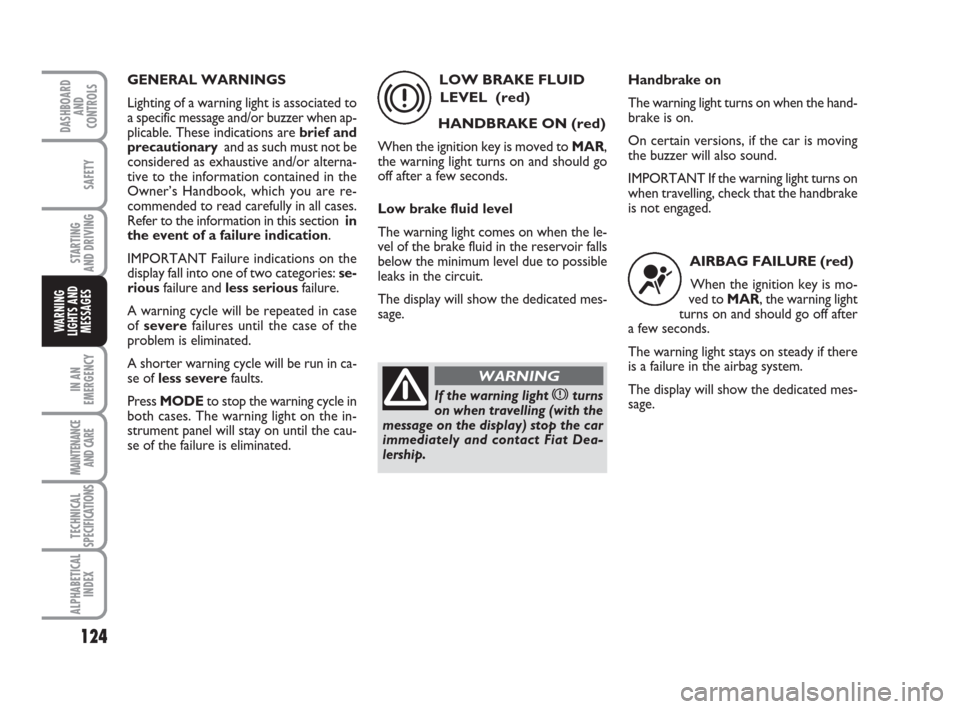
LEVEL (red)
HANDBRAKE ON (red)
When the ignition key is moved to MAR,
the warning light turns on and should go
off after a few seconds.
Low brake fluid level
The warning light comes on when the le-
vel of the brake fluid in the reservoir falls
below the minimum level due to possible
leaks in the circuit.
The display will show the dedicated mes-
sage.
x
Handbrake on
The warning light turns on when the hand-
brake is on.
On certain versions, if the car is moving
the buzzer will also sound.
IMPORTANT If the warning light turns on
when travelling, check that the handbrake
is not engaged.
AIRBAG FAILURE (red)
When the ignition key is mo-
ved to MAR, the warning light
turns on and should go off after
a few seconds.
The warning light stays on steady if there
is a failure in the airbag system.
The display will show the dedicated mes-
sage.¬
If the warning light xturns
on when travelling (with the
message on the display) stop the car
immediately and contact Fiat Dea-
lership.
WARNING
Page 136 of 210
135
STARTING
AND DRIVING
MAINTENANCE
AND CARE
TECHNICAL
SPECIFICATIONS
ALPHABETICAL
INDEX
DASHBOARD
AND
CONTROLS
SAFETY
WARNING
LIGHTS AND
MESSAGES
IN AN
EMERGENCY
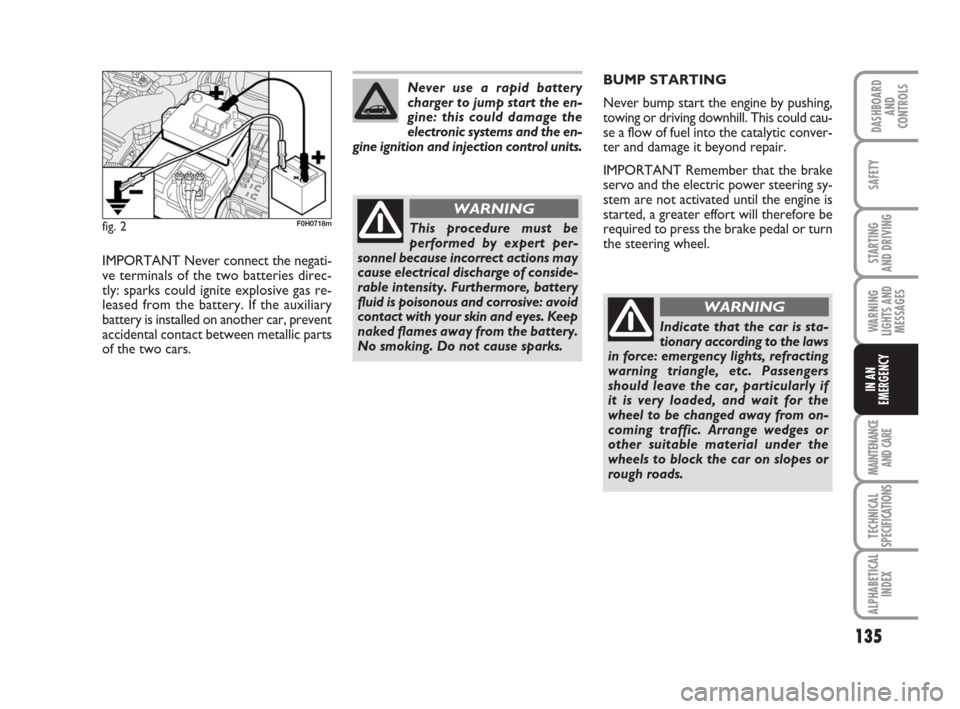
fig. 2F0H0718m
IMPORTANT Never connect the negati-
ve terminals of the two batteries direc-
tly: sparks could ignite explosive gas re-
leased from the battery. If the auxiliary
battery is installed on another car, prevent
accidental contact between metallic parts
of the two cars.
This procedure must be
performed by expert per-
sonnel because incorrect actions may
cause electrical discharge of conside-
rable intensity. Furthermore, battery
fluid is poisonous and corrosive: avoid
contact with your skin and eyes. Keep
naked flames away from the battery.
No smoking. Do not cause sparks.
WARNING
Never use a rapid battery
charger to jump start the en-
gine: this could damage the
electronic systems and the en-
gine ignition and injection control units.BUMP STARTING
Never bump start the engine by pushing,
towing or driving downhill. This could cau-
se a flow of fuel into the catalytic conver-
ter and damage it beyond repair.
IMPORTANT Remember that the brake
servo and the electric power steering sy-
stem are not activated until the engine is
started, a greater effort will therefore be
required to press the brake pedal or turn
the steering wheel.
Indicate that the car is sta-
tionary according to the laws
in force: emergency lights, refracting
warning triangle, etc. Passengers
should leave the car, particularly if
it is very loaded, and wait for the
wheel to be changed away from on-
coming traffic. Arrange wedges or
other suitable material under the
wheels to block the car on slopes or
rough roads.
WARNING
Page 138 of 210
137
STARTING
AND DRIVING
MAINTENANCE
AND CARE
TECHNICAL
SPECIFICATIONS
ALPHABETICAL
INDEX
DASHBOARD
AND
CONTROLS
SAFETY
WARNING
LIGHTS AND
MESSAGES
IN AN
EMERGENCY
The kit cannot be used to re-
pair damage to the tyre si-
dewall. Do not use the quick repair
kit if the tyre was damaged by run-
ning on a flat.
WARNING
The damage cannot be re-
paired with the kit if the
wheel rim is damaged (deformation
of the channel causing leakage of air).
Do not remove the foreign body
(screw or nail) from the tyre.
WARNING
Do not operate the com-
pressor for longer than 20
minutes consecutively. Risk of
overheating. The quick repair kit is
not suitable for definitive repairs. The
tyres may only be repaired tempora-
rily.
WARNING
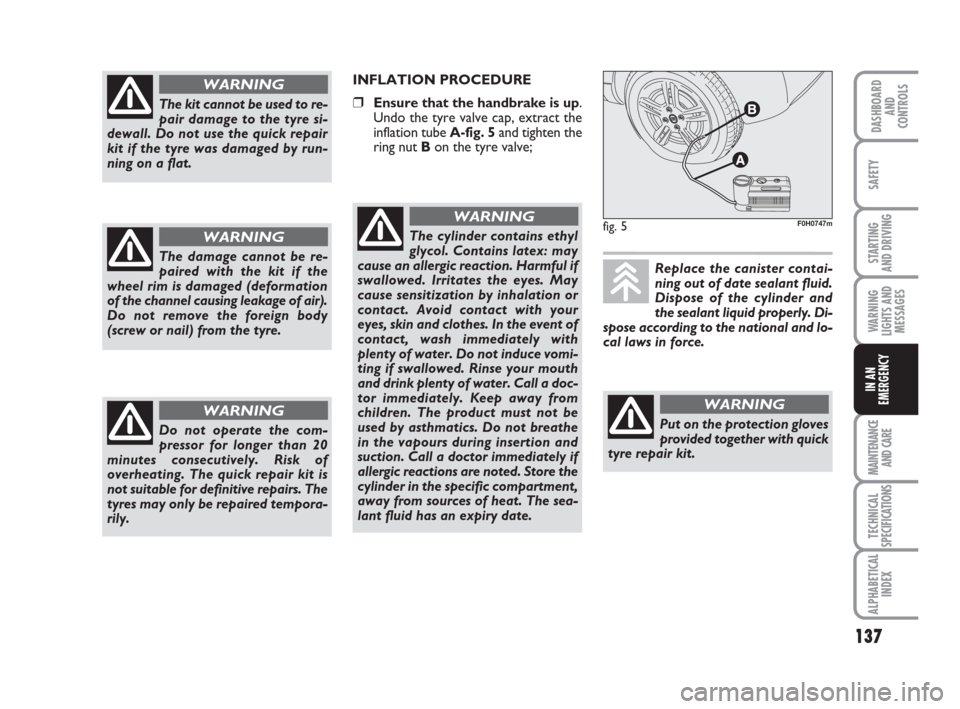
INFLATION PROCEDURE
❒Ensure that the handbrake is up.
Undo the tyre valve cap, extract the
inflation tube A-fig. 5and tighten the
ring nut Bon the tyre valve;
fig. 5F0H0747mThe cylinder contains ethyl
glycol. Contains latex: may
cause an allergic reaction. Harmful if
swallowed. Irritates the eyes. May
cause sensitization by inhalation or
contact. Avoid contact with your
eyes, skin and clothes. In the event of
contact, wash immediately with
plenty of water. Do not induce vomi-
ting if swallowed. Rinse your mouth
and drink plenty of water. Call a doc-
tor immediately. Keep away from
children. The product must not be
used by asthmatics. Do not breathe
in the vapours during insertion and
suction. Call a doctor immediately if
allergic reactions are noted. Store the
cylinder in the specific compartment,
away from sources of heat. The sea-
lant fluid has an expiry date.
WARNING
Replace the canister contai-
ning out of date sealant fluid.
Dispose of the cylinder and
the sealant liquid properly. Di-
spose according to the national and lo-
cal laws in force.
Put on the protection gloves
provided together with quick
tyre repair kit.
WARNING
Page 139 of 210
138
STARTING
AND DRIVING
MAINTENANCE
AND CARE
TECHNICAL
SPECIFICATIONS
ALPHABETICAL
INDEX
DASHBOARD
AND
CONTROLS
SAFETY
WARNING
LIGHTS AND
MESSAGES
IN AN
EMERGENCY
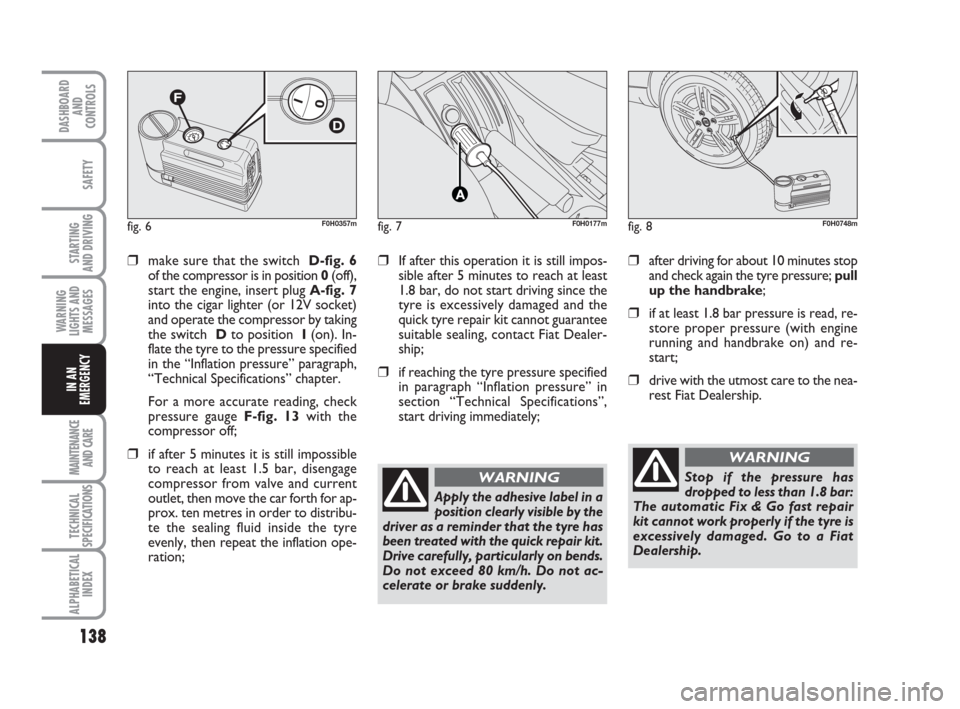
fig. 6F0H0357mfig. 7F0H0177mfig. 8F0H0748m
❒make sure that the switch D-fig. 6
of the compressor is in position 0(off),
start the engine, insert plug A-fig. 7
into the cigar lighter (or 12V socket)
and operate the compressor by taking
the switch Dto position I(on). In-
flate the tyre to the pressure specified
in the “Inflation pressure” paragraph,
“Technical Specifications” chapter.
For a more accurate reading, check
pressure gauge F-fig. 13with the
compressor off;
❒if after 5 minutes it is still impossible
to reach at least 1.5 bar, disengage
compressor from valve and current
outlet, then move the car forth for ap-
prox. ten metres in order to distribu-
te the sealing fluid inside the tyre
evenly, then repeat the inflation ope-
ration;
❒If after this operation it is still impos-
sible after 5 minutes to reach at least
1.8 bar, do not start driving since the
tyre is excessively damaged and the
quick tyre repair kit cannot guarantee
suitable sealing, contact Fiat Dealer-
ship;
❒if reaching the tyre pressure specified
in paragraph “Inflation pressure” in
section “Technical Specifications”,
start driving immediately;
Apply the adhesive label in a
position clearly visible by the
driver as a reminder that the tyre has
been treated with the quick repair kit.
Drive carefully, particularly on bends.
Do not exceed 80 km/h. Do not ac-
celerate or brake suddenly.
WARNINGStop if the pressure has
dropped to less than 1.8 bar:
The automatic Fix & Go fast repair
kit cannot work properly if the tyre is
excessively damaged. Go to a Fiat
Dealership.
WARNING
❒after driving for about 10 minutes stop
and check again the tyre pressure; pull
up the handbrake;
❒if at least 1.8 bar pressure is read, re-
store proper pressure (with engine
running and handbrake on) and re-
start;
❒drive with the utmost care to the nea-
rest Fiat Dealership.
Page 165 of 210
164
STARTING
AND DRIVING
IN AN
EMERGENCY
TECHNICAL
SPECIFICATIONS
ALPHABETICAL
INDEX
DASHBOARD
AND
CONTROLS
SAFETY
WARNING
LIGHTS AND
MESSAGES
MAINTENANCE
AND CARE
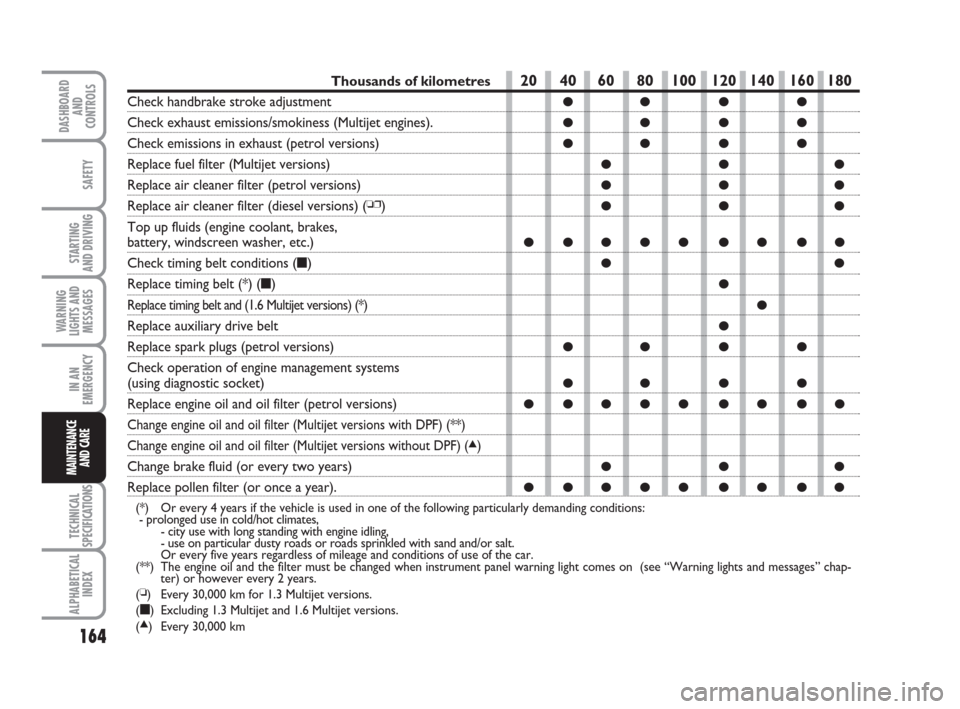
Thousands of kilometres
Check handbrake stroke adjustment
Check exhaust emissions/smokiness (Multijet engines).
Check emissions in exhaust (petrol versions)
Replace fuel filter (Multijet versions)
Replace air cleaner filter (petrol versions)
Replace air cleaner filter (diesel versions) (❏❒)
Top up fluids (engine coolant, brakes,
battery, windscreen washer, etc.)
Check timing belt conditions (■)
Replace timing belt (*) (■)
Replace timing belt and (1.6 Multijet versions) (*)
Replace auxiliary drive belt
Replace spark plugs (petrol versions)
Check operation of engine management systems
(using diagnostic socket)
Replace engine oil and oil filter (petrol versions)
Change engine oil and oil filter (Multijet versions with DPF) (**)
Change engine oil and oil filter (Multijet versions without DPF) (▲)
Change brake fluid (or every two years)
Replace pollen filter (or once a year).
(*) Or every 4 years if the vehicle is used in one of the following particularly demanding conditions:
- prolonged use in cold/hot climates,
- city use with long standing with engine idling,
- use on particular dusty roads or roads sprinkled with sand and/or salt.
Or every five years regardless of mileage and conditions of use of the car.
(**) The engine oil and the filter must be changed when instrument panel warning light comes on (see “Warning lights and messages” chap-
ter) or however every 2 years.
(
❏) Every 30,000 km for 1.3 Multijet versions.
(
■) Excluding 1.3 Multijet and 1.6 Multijet versions.
(▲) Every 30,000 km
20 40 60 80 100 120 140 160 180
●● ● ●
●● ● ●
●● ● ●
●●●
●●●
●●●
●●●●● ●●●●
●●
●
●
●
●● ● ●
●● ● ●
●●●●● ●●●●
●●●
●●●●● ●●●●
Page 166 of 210
165
STARTING
AND DRIVING
IN AN
EMERGENCY
TECHNICAL
SPECIFICATIONS
ALPHABETICAL
INDEX
DASHBOARD
AND
CONTROLS
SAFETY
WARNING
LIGHTS AND
MESSAGES
MAINTENANCE
AND CARE
YEARLY INSPECTION
PLAN
The following yearly inspection plan is re-
commended for cars clocking less than
20,000 km a year (e.g. approximately
15.000 km):
❒check tyre conditions/wear and pres-
sure (included spare wheel)
❒check lighting system operation (head-
lights, direction indicators, hazard li-
ghts, boot, passenger compartment,
instrument panel warning lights, etc.)
❒check windscreen wiper/washer
(nozzle direction and blade wear)
❒check front disk brake pad conditions
and wear;
❒visually inspect the conditions of: en-
gine, gearbox, flexible and stiff piping
(exhaust, fuel feed, brakes), rubber
parts (boots, sleeves, bushings, etc.)
❒check cleanness of locks, bonnet and
boot and lever cleanness and lubrica-
tion
❒check battery charge;
❒visually check the various drive belt
conditions;
❒check and top up liquids if required
(engine coolant, brakes, windscreen
washer, battery, etc.)
❒change engine oil;
❒change engine oil filter;
❒change pollen filter (where provided).
ADDITIONAL
INTERVENTIONS
Every 1,000 km or before long journeys,
check and, if necessary, top up:
❒engine coolant fluid level;
❒brake fluid level;
❒windscreen washer fluid level;
❒tyre pressure and conditions.
Every 3,000 km check and, if necessary,
top up: engine oil level.
You are recommended to use FL Selenia
products, designed and produced specifi-
cally for Fiat cars (see table “Capacities”
in section “Technical specifications”).
Page 168 of 210
167
STARTING
AND DRIVING
IN AN
EMERGENCY
TECHNICAL
SPECIFICATIONS
ALPHABETICAL
INDEX
DASHBOARD
AND
CONTROLS
SAFETY
WARNING
LIGHTS AND
MESSAGES
MAINTENANCE
AND CARE
LEVELS CHECK
IMPORTANT Be careful not to confuse
the various types of fluids while topping
up: they are all reciprocally incompatible
and may severely damage your car.
IMPORTANT Never smoke while
working in the engine compartment. Flam-
mable gases may be present. Risk of fire.
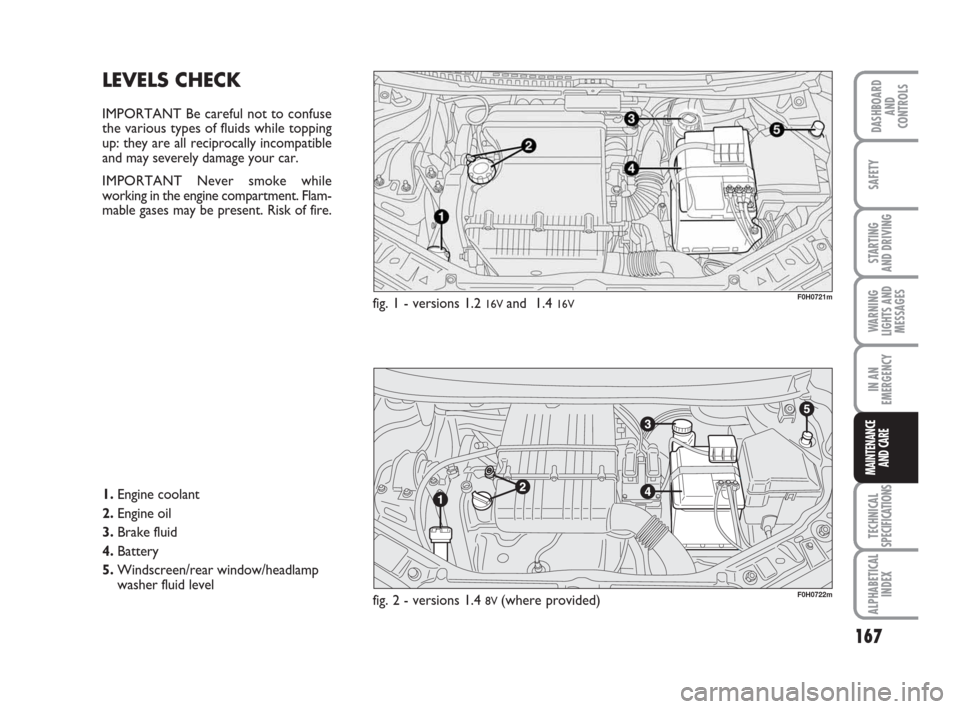
F0H0721mfig. 1 - versions 1.2 16V and 1.4 16V
F0H0722mfig. 2 - versions 1.4 8V (where provided) 1. Engine coolant
2. Engine oil
3. Brake fluid
4. Battery
5.Windscreen/rear window/headlamp
washer fluid level
Page 169 of 210
168
STARTING
AND DRIVING
IN AN
EMERGENCY
TECHNICAL
SPECIFICATIONS
ALPHABETICAL
INDEX
DASHBOARD
AND
CONTROLS
SAFETY
WARNING
LIGHTS AND
MESSAGES
MAINTENANCE
AND CARE
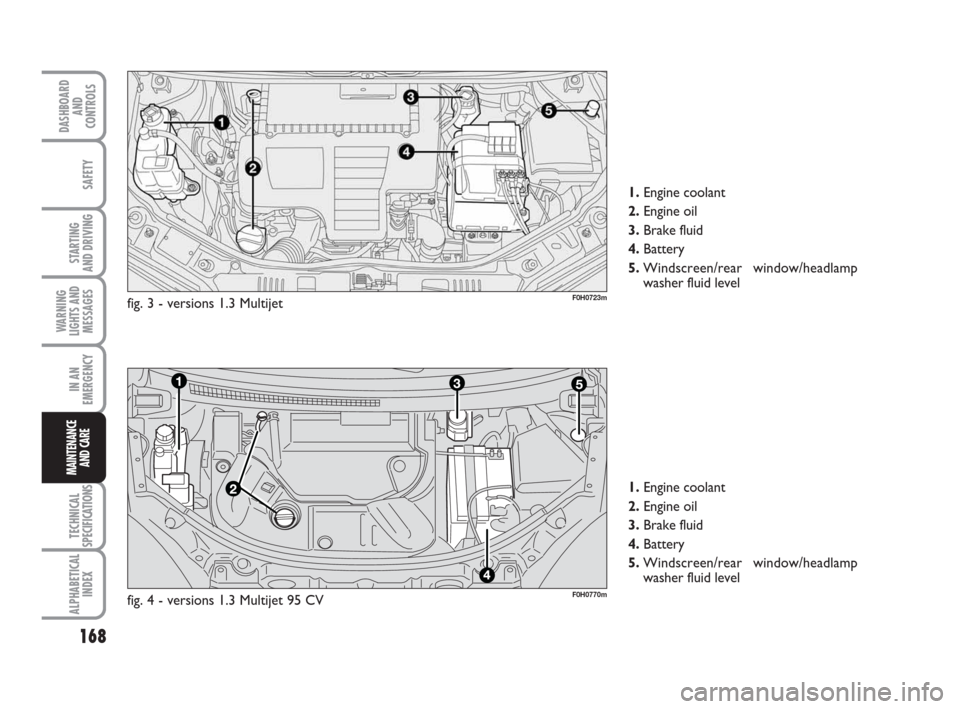
F0H0723mfig. 3 - versions 1.3 Multijet 1. Engine coolant
2. Engine oil
3. Brake fluid
4. Battery
5.Windscreen/rear window/headlamp
washer fluid level
F0H0770mfig. 4 - versions 1.3 Multijet 95 CV 1. Engine coolant
2.Engine oil
3. Brake fluid
4. Battery
5.Windscreen/rear window/headlamp
washer fluid level
Page 170 of 210
169
STARTING
AND DRIVING
IN AN
EMERGENCY
TECHNICAL
SPECIFICATIONS
ALPHABETICAL
INDEX
DASHBOARD
AND
CONTROLS
SAFETY
WARNING
LIGHTS AND
MESSAGES
MAINTENANCE
AND CARE
3
12
45
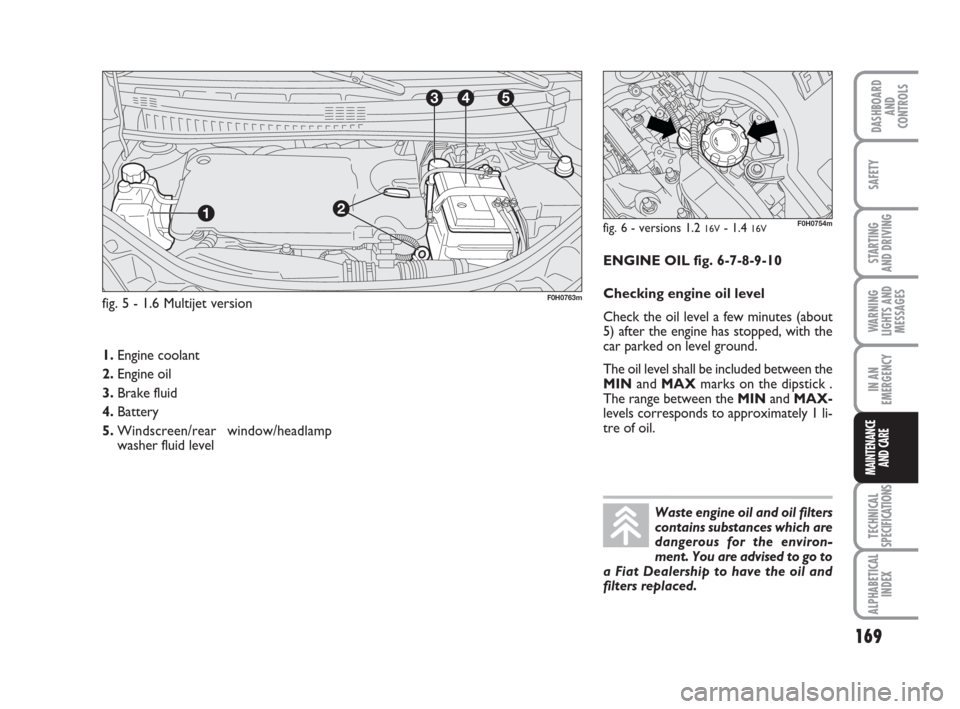
F0H0763mfig. 5 - 1.6 Multijet version
1. Engine coolant
2. Engine oil
3. Brake fluid
4. Battery
5.Windscreen/rear window/headlamp
washer fluid levelENGINE OIL fig. 6-7-8-9-10
Checking engine oil level
Check the oil level a few minutes (about
5) after the engine has stopped, with the
car parked on level ground.
The oil level shall be included between the
MINand MAXmarks on the dipstick .
The range between the MINand MAX-
levels corresponds to approximately 1 li-
tre of oil.
fig. 6 - versions 1.2 16V- 1.4 16VF0H0754m
Waste engine oil and oil filters
contains substances which are
dangerous for the environ-
ment. You are advised to go to
a Fiat Dealership to have the oil and
filters replaced.