climate control FIAT IDEA 2010 1.G User Guide
[x] Cancel search | Manufacturer: FIAT, Model Year: 2010, Model line: IDEA, Model: FIAT IDEA 2010 1.GPages: 210, PDF Size: 4.4 MB
Page 57 of 210
56
SAFETY
STARTING
AND DRIVING
WARNING
LIGHTS AND
MESSAGES
IN AN
EMERGENCY
MAINTENANCE
AND CARE
TECHNICAL
SPECIFICATIONS
ALPHABETICAL
INDEX
DASHBOARD
AND CONTROLS
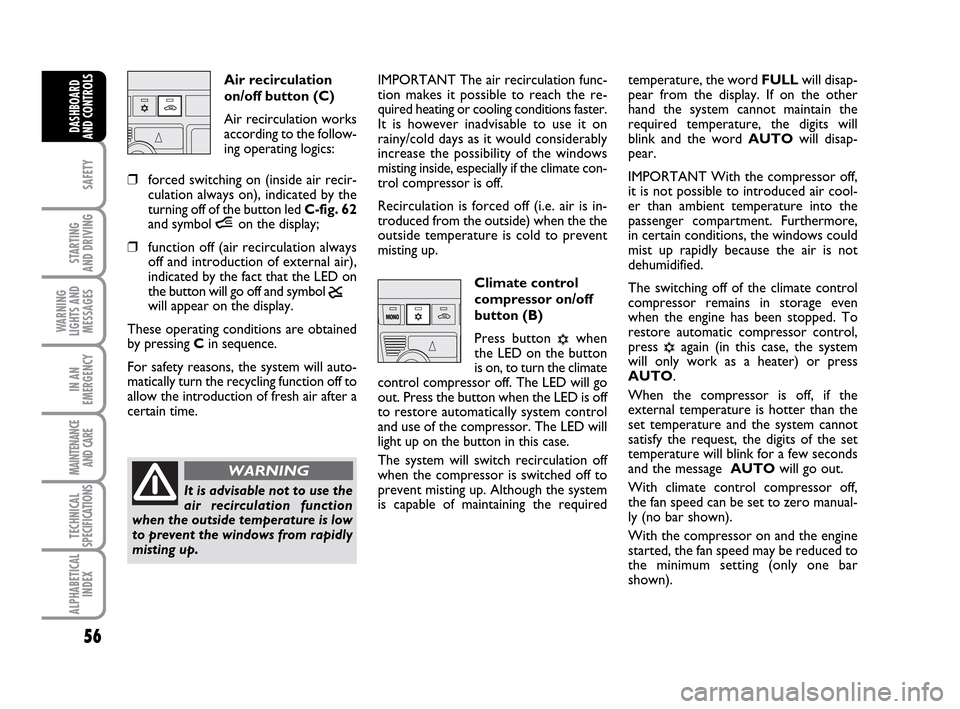
Air recirculation
on/off button (C)
Air recirculation works
according to the follow-
ing operating logics:
❒forced switching on (inside air recir-
culation always on), indicated by the
turning off of the button led C-fig. 62
and symbol íon the display;
❒function off (air recirculation always
off and introduction of external air),
indicated by the fact that the LED on
the button will go off and symbol
ê
will appear on the display.
These operating conditions are obtained
by pressing Cin sequence.
For safety reasons, the system will auto-
matically turn the recycling function off to
allow the introduction of fresh air after a
certain time.IMPORTANT The air recirculation func-
tion makes it possible to reach the re-
quired heating or cooling conditions faster.
It is however inadvisable to use it on
rainy/cold days as it would considerably
increase the possibility of the windows
misting inside, especially if the climate con-
trol compressor is off.
Recirculation is forced off (i.e. air is in-
troduced from the outside) when the the
outside temperature is cold to prevent
misting up.
Climate control
compressor on/off
button (B)
Press button
√when
the LED on the button
is on, to turn the climate
control compressor off. The LED will go
out. Press the button when the LED is off
to restore automatically system control
and use of the compressor. The LED will
light up on the button in this case.
The system will switch recirculation off
when the compressor is switched off to
prevent misting up. Although the system
is capable of maintaining the requiredtemperature, the word FULLwill disap-
pear from the display. If on the other
hand the system cannot maintain the
required temperature, the digits will
blink and the word AUTOwill disap-
pear.
IMPORTANT With the compressor off,
it is not possible to introduced air cool-
er than ambient temperature into the
passenger compartment. Furthermore,
in certain conditions, the windows could
mist up rapidly because the air is not
dehumidified.
The switching off of the climate control
compressor remains in storage even
when the engine has been stopped. To
restore automatic compressor control,
press √again (in this case, the system
will only work as a heater) or press
AUTO.
When the compressor is off, if the
external temperature is hotter than the
set temperature and the system cannot
satisfy the request, the digits of the set
temperature will blink for a few seconds
and the message AUTOwill go out.
With climate control compressor off,
the fan speed can be set to zero manual-
ly (no bar shown).
With the compressor on and the engine
started, the fan speed may be reduced to
the minimum setting (only one bar
shown).
It is advisable not to use the
air recirculation function
when the outside temperature is low
to prevent the windows from rapidly
misting up.
WARNING
036-092 LUM IDEA GB 2 ed.qxd 14-01-2010 12:14 Pagina 56
Page 58 of 210
57
SAFETY
STARTING
AND DRIVING
WARNING
LIGHTS AND
MESSAGES
IN AN
EMERGENCY
MAINTENANCE
AND CARE
TECHNICAL
SPECIFICATIONS
ALPHABETICAL
INDEX
DASHBOARD
AND CONTROLS
Fast window
demisting/
defrosting button
(F)
Press this button: the cli-
mate control system will automatically
switch on all the functions required for fast
windscreen and front side window demist-
ing/defrosting, that is:
❒switches on the climate control com-
pressor when weather conditions are
suitable;
❒air recycle off;
❒maximum air temperature HIon
both areas;
❒sets proper fan speed according to
engine coolant temperature to limit
the flow of not sufficiently warm air
to demist the windows into the pas-
senger compartment;
❒directs the air flow to the windscreen
and front side windows vents;
❒heated rear window on.
IMPORTANT The fast demist/defrost
function will remain on for approximate-
ly 3 minutes, from when the engine
coolant reaches a temperature of 50°C
(petrol versions) or 35°C (Multijet ver-
sions).
When this function is on, the LED of the
corresponding button switches on and
that of the rear window demister. Themessage FULL AUTOgoes off on the
display.
You can only adjust the fan speed and
switch the rear window demister off
manually when this function is active.
To restore running operations before
this function was activated, press either
button F-fig. 62, air recirculation but-
ton C, compressor button Bor button
AUTO Nor H
Rear window heater
and external
rearview mirror
heater on/off button
(G)
Press this button to turn
the rear window demister/defroster on.
The LED in the button will light up when
the function is on.
The heater will go out automatically af-
ter a certain time or by pressing the but-
ton again. It will also go out when the en-
gine is stopped until it is started again.
IMPORTANT Do not apply stickers over
the electric filaments on the inside of the
rear window to prevent damage and en-
sure perfect operation.Switching the
system off (E)
Press Eto switch the cli-
mate control system off.
The display will go out
as a consequence.
The following climate control conditions
will be established when the system is off:
❒LEDs off;
❒set temperature not shown;
❒air recirculation on, passenger com-
partment isolated from the outside;
❒air conditioner compressor off;
❒fan off.
The rear window heater can be turned
on and off manually by pressing Gwhen
the system is off.
IMPORTANT The climate control sys-
tem control unit stores the settings
before the system is turned off and rep-
resents the same settings when it turned
back on by pressing any button (except
for the heated rear window). If the but-
ton of a function was not pressed before
turning off the system if will be turned
on; if the functions was on it will be kept
on.
Press AUTOto turn the system in
automatic mode.
036-092 LUM IDEA GB 2 ed.qxd 14-01-2010 12:14 Pagina 57
Page 117 of 210
116
WARNING
LIGHTS AND
MESSAGES
IN AN
EMERGENCY
MAINTENANCE
AND CARE
TECHNICAL
SPECIFICATIONS
ALPHABETICAL
INDEX
DASHBOARD
AND
CONTROLS
SAFETY
STARTING
AND DRIVING
CONTAINING
RUNNING COSTS
Here are some suggestions which may
help you to keep the running costs of your
vehicle down and lower the amount of
toxic emissions released into the atmos-
phere.
GENERAL CONSIDERATIONS
Car maintenance
Have checks and adjustments carried out
in accordance with the “Service schedule”.
Tyres
Check tyre pressure regularly, at least
once every four weeks: excessively low
pressure will increase fuel consumption
because rolling resistance will be higher.
Unnecessary loads
Do not travel with an overloaded boot.
Do not travel with too much luggage
stowed in the boot. The weight of the car
(especially when driving in town) and its
trim greatly affects consumption and sta-
bility.Roof rack/ski rack
Remove the roof rack or the ski rack from
the roof after use. These accessories de-
crease aerodynamic penetration of the car
and have a negative effect on consumption.
It is better to use a trailer to transport
particularly bulky objects.
Electrical devices
Use electrical devices only for the amount
of time needed. Rear heated window, ad-
ditional headlights, windscreen wipers and
heater fan need a considerable amount of
energy, therefore increasing the require-
ment of current increases fuel consump-
tion (up to +25% in the urban cycle).
Climate control
The climate control system requires high-
er fuel consumption (up to +20% in av-
erage): use the air vents when the exter-
nal temperature allows to.
Spoilers
The use of non-certified aerodynamic
items may adversely affect air drag and fu-
el consumption levels.DRIVING STYLE
Starting
Do not warm the engine up with the car
standing: the engine warms up very slow-
ly in these conditions, increasing fuel con-
sumption and emissions. It is advisable to
start off immediately and slowly keeping
the engine speed down: the engine will
warm up much faster this way.
Unnecessary actions
Avoid revving up when starting at traffic
lights or before stopping the engine. The
latter action, like doubling the clutch, is un-
necessary and causes increase of con-
sumption and pollution.
Gear selection
Use a higher gear as soon as traffic and
road conditions allow. Using a low gear
for faster acceleration will increase fuel
consumption.
In the same way improper use of a high
gear increases consumption, emissions an
engine wear.
111-122 LUM IDEA GB 2 ed.qxd 14-01-2010 12:32 Pagina 116
Page 165 of 210
164
STARTING
AND DRIVING
IN AN
EMERGENCY
TECHNICAL
SPECIFICATIONS
ALPHABETICAL
INDEX
DASHBOARD
AND
CONTROLS
SAFETY
WARNING
LIGHTS AND
MESSAGES
MAINTENANCE
AND CARE
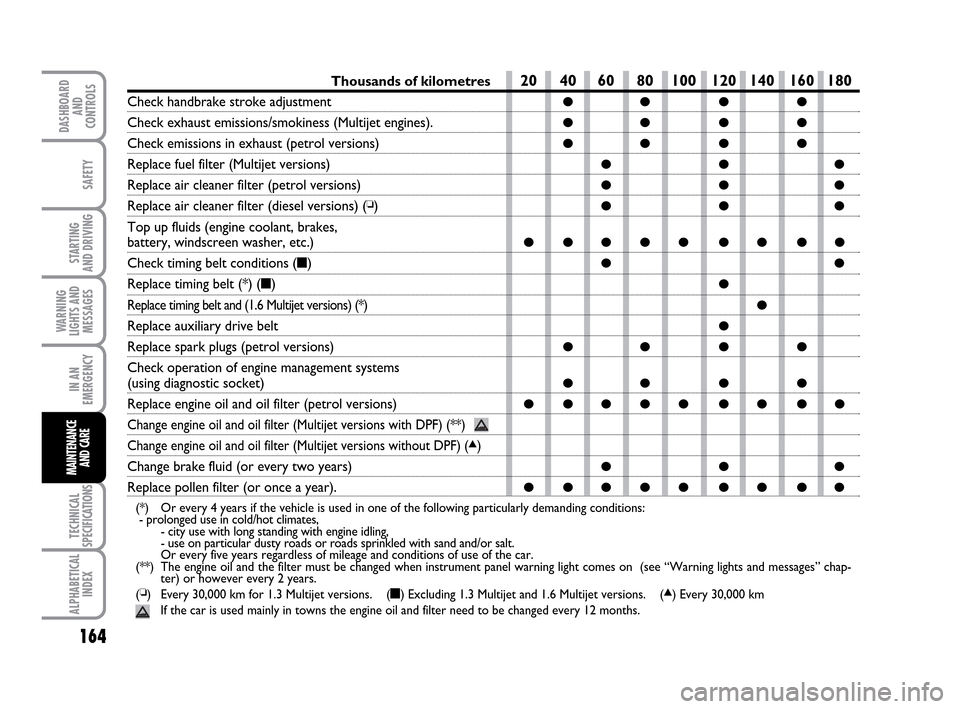
Thousands of kilometres
Check handbrake stroke adjustment
Check exhaust emissions/smokiness (Multijet engines).
Check emissions in exhaust (petrol versions)
Replace fuel filter (Multijet versions)
Replace air cleaner filter (petrol versions)
Replace air cleaner filter (diesel versions) (❏)
Top up fluids (engine coolant, brakes,
battery, windscreen washer, etc.)
Check timing belt conditions (■)
Replace timing belt (*) (■)
Replace timing belt and (1.6 Multijet versions) (*)
Replace auxiliary drive belt
Replace spark plugs (petrol versions)
Check operation of engine management systems
(using diagnostic socket)
Replace engine oil and oil filter (petrol versions)
Change engine oil and oil filter (Multijet versions with DPF) (**)
Change engine oil and oil filter (Multijet versions without DPF) (▲)
Change brake fluid (or every two years)
Replace pollen filter (or once a year).
(*) Or every 4 years if the vehicle is used in one of the following particularly demanding conditions:
- prolonged use in cold/hot climates,
- city use with long standing with engine idling,
- use on particular dusty roads or roads sprinkled with sand and/or salt.
Or every five years regardless of mileage and conditions of use of the car.
(**) The engine oil and the filter must be changed when instrument panel warning light comes on (see “Warning lights and messages” chap-
ter) or however every 2 years.
(
❏) Every 30,000 km for 1.3 Multijet versions. (■) Excluding 1.3 Multijet and 1.6 Multijet versions. (▲) Every 30,000 km
If the car is used mainly in towns the engine oil and filter need to be changed every 12 months.
20 40 60 80 100 120 140 160 180
●● ● ●
●● ● ●
●● ● ●
●●●
●●●
●●●
●●●●● ●●●●
●●
●
●
●
●● ● ●
●● ● ●
●●●●● ●●●●
●●●
●●●●● ●●●●
161-180 LUM IDEA GB 2 ed.qxd 14-01-2010 13:52 Pagina 164
Page 167 of 210
166
STARTING
AND DRIVING
IN AN
EMERGENCY
TECHNICAL
SPECIFICATIONS
ALPHABETICAL
INDEX
DASHBOARD
AND
CONTROLS
SAFETY
WARNING
LIGHTS AND
MESSAGES
MAINTENANCE
AND CARE
IMPORTANT - Engine oil
Should prevailing use of the car be under
one of the following specially heavy con-
ditions:
❒trailer or caravan towing;
❒dusty roads;
❒short repeated distances (less than 7-
8 km) and with external temperatures
below zero;
❒frequently idling engines or long dis-
tance low speed driving (e.g. taxis or
door-to-door deliveries) or in case of
a long term inactivity;
change engine oil more frequently than
shown on the “Service Schedule”.
IMPORTANT - Air cleaner
When the car is used on dusty roads,
change the air cleaner more frequently
than shown on the “Service Schedule”.
Call a Fiat Dealership for doubts regard-
ing engine oil and air cleaner replacement.IMPORTANT - Pollen filter
It is advisable to replace the filtering ele-
ment more frequently if the car is used in
dusty or very polluted places. Specifical-
ly, replace if a lower air flow into the pas-
senger compartment is found.
IMPORTANT - Diesel filter
Using diesel not complying with European
Specification EN590 may lead to the need
to replace the diesel fuel filter more fre-
quently than shown in the “Service Sched-
ule”.IMPORTANT - Battery
Check the battery charge once a year,
preferably before the beginning to winter,
to prevent freezing of the electrolyte.
Perform this inspection more frequently
if the car is mainly used for short distances
or if electrical devices running with the key
off are installed, particularly after-market.
Check the battery level (electrolyte) more
frequently than shown on the “Service
Schedule” if the car is used in hot climates
or in particularly demanding conditions.
Take the car to a Fiat Deal-
ership for servicing. Make
sure you have the right equip-
ment, genuine Fiat spare
parts and consumables for ordinary,
minor interventions. Do not attempt
the operations if you lack the experi-
ence.
161-180 LUM IDEA GB 2 ed.qxd 14-01-2010 13:52 Pagina 166
Page 172 of 210
171
STARTING
AND DRIVING
IN AN
EMERGENCY
TECHNICAL
SPECIFICATIONS
ALPHABETICAL
INDEX
DASHBOARD
AND
CONTROLS
SAFETY
WARNING
LIGHTS AND
MESSAGES
MAINTENANCE
AND CARE
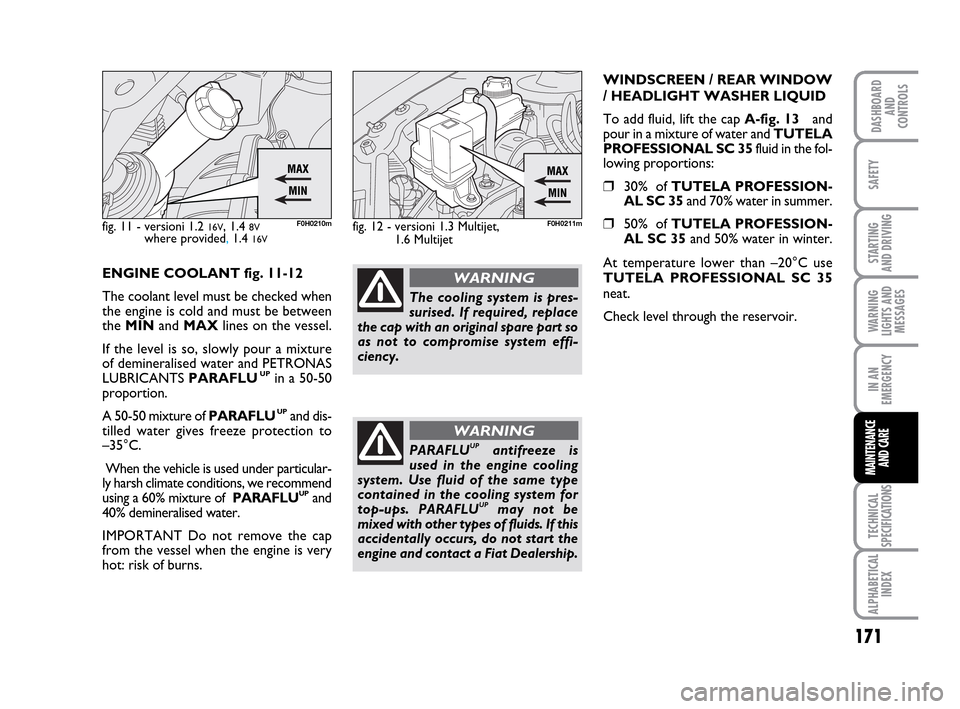
ENGINE COOLANT fig. 11-12
The coolant level must be checked when
the engine is cold and must be between
the MINand MAXlines on the vessel.
If the level is so, slowly pour a mixture
of demineralised water and PETRONAS
LUBRICANTS PARAFLU
UPin a 50-50
proportion.
A 50-50 mixture of PARAFLU
UPand dis-
tilled water gives freeze protection to
–35°C.
When the vehicle is used under particular-
ly harsh climate conditions, we recommend
using a 60% mixture of PARAFLU
UPand
40% demineralised water.
IMPORTANT Do not remove the cap
from the vessel when the engine is very
hot: risk of burns.
fig. 11 - versioni 1.2 16V, 1.4 8Vwhere provided, 1.4 16V
F0H0210mfig. 12 - versioni 1.3 Multijet,
1.6 MultijetF0H0211m
PARAFLUUPantifreeze is
used in the engine cooling
system. Use fluid of the same type
contained in the cooling system for
top-ups. PARAFLU
UPmay not be
mixed with other types of fluids. If this
accidentally occurs, do not start the
engine and contact a Fiat Dealership.
WARNING
The cooling system is pres-
surised. If required, replace
the cap with an original spare part so
as not to compromise system effi-
ciency.
WARNING
WINDSCREEN / REAR WINDOW
/ HEADLIGHT WASHER LIQUID
To add fluid, lift the cap A-fig. 13 and
pour in a mixture of water and TUTELA
PROFESSIONAL SC 35fluid in the fol-
lowing proportions:
❒30% of TUTELA PROFESSION-
AL SC 35and 70% water in summer.
❒50% of TUTELA PROFESSION-
AL SC 35and 50% water in winter.
At temperature lower than –20°C use
TUTELA PROFESSIONAL SC 35
neat.
Check level through the reservoir.
161-180 LUM IDEA GB 2 ed.qxd 14-01-2010 13:52 Pagina 171
Page 179 of 210
178
STARTING
AND DRIVING
IN AN
EMERGENCY
TECHNICAL
SPECIFICATIONS
ALPHABETICAL
INDEX
DASHBOARD
AND
CONTROLS
SAFETY
WARNING
LIGHTS AND
MESSAGES
MAINTENANCE
AND CARE
BODYWORK
PROTECTION FROM
ATMOSPHERIC AGENTS
The main causes of corrosion are the fol-
lowing:
❒atmospheric pollution;
❒salty air and humidity (coastal areas,
or hot humid climates);
❒seasonal environment conditions.
Not to be underestimated is also the abra-
sive action of wind-borne atmospheric
dust and sand and mud and gravel raised
by other cars.
On your car, Fiat implemented the best
manufacturing technologies to effectively
protect the bodywork against corrosion.
These are the most important:
❒painting products and systems which
give the car particular resistance to
corrosion and abrasion;
❒use of galvanised (or pre-treated) steel
sheets, with high resistance to corro-
sion;
❒spraying of plastic parts with a pro-
tective function in the more exposed
points: under door, inner wing parts,
edges, etc.;
❒boxed parts are designed to prevent
condensation and pooling of water
which can cause corrosion from the
inside.BODY AND UNDERBODY
WARRANTY
Your car is covered by warranty against
perforation due to rust of any original el-
ement of the structure or body. For the
general terms of this warranty, refer to
your “FIAT SERVICE” Booklet.
ADVICE FOR PRESERVING THE
BODYWORK
Paint
Paintwork does not only serve an aes-
thetic purpose, but also protects the un-
derlying sheet metal.
Touch up abrasions and scratches imme-
diately to prevent the formation of rust.
Only use genuine spare paint products for
touch-ups (see “Bodywork paint identifi-
cation plate” in the “Technical Specifica-
tions” section).Normal maintenance of paintwork con-
sists in washing the vehicle: the frequen-
cy depends on the conditions and envi-
ronment where the vehicle is used. For
example, it is advisable to wash the car
more often in areas with a high environ-
mental pollution or on roads sprinkled
with salt.
To correctly wash the car:
❒remove the aerial from the roof to
prevent damage to it if the car is
washed in an automatic system;
❒wash the body using a low pressure jet
of water;
❒wipe a sponge with a slightly soapy so-
lution over the bodywork, frequently
rinsing with the sponge;
❒rinse well with water and dry with a
jet of air or a chamois leather.
Dry the parts less in sight particularly care-
fully, such as the door frames and the
headlight frames, where water may stag-
nate more easily. It is a good idea to leave
the car in the open for a while after wash-
ing it to give time for the water to evap-
orate.
Do not wash the car after it has been
parked in the sun or when the engine is
bonnet is hot: this could take the shine off
the paint.
161-180 LUM IDEA GB 2 ed.qxd 14-01-2010 13:53 Pagina 178
Page 196 of 210
195
STARTING
AND DRIVING
IN AN
EMERGENCY
MAINTENANCE
AND CARE
ALPHABETICAL
INDEX
DASHBOARD
AND
CONTROLS
SAFETY
WARNING
LIGHTS AND
MESSAGES
TECHNICAL
SPECIFICATIONS
1.416V1.216Vkg
–
–
–
–
–
2,4
2,55
–
–
1,5
–
–kg
–
–
–
–
–
–
–
2,54
2,65
1,8
–
–litres
47
5 - 7
–
–
4,5
2,75
2,9
–
–
1,65
0,45
1,5 litres
47
5 - 7
–
–
4,5
2,5
2,7
–
–
1,65
0,45
1,5litres
–
–
47
5 - 7
6,0
–
–
2,85
3,0
1,98
0,45
1,51.6 Multijet1.48V (◊)
litres
47
5 - 7
–
–
4,5
2,4
2,6
–
–
1,65
0,45
1,5kg
–
–
–
–
–
2,1
2,25
–
–
1,5
–
–
kg
–
–
–
–
–
2,2
2,35
–
–
1,5
–
–litres
–
–
47
5 - 7
7,8
–
–
4,4
4,7
–
0,45
1,5kg
–
–
–
–
–
–
–
3,74
4,0
1,6
–
–1.3 MultijetRecommended fuels
Genuine products
Unleaded petrol with no less than 95
R.O.N. (EN 228 Specification)
Diesel for automotive engines
(Specification EN590)
50% mixture of demineralized water
and PARAFLU
UP(❒)
SELENIA K P.E.
SELENIA WR P.E.
TUTELA CAR
TECHNYX
TUTELA TOP 4
Mixture of water and TUTELA
PROFESSIONAL SC 35
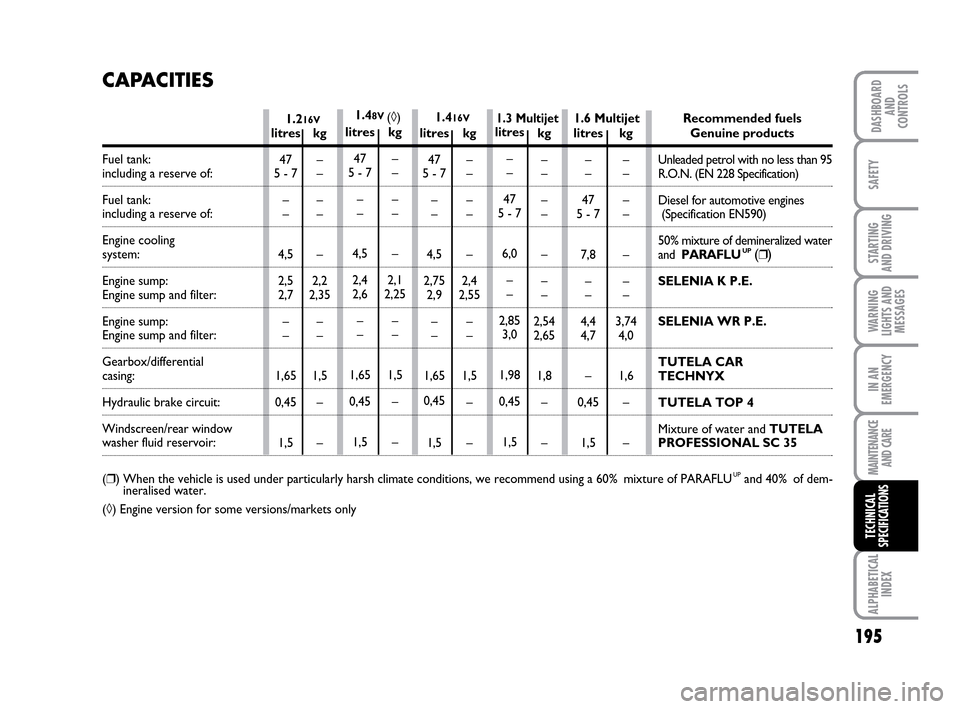
CAPACITIES
Fuel tank: including a reserve of:
Fuel tank:
including a reserve of:
Engine cooling
system:
Engine sump:
Engine sump and filter:
Engine sump:
Engine sump and filter:
Gearbox/differential
casing:
Hydraulic brake circuit:
Windscreen/rear window
washer fluid reservoir:
(❒) When the vehicle is used under particularly harsh climate conditions, we recommend using a 60% mixture of PARAFLU
UPand 40% of dem-
ineralised water.
(◊) Engine version for some versions/markets only
181-199 LUM IDEA GB 2 ed.qxd 14-01-2010 13:56 Pagina 195
Page 199 of 210
198
STARTING
AND DRIVING
IN AN
EMERGENCY
MAINTENANCE
AND CARE
ALPHABETICAL
INDEX
DASHBOARD
AND
CONTROLS
SAFETY
WARNING
LIGHTS AND
MESSAGES
TECHNICAL
SPECIFICATIONS
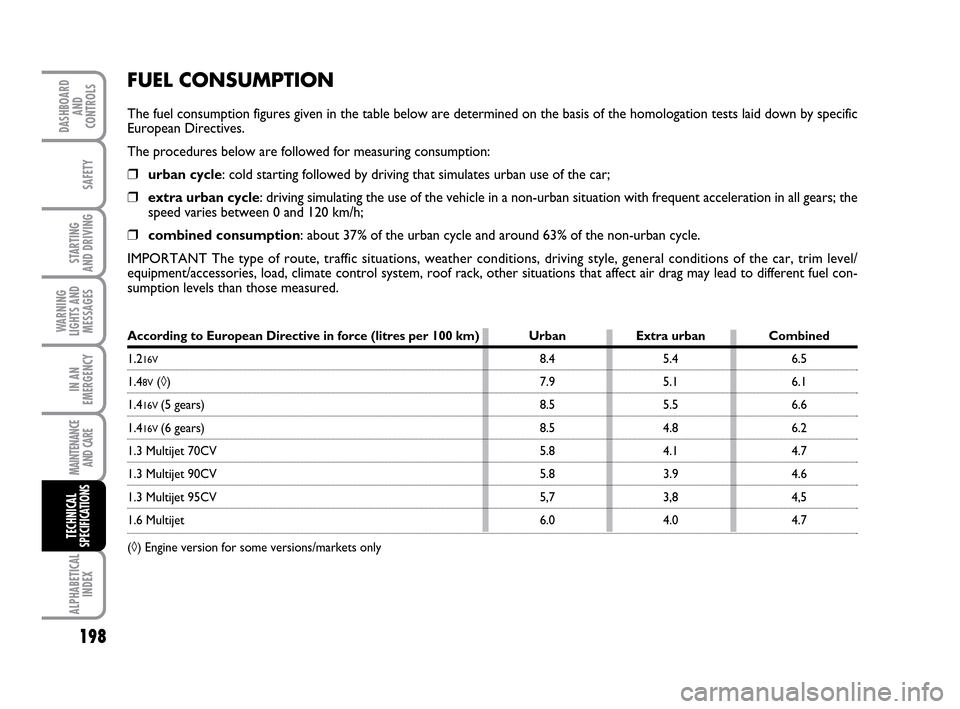
FUEL CONSUMPTION
The fuel consumption figures given in the table below are determined on the basis of the homologation tests laid down by specific
European Directives.
The procedures below are followed for measuring consumption:
❒urban cycle: cold starting followed by driving that simulates urban use of the car;
❒extra urban cycle: driving simulating the use of the vehicle in a non-urban situation with frequent acceleration in all gears; the
speed varies between 0 and 120 km/h;
❒combined consumption: about 37% of the urban cycle and around 63% of the non-urban cycle.
IMPORTANT The type of route, traffic situations, weather conditions, driving style, general conditions of the car, trim level/
equipment/accessories, load, climate control system, roof rack, other situations that affect air drag may lead to different fuel con-
sumption levels than those measured.
According to European Directive in force (litres per 100 km) Urban Extra urban Combined
1.216V8.4 5.4 6.5
1.48V(◊) 7.9 5.1 6.1
1.416V (5 gears) 8.5 5.5 6.6
1.416V (6 gears) 8.5 4.8 6.2
1.3 Multijet 70CV 5.8 4.1 4.7
1.3 Multijet 90CV 5.8 3.9 4.6
1.3 Multijet 95CV 5,7 3,8 4,5
1.6 Multijet 6.0 4.0 4.7
(◊) Engine version for some versions/markets only
181-199 LUM IDEA GB 2 ed.qxd 14-01-2010 13:56 Pagina 198
Page 203 of 210
202
STARTING
AND DRIVING
IN AN
EMERGENCY
MAINTENANCE
AND CARE
DASHBOARD
AND
CONTROLS
SAFETY
WARNING
LIGHTS AND
MESSAGES
TECHNICAL
SPECIFICATIONS
ALPHABETICAL
INDEX
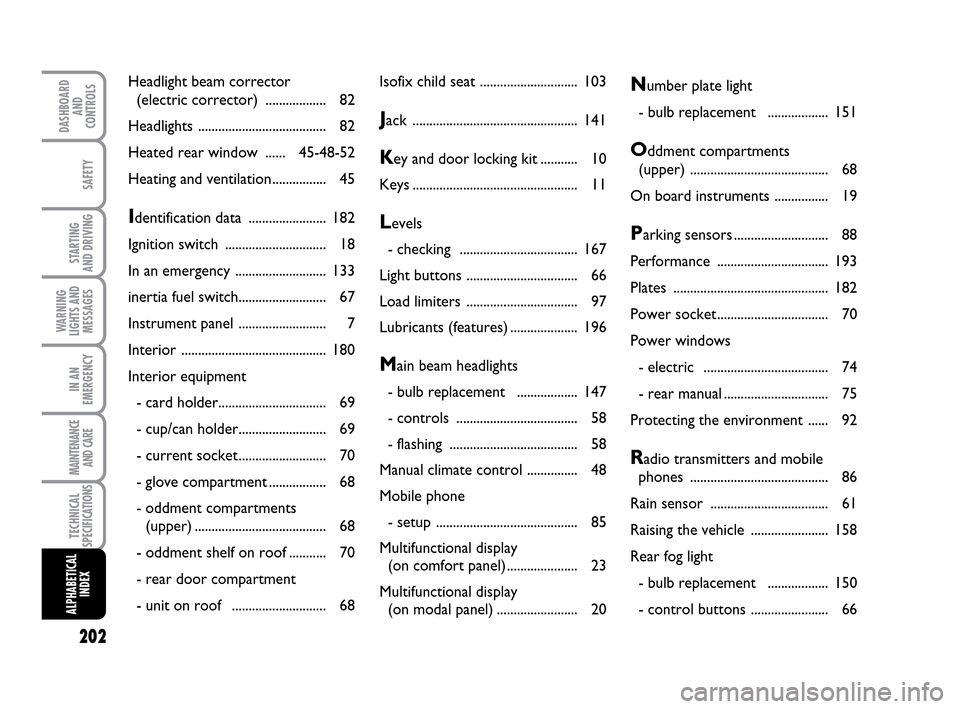
Headlight beam corrector
(electric corrector) .................. 82
Headlights ...................................... 82
Heated rear window ...... 45-48-52
Heating and ventilation................ 45
Identification data ....................... 182
Ignition switch .............................. 18
In an emergency ........................... 133
inertia fuel switch.......................... 67
Instrument panel .......................... 7
Interior ........................................... 180
Interior equipment
- card holder................................ 69
- cup/can holder.......................... 69
- current socket.......................... 70
- glove compartment ................. 68
- oddment compartments
(upper) ....................................... 68
- oddment shelf on roof ........... 70
- rear door compartment
- unit on roof ............................ 68Isofix child seat ............................. 103
Jack ................................................. 141
Key and door locking kit ........... 10
Keys ................................................. 11
Levels
- checking ................................... 167
Light buttons ................................. 66
Load limiters ................................. 97
Lubricants (features) .................... 196
Main beam headlights
- bulb replacement .................. 147
- controls .................................... 58
- flashing ...................................... 58
Manual climate control ............... 48
Mobile phone
- setup .......................................... 85
Multifunctional display
(on comfort panel) ..................... 23
Multifunctional display
(on modal panel) ........................ 20
Number plate light
- bulb replacement .................. 151
Oddment compartments
(upper) ......................................... 68
On board instruments ................ 19
Parking sensors ............................ 88
Performance ................................. 193
Plates .............................................. 182
Power socket................................. 70
Power windows
- electric ..................................... 74
- rear manual ............................... 75
Protecting the environment ...... 92
Radio transmitters and mobile
phones ......................................... 86
Rain sensor ................................... 61
Raising the vehicle ....................... 158
Rear fog light
- bulb replacement .................. 150
- control buttons ....................... 66
200-208 LUM IDEA GB 2 ed.qxd 14-01-2010 13:59 Pagina 202