steering wheel FIAT IDEA 2010 1.G User Guide
[x] Cancel search | Manufacturer: FIAT, Model Year: 2010, Model line: IDEA, Model: FIAT IDEA 2010 1.GPages: 210, PDF Size: 4.4 MB
Page 110 of 210
109
STARTING
AND DRIVING
WARNING
LIGHTS AND
MESSAGES
IN AN
EMERGENCY
MAINTENANCE
AND CARE
TECHNICAL
SPECIFICATIONS
ALPHABETICAL
INDEX
DASHBOARD
AND
CONTROLS
SAFETY
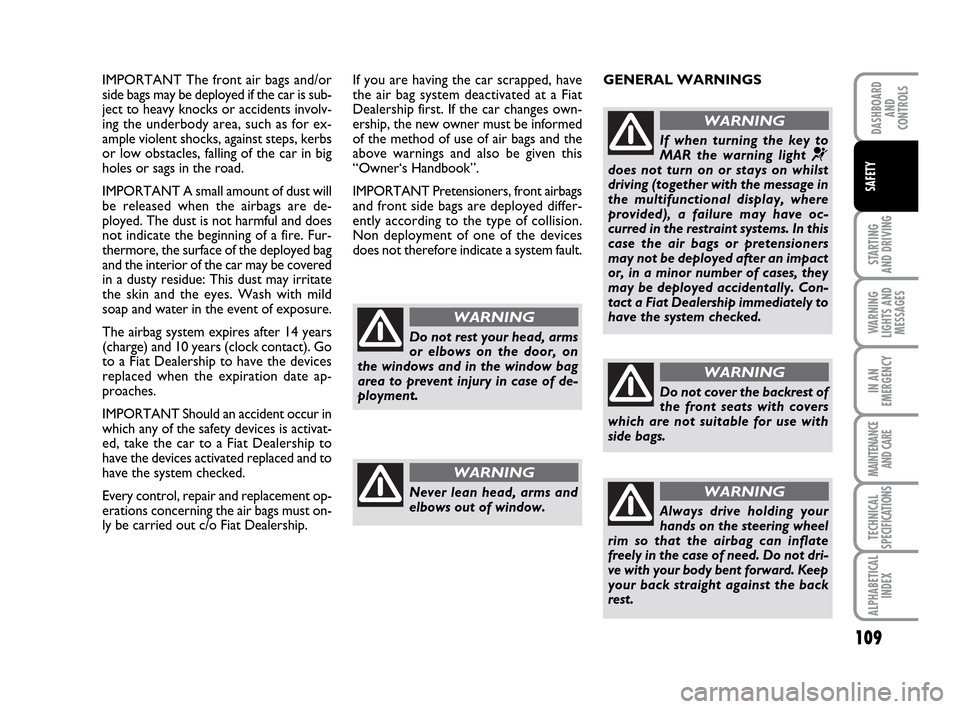
IMPORTANT The front air bags and/or
side bags may be deployed if the car is sub-
ject to heavy knocks or accidents involv-
ing the underbody area, such as for ex-
ample violent shocks, against steps, kerbs
or low obstacles, falling of the car in big
holes or sags in the road.
IMPORTANT A small amount of dust will
be released when the airbags are de-
ployed. The dust is not harmful and does
not indicate the beginning of a fire. Fur-
thermore, the surface of the deployed bag
and the interior of the car may be covered
in a dusty residue: This dust may irritate
the skin and the eyes. Wash with mild
soap and water in the event of exposure.
The airbag system expires after 14 years
(charge) and 10 years (clock contact). Go
to a Fiat Dealership to have the devices
replaced when the expiration date ap-
proaches.
IMPORTANT Should an accident occur in
which any of the safety devices is activat-
ed, take the car to a Fiat Dealership to
have the devices activated replaced and to
have the system checked.
Every control, repair and replacement op-
erations concerning the air bags must on-
ly be carried out c/o Fiat Dealership.If you are having the car scrapped, have
the air bag system deactivated at a Fiat
Dealership first. If the car changes own-
ership, the new owner must be informed
of the method of use of air bags and the
above warnings and also be given this
“Owner‘s Handbook”.
IMPORTANT Pretensioners, front airbags
and front side bags are deployed differ-
ently according to the type of collision.
Non deployment of one of the devices
does not therefore indicate a system fault.
Do not rest your head, arms
or elbows on the door, on
the windows and in the window bag
area to prevent injury in case of de-
ployment.
WARNING
Never lean head, arms and
elbows out of window.
WARNING
If when turning the key to
MAR the warning light
¬does not turn on or stays on whilst
driving (together with the message in
the multifunctional display, where
provided), a failure may have oc-
curred in the restraint systems. In this
case the air bags or pretensioners
may not be deployed after an impact
or, in a minor number of cases, they
may be deployed accidentally. Con-
tact a Fiat Dealership immediately to
have the system checked.
WARNING
GENERAL WARNINGS
Do not cover the backrest of
the front seats with covers
which are not suitable for use with
side bags.
WARNING
Always drive holding your
hands on the steering wheel
rim so that the airbag can inflate
freely in the case of need. Do not dri-
ve with your body bent forward. Keep
your back straight against the back
rest.
WARNING
093-110 LUM IDEA GB 2 ed.qxd 14-01-2010 12:16 Pagina 109
Page 114 of 210
113
WARNING
LIGHTS AND
MESSAGES
IN AN
EMERGENCY
MAINTENANCE
AND CARE
TECHNICAL
SPECIFICATIONS
ALPHABETICAL
INDEX
DASHBOARD
AND
CONTROLS
SAFETY
STARTING
AND DRIVING
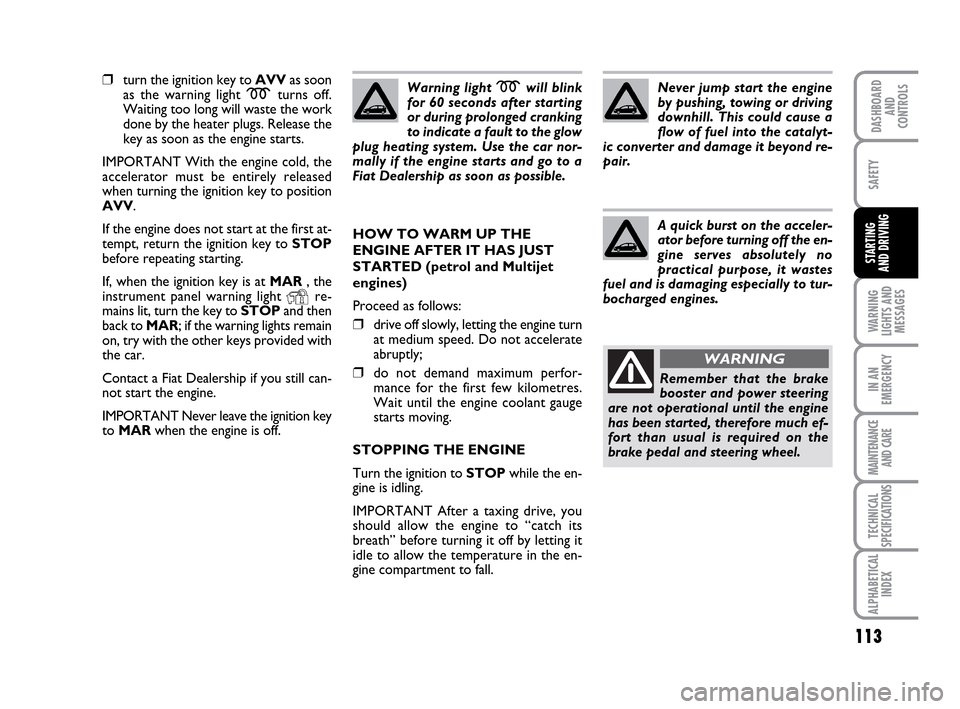
❒turn the ignition key to AVVas soon
as the warning light mturns off.
Waiting too long will waste the work
done by the heater plugs. Release the
key as soon as the engine starts.
IMPORTANT With the engine cold, the
accelerator must be entirely released
when turning the ignition key to position
AVV.
If the engine does not start at the first at-
tempt, return the ignition key to STOP
before repeating starting.
If, when the ignition key is at MAR, the
instrument panel warning light
Yre-
mains lit, turn the key to STOPand then
back to MAR; if the warning lights remain
on, try with the other keys provided with
the car.
Contact a Fiat Dealership if you still can-
not start the engine.
IMPORTANT Never leave the ignition key
to MARwhen the engine is off. Warning light
mwill blink
for 60 seconds after starting
or during prolonged cranking
to indicate a fault to the glow
plug heating system. Use the car nor-
mally if the engine starts and go to a
Fiat Dealership as soon as possible.
HOW TO WARM UP THE
ENGINE AFTER IT HAS JUST
STARTED (petrol and Multijet
engines)
Proceed as follows:
❒drive off slowly, letting the engine turn
at medium speed. Do not accelerate
abruptly;
❒do not demand maximum perfor-
mance for the first few kilometres.
Wait until the engine coolant gauge
starts moving.
STOPPING THE ENGINE
Turn the ignition to STOPwhile the en-
gine is idling.
IMPORTANT After a taxing drive, you
should allow the engine to “catch its
breath” before turning it off by letting it
idle to allow the temperature in the en-
gine compartment to fall. Never jump start the engine
by pushing, towing or driving
downhill. This could cause a
flow of fuel into the catalyt-
ic converter and damage it beyond re-
pair.
A quick burst on the acceler-
ator before turning off the en-
gine serves absolutely no
practical purpose, it wastes
fuel and is damaging especially to tur-
bocharged engines.
Remember that the brake
booster and power steering
are not operational until the engine
has been started, therefore much ef-
fort than usual is required on the
brake pedal and steering wheel.
WARNING
111-122 LUM IDEA GB 2 ed.qxd 14-01-2010 12:32 Pagina 113
Page 128 of 210
127
STARTING
AND DRIVING
IN AN
EMERGENCY
MAINTENANCE
AND CARE
TECHNICAL
SPECIFICATIONS
ALPHABETICAL
INDEX
DASHBOARD
AND
CONTROLS
SAFETY
WARNING
LIGHTS AND
MESSAGES
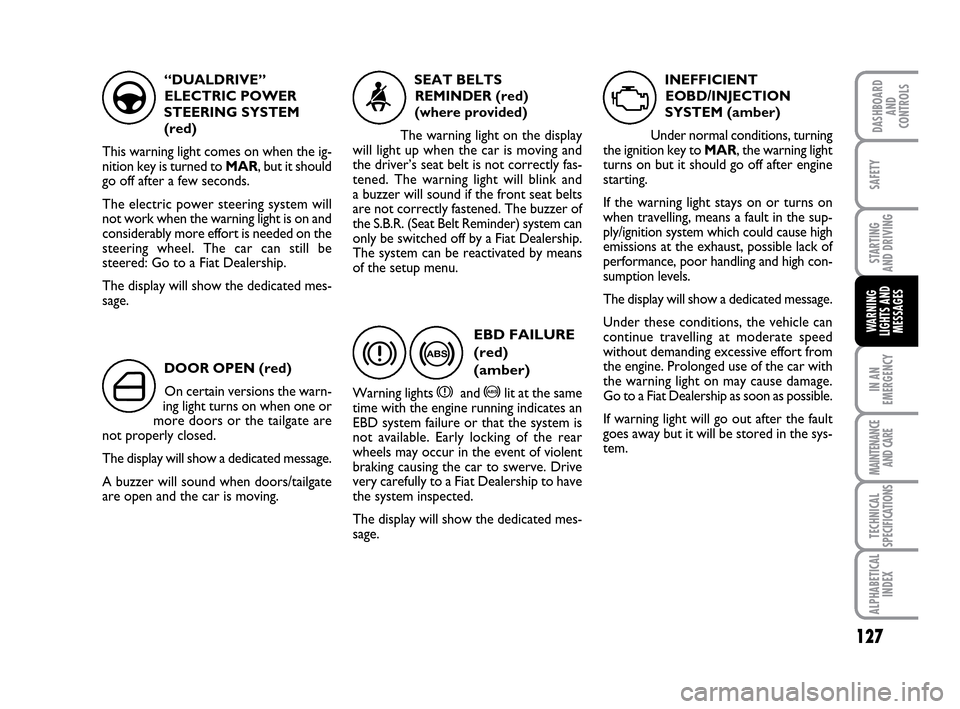
“DUALDRIVE”
ELECTRIC POWER
STEERING SYSTEM
(red)
This warning light comes on when the ig-
nition key is turned to MAR, but it should
go off after a few seconds.
The electric power steering system will
not work when the warning light is on and
considerably more effort is needed on the
steering wheel. The car can still be
steered: Go to a Fiat Dealership.
The display will show the dedicated mes-
sage.
g
DOOR OPEN (red)
On certain versions the warn-
ing light turns on when one or
more doors or the tailgate are
not properly closed.
The display will show a dedicated message.
A buzzer will sound when doors/tailgate
are open and the car is moving.
´
SEAT BELTS
REMINDER (red)
(where provided)
The warning light on the display
will light up when the car is moving and
the driver’s seat belt is not correctly fas-
tened. The warning light will blink and
a buzzer will sound if the front seat belts
are not correctly fastened. The buzzer of
the S.B.R. (Seat Belt Reminder) system can
only be switched off by a Fiat Dealership.
The system can be reactivated by means
of the setup menu.
<
>
EBD FAILURE
(red)
(amber)
Warning lights xand >lit at the same
time with the engine running indicates an
EBD system failure or that the system is
not available. Early locking of the rear
wheels may occur in the event of violent
braking causing the car to swerve. Drive
very carefully to a Fiat Dealership to have
the system inspected.
The display will show the dedicated mes-
sage.
x
INEFFICIENT
EOBD/INJECTION
SYSTEM (amber)
Under normal conditions, turning
the ignition key to MAR, the warning light
turns on but it should go off after engine
starting.
If the warning light stays on or turns on
when travelling, means a fault in the sup-
ply/ignition system which could cause high
emissions at the exhaust, possible lack of
performance, poor handling and high con-
sumption levels.
The display will show a dedicated message.
Under these conditions, the vehicle can
continue travelling at moderate speed
without demanding excessive effort from
the engine. Prolonged use of the car with
the warning light on may cause damage.
Go to a Fiat Dealership as soon as possible.
If warning light will go out after the fault
goes away but it will be stored in the sys-
tem.
U
123-132 LUM IDEA GB 2 ed.qxd 14-01-2010 13:47 Pagina 127
Page 133 of 210
132
STARTING
AND DRIVING
IN AN
EMERGENCY
MAINTENANCE
AND CARE
TECHNICAL
SPECIFICATIONS
ALPHABETICAL
INDEX
DASHBOARD
AND
CONTROLS
SAFETY
WARNING
LIGHTS AND
MESSAGES
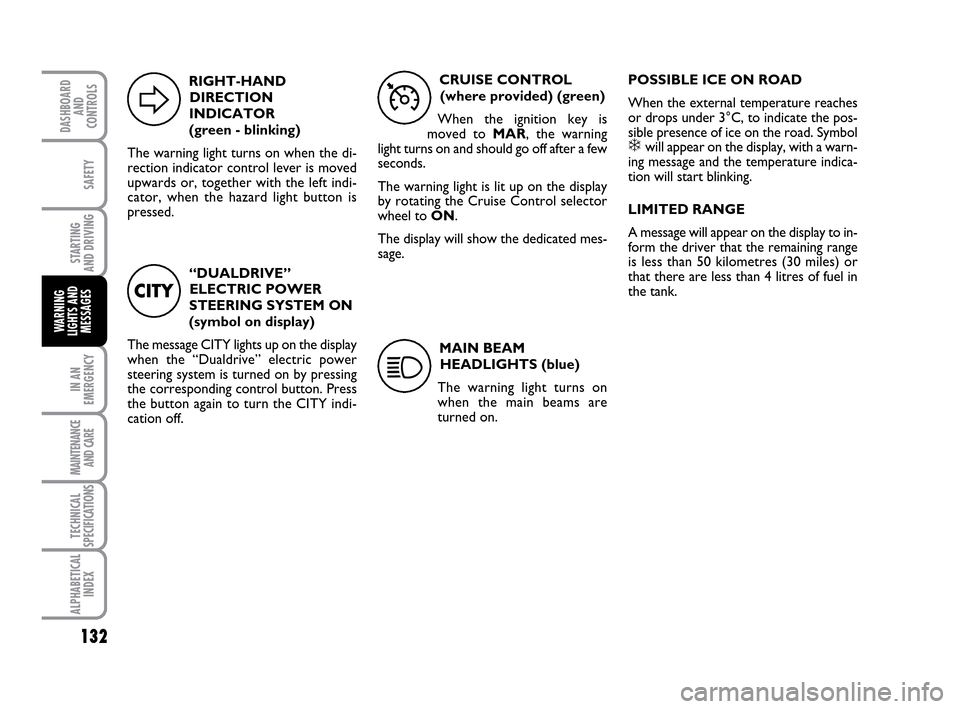
“DUALDRIVE”
ELECTRIC POWER
STEERING SYSTEM ON
(symbol on display)
The message CITY lights up on the display
when the “Dualdrive” electric power
steering system is turned on by pressing
the corresponding control button. Press
the button again to turn the CITY indi-
cation off.
CITY
CRUISE CONTROL
(where provided) (green)
When the ignition key is
moved to MAR, the warning
light turns on and should go off after a few
seconds.
The warning light is lit up on the display
by rotating the Cruise Control selector
wheel to ON.
The display will show the dedicated mes-
sage.
Ü
MAIN BEAM
HEADLIGHTS (blue)
The warning light turns on
when the main beams are
turned on.
1
POSSIBLE ICE ON ROAD
When the external temperature reaches
or drops under 3°C, to indicate the pos-
sible presence of ice on the road. Symbol
❄ will appear on the display, with a warn-
ing message and the temperature indica-
tion will start blinking.
LIMITED RANGE
A message will appear on the display to in-
form the driver that the remaining range
is less than 50 kilometres (30 miles) or
that there are less than 4 litres of fuel in
the tank. RIGHT-HAND
DIRECTION
INDICATOR
(green - blinking)
The warning light turns on when the di-
rection indicator control lever is moved
upwards or, together with the left indi-
cator, when the hazard light button is
pressed.
D
123-132 LUM IDEA GB 2 ed.qxd 14-01-2010 13:47 Pagina 132
Page 136 of 210
135
STARTING
AND DRIVING
MAINTENANCE
AND CARE
TECHNICAL
SPECIFICATIONS
ALPHABETICAL
INDEX
DASHBOARD
AND
CONTROLS
SAFETY
WARNING
LIGHTS AND
MESSAGES
IN AN
EMERGENCY
fig. 2F0H0718m
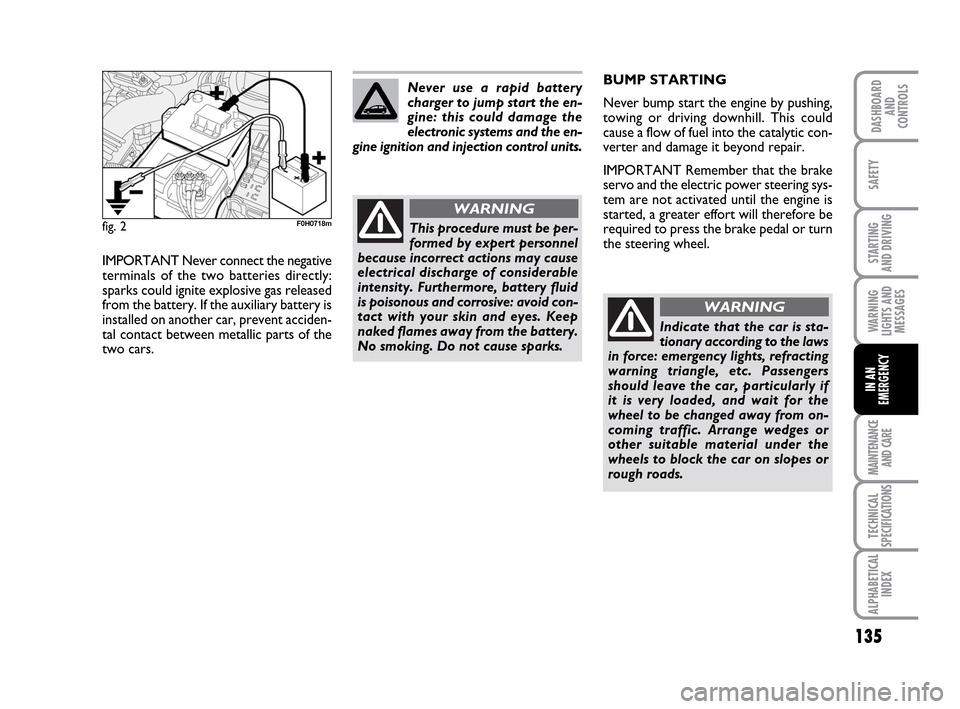
IMPORTANT Never connect the negative
terminals of the two batteries directly:
sparks could ignite explosive gas released
from the battery. If the auxiliary battery is
installed on another car, prevent acciden-
tal contact between metallic parts of the
two cars.
This procedure must be per-
formed by expert personnel
because incorrect actions may cause
electrical discharge of considerable
intensity. Furthermore, battery fluid
is poisonous and corrosive: avoid con-
tact with your skin and eyes. Keep
naked flames away from the battery.
No smoking. Do not cause sparks.
WARNING
Never use a rapid battery
charger to jump start the en-
gine: this could damage the
electronic systems and the en-
gine ignition and injection control units.BUMP STARTING
Never bump start the engine by pushing,
towing or driving downhill. This could
cause a flow of fuel into the catalytic con-
verter and damage it beyond repair.
IMPORTANT Remember that the brake
servo and the electric power steering sys-
tem are not activated until the engine is
started, a greater effort will therefore be
required to press the brake pedal or turn
the steering wheel.
Indicate that the car is sta-
tionary according to the laws
in force: emergency lights, refracting
warning triangle, etc. Passengers
should leave the car, particularly if
it is very loaded, and wait for the
wheel to be changed away from on-
coming traffic. Arrange wedges or
other suitable material under the
wheels to block the car on slopes or
rough roads.
WARNING
133-160 LUM IDEA GB 2 ed.qxd 14-01-2010 13:50 Pagina 135
Page 141 of 210
140
STARTING
AND DRIVING
MAINTENANCE
AND CARE
TECHNICAL
SPECIFICATIONS
ALPHABETICAL
INDEX
DASHBOARD
AND
CONTROLS
SAFETY
WARNING
LIGHTS AND
MESSAGES
IN AN
EMERGENCY
REPLACING A WHEEL
GENERAL INSTRUCTIONS
Wheel changing and correct use of the
jack and spare wheel call for some pre-
cautions as listed below.
IMPORTANT Refer to the instructions in
the previous chapter if the car is equipped
with “Fix&Go (quick tyre repair kit)”.
The spare wheel is specific
for your car. Do not use it on
cars of different models. Do not use
spare wheels of different models on
your car. The space saver spare wheel
must only be used in case of emer-
gency. Use only for as long as strict-
ly necessary and drive at a speed
slower than 80 km/h. An orange la-
bel is affixed on the spare wheel sum-
marising instructions and limitations
for use. Never remove or cover the la-
bel. Never apply a wheel cup on a
space saver spare. The following in-
formation is provided in four lan-
guages on the label: W
ARNING! SUIT-ABLE FOR TEMPORARY USE ONLY! 80 KM/H
MAX! REPLACE WITH A STANDARD WHEEL
AS SOON AS POSSIBLE. DO NOT COVER THIS
LABEL.
WARNING
The driving features of the
car may change when a
space saver spare wheel is fitted.
Avoid sudden acceleration and brak-
ing, sudden steering and fast corner-
ing. The total life of a space saver
spare wheel is approximately 3000
km, after which it must be replaced
by another wheel of the same type.
Never install a traditional tyre on a
space saver spare wheel rim. Repair
and refit the standard wheel as soon
as possible. Only one space saver
spare can be used at a time. Do not
apply grease to the bolt threads be-
fore assembly: the bolts could come
loose unexpectedly.
WARNING
133-160 LUM IDEA GB 2 ed.qxd 14-01-2010 13:50 Pagina 140
Page 161 of 210
160
STARTING
AND DRIVING
MAINTENANCE
AND CARE
TECHNICAL
SPECIFICATIONS
ALPHABETICAL
INDEX
DASHBOARD
AND
CONTROLS
SAFETY
WARNING
LIGHTS AND
MESSAGES
IN AN
EMERGENCY
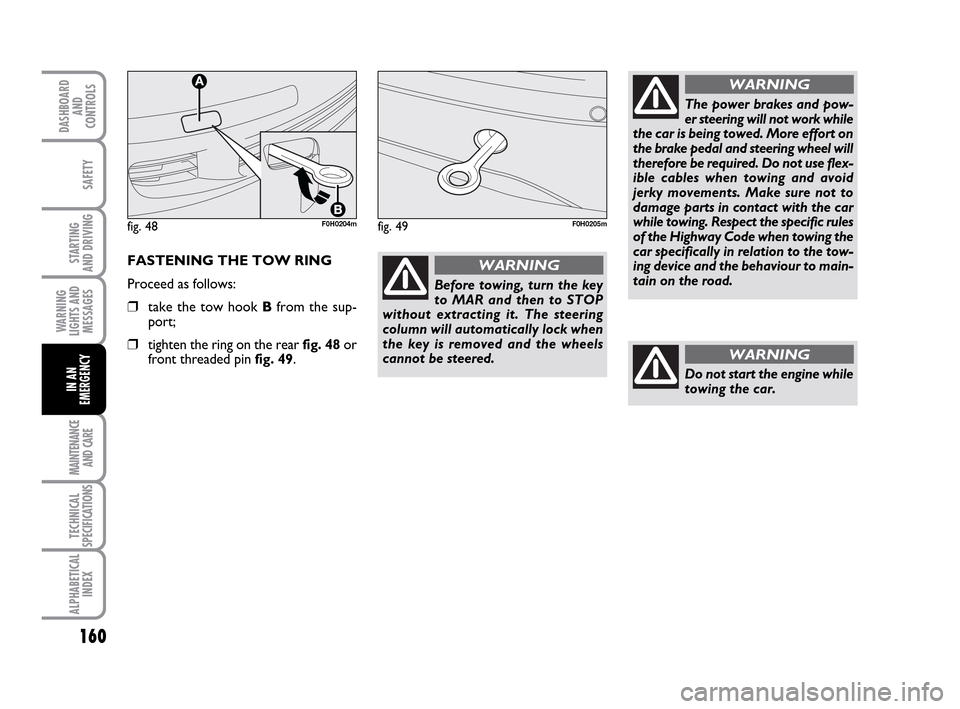
FASTENING THE TOW RING
Proceed as follows:
❒take the tow hook Bfrom the sup-
port;
❒tighten the ring on the rear fig. 48 or
front threaded pin fig. 49.
fig. 48F0H0204mfig. 49F0H0205m
Before towing, turn the key
to MAR and then to STOP
without extracting it. The steering
column will automatically lock when
the key is removed and the wheels
cannot be steered.
WARNING
The power brakes and pow-
er steering will not work while
the car is being towed. More effort on
the brake pedal and steering wheel will
therefore be required. Do not use flex-
ible cables when towing and avoid
jerky movements. Make sure not to
damage parts in contact with the car
while towing. Respect the specific rules
of the Highway Code when towing the
car specifically in relation to the tow-
ing device and the behaviour to main-
tain on the road.
WARNING
Do not start the engine while
towing the car.
WARNING
133-160 LUM IDEA GB 2 ed.qxd 14-01-2010 13:50 Pagina 160
Page 176 of 210
175
STARTING
AND DRIVING
IN AN
EMERGENCY
TECHNICAL
SPECIFICATIONS
ALPHABETICAL
INDEX
DASHBOARD
AND
CONTROLS
SAFETY
WARNING
LIGHTS AND
MESSAGES
MAINTENANCE
AND CARE
WHEELS AND TYRES
Check the pressure of each tyre, includ-
ing the spare wheel, approximately once
every two weeks and before setting off on
a long journey: this check must be per-
formed with the tyre rested and cold.
It is normal for pressure to increase when
the car is used. For the correct tyre in-
flation pressure, see “Wheels” in “Tech-
nical specifications” section.
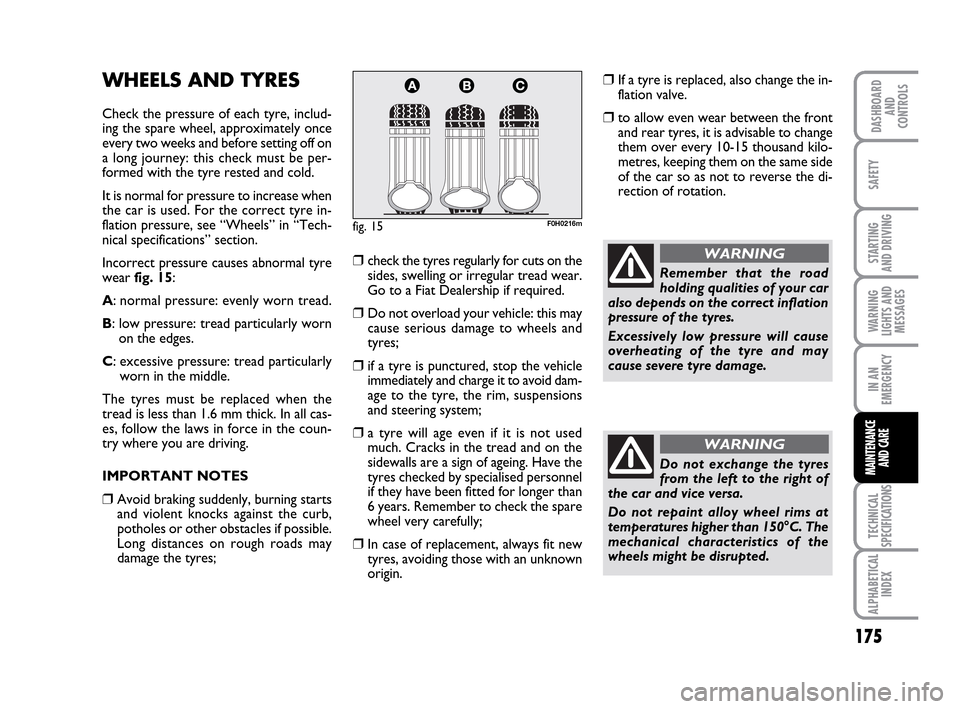
Incorrect pressure causes abnormal tyre
wearfig. 15:
A: normal pressure: evenly worn tread.
B: low pressure: tread particularly worn
on the edges.
C: excessive pressure: tread particularly
worn in the middle.
The tyres must be replaced when the
tread is less than 1.6 mm thick. In all cas-
es, follow the laws in force in the coun-
try where you are driving.
IMPORTANT NOTES
❒Avoid braking suddenly, burning starts
and violent knocks against the curb,
potholes or other obstacles if possible.
Long distances on rough roads may
damage the tyres;
❒check the tyres regularly for cuts on the
sides, swelling or irregular tread wear.
Go to a Fiat Dealership if required.
❒Do not overload your vehicle: this may
cause serious damage to wheels and
tyres;
❒if a tyre is punctured, stop the vehicle
immediately and charge it to avoid dam-
age to the tyre, the rim, suspensions
and steering system;
❒a tyre will age even if it is not used
much. Cracks in the tread and on the
sidewalls are a sign of ageing. Have the
tyres checked by specialised personnel
if they have been fitted for longer than
6 years. Remember to check the spare
wheel very carefully;
❒In case of replacement, always fit new
tyres, avoiding those with an unknown
origin.
fig. 15F0H0216m
Remember that the road
holding qualities of your car
also depends on the correct inflation
pressure of the tyres.
Excessively low pressure will cause
overheating of the tyre and may
cause severe tyre damage.
WARNING
Do not exchange the tyres
from the left to the right of
the car and vice versa.
Do not repaint alloy wheel rims at
temperatures higher than 150°C. The
mechanical characteristics of the
wheels might be disrupted.
WARNING
❒If a tyre is replaced, also change the in-
flation valve.
❒to allow even wear between the front
and rear tyres, it is advisable to change
them over every 10-15 thousand kilo-
metres, keeping them on the same side
of the car so as not to reverse the di-
rection of rotation.
161-180 LUM IDEA GB 2 ed.qxd 14-01-2010 13:53 Pagina 175
Page 181 of 210
180
STARTING
AND DRIVING
IN AN
EMERGENCY
TECHNICAL
SPECIFICATIONS
ALPHABETICAL
INDEX
DASHBOARD
AND
CONTROLS
SAFETY
WARNING
LIGHTS AND
MESSAGES
MAINTENANCE
AND CARE
INTERIORS
Periodically check that water is not
trapped under the mats (due to water
dripping off shoes, umbrellas, etc.) which
could cause oxidisation of the sheet met-
al.
CLEANING SEATS AND FABRIC
PARTS
Remove dust with a soft brush or a vacu-
um cleaner. It is advisable to use a moist
brush on velvet upholstery.
Rub the seats with a sponge moistened
with a solution of water and neutral de-
tergent.
LEATHER SEATS
Remove dry dirt with a moist chamois
leather or cloth without pressing too hard.
Remove stains of liquid or grease with a
dry absorbing cloth. Do not rub. Then
wipe with a soft cloth or chamois leather
dipped in water and mild soap.
Use specific products for persistent stains
paying attention to instructions for use.
IMPORTANT Never use alcohol. Make
sure that the products used do not con-
tain alcohol or derivates, even in low con-
centrations. INTERIOR PLASTIC PARTS
It is advisable to clean interior parts with
a moist cloth and a solution of water and
mild soap. Use specific products for clean-
ing plastic, without solvents and specifically
designed to prevent damage to the ap-
pearance and colour of the treated parts
to remove grease and tough stains.
IMPORTANT Never use spirit or petro-
leum to clean the instrument panel trans-
parent cover or other plastic parts.
Do not keep aerosol cans in
the car: risk of explosion.
Aerosol cans must not be exposed to
a temperature exceeding 50°C. When
the vehicle is exposed to sunlight, in-
ner temperature can greatly exceed
this value.
WARNING
The fabric upholstery of your
car is designed to withstand
the normal wear and tear of
your car for a long time.
Some precautions are however need-
ed. Avoid prolonged rubbing against
clothing accessories, such as metal
buckles, Velcro strips and the like,
which by applying a high pressure on
the fabric in a small area could cause
the breakage of some threads and
damage the upholstery.
LEATHER STEERING
WHEEL/GEAR KNOB
These components must be cleaned with
mild soap and water only. Never use spir-
it and/or alcohol based products. Read
the product label carefully before using
specific products for cleaning the interi-
ors: make sure the product does not con-
tain alcohol or alcohol based substances.
If window cleaner accidentally drips onto
the steering wheel or gear lever knob,
wipe away immediately and then wash the
concerned area with mild soap and water.
IMPORTANT Be careful when arranging
a steering wheel lock device, where ap-
plicable, to prevent damaging the leather
upholstery by rubbing.
161-180 LUM IDEA GB 2 ed.qxd 14-01-2010 13:53 Pagina 180
Page 182 of 210
181
STARTING
AND DRIVING
IN AN
EMERGENCY
MAINTENANCE
AND CARE
ALPHABETICAL
INDEX
DASHBOARD
AND
CONTROLS
SAFETY
WARNING
LIGHTS AND
MESSAGES
TECHNICAL
SPECIFICATIONS
IDENTIFICATION DATA ................................................. 182
ENGINE CODES - BODYWORK VERSIONS ............. 184
ENGINE ................................................................................. 185
FUEL FEED/IGNITION ....................................................... 187
TRANSMISSION UNIT ...................................................... 187
BRAKES .................................................................................. 188
SUSPENSIONS ..................................................................... 188
STEERING SYSTEM ............................................................. 188
WHEELS ................................................................................. 189
DIMENSIONS ....................................................................... 193
PERFORMANCE .................................................................. 193
WEIGHTS .............................................................................. 194
CAPACITIES ......................................................................... 195
FLUIDS AND LUBRICANTS ............................................ 196
FUEL CONSUMPTION ...................................................... 198
CO
2EMISSIONS .................................................................. 199
T T
E E
C C
H H
N N
I I
C C
A A
L L
S S
P P
E E
C C
I I
F F
I I
C C
A A
T T
I I
O O
N N
S S
181-199 LUM IDEA GB 2 ed.qxd 14-01-2010 13:56 Pagina 181