child restraint FIAT IDEA 2010 1.G Owners Manual
[x] Cancel search | Manufacturer: FIAT, Model Year: 2010, Model line: IDEA, Model: FIAT IDEA 2010 1.GPages: 210, PDF Size: 4.4 MB
Page 43 of 210
42
SAFETY
STARTING
AND DRIVING
WARNING
LIGHTS AND
MESSAGES
IN AN
EMERGENCY
MAINTENANCE
AND CARE
TECHNICAL
SPECIFICATIONS
ALPHABETICAL
INDEX
DASHBOARD
AND CONTROLS
The head restraints must be
adjusted so that they sup-
port your head and not your neck.
Only in this way may they perform
their protective action.
WARNING
To optimise head restraint
protective action, adjust the
seat back upright and keep your head
as close as possible to the head re-
straint.
WARNING
To refit the head restraint,
arrange it the right way and
then proceed as for checking that it
is locked.
WARNING
Saddle-shaped rear head re-
straints optimise visibility
and must always be raised it when an
occupant is present.
WARNING
REAR VIEW MIRRORS
INTERNAL MIRROR
The mirror is fitted with a safety device
that causes its release in the event of a vi-
olent impact with the passenger.
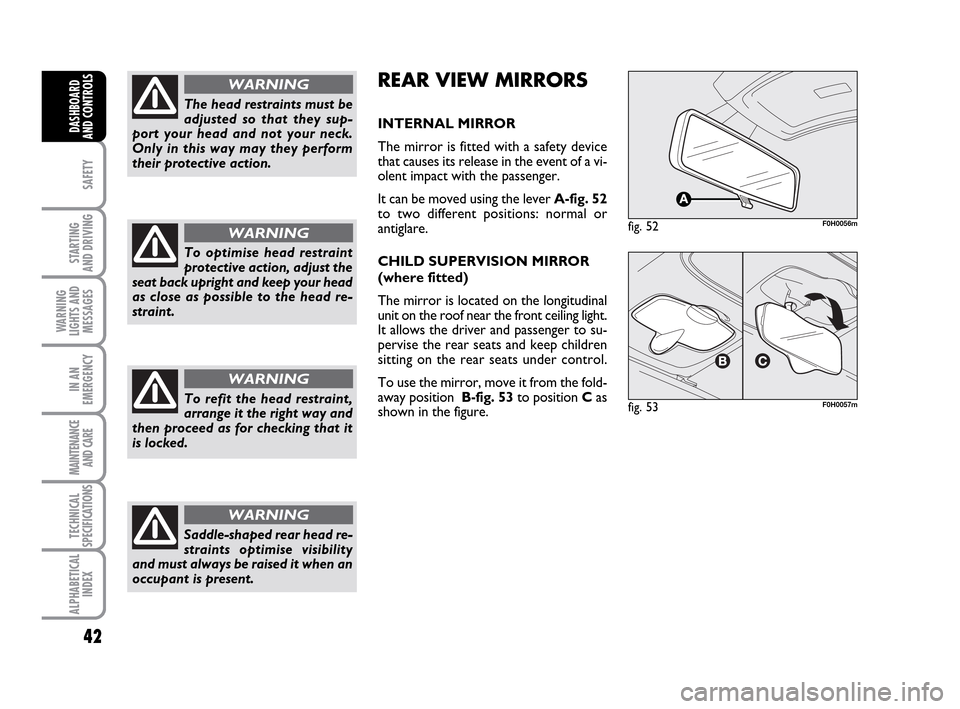
It can be moved using the lever A-fig. 52
to two different positions: normal or
antiglare.
CHILD SUPERVISION MIRROR
(where fitted)
The mirror is located on the longitudinal
unit on the roof near the front ceiling light.
It allows the driver and passenger to su-
pervise the rear seats and keep children
sitting on the rear seats under control.
To use the mirror, move it from the fold-
away position B-fig. 53to position Cas
shown in the figure.
fig. 52F0H0056m
fig. 53F0H0057m
036-092 LUM IDEA GB 2 ed.qxd 14-01-2010 12:14 Pagina 42
Page 94 of 210
93
STARTING
AND DRIVING
WARNING
LIGHTS AND
MESSAGES
IN AN
EMERGENCY
MAINTENANCE
AND CARE
TECHNICAL
SPECIFICATIONS
ALPHABETICAL
INDEX
DASHBOARD
AND
CONTROLSSEAT BELTS............................................................................ 94
PRETENSIONERS ................................................................. 97
CARRYING CHILDREN SAFELY ..................................... 99
“ISOFIX” CHILD RESTRAINT
ASSEMBLY SETUP ............................................................... 103
FRONT AIRBAGS................................................................. 106
FRONT AND SIDE
AIRBAGS (SIDE BAG + WINDOW BAG) .................... 108
S S
A A
F F
E E
T T
Y Y
SAFETY
093-110 LUM IDEA GB 2 ed.qxd 14-01-2010 12:16 Pagina 93
Page 100 of 210
99
STARTING
AND DRIVING
WARNING
LIGHTS AND
MESSAGES
IN AN
EMERGENCY
MAINTENANCE
AND CARE
TECHNICAL
SPECIFICATIONS
ALPHABETICAL
INDEX
DASHBOARD
AND
CONTROLS
SAFETY
HOW TO KEEP THE
SEAT BELTS ALWAYS IN
EFFICIENT CONDITIONS
❒always use the belt with the tap taut
and never twisted; make sure that it is
free to run without impediments;
❒Replace the belt after a serious acci-
dent even if it does not appear dam-
aged. Always replace the belt if the
pretensioners where deployed.
❒To clean the belt, wash by hand with
water and mild soap, rinse and leave
to dry in the shade. Do not use strong
detergents, bleach, paints or any oth-
er substance which could damage the
belt fibres;
❒Keep the reels dry: correct operation
may only be ensured if the reels are
dry.
❒replace the seat belt when showing
significant wear or cut signs.
CARRYING CHILDREN
SAFELY
For optimum protection in the event of
a crash, all passengers must be seated and
wearing adequate restraint systems.
This is even more important for children.
This prescription is compulsory in all EC
countries according to EC Directive
2003/20/EC.
A child’s head is larger and heavier in pro-
portion to its body and the child’s mus-
cular and bone structures are not fully de-
veloped. For this reason, they require re-
straint systems which are different from
those used by adults to protect them in
the event of an accident. The research re-
sults in relation to the best protection for
children is illustrated in European Regu-
lation EEC-R44 which divides the restraint
systems into five groups in addition to
making their use compulsory:
Group 0 - up to 10 kg of weight
Group 0+ - up to 13 kg of weight
Group 1 9-18 kg of weight
Group 2 15-25 kg of weight
Group 3 22-36 kg of weightAs it may be noted, the groups overlap
partly and in fact, in commerce it is pos-
sible to find devices that cover more than
one weight group.
All child restraint devices must bear the
certification data, together with the con-
trol brand, on a solidly fixed label which
must absolutely never be removed.
When over 1.50 m in height, from the
point of view of restraint systems, children
are considered as adults and have to wear
the standard seat belts.
Lineaccessori Fiat includes child restraint
systems for each weight group. These de-
vices are recommended having been
specifically designed for Fiat cars.
Do not place a cradle seat
facing backwards on the
front seat if the passenger side airbag
is on. Deployment of the airbag in an
accident could cause fatal injuries to
the baby regardless of the severity of
the collision. It is advisable to carry
children in an appropriate restraint
system on the rear seat which is the
most protected position in the event
of an accident.
WARNING
093-110 LUM IDEA GB 2 ed.qxd 14-01-2010 12:16 Pagina 99
Page 101 of 210
100
STARTING
AND DRIVING
WARNING
LIGHTS AND
MESSAGES
IN AN
EMERGENCY
MAINTENANCE
AND CARE
TECHNICAL
SPECIFICATIONS
ALPHABETICAL
INDEX
DASHBOARD
AND
CONTROLS
SAFETY
SEVERE DANGER If you
need to carry a baby on the
front passenger seat in a
cradle restraint system fac-
ing backwards, the passen-
ger side airbags (front and
side bags, where provided) must be
deactivated using the setup menu.
Check the warning light on the in-
strument panel. Move the passenger
seat as far back as possible to avoid
contact between the child seat and
the dashboard.
WARNING
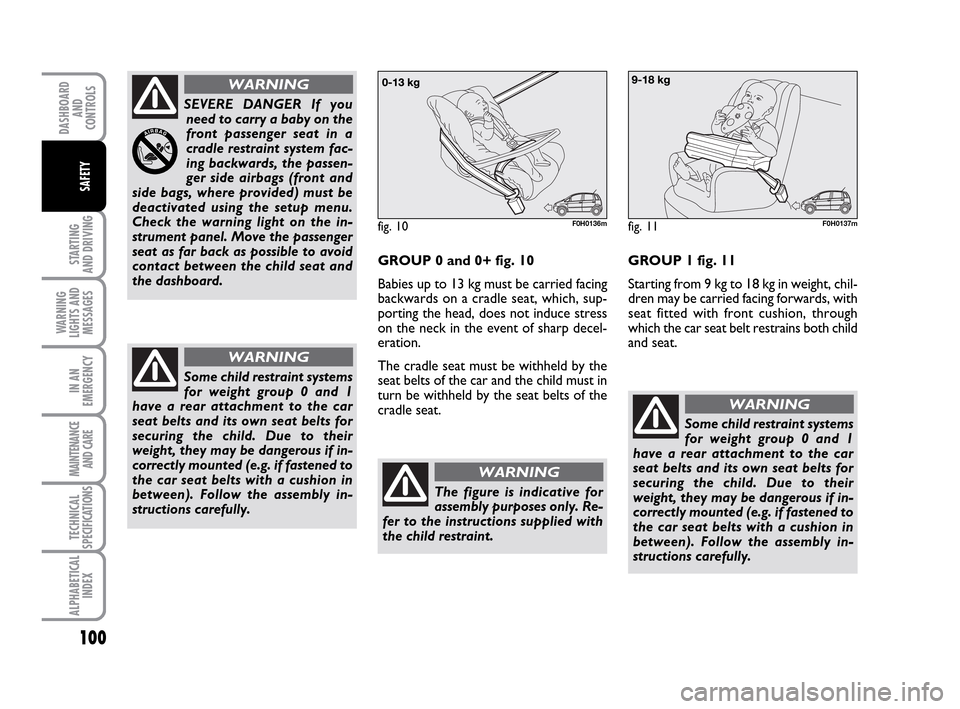
GROUP 0 and 0+ fig. 10
Babies up to 13 kg must be carried facing
backwards on a cradle seat, which, sup-
porting the head, does not induce stress
on the neck in the event of sharp decel-
eration.
The cradle seat must be withheld by the
seat belts of the car and the child must in
turn be withheld by the seat belts of the
cradle seat.
fig. 10F0H0136m
The figure is indicative for
assembly purposes only. Re-
fer to the instructions supplied with
the child restraint.
WARNING
Some child restraint systems
for weight group 0 and 1
have a rear attachment to the car
seat belts and its own seat belts for
securing the child. Due to their
weight, they may be dangerous if in-
correctly mounted (e.g. if fastened to
the car seat belts with a cushion in
between). Follow the assembly in-
structions carefully.
WARNING
fig. 11F0H0137m
GROUP 1 fig. 11
Starting from 9 kg to 18 kg in weight, chil-
dren may be carried facing forwards, with
seat fitted with front cushion, through
which the car seat belt restrains both child
and seat.
Some child restraint systems
for weight group 0 and 1
have a rear attachment to the car
seat belts and its own seat belts for
securing the child. Due to their
weight, they may be dangerous if in-
correctly mounted (e.g. if fastened to
the car seat belts with a cushion in
between). Follow the assembly in-
structions carefully.
WARNING
093-110 LUM IDEA GB 2 ed.qxd 14-01-2010 12:16 Pagina 100
Page 102 of 210
101
STARTING
AND DRIVING
WARNING
LIGHTS AND
MESSAGES
IN AN
EMERGENCY
MAINTENANCE
AND CARE
TECHNICAL
SPECIFICATIONS
ALPHABETICAL
INDEX
DASHBOARD
AND
CONTROLS
SAFETY
fig. 12F0H0138m
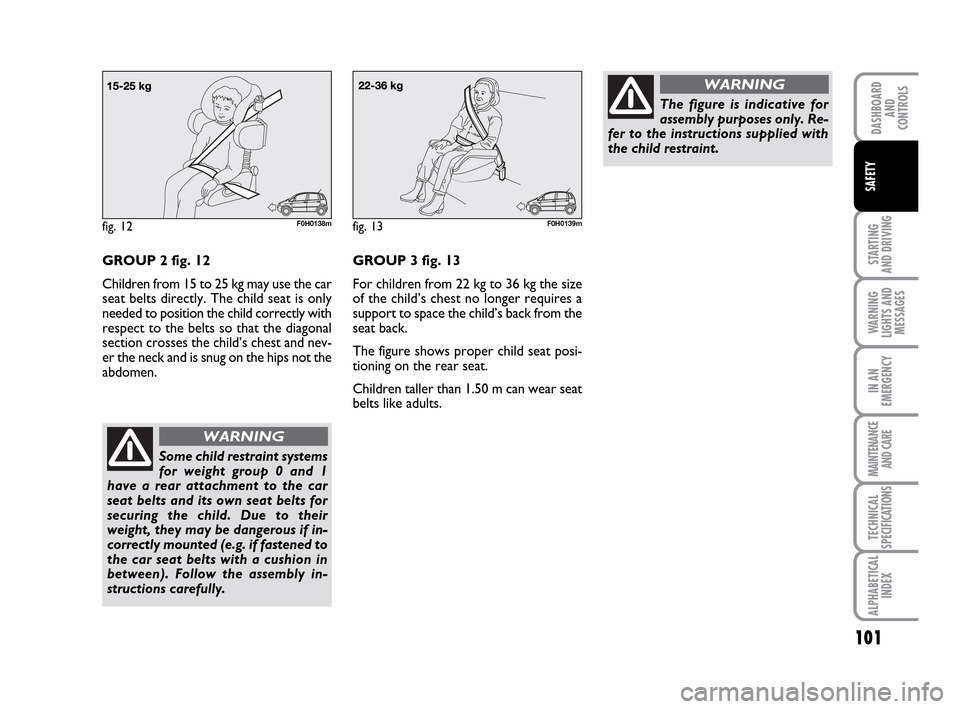
GROUP 2 fig. 12
Children from 15 to 25 kg may use the car
seat belts directly. The child seat is only
needed to position the child correctly with
respect to the belts so that the diagonal
section crosses the child’s chest and nev-
er the neck and is snug on the hips not the
abdomen.
Some child restraint systems
for weight group 0 and 1
have a rear attachment to the car
seat belts and its own seat belts for
securing the child. Due to their
weight, they may be dangerous if in-
correctly mounted (e.g. if fastened to
the car seat belts with a cushion in
between). Follow the assembly in-
structions carefully.
WARNING
fig. 13F0H0139m
The figure is indicative for
assembly purposes only. Re-
fer to the instructions supplied with
the child restraint.
WARNING
GROUP 3 fig. 13
For children from 22 kg to 36 kg the size
of the child’s chest no longer requires a
support to space the child’s back from the
seat back.
The figure shows proper child seat posi-
tioning on the rear seat.
Children taller than 1.50 m can wear seat
belts like adults.
093-110 LUM IDEA GB 2 ed.qxd 14-01-2010 12:16 Pagina 101
Page 103 of 210
102
STARTING
AND DRIVING
WARNING
LIGHTS AND
MESSAGES
IN AN
EMERGENCY
MAINTENANCE
AND CARE
TECHNICAL
SPECIFICATIONS
ALPHABETICAL
INDEX
DASHBOARD
AND
CONTROLS
SAFETY
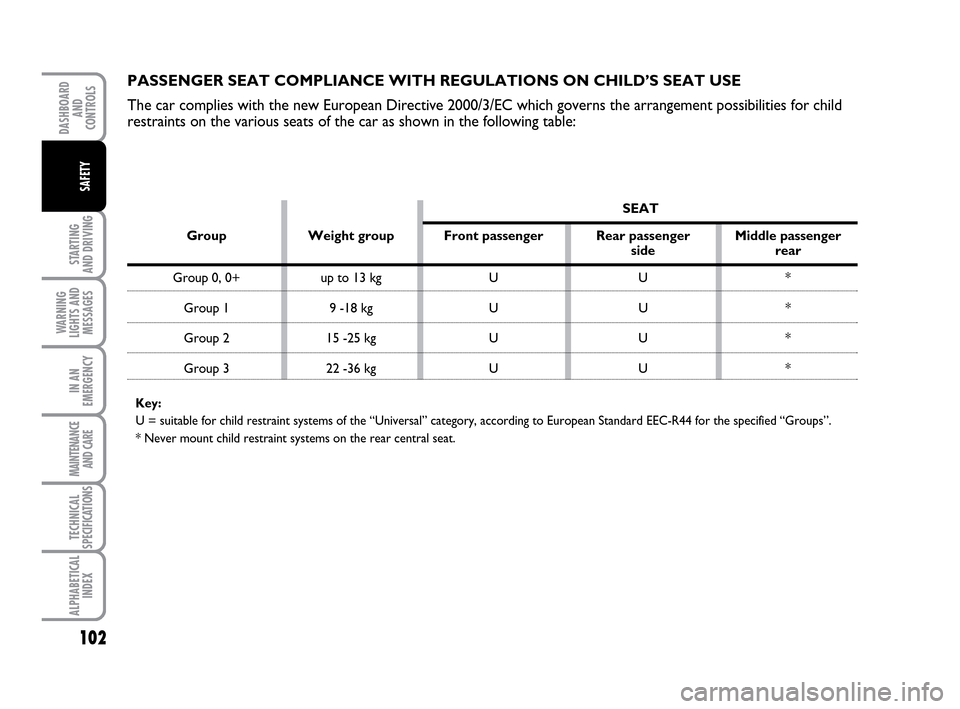
PASSENGER SEAT COMPLIANCE WITH REGULATIONS ON CHILD’S SEAT USE
The car complies with the new European Directive 2000/3/EC which governs the arrangement possibilities for child
restraints on the various seats of the car as shown in the following table:
SEAT
Group Weight group Front passenger Rear passenger Middle passenger
side rear
Group 0, 0+ up to 13 kg U U *
Group 1 9 -18 kg U U *
Group 2 15 -25 kg U U *
Group 3 22 -36 kg U U *
Key:
U = suitable for child restraint systems of the “Universal” category, according to European Standard EEC-R44 for the specified “Groups”.
* Never mount child restraint systems on the rear central seat.
093-110 LUM IDEA GB 2 ed.qxd 14-01-2010 12:16 Pagina 102
Page 104 of 210
103
STARTING
AND DRIVING
WARNING
LIGHTS AND
MESSAGES
IN AN
EMERGENCY
MAINTENANCE
AND CARE
TECHNICAL
SPECIFICATIONS
ALPHABETICAL
INDEX
DASHBOARD
AND
CONTROLS
SAFETY
Below is a summary of the
rules of safety to be followed for
carrying children:
❒The recommended position for in-
stalling child’s seat is on the rear seat,
as it is the most protected in the case
of a crash.
❒If the passenger’s air bag is deactivat-
ed always check the amber warning
light “on the cluster to make sure
that it has actually been deactivated.
❒Carefully follow the instructions sup-
plied with the child restraint system
which are mandatory by law. Keep the
instructions in the car along with the
other papers and this handbook. Do
not use child seats without instruc-
tions.
❒Always check the seat belt is well fas-
tened by pulling the webbing.
❒Only one child is to be strapped to
each retaining system.
❒Always check the seat belts do not fit
around the child’s throat.
❒While travelling, do not let the child
sit incorrectly or release the belts.
❒Never carry children on your lap, even
newborns. No-one, however strong,
can hold a child in the event of an ac-
cident.
❒In case of an accident, replace the
child’s seat with a new one.
Do not place a cradle seat
facing backwards on the
front seat if the passenger side airbag
is on. Deployment of the airbag in an
accident could cause fatal injuries to
the baby regardless of the severity of
the collision. It is advisable to carry
children in an appropriate restraint
system on the rear seat which is the
most protected position in the event
of an accident.
WARNING
“ISOFIX” CHILD
RESTRAINT
ASSEMBLY SETUP
This car is preset for mounting the Uni-
versal Isofix child restraint system, a new
European standardised system for carry-
ing children safely.
It is possible to fit either traditional re-
straint systems and “Isofix” restraint sys-
tems.
An example of child seat is shown in
Fig. 14.
The Universal Isofix child’s seat covers
weight group: 1.
Specific Isofix systems are provided for the
other weight classes and may be used on-
ly if specifically designed, tested and ap-
proved for use on this car (see list of cars
attached to the child restraint).
093-110 LUM IDEA GB 2 ed.qxd 14-01-2010 12:16 Pagina 103
Page 105 of 210
104
STARTING
AND DRIVING
WARNING
LIGHTS AND
MESSAGES
IN AN
EMERGENCY
MAINTENANCE
AND CARE
TECHNICAL
SPECIFICATIONS
ALPHABETICAL
INDEX
DASHBOARD
AND
CONTROLS
SAFETY
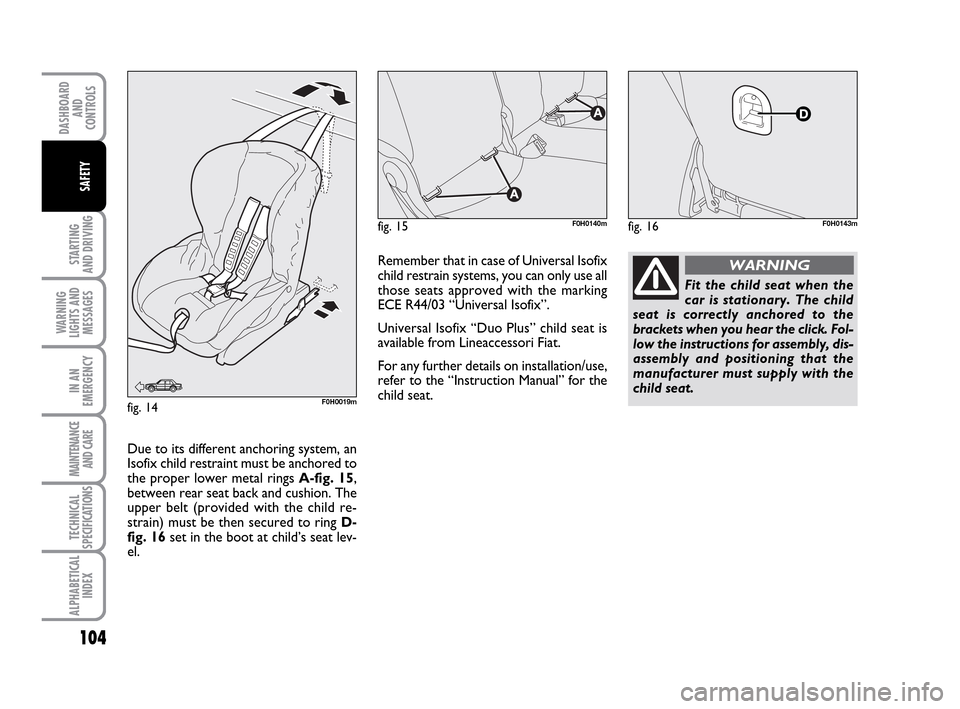
fig. 15F0H0140m
Fit the child seat when the
car is stationary. The child
seat is correctly anchored to the
brackets when you hear the click. Fol-
low the instructions for assembly, dis-
assembly and positioning that the
manufacturer must supply with the
child seat.
WARNING
fig. 14F0H0019m
Due to its different anchoring system, an
Isofix child restraint must be anchored to
the proper lower metal rings A-fig. 15,
between rear seat back and cushion. The
upper belt (provided with the child re-
strain) must be then secured to ring D-
fig. 16set in the boot at child’s seat lev-
el.
fig. 16F0H0143m
Remember that in case of Universal Isofix
child restrain systems, you can only use all
those seats approved with the marking
ECE R44/03 “Universal Isofix”.
Universal Isofix “Duo Plus” child seat is
available from Lineaccessori Fiat.
For any further details on installation/use,
refer to the “Instruction Manual” for the
child seat.
093-110 LUM IDEA GB 2 ed.qxd 14-01-2010 12:16 Pagina 104
Page 106 of 210
105
STARTING
AND DRIVING
WARNING
LIGHTS AND
MESSAGES
IN AN
EMERGENCY
MAINTENANCE
AND CARE
TECHNICAL
SPECIFICATIONS
ALPHABETICAL
INDEX
DASHBOARD
AND
CONTROLS
SAFETY
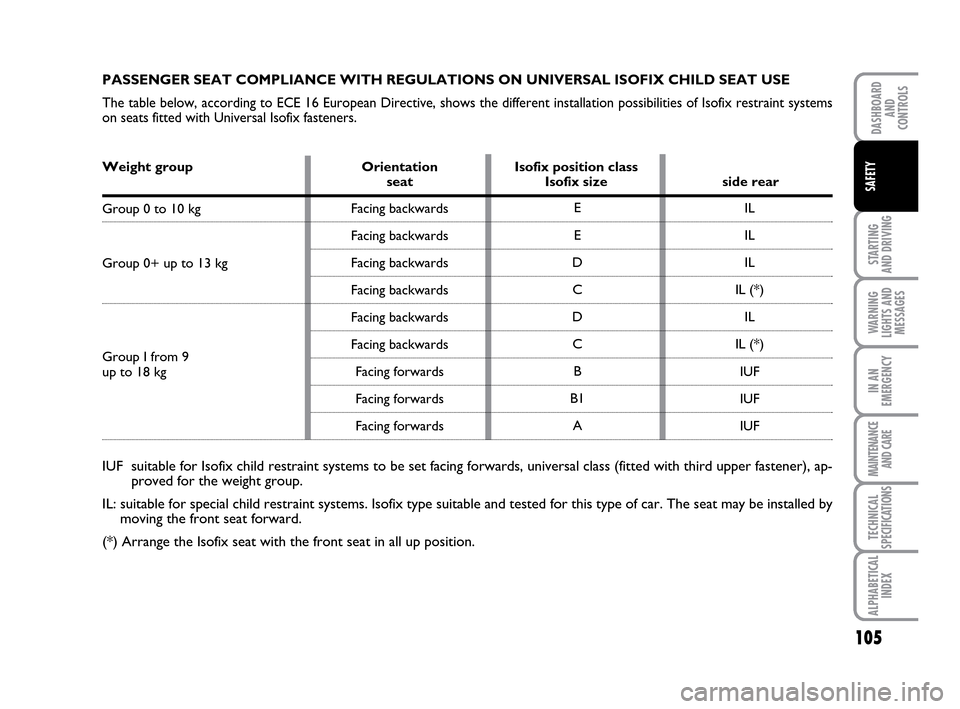
PASSENGER SEAT COMPLIANCE WITH REGULATIONS ON UNIVERSAL ISOFIX CHILD SEAT USE
The table below, according to ECE 16 European Directive, shows the different installation possibilities of Isofix restraint systems
on seats fitted with Universal Isofix fasteners.
Weight group Orientation Isofix position class seat Isofix size side rear
Group 0 to 10 kg
Group 0+ up to 13 kg
Group I from 9
up to 18 kg
Facing backwards
Facing backwards
Facing backwards
Facing backwards
Facing backwards
Facing backwards
Facing forwards
Facing forwards
Facing forwardsE
E
D
C
D
C
B
B1
AIL
IL
IL
IL (*)
IL
IL (*)
IUF
IUF
IUF
IUF suitable for Isofix child restraint systems to be set facing forwards, universal class (fitted with third upper fastener), ap-
proved for the weight group.
IL: suitable for special child restraint systems. Isofix type suitable and tested for this type of car. The seat may be installed by
moving the front seat forward.
(*) Arrange the Isofix seat with the front seat in all up position.
093-110 LUM IDEA GB 2 ed.qxd 14-01-2010 12:16 Pagina 105
Page 108 of 210
107
STARTING
AND DRIVING
WARNING
LIGHTS AND
MESSAGES
IN AN
EMERGENCY
MAINTENANCE
AND CARE
TECHNICAL
SPECIFICATIONS
ALPHABETICAL
INDEX
DASHBOARD
AND
CONTROLS
SAFETY
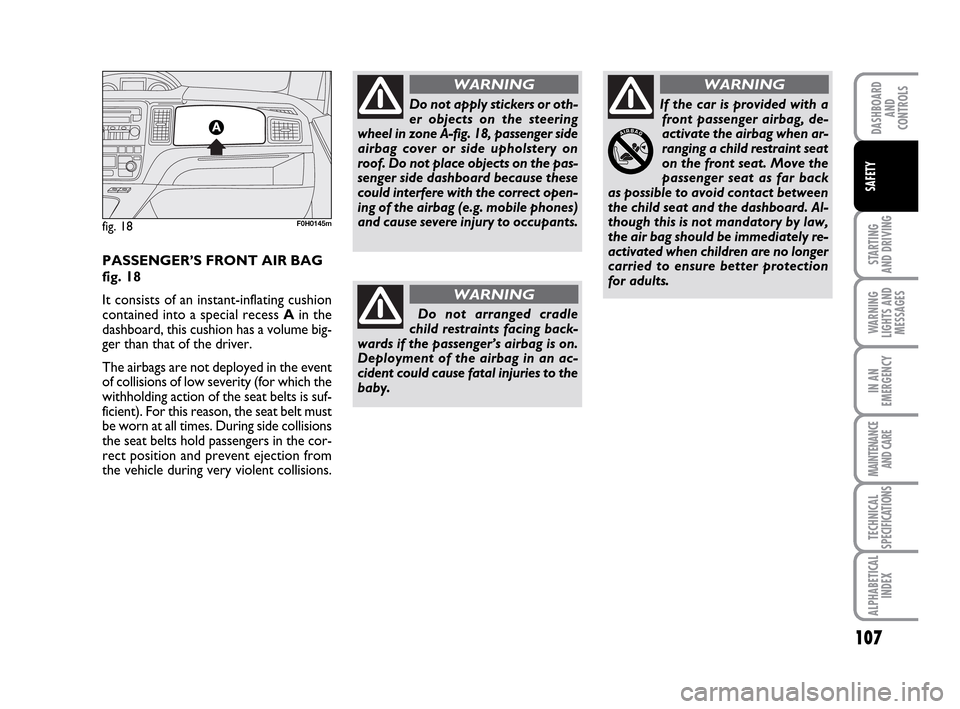
fig. 18F0H0145m
PASSENGER’S FRONT AIR BAG
fig. 18
It consists of an instant-inflating cushion
contained into a special recess Ain the
dashboard, this cushion has a volume big-
ger than that of the driver.
The airbags are not deployed in the event
of collisions of low severity (for which the
withholding action of the seat belts is suf-
ficient). For this reason, the seat belt must
be worn at all times. During side collisions
the seat belts hold passengers in the cor-
rect position and prevent ejection from
the vehicle during very violent collisions.
Do not apply stickers or oth-
er objects on the steering
wheel in zone A-fig. 18, passenger side
airbag cover or side upholstery on
roof. Do not place objects on the pas-
senger side dashboard because these
could interfere with the correct open-
ing of the airbag (e.g. mobile phones)
and cause severe injury to occupants.
WARNING
Do not arranged cradle
child restraints facing back-
wards if the passenger’s airbag is on.
Deployment of the airbag in an ac-
cident could cause fatal injuries to the
baby.
WARNING
If the car is provided with a
front passenger airbag, de-
activate the airbag when ar-
ranging a child restraint seat
on the front seat. Move the
passenger seat as far back
as possible to avoid contact between
the child seat and the dashboard. Al-
though this is not mandatory by law,
the air bag should be immediately re-
activated when children are no longer
carried to ensure better protection
for adults.
WARNING
093-110 LUM IDEA GB 2 ed.qxd 14-01-2010 12:16 Pagina 107