air condition FIAT IDEA 2012 1.G User Guide
[x] Cancel search | Manufacturer: FIAT, Model Year: 2012, Model line: IDEA, Model: FIAT IDEA 2012 1.GPages: 210, PDF Size: 3.65 MB
Page 126 of 210
125
IN AN
EMERGENCY
CAR
MAINTENANCE
TECHNICAL
SPECIFICATIONS
INDEX
DASHBOARD
AND CONTROLS
SAFETY
DEVICES
CORRECT USE
OF THE CAR
WARNING
LIGHTS AND
MESSAGES
If when turning the key to
MAR the warning light
¬does not turn on or stays on during
car travel (together with the message
on the multifunctional display, where
provided), a failure may have oc-
curred in the restraint systems. In this
case the airbags or pretensioners may
not be deployed after an impact or,
in a minor number of cases, they may
be deployed accidentally. Contact Fi-
at Dealership immediately to have
the system checked immediately.
WARNING
The failure of the warning
light
¬is indicated by the
warning light flashing longer than the
expected 4 seconds
“thus signalling
that the front passenger airbag is de-
activated. In addition, the airbag sys-
tem automatically disables the airbag
on the passenger’s side (both front
and side airbags, where provided). In
this case, the warning light
¬does
not necessarily indicate a failure in
the restraining systems. Contact Fiat
Dealership immediately to have the
system checked.
WARNING
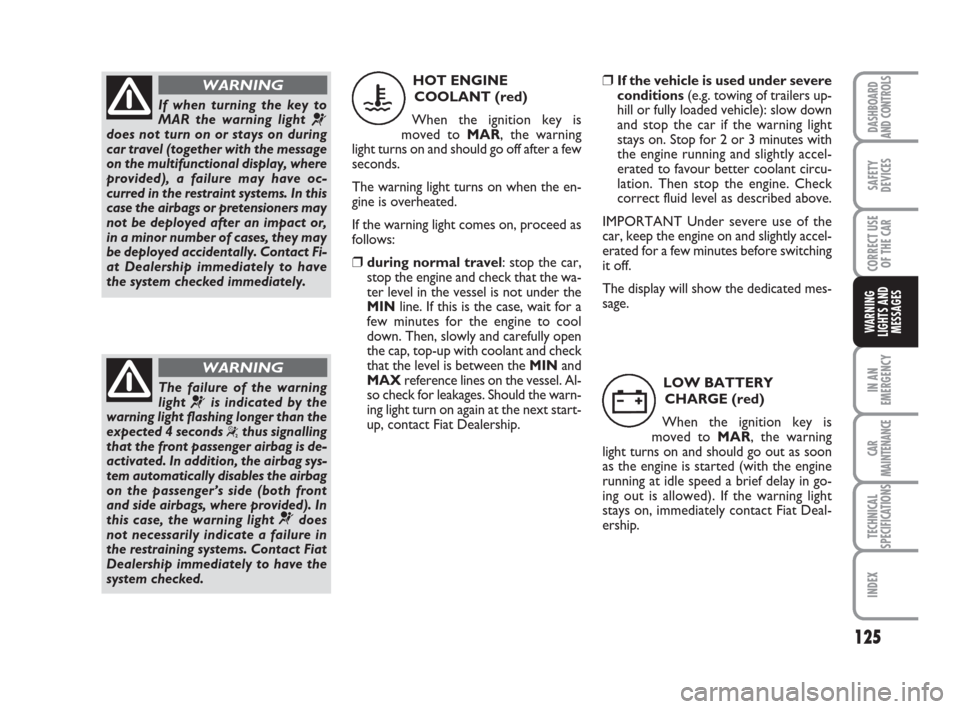
HOT ENGINE
COOLANT (red)
When the ignition key is
moved to MAR, the warning
light turns on and should go off after a few
seconds.
The warning light turns on when the en-
gine is overheated.
If the warning light comes on, proceed as
follows:
❒during normal travel: stop the car,
stop the engine and check that the wa-
ter level in the vessel is not under the
MINline. If this is the case, wait for a
few minutes for the engine to cool
down. Then, slowly and carefully open
the cap, top-up with coolant and check
that the level is between the MINand
MAXreference lines on the vessel. Al-
so check for leakages. Should the warn-
ing light turn on again at the next start-
up, contact Fiat Dealership.
u
❒If the vehicle is used under severe
conditions(e.g. towing of trailers up-
hill or fully loaded vehicle): slow down
and stop the car if the warning light
stays on. Stop for 2 or 3 minutes with
the engine running and slightly accel-
erated to favour better coolant circu-
lation. Then stop the engine. Check
correct fluid level as described above.
IMPORTANT Under severe use of the
car, keep the engine on and slightly accel-
erated for a few minutes before switching
it off.
The display will show the dedicated mes-
sage.
LOW BATTERY
CHARGE (red)
When the ignition key is
moved to MAR, the warning
light turns on and should go out as soon
as the engine is started (with the engine
running at idle speed a brief delay in go-
ing out is allowed). If the warning light
stays on, immediately contact Fiat Deal-
ership.
w
123-132 idea GB 1 ed 10-07-2008 8:29 Pagina 125
Page 131 of 210
130
IN AN
EMERGENCY
CAR
MAINTENANCE
TECHNICAL
SPECIFICATIONS
INDEX
DASHBOARD
AND CONTROLS
SAFETY
DEVICES
CORRECT USE
OF THE CAR
WARNING
LIGHTS AND
MESSAGES
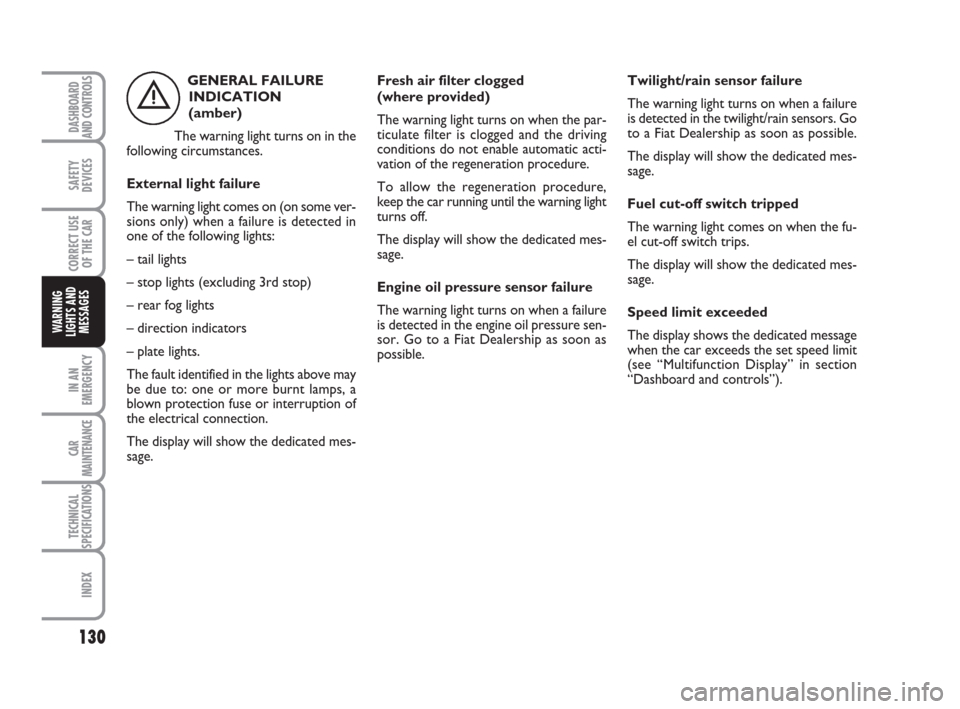
GENERAL FAILURE
INDICATION
(amber)
The warning light turns on in the
following circumstances.
External light failure
The warning light comes on (on some ver-
sions only) when a failure is detected in
one of the following lights:
– tail lights
– stop lights (excluding 3rd stop)
– rear fog lights
– direction indicators
– plate lights.
The fault identified in the lights above may
be due to: one or more burnt lamps, a
blown protection fuse or interruption of
the electrical connection.
The display will show the dedicated mes-
sage.
è
Fresh air filter clogged
(where provided)
The warning light turns on when the par-
ticulate filter is clogged and the driving
conditions do not enable automatic acti-
vation of the regeneration procedure.
To allow the regeneration procedure,
keep the car running until the warning light
turns off.
The display will show the dedicated mes-
sage.
Engine oil pressure sensor failure
The warning light turns on when a failure
is detected in the engine oil pressure sen-
sor. Go to a Fiat Dealership as soon as
possible.Twilight/rain sensor failure
The warning light turns on when a failure
is detected in the twilight/rain sensors. Go
to a Fiat Dealership as soon as possible.
The display will show the dedicated mes-
sage.
Fuel cut-off switch tripped
The warning light comes on when the fu-
el cut-off switch trips.
The display will show the dedicated mes-
sage.
Speed limit exceeded
The display shows the dedicated message
when the car exceeds the set speed limit
(see “Multifunction Display” in section
“Dashboard and controls”).
123-132 idea GB 1 ed 10-07-2008 8:29 Pagina 130
Page 165 of 210
164
TECHNICAL
SPECIFICATIONS
INDEX
DASHBOARD
AND CONTROLS
SAFETY
DEVICES
CORRECT USE
OF THE CAR
WARNING
LIGHTS AND
MESSAGES
IN AN
EMERGENCY
CAR
MAINTENANCE
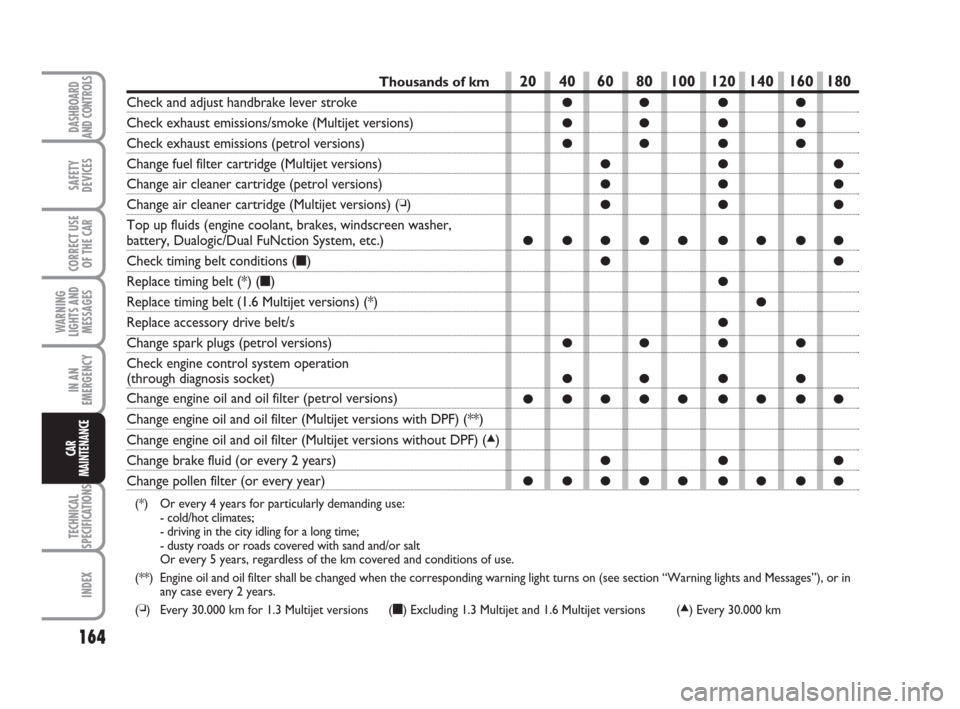
Thousands of km
Check and adjust handbrake lever stroke
Check exhaust emissions/smoke (Multijet versions)
Check exhaust emissions (petrol versions)
Change fuel filter cartridge (Multijet versions)
Change air cleaner cartridge (petrol versions)
Change air cleaner cartridge (Multijet versions) (❏)
Top up fluids (engine coolant, brakes, windscreen washer,
battery, Dualogic/Dual FuNction System, etc.)
Check timing belt conditions (■)
Replace timing belt (*) (■)
Replace timing belt (1.6 Multijet versions) (*)
Replace accessory drive belt/s
Change spark plugs (petrol versions)
Check engine control system operation
(through diagnosis socket)
Change engine oil and oil filter (petrol versions)
Change engine oil and oil filter (Multijet versions with DPF) (**)
Change engine oil and oil filter (Multijet versions without DPF) (▲)
Change brake fluid (or every 2 years)
Change pollen filter (or every year)
(*) Or every 4 years for particularly demanding use:
- cold/hot climates;
- driving in the city idling for a long time;
- dusty roads or roads covered with sand and/or salt
Or every 5 years, regardless of the km covered and conditions of use.
(**) Engine oil and oil filter shall be changed when the corresponding warning light turns on (see section “Warning lights and Messages”), or in
any case every 2 years.
(
❏) Every 30.000 km for 1.3 Multijet versions (■) Excluding 1.3 Multijet and 1.6 Multijet versions (▲) Every 30.000 km
20 40 60 80 100 120 140 160 180
●● ● ●
●● ● ●
●● ● ●
●●●
●●●
●●●
●●●●● ●●●●
●●
●
●
●
●● ● ●
●● ● ●
●●●●● ●●●●
●●●
●●●●● ●●●●
161-180 idea GB 1 ed 10-07-2008 8:30 Pagina 164
Page 167 of 210
166
TECHNICAL
SPECIFICATIONS
INDEX
DASHBOARD
AND CONTROLS
SAFETY
DEVICES
CORRECT USE
OF THE CAR
WARNING
LIGHTS AND
MESSAGES
IN AN
EMERGENCY
CAR
MAINTENANCE
IMPORTANT - Engine oil
Should prevailing use of the car be under
one of the following specially heavy con-
ditions:
❒trailer or caravan towing;
❒dusty roads;
❒short distances (less than 7-8 km) re-
peated and with external tempera-
tures below zero;
❒frequently idling engines or long dis-
tance low speed driving (e.g. taxis or
door-to-door deliveries) or in case of
a long term inactivity;
replace engine oil more frequently than
required on “Service schedule”.
IMPORTANT - Air cleaner
If the car is used on dusty roads change
the air cleaner more frequently than the
indications in the “Service schedule”.
If in doubt as to how often the engine oil
and air cleaner should be changed ac-
cording to how you use the car, contact
a Fiat Dealership.IMPORTANT - Pollen filter
If the vehicle is used frequently in dusty or
heavily polluted environments it is advis-
able to replace the filtering element more
frequently; in particular it should be re-
placed if a reduction of the amount of air
admitted to the passenger compartment
is noted.
IMPORTANT - Diesel filter
The possibility of topping up with diesel
fuel not complying with EN590 European
Norm might make it necessary to replace
the filter more frequently than indicated
in the “Service schedule”.IMPORTANT - Battery
The charge in the battery should be
checked at the start of winter to limit the
risk of electrolyte freezing.
This check should be carried out more
frequently if the car is used mainly for
short trips, or if it is fitted with accessories
that permanently absorb electricity even
with the ignition key removed, especially
in the case of after market accessories. If
the car is used in hot climates or particu-
larly harsh conditions it is wise to check
the level of the battery fluid (electrolyte)
more frequently than specified in the “Ser-
vice schedule” in this section.
Car maintenance should be
entrusted to Fiat Dealership.
For routine and minor main-
tenance operations you wish
to carry out yourself, always make sure
you have the proper equipment, gen-
uine Fiat spare parts and the necessary
fluids; do not however carry out these
operations if you have no experience.
161-180 idea GB 1 ed 10-07-2008 8:30 Pagina 166
Page 179 of 210
178
TECHNICAL
SPECIFICATIONS
INDEX
DASHBOARD
AND CONTROLS
SAFETY
DEVICES
CORRECT USE
OF THE CAR
WARNING
LIGHTS AND
MESSAGES
IN AN
EMERGENCY
CAR
MAINTENANCE
BODYWORK
PROTECTION FROM
ATMOSPHERIC AGENTS
The main causes of corrosion are the fol-
lowing:
❒atmospheric pollution;
❒salty air and humidity (coastal areas,
or hot humid climates);
❒seasonal environment conditions.
Not to be underestimated is also the abra-
sive action of wind-borne atmospheric
dust and sand and mud and gravel raised
by other vehicles.
On your Fiat Idea, Fiat implemented the
best manufacturing technologies to effec-
tively protect the bodywork against cor-
rosion.
These include:
❒Painting products and systems which
give the car particular resistance to
corrosion and abrasion;
❒Use of galvanised (or pretreated) steel
sheets, with high resistance to corro-
sion;
❒Spraying of plastic parts, with a pro-
tective function, in the more exposed
points: underdoor, inner fender parts,
edges, etc.;
❒Use of “open” boxed sections to pre-
vent condensation and pockets of
moisture from triggering rust inside.
BODY AND UNDERBODY
WARRANTY
Your Fiat Idea is covered by warranty
against perforation due to rust of any orig-
inal element of the structure or body. For
the general terms of this warranty, refer
to “FIAT WARRANTY” booklet.
ADVICE FOR PRESERVING THE
BODYWORK
Paint
Paintwork does not only serve an aesteth-
ic purpose, but also protects the under-
lying sheet metal.
In the case of deep scrapes or scores, you
are advised to have the necessary touch-
ing up carried out immediately to avoid
the formation of rust. Use only original
paint products for touching up (see “Body-
work paint identification plate” in section
“Technical specification”).
Normal paint maintenance consists in
washing at intervals depending on the con-
ditions and environment of use. For ex-
ample, in highly polluted areas, or if the
roads are sprayed with salt, it is wise to
wash the car more frequently.To correctly wash the car:
❒remove the aerial from the roof to
prevent damage to it if the car is
washed in an automatic system;
❒wash the body using a low pressure jet
of water;
❒wipe a sponge with a slightly soapy so-
lution over the bodywork, frequently
rinsing with the sponge;
❒rinse well with water and dry with a
jet of air or a chamois leather.
When drying, take particular care with the
less visible parts like door surrounds, bon-
net and around the headlights where wa-
ter may stagnate. The car should not be
taken to a closed area immediately, but left
in the open so that residual water can
evaporate.
Do not wash the car after it has been left
in the sun or with the bonnet hot: this may
alter the shine of the paintwork.
Exterior plastic parts must be cleaned in
the same way as the rest of the vehicle.
Where possible, do not park under trees;
the resinous substance many species re-
lease give the paint a dull appearance and
increase the possibility of triggering rust
processes.
161-180 idea GB 1 ed 10-07-2008 8:30 Pagina 178
Page 199 of 210
198
INDEX
DASHBOARD
AND CONTROLS
SAFETY
DEVICES
CORRECT USE
OF THE CAR
WARNING
LIGHTS AND
MESSAGES
IN AN
EMERGENCY
CAR
MAINTENANCE
TECHNICAL
SPECIFICATIONS
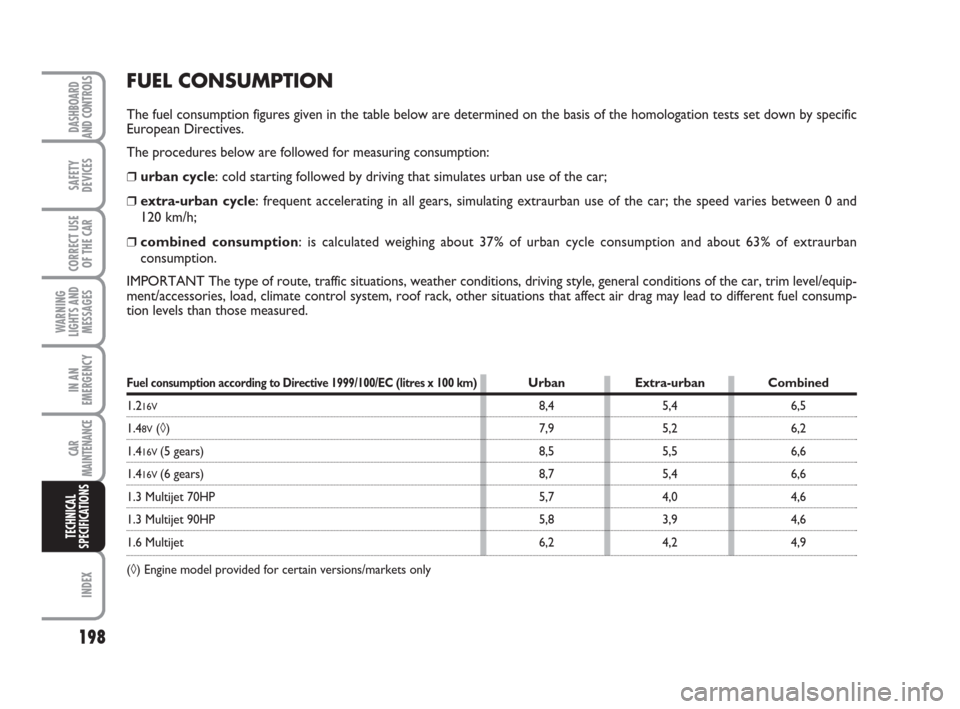
FUEL CONSUMPTION
The fuel consumption figures given in the table below are determined on the basis of the homologation tests set down by specific
European Directives.
The procedures below are followed for measuring consumption:
❒urban cycle: cold starting followed by driving that simulates urban use of the car;
❒extra-urban cycle: frequent accelerating in all gears, simulating extraurban use of the car; the speed varies between 0 and
120 km/h;
❒combined consumption: is calculated weighing about 37% of urban cycle consumption and about 63% of extraurban
consumption.
IMPORTANT The type of route, traffic situations, weather conditions, driving style, general conditions of the car, trim level/equip-
ment/accessories, load, climate control system, roof rack, other situations that affect air drag may lead to different fuel consump-
tion levels than those measured.
Fuel consumption according to Directive 1999/100/EC (litres x 100 km)Urban Extra-urban Combined
1.216V8,4 5,4 6,5
1.48V(◊) 7,9 5,2 6,2
1.416V (5 gears) 8,5 5,5 6,6
1.416V (6 gears) 8,7 5,4 6,6
1.3 Multijet 70HP 5,7 4,0 4,6
1.3 Multijet 90HP 5,8 3,9 4,6
1.6 Multijet 6,2 4,2 4,9
(◊) Engine model provided for certain versions/markets only
181-199 idea GB 1 ed 10-07-2008 8:31 Pagina 198