air condition FIAT IDEA 2012 1.G Owners Manual
[x] Cancel search | Manufacturer: FIAT, Model Year: 2012, Model line: IDEA, Model: FIAT IDEA 2012 1.GPages: 210, PDF Size: 3.65 MB
Page 47 of 210
46
SAFETY
DEVICES
CORRECT USE
OF THE CAR
WARNING
LIGHTS AND
MESSAGES
IN AN
EMERGENCY
CAR
MAINTENANCE
TECHNICAL
SPECIFICATIONS
INDEX
DASHBOARD
AND CONTROLS
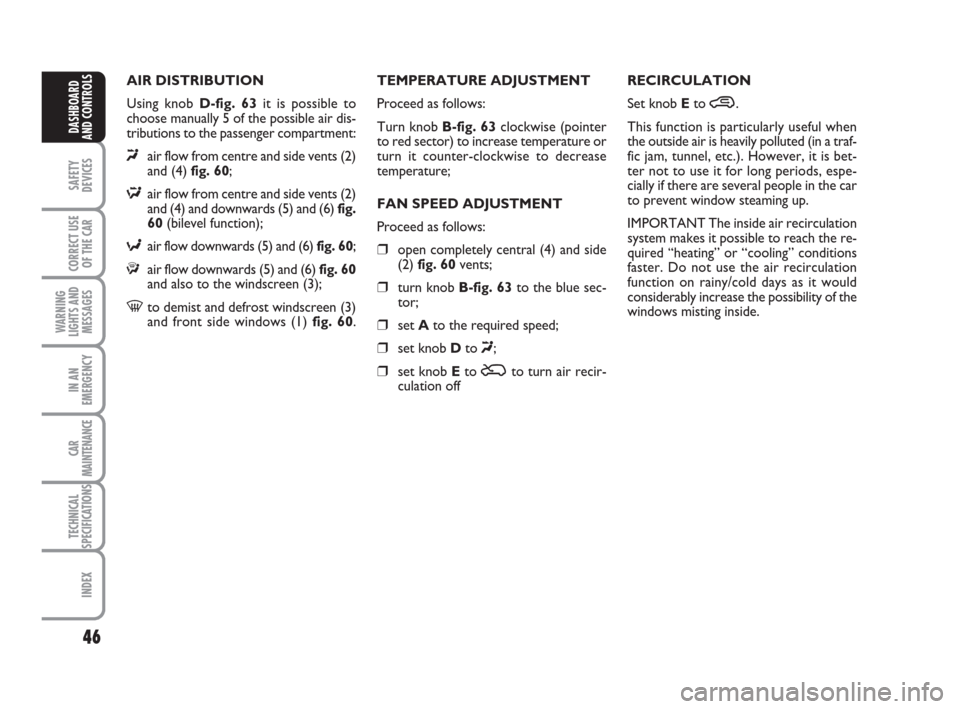
AIR DISTRIBUTION
Using knob D-fig. 63it is possible to
choose manually 5 of the possible air dis-
tributions to the passenger compartment:
«air flow from centre and side vents (2)
and (4) fig. 60;
Δair flow from centre and side vents (2)
and (4) and downwards (5) and (6) fig.
60(bilevel function);
≈air flow downwards (5) and (6) fig. 60;
ƒair flow downwards (5) and (6) fig. 60
and also to the windscreen (3);
-to demist and defrost windscreen (3)
and front side windows (1) fig. 60.TEMPERATURE ADJUSTMENT
Proceed as follows:
Turn knob B-fig. 63clockwise (pointer
to red sector) to increase temperature or
turn it counter-clockwise to decrease
temperature;
FAN SPEED ADJUSTMENT
Proceed as follows:
❒open completely central (4) and side
(2) fig. 60vents;
❒turn knob B-fig. 63to the blue sec-
tor;
❒set Ato the required speed;
❒set knob Dto «;
❒set knob Eto Úto turn air recir-
culation offRECIRCULATION
Set knob Eto ….
This function is particularly useful when
the outside air is heavily polluted (in a traf-
fic jam, tunnel, etc.). However, it is bet-
ter not to use it for long periods, espe-
cially if there are several people in the car
to prevent window steaming up.
IMPORTANT The inside air recirculation
system makes it possible to reach the re-
quired “heating” or “cooling” conditions
faster. Do not use the air recirculation
function on rainy/cold days as it would
considerably increase the possibility of the
windows misting inside.
036-092 idea GB 1 ed 10-07-2008 16:12 Pagina 46
Page 50 of 210
49
SAFETY
DEVICES
CORRECT USE
OF THE CAR
WARNING
LIGHTS AND
MESSAGES
IN AN
EMERGENCY
CAR
MAINTENANCE
TECHNICAL
SPECIFICATIONS
INDEX
DASHBOARD
AND CONTROLS
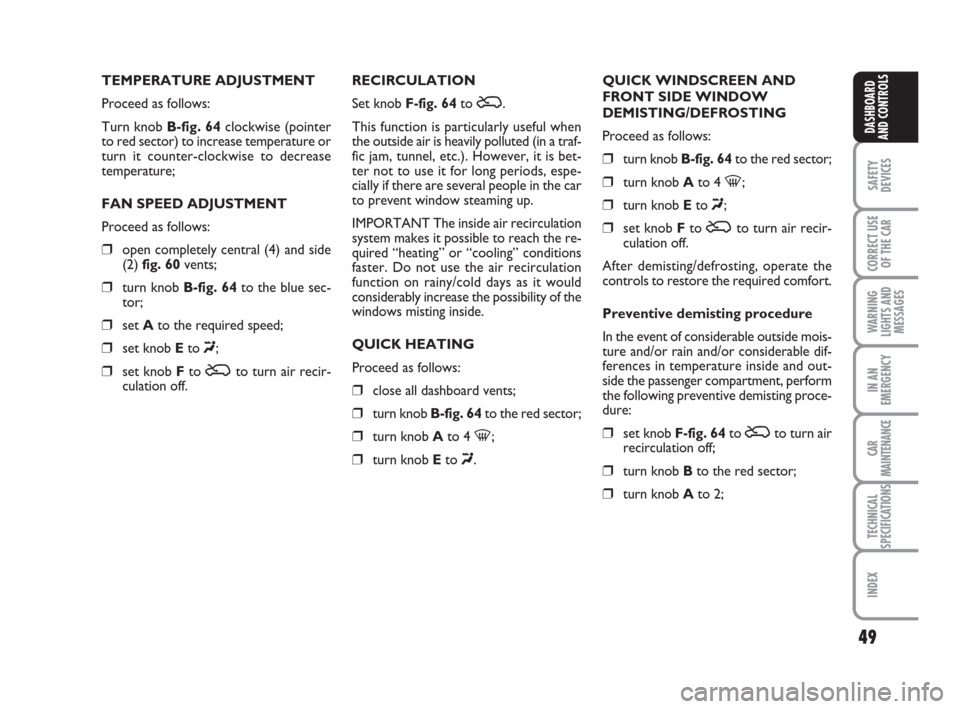
TEMPERATURE ADJUSTMENT
Proceed as follows:
Turn knob B-fig. 64clockwise (pointer
to red sector) to increase temperature or
turn it counter-clockwise to decrease
temperature;
FAN SPEED ADJUSTMENT
Proceed as follows:
❒open completely central (4) and side
(2) fig. 60vents;
❒turn knob B-fig. 64to the blue sec-
tor;
❒set Ato the required speed;
❒set knob Eto «;
❒set knob Fto Úto turn air recir-
culation off.RECIRCULATION
Set knob F-fig. 64to Ú.
This function is particularly useful when
the outside air is heavily polluted (in a traf-
fic jam, tunnel, etc.). However, it is bet-
ter not to use it for long periods, espe-
cially if there are several people in the car
to prevent window steaming up.
IMPORTANT The inside air recirculation
system makes it possible to reach the re-
quired “heating” or “cooling” conditions
faster. Do not use the air recirculation
function on rainy/cold days as it would
considerably increase the possibility of the
windows misting inside.
QUICK HEATING
Proceed as follows:
❒close all dashboard vents;
❒turn knob B-fig. 64to the red sector;
❒turn knob Ato 4 -;
❒turn knob Eto «.QUICK WINDSCREEN AND
FRONT SIDE WINDOW
DEMISTING/DEFROSTING
Proceed as follows:
❒turn knob B-fig. 64to the red sector;
❒turn knob Ato 4 -;
❒turn knob Eto «;
❒set knob Fto Úto turn air recir-
culation off.
After demisting/defrosting, operate the
controls to restore the required comfort.
Preventive demisting procedure
In the event of considerable outside mois-
ture and/or rain and/or considerable dif-
ferences in temperature inside and out-
side the passenger compartment, perform
the following preventive demisting proce-
dure:
❒set knob F-fig. 64 to Úto turn air
recirculation off;
❒turn knob Bto the red sector;
❒turn knob Ato 2;
036-092 idea GB 1 ed 10-07-2008 16:12 Pagina 49
Page 52 of 210
51
SAFETY
DEVICES
CORRECT USE
OF THE CAR
WARNING
LIGHTS AND
MESSAGES
IN AN
EMERGENCY
CAR
MAINTENANCE
TECHNICAL
SPECIFICATIONS
INDEX
DASHBOARD
AND CONTROLS
AUTOMATIC
TWO-ZONE CLIMATE
CONTROL SYSTEM
(where provided)
GENERAL
The car is fitted with a two-zone climate
control system which makes it possible to
separately adjust the air temperature on
the driver’s side and on the passenger’s
side. Temperature control is based on the
“equivalent temperature” logic, i.e.: the
system continuously works to keep con-
stant the comfort inside the passenger
compartment and to compensate any vari-
ation of the outside climate conditions, in-
cluding sunshine detected by a proper sen-
sor provided for the purpose.
The climate control system automatically
controls and adjusts the following para-
meters and functions:
❒air temperature at driver/front pas-
senger vents;
❒air distribution at driver/front passen-
ger vents;
❒fan speed (continuous air flow varia-
tion);
❒compressor switching on (to cool/de-
humidify air);
❒air recirculation.
All the above functions can be changed
manually at any time, i.e.: you can always
modify one or more function settings. In
this event, the system will no longer im-
plement the automatic control of the func-
tions changed manually (except for safety
reasons, e.g.: risk of window misting).
Manual selections prevail over automatic
ones and remain in storage until the user
decides to resume automatic control, ex-
cept when the system cuts in for particu-
lar safety conditions.
The control of functions not changed man-
ually remains automatic.
The amount of air admitted to the pas-
senger compartment does not depend on
the car speed, since it is electronically con-
trolled by the fan.
In any case, the temperature of the air ad-
mitted to the passenger compartment is
controlled automatically (except when the
system is off) according to the tempera-
tures set on the driver’s and front pas-
senger’s displays or under certain climat-
ic conditions if the compressor is off).The system enables to set or to change
the following parameters and functions
manually:❒air temperatures on driver/front pas-
senger side;
❒fan speed (continuous variation);
❒air distribution on five levels (driver/
front passenger side);
❒climate control compressor on/off en-
able;
❒monozone/two-zone distribution pri-
ority;
❒fast demisting/defrosting;
❒air recirculation;
❒rear heated window;
❒system off;
036-092 idea GB 1 ed 10-07-2008 16:12 Pagina 51
Page 54 of 210
53
SAFETY
DEVICES
CORRECT USE
OF THE CAR
WARNING
LIGHTS AND
MESSAGES
IN AN
EMERGENCY
CAR
MAINTENANCE
TECHNICAL
SPECIFICATIONS
INDEX
DASHBOARD
AND CONTROLS
During fully automatic operation, the on-
ly manual settings required are the fol-
lowing:
❒MONO, to align the air temperature
and distribution set on the passenger’s
side (front or rear) with that on the
driver’s side;
❒…, air recirculation, to keep it al-
ways on or off;
❒-, to speed up demisting/defrosting
of windscreen, front side windows,
rear window and door mirrors;
❒(, to demist/defrost the rear heat-
ed window and the door mirrors.
During completely automatic system op-
eration, the temperatures, air distribution
and the fan speed set can be changed at
any time through the relevant buttons or
knobs: the system will automatically
change its settings to adjust to the new re-
quirements.
During full automatic operation (FULL
AUTO), any change in air distribution
and/or air flow and/or compressor turn-
ing on and/or air recirculation will obtain
FULLdisappearing. In this way functions
will be controlled manually until pressing
the AUTObutton again. The fan speed is
the same for all passenger compartment
areas.With one or more functions engaged man-
ually, the adjustment of the temperature
of the air admitted to the passenger com-
partment continues to be controlled au-
tomatically by the system, except with the
climate control compressor off. In fact, in
this condition, the air admitted to the pas-
senger compartment cannot have a low-
er temperature than the outside air.
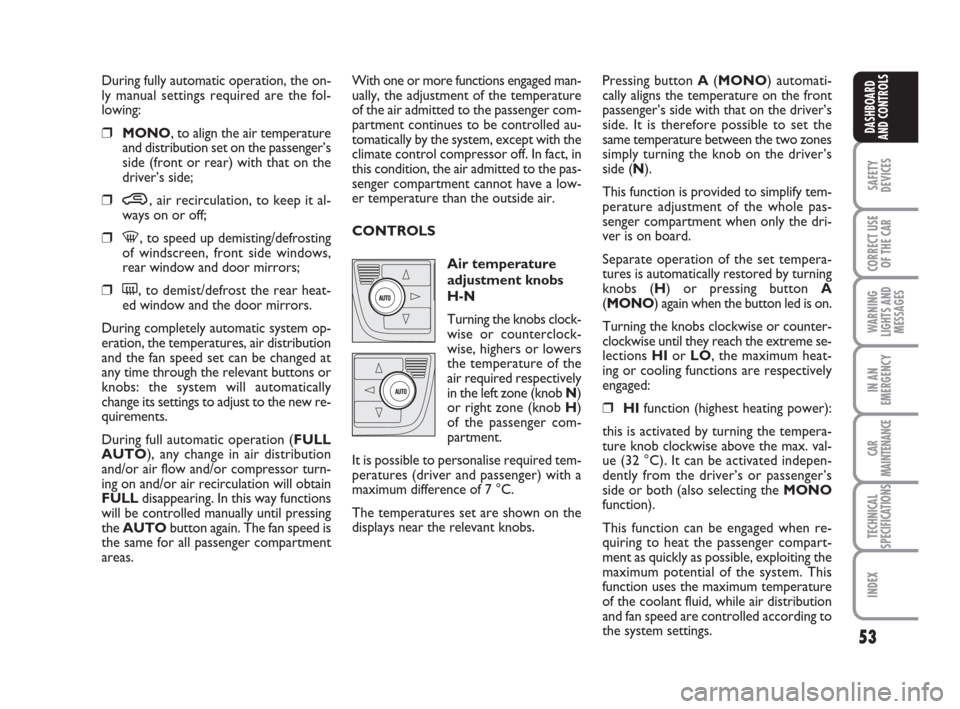
CONTROLS
Air temperature
adjustment knobs
H-N
Turning the knobs clock-
wise or counterclock-
wise, highers or lowers
the temperature of the
air required respectively
in the left zone (knob N)
or right zone (knob H)
of the passenger com-
partment.
It is possible to personalise required tem-
peratures (driver and passenger) with a
maximum difference of 7 °C.
The temperatures set are shown on the
displays near the relevant knobs.Pressing button A(MONO) automati-
cally aligns the temperature on the front
passenger’s side with that on the driver’s
side. It is therefore possible to set the
same temperature between the two zones
simply turning the knob on the driver’s
side (N).
This function is provided to simplify tem-
perature adjustment of the whole pas-
senger compartment when only the dri-
ver is on board.
Separate operation of the set tempera-
tures is automatically restored by turning
knobs (H) or pressing button A
(MONO) again when the button led is on.
Turning the knobs clockwise or counter-
clockwise until they reach the extreme se-
lections HIor LO, the maximum heat-
ing or cooling functions are respectively
engaged:
❒HIfunction (highest heating power):
this is activated by turning the tempera-
ture knob clockwise above the max. val-
ue (32 °C). It can be activated indepen-
dently from the driver’s or passenger’s
side or both (also selecting the MONO
function).
This function can be engaged when re-
quiring to heat the passenger compart-
ment as quickly as possible, exploiting the
maximum potential of the system. This
function uses the maximum temperature
of the coolant fluid, while air distribution
and fan speed are controlled according to
the system settings.
036-092 idea GB 1 ed 10-07-2008 16:12 Pagina 53
Page 55 of 210
54
SAFETY
DEVICES
CORRECT USE
OF THE CAR
WARNING
LIGHTS AND
MESSAGES
IN AN
EMERGENCY
CAR
MAINTENANCE
TECHNICAL
SPECIFICATIONS
INDEX
DASHBOARD
AND CONTROLS
More particularly, max. fan speed will not
be immediately engaged if coolant is not
hot enough; this to prevent admitting air
that is not warm enough to the passenger
compartment.
All manual settings are however possible
with this function on.
To switch the function off, simply turn the
temperature knob counterclockwise and
set the required temperature.
❒LOfunction (highest cooling power):
this is activated by turning the tempera-
ture knob counterclockwise below the
min. value (16 °C). It can be activated in-
dependently from the driver’s or passen-
ger’s side or both (also selecting the
MONOfunction).
This function can be engaged when re-
quiring to cool the passenger compart-
ment as quickly as possible, exploiting the
maximum potential of the system. This
function engages inside air recirculation
and climate control compressor, while air
distribution and fan speed are controlled
according to environmental conditions. All manual settings are however possible
with this function on.
To switch the function off, simply turn the
temperature knob clockwise and set the
required temperature.
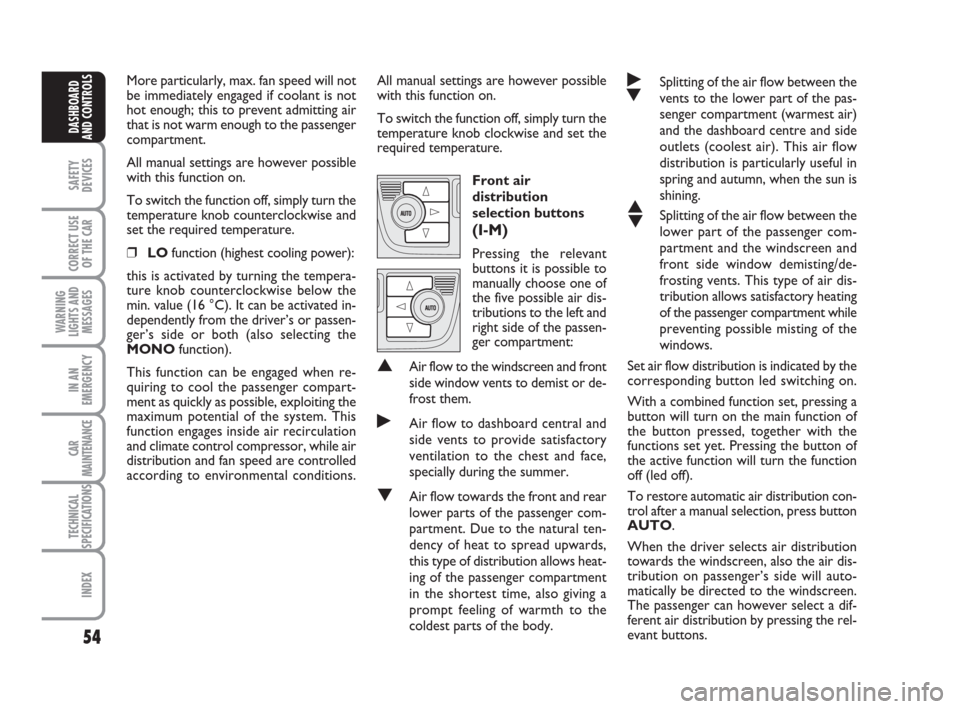
Front air
distribution
selection buttons
(I-M)
Pressing the relevant
buttons it is possible to
manually choose one of
the five possible air dis-
tributions to the left and
right side of the passen-
ger compartment:
▲Air flow to the windscreen and front
side window vents to demist or de-
frost them.
˙Air flow to dashboard central and
side vents to provide satisfactory
ventilation to the chest and face,
specially during the summer.
▼Air flow towards the front and rear
lower parts of the passenger com-
partment. Due to the natural ten-
dency of heat to spread upwards,
this type of distribution allows heat-
ing of the passenger compartment
in the shortest time, also giving a
prompt feeling of warmth to the
coldest parts of the body.
˙
▼Splitting of the air flow between the
vents to the lower part of the pas-
senger compartment (warmest air)
and the dashboard centre and side
outlets (coolest air). This air flow
distribution is particularly useful in
spring and autumn, when the sun is
shining.
▲
▼Splitting of the air flow between the
lower part of the passenger com-
partment and the windscreen and
front side window demisting/de-
frosting vents. This type of air dis-
tribution allows satisfactory heating
of the passenger compartment while
preventing possible misting of the
windows.
Set air flow distribution is indicated by the
corresponding button led switching on.
With a combined function set, pressing a
button will turn on the main function of
the button pressed, together with the
functions set yet. Pressing the button of
the active function will turn the function
off (led off).
To restore automatic air distribution con-
trol after a manual selection, press button
AUTO.
When the driver selects air distribution
towards the windscreen, also the air dis-
tribution on passenger’s side will auto-
matically be directed to the windscreen.
The passenger can however select a dif-
ferent air distribution by pressing the rel-
evant buttons.
036-092 idea GB 1 ed 10-07-2008 16:12 Pagina 54
Page 56 of 210
55
SAFETY
DEVICES
CORRECT USE
OF THE CAR
WARNING
LIGHTS AND
MESSAGES
IN AN
EMERGENCY
CAR
MAINTENANCE
TECHNICAL
SPECIFICATIONS
INDEX
DASHBOARD
AND CONTROLS
Fan speed
adjustment
buttons (L)
Pressing the ends of but-
ton
pincreases or de-
creases the fan speed
and therefore the amount of air admitted
to the passenger compartment, although
keeping the required temperature.
The fan speed is shown by the lit bars on
the display
❒max fan speed = all bars lit
❒min fan speed = one bar lit.
The fan can be cut off only if the climate
control compressor has been switched off
pressing button B.
IMPORTANT To restore automatic fan
speed control after a manual adjustment,
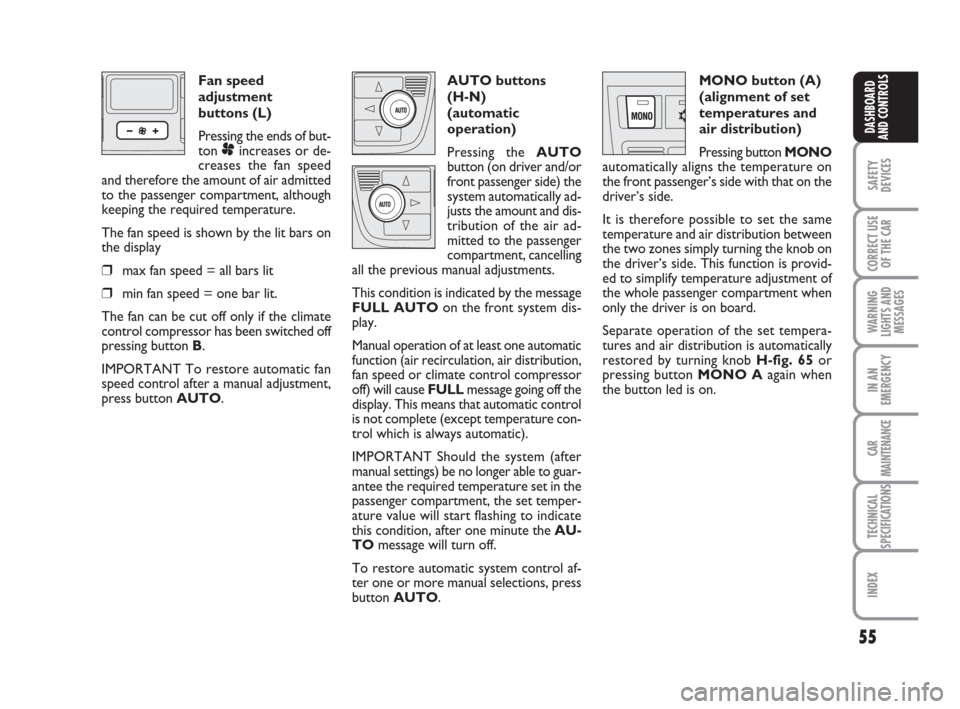
press button AUTO.AUTO buttons
(H-N)
(automatic
operation)
Pressing the AUTO
button (on driver and/or
front passenger side) the
system automatically ad-
justs the amount and dis-
tribution of the air ad-
mitted to the passenger
compartment, cancelling
all the previous manual adjustments.
This condition is indicated by the message
FULL AUTOon the front system dis-
play.
Manual operation of at least one automatic
function (air recirculation, air distribution,
fan speed or climate control compressor
off) will cause FULLmessage going off the
display. This means that automatic control
is not complete (except temperature con-
trol which is always automatic).
IMPORTANT Should the system (after
manual settings) be no longer able to guar-
antee the required temperature set in the
passenger compartment, the set temper-
ature value will start flashing to indicate
this condition, after one minute the AU-
TOmessage will turn off.
To restore automatic system control af-
ter one or more manual selections, press
button AUTO.MONO button (A)
(alignment of set
temperatures and
air distribution)
Pressing button MONO
automatically aligns the temperature on
the front passenger’s side with that on the
driver’s side.
It is therefore possible to set the same
temperature and air distribution between
the two zones simply turning the knob on
the driver’s side. This function is provid-
ed to simplify temperature adjustment of
the whole passenger compartment when
only the driver is on board.
Separate operation of the set tempera-
tures and air distribution is automatically
restored by turning knob H-fig. 65or
pressing button MONO Aagain when
the button led is on.
036-092 idea GB 1 ed 10-07-2008 16:12 Pagina 55
Page 57 of 210
56
SAFETY
DEVICES
CORRECT USE
OF THE CAR
WARNING
LIGHTS AND
MESSAGES
IN AN
EMERGENCY
CAR
MAINTENANCE
TECHNICAL
SPECIFICATIONS
INDEX
DASHBOARD
AND CONTROLS
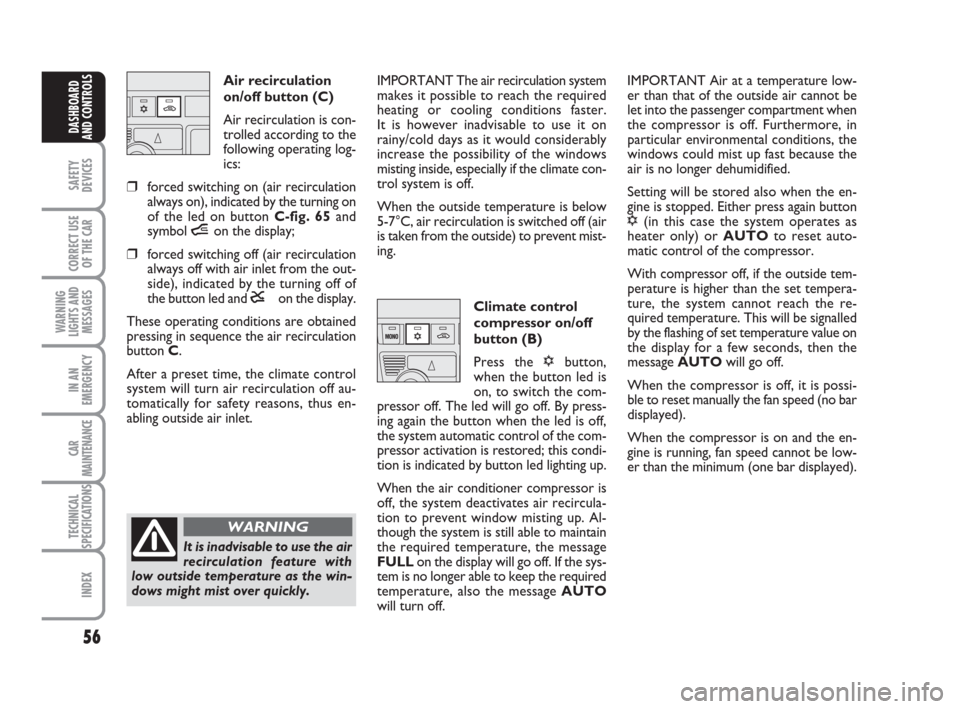
Air recirculation
on/off button (C)
Air recirculation is con-
trolled according to the
following operating log-
ics:
❒forced switching on (air recirculation
always on), indicated by the turning on
of the led on button C-fig. 65and
symbol íon the display;
❒forced switching off (air recirculation
always off with air inlet from the out-
side), indicated by the turning off of
the button led and êon the display.
These operating conditions are obtained
pressing in sequence the air recirculation
button C.
After a preset time, the climate control
system will turn air recirculation off au-
tomatically for safety reasons, thus en-
abling outside air inlet.IMPORTANT The air recirculation system
makes it possible to reach the required
heating or cooling conditions faster.
It is however inadvisable to use it on
rainy/cold days as it would considerably
increase the possibility of the windows
misting inside, especially if the climate con-
trol system is off.
When the outside temperature is below
5-7°C, air recirculation is switched off (air
is taken from the outside) to prevent mist-
ing.
Climate control
compressor on/off
button (B)
Press the √button,
when the button led is
on, to switch the com-
pressor off. The led will go off. By press-
ing again the button when the led is off,
the system automatic control of the com-
pressor activation is restored; this condi-
tion is indicated by button led lighting up.
When the air conditioner compressor is
off, the system deactivates air recircula-
tion to prevent window misting up. Al-
though the system is still able to maintain
the required temperature, the message
FULLon the display will go off. If the sys-
tem is no longer able to keep the required
temperature, also the message AUTO
will turn off.IMPORTANT Air at a temperature low-
er than that of the outside air cannot be
let into the passenger compartment when
the compressor is off. Furthermore, in
particular environmental conditions, the
windows could mist up fast because the
air is no longer dehumidified.
Setting will be stored also when the en-
gine is stopped. Either press again button
√(in this case the system operates as
heater only) or AUTOto reset auto-
matic control of the compressor.
With compressor off, if the outside tem-
perature is higher than the set tempera-
ture, the system cannot reach the re-
quired temperature. This will be signalled
by the flashing of set temperature value on
the display for a few seconds, then the
message AUTOwill go off.
When the compressor is off, it is possi-
ble to reset manually the fan speed (no bar
displayed).
When the compressor is on and the en-
gine is running, fan speed cannot be low-
er than the minimum (one bar displayed).
It is inadvisable to use the air
recirculation feature with
low outside temperature as the win-
dows might mist over quickly.
WARNING
036-092 idea GB 1 ed 10-07-2008 16:12 Pagina 56
Page 58 of 210
57
SAFETY
DEVICES
CORRECT USE
OF THE CAR
WARNING
LIGHTS AND
MESSAGES
IN AN
EMERGENCY
CAR
MAINTENANCE
TECHNICAL
SPECIFICATIONS
INDEX
DASHBOARD
AND CONTROLS
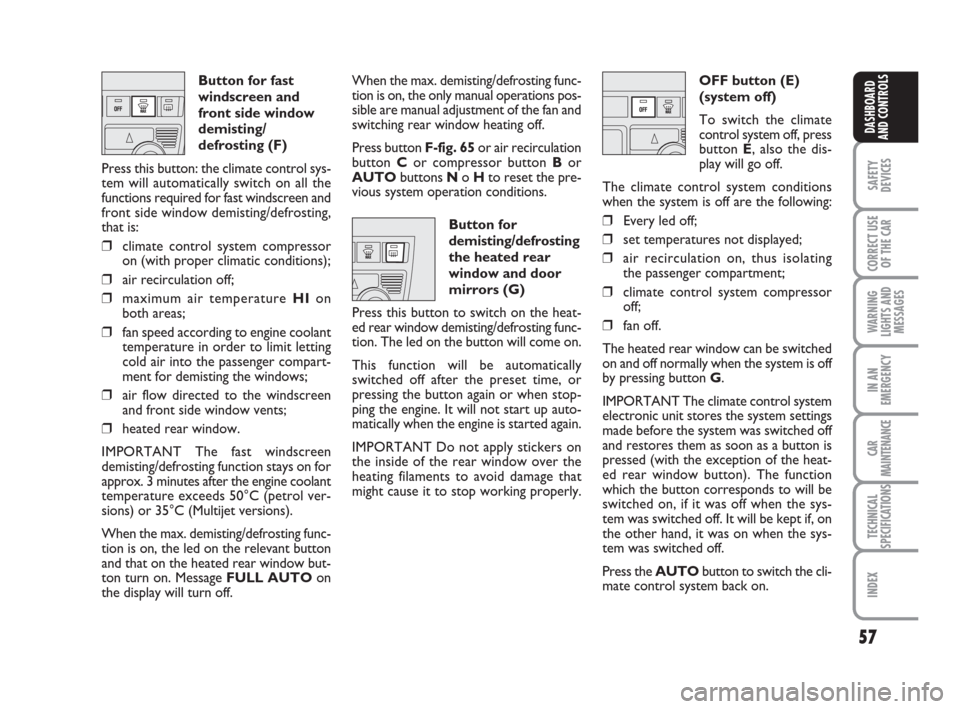
Button for fast
windscreen and
front side window
demisting/
defrosting (F)
Press this button: the climate control sys-
tem will automatically switch on all the
functions required for fast windscreen and
front side window demisting/defrosting,
that is:
❒climate control system compressor
on (with proper climatic conditions);
❒air recirculation off;
❒maximum air temperature HIon
both areas;
❒fan speed according to engine coolant
temperature in order to limit letting
cold air into the passenger compart-
ment for demisting the windows;
❒air flow directed to the windscreen
and front side window vents;
❒heated rear window.
IMPORTANT The fast windscreen
demisting/defrosting function stays on for
approx. 3 minutes after the engine coolant
temperature exceeds 50°C (petrol ver-
sions) or 35°C (Multijet versions).
When the max. demisting/defrosting func-
tion is on, the led on the relevant button
and that on the heated rear window but-
ton turn on. Message FULL AUTOon
the display will turn off.When the max. demisting/defrosting func-
tion is on, the only manual operations pos-
sible are manual adjustment of the fan and
switching rear window heating off.
Press button F-fig. 65or air recirculation
button Cor compressor button Bor
AUTObuttons No Hto reset the pre-
vious system operation conditions.
Button for
demisting/defrosting
the heated rear
window and door
mirrors (G)
Press this button to switch on the heat-
ed rear window demisting/defrosting func-
tion. The led on the button will come on.
This function will be automatically
switched off after the preset time, or
pressing the button again or when stop-
ping the engine. It will not start up auto-
matically when the engine is started again.
IMPORTANT Do not apply stickers on
the inside of the rear window over the
heating filaments to avoid damage that
might cause it to stop working properly.OFF button (E)
(system off)
To switch the climate
control system off, press
button E, also the dis-
play will go off.
The climate control system conditions
when the system is off are the following:
❒Every led off;
❒set temperatures not displayed;
❒air recirculation on, thus isolating
the passenger compartment;
❒climate control system compressor
off;
❒fan off.
The heated rear window can be switched
on and off normally when the system is off
by pressing button G.
IMPORTANT The climate control system
electronic unit stores the system settings
made before the system was switched off
and restores them as soon as a button is
pressed (with the exception of the heat-
ed rear window button). The function
which the button corresponds to will be
switched on, if it was off when the sys-
tem was switched off. It will be kept if, on
the other hand, it was on when the sys-
tem was switched off.
Press the AUTObutton to switch the cli-
mate control system back on.
036-092 idea GB 1 ed 10-07-2008 16:12 Pagina 57
Page 100 of 210
99
CORRECT USE
OF THE CAR
WARNING
LIGHTS AND
MESSAGES
IN AN
EMERGENCY
CAR
MAINTENANCE
TECHNICAL
SPECIFICATIONS
INDEX
DASHBOARD
AND CONTROLS
SAFETY
DEVICES
HOW TO KEEP
THE SEAT BELTS ALWAYS
IN EFFICIENT CONDITIONS
❒Always use the belt with the tape taut
and never twisted; make sure that it is
free to run without impediments.
❒After a serious accident, replace the
belt being worn at that time, even if
it does not appear damaged. Always
replace the seat belts if pretensioners
have been activated.
❒To clean the belts, wash by hand with
neutral soap, rinse and leave to dry in
the shade. Never use strong deter-
gents, bleach or dyes or other chem-
ical substance that might weaken the
fibres.
❒Prevent the reels from getting wet:
their correct operation is only guar-
anteed if water does not get inside.
❒Replace the seat belt when showing
significant wear or cut signs.
CARRYING CHILDREN
SAFELY
For optimal protection in the event of a
crash, all passengers must be seated and
wearing adequate restraint systems.
This is even more important for children.
According to 2003/20/EC Directive, this
prescription is compulsory for all Euro-
pean Community countries.
Compared with adults, their head is pro-
portionally larger and heavier than the rest
of the body, while the muscles and bone
structure are not completely developed.
Therefore, correct restraint systems are
necessary, other than adult seat belts. The
results of research on the best child re-
straint systems are contained in the Eu-
ropean Standard ECE-R44. This Standard
enforces the use of restraint systems clas-
sified in five groups:
Group 0 0-10 kg in weight
Group 0+ 0-13 kg in weight
Group 1 9-18 kg in weight
Group 2 15-25 kg in weight
Group 3 22-36 kg in weight
As it may be noted, the groups overlap
partly and in fact, in commerce it is pos-
sible to find devices that cover more than
one weight group.All restraint devices must bear the certi-
fication data, together with the control
brand, on a solidly fixed label which must
absolutely never be removed.
Over 1.50 m in height, from the point of
view of restraint systems, children are
considered as adults and wear the seat
belts normally.
Lineaccessori Fiat offers seats for each
weight group, which are the recommend-
ed choice, as they have been designed and
experimented specifically for Fiat cars.
With passenger’s air bag ac-
tive, never place child’s seats
with the cradle facing backwards
since the air bag activation could
cause to the child serious injuries,
even mortal, regardless of the seri-
ousness of the crash that triggered it.
You are advised to carry children al-
ways with proper restraint systems on
the rear seats, as this is the most pro-
tected position in the case of a crash.
WARNING
093-110 idea GB 1 ed 10-07-2008 8:28 Pagina 99
Page 117 of 210
116
WARNING
LIGHTS AND
MESSAGES
IN AN
EMERGENCY
CAR
MAINTENANCE
TECHNICAL
SPECIFICATIONS
INDEX
DASHBOARD
AND CONTROLS
SAFETY
DEVICES
CORRECT USE
OF THE CAR
CONTAINING
RUNNING COSTS
Here are some suggestions which may
help you to keep the running costs of your
car down and lower the amount of toxic
emissions released into the atmosphere.
GENERAL CONSIDERATIONS
Car maintenance
Have checks and adjustments carried out
in accordance with the “Service schedule”.
Tyres
Check the pressure of the tyres routine-
ly at an interval of no more than 4 weeks:
if the pressure is too low, consumption
levels increase as resistance to rolling is
higher.
Unnecessary loads
Do not travel with too much luggage
stowed in the boot. The weight of the car
(especially when driving in town) and its
trim greatly affects consumption and sta-
bility.Roof rack/ski rack
Remove the roof rack or the ski rack from
the roof as soon as they are no longer
used. These accessories lower air pene-
tration and adversely affect consumption
levels. When needing to carry particular-
ly voluminous objects, preferably use a
trailer.
Electric devices
Use electric devices only for the amount
of time needed. Rear heated window, ad-
ditional headlights, windscreen wipers and
heater fan need a considerable amount of
energy, therefore increasing the require-
ment of current increases fuel consump-
tion (up to +25% in the urban cycle).
Climate control
The air conditioner is an additional load
which greatly affects the engine leading to
higher consumption (on average up to
+20%). When the temperature outside
the vehicle permits it, use the air vents
where possible.
Spoilers
The use of non-certified aerodynamic
items may adversely affect air drag and
consumption levels.DRIVING STYLE
Starting
Do not warm the engine with the car at
a standstill or at idle or high speed: under
these conditions the engine warms up
much more slowly, increasing electrical
consumption and emissions. It is therefore
advisable to move off immediately, slow-
ly, avoiding high speeds. This way the en-
gine will warm faster.
Unnecessary actions
Avoid accelerating when waiting at traffic
lights or before switching off the engine.
This and also double declutching is ab-
solutely pointless on modern cars and al-
so increase consumption and pollution.
Gear selection
As soon as the conditions of the traffic and
road allow, use a higher gear. Using a low
gear to obtain brilliant performance in-
creases consumption.
In the same way improper use of a high
gear increases consumption, emissions an
engine wear.
111-122 idea GB 1 ed 10-07-2008 8:29 Pagina 116