brake FIAT IDEA 2012 1.G User Guide
[x] Cancel search | Manufacturer: FIAT, Model Year: 2012, Model line: IDEA, Model: FIAT IDEA 2012 1.GPages: 210, PDF Size: 3.65 MB
Page 85 of 210
84
SAFETY
DEVICES
CORRECT USE
OF THE CAR
WARNING
LIGHTS AND
MESSAGES
IN AN
EMERGENCY
CAR
MAINTENANCE
TECHNICAL
SPECIFICATIONS
INDEX
DASHBOARD
AND CONTROLS
When the ABS cuts in, and
you feel the brake pedal pul-
sating, do not remove your foot, but
keep it pressed; in doing so you will
stop in the shortest amount of space
possible under the current road con-
ditions.
WARNING
If brake fluid low warning
light xlights up on the in-
strument panel (together, where pro-
vided, with the message on the re-
configurable multifunction display),
stop immediately the car and contact
the closest Fiat Dealership. Fluid leaks
from the hydraulic system, in fact, can
compromise the braking system, both
traditional systems and systems with
ABS.
WARNING
EOBD SYSTEM
The EOBD system (European On Board
Diagnosis) allows continuos diagnosis of
the components of the car correlated with
emissions.
It also alerts the driver, by turning on the
warning light Uon the instrument panel
(together, where provided, with the mes-
sage on the reconfigurable multifunction
display - see the “Warning lights” chapter)
when these components are no longer in
peak conditions.
The objective is:
❒to keep system efficiency under con-
trol;
❒to warn when a fault causes emission
levels to increase;
❒to warn of the need to replace dete-
riorated components.The system also has a diagnostic connec-
tor that can be interfaced with appropri-
ate tools, which makes it possible to read
the error codes stored in the control unit,
together with a series of specific parame-
ters for engine operation and diagnosis.
This check can also be carried out by the
traffic police.
IMPORTANT After eliminating the in-
convenience, to check the system com-
pletely, Fiat Dealerships are obliged to run
a bench test and, if necessary, road tests
which may also call for a long journey.
If turning the ignition key to
MAR, the warning light
Udoes not turn on or if, while
travelling, it turns on glowing
steadily or flashing, (on some versions
together with the message on the re-
configurable multifunction display),
contact Fiat Dealership as soon as pos-
sible. The operation of warning light
Ucan be checked by the traffic po-
lice. Attain to the rules enforced in the
country where the car is being used.
036-092 idea GB 1 ed 10-07-2008 16:12 Pagina 84
Page 87 of 210
86
SAFETY
DEVICES
CORRECT USE
OF THE CAR
WARNING
LIGHTS AND
MESSAGES
IN AN
EMERGENCY
CAR
MAINTENANCE
TECHNICAL
SPECIFICATIONS
INDEX
DASHBOARD
AND CONTROLS
ACCESSORIES
PURCHASED
BY THE OWNER
If, after buying the car, you decide to in-
stall electrical accessories that require a
permanent electric supply (alarm, satellite
antitheft system, etc.) or accessories that
in any case burden the electric supply,
contact Fiat Dealership, whose qualified
personnel, besides suggesting the most
suitable devices belonging to Lineaccessori
Fiat, will also evaluate the overall electric
absorption, checking whether the vehicle
electric system is able to withstand the
load required, or whether it needs to be
integrated with a more powerful battery.
INSTALLATION OF ELECTRIC/
ELECTRONIC DEVICES
Electric/electronic devices installed after
buying the car or in aftermarket shall bear
the and marking:
Fiat Auto S.p.A. authorizes the installation
of transceivers provided that installation
is carried out at a specialized shop, work-
manlike performed and in compliance with
manufacturer's specifications.IMPORTANT Installation of devices re-
sulting in modifications of car characteris-
tics may cause driving license seizing by
traffic agents and also the lapse of the war-
ranty as concerns defects due to the
abovementioned modification or traceable
back to it directly or indirectly.
Fiat Auto S.p.A. declines all responsibility
for damages caused by the installation of
non-genuine accessories or not recom-
mended by Fiat Auto S.p.A. and installed
not in compliance with the specified re-
quirements.
RADIO TRANSMITTERS AND
CELLULAR TELEPHONES
Radio transceiver equipment (e.g.: e-tacs
mobile phones, HAM radio systems and
the like) shall not be used inside the ve-
hicle unless a separate aerial is mounted
on the roof.
IMPORTANT The use of similar devices
inside the passenger compartment (with-
out separated aerial) produces radio-fre-
quency electromagnetic fields which, am-
plified by the resonance effects inside the
passenger compartment, may cause elec-
trical systems equipping the vehicle to mal-
function. This could compromise safety in
addition to constituting a potential hazard
for the passengers.In addition, transmission and reception of
these devices may be affected by the
shielding effect of the vehicle body.
As concerns EC-approved mobile phones
(GSM, GPRS, UMTS), strictly comply with
the instructions for use provided by the
mobile phone’s manufacturer.
Be careful when mounting
additional spoilers, alloy rims
and non original wheel caps: they
may reduce the brake ventilation and
efficiency during sharp and repeat-
ed braking or sloping downhill. Also
make sure that nothing (over-carpet-
ing, etc.) interferes with the pedal
stroke.
WARNING
036-092 idea GB 1 ed 10-07-2008 16:12 Pagina 86
Page 90 of 210
89
SAFETY
DEVICES
CORRECT USE
OF THE CAR
WARNING
LIGHTS AND
MESSAGES
IN AN
EMERGENCY
CAR
MAINTENANCE
TECHNICAL
SPECIFICATIONS
INDEX
DASHBOARD
AND CONTROLS
FAILURE WARNINGS
See the “Warning lights and messages”
chapter.
OPERATION WITH TRAILER
The system is preset for deactivating au-
tomatically when the trailer electric ca-
ble plug is fitted into the car tow hook
socket.
Sensors are reactivated when removing
the trailer cable plug.For proper operation, the
parking sensors set on the
bumpers shall be clean from
mud, dirt, snow or ice. When
cleaning the sensors, take the utmost
care to prevent their damaging; do not
use therefore dry or rough clothes. Sen-
sors shall be washed with clean water
and car detergent, if required. In wash-
ing stations, clean sensors quickly keep-
ing the vapour jet/high pressure wash-
ing nozzles at 10 cm at least from the
sensors.
Parking manoeuvres howev-
er are always under the dri-
ver’s responsibility that shall always
check the absence of people, animals
or objects in the manoeuvre space.
This system is just a help for the dri-
ver but he shall never reduce impor-
tant during dangerous manoeuvres
even if performed at low speed.
WARNING
GENERAL WARNINGS
❒When parking, take the utmost care
to obstacles set above or under the
sensors.
❒Objects set close to car rear part, un-
der certain circumstances are not de-
tected and could therefore cause dam-
ages to the car.
❒Indications sent by the sensor can be
altered by dirt, snow or ice deposit-
ed on the sensors or by ultrasound
systems (e.g.: truck pneumatic brakes
or pneumatic hammers) set nearby the
car.
036-092 idea GB 1 ed 10-07-2008 16:12 Pagina 89
Page 95 of 210

94
CORRECT USE
OF THE CAR
WARNING
LIGHTS AND
MESSAGES
IN AN
EMERGENCY
CAR
MAINTENANCE
TECHNICAL
SPECIFICATIONS
INDEX
DASHBOARD
AND CONTROL
SAFETY
DEVICES
SEAT BELTS
USING THE FRONT
AND REAR SIDE SEAT BELTS
The belt should be worn keeping the chest
straight and rested against the seat back.
To fasten the belt, take hold the tongue
A-fig. 1and insert it into the buckle B,
until hearing the locking click.
At removal, if it jams, let it rewind for a
short stretch, then pull it out again with-
out jerking.
To unfasten the seat belts, press button
C-fig. 1. Guide the seat belt with your
hand while it is rewinding, to prevent it
from twisting.
Through the reel, the belt automatically
adapts to the body of the passenger wear-
ing it, allowing freedom of movement.
When the car is parked on a steep slope
the reel mechanism may block; this is nor-
mal. The reel mechanism prevents the
webbing coming out when it is jerked or
if the car brakes sharply, in a collision or
when cornering at high speed.The rear seat is fitted with inertial seat
belts with three anchor points and reel.
Rear seat belts shall be worn as shown in
diagram D-fig. 2(5-seat versions) or as
shown in diagram E-fig. 3(4-seat ver-
sions).
fig. 1F0H0126mfig. 2F0H0309m
fig. 3F0H0348m
Do not press button C-fig. 1
during travelling.
WARNINGS.B.R. system
The car is fitted with the S.B.R. system
(Seat Belt Reminder), consisting of a
buzzer which, together with the flashing
of warning light
belts.
093-110 idea GB 1 ed 10-07-2008 8:28 Pagina 94
Page 113 of 210
112
WARNING
LIGHTS AND
MESSAGES
IN AN
EMERGENCY
CAR
MAINTENANCE
TECHNICAL
SPECIFICATIONS
INDEX
DASHBOARD
AND CONTROLS
SAFETY
DEVICES
CORRECT USE
OF THE CAR
ENGINE STARTING
The car is fitted with an electronic engine
lock device. If the engine fails to start, see
paragraph “Fiat CODE system” in section
“Dashboard and controls”.
The engine may be noisier than usual dur-
ing the first seconds of operation, espe-
cially after it has not been used for a while.
This characteristic feature of the hydraulic
tappet system does not compromise func-
tionality or reliability. The system devised
for the Fiat Idea was designed to limit
maintenance interventions.
STARTING PROCEDURE
FOR PETROL VERSIONS
Proceed as follows:
❒Ensure that the handbrake is up;
❒Put the gear lever into neutral;
❒Press the clutch pedal down to the
floor without touching the accelera-
tor;
❒Turn the ignition key to AVVand let
it go the moment the engine starts.
If the engine does not start at the first at-
tempt, return the ignition key to STOP
before repeating starting.
If, when the ignition key is on MAR, warn-
ing light
Yremains lit together with
warning light U, turn the key to STOP
Running the engine in con-
fined areas is extremely dan-
gerous. The engine consumes oxygen
and produces carbon monoxide
which is a highly toxic and lethal gas.
WARNINGand then back to MAR; if the warning light
remains on, try with the other keys pro-
vided with the car.
If you are still unable to start the engine,
perform the emergency start-up proce-
dure (see “Emergency start-up” in section
“In an emergency”) and contact Fiat Deal-
ership.
IMPORTANT Never leave the ignition key
at MARwhen the engine is off.
STARTING PROCEDURE FOR
Multijet VERSIONS
Proceed as follows:
❒Ensure that the handbrake is up;
❒Put the gear lever into neutral;
❒Turn the ignition key to MAR: the
warning lights m, Uand
Ywill
light up on the instrument panel;
❒Wait for the warning lights Yand
m. The hotter the engine is, the
quicker this will happen;
❒Press the clutch pedal down to the
floor without touching the accelera-
tor; We recommend that during
the initial period you do not
drive to full vehicle perfor-
mance (e.g.: excessive accel-
eration, long journeys at top speed,
sharp braking, etc.).
When the engine is switched
off never leave the ignition
key in the MAR position to
prevent pointless current ab-
sorption from draining the battery.
111-122 idea GB 1 ed 10-07-2008 8:29 Pagina 112
Page 114 of 210
113
WARNING
LIGHTS AND
MESSAGES
IN AN
EMERGENCY
CAR
MAINTENANCE
TECHNICAL
SPECIFICATIONS
INDEX
DASHBOARD
AND CONTROLS
SAFETY
DEVICES
CORRECT USE
OF THE CAR
❒Turn the ignition key to AVVas soon
as warning light m goes out. If you wait
too long you will lose the benefit of
the work done by the glow plugs. Re-
lease the key as soon as the engine
starts.
IMPORTANT With cold engine, the ac-
celerator pedal shall be completely re-
leased while turning the ignition key to
AVV.
If the engine does not start at the first at-
tempt, return the ignition key to STOP
before repeating starting.
If, when the ignition key is on MAR, warn-
ing light
Yremains lit, turn the key to
STOPand then back to MAR; if the
warning light remains on, try with the oth-
er keys provided with the car.
If you still cannot start the engine, contact
Fiat Dealership.
IMPORTANT Never leave the ignition key
at MARwhen the engine is off.The warning light
mwill
flash for 60 seconds at start-
up or during prolonged crank-
ing to signal a fault in the
glow plug heating system. You can use
the car as usual if the engine starts but
you should contact a Fiat Dealership
as soon as possible.
HOW TO WARM UP
THE ENGINE AFTER
IT HAS JUST STARTED
(petrol and Multijet versions)
Proceed as follows:
❒Drive off slowly, letting the engine turn
at medium revs. Do not accelerate
abruptly;
❒Do not drive at full performance for
the initial kilometres. Wait until the
coolant temperature gauge starts
moving.
STOPPING THE ENGINE
Turn the ignition to STOPwhile the en-
gine is idling.
IMPORTANT After a taxing drive, you
should allow the engine to “catch its
breath” before turning it off by letting it
idle to allow the temperature in the en-
gine compartment to fall.Never bump start the engine
by pushing, towing or coast-
ing downhill. This could cause
fuel to flow into the catalyt-
ic exhaust system and damage it be-
yond repair.
A quick burst on the acceler-
ator before turning off the en-
gine serves absolutely no
practical purpose, it wastes
fuel and is damaging especially to tur-
bocharged engines.
Remember that the servo-
brake and power steering
are not operational until the engine
has been started, therefore much ef-
fort than usual is required on the
brake pedal and steering wheel.
WARNING
111-122 idea GB 1 ed 10-07-2008 8:29 Pagina 113
Page 115 of 210
114
WARNING
LIGHTS AND
MESSAGES
IN AN
EMERGENCY
CAR
MAINTENANCE
TECHNICAL
SPECIFICATIONS
INDEX
DASHBOARD
AND CONTROLS
SAFETY
DEVICES
CORRECT USE
OF THE CAR
PARKING
Proceed as follows:
❒stop the engine and engage the hand-
brake;
❒engage a gear (on a slope, engage first
gear if the car is faced uphill or reverse
if it is faced downhill) and leave the
wheels steered.
Block the wheels with a wedge or a stone
if the car is parked on a steep slope. Avoid
leaving the car parked with a wheel on the
sidewalk or steered against the kerb. Do
not leave the ignition key at MARto pre-
vent draining the battery. Always remove
the key when you leave the car.
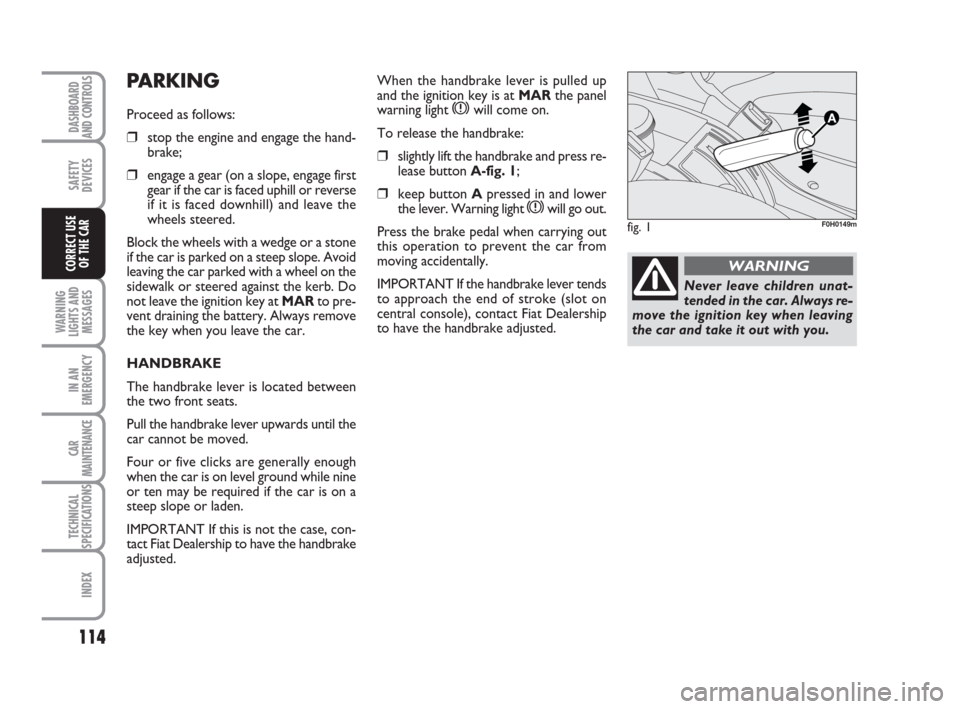
HANDBRAKE
The handbrake lever is located between
the two front seats.
Pull the handbrake lever upwards until the
car cannot be moved.
Four or five clicks are generally enough
when the car is on level ground while nine
or ten may be required if the car is on a
steep slope or laden.
IMPORTANT If this is not the case, con-
tact Fiat Dealership to have the handbrake
adjusted.When the handbrake lever is pulled up
and the ignition key is at MARthe panel
warning light
xwill come on.
To release the handbrake:
❒slightly lift the handbrake and press re-
lease button A-fig. 1;
❒keep button Apressed in and lower
the lever. Warning light xwill go out.
Press the brake pedal when carrying out
this operation to prevent the car from
moving accidentally.
IMPORTANT If the handbrake lever tends
to approach the end of stroke (slot on
central console), contact Fiat Dealership
to have the handbrake adjusted.
fig. 1F0H0149m
Never leave children unat-
tended in the car. Always re-
move the ignition key when leaving
the car and take it out with you.
WARNING
111-122 idea GB 1 ed 10-07-2008 8:29 Pagina 114
Page 118 of 210
117
WARNING
LIGHTS AND
MESSAGES
IN AN
EMERGENCY
CAR
MAINTENANCE
TECHNICAL
SPECIFICATIONS
INDEX
DASHBOARD
AND CONTROLS
SAFETY
DEVICES
CORRECT USE
OF THE CAR
Top speed
Fuel consumption considerably increases
with speed. Keep speed as constant as
possible, avoid superfluous braking and ac-
celerating, which cost in terms of both fu-
el and emissions.
Acceleration
Accelerating violently increasing the revs
will greatly affect consumption and emis-
sions: acceleration should be gradual and
should not exceed the maximum torque.CONDITIONS OF USE
Cold starting
Short journeys and frequent cold starts do
not allow the engine to reach optimum
operating temperature. This results in a
significant increase in consumption levels
(from +15 to +30% on the urban cycle)
and emission of harmful substances.
Traffic situations
and road conditions
Rather high consumption levels are tied to
situations with heavy traffic, for example
in queues with frequent use of the lower
gears or in cities with many traffic lights.
Also winding mountain roads and rough
road surfaces adversely affect consump-
tion.
Traffic hold-ups
During prolonged hold-ups (e.g.: level
crossings) the engine should be switched
off.TOWING TRAILERS
IMPORTANT NOTES
For towing caravans or trailers the car
must be fitted with a certified tow hook
and an adequate electric system. Installa-
tion should be carried out by specialised
personnel who release a special document
for circulation on the road.
Install any specific and/or additional rear-
view mirrors as specified by law.
Remember that when towing a trailer,
steep hills are harder to climb, the brak-
ing spaces increase and overtaking takes
longer depending on the overall weight.
Engage a low gear when driving downhill,
rather than constantly using the brake.
The weight the trailer exerts on the car
tow hook reduces by the same amount
the actual vehicle loading capacity. To
make sure the maximum towable weight
is not exceeded (given in the log book) ac-
count should be taken of the fully laden
trailer, including accessories and person-
al belongings.
111-122 idea GB 1 ed 10-07-2008 8:29 Pagina 117
Page 119 of 210
118
WARNING
LIGHTS AND
MESSAGES
IN AN
EMERGENCY
CAR
MAINTENANCE
TECHNICAL
SPECIFICATIONS
INDEX
DASHBOARD
AND CONTROLS
SAFETY
DEVICES
CORRECT USE
OF THE CAR
Do not exceed the speed limits of the
country you are driving in. In any case do
not exceed 100 km/h.
The ABS system with which
the car may be fitted does
not control the trailer braking system.
Great care should therefore be taken
when driving on slippery road sur-
faces.
Under no circumstances
should the vehicle brake sys-
tem be altered to control the trailer
brake. The trailer braking system
must be fully independent of the ve-
hicle’s hydraulic system.
WARNING
WARNING
INSTALLING THE TOW HOOK
The towing device should be fastened to
the body by specialised personnel ac-
cording to any additional and/or integra-
tive information supplied by the Manufac-
turer of the device.
The towing device must meet current reg-
ulations with reference to 94/20/EC Di-
rective and subsequent amendments.
For any version the towing device used
must match the towable weight of the ve-
hicle on which it is to be installed.
For the electric connection a unified con-
nector should be used which is generally
placed on a special bracket normally fas-
tened to the towing device, and a special
ECU for external trailer light control shall
be installed on the car. For the electrical connection 7 or 13 pins
12VDC connection is to be used (CU-
NA/UNI and ISO/DIN Standards). Follow
the instructions provided by the car man-
ufacturer and/or the tow hitch manufac-
turer.
An electric brake should be supplied di-
rectly by the battery through a cable with
a cross section of no less than 2.5 mm
2.
IMPORTANT Electric brake or other de-
vice shall be used with running engine.
In addition to the electrical branches, the
car’s electric system can only be con-
nected to the supply cable for an electric
brake and to the cable for an internal light,
though not above 15W.
For connections use a preset control unit
with battery cable no less than 2.5 mm
2.
111-122 idea GB 1 ed 10-07-2008 8:29 Pagina 118
Page 123 of 210
122
WARNING
LIGHTS AND
MESSAGES
IN AN
EMERGENCY
CAR
MAINTENANCE
TECHNICAL
SPECIFICATIONS
INDEX
DASHBOARD
AND CONTROLS
SAFETY
DEVICES
CORRECT USE
OF THE CAR
CAR INACTIVITY
If the car is to be left inactive for longer
than a month, the following precautions
should be noted:
❒park the car in covered, dry and if pos-
sible well-ventilated premises;
❒engage a gear;
❒check that the handbrake is not en-
gaged;
❒disconnect battery terminals (first dis-
connect the negative terminal) and
check the battery charge. This check
is to be repeated every three months
when the car is left inactive. Recharge
if the optical indicator shows a dark
colour without the central green area;
❒clean and protect the painted parts us-
ing protective wax;
❒clean and protect the shiny metal
parts using special compounds readi-
ly available;
❒sprinkle talcum powder on the rub-
ber windscreen and rear window
wiper blades and lift them off the
glass;
❒slightly open the windows;
❒cover the car with a cloth or perfo-
rated plastic sheet. Do not use sheets
of non-perforated plastic as they do
not allow moisture on the car body to
evaporate;
❒inflate tyres to +0.5 bar above the
normal specified pressure and check it
at intervals;
❒if you don’t disconnect the battery
from the electric system, check its
charge every month and recharge it if
the optical indicator shows a dark
colour without the central green area;
❒do not drain the engine cooling sys-
tem.
111-122 idea GB 1 ed 10-07-2008 8:29 Pagina 122