steering wheel FIAT IDEA 2012 1.G User Guide
[x] Cancel search | Manufacturer: FIAT, Model Year: 2012, Model line: IDEA, Model: FIAT IDEA 2012 1.GPages: 210, PDF Size: 3.65 MB
Page 110 of 210
109
CORRECT USE
OF THE CAR
WARNING
LIGHTS AND
MESSAGES
IN AN
EMERGENCY
CAR
MAINTENANCE
TECHNICAL
SPECIFICATIONS
INDEX
DASHBOARD
AND CONTROLS
SAFETY
DEVICES
IMPORTANT The front air bags and/or
side bags may be deployed if the car is sub-
ject to heavy knocks or accidents involv-
ing the underbody area, such as for ex-
ample violent shocks against steps, kerbs
or low obstacles, falling of the car in big
holes or sags in the road.
IMPORTANT When the air bag inflates
it emits a small amount of dusts. These
dusts are harmless and is not the begin-
ning of a fire; then the unfold cushion sur-
face and the car interiors can be covered
by a dusty remains: this dust can irritate
skin and eyes. In case of contact, wash
yourself using neutral soap and water.
The air bag system has a validity of 14
years as to the pyrotechnic charge, and 10
years as to the twisted contact. As this
date approaches, contact Fiat Dealership
to have it replaced.
IMPORTANT Should an accident occur in
which any of the safety devices is activat-
ed, take the car to a Fiat Dealership to
have the devices activated replaced and to
have the system checked.
All check, repair and replacement opera-
tions concerning the air bags must only be
carried out c/o Fiat Dealership.If you are having the car scrapped, have
the air bag system deactivated at a Fiat
Dealership first. If the car changes own-
ership, the new owner must be informed
of the method of use of air bags and the
above warnings and also be given this
“Owner handbook”.
IMPORTANT The triggering of preten-
sioners, front air bags and front side bags
is decided in a differentiated manner. The
failure to deploy one or more of them
does not mean that the system is not
working properly.
Never rest head, arms and
elbows on the door, on the
windows and in the window bag area
to prevent possible injuries during the
inflation phase.
WARNING
Never put head, arms and el-
bows out of the window.
WARNING
If warning light ¬does not
come on when turning the
key to MAR or if it stays on when
travelling it could indicate a failure in
restraint systems; in this case air bags
or pretensioners could not trigger in
the event of an accident, or in a re-
stricted numbers of cases they could
trigger accidentally. Stop the car and
contact Fiat Dealership to have the
system checked immediately.
WARNING
GENERAL WARNINGS
Do not cover the back rest of
front seats with trims or cov-
ers there are not set for the use of side
bags.
WARNING
Always keep your hands on
the steering wheel rim when
driving, so that if the air bag is trig-
gered, it can inflate without meeting
any obstacles which could cause seri-
ous harm to you. Do not drive with
the body bent forwards, keep the seat
back rest in the erect position and
lean your back well against it.
WARNING
093-110 idea GB 1 ed 10-07-2008 8:28 Pagina 109
Page 114 of 210
113
WARNING
LIGHTS AND
MESSAGES
IN AN
EMERGENCY
CAR
MAINTENANCE
TECHNICAL
SPECIFICATIONS
INDEX
DASHBOARD
AND CONTROLS
SAFETY
DEVICES
CORRECT USE
OF THE CAR
❒Turn the ignition key to AVVas soon
as warning light m goes out. If you wait
too long you will lose the benefit of
the work done by the glow plugs. Re-
lease the key as soon as the engine
starts.
IMPORTANT With cold engine, the ac-
celerator pedal shall be completely re-
leased while turning the ignition key to
AVV.
If the engine does not start at the first at-
tempt, return the ignition key to STOP
before repeating starting.
If, when the ignition key is on MAR, warn-
ing light
Yremains lit, turn the key to
STOPand then back to MAR; if the
warning light remains on, try with the oth-
er keys provided with the car.
If you still cannot start the engine, contact
Fiat Dealership.
IMPORTANT Never leave the ignition key
at MARwhen the engine is off.The warning light
mwill
flash for 60 seconds at start-
up or during prolonged crank-
ing to signal a fault in the
glow plug heating system. You can use
the car as usual if the engine starts but
you should contact a Fiat Dealership
as soon as possible.
HOW TO WARM UP
THE ENGINE AFTER
IT HAS JUST STARTED
(petrol and Multijet versions)
Proceed as follows:
❒Drive off slowly, letting the engine turn
at medium revs. Do not accelerate
abruptly;
❒Do not drive at full performance for
the initial kilometres. Wait until the
coolant temperature gauge starts
moving.
STOPPING THE ENGINE
Turn the ignition to STOPwhile the en-
gine is idling.
IMPORTANT After a taxing drive, you
should allow the engine to “catch its
breath” before turning it off by letting it
idle to allow the temperature in the en-
gine compartment to fall.Never bump start the engine
by pushing, towing or coast-
ing downhill. This could cause
fuel to flow into the catalyt-
ic exhaust system and damage it be-
yond repair.
A quick burst on the acceler-
ator before turning off the en-
gine serves absolutely no
practical purpose, it wastes
fuel and is damaging especially to tur-
bocharged engines.
Remember that the servo-
brake and power steering
are not operational until the engine
has been started, therefore much ef-
fort than usual is required on the
brake pedal and steering wheel.
WARNING
111-122 idea GB 1 ed 10-07-2008 8:29 Pagina 113
Page 127 of 210
126
IN AN
EMERGENCY
CAR
MAINTENANCE
TECHNICAL
SPECIFICATIONS
INDEX
DASHBOARD
AND CONTROLS
SAFETY
DEVICES
CORRECT USE
OF THE CAR
WARNING
LIGHTS AND
MESSAGES
LOW ENGINE OIL
PRESSURE (red)
EXHAUSTED OIL (red)
(Multijet versions
with DPF)
Low engine oil pressure
When the ignition key is moved to MAR,
the warning light turns on and should go
out as soon as the engine is started.
The display will show the dedicated mes-
sage.
v
Exhausted oil
The warning light turns on and flashes
along with the message on the display
when the system detects that the engine
oil is exhausted.
After the first indication, at each engine
start-up, the warning light
vcontin-
ues to flash for about 60 seconds and then
every 2 hours until the oil is changed.“DUALDRIVE”
ELECTRIC POWER
STEERING FAILURE
(red)
When the ignition key is moved to MAR,
the warning light turns on and should go
off after a few seconds.
If the warning light stays on, the electric
steering system provides no assistance and
the effort on the steering wheel is in-
creased, although steering is still possible.
In this case, go to a Fiat Dealership.
The display will show the dedicated mes-
sage.
g
INCOMPLETE DOOR
LOCKING (red)
On certain versions the warn-
ing light turns on when one or
more doors or the tailgate are not prop-
erly closed.
The display will show the dedicated mes-
sage.
A buzzer is triggered when doors/tailgate
are open and the car is moving.
´
SEAT BELTS NOT
FASTENED (red)
(where provided)
The warning light on the display
lights up when the car is moving and the
driver’s seat belt is not correctly fastened.
The warning light flashes, and a buzzer is
triggered, if the driver’s seat belt is not
correctly fastened. The buzzer of the
S.B.R. (Seat Belt Reminder) system can be
disabled by the Fiat Dealership only. The
system can be enabled from the “setup”
menu.
with the message on the display) stop
the engine immediately and contact
Fiat Dealership.
WARNING
If the warning light vflashes, promptly contact
Fiat Dealership in order to have the
oil changed and the warning light on
the instrument panel turned off.
WARNING
123-132 idea GB 1 ed 10-07-2008 8:29 Pagina 126
Page 136 of 210
135
CAR
MAINTENANCE
TECHNICAL
SPECIFICATIONS
INDEX
DASHBOARD
AND CONTROLS
SAFETY
DEVICES
CORRECT USE
OF THE CAR
WARNING
LIGHTS AND
MESSAGES
IN AN
EMERGENCY
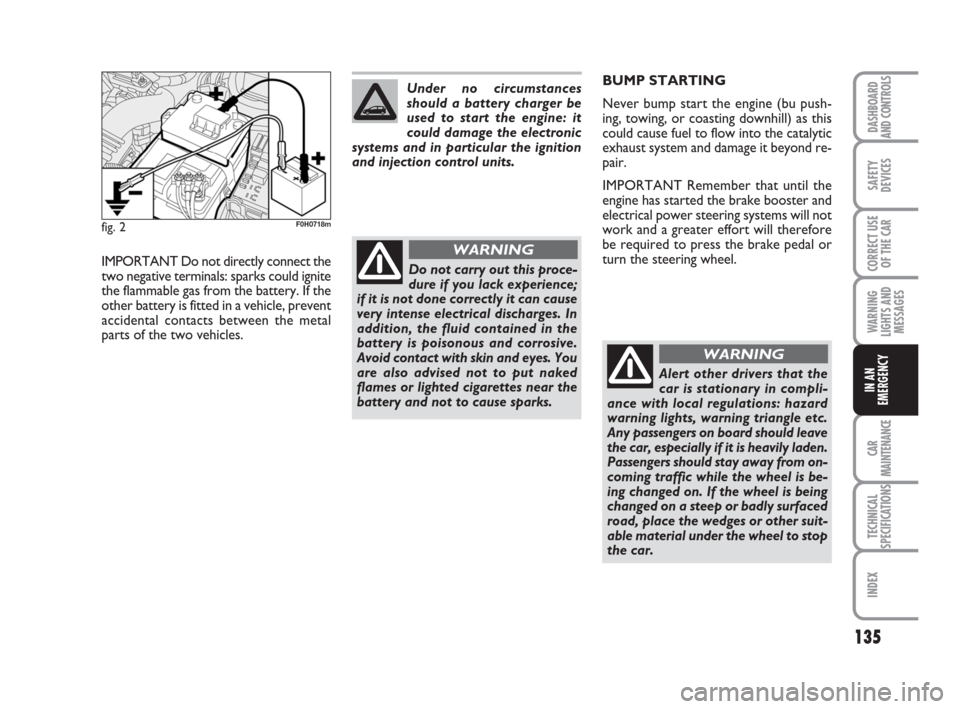
fig. 2F0H0718m
IMPORTANT Do not directly connect the
two negative terminals: sparks could ignite
the flammable gas from the battery. If the
other battery is fitted in a vehicle, prevent
accidental contacts between the metal
parts of the two vehicles.Do not carry out this proce-
dure if you lack experience;
if it is not done correctly it can cause
very intense electrical discharges. In
addition, the fluid contained in the
battery is poisonous and corrosive.
Avoid contact with skin and eyes. You
are also advised not to put naked
flames or lighted cigarettes near the
battery and not to cause sparks.
WARNING
Under no circumstances
should a battery charger be
used to start the engine: it
could damage the electronic
systems and in particular the ignition
and injection control units.BUMP STARTING
Never bump start the engine (bu push-
ing, towing, or coasting downhill) as this
could cause fuel to flow into the catalytic
exhaust system and damage it beyond re-
pair.
IMPORTANT Remember that until the
engine has started the brake booster and
electrical power steering systems will not
work and a greater effort will therefore
be required to press the brake pedal or
turn the steering wheel.
Alert other drivers that the
car is stationary in compli-
ance with local regulations: hazard
warning lights, warning triangle etc.
Any passengers on board should leave
the car, especially if it is heavily laden.
Passengers should stay away from on-
coming traffic while the wheel is be-
ing changed on. If the wheel is being
changed on a steep or badly surfaced
road, place the wedges or other suit-
able material under the wheel to stop
the car.
WARNING
133-160 idea GB 1 ed 10-07-2008 8:30 Pagina 135
Page 141 of 210
140
CAR
MAINTENANCE
TECHNICAL
SPECIFICATIONS
INDEX
DASHBOARD
AND CONTROLS
SAFETY
DEVICES
CORRECT USE
OF THE CAR
WARNING
LIGHTS AND
MESSAGES
IN AN
EMERGENCY
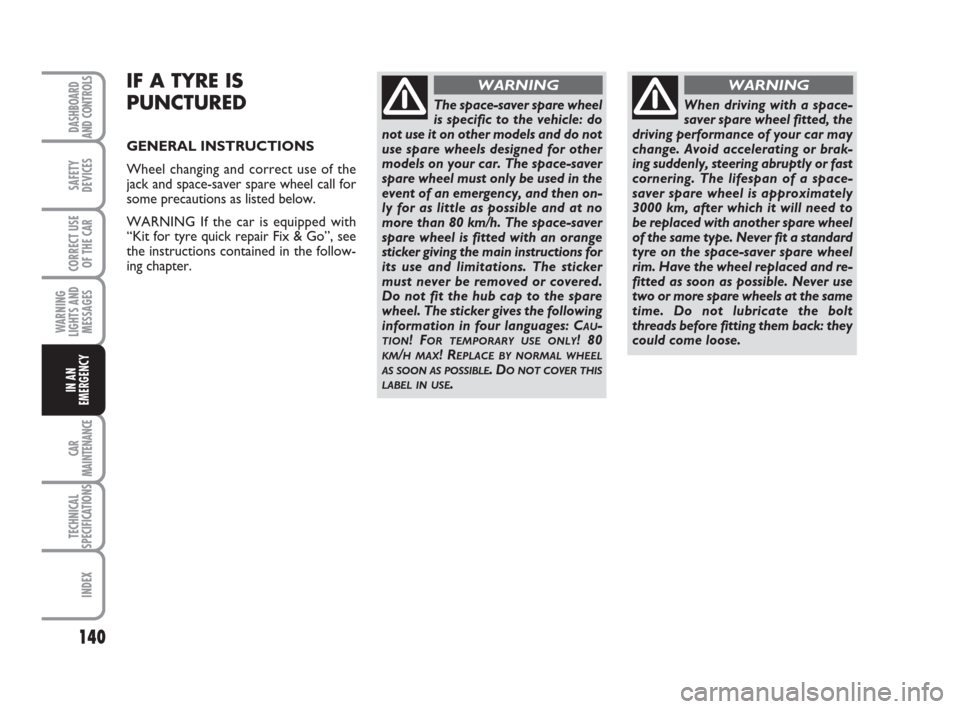
IF A TYRE IS
PUNCTURED
GENERAL INSTRUCTIONS
Wheel changing and correct use of the
jack and space-saver spare wheel call for
some precautions as listed below.
WARNING If the car is equipped with
“Kit for tyre quick repair Fix & Go”, see
the instructions contained in the follow-
ing chapter.
The space-saver spare wheel
is specific to the vehicle: do
not use it on other models and do not
use spare wheels designed for other
models on your car. The space-saver
spare wheel must only be used in the
event of an emergency, and then on-
ly for as little as possible and at no
more than 80 km/h. The space-saver
spare wheel is fitted with an orange
sticker giving the main instructions for
its use and limitations. The sticker
must never be removed or covered.
Do not fit the hub cap to the spare
wheel. The sticker gives the following
information in four languages: C
AU-TION! FOR TEMPORARY USE ONLY! 80KM/H MAX! REPLACE BY NORMAL WHEEL
AS SOON AS POSSIBLE. DO NOT COVER THIS
LABEL IN USE.
WARNING
When driving with a space-
saver spare wheel fitted, the
driving performance of your car may
change. Avoid accelerating or brak-
ing suddenly, steering abruptly or fast
cornering. The lifespan of a space-
saver spare wheel is approximately
3000 km, after which it will need to
be replaced with another spare wheel
of the same type. Never fit a standard
tyre on the space-saver spare wheel
rim. Have the wheel replaced and re-
fitted as soon as possible. Never use
two or more spare wheels at the same
time. Do not lubricate the bolt
threads before fitting them back: they
could come loose.
WARNING
133-160 idea GB 1 ed 10-07-2008 8:30 Pagina 140
Page 161 of 210
160
CAR
MAINTENANCE
TECHNICAL
SPECIFICATIONS
INDEX
DASHBOARD
AND CONTROLS
SAFETY
DEVICES
CORRECT USE
OF THE CAR
WARNING
LIGHTS AND
MESSAGES
IN AN
EMERGENCY
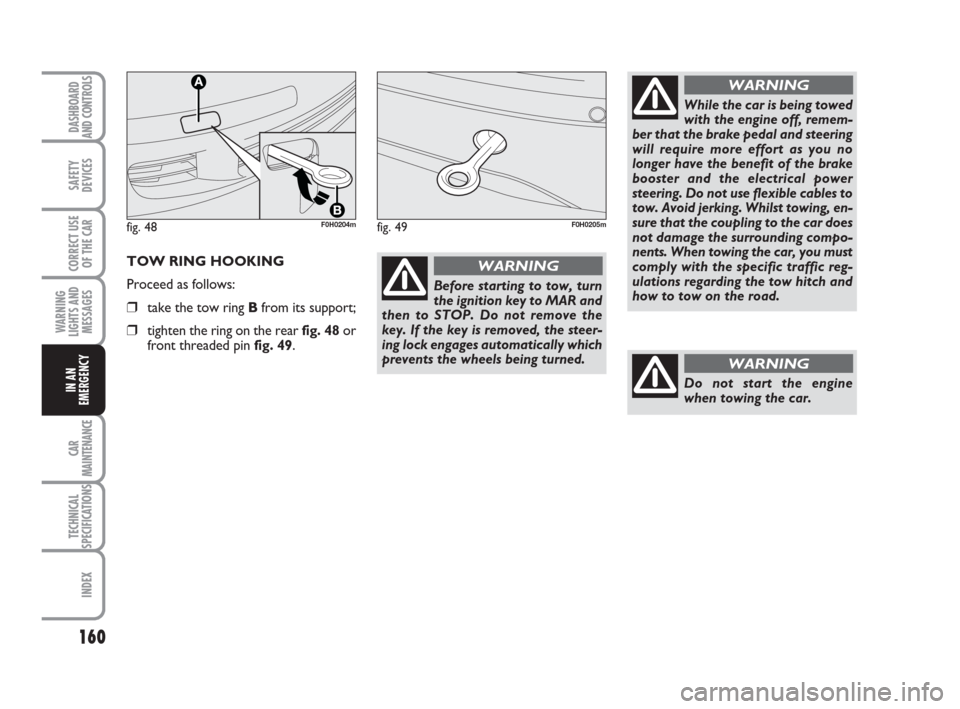
TOW RING HOOKING
Proceed as follows:
❒take the tow ring Bfrom its support;
❒tighten the ring on the rear fig. 48 or
front threaded pin fig. 49.
fig. 48F0H0204mfig. 49F0H0205m
Before starting to tow, turn
the ignition key to MAR and
then to STOP. Do not remove the
key. If the key is removed, the steer-
ing lock engages automatically which
prevents the wheels being turned.
WARNING
While the car is being towed
with the engine off, remem-
ber that the brake pedal and steering
will require more effort as you no
longer have the benefit of the brake
booster and the electrical power
steering. Do not use flexible cables to
tow. Avoid jerking. Whilst towing, en-
sure that the coupling to the car does
not damage the surrounding compo-
nents. When towing the car, you must
comply with the specific traffic reg-
ulations regarding the tow hitch and
how to tow on the road.
WARNING
Do not start the engine
when towing the car.
WARNING
133-160 idea GB 1 ed 10-07-2008 8:30 Pagina 160
Page 181 of 210
180
TECHNICAL
SPECIFICATIONS
INDEX
DASHBOARD
AND CONTROLS
SAFETY
DEVICES
CORRECT USE
OF THE CAR
WARNING
LIGHTS AND
MESSAGES
IN AN
EMERGENCY
CAR
MAINTENANCE
INTERIORS
Periodically check that water is not
trapped under the mats (due to water
dripping off shoes, umbrellas, etc.) which
could cause oxidisation of the sheet met-
al.
CLEANING SEATS AND FABRIC
AND VELVET PARTS
Use a soft brush or vacuum cleaner to re-
move dust. Velvet is cleaned better if the
brush is moistened.
Rub the seats with a sponge moistened
with a solution of water and neutral de-
tergent.
CLEANING LEATHER SEATS
Remove dried on dirt with lightly moist-
ened chamois leather or cloth without
pressing too hard.
Remove liquid or grease stains with a dry
absorbent cloth without rubbing. Then
wipe with a soft cloth or chamois leather
with water and neutral soap.
If the stain persists, use specific products,
carefully following the instructions for use.
IMPORTANT Never use spirit or alcohol-
based products.INTERIOR PLASTIC PARTS
For routine cleaning, wipe with a cloth
with water and neutral non-abrasive de-
tergent. Remove grease or persistent
stains with appropriate products designed
to preserve the appearance of compo-
nents.
IMPORTANT Never use spirit or petro-
leum to clean the instrument panel or oth-
er plastic parts.
Do not keep aerosol cans in
the car: they might explode.
Aerosol cans must never be exposed
to a temperature above 50°C. The
temperature inside the car exposed
to the sun may go well beyond that
figure.
WARNING
Upholstery of your car has
been designed to withstand
wear deriving from common
use of the car. You are how-
ever recommended to avoid strong
and/or continuous scratching with
clothing accessories such as metallic
buckles, studs, Velcro fastenings and
the like, since these items cause cir-
cumscribed stress of the cover fabric
that could lead to yarn breaking, and
damage the cover as a consequence.
STEERING WHEEL / GEARBOX
LEVER KNOB AND SEATS
COATED WITH REAL LEATHER
These components shall only be cleaned
with water and neutral soap. Never use
spirit or alcohol-based products.
Before using special products for clean-
ing interiors, read carefully label instruc-
tions and indications to make sure they
are free from spirit and/or alcohol-based
substances.
If when cleaning the windscreen with spe-
cial glass products, some drops fall on the
leather covering of the steering wheel/gear
lever knob remove them immediately and
then clean with water and neutral soap.
IMPORTANT Take the utmost care when
engaging the steering lock to prevent
scratching the leather covering.
161-180 idea GB 1 ed 10-07-2008 8:30 Pagina 180
Page 182 of 210
181
INDEX
DASHBOARD
AND CONTROLS
SAFETY
DEVICES
CORRECT USE
OF THE CAR
WARNING
LIGHTS AND
MESSAGES
IN AN
EMERGENCY
CAR
MAINTENANCE
TECHNICAL
SPECIFICATIONS
IDENTIFICATION DATA ................................................. 182
ENGINE CODES - BODYWORK VERSIONS .............. 184
ENGINE ................................................................................. 185
FUEL FEED/IGNITION ....................................................... 187
TRANSMISSION .................................................................. 187
BRAKES ................................................................................... 188
SUSPENSIONS ....................................................................... 188
STEERING............................................................................... 188
WHEELS .................................................................................. 189
DIMENSIONS ........................................................................ 193
PERFORMANCE ................................................................... 193
WEIGHTS ............................................................................... 194
CAPACITIES........................................................................... 195
FLUIDS AND LUBRICANTS ............................................. 196
FUEL CONSUMPTION ....................................................... 198
CO
2EMISSIONS ................................................................. 199
TT T
E E
C C
H H
N N
I I
C C
A A
L L
S S
P P
E E
C C
I I
F F
I I
C C
A A
T T
I I
O O
N N
S S
181-199 idea GB 1 ed 10-07-2008 8:31 Pagina 181
Page 189 of 210
188
INDEX
DASHBOARD
AND CONTROLS
SAFETY
DEVICES
CORRECT USE
OF THE CAR
WARNING
LIGHTS AND
MESSAGES
IN AN
EMERGENCY
CAR
MAINTENANCE
TECHNICAL
SPECIFICATIONS
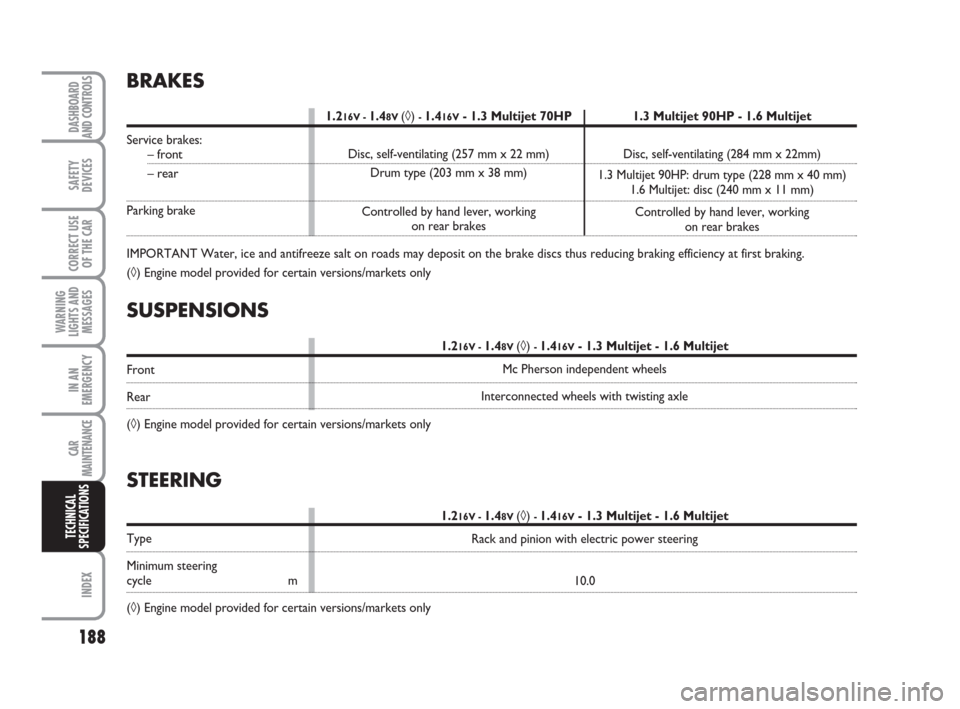
SUSPENSIONS
Front
Rear
(◊) Engine model provided for certain versions/markets only1.2
16V - 1.48V (◊) - 1.416V- 1.3 Multijet - 1.6 Multijet
Mc Pherson independent wheels
Interconnected wheels with twisting axle
STEERING
Type
Minimum steering
cycle m
(◊) Engine model provided for certain versions/markets only1.2
16V - 1.48V (◊) - 1.416V- 1.3 Multijet - 1.6 Multijet
Rack and pinion with electric power steering
10.0
BRAKES
Service brakes:– front
– rear
Parking brake
IMPORTANT Water, ice and antifreeze salt on roads may deposit on the brake discs thus reducing braking efficiency at first braking.
(◊) Engine model provided for certain versions/markets only1.2
16V - 1.48V (◊) - 1.416V- 1.3 Multijet 70HP
Disc, self-ventilating (257 mm x 22 mm)
Drum type (203 mm x 38 mm)
Controlled by hand lever, working
on rear brakes1.3 Multijet 90HP - 1.6 Multijet
Disc, self-ventilating (284 mm x 22mm)
1.3 Multijet 90HP: drum type (228 mm x 40 mm)
1.6 Multijet: disc (240 mm x 11 mm)
Controlled by hand lever, working
on rear brakes
181-199 idea GB 1 ed 10-07-2008 8:31 Pagina 188
Page 198 of 210
197
INDEX
DASHBOARD
AND CONTROLS
SAFETY
DEVICES
CORRECT USE
OF THE CAR
WARNING
LIGHTS AND
MESSAGES
IN AN
EMERGENCY
CAR
MAINTENANCE
TECHNICAL
SPECIFICATIONS
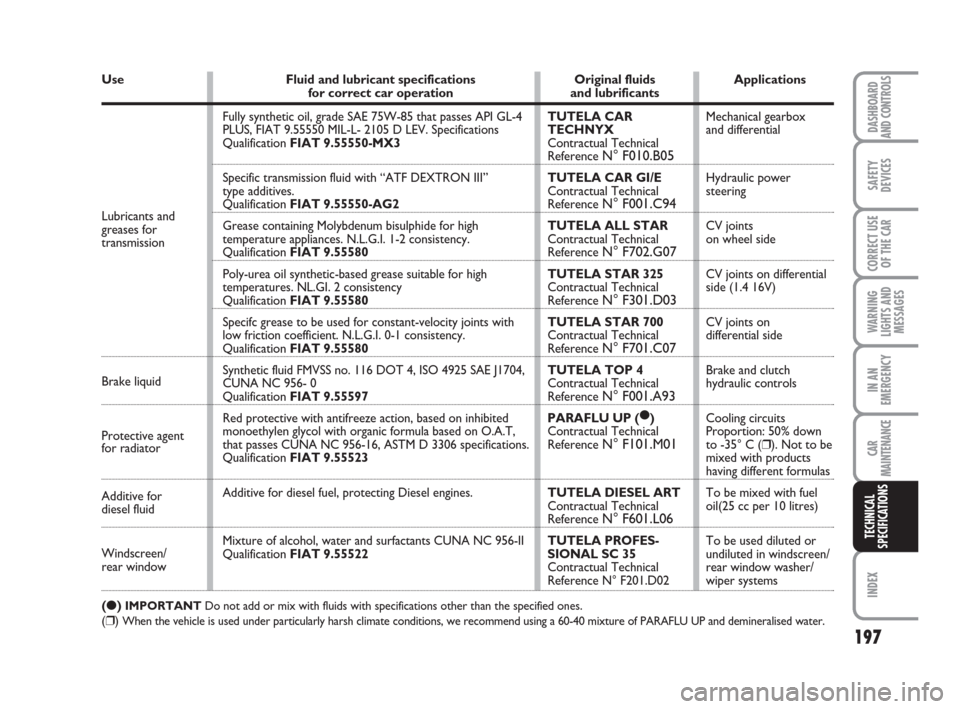
Windscreen/
rear window Protective agent
for radiator Brake liquid Lubricants and
greases for
transmission
Use
(●) IMPORTANT Do not add or mix with fluids with specifications other than the specified ones.
(❒) When the vehicle is used under particularly harsh climate conditions, we recommend using a 60-40 mixture of PARAFLU UP and demineralised water.
Fluid and lubricant specifications
for correct car operation
Fully synthetic oil, grade SAE 75W-85 that passes API GL-4
PLUS, FIAT 9.55550 MIL-L- 2105 D LEV. Specifications
Qualification FIAT 9.55550-MX3
Specific transmission fluid with “ATF DEXTRON III”
type additives.
Qualification FIAT 9.55550-AG2
Grease containing Molybdenum bisulphide for high
temperature appliances. N.L.G.I. 1-2 consistency.
Qualification FIAT 9.55580
Poly-urea oil synthetic-based grease suitable for high
temperatures. NL.GI. 2 consistency
Qualification FIAT 9.55580
Specifc grease to be used for constant-velocity joints with
low friction coefficient. N.L.G.I. 0-1 consistency.
Qualification FIAT 9.55580
Synthetic fluid FMVSS no. 116 DOT 4, ISO 4925 SAE J1704,
CUNA NC 956- 0
Qualification FIAT 9.55597
Red protective with antifreeze action, based on inhibited
monoethylen glycol with organic formula based on O.A.T,
that passes CUNA NC 956-16, ASTM D 3306 specifications.
Qualification FIAT 9.55523
Additive for diesel fuel, protecting Diesel engines.
Mixture of alcohol, water and surfactants CUNA NC 956-II
Qualification FIAT 9.55522Original fluids
and lubrificants
TUTELA CAR
TECHNYX
Contractual Technical
Reference
N° F010.B05
TUTELA CAR GI/E
Contractual Technical
Reference
N° F001.C94
TUTELA ALL STAR
Contractual Technical
Reference
N° F702.G07
TUTELA STAR 325
Contractual Technical
Reference
N° F301.D03
TUTELA STAR 700
Contractual Technical
Reference
N° F701.C07
TUTELA TOP 4
Contractual Technical
Reference
N° F001.A93
PARAFLU UP (●)
Contractual Technical
Reference
N° F101.M01
TUTELA DIESEL ART
Contractual Technical
Reference
N° F601.L06
TUTELA PROFES-
SIONAL SC 35
Contractual Technical
Reference N° F201.D02 Additive for
diesel fluidApplications
Mechanical gearbox
and differential
Hydraulic power
steering
CV joints
on wheel side
CV joints on differential
side (1.4 16V)
CV joints on
differential side
Brake and clutch
hydraulic controls
Cooling circuits
Proportion: 50% down
to -35° C (❒). Not to be
mixed with products
having different formulas
To be mixed with fuel
oil(25 cc per 10 litres)
To be used diluted or
undiluted in windscreen/
rear window washer/
wiper systems
181-199 idea GB 1 ed 10-07-2008 8:31 Pagina 197