wheel FIAT LINEA 2007 1.G User Guide
[x] Cancel search | Manufacturer: FIAT, Model Year: 2007, Model line: LINEA, Model: FIAT LINEA 2007 1.GPages: 230, PDF Size: 3.31 MB
Page 94 of 230
93
SAFETY
DEVICES
CORRECT USE
OF THE
CAR
WARNING
LIGHTS AND
MESSAGES
IN AN
EMERGENCY
CAR
MAINTENANCE
TECHNICAL
SPECIFICATIONS
INDEX
DASHBOARD
AND CONTROLS
BRAKE ASSIST
(integrated ESP emergency
braking assistance)
(where provided)
This system (which cannot be deactivat-
ed) recognises emergency braking condi-
tions according to the speed of operation
of the brake pedal and provides an addi-
tional hydraulic braking pressure to sup-
port that provided by the driver. This al-
lows faster and more power operation of
the braking system.
Brake Assist is deactivated on the versions
equipped with ESP, in the event of ESP sys-
tem failure (indicated by warning light
áswitching on together with the message
on the multifunctional display, where pro-
vided).
ESP SYSTEM
(Electronic Stability
Program)
(where provided)
The ESP system is an electronic system
controlling the car stability in the event of
tyre grip loss.
The ESP system is therefore particularly
useful when grip conditions of the road sur-
faces changes.
In addition to the ESP system, ASR system
and Hill Holder, (where provided) also the
MSR system (adjusting the engine braking
torque) and the HBA system (improving
the braking force during emergency brak-
ing) are provided.
ABS SYSTEM INTERVENTION
It is signalled by the blinking of the warn-
ing light
áon the instrument panel, to
inform the driver that the car is in criti-
cal stability and grip conditions.When the ABS cuts in, and
you feel the brake pedal pul-
sating, do not remove your foot, but
keep it pressed; in doing so you will
stop in the shortest amount of space
possible under the current road con-
ditions.
WARNING
EBD failure
ABS failure is indicated by the turning on
warning lights
>and xon the instru-
ment panel together with the dedicated
message on the multifunctional display
(where provided), (see section “Warning
lights and messages”).
In this case, the rear wheels may sudden-
ly lock and the car may swerve. Drive
carefully to the nearest Fiat Dealership to
have the system checked.
If warning light xonly lights
up on the instrument panel
(with a message on the multifunc-
tional display, where provided), stop
the car immediate and go to the
nearest Fiat Dealership. Leakage of
hydraulic fluid from the braking sys-
tem will compromise functionality of
the braking system, either of the con-
ventional type or with ABS.
WARNING
Page 95 of 230
94
SAFETY
DEVICES
CORRECT USE
OF THE
CAR
WARNING
LIGHTS AND
MESSAGES
IN AN
EMERGENCY
CAR
MAINTENANCE
TECHNICAL
SPECIFICATIONS
INDEX
DASHBOARD
AND CONTROLS
ESP SYSTEM ACTIVATION
The ESP system is automatically activat-
ed when the car is started and cannot be
de-activated.
FAILURE INDICATIONS
In the event of a failure, the In ESP will be
automatically switched off and warning
light
áwill appear on the instrument pan-
el along with a message on the multifunc-
tional display (where provided) (see
“Warning lights and messages”). The LED
on the ASR OFF button will light up. Con-
tact Fiat Dealership as soon as possible.
Do not take unnecessary
risks, even if your cars fits an
ESP system. Your driving style must
always be suited to the conditions of
the road, visibility and traffic. The dri-
ver is always and only responsible for
road safety.
WARNING
HILL HOLDER SYSTEM
This system is an integral part of the ESP
system and it is provided to facilitate start-
ing on slopes.
It will activate automatically with the fol-
lowing conditions:
❒uphill: car at a standstill on a road with
a gradient higher than 5%, engine run-
ning, clutch and brake pedal pressed,
gearbox to neutral or engaged gear oth-
er than reverse.
❒downhill: car at a standstill on a road
with a gradient higher than 5%, engine
running, clutch and brake pedal pressed
and reverse gear engaged.
At pickup the ESP system control unit will
keep brake force on wheels until reaching
the torque suitable for starting, or in any
case for max. 2 seconds in order to pass
easily from the brake pedal to the accel-
erator pedal.
After 2 seconds without starting, the sys-
tem will deactivate automatically by re-
leasing gradually the brake force.
At releasing, the typical brake disengage-
ment noise indicating that the car is go-
ing to move will be heard.Failure indications
Warning light
èon the instrument pan-
el will light up in the event of a failure (see
“Warning lights and messages”).
IMPORTANT The Hill Holder system is
not a parking brake therefore, never leave
the car without having engaged the hand-
brake, turned the engine off and engaged
the first speed.
For correct operation of the
ESP and ASR systems, the
tyres must absolutely be of the same
brand and type on all wheels, in per-
fect conditions and, above all, of
type, brand and size specified.
WARNING
Page 96 of 230
95
SAFETY
DEVICES
CORRECT USE
OF THE
CAR
WARNING
LIGHTS AND
MESSAGES
IN AN
EMERGENCY
CAR
MAINTENANCE
TECHNICAL
SPECIFICATIONS
INDEX
DASHBOARD
AND CONTROLS
MSR system
(engine braking torque control)
It is an integral part of the ASR system that
in case of sudden gear shifting, cuts in pro-
viding torque to the engine thus prevent-
ing excessive driving wheel drive that, spe-
cially in poor grip conditions, can lead to
loss of stability.
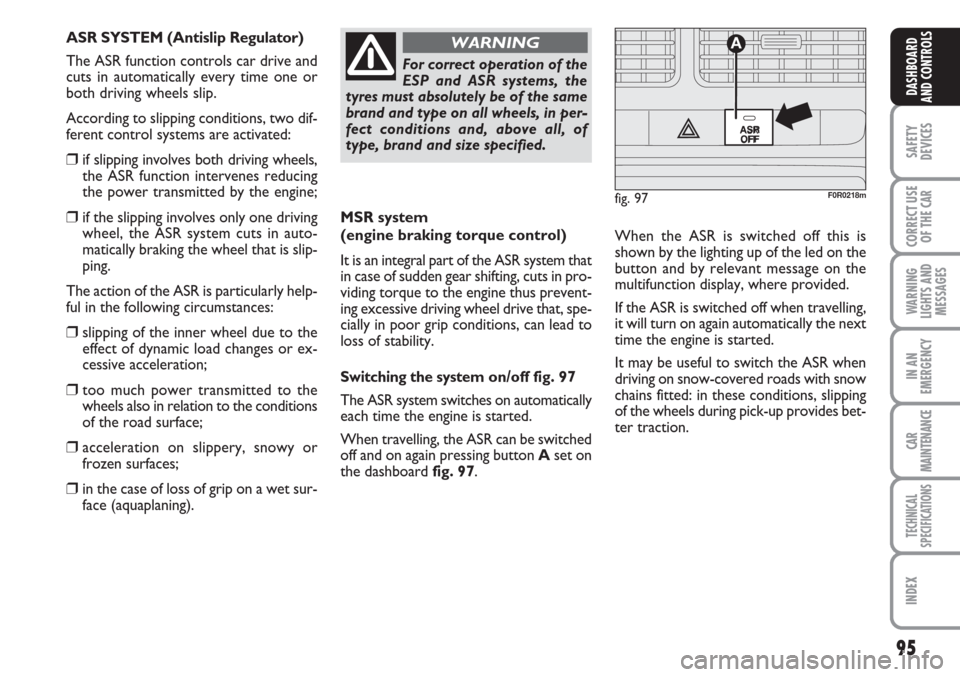
Switching the systemon/off fig. 97
The ASR system switches on automatically
each time the engine is started.
When travelling, the ASR can be switched
off and on again pressing button Aset on
the dashboard fig. 97. When the ASR is switched off this is
shown by the lighting up of the led on the
button and by relevant message on the
multifunction display, where provided.
If the ASR is switched off when travelling,
it will turn on again automatically the next
time the engine is started.
It may be useful to switch the ASR when
driving on snow-covered roads with snow
chains fitted: in these conditions, slipping
of the wheels during pick-up provides bet-
ter traction.
For correct operation of the
ESP and ASR systems, the
tyres must absolutely be of the same
brand and type on all wheels, in per-
fect conditions and, above all, of
type, brand and size specified.
WARNING
fig. 97
ASR
OFF
A
F0R0218m
ASR SYSTEM (Antislip Regulator)
The ASR function controls car drive and
cuts in automatically every time one or
both driving wheels slip.
According to slipping conditions, two dif-
ferent control systems are activated:
❒if slipping involves both driving wheels,
the ASR function intervenes reducing
the power transmitted by the engine;
❒if the slipping involves only one driving
wheel, the ASR system cuts in auto-
matically braking the wheel that is slip-
ping.
The action of the ASR is particularly help-
ful in the following circumstances:
❒slipping of the inner wheel due to the
effect of dynamic load changes or ex-
cessive acceleration;
❒too much power transmitted to the
wheels also in relation to the conditions
of the road surface;
❒acceleration on slippery, snowy or
frozen surfaces;
❒in the case of loss of grip on a wet sur-
face (aquaplaning).
Page 97 of 230
96
SAFETY
DEVICES
CORRECT USE
OF THE
CAR
WARNING
LIGHTS AND
MESSAGES
IN AN
EMERGENCY
CAR
MAINTENANCE
TECHNICAL
SPECIFICATIONS
INDEX
DASHBOARD
AND CONTROLS
Do not take unnecessary
risks, even if your cars fits
such a system. Your driving style must
always be suited to the conditions of
the road, visibility and traffic. The dri-
ver is always and only responsible for
road safety.
WARNING
For correct operation of the ASR system,
the tyres must absolutely be of the same
brand and type on all wheels, in perfect
conditions and, above all, of type, brand
and size specified.
FAILURE INDICATIONS
In the event of a failure, the In ASR will be
automatically switched off and warning
light
áwill appear on the instrument
panel along with a message on the multi-
functional display (where provided) (see
“Warning lights and messages”). In this
case, contact Fiat Dealership as soon as
possible.
EOBD SYSTEM
(where provided)
The EOBD system (European On Board
Diagnosis) allows continuous diagnosis of
the components of the car correlated with
emissions.
It also alerts the driver, by turning on the
warning light
Uon the instrument pan-
el (together with relevant message on the
multifunctional display, where provided)
(see section “Warning lights and mes-
sages”), when these conditions are no
longer in peak conditions.
The objective is:
❒to monitor system efficiency;
❒warn when a fault causes emissions lev-
els to increase;
❒to warn of the need to replace deteri-
orated components.
The system also has a diagnostic connec-
tor that can be interfaced with appropri-
ate tools, which makes it possible to read
the error codes stored in the control unit,
together with a series of specific parame-
ters for engine operation and diagnosis.
This check can also be carried out by the
traffic police.IMPORTANT After eliminating the in-
convenience, to check the system com-
pletely, Fiat Dealerships are obliged to run
a bench test and, if necessary, road tests
which may also call for a long journey.
Go to a Fiat Dealership as
soon as possible if warning
light Ueither does not light
up when the key is turned to
MAR to if while travelling the warning
lights comes on either steady or blink-
ing (along with a message on the mul-
tifunctional display, where provided).
The operation of warning light Umay
be checked by the traffic police using
specific devices. Follow the laws in
force in the country where you are dri-
ving.
Page 101 of 230
100
SAFETY
DEVICES
CORRECT USE
OF THE
CAR
WARNING
LIGHTS AND
MESSAGES
IN AN
EMERGENCY
CAR
MAINTENANCE
TECHNICAL
SPECIFICATIONS
INDEX
DASHBOARD
AND CONTROLS
TRANSCEIVERS
AND MOBILE PHONES
Radio transceiver equipment (e.g.: e-tacs
mobile phones, HAM radio systems and
the like) shall not be used inside the car
unless a separate aerial is mounted on the
roof.
IMPORTANT The use of similar devices
inside the passenger compartment (with-
out separated aerial) produces radio-fre-
quency electromagnetic fields which, am-
plified by the resonance effects inside the
passenger compartment, may cause elec-
trical systems equipping the car to mal-
function. This could compromise safety in
addition to constituting a potential hazard
for the passengers.
In addition, transmission and reception of
these devices may be affected by the
shielding effect of the car body.
As concerns EC-approved mobile phones
(GSM, GPRS, UMTS), strictly comply with
the instructions for use provided by the
mobile phone’s manufacturer.ACCESSORIES
PURCHASED BY THE
OWNER
If after buying the car, you decide to install
electrical accessories that require a per-
manent electric supply (alarm, satellite an-
titheft system, etc.) or accessories that in
any case burden the electric supply, con-
tact Fiat Dealership, whose qualified per-
sonnel, besides suggesting the most suit-
able devices belonging to Lineaccessori Fi-
at, will also evaluate the overall electric ab-
sorption, checking whether the car’s elec-
tric system is able to withstand the load
required, or whether it needs to be inte-
grated with a more powerful battery.
Be very careful when fitting
non-standard additional
spoilers, light alloy wheels or wheel
cups: they could reduce brake venti-
lation and consequently brake effi-
ciency in the case of repeated, violent
braking or on long downhill roads.
Make sure that nothing obstructs the
pedal stroke (mats, etc.)
WARNING
ELECTRICAL/ELECTRONIC
DEVICE INSTALLATION
Electrical and electronic devices installed
after buying the car by after-market ser-
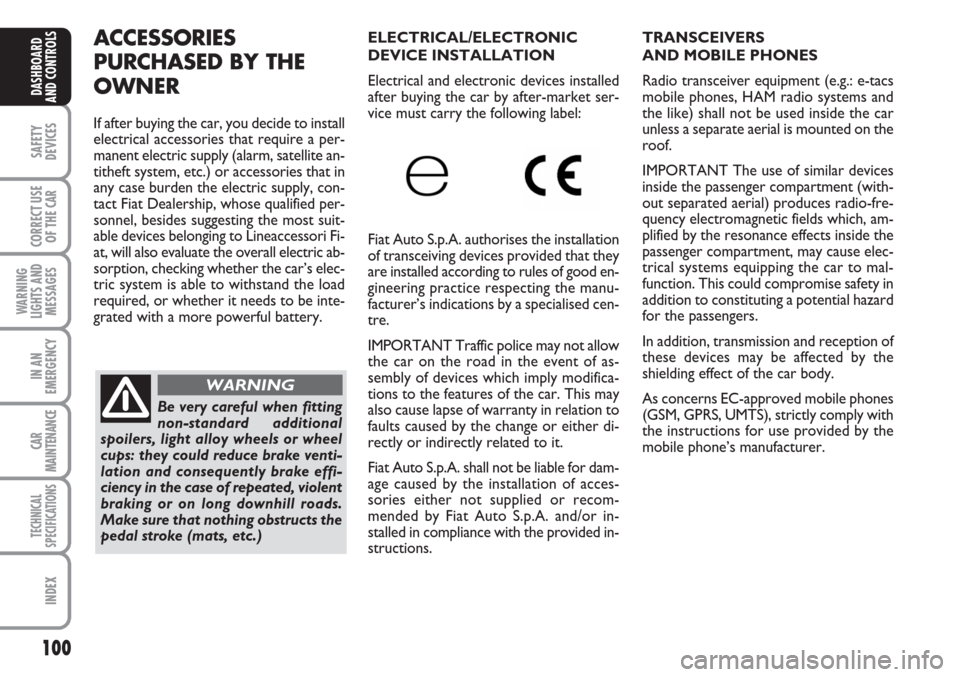
vice must carry the following label:
Fiat Auto S.p.A. authorises the installation
of transceiving devices provided that they
are installed according to rules of good en-
gineering practice respecting the manu-
facturer’s indications by a specialised cen-
tre.
IMPORTANT Traffic police may not allow
the car on the road in the event of as-
sembly of devices which imply modifica-
tions to the features of the car. This may
also cause lapse of warranty in relation to
faults caused by the change or either di-
rectly or indirectly related to it.
Fiat Auto S.p.A. shall not be liable for dam-
age caused by the installation of acces-
sories either not supplied or recom-
mended by Fiat Auto S.p.A. and/or in-
stalled in compliance with the provided in-
structions.
Page 116 of 230
115
CORRECT USE
OF THE
CAR
WARNING
LIGHTS AND
MESSAGES
IN AN
EMERGENCY
CAR
MAINTENANCE
TECHNICAL
SPECIFICATIONS
INDEX
DASHBOARD
AND CONTROLS
SAFETY
DEVICES
FRONT AIRBAGS
The car is provided with front airbags for
the driver and the passenger.
The front driver / passenger air bags have
been designed to protect the occupants in
the event of head-on crashes of medium-
high severity, by placing the cushion be-
tween the occupant and the steering
wheel or dashboard.
Front air bags are designed to protect
car’s occupants in front crashes and there-
fore non-activation in other types of col-
lisions (side collisions, rear shunts, roll-
overs, etc.) is not a system malfunction.
An electronic control unit will make the
bag inflate in the event of a frontal crash.
The bag will inflate instantaneously placing
itself between the front occupant’s body
and the structures which could cause in-
jury. It will deflate immediately afterwards.
Driver and passenger front airbags are not
a replacement of but complementary to
the belts, which you are recommended to
always wear, as specified by law in Europe
and most non-European countries.
The volume of front air bags at max. in-
flation fills most of the space between the
steering wheel and the driver and between
the dashboard and the passenger.
E
E
D
C
D
C
B
B1
A
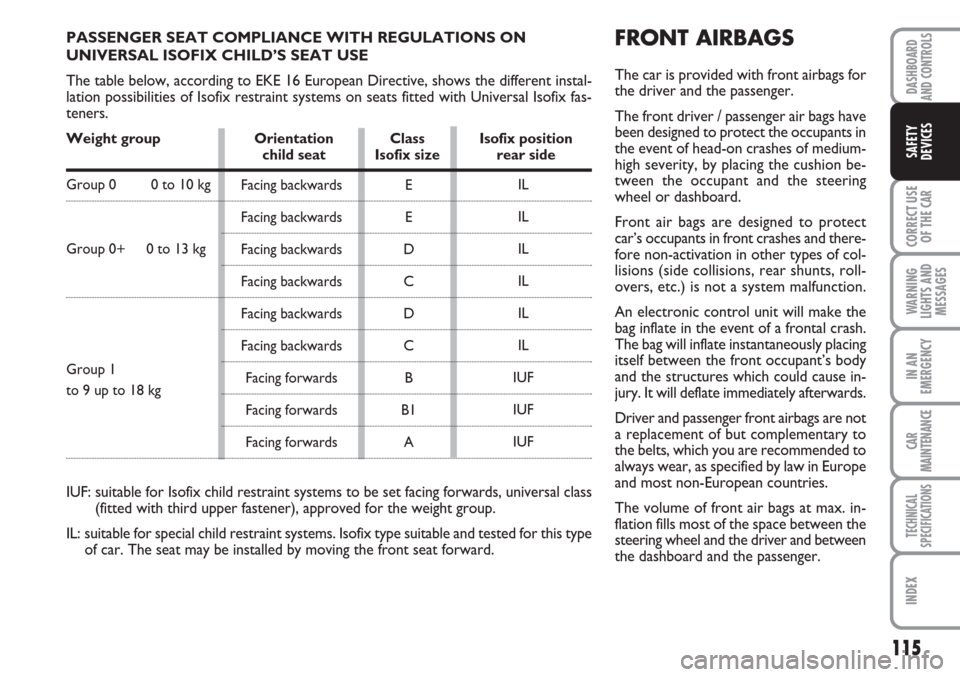
PASSENGER SEAT COMPLIANCE WITH REGULATIONS ON
UNIVERSAL ISOFIX CHILD’S SEAT USE
The table below, according to EKE 16 European Directive, shows the different instal-
lation possibilities of Isofix restraint systems on seats fitted with Universal Isofix fas-
teners.
Weight group Orientation Class Isofix position child seat Isofix size rear side
Group 0 0 to 10 kg
Group 0+ 0 to 13 kg
Group 1
to 9 up to 18 kg
IUF: suitable for Isofix child restraint systems to be set facing forwards, universal class
(fitted with third upper fastener), approved for the weight group.
IL: suitable for special child restraint systems. Isofix type suitable and tested for this type
of car. The seat may be installed by moving the front seat forward.
IL
IL
IL
IL
IL
IL
IUF
IUF
IUF Facing backwards
Facing backwards
Facing backwards
Facing backwards
Facing backwards
Facing backwards
Facing forwards
Facing forwards
Facing forwards
Page 117 of 230
116
CORRECT USE
OF THE
CAR
WARNING
LIGHTS AND
MESSAGES
IN AN
EMERGENCY
CAR
MAINTENANCE
TECHNICAL
SPECIFICATIONS
IINDEX
DASHBOARD
AND CONTROLS
SAFETY
DEVICES
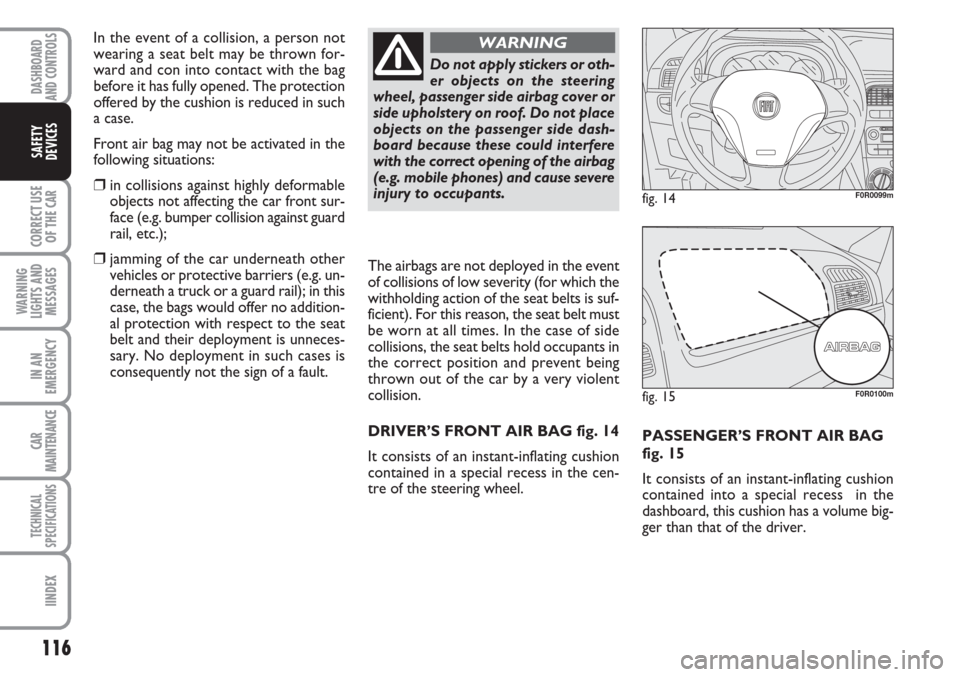
PASSENGER’S FRONT AIR BAG
fig. 15
It consists of an instant-inflating cushion
contained into a special recess in the
dashboard, this cushion has a volume big-
ger than that of the driver.
fig. 14F0R0099m
fig. 15F0R0100m
The airbags are not deployed in the event
of collisions of low severity (for which the
withholding action of the seat belts is suf-
ficient). For this reason, the seat belt must
be worn at all times. In the case of side
collisions, the seat belts hold occupants in
the correct position and prevent being
thrown out of the car by a very violent
collision.
DRIVER’S FRONT AIR BAG fig. 14
It consists of an instant-inflating cushion
contained in a special recess in the cen-
tre of the steering wheel.
Do not apply stickers or oth-
er objects on the steering
wheel, passenger side airbag cover or
side upholstery on roof. Do not place
objects on the passenger side dash-
board because these could interfere
with the correct opening of the airbag
(e.g. mobile phones) and cause severe
injury to occupants.
WARNINGIn the event of a collision, a person not
wearing a seat belt may be thrown for-
ward and con into contact with the bag
before it has fully opened. The protection
offered by the cushion is reduced in such
a case.
Front air bag may not be activated in the
following situations:
❒in collisions against highly deformable
objects not affecting the car front sur-
face (e.g. bumper collision against guard
rail, etc.);
❒jamming of the car underneath other
vehicles or protective barriers (e.g. un-
derneath a truck or a guard rail); in this
case, the bags would offer no addition-
al protection with respect to the seat
belt and their deployment is unneces-
sary. No deployment in such cases is
consequently not the sign of a fault.
Page 121 of 230
120
CORRECT USE
OF THE
CAR
WARNING
LIGHTS AND
MESSAGES
IN AN
EMERGENCY
CAR
MAINTENANCE
TECHNICAL
SPECIFICATIONS
IINDEX
DASHBOARD
AND CONTROLS
SAFETY
DEVICES
Always drive holding your
hands on the steering wheel
rim so that the airbag can inflate
freely in the case of need. Do not dri-
ve with your body bent forward. Keep
your back straight against the back
rest.
WARNING
Airbags may be deployed if
another vehicle crashes if the
key is inserted and at MAR also if the
engine is not running and the car is
stationary. For this reason, children
must never sit on the front seat, even
if the car is not moving. On the oth-
er hand, if the key is inserted and at
STOP, none of the safety devices
(airbag or pretensioners) will be de-
ployed in a collision. Non deployment
of the devices in this case does not in-
dicate a system fault.
WARNING
Do not wash the seats with
pressurised water or steam
(by hand or in automatic seat wash-
ing stations).
WARNING
The airbag deployment
threshold is higher than that
of the pretensioners. For collisions in
the range between the two thresh-
olds, it is normal for only the preten-
sioners to be activated.
WARNING
Do not hook rigid objects to
the coat hooks and to the
support handles.
WARNING
Airbags do not replace seat
belts but increase their effi-
ciency. Furthermore, since front
airbags are not deployed in low speed
collisions, side collisions, rear-end
shunts or roll-overs, the occupants are
only protected by the seat belts which
must be fastened at all times.
WARNING
When the key is turned to
MAR warning light F(with
passenger front airbag activate) will
blink for a few seconds to remind you
that the airbag will be deployed in the
event of a collision after which it
should go out.
WARNING
Have the airbag system
checked by a Fiat Dealership
if the car was stolen, if theft was at-
tempted, or if the car was subjected
to vandalism or flooding.
WARNING
Page 123 of 230
122
WARNING
LIGHTS AND
MESSAGES
IN AN
EMERGENCY
CAR
MAINTENANCE
TECHNICAL
SPECIFICATIONS
INDEX
DASHBOARD
AND CONTROLS
SAFETY
DEVICES
CORRECT USE
OF THE CAR
ENGINE STARTING
The car is provided with an electronic en-
gine lock device: refer to “The Fiat CODE
system” paragraph in “Dashboard and
controls” if you cannot start the engine.
The engine may be noisier during the first
seconds of operation, particularly after a
long period of inactivity. This is charac-
teristic of hydraulic tappets, the timing sys-
tem chosen to reduce the number of ser-
vicing interventions and does effects nei-
ther functionality nor reliability.
It is advisable not to demand
maximum performance from
your car (e.g. excessive accel-
erations, long distances at top
rpm, excessive intense braking, etc.) as
soon as the engine is started.
Do not leave the key in the ig-
nition switch with the engine
off to avoid unnecessary con-
sumption of electricity which
could drain the battery. It is dangerous
to run the engine in closed environ-
ments.
Running the engine in con-
fined areas is extremely dan-
gerous. The engine consumes oxygen
and produces carbon monoxide
which is a highly toxic and lethal gas.
WARNING
Remember that the brake
booster and power steering
are not operational until the engine
has been started, therefore much ef-
fort than usual is required on the
brake pedal and steering wheel.
WARNING
STARTING PROCEDURE FOR
PETROL VERSIONS
Proceed as follows:
❒ensure that the handbrake is up;
❒put the gear lever into neutral;
❒press the clutch pedal down to the
floor without touching the accelerator;
❒turn the ignition key to AVVand let
it go the moment the engine starts.
If the engine does not start at the first at-
tempt, return the ignition key to STOP
before repeating starting.
Page 125 of 230
124
WARNING
LIGHTS AND
MESSAGES
IN AN
EMERGENCY
CAR
MAINTENANCE
TECHNICAL
SPECIFICATIONS
INDEX
DASHBOARD
AND CONTROLS
SAFETY
DEVICES
CORRECT USE
OF THE CAR
STOPPING THE ENGINE
Turn the ignition to STOPwhile the en-
gine is idling.
IMPORTANT After a taxing drive, you
should allow the engine to “catch its
breath” before turning it off by letting it
idle to allow the temperature in the en-
gine compartment to fall.
A quick burst on the acceler-
ator before turning off the en-
gine serves absolutely no
practical purpose, it wastes
fuel and is damaging especially to tur-
bocharged engines.HOW TO WARM UP THE
ENGINE AFTER IT HAS JUST
STARTED
(petrol and diesel engines)
Proceed as follows:
❒drive off slowly, letting the engine turn
at medium revs. Do not accelerate
abruptly;
❒do not demand to performance for the
first few kilometres. Wait until the en-
gine coolant gauge starts moving.
Remember that the brake
booster and power steering
are not operational until the
engine has been started,
therefore much effort than usual is re-
quired on the brake pedal and steering
wheel.
Never jump start the engine
by pushing, towing or driving
downhill. This could cause a
flow of fuel into the catalyt-
ic converter and damage it beyond re-
pair.