wiper FIAT LINEA 2007 1.G User Guide
[x] Cancel search | Manufacturer: FIAT, Model Year: 2007, Model line: LINEA, Model: FIAT LINEA 2007 1.GPages: 230, PDF Size: 3.31 MB
Page 182 of 230
181
WARNING
LIGHTS AND
MESSAGES
TECHNICAL
SPECIFICATIONS
INDEX
DASHBOARD
AND CONTROLS
SAFETY
DEVICES
CORRECT USE
OF THE CAR
IN AN
EMERGENCY
CAR
MAINTENANCE
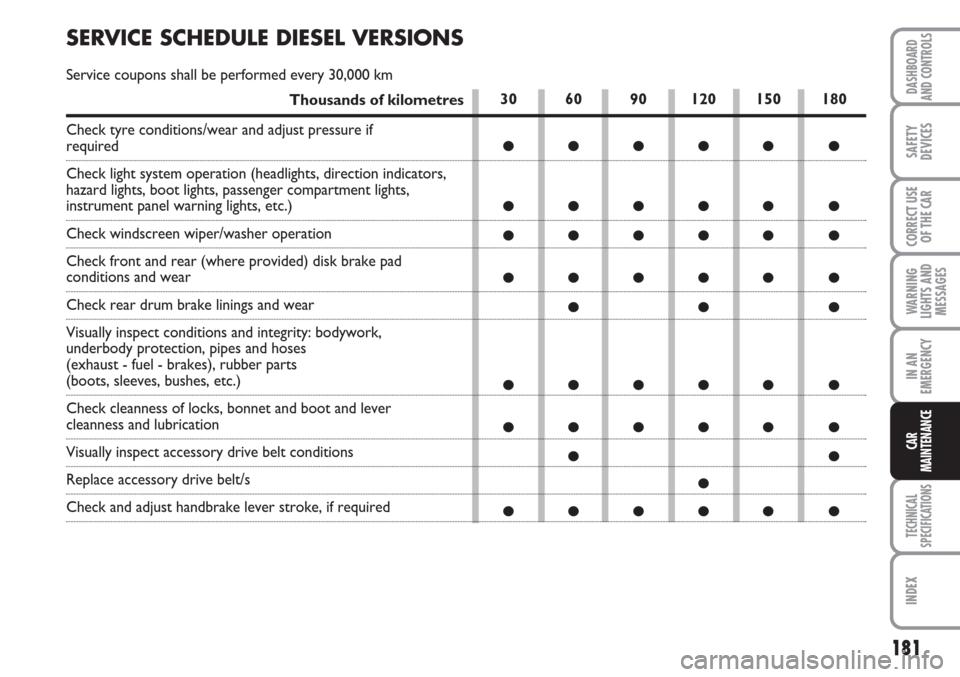
30 60 90 120 150 180
●●●●● ●
●●●●● ●
●●●●● ●
●●●●● ●
●● ●
●●●●● ●
●●●●● ●
●●
●
●●●●● ●
SERVICE SCHEDULE DIESEL VERSIONS
Service coupons shall be performed every 30,000 km
Thousands of kilometres
Check tyre conditions/wear and adjust pressure if
required
Check light system operation (headlights, direction indicators,
hazard lights, boot lights, passenger compartment lights,
instrument panel warning lights, etc.)
Check windscreen wiper/washer operation
Check front and rear (where provided) disk brake pad
conditions and wear
Check rear drum brake linings and wear
Visually inspect conditions and integrity: bodywork,
underbody protection, pipes and hoses
(exhaust - fuel - brakes), rubber parts
(boots, sleeves, bushes, etc.)
Check cleanness of locks, bonnet and boot and lever
cleanness and lubrication
Visually inspect accessory drive belt conditions
Replace accessory drive belt/s
Check and adjust handbrake lever stroke, if required
Page 184 of 230
183
WARNING
LIGHTS AND
MESSAGES
TECHNICAL
SPECIFICATIONS
INDEX
DASHBOARD
AND CONTROLS
SAFETY
DEVICES
CORRECT USE
OF THE CAR
IN AN
EMERGENCY
CAR
MAINTENANCE
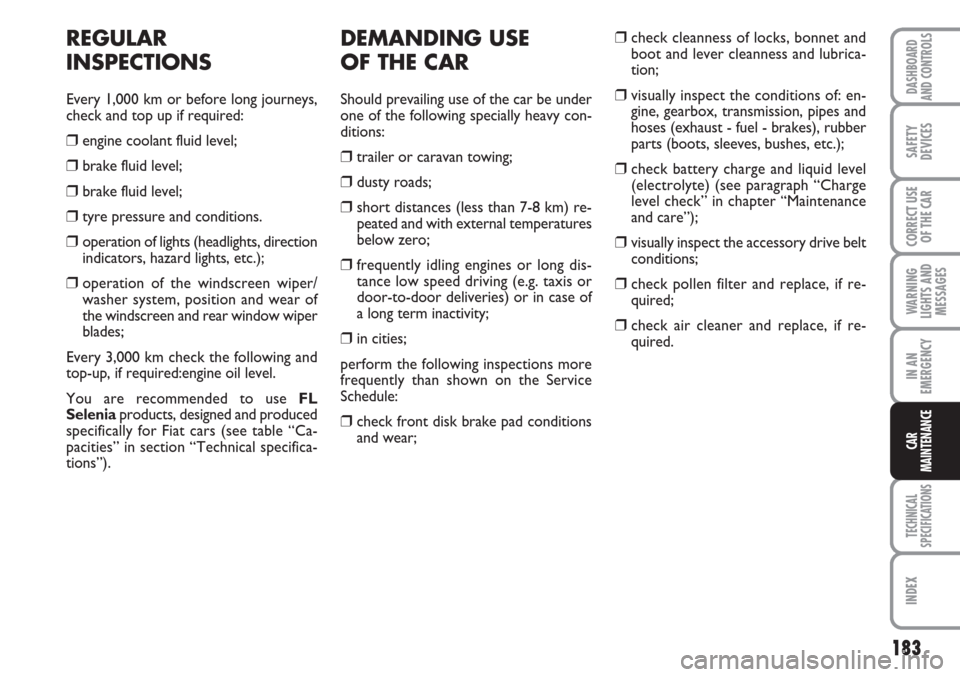
DEMANDING USE
OF THE CAR
Should prevailing use of the car be under
one of the following specially heavy con-
ditions:
❒trailer or caravan towing;
❒dusty roads;
❒short distances (less than 7-8 km) re-
peated and with external temperatures
below zero;
❒frequently idling engines or long dis-
tance low speed driving (e.g. taxis or
door-to-door deliveries) or in case of
a long term inactivity;
❒in cities;
perform the following inspections more
frequently than shown on the Service
Schedule:
❒check front disk brake pad conditions
and wear;
❒check cleanness of locks, bonnet and
boot and lever cleanness and lubrica-
tion;
❒visually inspect the conditions of: en-
gine, gearbox, transmission, pipes and
hoses (exhaust - fuel - brakes), rubber
parts (boots, sleeves, bushes, etc.);
❒check battery charge and liquid level
(electrolyte) (see paragraph “Charge
level check” in chapter “Maintenance
and care”);
❒visually inspect the accessory drive belt
conditions;
❒check pollen filter and replace, if re-
quired;
❒check air cleaner and replace, if re-
quired.
REGULAR
INSPECTIONS
Every 1,000 km or before long journeys,
check and top up if required:
❒engine coolant fluid level;
❒brake fluid level;
❒brake fluid level;
❒tyre pressure and conditions.
❒operation of lights (headlights, direction
indicators, hazard lights, etc.);
❒operation of the windscreen wiper/
washer system, position and wear of
the windscreen and rear window wiper
blades;
Every 3,000 km check the following and
top-up, if required:engine oil level.
You are recommended to use FL
Seleniaproducts, designed and produced
specifically for Fiat cars (see table “Ca-
pacities” in section “Technical specifica-
tions”).
Page 194 of 230
193
WARNING
LIGHTS AND
MESSAGES
TECHNICAL
SPECIFICATIONS
INDEX
DASHBOARD
AND CONTROLS
SAFETY
DEVICES
CORRECT USE
OF THE CAR
IN AN
EMERGENCY
CAR
MAINTENANCE
WINDSCREEN WIPER
BLADES
Periodically clean the rubber part using
special products; TUTELA PROFES-
SIONAL SC 35is recommended.
Replace the blades if the rubber edge is
deformed or worn. In all cases, it is ad-
visable to replace them approximately
once a year.
A few simple precautions can reduce the
possibility of damage to the blades:
❒make sure that the rubber part is not
stuck to the windscreen at sub-zero
temperatures. Use an antifreeze prod-
uct to release it if required.
❒remove the snow from the window:
this will avoid overstressing the elec-
trical motor in addition to protecting
the blades;
❒do not operate the windscreen wipers
on dry glass.
Driving with worn wiper
blades is a serious hazard,
because visibility is reduced in bad
weather.
WARNING
RUBBER HOSES
Carefully follow the information contained
in the “Service schedule” in this section
for maintenance of brake system and fuel
feed rubber hoses.
Ozone, high temperatures and prolonged
lack of fluid in the system may cause hard-
ening and cracking of the hoses, with pos-
sible leaks. Careful inspections are there-
fore necessary.Excessively low pressure will
cause overheating of the
tyre and may cause severe tyre dam-
age.
WARNING
Do not exchange the tyres
from the left to the right of
the car and vice versa.
WARNING
Do not repaint alloy wheel
rims at temperatures higher
than 150°C. The mechanical features
of the wheels could be compromised.
WARNING
Page 195 of 230
194
WARNING
LIGHTS AND
MESSAGES
TECHNICAL
SPECIFICATIONS
INDEX
DASHBOARD
AND CONTROLS
SAFETY
DEVICES
CORRECT USE
OF THE CAR
IN AN
EMERGENCY
CAR
MAINTENANCE
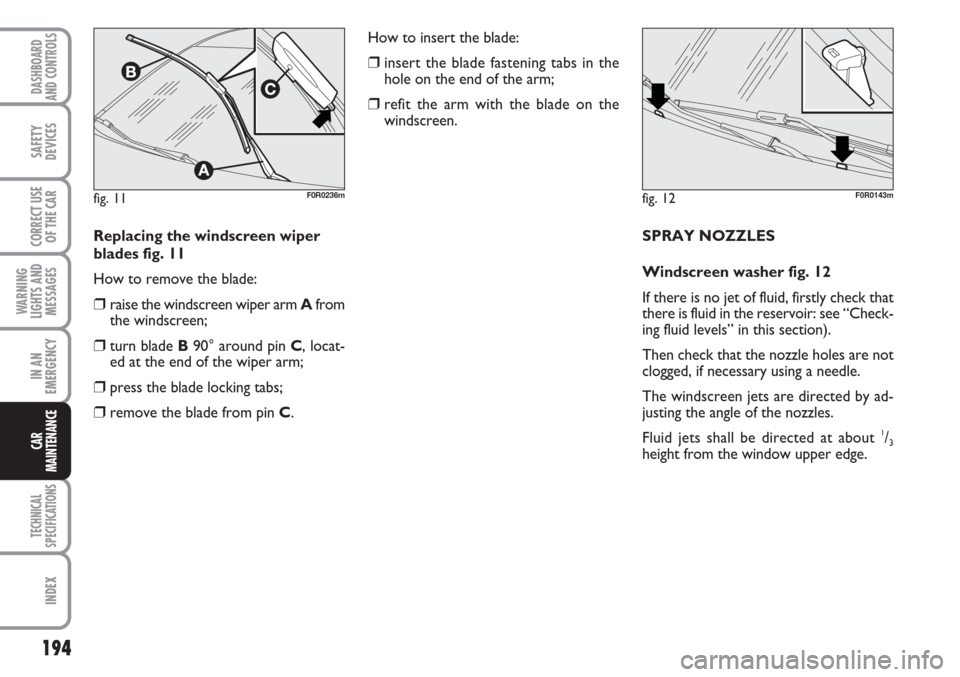
Replacing the windscreen wiper
blades fig. 11
How to remove the blade:
❒raise the windscreen wiper arm Afrom
the windscreen;
❒turn blade B90° around pin C, locat-
ed at the end of the wiper arm;
❒press the blade locking tabs;
❒remove the blade from pin C.
fig. 11F0R0236m
SPRAY NOZZLES
Windscreen washer fig. 12
If there is no jet of fluid, firstly check that
there is fluid in the reservoir: see “Check-
ing fluid levels” in this section).
Then check that the nozzle holes are not
clogged, if necessary using a needle.
The windscreen jets are directed by ad-
justing the angle of the nozzles.
Fluid jets shall be directed at about
1/3height from the window upper edge.
fig. 12F0R0143m
How to insert the blade:
❒insert the blade fastening tabs in the
hole on the end of the arm;
❒refit the arm with the blade on the
windscreen.
Page 197 of 230
196
WARNING
LIGHTS AND
MESSAGES
TECHNICAL
SPECIFICATIONS
INDEX
DASHBOARD
AND CONTROLS
SAFETY
DEVICES
CORRECT USE
OF THE CAR
IN AN
EMERGENCY
CAR
MAINTENANCE
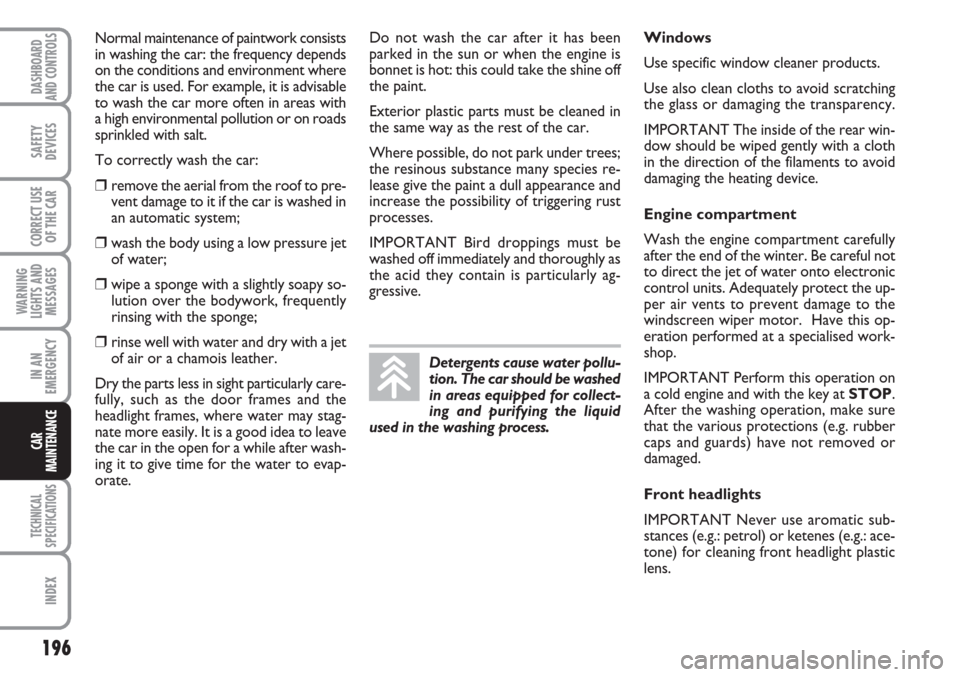
Normal maintenance of paintwork consists
in washing the car: the frequency depends
on the conditions and environment where
the car is used. For example, it is advisable
to wash the car more often in areas with
a high environmental pollution or on roads
sprinkled with salt.
To correctly wash the car:
❒remove the aerial from the roof to pre-
vent damage to it if the car is washed in
an automatic system;
❒wash the body using a low pressure jet
of water;
❒wipe a sponge with a slightly soapy so-
lution over the bodywork, frequently
rinsing with the sponge;
❒rinse well with water and dry with a jet
of air or a chamois leather.
Dry the parts less in sight particularly care-
fully, such as the door frames and the
headlight frames, where water may stag-
nate more easily. It is a good idea to leave
the car in the open for a while after wash-
ing it to give time for the water to evap-
orate.Do not wash the car after it has been
parked in the sun or when the engine is
bonnet is hot: this could take the shine off
the paint.
Exterior plastic parts must be cleaned in
the same way as the rest of the car.
Where possible, do not park under trees;
the resinous substance many species re-
lease give the paint a dull appearance and
increase the possibility of triggering rust
processes.
IMPORTANT Bird droppings must be
washed off immediately and thoroughly as
the acid they contain is particularly ag-
gressive.
Detergents cause water pollu-
tion. The car should be washed
in areas equipped for collect-
ing and purifying the liquid
used in the washing process.
Windows
Use specific window cleaner products.
Use also clean cloths to avoid scratching
the glass or damaging the transparency.
IMPORTANT The inside of the rear win-
dow should be wiped gently with a cloth
in the direction of the filaments to avoid
damaging the heating device.
Engine compartment
Wash the engine compartment carefully
after the end of the winter. Be careful not
to direct the jet of water onto electronic
control units. Adequately protect the up-
per air vents to prevent damage to the
windscreen wiper motor. Have this op-
eration performed at a specialised work-
shop.
IMPORTANT Perform this operation on
a cold engine and with the key at STOP.
After the washing operation, make sure
that the various protections (e.g. rubber
caps and guards) have not removed or
damaged.
Front headlights
IMPORTANT Never use aromatic sub-
stances (e.g.: petrol) or ketenes (e.g.: ace-
tone) for cleaning front headlight plastic
lens.
Page 216 of 230
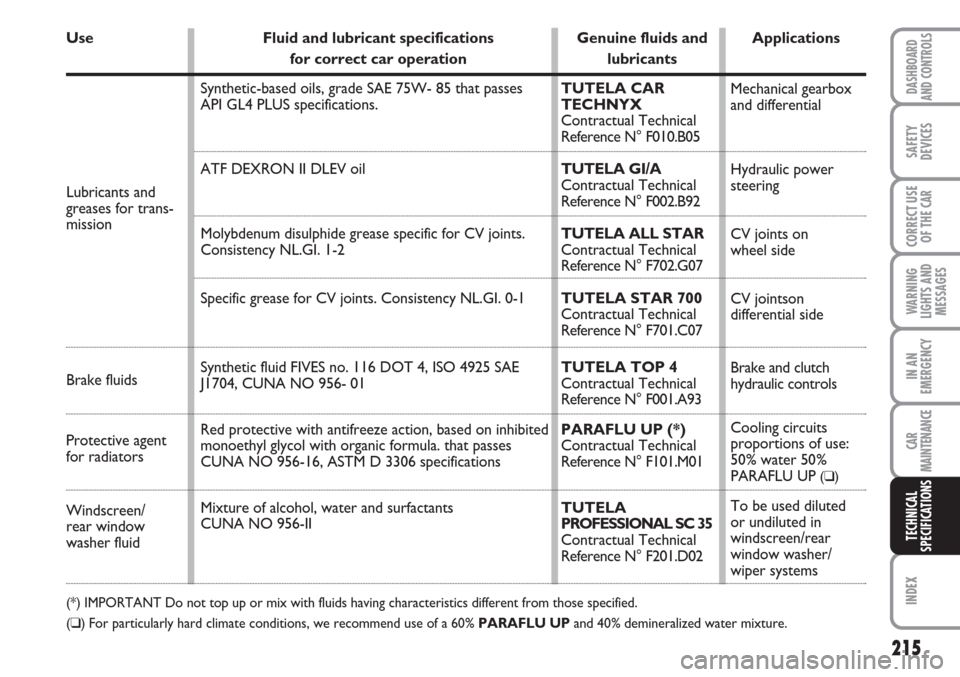
Lubricants and
greases for trans-
mission
215
WARNING
LIGHTS AND
MESSAGES
INDEX
DASHBOARD
AND CONTROLS
SAFETY
DEVICES
CORRECT USE
OF THE
CAR
IN AN
EMERGENCY
CAR
MAINTENANCE
TECHNICAL
SPECIFICATIONS
Synthetic-based oils, grade SAE 75W- 85 that passes
API GL4 PLUS specifications.
ATF DEXRON II DLEV oil
Molybdenum disulphide grease specific for CV joints.
Consistency NL.GI. 1-2
Specific grease for CV joints. Consistency NL.GI. 0-1
Synthetic fluid FIVES no. 116 DOT 4, ISO 4925 SAE
J1704, CUNA NO 956- 01
Red protective with antifreeze action, based on inhibited
monoethyl glycol with organic formula. that passes
CUNA NO 956-16, ASTM D 3306 specifications
Mixture of alcohol, water and surfactants
CUNA NO 956-IITUTELA CAR
TECHNYX
Contractual Technical
Reference N° F010.B05
TUTELA GI/A
Contractual Technical
Reference N° F002.B92
TUTELA ALL STAR
Contractual Technical
Reference N° F702.G07
TUTELA STAR 700
Contractual Technical
Reference N° F701.C07
TUTELA TOP 4
Contractual Technical
Reference N° F001.A93
PARAFLU UP (*)
Contractual Technical
Reference N° F101.M01
TUTELA
PROFESSIONAL SC 35
Contractual Technical
Reference N° F201.D02Mechanical gearbox
and differential
Hydraulic power
steering
CV joints on
wheel side
CV jointson
differential side
Brake and clutch
hydraulic controls
Cooling circuits
proportions of use:
50% water 50%
PARAFLU UP
(❑)
To be used diluted
or undiluted in
windscreen/rear
window washer/
wiper systems Brake fluids
Protective agent
for radiators
Windscreen/
rear window
washer fluid Use Fluid and lubricant specifications Genuine fluids and Applications
for correct car operation lubricants
(*) IMPORTANT Do not top up or mix with fluids having characteristics different from those specified.
(❑) For particularly hard climate conditions, we recommend use of a 60% PARAFLU UPand 40% demineralized water mixture.
Page 221 of 230
220
WARNING
LIGHTS AND
MESSAGES
DASHBOARD
AND CONTROLS
SAFETY
DEVICES
CORRECT USE
OF THE
CAR
IN AN
EMERGENCY
CAR
MAINTENANCE
TECHNICAL
SPECIFICATIONS
INDEX
Prolonged car inactivity...................... 138
Protecting the environment ............. 102
Puddle lights.......................................... 74
– bulb replacement .......................... 174
Radio transmitters and cellular
telephones ......................................... 100
Radionavigator presetting system .... 104
Rain sensor............................................ 69
Rear ceiling lights
– bulb replacement........................... 165
– control ............................................ 72
Rear doors emergency
lock device.......................................... 79
Rear fog lights
– bulb replacement .......................... 162
– control button .............................. 75
Rear window washer
– control ............................................ 61
– fluid level ........................................ 200
Rear window wiper
– blades .............................................. 207
– control ............................................ 61
– nozzles ............................................ 208
Rearview mirrors
– door mirrors ................................. 47
– driving mirror ................................ 48
Reconfigurable
Multifunctional Display ................... 32Refuelling............................................... 106
Rev. counter......................................... 16
Reversing light ..................................... 171
Roof rack/ski rack .............................. 90
Rubber hoses ....................................... 193Safety ................................................... 103
Seat adjustment ................................... 44
Seat belts
– general instructions ..................... 107
– load limiters ................................... 106
– maintenance .................................. 109
– using the seat belts ........................ 104
Seats
– adjustment ..................................... 44
– cleaning ........................................... 197
– tilting (rear seats).......................... 87
Side/taillights
– control ............................................ 57
– front bulb replacement................. 168
– rear bulb replacement.................. 170
Smart washing ..................................... 60
Smoker’s kit ......................................... 72
Snow chains ......................................... 131
Sound system ...................................... 99
Spark plugs
– type ................................................. 215
Speedometer ....................................... 16
Starting and driving ............................ 121
Load limiters ...................................... 106
Main beam headlights
– bulb replacement .......................... 161
– control ............................................ 66
– flashing ............................................ 66
Manual climate control system ........ 53
Multifunctional display........................ 23
Number plate light ............................ 164
Oddment compartments.................. 70
Paint ..................................................... 208
Parking .................................................. 125
Parking sensors.................................... 97
Performance ........................................ 211
Plates
– bodywork paint
identification plate ....................... 213
– model plate .................................... 212
Pollen filter ........................................... 189
Power socket ...................................... 73
Power steering .................................... 96
Power windows .................................. 79
Presetting for mounting the
“Isofix Universal” child
restraint system................................. 120
Pretensioners ...................................... 106
Page 222 of 230
221
WARNING
LIGHTS AND
MESSAGES
DASHBOARD
AND CONTROLS
SAFETY
DEVICES
CORRECT USE
OF THE
VEHICLE
IN AN
EMERGENCY
VEHICLE
MAINTENANCE
TECHNICAL
SPECIFICATIONS
INDEX
Tyres
– replacing a wheel ........................... 147
– maintenance .................................. 192
– reading tyre markings .................. 206
– standard tyres................................ 208
– cold tyre inflation pressure 209
Using the manual gearbox .............. 126
Ventilation .......................................... 51
Warning lights and messages ......... 133
Weights ................................................ 212
Wheel..................................................... 206
– replacing a wheel .......................... 147
– spare wheel ................................... 220
– wheel geometry ............................ 206
Wheel rims
– understanding rim marking ........ 219
Window washing................................. 68
Window winders................................. 83
Windscreen/rear window/
headlight washer fluid level ............ 200
Windscreen/rear window
wiper blades ...................................... 206
Windscreen washer
– control ............................................ 68
– fluid level ........................................ 187Windscreen wiper
– blades .............................................. 193
– control ............................................ 59
– spray nozzles ................................. 194 Starting the engine
– bump starting ................................ 147
– diesel engines ................................ 123
– emergency start-up ...................... 146
– ignition switch ............................... 13
– jump starting .................................. 146
– petrol engines ............................... 122
– stopping the engine....................... 124
– warm up the engine after
just started...................................... 124
Steering.................................................. 217
Steering column lock ......................... 13
Steering wheel ..................................... 47
Sunroof.................................................. 74
Sun visors ............................................. 81
Suspensions .......................................... 205
Symbols ................................................. 6
Tailgate ................................................ 82
Technical specifications ..................... 199
Third brake light ................................. 172
Top speeds ........................................... 223
Towing the car .................................... 175
Towing trailers
– tow hook installation ................... 129
Transmission ........................................ 204
Trip computer ..................................... 42