wiper FIAT LINEA 2007 1.G Owners Manual
[x] Cancel search | Manufacturer: FIAT, Model Year: 2007, Model line: LINEA, Model: FIAT LINEA 2007 1.GPages: 230, PDF Size: 3.31 MB
Page 6 of 230
5
SAFETY
DEVICES
CORRECT USE
OF THE
CAR
WARNING
LIGHTS AND
MESSAGES
IN AN
EMERGENCY
CAR
MAINTENANCE
TECHNICAL
SPECIFICATIONS
INDEX
DASHBOARD
AND CONTROLS
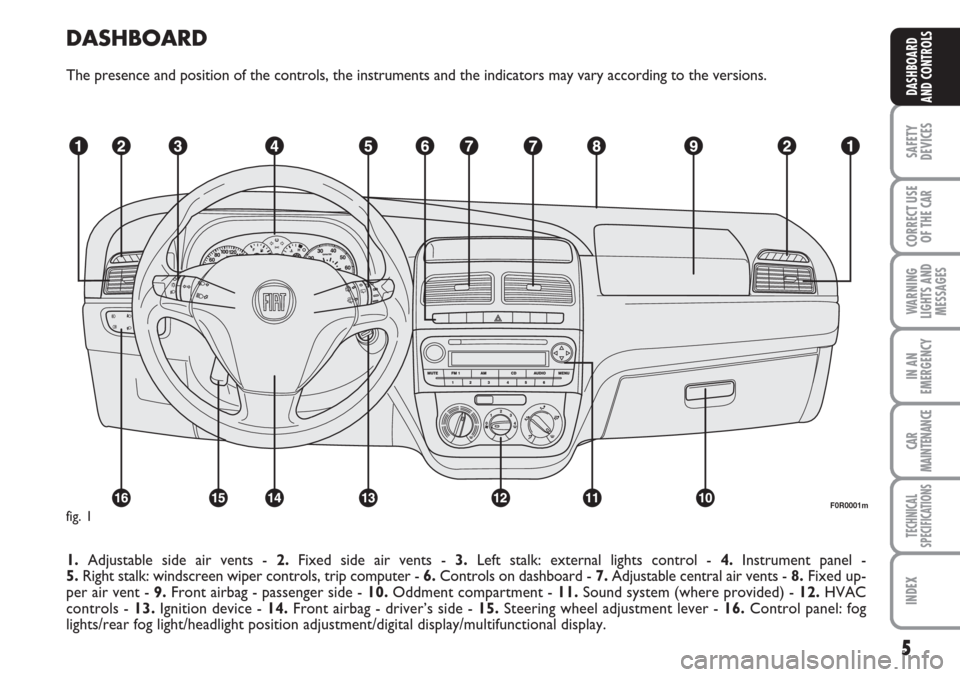
DASHBOARD
The presence and position of the controls, the instruments and the indicators may vary according to the versions.
1.Adjustable side air vents - 2.Fixed side air vents - 3.Left stalk: external lights control - 4.Instrument panel -
5.Right stalk: windscreen wiper controls, trip computer - 6.Controls on dashboard - 7.Adjustable central air vents - 8.Fixed up-
per air vent - 9.Front airbag - passenger side - 10.Oddment compartment - 11.Sound system (where provided) - 12.HVAC
controls - 13.Ignition device - 14.Front airbag - driver’s side - 15. Steering wheel adjustment lever - 16.Control panel: fog
lights/rear fog light/headlight position adjustment/digital display/multifunctional display.
F0R0001mfig. 1
Page 69 of 230
68
SAFETY
DEVICES
CORRECT USE
OF THE
CAR
WARNING
LIGHTS AND
MESSAGES
IN AN
EMERGENCY
CAR
MAINTENANCE
TECHNICAL
SPECIFICATIONS
INDEX
DASHBOARD
AND CONTROLS
WINDOW WASHING
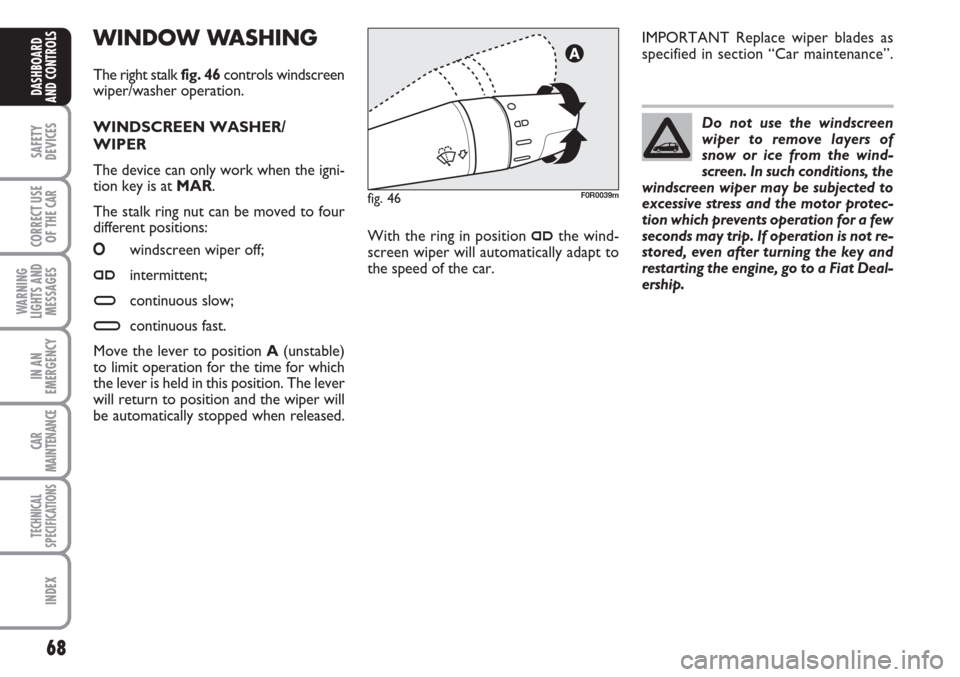
The right stalk fig. 46controls windscreen
wiper/washer operation.
WINDSCREEN WASHER/
WIPER
The device can only work when the igni-
tion key is at MAR.
The stalk ring nut can be moved to four
different positions:
Owindscreen wiper off;
≤intermittent;
≥continuous slow;
¥continuous fast.
Move the lever to position A(unstable)
to limit operation for the time for which
the lever is held in this position. The lever
will return to position and the wiper will
be automatically stopped when released.Do not use the windscreen
wiper to remove layers of
snow or ice from the wind-
screen. In such conditions, the
windscreen wiper may be subjected to
excessive stress and the motor protec-
tion which prevents operation for a few
seconds may trip. If operation is not re-
stored, even after turning the key and
restarting the engine, go to a Fiat Deal-
ership.
With the ring in position
≤the wind-
screen wiper will automatically adapt to
the speed of the car.IMPORTANT Replace wiper blades as
specified in section “Car maintenance”.
fig. 46F0R0039m
Page 70 of 230
69
SAFETY
DEVICES
CORRECT USE
OF THE
CAR
WARNING
LIGHTS AND
MESSAGES
IN AN
EMERGENCY
CAR
MAINTENANCE
TECHNICAL
SPECIFICATIONS
INDEX
DASHBOARD
AND CONTROLS
RAIN SENSOR
(where provided)
The rain sensor is located behind the dri-
ving mirror in contact with the windscreen
and has the purpose of automatically ad-
just, during the intermittent operation, the
frequency of the windscreen wiper
strokes as to the rain intensity.
IMPORTANT Keep clean the glass in the
sensor area.
Activation
Move the right-hand stalk knurled ring to
≤fig. 46.
The activation of the rain sensor is sig-
nalled by a control acquisition “stroke”.
Through the set up menu it is possible to
increase the sensitivity of the rain sensor.
The increase of the sensitivity of the rain
sensor is signalled by a control and acqui-
sition “stroke”.
Operating the windscreen washer with
the rain sensor activated the normal wash-
ing cycle is performed at the end of which
the rain sensor resumes its normal auto-
matic function.Deactivation
Change the stalk knurled ring position
from
≤fig. 46or turn the ignition key
to STOP.
At the next start-up (key at MAR), the
sensor will not be reactivated even if the
knurled ring is at
≤fig. 46. To reacti-
vate the sensor, move the ring from po-
sition
≤to any other position and then
return it to position
≤.
Rain sensor activation will be indicated by
at least one wiper “stroke” even if the
windscreen is dry.
The rain sensor is able to recognize and
automatically adjust itself in the presence
of the following particular conditions:
❒presence of dirt on the controlled sur-
face (salt, dirt, etc.);
❒difference between day and night.
IMPORTANT Streaks of water may cause
unnecessary blade moving. “Smart washing” function
Pull the stalk towards the steering wheel
(unstable position) to operate the wind-
screen washer.
Keeping the stalk pulled for more than half
a second, with just one movement it is
possible to operate the washer jet and the
wiper at the same time.
The wiper stops working three strokes af-
ter releasing the stalk.
A further stroke after 6 seconds com-
pletes the wiping operation.
Page 90 of 230
89
SAFETY
DEVICES
CORRECT USE
OF THE
CAR
WARNING
LIGHTS AND
MESSAGES
IN AN
EMERGENCY
CAR
MAINTENANCE
TECHNICAL
SPECIFICATIONS
INDEX
DASHBOARD
AND CONTROLS
IMPORTANT Before opening the bonnet,
check that windscreen wiper arms are not
lifted from the windscreen.CLOSING THE BONNET
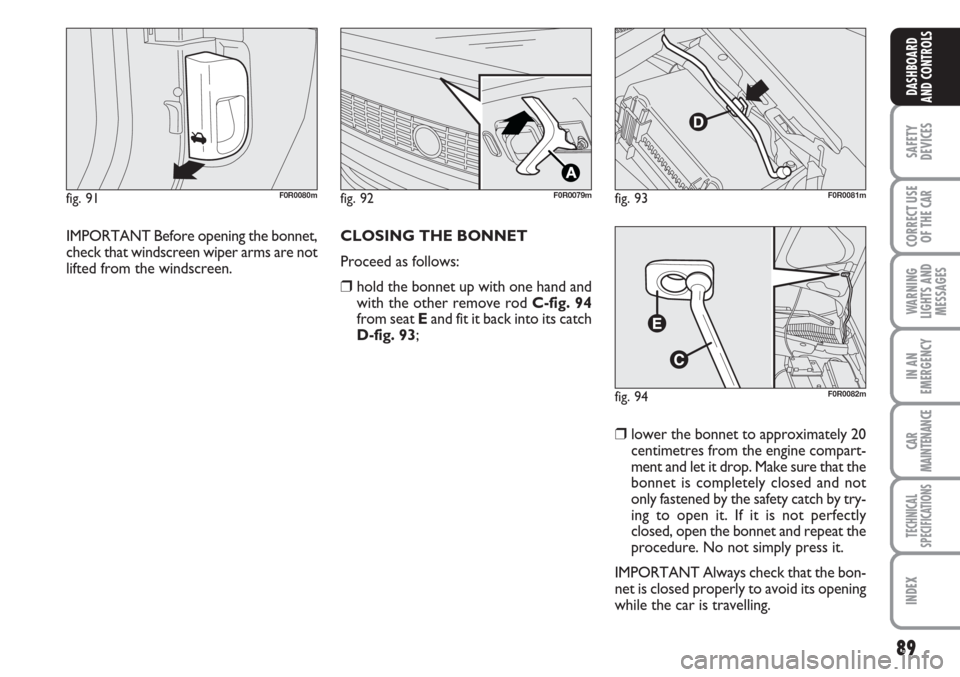
Proceed as follows:
❒hold the bonnet up with one hand and
with the other remove rod C-fig. 94
from seat Eand fit it back into its catch
D-fig. 93;
❒lower the bonnet to approximately 20
centimetres from the engine compart-
ment and let it drop. Make sure that the
bonnet is completely closed and not
only fastened by the safety catch by try-
ing to open it. If it is not perfectly
closed, open the bonnet and repeat the
procedure. No not simply press it.
IMPORTANT Always check that the bon-
net is closed properly to avoid its opening
while the car is travelling.
fig. 91F0R0080mfig. 92F0R0079m
fig. 94F0R0082m
fig. 93F0R0081m
Page 128 of 230
127
WARNING
LIGHTS AND
MESSAGES
IN AN
EMERGENCY
CAR
MAINTENANCE
TECHNICAL
SPECIFICATIONS
INDEX
DASHBOARD
AND CONTROLS
SAFETY
DEVICES
CORRECT USE
OF THE CAR
Roof rack/ski rack
Remove the roof rack or the ski rack from
the roof after use. These accessories de-
crease aerodynamic penetration of the car
and have a negative effect on consumption.
It is better to use a trailer to transport
particularly bulky objects.
Electric devices
Use electric devices only for the amount
of time needed. Rear heated window, ad-
ditional headlights, windscreen wipers and
heater fan need a considerable amount of
energy, therefore increasing the require-
ment of current increases fuel consump-
tion (up to +25% in the urban cycle).
Climate control
The climate control system requires high-
er fuel consumption (up to +20% in av-
erage): use the air vents when the exter-
nal temperature allows to.
Spoilers
The use of non-certified aerodynamic
items may adversely affect air drag and
consumption levels.DRIVING STYLE
Starting
Do not warm the engine up with the car
standing: the engine warms up very slow-
ly in these conditions, increasing con-
sumption and emissions. It is advisable to
start off immediately and slowly keeping
the engine speed down: the engine will
warm up much faster this way.
Unnecessary actions
Avoid revving up when starting at traffic
lights or before stopping the engine. The
latter action, like doubling the clutch, is un-
necessary and causes increase of con-
sumption and pollution.
Gear selection
Use a higher gear as soon as traffic and
road conditions allow. Using a low gear
for faster acceleration will increase con-
sumption.
In the same way improper use of a high
gear increases consumption, emissions an
engine wear.CONTAINING
RUNNING COSTS
Here are some suggestions which may
help you to keep the running costs of your
car down and lower the amount of toxic
emissions released into the atmosphere.
GENERAL CONSIDERATIONS
Car maintenance
Have checks and adjustments carried out
in accordance with the “Service schedule”.
Tyres
Check tyre pressure regularly at least
once every four weeks: excessively low
pressure will increase consumption be-
cause rolling resistance will be higher.
Unnecessary loads
Do not travel with too much luggage
stowed in the boot. The weight of the car
(especially when driving in town) and its
trim greatly affects consumption and sta-
bility.
Page 133 of 230
132
WARNING
LIGHTS AND
MESSAGES
IN AN
EMERGENCY
CAR
MAINTENANCE
TECHNICAL
SPECIFICATIONS
INDEX
DASHBOARD
AND CONTROLS
SAFETY
DEVICES
CORRECT USE
OF THE CAR
CAR INACTIVITY
If the car is to be left inactive for longer
than a month, the following precautions
should be noted:
❒park the car in covered, dry and if pos-
sible well-ventilated premises;
❒engage a gear;
❒check that the handbrake is not en-
gaged;
❒disconnect the negative battery termi-
nal and check battery charge (see para-
graph “Charge level check” in chapter
“Maintenance and care”). Repeat this
check once every three months dur-
ing storage. Recharge the battery if nec-
essary (see paragraph “If the battery is
flat” in chapter “In an emergency”);
❒clean and protect the painted parts us-
ing protective wax;
❒clean and protect the shiny metal parts
using special compounds readily avail-
able;
❒sprinkle talcum powder on the rubber
windscreen and rear window wiper
blades and lift them off the glass;
❒slightly open the windows;
❒cover the car with a fabric or perfo-
rated plastic terrapin. Do not use com-
pact plastic sheets which do not allow
humidity to evaporate from the surface
of the car;
❒inflate tyres to +0.5 bar above the nor-
mal specified pressure and check it at
intervals;
❒if you don’t disconnect the battery from
the electric system, check its charge
every month (see paragraph “Charge
level check” in chapter “Maintenance
and care”);
❒recharge the battery if necessary (see
paragraph “If the battery is flat” in chap-
ter “In an emergency”);
❒do not drain the engine cooling system.
IMPORTANT Where relevant, switch off
the car alarm with the remote control.
Keep your speed down when
snow chains are fitted. Do
not exceed 50 km/h. Avoid
potholes, steps and pave-
ments and avoid also to dri-
ve for long distances on
roads not covered with snow to pre-
vent damaging the car and the
roadbed.
WARNING
Chains cannot be applied to
tyre 205/45 R17 88V.
WARNING
Page 171 of 230
170
WARNING
LIGHTS AND
MESSAGES
CAR
MAINTENANCE
TECHNICAL
SPECIFICATIONS
IINDEX
DASHBOARD
AND CONTROLS
SAFETY
DEVICES
CORRECT USE
OF THE
CAR
IN AN
EMERGENCY
7.5
7.5
7.5
15
20
20
7.5
7.5
7.5
20
10
30
7.5
7.5
20 F12
F13
F31
F32
F33
F34
F35
F36
F37
F38
F39
F40
F41
F42
F43
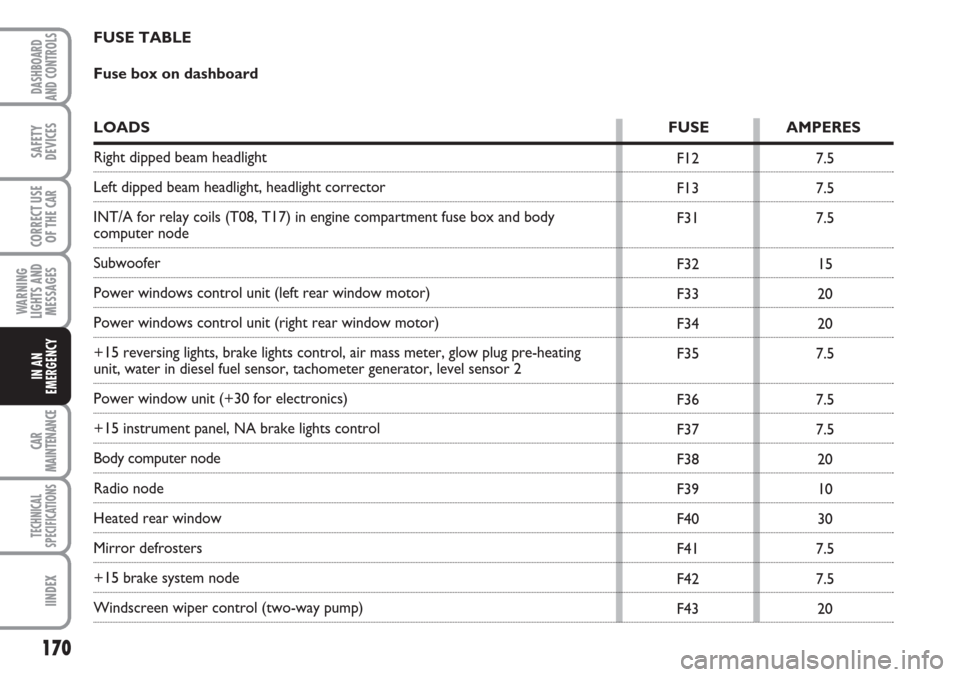
FUSE TABLE
Fuse box on dashboard
LOADS FUSE AMPERES
Right dipped beam headlight
Left dipped beam headlight, headlight corrector
INT/A for relay coils (T08, T17) in engine compartment fuse box and body
computer node
Subwoofer
Power windows control unit (left rear window motor)
Power windows control unit (right rear window motor)
+15 reversing lights, brake lights control, air mass meter, glow plug pre-heating
unit, water in diesel fuel sensor, tachometer generator, level sensor 2
Power window unit (+30 for electronics)
+15 instrument panel, NA brake lights control
Body computer node
Radio node
Heated rear window
Mirror defrosters
+15 brake system node
Windscreen wiper control (two-way pump)
Page 174 of 230
173
WARNING
LIGHTS AND
MESSAGES
CAR
MAINTENANCE
TECHNICAL
SPECIFICATIONS
INDEX
DASHBOARD
AND CONTROLS
SAFETY
DEVICES
CORRECT USE
OF THE
CAR
IN AN
EMERGENCY
15
15
20
–
50
15 F21
F22
F23
F24
F00
F30
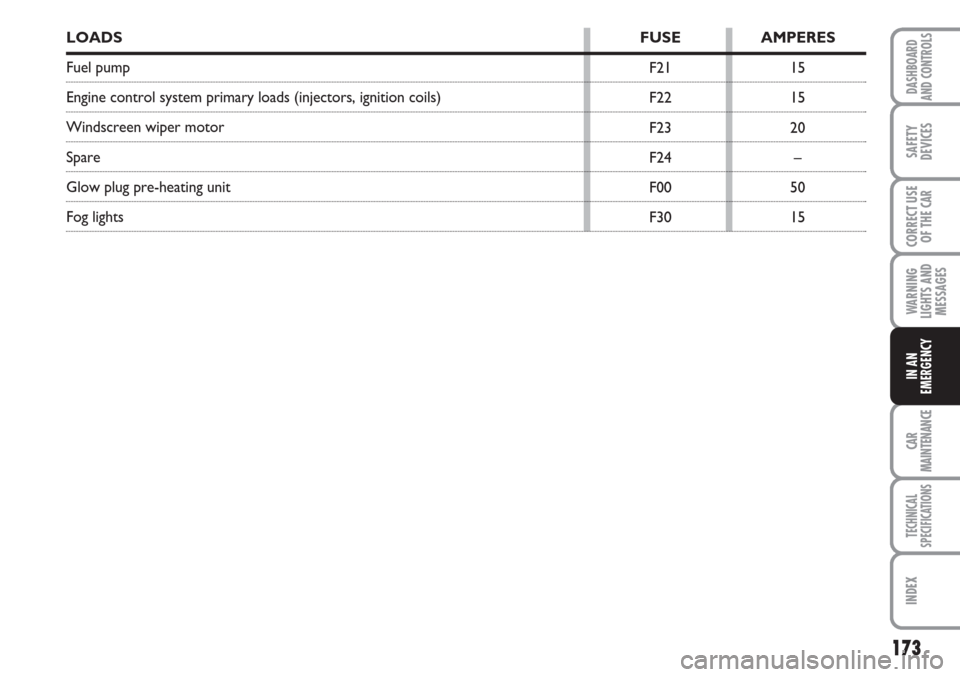
LOADSFUSE AMPERES
Fuel pump
Engine control system primary loads (injectors, ignition coils)
Windscreen wiper motor
Spare
Glow plug pre-heating unit
Fog lights
Page 178 of 230
177
WARNING
LIGHTS AND
MESSAGES
TECHNICAL
SPECIFICATIONS
INDEX
DASHBOARD
AND CONTROLS
SAFETY
DEVICES
CORRECT USE
OF THE CAR
IN AN
EMERGENCY
CAR
MAINTENANCE
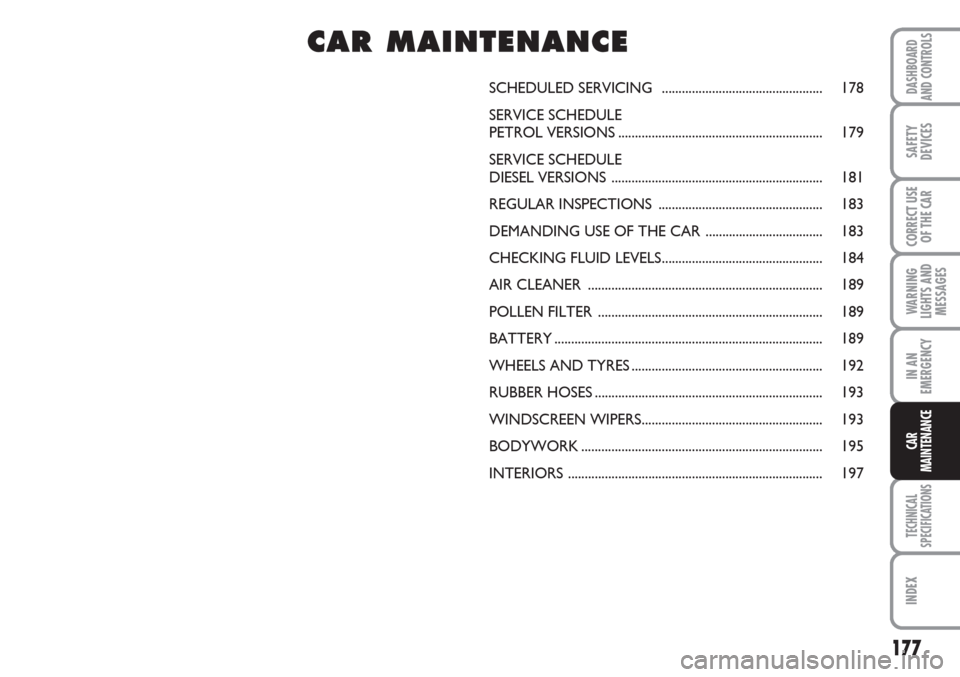
SCHEDULED SERVICING ................................................ 178
SERVICE SCHEDULE
PETROL VERSIONS............................................................. 179
SERVICE SCHEDULE
DIESEL VERSIONS ............................................................... 181
REGULAR INSPECTIONS ................................................. 183
DEMANDING USE OF THE CAR ................................... 183
CHECKING FLUID LEVELS................................................ 184
AIR CLEANER ...................................................................... 189
POLLEN FILTER ................................................................... 189
BATTERY................................................................................ 189
WHEELS AND TYRES......................................................... 192
RUBBER HOSES .................................................................... 193
WINDSCREEN WIPERS...................................................... 193
BODYWORK........................................................................ 195
INTERIORS ............................................................................ 197
CC C
A A
R R
M M
A A
I I
N N
T T
E E
N N
A A
N N
C C
E E
Page 180 of 230
179
WARNING
LIGHTS AND
MESSAGES
TECHNICAL
SPECIFICATIONS
INDEX
DASHBOARD
AND CONTROLS
SAFETY
DEVICES
CORRECT USE
OF THE CAR
IN AN
EMERGENCY
CAR
MAINTENANCE
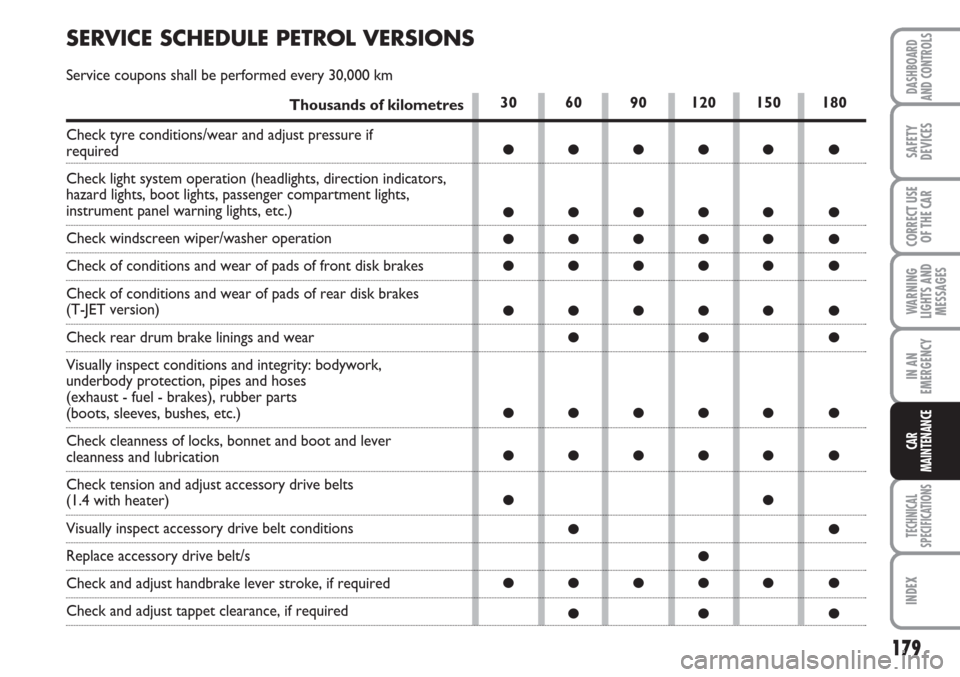
30 60 90 120 150 180
●●●●● ●
●●●●● ●
●●●●● ●
●●●●● ●
●●●●● ●
●● ●
●●●●● ●
●●●●● ●
●●
●●
●
●●●●● ●
●● ●
SERVICE SCHEDULE PETROL VERSIONS
Service coupons shall be performed every 30,000 km
Thousands of kilometres
Check tyre conditions/wear and adjust pressure if
required
Check light system operation (headlights, direction indicators,
hazard lights, boot lights, passenger compartment lights,
instrument panel warning lights, etc.)
Check windscreen wiper/washer operation
Check of conditions and wear of pads of front disk brakes
Check of conditions and wear of pads of rear disk brakes
(T-JET version)
Check rear drum brake linings and wear
Visually inspect conditions and integrity: bodywork,
underbody protection, pipes and hoses
(exhaust - fuel - brakes), rubber parts
(boots, sleeves, bushes, etc.)
Check cleanness of locks, bonnet and boot and lever
cleanness and lubrication
Check tension and adjust accessory drive belts
(1.4 with heater)
Visually inspect accessory drive belt conditions
Replace accessory drive belt/s
Check and adjust handbrake lever stroke, if required
Check and adjust tappet clearance, if required