fuel FIAT LINEA 2008 1.G Owner's Guide
[x] Cancel search | Manufacturer: FIAT, Model Year: 2008, Model line: LINEA, Model: FIAT LINEA 2008 1.GPages: 234, PDF Size: 3.41 MB
Page 184 of 234
183
WARNING
LIGHTS AND
MESSAGES
TECHNICAL
SPECIFICATIONS
INDEX
DASHBOARD
AND CONTROLS
SAFETY
DEVICES
CORRECT USE
OF THE CAR
IN AN
EMERGENCY
CAR
MAINTENANCE
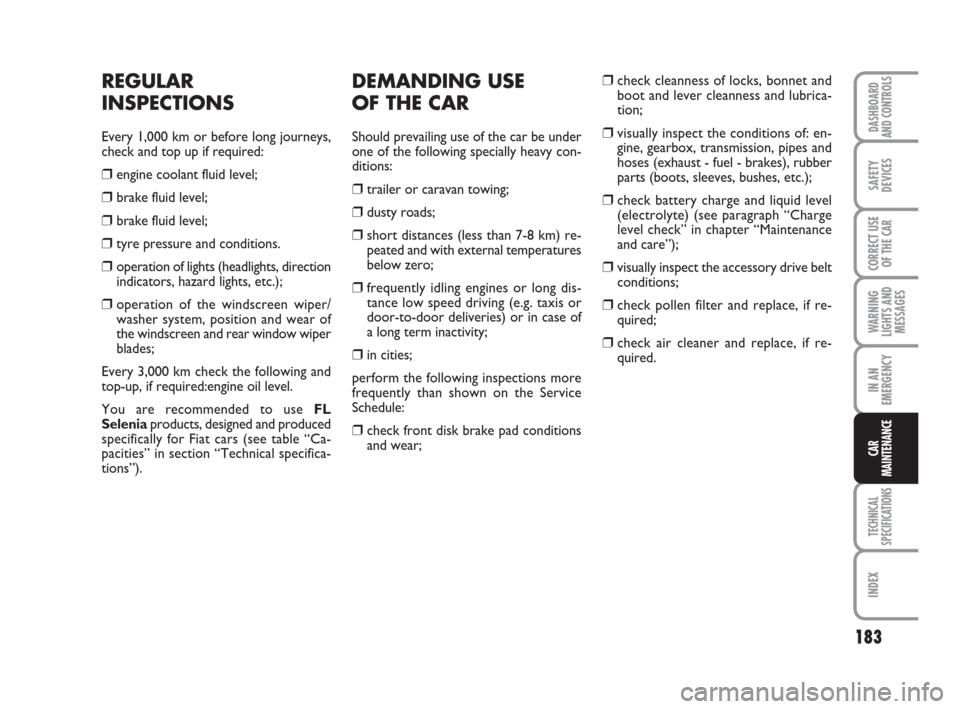
DEMANDING USE
OF THE CAR
Should prevailing use of the car be under
one of the following specially heavy con-
ditions:
❒trailer or caravan towing;
❒dusty roads;
❒short distances (less than 7-8 km) re-
peated and with external temperatures
below zero;
❒frequently idling engines or long dis-
tance low speed driving (e.g. taxis or
door-to-door deliveries) or in case of
a long term inactivity;
❒in cities;
perform the following inspections more
frequently than shown on the Service
Schedule:
❒check front disk brake pad conditions
and wear;
❒check cleanness of locks, bonnet and
boot and lever cleanness and lubrica-
tion;
❒visually inspect the conditions of: en-
gine, gearbox, transmission, pipes and
hoses (exhaust - fuel - brakes), rubber
parts (boots, sleeves, bushes, etc.);
❒check battery charge and liquid level
(electrolyte) (see paragraph “Charge
level check” in chapter “Maintenance
and care”);
❒visually inspect the accessory drive belt
conditions;
❒check pollen filter and replace, if re-
quired;
❒check air cleaner and replace, if re-
quired.
REGULAR
INSPECTIONS
Every 1,000 km or before long journeys,
check and top up if required:
❒engine coolant fluid level;
❒brake fluid level;
❒brake fluid level;
❒tyre pressure and conditions.
❒operation of lights (headlights, direction
indicators, hazard lights, etc.);
❒operation of the windscreen wiper/
washer system, position and wear of
the windscreen and rear window wiper
blades;
Every 3,000 km check the following and
top-up, if required:engine oil level.
You are recommended to use FL
Seleniaproducts, designed and produced
specifically for Fiat cars (see table “Ca-
pacities” in section “Technical specifica-
tions”).
177-200 LINEA 1ed GB 3-09-2008 17:31 Pagina 183
Page 195 of 234
194
WARNING
LIGHTS AND
MESSAGES
TECHNICAL
SPECIFICATIONS
INDEX
DASHBOARD
AND CONTROLS
SAFETY
DEVICES
CORRECT USE
OF THE CAR
IN AN
EMERGENCY
CAR
MAINTENANCE
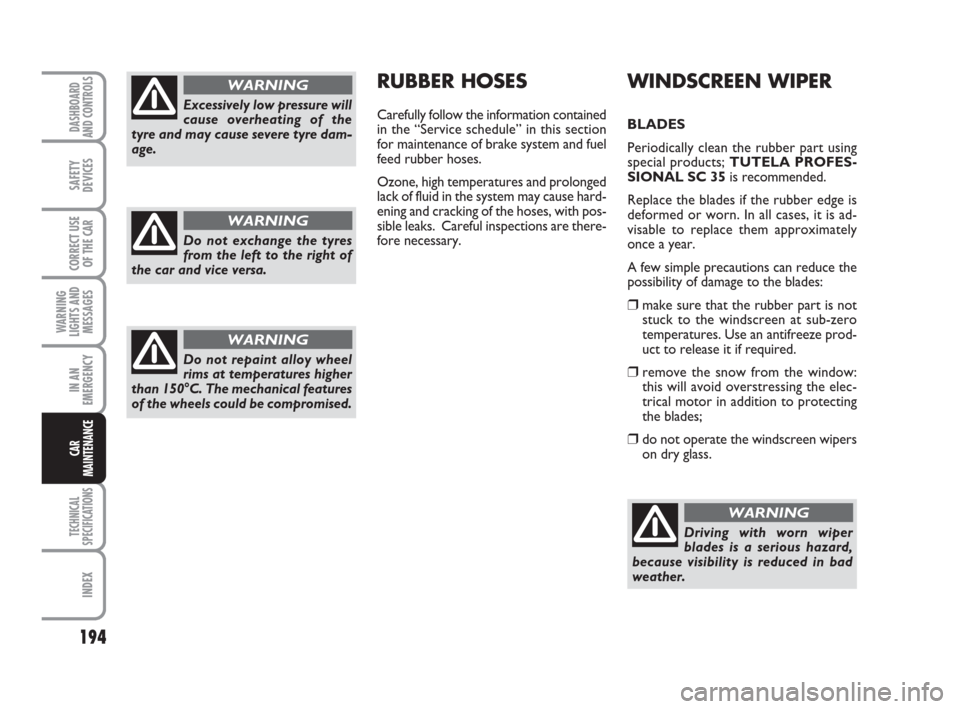
WINDSCREEN WIPER
BLADES
Periodically clean the rubber part using
special products; TUTELA PROFES-
SIONAL SC 35is recommended.
Replace the blades if the rubber edge is
deformed or worn. In all cases, it is ad-
visable to replace them approximately
once a year.
A few simple precautions can reduce the
possibility of damage to the blades:
❒make sure that the rubber part is not
stuck to the windscreen at sub-zero
temperatures. Use an antifreeze prod-
uct to release it if required.
❒remove the snow from the window:
this will avoid overstressing the elec-
trical motor in addition to protecting
the blades;
❒do not operate the windscreen wipers
on dry glass.
Driving with worn wiper
blades is a serious hazard,
because visibility is reduced in bad
weather.
WARNING
RUBBER HOSES
Carefully follow the information contained
in the “Service schedule” in this section
for maintenance of brake system and fuel
feed rubber hoses.
Ozone, high temperatures and prolonged
lack of fluid in the system may cause hard-
ening and cracking of the hoses, with pos-
sible leaks. Careful inspections are there-
fore necessary.Excessively low pressure will
cause overheating of the
tyre and may cause severe tyre dam-
age.
WARNING
Do not exchange the tyres
from the left to the right of
the car and vice versa.
WARNING
Do not repaint alloy wheel
rims at temperatures higher
than 150°C. The mechanical features
of the wheels could be compromised.
WARNING
177-200 LINEA 1ed GB 3-09-2008 17:31 Pagina 194
Page 202 of 234
201
WARNING
LIGHTS AND
MESSAGES
INDEX
DASHBOARD
AND CONTROLS
SAFETY
DEVICES
CORRECT USE
OF THE
CAR
IN AN
EMERGENCY
CAR
MAINTENANCE
TECHNICAL
SPECIFICATIONS
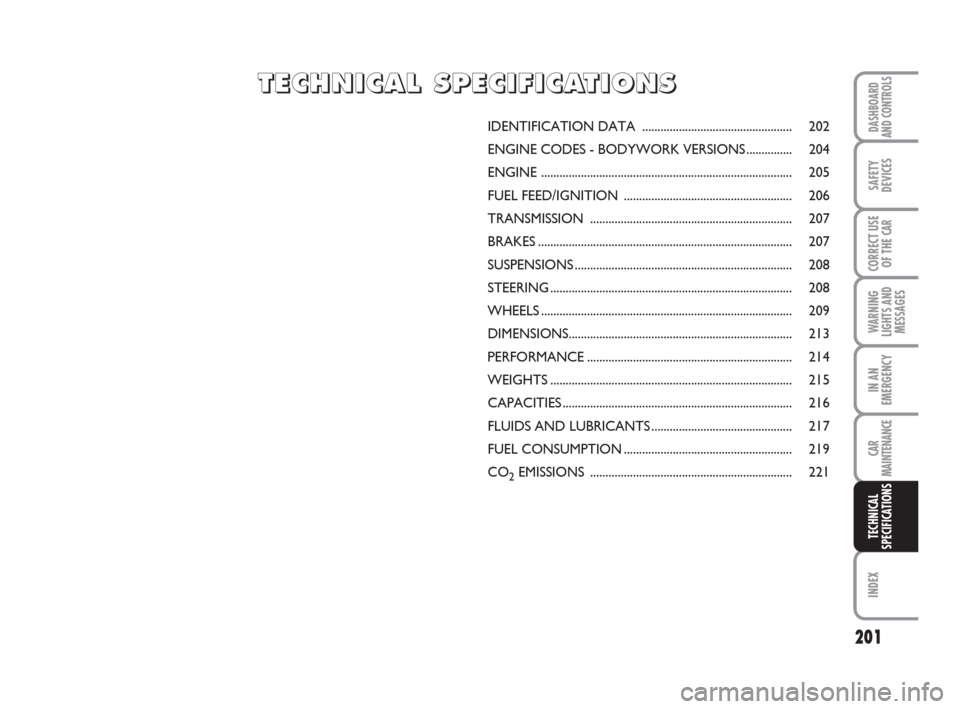
IDENTIFICATION DATA ................................................. 202
ENGINE CODES - BODYWORK VERSIONS............... 204
ENGINE .................................................................................. 205
FUEL FEED/IGNITION ....................................................... 206
TRANSMISSION .................................................................. 207
BRAKES................................................................................... 207
SUSPENSIONS....................................................................... 208
STEERING............................................................................... 208
WHEELS.................................................................................. 209
DIMENSIONS......................................................................... 213
PERFORMANCE................................................................... 214
WEIGHTS............................................................................... 215
CAPACITIES........................................................................... 216
FLUIDS AND LUBRICANTS.............................................. 217
FUEL CONSUMPTION....................................................... 219
CO
2EMISSIONS .................................................................. 221
TT T
E E
C C
H H
N N
I I
C C
A A
L L
S S
P P
E E
C C
I I
F F
I I
C C
A A
T T
I I
O O
N N
S S
201-221 LINEA 1ed GB 5-09-2008 9:24 Pagina 201
Page 206 of 234
205
WARNING
LIGHTS AND
MESSAGES
INDEX
DASHBOARD
AND CONTROLS
SAFETY
DEVICES
CORRECT USE
OF THE
CAR
IN AN
EMERGENCY
CAR
MAINTENANCE
TECHNICAL
SPECIFICATIONS
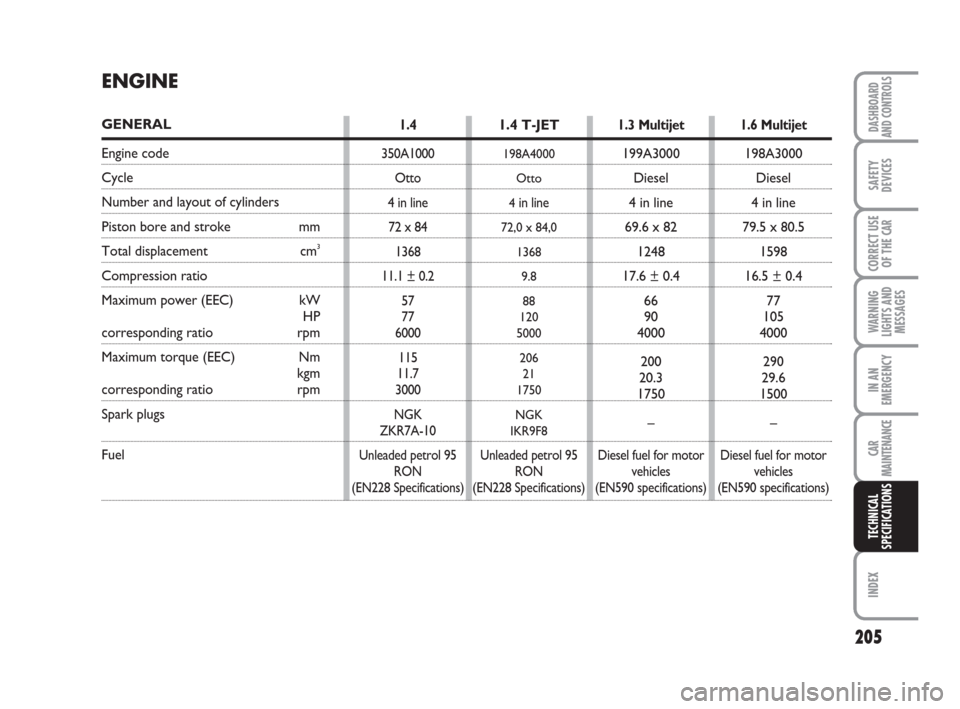
ENGINE
GENERAL
Engine code
Cycle
Number and layout of cylinders
Piston bore and stroke mm
Total displacement cm3
Compression ratio
Maximum power (EEC) kW
HP
corresponding ratio rpm
Maximum torque (EEC) Nm
kgm
corresponding ratio rpm
Spark plugs
Fuel
1.4
350A1000
Otto
4 in line
72 x 84
1368
11.1 ± 0.2
57
77
6000
115
11.7
3000
NGK
ZKR7A-10
Unleaded petrol 95
RON
(EN228 Specifications)
1.4 T-JET
198A4000
Otto
4
in line
72,0 x 84,0
1368
9.8
88
120
5000
206
21
1750
NGK
IKR9F8
Unleaded petrol 95
RON
(EN228 Specifications)
1.3 Multijet
199A3000
Diesel
4 in line
69.6 x 82
1248
17.6 ± 0.4
66
90
4000
200
20.3
1750
–
Diesel fuel for motor
vehicles
(EN590 specifications)
1.6 Multijet
198A3000
Diesel
4 in line
79.5 x 80.5
1598
16.5 ± 0.4
77
105
4000
290
29.6
1500
–
Diesel fuel for motor
vehicles
(EN590 specifications)
201-221 LINEA 1ed GB 5-09-2008 9:24 Pagina 205
Page 207 of 234
206
WARNING
LIGHTS AND
MESSAGES
INDEX
DASHBOARD
AND CONTROLS
SAFETY
DEVICES
CORRECT USE
OF THE
CAR
IN AN
EMERGENCY
CAR
MAINTENANCE
TECHNICAL
SPECIFICATIONS
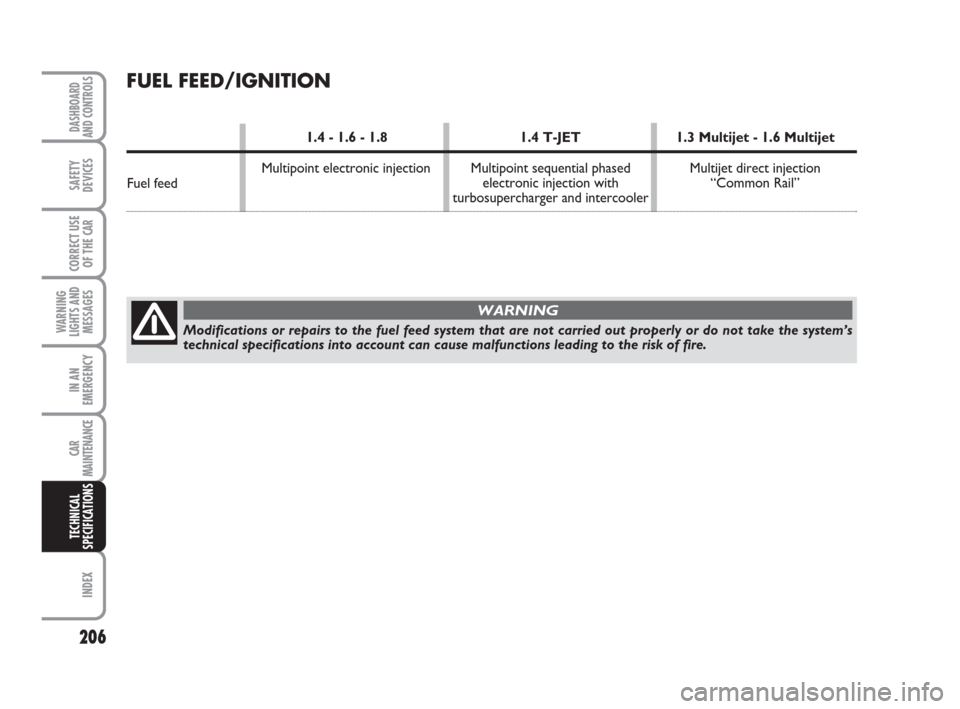
Modifications or repairs to the fuel feed system that are not carried out properly or do not take the system’s
technical specifications into account can cause malfunctions leading to the risk of fire.
WARNING
Fuel feedMultipoint electronic injection Multipoint sequential phased
electronic injection with
turbosupercharger and intercoolerMultijet direct injection
“Common Rail”
FUEL FEED/IGNITION
1.4 - 1.6 - 1.8 1.4 T-JET 1.3 Multijet - 1.6 Multijet
201-221 LINEA 1ed GB 5-09-2008 9:24 Pagina 206
Page 216 of 234
215
WARNING
LIGHTS AND
MESSAGES
INDEX
DASHBOARD
AND CONTROLS
SAFETY
DEVICES
CORRECT USE
OF THE
CAR
IN AN
EMERGENCY
CAR
MAINTENANCE
TECHNICAL
SPECIFICATIONS
1160
500
1000
900
1660
1200
500
75
70
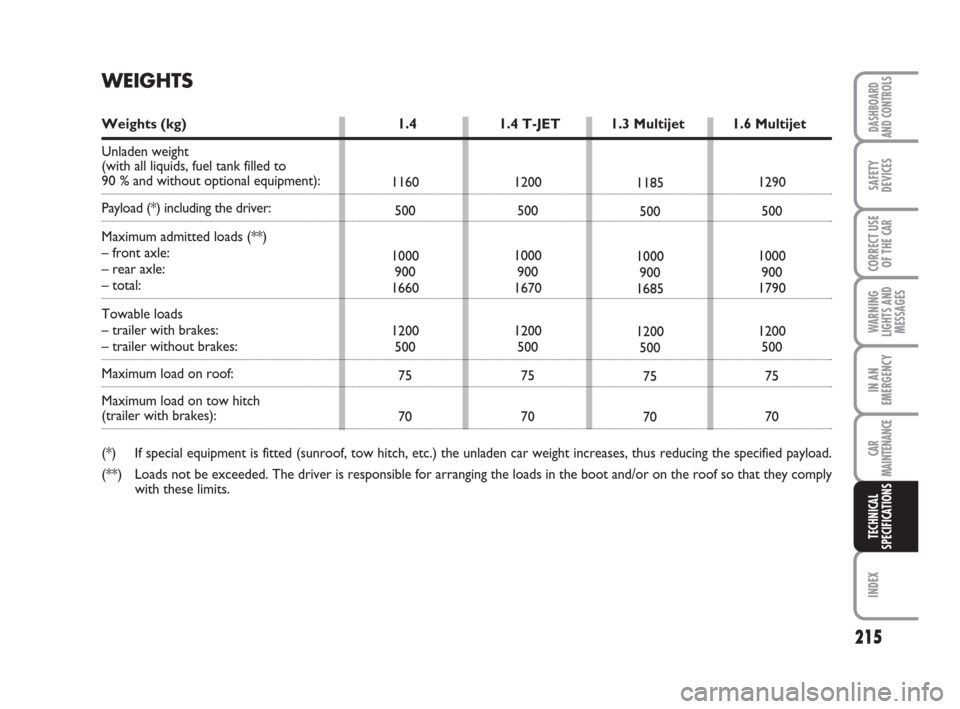
WEIGHTS
Weights (kg) 1.4 1.4 T-JET 1.3 Multijet 1.6 Multijet
Unladen weight
(with all liquids, fuel tank filled to
90 % and without optional equipment):
Payload (*) including the driver:
Maximum admitted loads (**)
– front axle:
– rear axle:
– total:
Towable loads
– trailer with brakes:
– trailer without brakes:
Maximum load on roof:
Maximum load on tow hitch
(trailer with brakes):
(*) If special equipment is fitted (sunroof, tow hitch, etc.) the unladen car weight increases, thus reducing the specified payload.
(**) Loads not be exceeded. The driver is responsible for arranging the loads in the boot and/or on the roof so that they comply
with these limits.1200
500
1000
900
1670
1200
500
75
701185
500
1000
900
1685
1200
500
75
701290
500
1000
900
1790
1200
500
75
70
201-221 LINEA 1ed GB 5-09-2008 9:24 Pagina 215
Page 217 of 234
216
WARNING
LIGHTS AND
MESSAGES
INDEX
DASHBOARD
AND CONTROLS
SAFETY
DEVICES
CORRECT USE
OF THE
CAR
IN AN
EMERGENCY
CAR
MAINTENANCE
TECHNICAL
SPECIFICATIONS
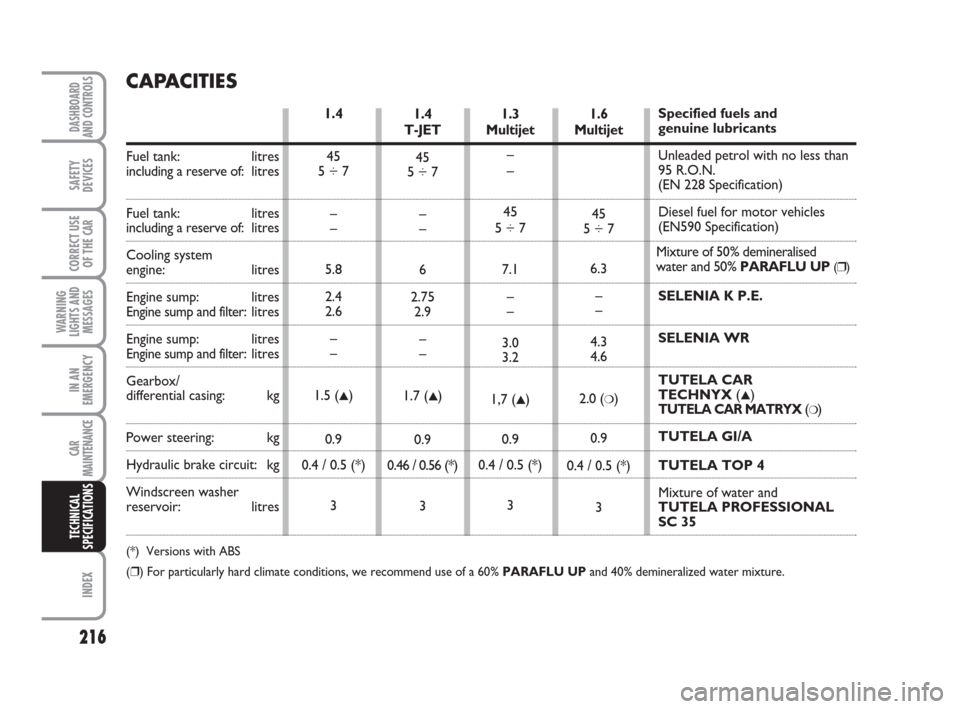
CAPACITIES
Fuel tank: litres
including a reserve of:litres
Fuel tank: litresincluding a reserve of:litres
Cooling system
engine: litres
Engine sump: litres
Engine sump and filter:litres
Engine sump: litres
Engine sump and filter:litres
Gearbox/
differential casing: kg
Power steering: kg
Hydraulic brake circuit: kg
Windscreen washer
reservoir: litres
(*) Versions with ABS
(❒) For particularly hard climate conditions, we recommend use of a 60% PARAFLU UPand 40% demineralized water mixture.
1.6
Multijet
45
5 ÷ 7
6.3
–
–
4.3
4.6
2.0 (
❍)
0.9
0.4 / 0.5 (*)
3 1.4
T-JET
45
5 ÷ 7
–
–
6
2.75
2.9
–
–
1.7 (▲)
0.9
0.46 / 0.56 (*)
31.3
Multijet
–
–
45
5 ÷ 7
7.1
–
–
3.0
3.2
1,7 (▲)
0.9
0.4 / 0.5 (*)
3 1.4
45
5 ÷ 7
–
–
5.8
2.4
2.6
–
–
1.5 (▲)
0.9
0.4 / 0.5 (*)
3Specified fuels and
genuine lubricants
Unleaded petrol with no less than
95 R.O.N.
(EN 228 Specification)
Diesel fuel for motor vehicles
(EN590 Specification)
Mixture of 50% demineralised
water and 50% PARAFLU UP
(❒)
SELENIA K P.E.
SELENIA WR
TUTELA CAR
TECHNYX (
▲)TUTELA CAR MATRYX (❍)
TUTELA GI/A
TUTELA TOP 4
Mixture of water and
TUTELA PROFESSIONAL
SC 35
201-221 LINEA 1ed GB 5-09-2008 9:24 Pagina 216
Page 219 of 234
218
WARNING
LIGHTS AND
MESSAGES
INDEX
DASHBOARD
AND CONTROLS
SAFETY
DEVICES
CORRECT USE
OF THE
CAR
IN AN
EMERGENCY
CAR
MAINTENANCE
TECHNICAL
SPECIFICATIONS
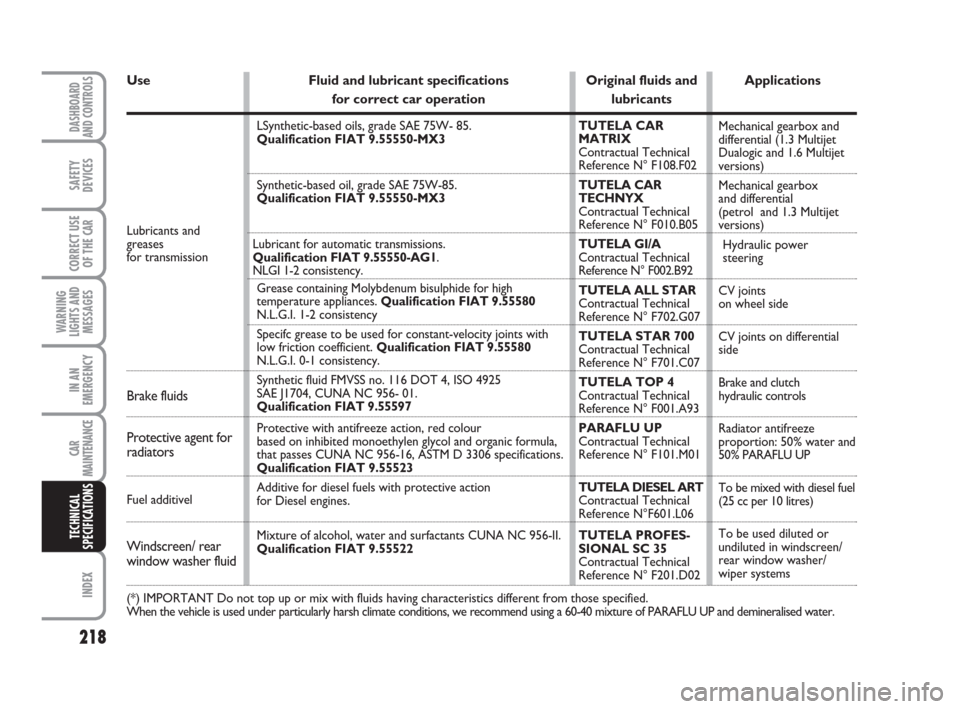
Lubricants and
greases
for transmission
Use Fluid and lubricant specifications Original fluids and Applications
for correct car operation lubricants
(*) IMPORTANT Do not top up or mix with fluids having characteristics different from those specified.
When the vehicle is used under particularly harsh climate conditions, we recommend using a 60-40 mixture of PARAFLU UP and demineralised water. LSynthetic-based oils, grade SAE 75W- 85.
Qualification FIAT 9.55550-MX3
Synthetic-based oil, grade SAE 75W-85.
Qualification FIAT 9.55550-MX3
Lubricant for automatic transmissions.
QualificationFIAT 9.55550-AG1.
NLGI 1-2 consistency.
Grease containing Molybdenum bisulphide for high
temperature appliances. Qualification FIAT 9.55580
N.L.G.I. 1-2 consistency
Specifc grease to be used for constant-velocity joints with
low friction coefficient. Qualification FIAT 9.55580
N.L.G.I. 0-1 consistency.
Synthetic fluid FMVSS no. 116 DOT 4, ISO 4925
SAE J1704, CUNA NC 956- 01.
QualificationFIAT 9.55597
Protective with antifreeze action, red colour
based on inhibited monoethylen glycol and organic formula,
that passes CUNA NC 956-16, ASTM D 3306 specifications.
Qualification FIAT 9.55523
Additive for diesel fuels with protective action
for Diesel engines.
Mixture of alcohol, water and surfactants CUNA NC 956-II.
Qualification FIAT 9.55522TUTELA CAR
MATRIX
Contractual Technical
Reference N° F108.F02
TUTELA CAR
TECHNYX
Contractual Technical
Reference N° F010.B05
TUTELA GI/A
Contractual Technical
Reference N° F002.B92
TUTELA ALL STAR
Contractual Technical
Reference N° F702.G07
TUTELA STAR 700
Contractual Technical
Reference N° F701.C07
TUTELA TOP 4
Contractual Technical
Reference N° F001.A93
PARAFLU UP
Contractual Technical
Reference N° F101.M01
TUTELA DIESEL ART
Contractual Technical
Reference N°F601.L06
TUTELA PROFES-
SIONAL SC 35
Contractual Technical
Reference N° F201.D02Mechanical gearbox and
differential (1.3 Multijet
Dualogic and 1.6 Multijet
versions)
Mechanical gearbox
and differential
(petrol and 1.3 Multijet
versions)
Hydraulic power
steering
CV joints
on wheel side
CV joints on differential
side
Brake and clutch
hydraulic controls
Radiator antifreeze
proportion: 50% water and
50% PARAFLU UP
To be mixed with diesel fuel
(25 cc per 10 litres)
To be used diluted or
undiluted in windscreen/
rear window washer/
wiper systems
Brake fluids
Protective agent for
radiators
Windscreen/ rear
window washer fluid
Fuel additivel
201-221 LINEA 1ed GB 5-09-2008 9:24 Pagina 218
Page 220 of 234
219
WARNING
LIGHTS AND
MESSAGES
INDEX
DASHBOARD
AND CONTROLS
SAFETY
DEVICES
CORRECT USE
OF THE
CAR
IN AN
EMERGENCY
CAR
MAINTENANCE
TECHNICAL
SPECIFICATIONS
❒extra-urban cycle: frequent accelerat-
ing in all gears, simulating extraurban
use of the car: speed varies between 0
and 120 km/h;
❒combined consumption: calculated
weighing about 37% of urban cycle con-
sumption and about 63% of extraurban
consumption.
FUEL
CONSUMPTION
The fuel consumption figures given in the
table below are determined on the basis
of the homologation tests set down by
specific European Directives.
The procedures below are followed for
measuring consumption:
❒urban cycle: cold starting followed by
driving that simulates urban use of the
car;IMPORTANT The type of route, traffic
situations, weather conditions, driving
style, general conditions of the car, trim
level/equipment/accessories, load, climate
control system, roof rack, other situations
that affect air drag may lead to different
fuel consumption levels than those mea-
sured.
201-221 LINEA 1ed GB 5-09-2008 9:24 Pagina 219
Page 221 of 234
220
WARNING
LIGHTS AND
MESSAGES
INDEX
DASHBOARD
AND CONTROLS
SAFETY
DEVICES
CORRECT USE
OF THE
CAR
IN AN
EMERGENCY
CAR
MAINTENANCE
TECHNICAL
SPECIFICATIONS
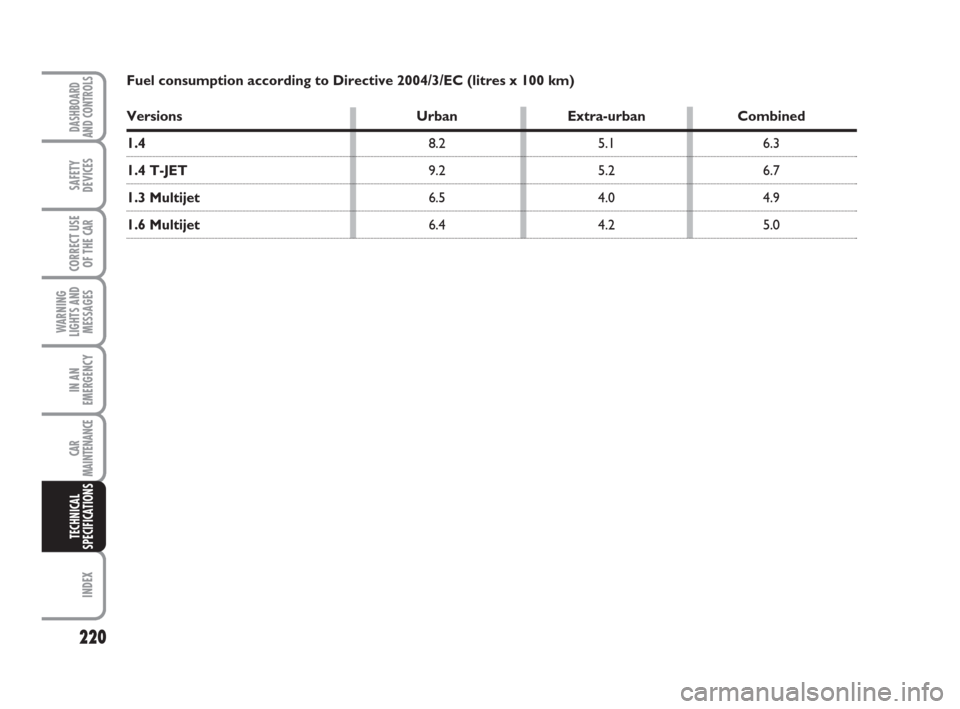
Fuel consumption according to Directive 2004/3/EC (litres x 100 km)
Versions Urban Extra-urban Combined
1.4 8.2 5.1 6.3
1.4 T-JET9.2 5.2 6.7
1.3 Multijet6.5 4.0 4.9
1.6 Multijet6.4 4.2 5.0
201-221 LINEA 1ed GB 5-09-2008 9:24 Pagina 220