fuel FIAT MULTIPLA 2007 1.G User Guide
[x] Cancel search | Manufacturer: FIAT, Model Year: 2007, Model line: MULTIPLA, Model: FIAT MULTIPLA 2007 1.GPages: 266, PDF Size: 4.66 MB
Page 141 of 266
140
WARNING
LIGHTS AND
MESSAGES
IN AN
EMERGENCY
CAR
MAINTENANCE
TECHNICAL
SPECIFICATIONS
INDEX
DASHBOARD
AND CONTROLS
SAFETY
DEVICES
CORRECT USE
OF THE CAR
STOPPING THE ENGINE
Turn the ignition to STOP while the engine is idling.
IMPORTANT After a taxing drive, you should allow
the engine to “catch its breath” before turning it off by
letting it idle to allow the temperature in the engine
compartment to fall.PARKING
Proceed as follows:
❒stop the engine and engage the handbrake;
❒engage a gear (first if the car is faced uphill or
reverse if it is faced downhill) and leave the wheels
steered.
Block the wheels with a wedge or a stone if the car is
parked on a steep slope.
Do not leave the ignition key at MAR to prevent
draining the battery. Always remove the key when you
leave the car.
Never leave children unattended in the car. Always
remove the ignition key when leaving the car and take
it out with you.
A quick burst on the accelerator before turning off the engine does not serve any practical purpose at
all. It wastes fuel and is damaging, particularly to turbo-charged engines.
Page 144 of 266
143
WARNING
LIGHTS AND
MESSAGES
IN AN
EMERGENCY
CAR
MAINTENANCE
TECHNICAL
SPECIFICATIONS
INDEX
DASHBOARD
AND CONTROLS
SAFETY
DEVICES
CORRECT USE
OF THE CAR
CONTAINING RUNNING COSTS
Here are some suggestions which may help you to
keep the running costs of your car down and lower
the amount of toxic emissions released into the
atmosphere.
GENERAL CONSIDERATIONS
Car maintenance
Have checks and adjustments carried out in
accordance with the “Service schedule”.
Tyres
Check the pressure of the tyres routinely at an
interval of no more than 4 weeks: if the pressure is
too low, consumption levels increase as resistance to
rolling is higher.
Unnecessary loads
Do not travel with too much luggage stowed in the
boot. The weight of the car (especially when driving in
town) and its trim greatly affects consumption and
stability.Roof rack/ski rack
Remove the roof rack or the ski rack from the roof as
soon as they are no longer used. These accessories
lower air penetration and adversely affect
consumption levels. When needing to carry
particularly voluminous objects, preferably use a
trailer.
Electric devices
Use electric devices only for the amount of time
needed. Rear heated window, additional headlights,
windscreen wipers and heater fan need a considerable
amount of energy, therefore increasing the
requirement of current increases fuel consumption (up
to +25% in the urban cycle).
Climate control
The air conditioner is an additional load which greatly
affects the engine leading to higher consumption (on
average up to +20%). When the temperature outside
the vehicle permits it, use the air vents where possible.
Aerodynamic accessories
The use of non-certified aerodynamic items may
adversely affect air drag and consumption levels.
Page 145 of 266
144
WARNING
LIGHTS AND
MESSAGES
IN AN
EMERGENCY
CAR
MAINTENANCE
TECHNICAL
SPECIFICATIONS
INDEX
DASHBOARD
AND CONTROLS
SAFETY
DEVICES
CORRECT USE
OF THE CAR
DRIVING STYLE
Starting
Do not warm the engine with the car at a standstill or
at idle or high speed: under these conditions the
engine warms up much more slowly, increasing
electrical consumption and emissions. It is therefore
advisable to move off immediately, slowly, avoiding
high speeds. This way the engine will warm faster.
Unnecessary actions
Avoid accelerating when waiting at traffic lights or
before switching off the engine. This and also double
declutching is absolutely pointless on modern cars and
also increase consumption and pollution.
Gear selection
As soon as the conditions of the traffic and road allow,
use a higher gear. Using a low gear to obtain brilliant
performance increases consumption.
In the same way improper use of a high gear increases
consumption, emissions an engine wear.
Top speed
Fuel consumption considerably increases with speed.
Keep speed as constant as possible and avoid
superfluous braking and accelerating, which cost in
terms of both fuel and emissions.Acceleration
Accelerating violently increasing the revs will greatly
affect consumption and emissions: acceleration should
be gradual and should not exceed the maximum
torque.
CONDITIONS OF USE
Cold starting
Short journeys and frequent cold starts do not allow
the engine to reach optimum operating temperature.
This results in a significant increase in consumption
levels (from +15 to +30% on the urban cycle) and
emission of harmful substances.
Traffic situations and road conditions
Rather high consumption levels are tied to situations
with heavy traffic, for example in queues with frequent
use of the lower gears or in cities with many traffic
lights. Also winding mountain roads and rough road
surfaces adversely affect consumption.
Traffic hold-ups
During prolonged hold-ups (e.g. level crossings) the
engine should be switched off.
Page 153 of 266
152
IN AN
EMERGENCY
CAR
MAINTENANCE
TECHNICAL
SPECIFICATIONS
INDEX
DASHBOARD
AND CONTROLS
SAFETY
DEVICES
CORRECT USE
OF THE CAR
WARNING
LIGHTS AND
MESSAGES
152
WW W
A A
R R
N N
I I
N N
G G
L L
I I
G G
H H
T T
S S
A A
N N
D D
M M
E E
S S
S S
A A
G G
E E E
S S
GENERAL INFORMATION .............................................. 153
ENGINE COOLANT TOO HOT ................................... 154
LOW BRAKE FLUID LEVEL .............................................. 154
BATTERY NOT RECHARGING PROPERLY ............... 155
SEAT BELTS NOT FASTENED ......................................... 155
AIRBAG FAILURE ................................................................ 155
DOORS OPEN ..................................................................... 156
FRONT BRAKES PADS WORN....................................... 156
LOW ENGINE OIL PRESSURE ........................................ 156
ABS (WHEEL ANTI-LOCKING SYSTEM) FAILURE.... 157
EBD (ELECTRONIC BRAKE FORCE DISTRIBUTOR)
FAILURE .................................................................................. 157
ESP SYSTEM ........................................................................... 157
EOBD / INJECTION SYSTEM FAILURE.......................... 158
FIAT CODE ........................................................................... 159
POSSIBLE ICE ON ROAD ................................................ 159INERTIAL FUEL CUT-OFF SWITCH .............................. 159
EXHAUST OIL ..................................................................... 160
DIESEL PARTICULATE FILTER CLOGGED ................. 161
GLOW PLUGS ..................................................................... 162
DIRECTION INDICATORS ............................................. 162
PASSENGER SIDE AIRBAG DEACTIVATED ............... 162
OUTSIDE LIGHTS ............................................................... 163
MAIN BEAM HEADLIGHTS ............................................. 163
SERVICE ................................................................................. 163
WARNING LIGHT FAILURE ........................................... 163
WATER IN DIESEL FUEL FILTER .................................... 163
Page 160 of 266
159
CORRECT USE
OF THE CAR
IN AN
EMERGENCY
CAR
MAINTENANCE
TECHNICAL
SPECIFICATIONS
INDEX
DASHBOARD
AND CONTROLS
SAFETY
DEVICES
WARNING
LIGHTS AND
MESSAGES
159
Warning Messagelight on panel on display
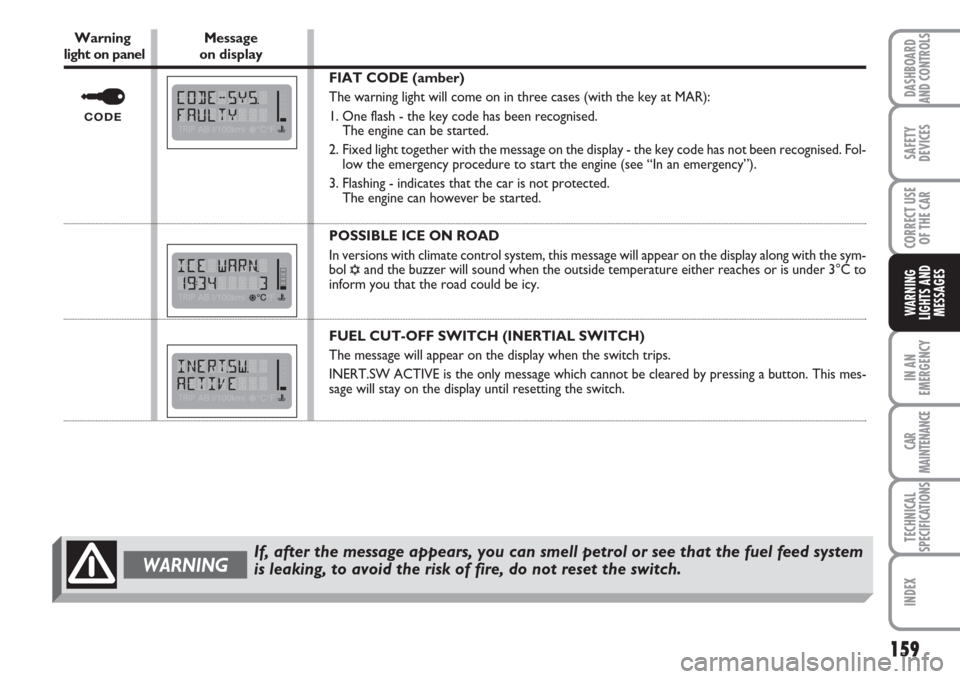
FIAT CODE (amber)
The warning light will come on in three cases (with the key at MAR):
1. One flash - the key code has been recognised.
The engine can be started.
2. Fixed light together with the message on the display - the key code has not been recognised. Fol-
low the emergency procedure to start the engine (see “In an emergency”).
3. Flashing - indicates that the car is not protected.
The engine can however be started.
POSSIBLE ICE ON ROAD
In versions with climate control system, this message will appear on the display along with the sym-
bol
√and the buzzer will sound when the outside temperature either reaches or is under 3°C to
inform you that the road could be icy.
FUEL CUT-OFF SWITCH (INERTIAL SWITCH)
The message will appear on the display when the switch trips.
INERT.SW ACTIVE is the only message which cannot be cleared by pressing a button. This mes-
sage will stay on the display until resetting the switch.
¢
If, after the message appears, you can smell petrol or see that the fuel feed system
is leaking, to avoid the risk of fire, do not reset the switch.WARNING
Page 164 of 266
163
CORRECT USE
OF THE CAR
IN AN
EMERGENCY
CAR
MAINTENANCE
TECHNICAL
SPECIFICATIONS
INDEX
DASHBOARD
AND CONTROLS
SAFETY
DEVICES
WARNING
LIGHTS AND
MESSAGES
163
Warning Messagelight on panel on display
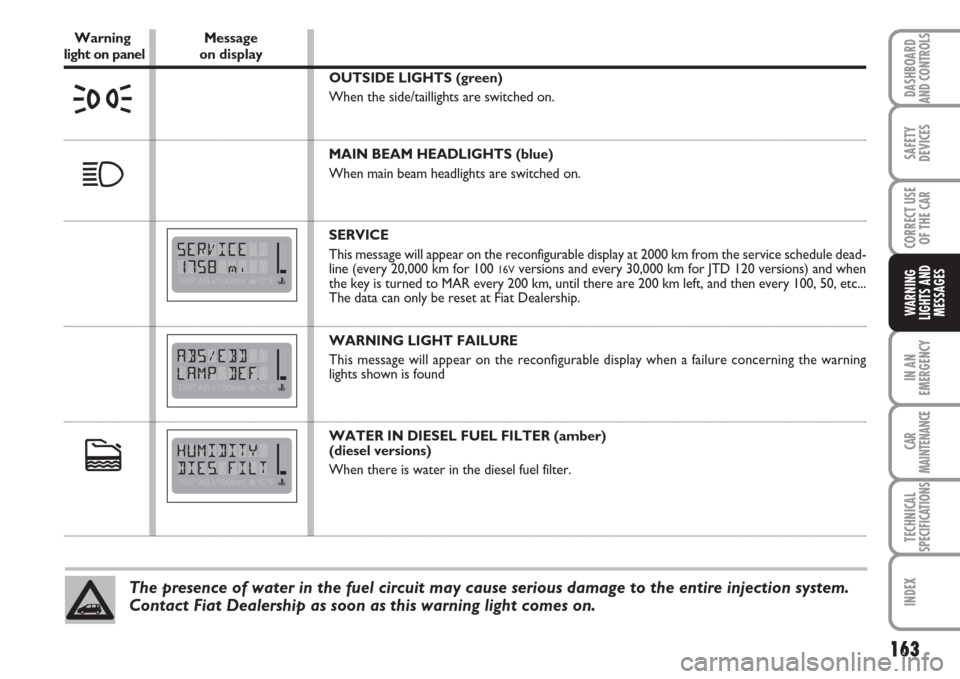
OUTSIDE LIGHTS (green)
When the side/taillights are switched on.
MAIN BEAM HEADLIGHTS (blue)
When main beam headlights are switched on.
SERVICE
This message will appear on the reconfigurable display at 2000 km from the service schedule dead-
line (every 20,000 km for 100
16Vversions and every 30,000 km for JTD 120 versions) and when
the key is turned to MAR every 200 km, until there are 200 km left, and then every 100, 50, etc...
The data can only be reset at Fiat Dealership.
WARNING LIGHT FAILURE
This message will appear on the reconfigurable display when a failure concerning the warning
lights shown is found
WATER IN DIESEL FUEL FILTER (amber)
(diesel versions)
When there is water in the diesel fuel filter.
3
1
The presence of water in the fuel circuit may cause serious damage to the entire injection system.
Contact Fiat Dealership as soon as this warning light comes on.
c
Page 167 of 266
166
SAFETY
DEVICES
CORRECT USE
OF THE CAR
WARNING
LIGHTS AND
MESSAGES
CAR
MAINTENANCE
TECHNICAL
SPECIFICATIONS
INDEX
DASHBOARD
AND CONTROLS
IN AN
EMERGENCY
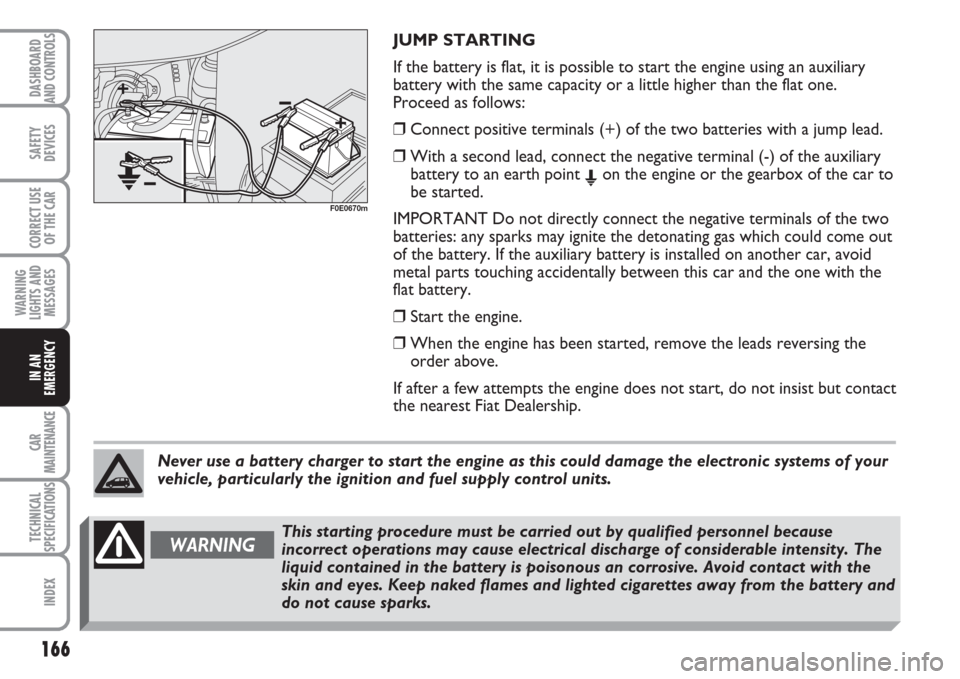
JUMP STARTING
If the battery is flat, it is possible to start the engine using an auxiliary
battery with the same capacity or a little higher than the flat one.
Proceed as follows:
❒Connect positive terminals (+) of the two batteries with a jump lead.
❒With a second lead, connect the negative terminal (-) of the auxiliary
battery to an earth point
Eon the engine or the gearbox of the car to
be started.
IMPORTANT Do not directly connect the negative terminals of the two
batteries: any sparks may ignite the detonating gas which could come out
of the battery. If the auxiliary battery is installed on another car, avoid
metal parts touching accidentally between this car and the one with the
flat battery.
❒Start the engine.
❒When the engine has been started, remove the leads reversing the
order above.
If after a few attempts the engine does not start, do not insist but contact
the nearest Fiat Dealership.
F0E0670m
Never use a battery charger to start the engine as this could damage the electronic systems of your
vehicle, particularly the ignition and fuel supply control units.
WARNINGThis starting procedure must be carried out by qualified personnel because
incorrect operations may cause electrical discharge of considerable intensity. The
liquid contained in the battery is poisonous an corrosive. Avoid contact with the
skin and eyes. Keep naked flames and lighted cigarettes away from the battery and
do not cause sparks.
Page 168 of 266
167
SAFETY
DEVICES
CORRECT USE
OF THE CAR
WARNING
LIGHTS AND
MESSAGES
CAR
MAINTENANCE
TECHNICAL
SPECIFICATIONS
INDEX
DASHBOARD
AND CONTROLS
IN AN
EMERGENCY
BUMP STARTING
Never bump start the engine by pushing, towing or
coasting downhill.
This could cause fuel to flow into the catalytic
converter and damage it beyond repair.
IMPORTANT Remember that the servobrake and
electrical power steering system are not operating
until the engine is started, a greater effort will
therefore be required to press the brake pedal or turn
the steering wheel.IF A TYRE IS PUNCTURED
GENERAL INSTRUCTIONS
For versions/markets where applicable, the car can be
fitted with a quick tyre repair kit called FIX & GO,
replacing the usual tool fitting, the spare wheel lifting
winch and the space-saver spare wheel.
Normal spare small wheel, or (where provided)
normal size spare wheel, can be supplied on request;
for its use, follow what indicated below.
VAN versions are fitted as standard with a spare
wheel with steel rim of the same type and size as the
standard wheels mounted on the car.
Wheel changing and correct use of the jack and space-
saver spare wheel call for some precautions as listed
below.
WARNINGAlert other drivers that the car is stationary in compliance with local regulations:
hazard warning lights, warning triangle, etc. Any passengers on board should leave the
car, especially if it is heavily laden. Passengers should stay away from oncoming traffic
while the wheel is being changed. If parked on a slope or rough surface, chock the
wheels with wedges or other suitable devices to prevent the car from rolling.
Page 201 of 266
200
SAFETY
DEVICES
CORRECT USE
OF THE CAR
WARNING
LIGHTS AND
MESSAGES
CAR
MAINTENANCE
TECHNICAL
SPECIFICATIONS
INDEX
DASHBOARD
AND CONTROLS
IN AN
EMERGENCY
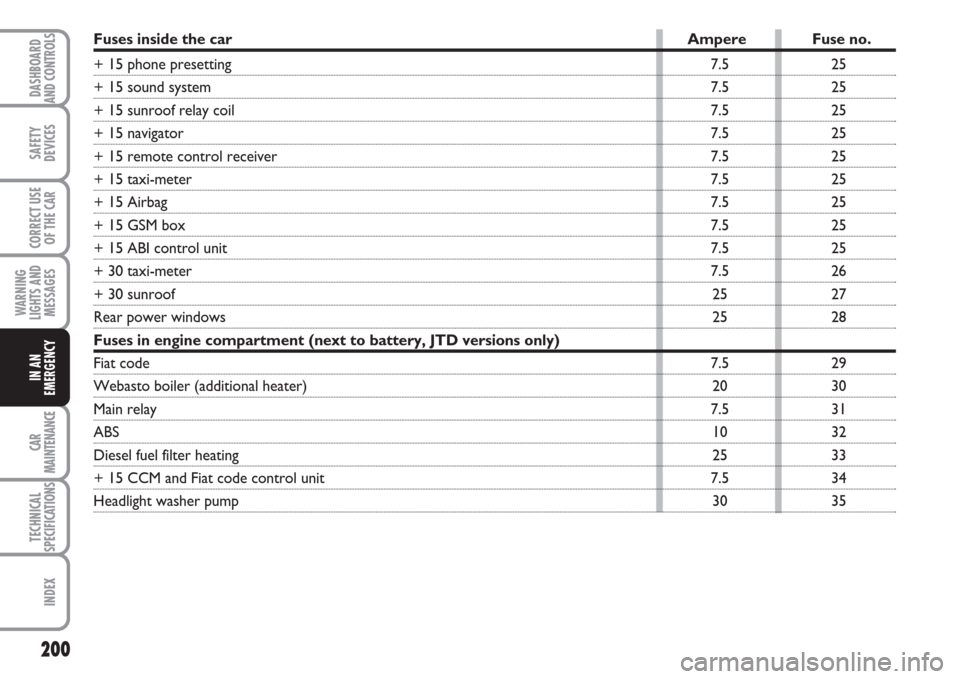
25
25
25
25
25
25
25
25
25
26
27
28
29
30
31
32
33
34
35 7.5
7.5
7.5
7.5
7.5
7.5
7.5
7.5
7.5
7.5
25
25
7.5
20
7.5
10
25
7.5
30+ 15 phone presetting
+ 15 sound system
+ 15 sunroof relay coil
+ 15 navigator
+ 15 remote control receiver
+ 15 taxi-meter
+ 15 Airbag
+ 15 GSM box
+ 15 ABI control unit
+ 30 taxi-meter
+ 30 sunroof
Rear power windows
Fuses in engine compartment (next to battery, JTD versions only)
Fiat code
Webasto boiler (additional heater)
Main relay
ABS
Diesel fuel filter heating
+ 15 CCM and Fiat code control unit
Headlight washer pump
Fuses inside the car Ampere Fuse no.
Page 206 of 266
205
SAFETY
DEVICES
CORRECT USE
OF THE CAR
WARNING
LIGHTS AND
MESSAGES
TECHNICAL
SPECIFICATIONS
INDEX
DASHBOARD
AND CONTROLS
IN AN
EMERGENCY
CAR
MAINTENANCE
CC C
A A
R R
M M
A A
I I
N N
T T
E E
N N
A A
N N
C C
E E
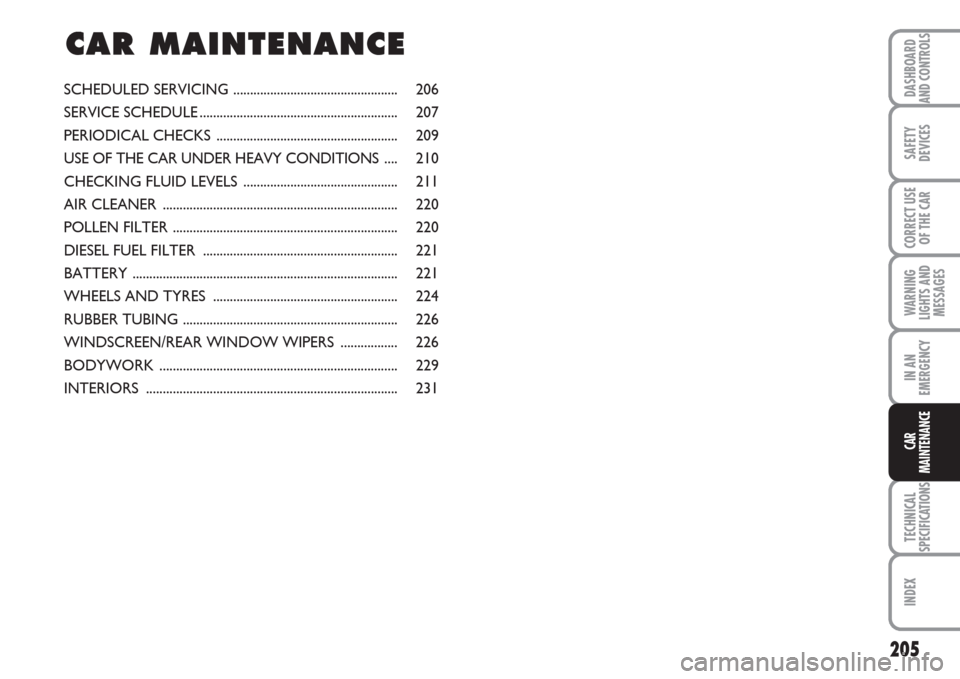
SCHEDULED SERVICING ................................................. 206
SERVICE SCHEDULE ........................................................... 207
PERIODICAL CHECKS ...................................................... 209
USE OF THE CAR UNDER HEAVY CONDITIONS.... 210
CHECKING FLUID LEVELS .............................................. 211
AIR CLEANER ...................................................................... 220
POLLEN FILTER ................................................................... 220
DIESEL FUEL FILTER .......................................................... 221
BATTERY ............................................................................... 221
WHEELS AND TYRES ....................................................... 224
RUBBER TUBING ................................................................ 226
WINDSCREEN/REAR WINDOW WIPERS ................. 226
BODYWORK ....................................................................... 229
INTERIORS ........................................................................... 231