pressure FIAT MULTIPLA 2007 1.G User Guide
[x] Cancel search | Manufacturer: FIAT, Model Year: 2007, Model line: MULTIPLA, Model: FIAT MULTIPLA 2007 1.GPages: 266, PDF Size: 4.66 MB
Page 181 of 266
180
SAFETY
DEVICES
CORRECT USE
OF THE CAR
WARNING
LIGHTS AND
MESSAGES
CAR
MAINTENANCE
TECHNICAL
SPECIFICATIONS
INDEX
DASHBOARD
AND CONTROLS
IN AN
EMERGENCY
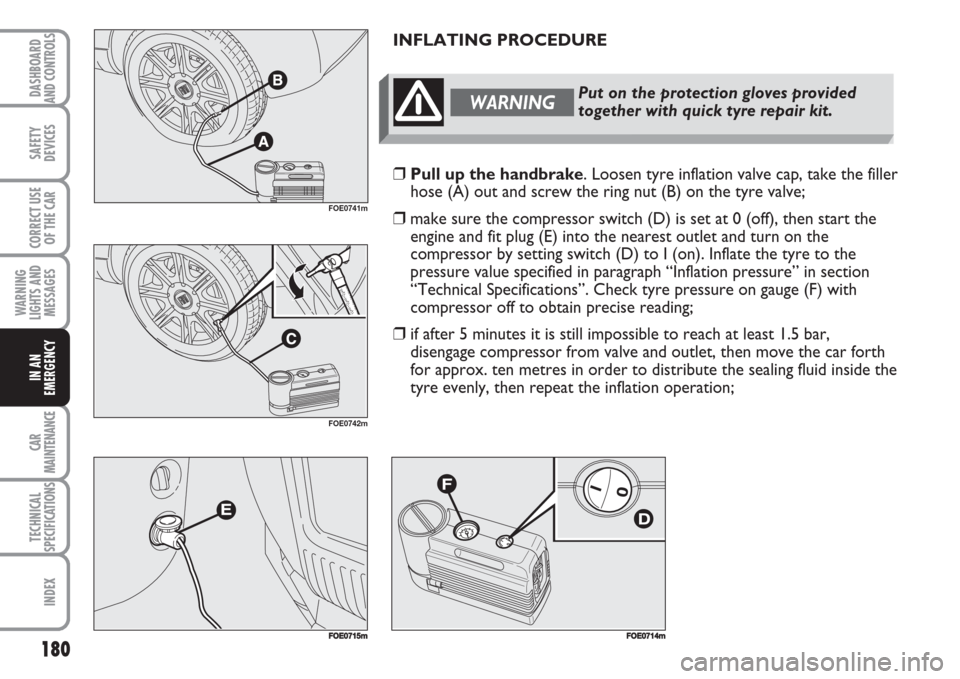
INFLATING PROCEDURE
WARNINGPut on the protection gloves provided
together with quick tyre repair kit.
❒Pull up the handbrake. Loosen tyre inflation valve cap, take the filler
hose (A) out and screw the ring nut (B) on the tyre valve;
❒make sure the compressor switch (D) is set at 0 (off), then start the
engine and fit plug (E) into the nearest outlet and turn on the
compressor by setting switch (D) to I (on). Inflate the tyre to the
pressure value specified in paragraph “Inflation pressure” in section
“Technical Specifications”. Check tyre pressure on gauge (F) with
compressor off to obtain precise reading;
❒if after 5 minutes it is still impossible to reach at least 1.5 bar,
disengage compressor from valve and outlet, then move the car forth
for approx. ten metres in order to distribute the sealing fluid inside the
tyre evenly, then repeat the inflation operation;
FOE0741m
FOE0742m
FOE0715mFOE0714m
Page 182 of 266
181
SAFETY
DEVICES
CORRECT USE
OF THE CAR
WARNING
LIGHTS AND
MESSAGES
CAR
MAINTENANCE
TECHNICAL
SPECIFICATIONS
INDEX
DASHBOARD
AND CONTROLS
IN AN
EMERGENCY
❒if also in this case, after 5 minutes from turning the
compressor on it is still impossible to reach at least
1.8 bar, do not start driving since the tyre is
excessively damaged and the quick tyre repair kit
cannot guarantee suitable sealing, contact Fiat
Dealership;
❒if the proper tyre pressure has been reached (see
paragraph “Inflation pressure” in section “Technical
Specifications”, start driving immediately;❒after driving for about 10 minutes stop and check
again the tyre pressure; pull up the handbrake;
WARNING
WARNING
WARNING
Apply the sticker in a visible position
for the driver to indicate that the tyre
has been treated with the quick tyre
repair kit. Drive carefully especially
when cornering. Do not exceed 80
km/h. Avoid heavy braking and
accelerating.
It is of vital importance to
communicate that the tyre has been
repaired using the quick tyre repair kit.
Hand the instruction brochure to the
personnel charged with treating the
tyre repaired with the kit. If the pressure falls below 1.8 bars, do
not drive any further: the quick tyre
repair kit Fix & Go automatic cannot
guarantee proper hold
because the tyre
is too much damaged.
Contact Fiat
Dealership.
❒if pressure read is at least 1.8 bar, restore proper
pressure (with engine running and handbrake on)
and restart;
❒drive with the utmost care to the nearest Fiat
Dealership.
Page 183 of 266
182
SAFETY
DEVICES
CORRECT USE
OF THE CAR
WARNING
LIGHTS AND
MESSAGES
CAR
MAINTENANCE
TECHNICAL
SPECIFICATIONS
INDEX
DASHBOARD
AND CONTROLS
IN AN
EMERGENCY
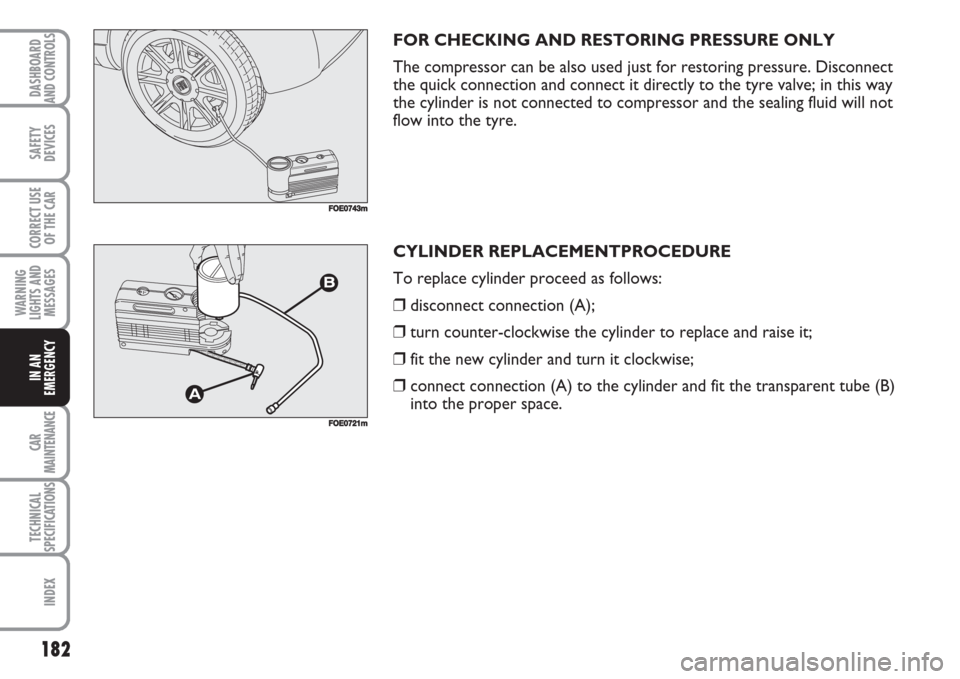
FOR CHECKING AND RESTORING PRESSURE ONLY
The compressor can be also used just for restoring pressure. Disconnect
the quick connection and connect it directly to the tyre valve; in this way
the cylinder is not connected to compressor and the sealing fluid will not
flow into the tyre.
CYLINDER REPLACEMENTPROCEDURE
To replace cylinder proceed as follows:
❒disconnect connection (A);
❒turn counter-clockwise the cylinder to replace and raise it;
❒fit the new cylinder and turn it clockwise;
❒connect connection (A) to the cylinder and fit the transparent tube (B)
into the proper space.
FOE0743m
FOE0721m
Page 207 of 266
206
SAFETY
DEVICES
CORRECT USE
OF THE CAR
WARNING
LIGHTS AND
MESSAGES
IN AN
EMERGENCY
TECHNICAL
SPECIFICATIONS
INDEX
DASHBOARD
AND CONTROLS
CAR
MAINTENANCE
SCHEDULED SERVICING
Correct maintenance is essential for ensuring long car
life under the best conditions.
This is why Fiat has programmed a series of checks
and maintenance operations every 20,000 km.
It is however important to remember that scheduled
servicing does not completely cover all the car’s
requirements: also in the initial period before the first
service coupon and later, between one coupon and
another, ordinary care is still required such as for
example routine check and topping up the level of
fluids, tyre pressure check, etc.IMPORTANT The Programmed Maintenance coupons
are specified by the Manufacturer. Failure to have
them carried out may invalidate the warranty.
Scheduled Servicing is performed by all Fiat Dealership,
at pre-established times.
If during each operation, in addition to the ones
programmed, the need arises for further replacements
or repairs, these may be carried out only with the
explicit agreement of the Customer.
IMPORTANT You are advised to contact Fiat
Dealership in the event of any minor operating faults,
without waiting for the next service coupon.
If your car is used frequently for towing, the interval between one service coupon and the other
must be reduced.
Page 208 of 266
207
SAFETY
DEVICES
CORRECT USE
OF THE CAR
WARNING
LIGHTS AND
MESSAGES
TECHNICAL
SPECIFICATIONS
INDEX
DASHBOARD
AND CONTROLS
IN AN
EMERGENCY
CAR
MAINTENANCE
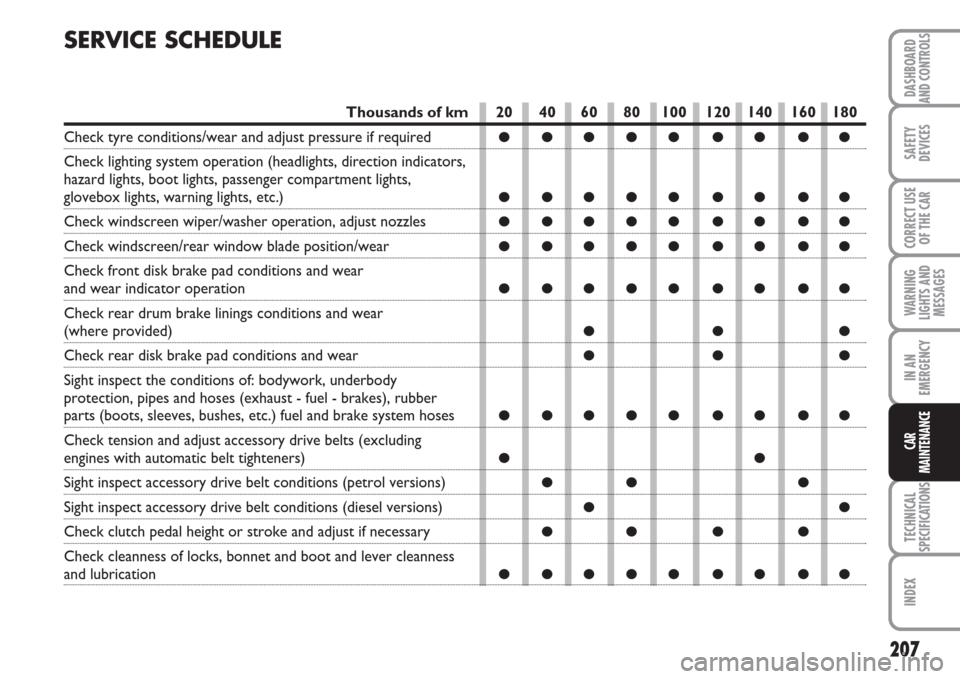
SERVICE SCHEDULE
20 40 60 80 100 120 140 160 180
●●●●● ●●●●
●●●●● ●●●●
●●●●● ●●●●
●●●●● ●●●●
●●●●● ●●●●
●●●
●●●
●●●●● ●●●●
●●
●● ●
●●
●● ● ●
●●●●● ●●●●
Thousands of km
Check tyre conditions/wear and adjust pressure if required
Check lighting system operation (headlights, direction indicators,
hazard lights, boot lights, passenger compartment lights,
glovebox lights, warning lights, etc.)
Check windscreen wiper/washer operation, adjust nozzles
Check windscreen/rear window blade position/wear
Check front disk brake pad conditions and wear
and wear indicator operation
Check rear drum brake linings conditions and wear
(where provided)
Check rear disk brake pad conditions and wear
Sight inspect the conditions of: bodywork, underbody
protection, pipes and hoses (exhaust - fuel - brakes), rubber
parts (boots, sleeves, bushes, etc.) fuel and brake system hoses
Check tension and adjust accessory drive belts (excluding
engines with automatic belt tighteners)
Sight inspect accessory drive belt conditions (petrol versions)
Sight inspect accessory drive belt conditions (diesel versions)
Check clutch pedal height or stroke and adjust if necessary
Check cleanness of locks, bonnet and boot and lever cleanness
and lubrication
Page 210 of 266
209
SAFETY
DEVICES
CORRECT USE
OF THE CAR
WARNING
LIGHTS AND
MESSAGES
TECHNICAL
SPECIFICATIONS
INDEX
DASHBOARD
AND CONTROLS
IN AN
EMERGENCY
CAR
MAINTENANCE
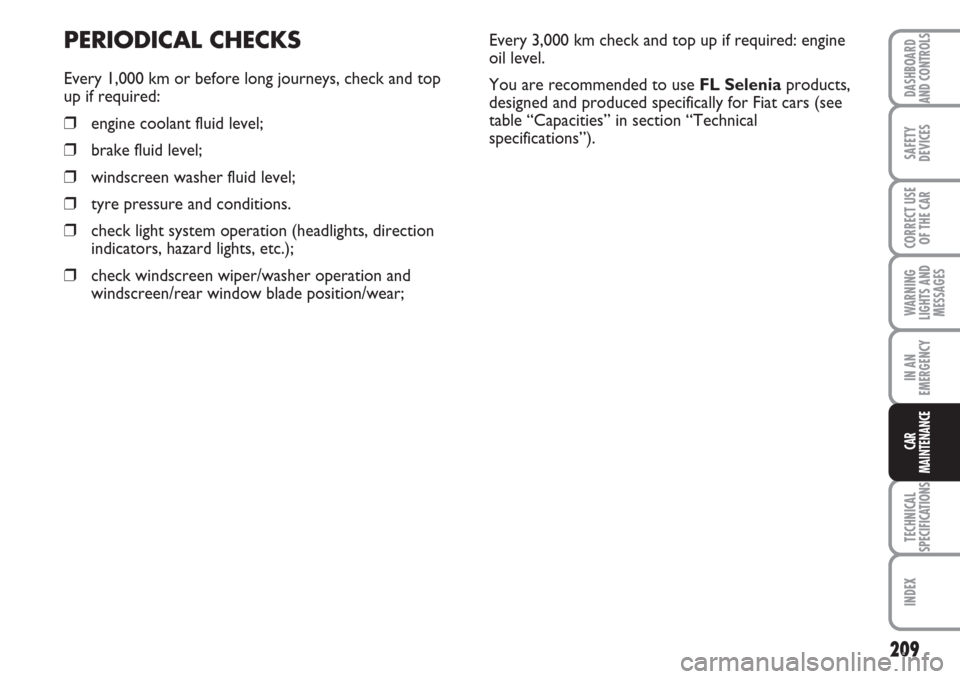
PERIODICAL CHECKS
Every 1,000 km or before long journeys, check and top
up if required:
❒engine coolant fluid level;
❒brake fluid level;
❒windscreen washer fluid level;
❒tyre pressure and conditions.
❒check light system operation (headlights, direction
indicators, hazard lights, etc.);
❒check windscreen wiper/washer operation and
windscreen/rear window blade position/wear;Every 3,000 km check and top up if required: engine
oil level.
You are recommended to use FL Seleniaproducts,
designed and produced specifically for Fiat cars (see
table “Capacities” in section “Technical
specifications”).
Page 225 of 266
224
SAFETY
DEVICES
CORRECT USE
OF THE CAR
WARNING
LIGHTS AND
MESSAGES
IN AN
EMERGENCY
TECHNICAL
SPECIFICATIONS
INDEX
DASHBOARD
AND CONTROLS
CAR
MAINTENANCE
WHEELS AND TYRES
TYRE PRESSURE
Check the pressure of each tyre, including the spare wheel, every two
weeks and before long journeys. The pressure should be checked with
the tyre rested and cold.
It is normal for the pressure to rise when you are driving; for the correct
tyre inflation pressure, see “Wheels” in “Technical specifications”
section.
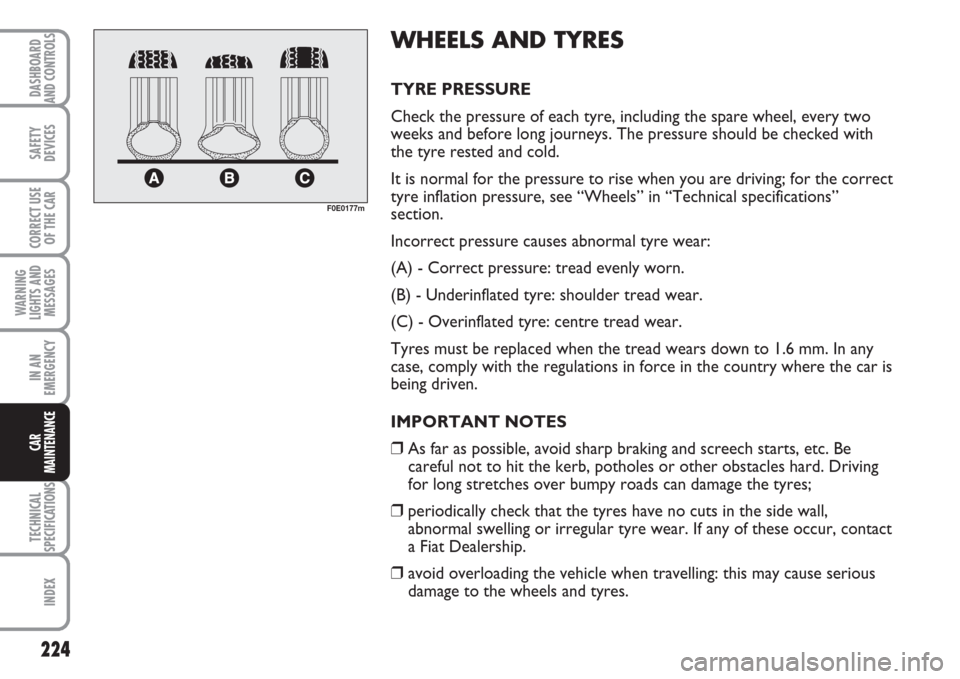
Incorrect pressure causes abnormal tyre wear:
(A) - Correct pressure: tread evenly worn.
(B) - Underinflated tyre: shoulder tread wear.
(C) - Overinflated tyre: centre tread wear.
Tyres must be replaced when the tread wears down to 1.6 mm. In any
case, comply with the regulations in force in the country where the car is
being driven.
IMPORTANT NOTES
❒As far as possible, avoid sharp braking and screech starts, etc. Be
careful not to hit the kerb, potholes or other obstacles hard. Driving
for long stretches over bumpy roads can damage the tyres;
❒periodically check that the tyres have no cuts in the side wall,
abnormal swelling or irregular tyre wear. If any of these occur, contact
a Fiat Dealership.
❒avoid overloading the vehicle when travelling: this may cause serious
damage to the wheels and tyres.
F0E0177m
Page 226 of 266

225
SAFETY
DEVICES
CORRECT USE
OF THE CAR
WARNING
LIGHTS AND
MESSAGES
TECHNICAL
SPECIFICATIONS
INDEX
DASHBOARD
AND CONTROLS
IN AN
EMERGENCY
CAR
MAINTENANCE
❒if a tyre is punctured, stop immediately and change
it to avoid damage to the tyre, the rim, suspensions
and steering system.
❒tyres age even if they are not used much. Cracks in
the tread rubber are a sign of ageing. In any case, if
the tyres have been on the car for over 6 years,
they should be checked by specialised personnel, to
see if they can still be used. Also remember to
check the space-saver spare wheel.
❒in the case of replacement, always fit new tyres,
avoiding those of dubious origin.
WARNINGRemember that road holding depends also on the correct tyre inflating pressure.
WARNINGIf the pressure is too low the tyre overheats and this can cause it serious damage.❒if a tyre is changed, also change the inflation valve.
❒to allow even wear between the front and rear
tyres, it is advisable to change them over every 10-
15 thousand kilometres, keeping them on the same
side of the car so as to not reverse the direction of
rotation.
WARNINGDo not cross switch the tyres, moving them from the right of the car to the left and
vice versa.
Never submit alloy rims to repainting treatments requiring to use temperatures
exceeding 150°C since the mechanical properties of the wheels could be
impaired.WARNING
Page 231 of 266
230
SAFETY
DEVICES
CORRECT USE
OF THE CAR
WARNING
LIGHTS AND
MESSAGES
IN AN
EMERGENCY
TECHNICAL
SPECIFICATIONS
INDEX
DASHBOARD
AND CONTROLS
CAR
MAINTENANCE
ADVICE FOR PRESERVING
THE BODYWORK
Paint
Paintwork does not only serve an aesthetic purpose,
but also protects the underlying sheet metal.
In the case of deep scrapes or scores, you are advised
to have the necessary touching up carried out
immediately to avoid the formation of rust.
Only use original products when touching up the
paintwork (see section “Technical specifications”).
Ordinary paint maintenance consists in washing at
intervals depending on the conditions and environment
of use. For example, in highly polluted areas, or if the
roads are sprayed with salt, it is wise to wash the car
more frequently.
To wash the car properly:
❒remove the aerial from the roof to prevent damages
if the car is washed in an automatic carwash;
❒wash the body using a low pressure jet of water.
❒wipe a sponge with a slightly soapy solution over
the bodywork, frequently rinsing with the sponge.❒rinse well with water and dry with a jet of air or a
chamois leather.
When drying, take particular care with the less visible
parts like door frames, bonnet and around the
headlights where water may collect. The car should
not be taken to a closed area immediately, but left in
the open so that residual water can evaporate.
Do not wash the car after it has been left in the sun or
with the bonnet hot: this may alter the shine of the
paintwork.
Exterior plastic parts must be cleaned in the same way
as the rest of the car.
Where possible, do not park under trees; the resinous
substance many species release give the paint a dull
appearance and increase the possibility of triggering
rust processes.
IMPORTANT Bird droppings must be washed off
immediately and thoroughly as the acid they contain is
particularly aggressive.
Detergents cause water pollution. Therefore the engine compartment should be washed in areas
equipped for collecting and purifying the liquid used in the washing process.
Page 244 of 266
243
SAFETY
DEVICES
CORRECT USE
OF THE CAR
WARNING
LIGHTS AND
MESSAGES
CAR
MAINTENANCE
INDEX
DASHBOARD
AND CONTROLS
IN AN
EMERGENCY
TECHNICAL
SPECIFICATIONS
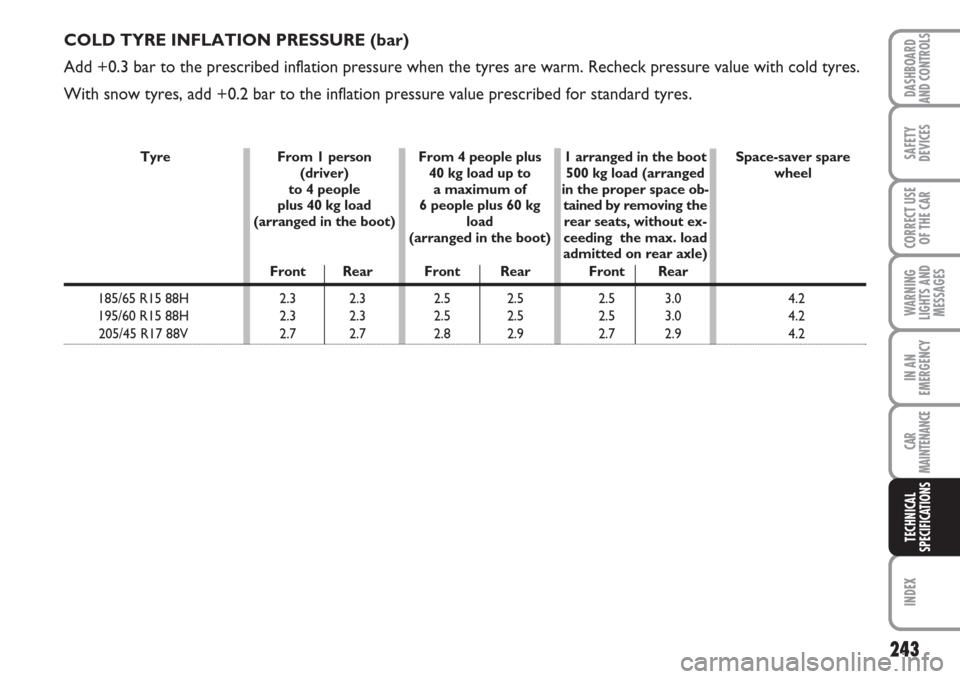
COLD TYRE INFLATION PRESSURE (bar)
Add +0.3 bar to the prescribed inflation pressure when the tyres are warm. Recheck pressure value with cold tyres.
With snow tyres, add +0.2 bar to the inflation pressure value prescribed for standard tyres.
Space-saver spare
wheel 1 arranged in the boot
500 kg load (arranged
in the proper space ob-
tained by removing the
rear seats, without ex-
ceeding the max. load
admitted on rear axle) From 4 people plus
40 kg load up to
a maximum of
6 people plus 60 kg
load
(arranged in the boot) From 1 person
(driver)
to 4 people
plus 40 kg load
(arranged in the boot) Tyre
Front Rear Front Rear Front Rear
185/65 R15 88H 2.3 2.3 2.5 2.5 2.5 3.0 4.2
195/60 R15 88H 2.3 2.3 2.5 2.5 2.5 3.0 4.2
205/45 R17 88V 2.7 2.7 2.8 2.9 2.7 2.9 4.2