weight FIAT MULTIPLA 2007 1.G User Guide
[x] Cancel search | Manufacturer: FIAT, Model Year: 2007, Model line: MULTIPLA, Model: FIAT MULTIPLA 2007 1.GPages: 266, PDF Size: 4.66 MB
Page 128 of 266
127
CORRECT USE
OF THE CAR
WARNING
LIGHTS AND
MESSAGES
IN AN
EMERGENCY
CAR
MAINTENANCE
TECHNICAL
SPECIFICATIONS
INDEX
DASHBOARD
AND CONTROLS
SAFETY
DEVICES
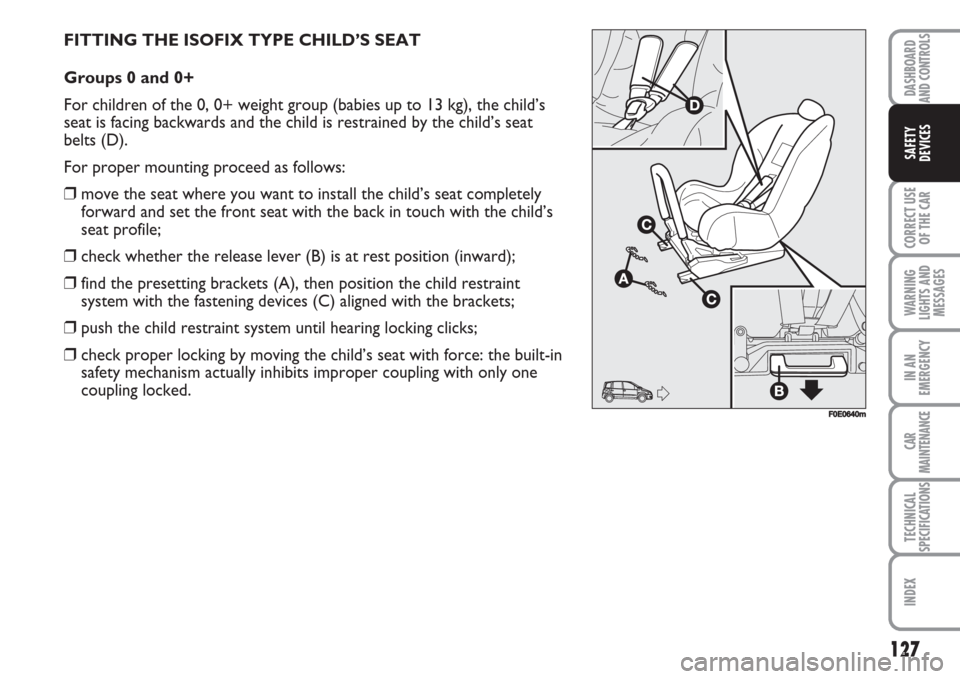
FITTING THE ISOFIX TYPE CHILD’S SEAT
Groups 0 and 0+
For children of the 0, 0+ weight group (babies up to 13 kg), the child’s
seat is facing backwards and the child is restrained by the child’s seat
belts (D).
For proper mounting proceed as follows:
❒move the seat where you want to install the child’s seat completely
forward and set the front seat with the back in touch with the child’s
seat profile;
❒check whether the release lever (B) is at rest position (inward);
❒find the presetting brackets (A), then position the child restraint
system with the fastening devices (C) aligned with the brackets;
❒push the child restraint system until hearing locking clicks;
❒check proper locking by moving the child’s seat with force: the built-in
safety mechanism actually inhibits improper coupling with only one
coupling locked.
F0E0640m
Page 129 of 266
128
CORRECT USE
OF THE CAR
WARNING
LIGHTS AND
MESSAGES
IN AN
EMERGENCY
CAR
MAINTENANCE
TECHNICAL
SPECIFICATIONS
INDEX
DASHBOARD
AND CONTROLS
SAFETY
DEVICES
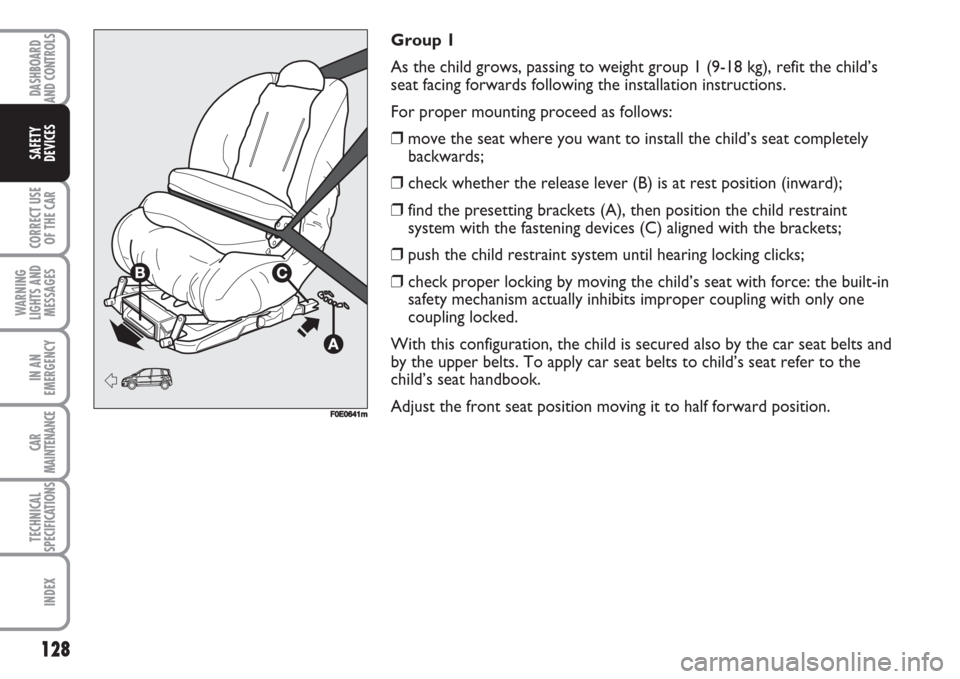
Group 1
As the child grows, passing to weight group 1 (9-18 kg), refit the child’s
seat facing forwards following the installation instructions.
For proper mounting proceed as follows:
❒move the seat where you want to install the child’s seat completely
backwards;
❒check whether the release lever (B) is at rest position (inward);
❒find the presetting brackets (A), then position the child restraint
system with the fastening devices (C) aligned with the brackets;
❒push the child restraint system until hearing locking clicks;
❒check proper locking by moving the child’s seat with force: the built-in
safety mechanism actually inhibits improper coupling with only one
coupling locked.
With this configuration, the child is secured also by the car seat belts and
by the upper belts. To apply car seat belts to child’s seat refer to the
child’s seat handbook.
Adjust the front seat position moving it to half forward position.
F0E0641m
Page 144 of 266
143
WARNING
LIGHTS AND
MESSAGES
IN AN
EMERGENCY
CAR
MAINTENANCE
TECHNICAL
SPECIFICATIONS
INDEX
DASHBOARD
AND CONTROLS
SAFETY
DEVICES
CORRECT USE
OF THE CAR
CONTAINING RUNNING COSTS
Here are some suggestions which may help you to
keep the running costs of your car down and lower
the amount of toxic emissions released into the
atmosphere.
GENERAL CONSIDERATIONS
Car maintenance
Have checks and adjustments carried out in
accordance with the “Service schedule”.
Tyres
Check the pressure of the tyres routinely at an
interval of no more than 4 weeks: if the pressure is
too low, consumption levels increase as resistance to
rolling is higher.
Unnecessary loads
Do not travel with too much luggage stowed in the
boot. The weight of the car (especially when driving in
town) and its trim greatly affects consumption and
stability.Roof rack/ski rack
Remove the roof rack or the ski rack from the roof as
soon as they are no longer used. These accessories
lower air penetration and adversely affect
consumption levels. When needing to carry
particularly voluminous objects, preferably use a
trailer.
Electric devices
Use electric devices only for the amount of time
needed. Rear heated window, additional headlights,
windscreen wipers and heater fan need a considerable
amount of energy, therefore increasing the
requirement of current increases fuel consumption (up
to +25% in the urban cycle).
Climate control
The air conditioner is an additional load which greatly
affects the engine leading to higher consumption (on
average up to +20%). When the temperature outside
the vehicle permits it, use the air vents where possible.
Aerodynamic accessories
The use of non-certified aerodynamic items may
adversely affect air drag and consumption levels.
Page 146 of 266
145
WARNING
LIGHTS AND
MESSAGES
IN AN
EMERGENCY
CAR
MAINTENANCE
TECHNICAL
SPECIFICATIONS
INDEX
DASHBOARD
AND CONTROLS
SAFETY
DEVICES
CORRECT USE
OF THE CAR
TOWING TRAILERS
IMPORTANT NOTES
For towing caravans or trailers the car must be fitted
with a certified tow hook and an adequate electric
system. Installation should be carried out by
specialised personnel who release a special document
for circulation on the road.
Install any specific and/or additional rear-view mirrors
in accordance with the Highway Code.
Remember that when towing a trailer, steep hills are
harder to climb, the braking spaces increase and
overtaking takes longer depending on the overall
weight.Engage a low gear when driving downhill, rather than
constantly using the brake.
The weight the trailer exerts on the car tow hook
reduces by the same amount the actual vehicle loading
capacity.
To make sure the maximum towable weight is not
exceeded, account should be taken of the fully laden
trailer, including accessories and personal belongings.
Do not exceed the speed limits of the country you are
driving in. In any case do not exceed 100 km/h.
WARNINGThe ABS system with which the car may be fitted does not control the trailer
braking system.
Under no circumstances should the vehicle brake system be altered to control the
trailer brake. The trailer braking system must be fully independent of the vehicle’s
hydraulic system.WARNING
Page 147 of 266
146
WARNING
LIGHTS AND
MESSAGES
IN AN
EMERGENCY
CAR
MAINTENANCE
TECHNICAL
SPECIFICATIONS
INDEX
DASHBOARD
AND CONTROLS
SAFETY
DEVICES
CORRECT USE
OF THE CAR
INSTALLING THE TOW HOOK
The towing device should be fastened to the body by
specialised personnel according to any additional
and/or integrative information supplied by the
Manufacturer of the device.
Have installation carried out at Fiat Dealership.
The towing device must meet current regulations with
reference to 94/20/EC Directive and subsequent
amendments.
For any version the towing device used must match
the towable weight of the car on which it is to be
installed.
For the electric connection a unified connector should
be used which is generally placed on a special bracket
normally fastened to the towing device, and a special
ECU for external trailer light control shall be installed
on the car.
When fitting the trailer, parking sensors are
deactivated.For the electrical connection, a 7 pin 12VDC
connection is to be used (CUNA/UNI and ISO/DIN
Standards). Follow the instructions provided by the car
manufacturer and/or the tow hitch manufacturer.
An electric brake should be supplied directly by the
battery through a cable with a cross section of no less
than 2.5 mm
2.
IMPORTANT Electric brake or other device shall be
used with running engine.
In addition to the electrical branches, the car’s electric
system can only be connected to the supply cable for
an electric brake and to the cable for an internal light,
though not above 15W.
For connections, use the preset control unit with
battery cable no less than 2.5 mm
2.
The two hitches are shown on the following pages.
Page 171 of 266
170
SAFETY
DEVICES
CORRECT USE
OF THE CAR
WARNING
LIGHTS AND
MESSAGES
CAR
MAINTENANCE
TECHNICAL
SPECIFICATIONS
INDEX
DASHBOARD
AND CONTROLS
IN AN
EMERGENCY
Please note:
❒the jack weight is 3.5 kg
❒the jack requires no adjustment
❒the jack cannot be repaired and in the event of a fault it must be
replaced by another original one
❒no tool other than its cranking device may be fitted on the jack.
To change a wheel proceed as follows:
❒Stop the car is a position that is not dangerous for oncoming traffic
where you can change the wheel safely. The ground should be flat and
adequately firm. At night choose a lit area;
❒Turn the engine off and pull up the handbrake;
❒Engage first gear or reverse;
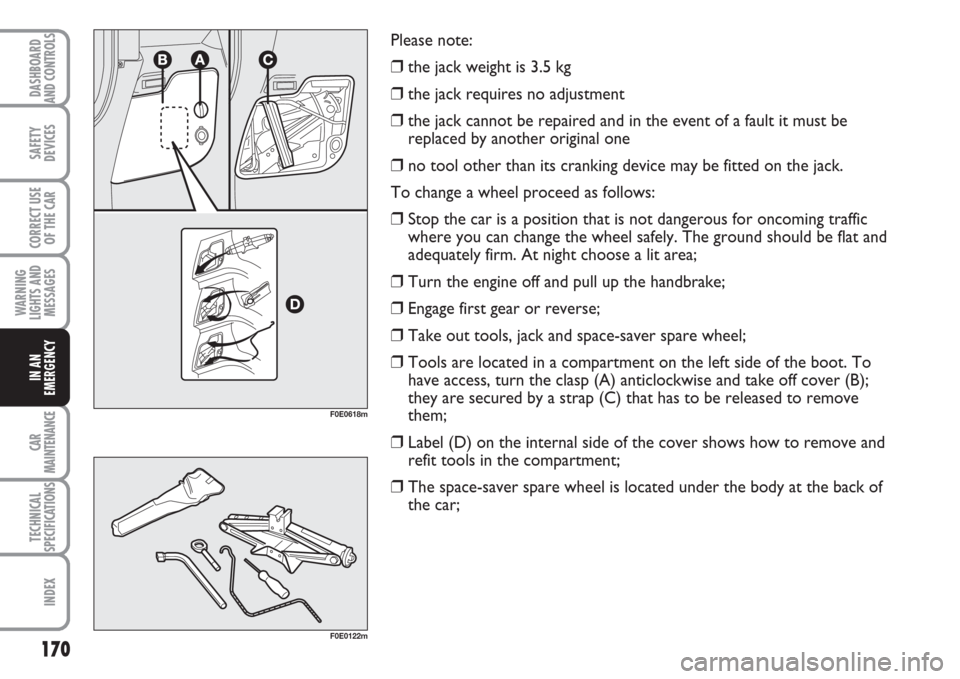
❒Take out tools, jack and space-saver spare wheel;
❒Tools are located in a compartment on the left side of the boot. To
have access, turn the clasp (A) anticlockwise and take off cover (B);
they are secured by a strap (C) that has to be released to remove
them;
❒Label (D) on the internal side of the cover shows how to remove and
refit tools in the compartment;
❒The space-saver spare wheel is located under the body at the back of
the car;
F0E0618m
F0E0122m
Page 234 of 266
233
SAFETY
DEVICES
CORRECT USE
OF THE CAR
WARNING
LIGHTS AND
MESSAGES
CAR
MAINTENANCE
INDEX
DASHBOARD
AND CONTROLS
IN AN
EMERGENCY
TECHNICAL
SPECIFICATIONS
TT T
E E
C C
H H
N N
I I
C C
A A
L L
S S
P P
E E
C C
I I
F F
I I
C C
A A
T T
I I
O O
N N
S S
IDENTIFICATION DATA ................................................. 234
ENGINE CODES - BODYWORK VERSIONS .............. 236
ENGINE ................................................................................. 237
FUEL FEED/IGNITION ....................................................... 238
TRANSMISSION .................................................................. 238
BRAKES .................................................................................. 239
SUSPENSIONS ..................................................................... 239
STEERING ............................................................................. 239
WHEELS ................................................................................. 240
DIMENSIONS ....................................................................... 244
PERFORMANCE ................................................................... 246
WEIGHTS ............................................................................... 247
CAPACITIES ......................................................................... 249
FLUIDS AND LUBRICANTS ........................................... 250
FUEL CONSUMPTION ....................................................... 252
CO
2EMISSIONS .................................................................. 253
RADIOFREQUENCY REMOTE CONTROL
MINISTERIAL HOMOLOGATION ................................. 254
Page 235 of 266
234
SAFETY
DEVICES
CORRECT USE
OF THE CAR
WARNING
LIGHTS AND
MESSAGES
CAR
MAINTENANCE
INDEX
DASHBOARD
AND CONTROLS
IN AN
EMERGENCY
TECHNICAL
SPECIFICATIONS
IDENTIFICATION DATA
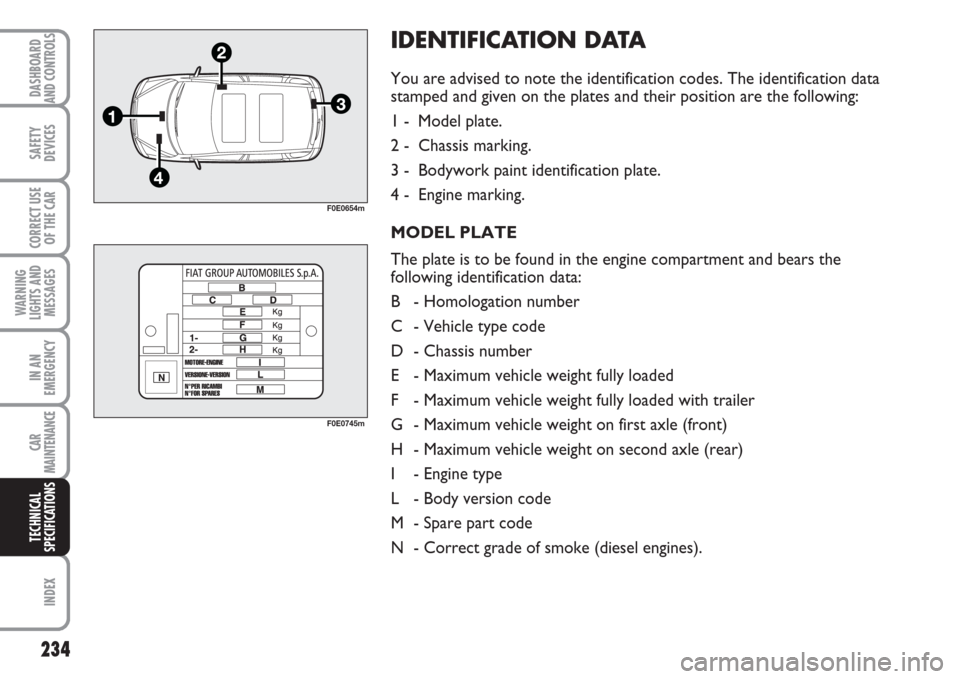
You are advised to note the identification codes. The identification data
stamped and given on the plates and their position are the following:
1 - Model plate.
2 - Chassis marking.
3 - Bodywork paint identification plate.
4 - Engine marking.
MODEL PLATE
The plate is to be found in the engine compartment and bears the
following identification data:
B - Homologation number
C - Vehicle type code
D - Chassis number
E - Maximum vehicle weight fully loaded
F - Maximum vehicle weight fully loaded with trailer
G - Maximum vehicle weight on first axle (front)
H - Maximum vehicle weight on second axle (rear)
I - Engine type
L - Body version code
M - Spare part code
N - Correct grade of smoke (diesel engines).
F0E0745m
F0E0654m
Page 248 of 266
247
SAFETY
DEVICES
CORRECT USE
OF THE CAR
WARNING
LIGHTS AND
MESSAGES
CAR
MAINTENANCE
INDEX
DASHBOARD
AND CONTROLS
IN AN
EMERGENCY
TECHNICAL
SPECIFICATIONS
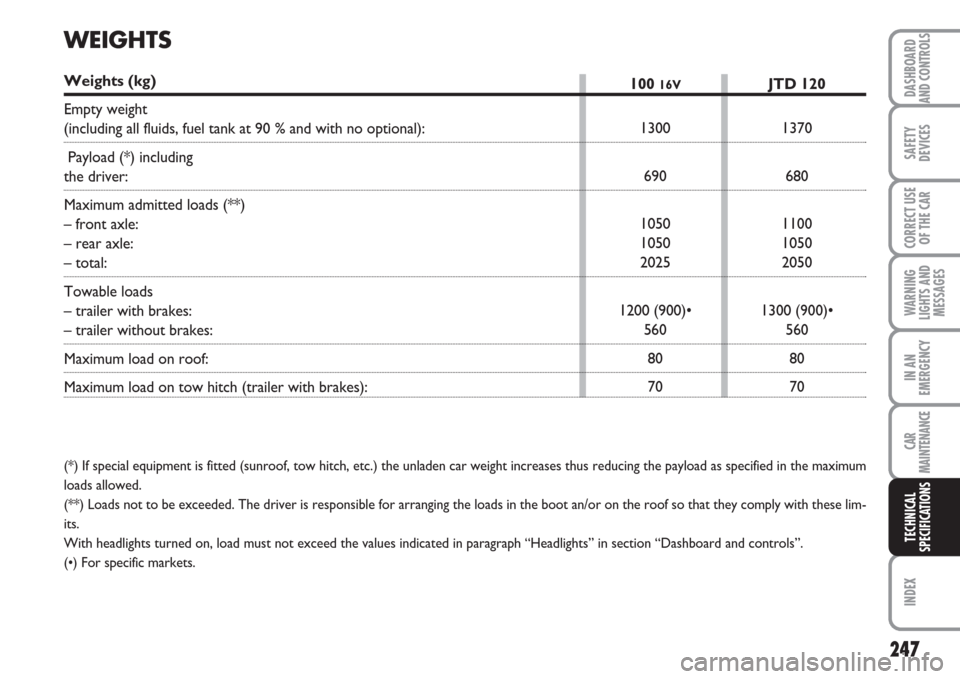
JTD 120
1370
680
1100
1050
2050
1300 (900)•
560
80
70
(*) If special equipment is fitted (sunroof, tow hitch, etc.) the unladen car weight increases thus reducing the payload as specified in the maximum
loads allowed.
(**) Loads not to be exceeded. The driver is responsible for arranging the loads in the boot an/or on the roof so that they comply with these lim-
its.
With headlights turned on, load must not exceed the values indicated in paragraph “Headlights” in section “Dashboard and controls”.
(•) For specific markets.
WEIGHTS
Weights (kg)
Empty weight
(including all fluids, fuel tank at 90 % and with no optional):
Payload (*) including
the driver:
Maximum admitted loads (**)
– front axle:
– rear axle:
– total:
Towable loads
– trailer with brakes:
– trailer without brakes:
Maximum load on roof:
Maximum load on tow hitch (trailer with brakes):100
16V
1300
690
1050
1050
2025
1200 (900)•
560
80
70
Page 249 of 266
248
SAFETY
DEVICES
CORRECT USE
OF THE CAR
WARNING
LIGHTS AND
MESSAGES
CAR
MAINTENANCE
INDEX
DASHBOARD
AND CONTROLS
IN AN
EMERGENCY
TECHNICAL
SPECIFICATIONS
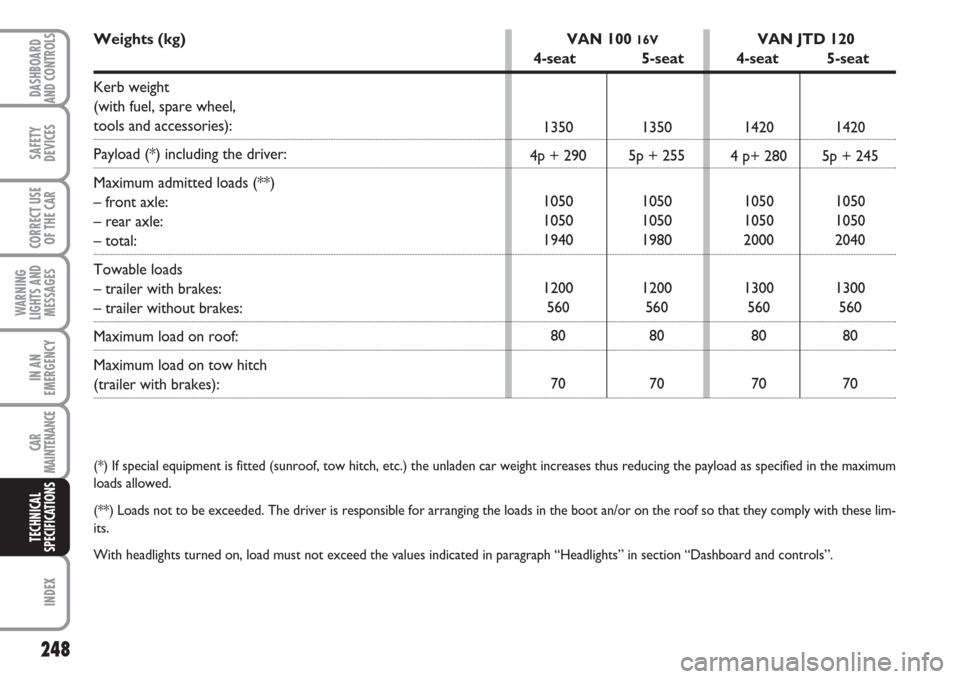
1420
4 p+ 280
1050
1050
2000
1300
560
80
701420
5p + 245
1050
1050
2040
1300
560
80
70 1350
5p + 255
1050
1050
1980
1200
560
80
70 1350
4p + 290
1050
1050
1940
1200
560
80
70
(*) If special equipment is fitted (sunroof, tow hitch, etc.) the unladen car weight increases thus reducing the payload as specified in the maximum
loads allowed.
(**) Loads not to be exceeded. The driver is responsible for arranging the loads in the boot an/or on the roof so that they comply with these lim-
its.
With headlights turned on, load must not exceed the values indicated in paragraph “Headlights” in section “Dashboard and controls”.
Weights (kg) VAN 100 16VVAN JTD 120
4-seat 5-seat 4-seat 5-seat
Kerb weight
(with fuel, spare wheel,
tools and accessories):
Payload (*) including the driver:
Maximum admitted loads (**)
– front axle:
– rear axle:
– total:
Towable loads
– trailer with brakes:
– trailer without brakes:
Maximum load on roof:
Maximum load on tow hitch
(trailer with brakes):