battery FIAT MULTIPLA 2007 1.G Owner's Manual
[x] Cancel search | Manufacturer: FIAT, Model Year: 2007, Model line: MULTIPLA, Model: FIAT MULTIPLA 2007 1.GPages: 266, PDF Size: 4.66 MB
Page 202 of 266
201
SAFETY
DEVICES
CORRECT USE
OF THE CAR
WARNING
LIGHTS AND
MESSAGES
CAR
MAINTENANCE
TECHNICAL
SPECIFICATIONS
INDEX
DASHBOARD
AND CONTROLS
IN AN
EMERGENCY
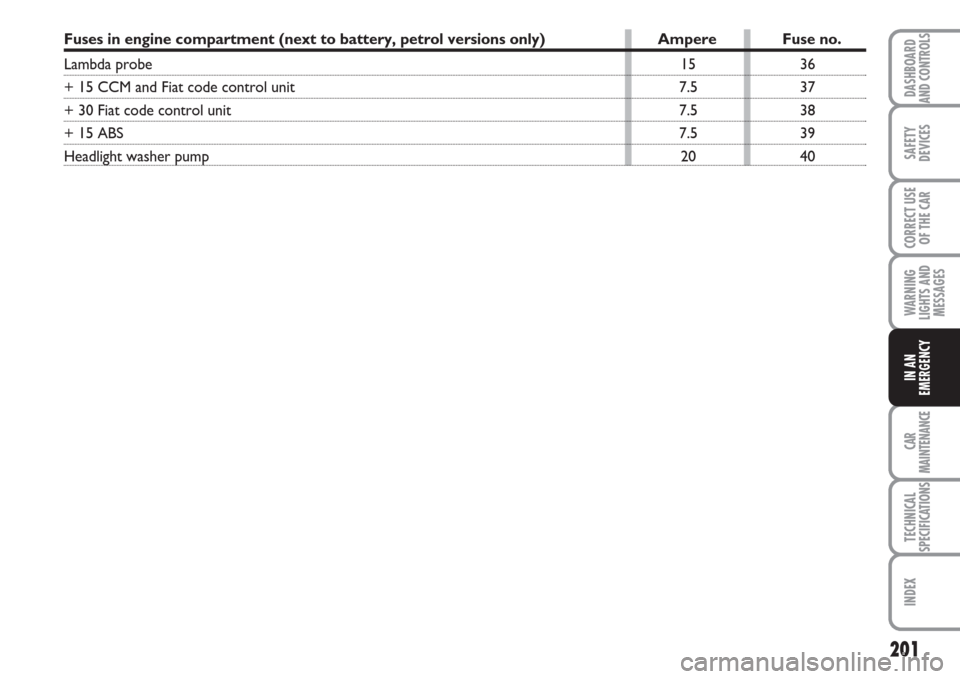
36
37
38
39
40 15
7.5
7.5
7.5
20
Fuses in engine compartment (next to battery, petrol versions only) Ampere Fuse no.
Lambda probe
+ 15 CCM and Fiat code control unit
+ 30 Fiat code control unit
+ 15 ABS
Headlight washer pump
Page 203 of 266
202
SAFETY
DEVICES
CORRECT USE
OF THE CAR
WARNING
LIGHTS AND
MESSAGES
CAR
MAINTENANCE
TECHNICAL
SPECIFICATIONS
INDEX
DASHBOARD
AND CONTROLS
IN AN
EMERGENCY
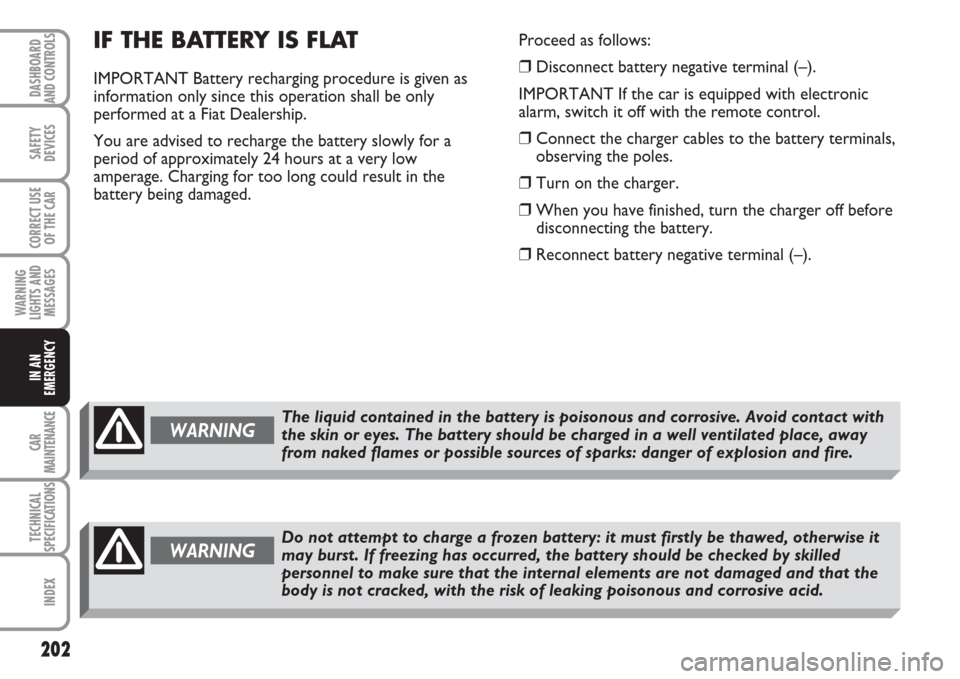
IF THE BATTERY IS FLAT
IMPORTANT Battery recharging procedure is given as
information only since this operation shall be only
performed at a Fiat Dealership.
You are advised to recharge the battery slowly for a
period of approximately 24 hours at a very low
amperage. Charging for too long could result in the
battery being damaged.Proceed as follows:
❒Disconnect battery negative terminal (–).
IMPORTANT If the car is equipped with electronic
alarm, switch it off with the remote control.
❒Connect the charger cables to the battery terminals,
observing the poles.
❒Turn on the charger.
❒When you have finished, turn the charger off before
disconnecting the battery.
❒Reconnect battery negative terminal (–).
The liquid contained in the battery is poisonous and corrosive. Avoid contact with
the skin or eyes. The battery should be charged in a well ventilated place, away
from naked flames or possible sources of sparks: danger of explosion and fire.WARNING
WARNINGDo not attempt to charge a frozen battery: it must firstly be thawed, otherwise it
may burst. If freezing has occurred, the battery should be checked by skilled
personnel to make sure that the internal elements are not damaged and that the
body is not cracked, with the risk of leaking poisonous and corrosive acid.
Page 206 of 266
205
SAFETY
DEVICES
CORRECT USE
OF THE CAR
WARNING
LIGHTS AND
MESSAGES
TECHNICAL
SPECIFICATIONS
INDEX
DASHBOARD
AND CONTROLS
IN AN
EMERGENCY
CAR
MAINTENANCE
CC C
A A
R R
M M
A A
I I
N N
T T
E E
N N
A A
N N
C C
E E
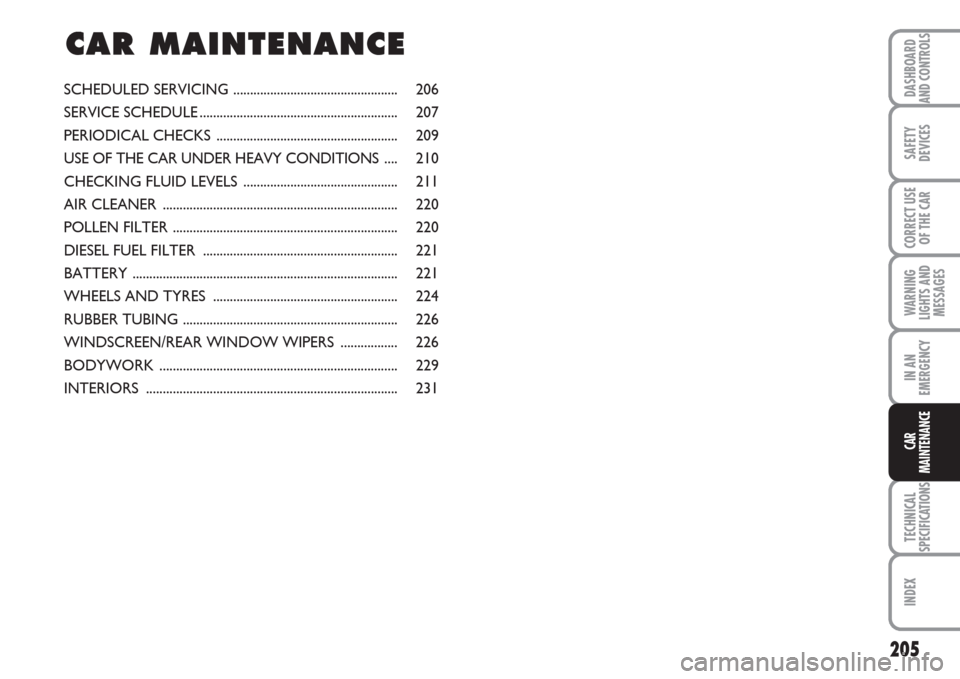
SCHEDULED SERVICING ................................................. 206
SERVICE SCHEDULE ........................................................... 207
PERIODICAL CHECKS ...................................................... 209
USE OF THE CAR UNDER HEAVY CONDITIONS.... 210
CHECKING FLUID LEVELS .............................................. 211
AIR CLEANER ...................................................................... 220
POLLEN FILTER ................................................................... 220
DIESEL FUEL FILTER .......................................................... 221
BATTERY ............................................................................... 221
WHEELS AND TYRES ....................................................... 224
RUBBER TUBING ................................................................ 226
WINDSCREEN/REAR WINDOW WIPERS ................. 226
BODYWORK ....................................................................... 229
INTERIORS ........................................................................... 231
Page 209 of 266
208
SAFETY
DEVICES
CORRECT USE
OF THE CAR
WARNING
LIGHTS AND
MESSAGES
IN AN
EMERGENCY
TECHNICAL
SPECIFICATIONS
INDEX
DASHBOARD
AND CONTROLS
CAR
MAINTENANCE
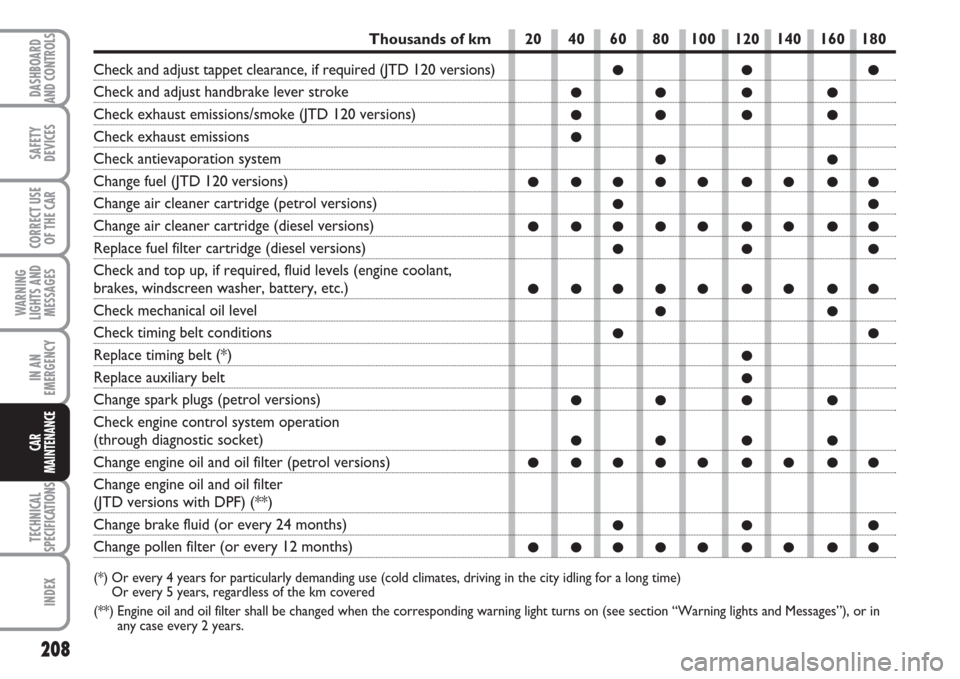
Thousands of km
●●●
●● ● ●
●● ● ●
●
●●
●●●●● ●●●●
●●
●●●●● ●●●●
●●●
●●●●● ●●●●
●●
●●
●
●
●● ● ●
●● ● ●
●●●●● ●●●●
●●●
●●●●● ●●●●
20 40 60 80 100 120 140 160 180
(*) Or every 4 years for particularly demanding use (cold climates, driving in the city idling for a long time)
Or every 5 years, regardless of the km covered
(**) Engine oil and oil filter shall be changed when the corresponding warning light turns on (see section “Warning lights and Messages”), or in
any case every 2 years.
Check and adjust tappet clearance, if required (JTD 120 versions)
Check and adjust handbrake lever stroke
Check exhaust emissions/smoke (JTD 120 versions)
Check exhaust emissions
Check antievaporation system
Change fuel (JTD 120 versions)
Change air cleaner cartridge (petrol versions)
Change air cleaner cartridge (diesel versions)
Replace fuel filter cartridge (diesel versions)
Check and top up, if required, fluid levels (engine coolant,
brakes, windscreen washer, battery, etc.)
Check mechanical oil level
Check timing belt conditions
Replace timing belt (*)
Replace auxiliary belt
Change spark plugs (petrol versions)
Check engine control system operation
(through diagnostic socket)
Change engine oil and oil filter (petrol versions)
Change engine oil and oil filter
(JTD versions with DPF) (**)
Change brake fluid (or every 24 months)
Change pollen filter (or every 12 months)
Page 211 of 266
210
SAFETY
DEVICES
CORRECT USE
OF THE CAR
WARNING
LIGHTS AND
MESSAGES
IN AN
EMERGENCY
TECHNICAL
SPECIFICATIONS
INDEX
DASHBOARD
AND CONTROLS
CAR
MAINTENANCE
USE OF THE CAR UNDER
HEAVY CONDITIONS
Should prevailing use of the car be under one of the
following specially heavy conditions:
❒trailer or caravan towing;
❒dusty roads;
❒short distances (less than 7-8 km) and repeated
with external temperatures below zero;
❒frequently idling engines or long distance low
speed driving (e.g.: door-to-door deliveries) or in
case of a long term inactivity;
❒urban routes;carry out checks more frequently than required on
Service Schedule:
❒check front disk brake pad conditions and wear;
❒check cleanness of bonnet and boot locks and
lever cleanness and lubrication;
❒sight inspect the conditions of: engine, gearbox,
transmission, pipes and hoses (exhaust - fuel -
brakes), rubber parts (boots, sleeves, bushes, etc.);
❒check battery charge and fluid level (electrolyte);
❒visual check on various drive belt conditions;
❒check and replace pollen filter, if required;
❒check and replace air cleaner, if required.
Page 212 of 266
211
SAFETY
DEVICES
CORRECT USE
OF THE CAR
WARNING
LIGHTS AND
MESSAGES
TECHNICAL
SPECIFICATIONS
INDEX
DASHBOARD
AND CONTROLS
IN AN
EMERGENCY
CAR
MAINTENANCE
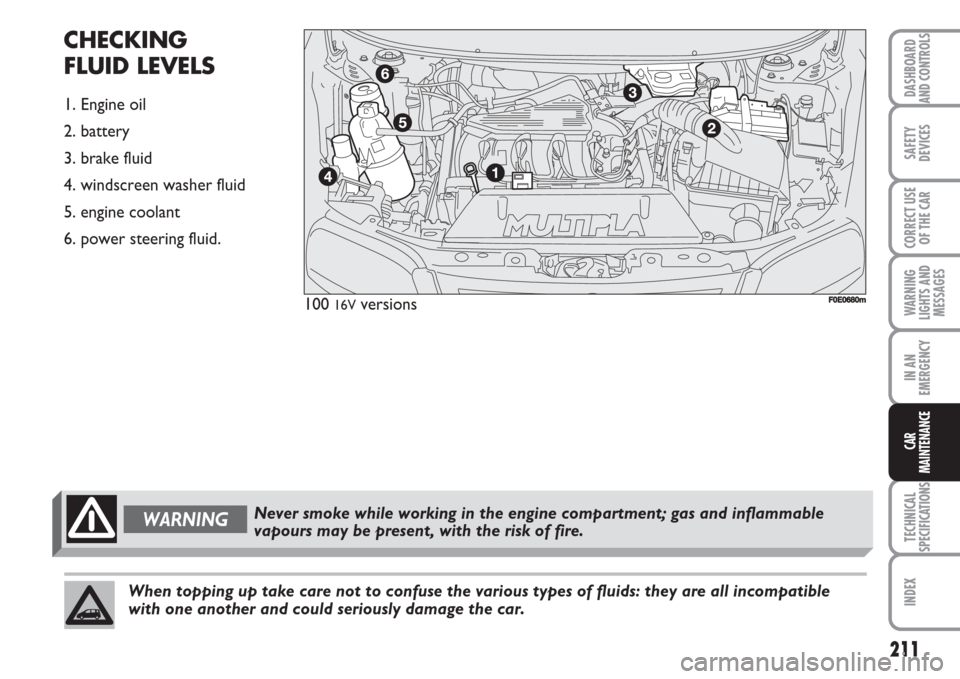
CHECKING
FLUID LEVELS
1. Engine oil
2. battery
3. brake fluid
4. windscreen washer fluid
5. engine coolant
6. power steering fluid.
F0E0680m100 16Vversions
WARNINGNever smoke while working in the engine compartment; gas and inflammable
vapours may be present, with the risk of fire.
When topping up take care not to confuse the various types of fluids: they are all incompatible
with one another and could seriously damage the car.
Page 213 of 266
212
SAFETY
DEVICES
CORRECT USE
OF THE CAR
WARNING
LIGHTS AND
MESSAGES
IN AN
EMERGENCY
TECHNICAL
SPECIFICATIONS
INDEX
DASHBOARD
AND CONTROLS
CAR
MAINTENANCE
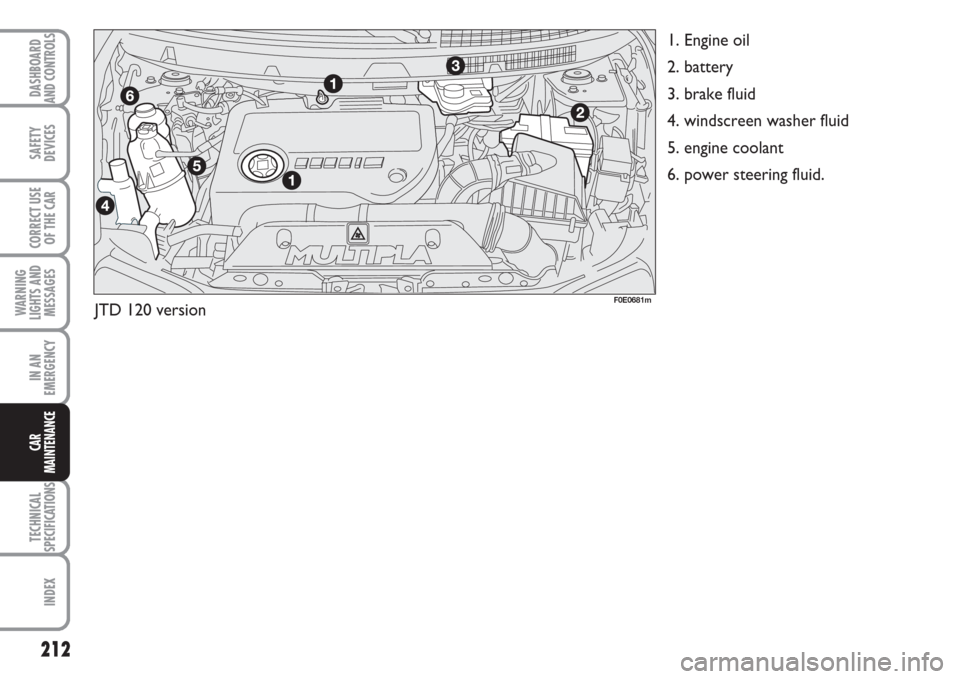
1. Engine oil
2. battery
3. brake fluid
4. windscreen washer fluid
5. engine coolant
6. power steering fluid.
F0E0681mJTD 120 version
Page 222 of 266
221
SAFETY
DEVICES
CORRECT USE
OF THE CAR
WARNING
LIGHTS AND
MESSAGES
TECHNICAL
SPECIFICATIONS
INDEX
DASHBOARD
AND CONTROLS
IN AN
EMERGENCY
CAR
MAINTENANCE
DIESEL FUEL FILTER
DRAINING THE CONDENSE (diesel versions)
IMPORTANT The presence of water in the fuel circuit
can severely damage the injection system and make
the engine misfire. If the warning light
cturns on,
contact a Fiat Dealership as soon as possible to have
the bleeding operation carried out.
If the warning light comes on immediately after
refuelling, water is probably present in the tank: turn
the engine off immediately and contact Fiat Dealership.
BATTERY
Fiat Multipla battery is of the “Limited maintenance”
type: under normal conditions of use it does not
require topping up with distilled water.
CHECKING THE BATTERY FLUID LEVEL
(electrolyte)
Check the electrolyte level (and top up if required) at
the intervals shown in the Service Schedule in this
section. Have this operation carried out at Fiat
Dealership.
Batteries contain substances that are very harmful for the environment. You are advised to have
the battery changed at a Fiat Dealership, which is properly equipped for disposing of used batteries
respecting nature and law.
The liquid in the battery is poisonous and corrosive. Avoid contact with eyes and
skin. Do not bring naked flames or possible sources of sparks near to the battery:
risk of fire and explosion.WARNING
Page 223 of 266
222
SAFETY
DEVICES
CORRECT USE
OF THE CAR
WARNING
LIGHTS AND
MESSAGES
IN AN
EMERGENCY
TECHNICAL
SPECIFICATIONS
INDEX
DASHBOARD
AND CONTROLS
CAR
MAINTENANCE
Incorrect fitting of electrical and electronic accessories can seriously damage the car. If after buying
the car, you want to install electric accessories which require permanent electric supply (alarm,
sound system, free-hand phone kit, etc.) contact Fiat Dealership whose qualified personnel, in
addition to suggesting the most suitable devices, will evaluate the overall electric absorption,
checking whether the car’s electric system is capable of withstanding the load required, or whether
it should be integrated with a more powerful battery.
WARNINGWhen working on the battery or near it, always wear the proper goggles.
WARNINGRunning the battery with low fluid level can damage the battery beyond repair and
could also cause its explosion. CHANGING THE BATTERY
If required, replace the battery with a genuine spare
part having the same specifications. If a battery with
different specifications is fitted, the service intervals
given in the “Service Schedule” in this section will nolonger be valid. Refer to the instructions provided by
the battery’s Manufacturer.
WARNINGIf the car is left inactive for long periods at cold, remove the battery and store it in
a warm place to prevent freezing.
Page 224 of 266
223
SAFETY
DEVICES
CORRECT USE
OF THE CAR
WARNING
LIGHTS AND
MESSAGES
TECHNICAL
SPECIFICATIONS
INDEX
DASHBOARD
AND CONTROLS
IN AN
EMERGENCY
CAR
MAINTENANCE
USEFUL ADVICE FOR LENGTHENING
THE LIFE OF YOUR BATTERY
To avoid draining your battery and lengthen its life,
observe the following indications:
❒when you park the car, ensure the doors, tailgate
and bonnet are closed properly. Passenger’s
compartment lights must be off;
❒ceiling lights must be off. The car is however
provided with an automatic system for switching off
internal lights;
❒do not keep accessories (e.g.: sound system, hazard
lights, etc.) switched on for a long time when the
engine is not running;
❒before performing any operation on the electrical
system, disconnect the battery negative cable;
❒battery terminals shall always be perfectly tightened.
IMPORTANT A battery which is kept at a charge of
less than 50% (optical indicator with dark colour
without green area in the middle) for any length of
time will be damaged by sulphation leading to a
reduction in cranking power.Moreover, this might lead to a higher risk of the
battery electrolyte freezing (this may even occur at -
10°C). If the car is inactive for a long period of time,
refer to “Storing the car”, in section “Driving your
car”.
If after buying the car, you want to install electric
accessories which require permanent electric supply
(alarm, etc.) contact Fiat Dealership whose qualified
personnel, in addition to suggesting the most suitable
devices, will evaluate the overall electric absorption,
checking whether the car’s electric system is capable
of withstanding the load required, or whether it
should be integrated with a more powerful battery.
In fact, since these devices continue absorbing energy
even when the ignition key is off, they gradually run
down the battery.
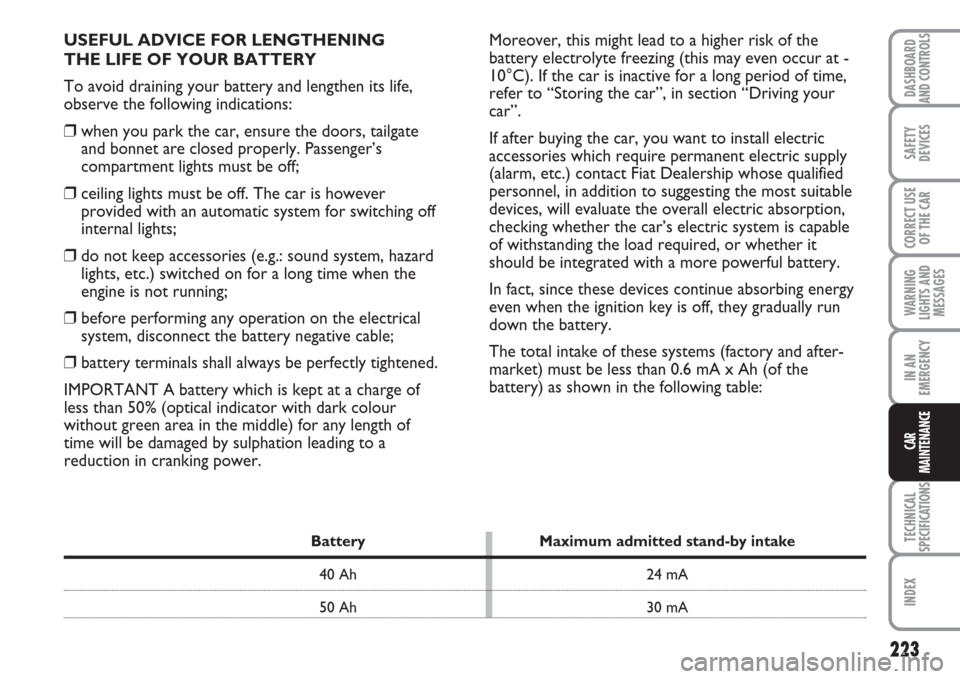
The total intake of these systems (factory and after-
market) must be less than 0.6 mA x Ah (of the
battery) as shown in the following table:
Battery Maximum admitted stand-by intake
40 Ah 24 mA
50 Ah 30 mA