lock FIAT MULTIPLA 2007 1.G Owner's Manual
[x] Cancel search | Manufacturer: FIAT, Model Year: 2007, Model line: MULTIPLA, Model: FIAT MULTIPLA 2007 1.GPages: 266, PDF Size: 4.66 MB
Page 78 of 266
77
SAFETY
DEVICES
CORRECT USE
OF THE CAR
WARNING
LIGHTS AND
MESSAGES
IN AN
EMERGENCY
CAR
MAINTENANCE
TECHNICAL
SPECIFICATIONS
INDEX
DASHBOARD
AND CONTROLS
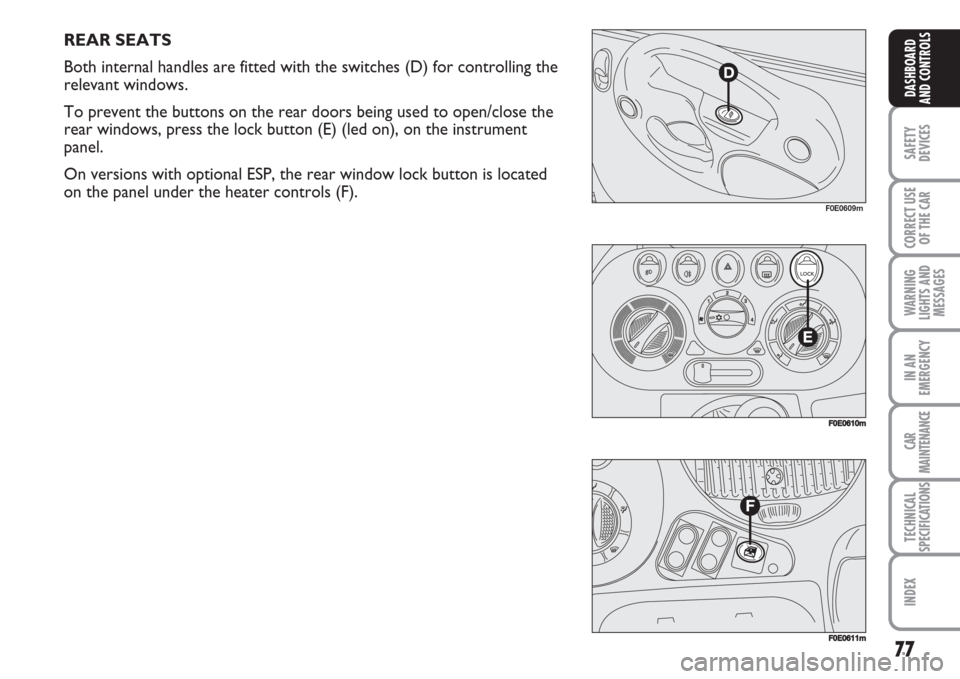
REAR SEATS
Both internal handles are fitted with the switches (D) for controlling the
relevant windows.
To prevent the buttons on the rear doors being used to open/close the
rear windows, press the lock button (E) (led on), on the instrument
panel.
On versions with optional ESP, the rear window lock button is located
on the panel under the heater controls (F).
F0E0610m
F0E0611m
F0E0609m
Page 79 of 266
78
SAFETY
DEVICES
CORRECT USE
OF THE CAR
WARNING
LIGHTS AND
MESSAGES
IN AN
EMERGENCY
CAR
MAINTENANCE
TECHNICAL
SPECIFICATIONS
INDEX
DASHBOARD
AND CONTROLS
BOOT
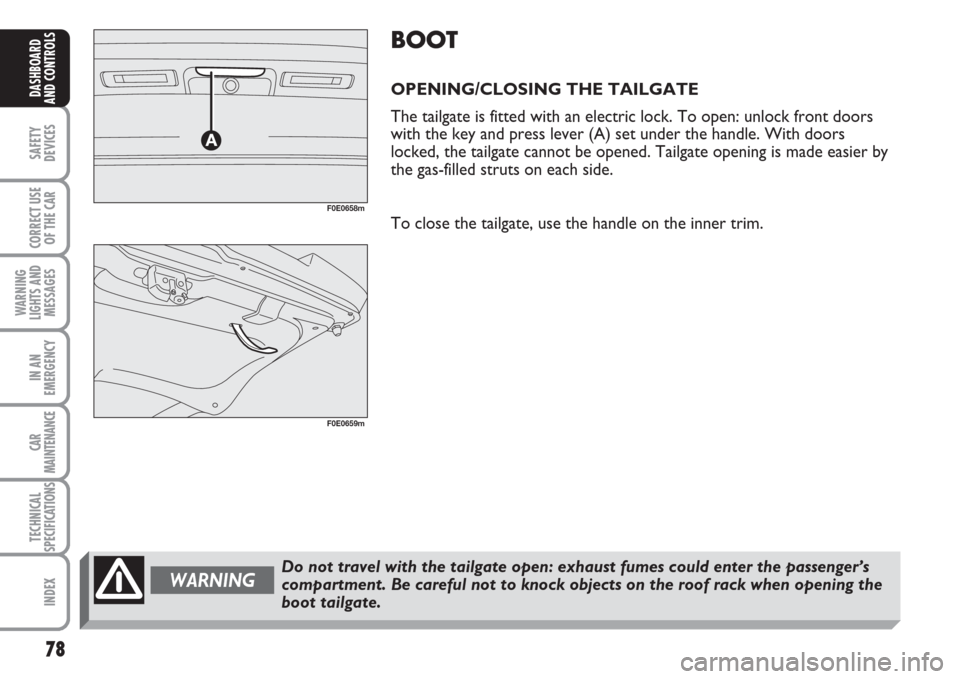
OPENING/CLOSING THE TAILGATE
The tailgate is fitted with an electric lock. To open: unlock front doors
with the key and press lever (A) set under the handle. With doors
locked, the tailgate cannot be opened. Tailgate opening is made easier by
the gas-filled struts on each side.
To close the tailgate, use the handle on the inner trim.
F0E0658m
F0E0659m
Do not travel with the tailgate open: exhaust fumes could enter the passenger’s
compartment. Be careful not to knock objects on the roof rack when opening the
boot tailgate.WARNING
Page 80 of 266
79
SAFETY
DEVICES
CORRECT USE
OF THE CAR
WARNING
LIGHTS AND
MESSAGES
IN AN
EMERGENCY
CAR
MAINTENANCE
TECHNICAL
SPECIFICATIONS
INDEX
DASHBOARD
AND CONTROLS
WARNINGWhen using the boot, make sure the loads you are carrying do not exceed the
permitted weight (see section “Technical specifications”). Also make sure the items
in the boot are arranged properly to prevent them being thrown forwards and
injuring passengers should you brake sharply.
F0E0397m
F0E0396m
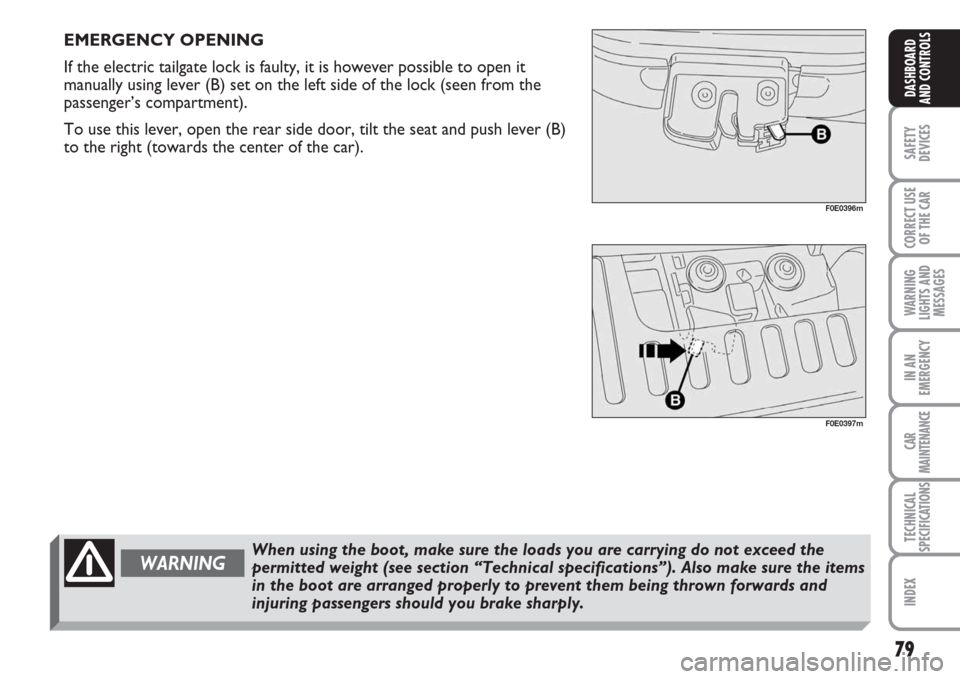
EMERGENCY OPENING
If the electric tailgate lock is faulty, it is however possible to open it
manually using lever (B) set on the left side of the lock (seen from the
passenger’s compartment).
To use this lever, open the rear side door, tilt the seat and push lever (B)
to the right (towards the center of the car).
Page 84 of 266
83
SAFETY
DEVICES
CORRECT USE
OF THE CAR
WARNING
LIGHTS AND
MESSAGES
IN AN
EMERGENCY
CAR
MAINTENANCE
TECHNICAL
SPECIFICATIONS
INDEX
DASHBOARD
AND CONTROLS
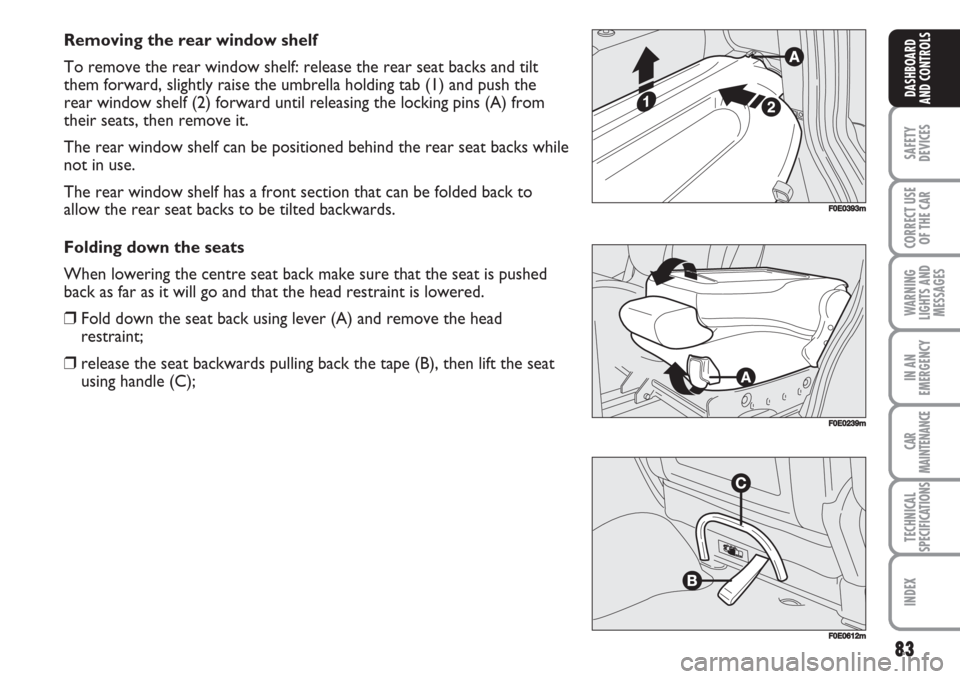
Removing the rear window shelf
To remove the rear window shelf: release the rear seat backs and tilt
them forward, slightly raise the umbrella holding tab (1) and push the
rear window shelf (2) forward until releasing the locking pins (A) from
their seats, then remove it.
The rear window shelf can be positioned behind the rear seat backs while
not in use.
The rear window shelf has a front section that can be folded back to
allow the rear seat backs to be tilted backwards.
Folding down the seats
When lowering the centre seat back make sure that the seat is pushed
back as far as it will go and that the head restraint is lowered.
❒Fold down the seat back using lever (A) and remove the head
restraint;
❒release the seat backwards pulling back the tape (B), then lift the seat
using handle (C);
F0E0239m
F0E0393m
F0E0612m
Page 91 of 266
90
SAFETY
DEVICES
CORRECT USE
OF THE CAR
WARNING
LIGHTS AND
MESSAGES
IN AN
EMERGENCY
CAR
MAINTENANCE
TECHNICAL
SPECIFICATIONS
INDEX
DASHBOARD
AND CONTROLS
ABS SYSTEM (where provided)
If this is the first car with ABS you drive, get familiar
with it by some preliminary “driving tests” on poor
grip roadbeds, obviously under safety conditions and in
compliance with the traffic regulations of the Country
you are driving in. Read carefully the following
instructions.
ABS is an integral part of the brake system that
prevents the wheels from locking when braking, makes
the most of road grip and gives the best control when
emergency braking under difficult road conditions.
System is completed by EBD (Electronic Braking Force
Distribution), which distributes the braking action
between front and rear wheels.IMPORTANT To have the maximum efficiency of the
braking system, it is necessary a setting period of
about 500 km: during this period, it is better to avoid
sharp, repeated and prolonged brakes.
ABS INTERVENTION
You can tell when the ABS is working by slight
throbbing of the brake pedal and the noise it makes:
slow down to match your speed to the road grip.
ABS exploits the available road grip as fully as possible, but it cannot increase it;
therefore prudence is always necessary on slippery surfaces: do not take
unnecessary risks.WARNING
When the ABS cuts in, and you feel the brake pedal pulsating, do not remove your
foot, but keep it pressed; in doing so you will stop in the shortest amount of space
possible under the current road conditions. WARNING
If the ABS system cuts in it is a sign that the grip between the tyre and the road
surface has reached the limit: slow down to match your speed to the road grip.WARNING
Page 92 of 266
91
SAFETY
DEVICES
CORRECT USE
OF THE CAR
WARNING
LIGHTS AND
MESSAGES
IN AN
EMERGENCY
CAR
MAINTENANCE
TECHNICAL
SPECIFICATIONS
INDEX
DASHBOARD
AND CONTROLS
FAILURE WARNINGS
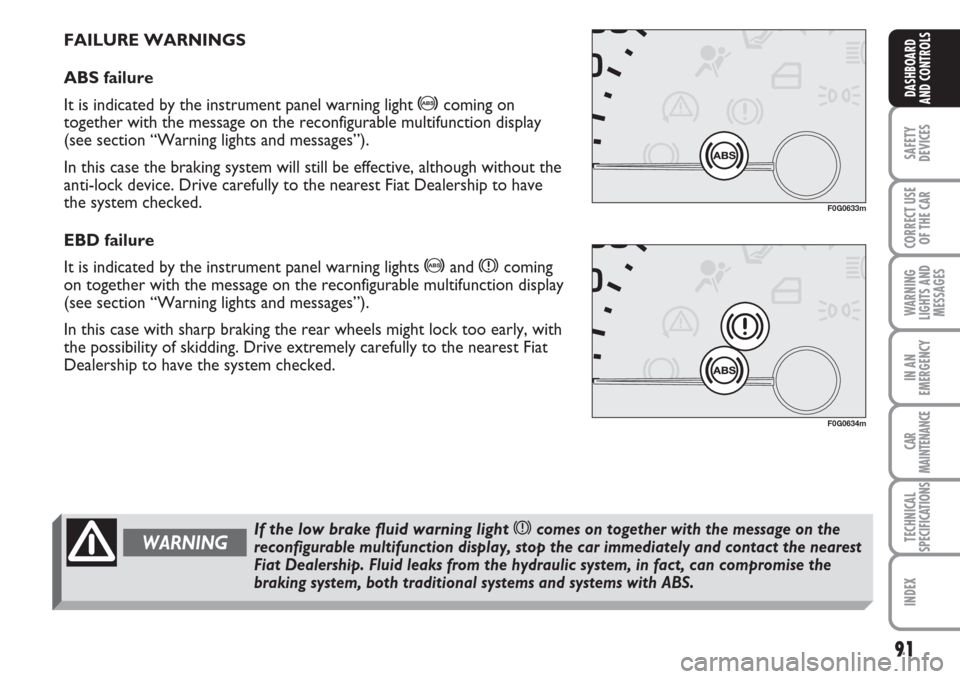
ABS failure
It is indicated by the instrument panel warning light
>coming on
together with the message on the reconfigurable multifunction display
(see section “Warning lights and messages”).
In this case the braking system will still be effective, although without the
anti-lock device. Drive carefully to the nearest Fiat Dealership to have
the system checked.
EBD failure
It is indicated by the instrument panel warning lights
>and xcoming
on together with the message on the reconfigurable multifunction display
(see section “Warning lights and messages”).
In this case with sharp braking the rear wheels might lock too early, with
the possibility of skidding. Drive extremely carefully to the nearest Fiat
Dealership to have the system checked.
F0G0633m
F0G0634m
WARNINGIf the low brake fluid warning light xcomes on together with the message on the
reconfigurable multifunction display, stop the car immediately and contact the nearest
Fiat Dealership. Fluid leaks from the hydraulic system, in fact, can compromise the
braking system, both traditional systems and systems with ABS.
Page 109 of 266
108
SAFETY
DEVICES
CORRECT USE
OF THE CAR
WARNING
LIGHTS AND
MESSAGES
IN AN
EMERGENCY
CAR
MAINTENANCE
TECHNICAL
SPECIFICATIONS
INDEX
DASHBOARD
AND CONTROLS
FUEL FILLER CAP
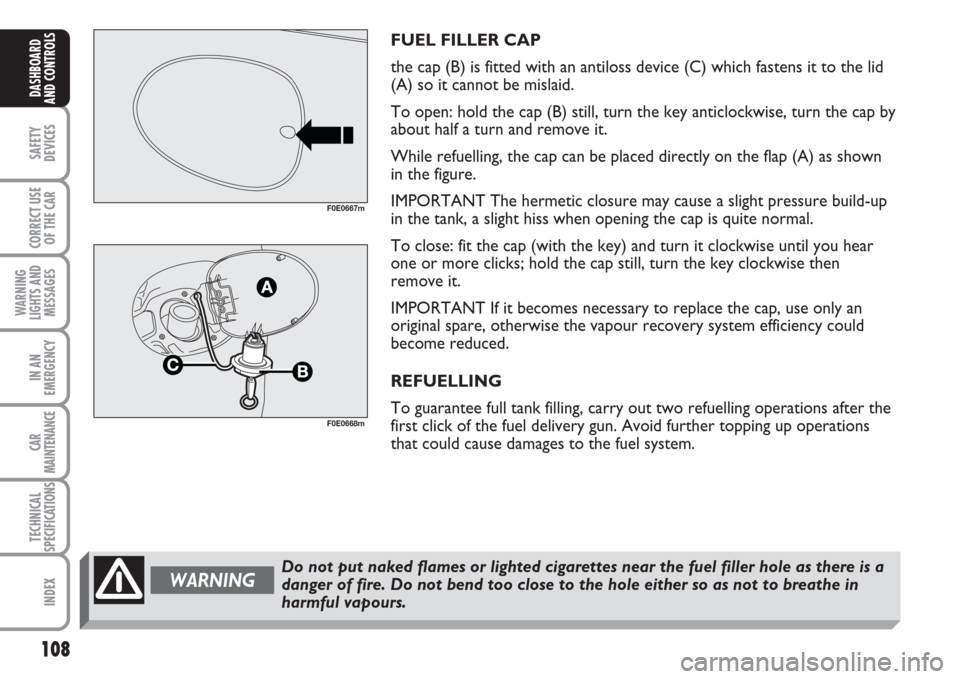
the cap (B) is fitted with an antiloss device (C) which fastens it to the lid
(A) so it cannot be mislaid.
To open: hold the cap (B) still, turn the key anticlockwise, turn the cap by
about half a turn and remove it.
While refuelling, the cap can be placed directly on the flap (A) as shown
in the figure.
IMPORTANT The hermetic closure may cause a slight pressure build-up
in the tank, a slight hiss when opening the cap is quite normal.
To close: fit the cap (with the key) and turn it clockwise until you hear
one or more clicks; hold the cap still, turn the key clockwise then
remove it.
IMPORTANT If it becomes necessary to replace the cap, use only an
original spare, otherwise the vapour recovery system efficiency could
become reduced.
REFUELLING
To guarantee full tank filling, carry out two refuelling operations after the
first click of the fuel delivery gun. Avoid further topping up operations
that could cause damages to the fuel system.
F0E0667m
Do not put naked flames or lighted cigarettes near the fuel filler hole as there is a
danger of fire. Do not bend too close to the hole either so as not to breathe in
harmful vapours.WARNING
F0E0668m
Page 113 of 266
112
CORRECT USE
OF THE CAR
WARNING
LIGHTS AND
MESSAGES
IN AN
EMERGENCY
CAR
MAINTENANCE
TECHNICAL
SPECIFICATIONS
INDEX
DASHBOARD
AND CONTROLS
SAFETY
DEVICES
SEAT BELTS
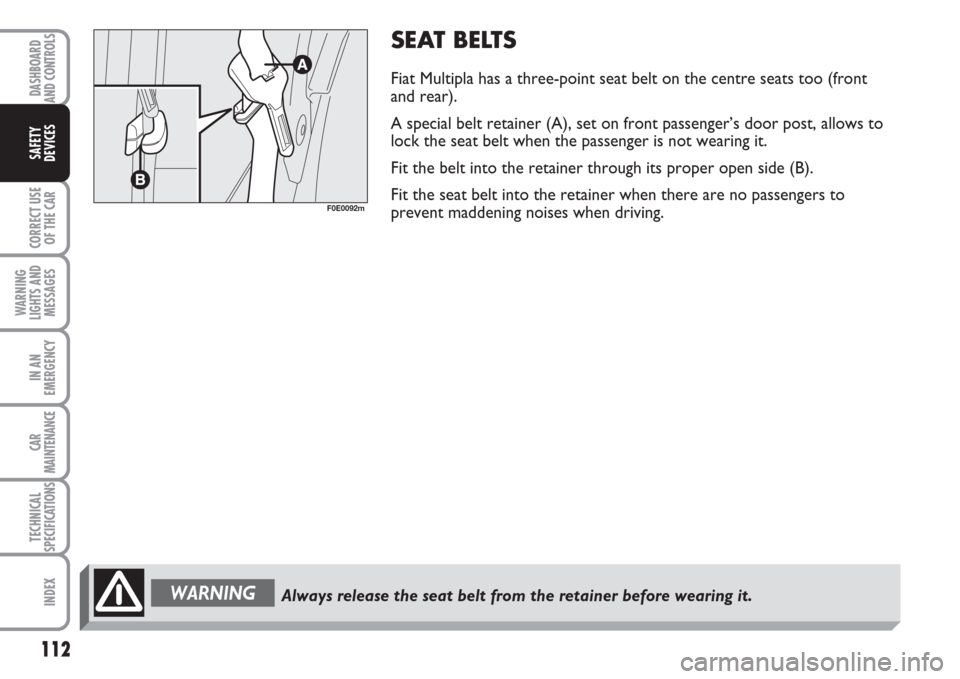
Fiat Multipla has a three-point seat belt on the centre seats too (front
and rear).
A special belt retainer (A), set on front passenger’s door post, allows to
lock the seat belt when the passenger is not wearing it.
Fit the belt into the retainer through its proper open side (B).
Fit the seat belt into the retainer when there are no passengers to
prevent maddening noises when driving.
F0E0092m
WARNINGAlways release the seat belt from the retainer before wearing it.
Page 114 of 266
113
CORRECT USE
OF THE CAR
WARNING
LIGHTS AND
MESSAGES
IN AN
EMERGENCY
CAR
MAINTENANCE
TECHNICAL
SPECIFICATIONS
INDEX
DASHBOARD
AND CONTROLS
SAFETY
DEVICES
HOW TO USE THE SEAT BELTS
(for front seats)
The belt should be worn keeping the chest straight and rested against the
seat back.
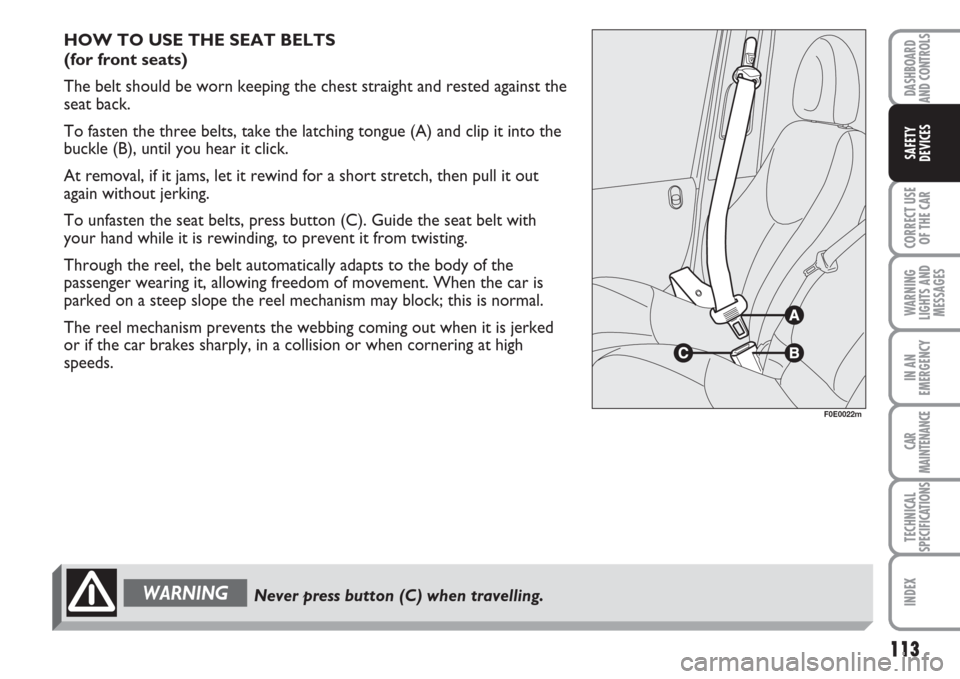
To fasten the three belts, take the latching tongue (A) and clip it into the
buckle (B), until you hear it click.
At removal, if it jams, let it rewind for a short stretch, then pull it out
again without jerking.
To unfasten the seat belts, press button (C). Guide the seat belt with
your hand while it is rewinding, to prevent it from twisting.
Through the reel, the belt automatically adapts to the body of the
passenger wearing it, allowing freedom of movement. When the car is
parked on a steep slope the reel mechanism may block; this is normal.
The reel mechanism prevents the webbing coming out when it is jerked
or if the car brakes sharply, in a collision or when cornering at high
speeds.
F0E0022m
WARNINGNever press button (C) when travelling.
Page 116 of 266
115
CORRECT USE
OF THE CAR
WARNING
LIGHTS AND
MESSAGES
IN AN
EMERGENCY
CAR
MAINTENANCE
TECHNICAL
SPECIFICATIONS
INDEX
DASHBOARD
AND CONTROLS
SAFETY
DEVICES
Centre seat belt
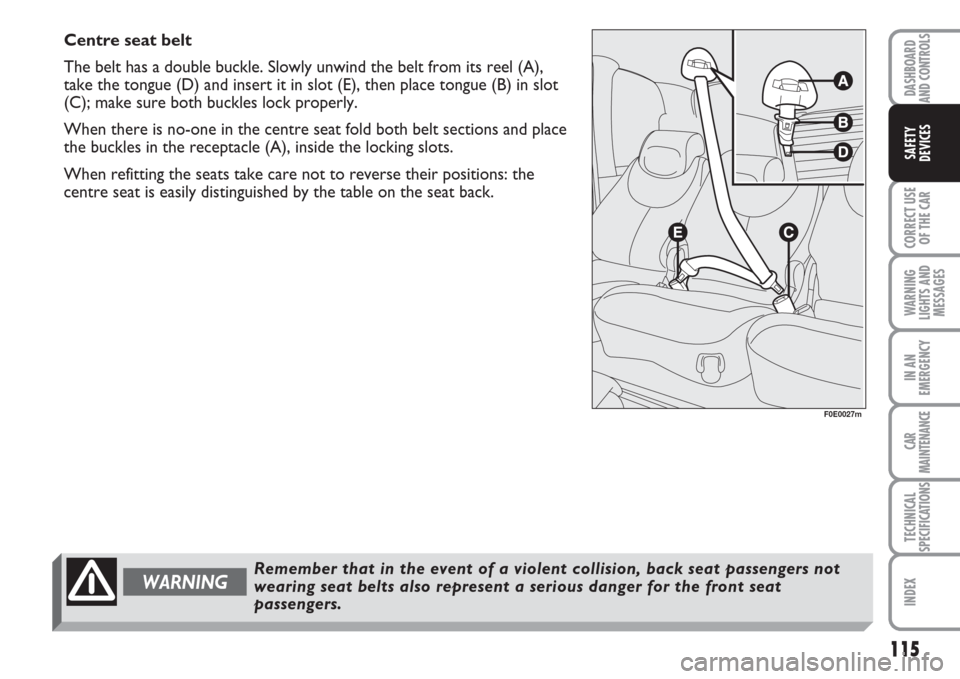
The belt has a double buckle. Slowly unwind the belt from its reel (A),
take the tongue (D) and insert it in slot (E), then place tongue (B) in slot
(C); make sure both buckles lock properly.
When there is no-one in the centre seat fold both belt sections and place
the buckles in the receptacle (A), inside the locking slots.
When refitting the seats take care not to reverse their positions: the
centre seat is easily distinguished by the table on the seat back.
F0E0027m
Remember that in the event of a violent collision, back seat passengers not
wearing seat belts also represent a serious danger for the front seat
passengers.WARNING