ignition FIAT MULTIPLA 2007 1.G Service Manual
[x] Cancel search | Manufacturer: FIAT, Model Year: 2007, Model line: MULTIPLA, Model: FIAT MULTIPLA 2007 1.GPages: 266, PDF Size: 4.66 MB
Page 158 of 266
157
CORRECT USE
OF THE CAR
IN AN
EMERGENCY
CAR
MAINTENANCE
TECHNICAL
SPECIFICATIONS
INDEX
DASHBOARD
AND CONTROLS
SAFETY
DEVICES
WARNING
LIGHTS AND
MESSAGES
157
Warning Messagelight on panel on display
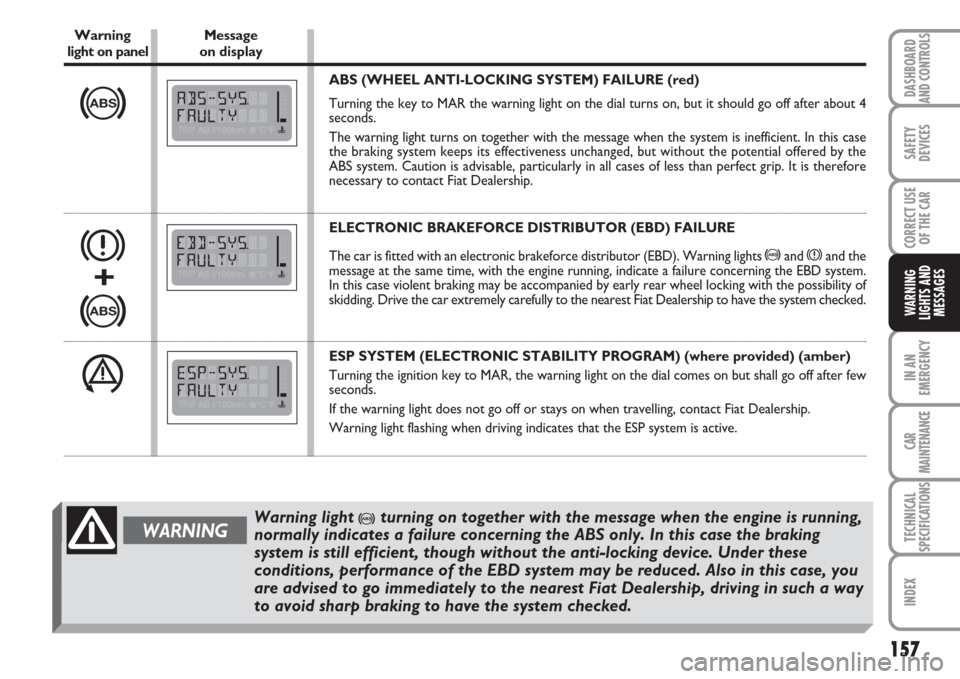
ABS (WHEEL ANTI-LOCKING SYSTEM) FAILURE (red)
Turning the key to MAR the warning light on the dial turns on, but it should go off after about 4
seconds.
The warning light turns on together with the message when the system is inefficient. In this case
the braking system keeps its effectiveness unchanged, but without the potential offered by the
ABS system. Caution is advisable, particularly in all cases of less than perfect grip. It is therefore
necessary to contact Fiat Dealership.
ELECTRONIC BRAKEFORCE DISTRIBUTOR (EBD) FAILURE
The car is fitted with an electronic brakeforce distributor (EBD). Warning lights >and xand the
message at the same time, with the engine running, indicate a failure concerning the EBD system.
In this case violent braking may be accompanied by early rear wheel locking with the possibility of
skidding. Drive the car extremely carefully to the nearest Fiat Dealership to have the system checked.
ESP SYSTEM (ELECTRONIC STABILITY PROGRAM) (where provided) (amber)
Turning the ignition key to MAR, the warning light on the dial comes on but shall go off after few
seconds.
If the warning light does not go off or stays on when travelling, contact Fiat Dealership.
Warning light flashing when driving indicates that the ESP system is active.
x
+
>
>
WARNINGWarning light >turning on together with the message when the engine is running,
normally indicates a failure concerning the ABS only. In this case the braking
system is still efficient, though without the anti-locking device. Under these
conditions, performance of the EBD system may be reduced. Also in this case, you
are advised to go immediately to the nearest Fiat Dealership, driving in such a way
to avoid sharp braking to have the system checked.
á
Page 159 of 266
158
IN AN
EMERGENCY
CAR
MAINTENANCE
TECHNICAL
SPECIFICATIONS
INDEX
DASHBOARD
AND CONTROLS
SAFETY
DEVICES
CORRECT USE
OF THE CAR
WARNING
LIGHTS AND
MESSAGES
158
Warning Messagelight on panel on display
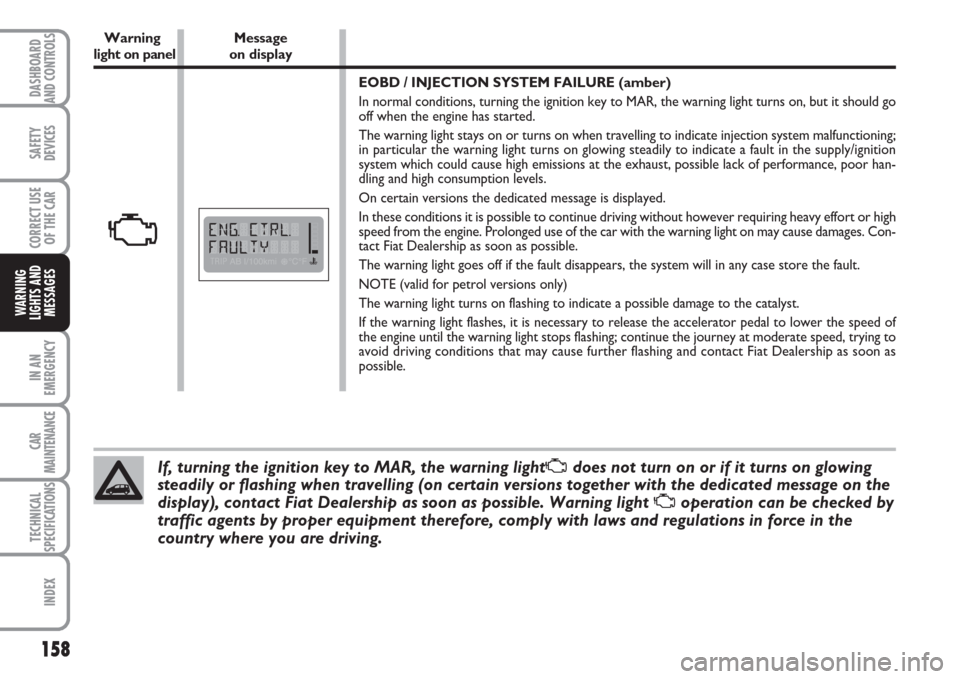
EOBD / INJECTION SYSTEM FAILURE (amber)
In normal conditions, turning the ignition key to MAR, the warning light turns on, but it should go
off when the engine has started.
The warning light stays on or turns on when travelling to indicate injection system malfunctioning;
in particular the warning light turns on glowing steadily to indicate a fault in the supply/ignition
system which could cause high emissions at the exhaust, possible lack of performance, poor han-
dling and high consumption levels.
On certain versions the dedicated message is displayed.
In these conditions it is possible to continue driving without however requiring heavy effort or high
speed from the engine. Prolonged use of the car with the warning light on may cause damages. Con-
tact Fiat Dealership as soon as possible.
The warning light goes off if the fault disappears, the system will in any case store the fault.
NOTE (valid for petrol versions only)
The warning light turns on flashing to indicate a possible damage to the catalyst.
If the warning light flashes, it is necessary to release the accelerator pedal to lower the speed of
the engine until the warning light stops flashing; continue the journey at moderate speed, trying to
avoid driving conditions that may cause further flashing and contact Fiat Dealership as soon as
possible.
If, turning the ignition key to MAR, the warning lightUdoes not turn on or if it turns on glowing
steadily or flashing when travelling (on certain versions together with the dedicated message on the
display), contact Fiat Dealership as soon as possible. Warning light
Uoperation can be checked by
traffic agents by proper equipment therefore, comply with laws and regulations in force in the
country where you are driving.
U
Page 163 of 266
162
IN AN
EMERGENCY
CAR
MAINTENANCE
TECHNICAL
SPECIFICATIONS
INDEX
DASHBOARD
AND CONTROLS
SAFETY
DEVICES
CORRECT USE
OF THE CAR
WARNING
LIGHTS AND
MESSAGES
162
Warning Messagelight on panel on display
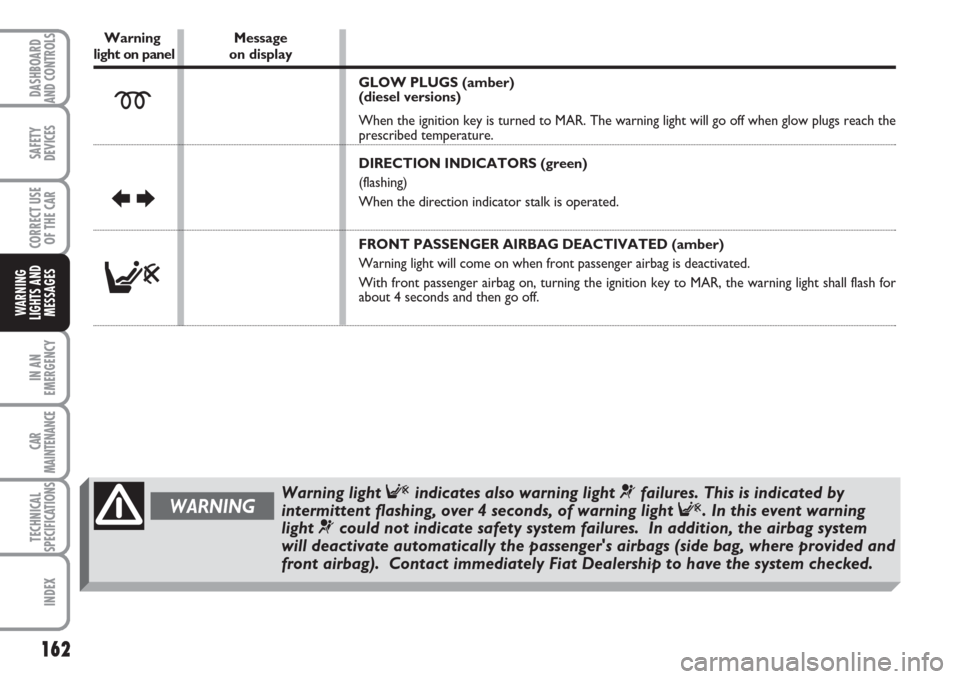
GLOW PLUGS (amber)
(diesel versions)
When the ignition key is turned to MAR. The warning light will go off when glow plugs reach the
prescribed temperature.
DIRECTION INDICATORS (green)
(flashing)
When the direction indicator stalk is operated.
FRONT PASSENGER AIRBAG DEACTIVATED (amber)
Warning light will come on when front passenger airbag is deactivated.
With front passenger airbag on, turning the ignition key to MAR, the warning light shall flash for
about 4 seconds and then go off.
F
m
RE
WARNINGWarning light Findicates also warning light ¬failures. This is indicated by
intermittent flashing, over 4 seconds, of warning light F. In this event warning
light ¬could not indicate safety system failures. In addition, the airbag system
will deactivate automatically the passenger's airbags (side bag, where provided and
front airbag). Contact immediately Fiat Dealership to have the system checked.
Page 166 of 266
165
SAFETY
DEVICES
CORRECT USE
OF THE CAR
WARNING
LIGHTS AND
MESSAGES
CAR
MAINTENANCE
TECHNICAL
SPECIFICATIONS
INDEX
DASHBOARD
AND CONTROLS
IN AN
EMERGENCY
ENGINE STARTING
EMERGENCY START-UP
If the Fiat Code system cannot deactivate the engine
immobiliser, the warning lights
¢and Uwill remain
lit and the engine will not start. To start your car
follow the emergency start-up procedure.
Read the whole procedure carefully before trying to
carry it out. If you make a mistake, you must turn the
ignition key back to STOP and repeat the whole
operation from beginning (step 1).
❒Read the 5-figure electronic code given on the
CODE card.
❒Turn the ignition key to MAR.
❒Press and hold down the accelerator pedal. The
warning light
Uturns on for about 8 seconds, and
then goes off; release the accelerator pedal and get
ready to count the flashes of the
Uwarning light.
❒Count the number of flashes that corresponds to
the first figure of the code on the CODE card, then
press the accelerator pedal and keep it there until
the
Uwarning light comes on (for 4 seconds) and
then goes off; release the accelerator pedal.❒The warning light
Uwill start flashing again: after it
has flashed the number of times that corresponds to
the second figure on the CODE card, press the
accelerator pedal to the floor and keep it there.
❒Do the same for the remaining figures on the
CODE card.
❒Once the final figure has been entered, keep the
accelerator pedal pressed. The warning light
Uwill
light up for 4 seconds and then go out; release the
accelerator pedal.
❒Rapid flashing of the warning light
U(for about 4
seconds) confirms the operation has been carried
out successfully.
❒Start the engine by turning the ignition key from
MAR to AVV.
If however the warning light
Ustays on, turn the
ignition key to STOP and repeat the procedure from
step 1.
IMPORTANT After an emergency start-up, you should
contact a Fiat Dealership otherwise you will have to
repeat the procedure described each time you want to
start the engine.
Page 167 of 266
166
SAFETY
DEVICES
CORRECT USE
OF THE CAR
WARNING
LIGHTS AND
MESSAGES
CAR
MAINTENANCE
TECHNICAL
SPECIFICATIONS
INDEX
DASHBOARD
AND CONTROLS
IN AN
EMERGENCY
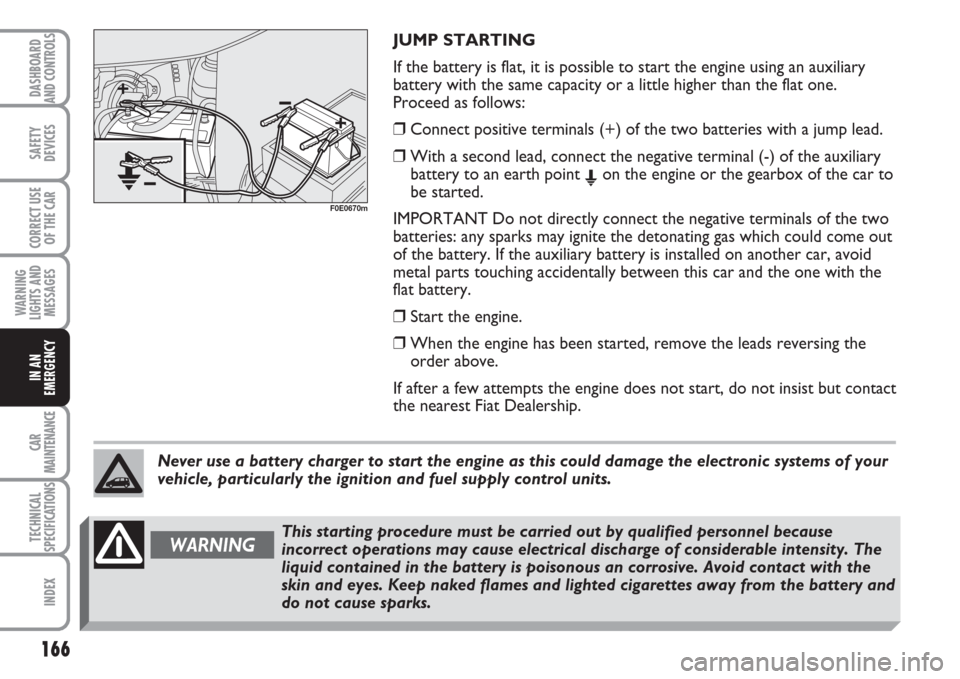
JUMP STARTING
If the battery is flat, it is possible to start the engine using an auxiliary
battery with the same capacity or a little higher than the flat one.
Proceed as follows:
❒Connect positive terminals (+) of the two batteries with a jump lead.
❒With a second lead, connect the negative terminal (-) of the auxiliary
battery to an earth point
Eon the engine or the gearbox of the car to
be started.
IMPORTANT Do not directly connect the negative terminals of the two
batteries: any sparks may ignite the detonating gas which could come out
of the battery. If the auxiliary battery is installed on another car, avoid
metal parts touching accidentally between this car and the one with the
flat battery.
❒Start the engine.
❒When the engine has been started, remove the leads reversing the
order above.
If after a few attempts the engine does not start, do not insist but contact
the nearest Fiat Dealership.
F0E0670m
Never use a battery charger to start the engine as this could damage the electronic systems of your
vehicle, particularly the ignition and fuel supply control units.
WARNINGThis starting procedure must be carried out by qualified personnel because
incorrect operations may cause electrical discharge of considerable intensity. The
liquid contained in the battery is poisonous an corrosive. Avoid contact with the
skin and eyes. Keep naked flames and lighted cigarettes away from the battery and
do not cause sparks.
Page 195 of 266
194
SAFETY
DEVICES
CORRECT USE
OF THE CAR
WARNING
LIGHTS AND
MESSAGES
CAR
MAINTENANCE
TECHNICAL
SPECIFICATIONS
INDEX
DASHBOARD
AND CONTROLS
IN AN
EMERGENCY
IF A FUSE BLOWS
GENERAL
The fuse is a protective device for the electric system: it comes into
action (i.e. it cuts off) mainly due to a fault or improper action on the
system.
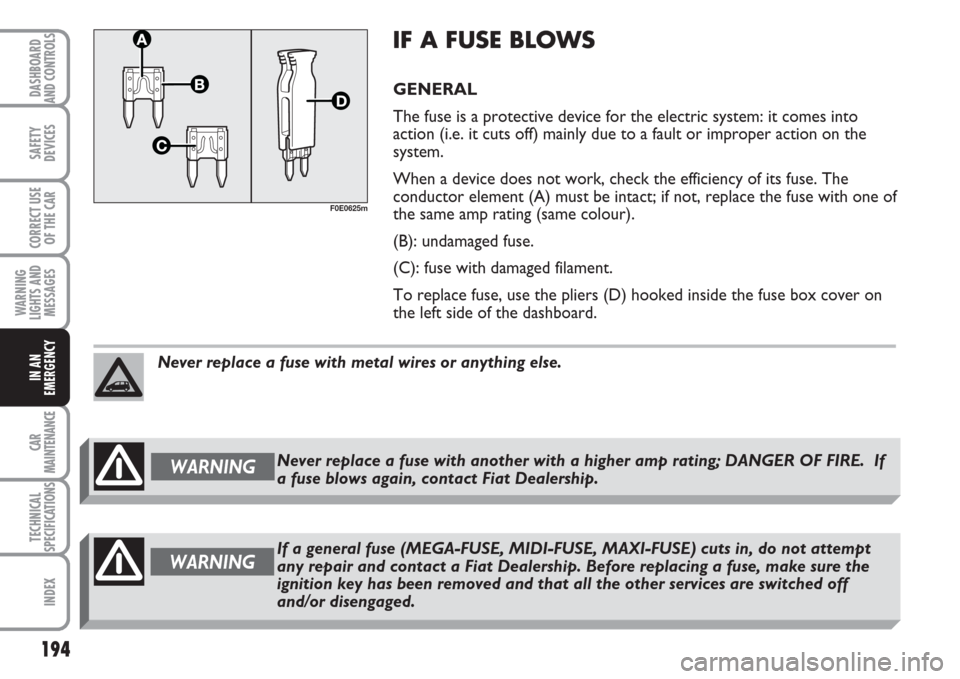
When a device does not work, check the efficiency of its fuse. The
conductor element (A) must be intact; if not, replace the fuse with one of
the same amp rating (same colour).
(B): undamaged fuse.
(C): fuse with damaged filament.
To replace fuse, use the pliers (D) hooked inside the fuse box cover on
the left side of the dashboard.
F0E0625m
Never replace a fuse with metal wires or anything else.
WARNINGIf a general fuse (MEGA-FUSE, MIDI-FUSE, MAXI-FUSE) cuts in, do not attempt
any repair and contact a Fiat Dealership. Before replacing a fuse, make sure the
ignition key has been removed and that all the other services are switched off
and/or disengaged.
WARNINGNever replace a fuse with another with a higher amp rating; DANGER OF FIRE. If
a fuse blows again, contact Fiat Dealership.
Page 196 of 266
195
SAFETY
DEVICES
CORRECT USE
OF THE CAR
WARNING
LIGHTS AND
MESSAGES
CAR
MAINTENANCE
TECHNICAL
SPECIFICATIONS
INDEX
DASHBOARD
AND CONTROLS
IN AN
EMERGENCY
Certain fuses are protected by a plastic grid.
To replace these fuses, first of all remove the grid
using a screwdriver. Replace the blown fuse and refit
the plastic grid.
To locate the fuse, refer to the tables on the following
pages.
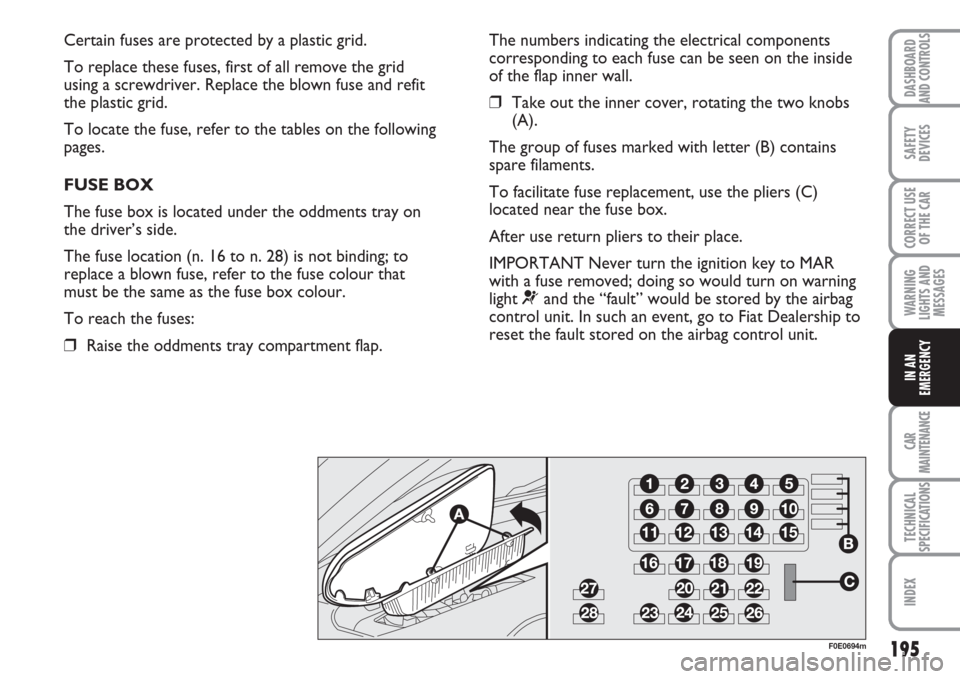
FUSE BOX
The fuse box is located under the oddments tray on
the driver’s side.
The fuse location (n. 16 to n. 28) is not binding; to
replace a blown fuse, refer to the fuse colour that
must be the same as the fuse box colour.
To reach the fuses:
❒Raise the oddments tray compartment flap.
F0E0694m
The numbers indicating the electrical components
corresponding to each fuse can be seen on the inside
of the flap inner wall.
❒Take out the inner cover, rotating the two knobs
(A).
The group of fuses marked with letter (B) contains
spare filaments.
To facilitate fuse replacement, use the pliers (C)
located near the fuse box.
After use return pliers to their place.
IMPORTANT Never turn the ignition key to MAR
with a fuse removed; doing so would turn on warning
light
¬and the “fault” would be stored by the airbag
control unit. In such an event, go to Fiat Dealership to
reset the fault stored on the airbag control unit.
Page 205 of 266
204
SAFETY
DEVICES
CORRECT USE
OF THE CAR
WARNING
LIGHTS AND
MESSAGES
CAR
MAINTENANCE
TECHNICAL
SPECIFICATIONS
INDEX
DASHBOARD
AND CONTROLS
IN AN
EMERGENCY
WARNINGDo not start the engine when towing the vehicle.
Before starting to tow, turn the ignition key to MAR and then to STOP. Do not
remove the key. If the key is removed, the steering lock engages automatically
resulting in the impossibility to steer the wheels. WARNING
WARNINGWhen towing, remember that without the help of the servobrake and power
steering, a greater effort is required on the pedal and steering wheel. Do not use
flexible cables for towing and avoid jerks. During towing operations make sure that
fastening the joint to the car does not damage the components in contact with it.
When towing the car, you must comply with the specific traffic regulations
regarding the tow ring and how to tow on the road.
Page 224 of 266
223
SAFETY
DEVICES
CORRECT USE
OF THE CAR
WARNING
LIGHTS AND
MESSAGES
TECHNICAL
SPECIFICATIONS
INDEX
DASHBOARD
AND CONTROLS
IN AN
EMERGENCY
CAR
MAINTENANCE
USEFUL ADVICE FOR LENGTHENING
THE LIFE OF YOUR BATTERY
To avoid draining your battery and lengthen its life,
observe the following indications:
❒when you park the car, ensure the doors, tailgate
and bonnet are closed properly. Passenger’s
compartment lights must be off;
❒ceiling lights must be off. The car is however
provided with an automatic system for switching off
internal lights;
❒do not keep accessories (e.g.: sound system, hazard
lights, etc.) switched on for a long time when the
engine is not running;
❒before performing any operation on the electrical
system, disconnect the battery negative cable;
❒battery terminals shall always be perfectly tightened.
IMPORTANT A battery which is kept at a charge of
less than 50% (optical indicator with dark colour
without green area in the middle) for any length of
time will be damaged by sulphation leading to a
reduction in cranking power.Moreover, this might lead to a higher risk of the
battery electrolyte freezing (this may even occur at -
10°C). If the car is inactive for a long period of time,
refer to “Storing the car”, in section “Driving your
car”.
If after buying the car, you want to install electric
accessories which require permanent electric supply
(alarm, etc.) contact Fiat Dealership whose qualified
personnel, in addition to suggesting the most suitable
devices, will evaluate the overall electric absorption,
checking whether the car’s electric system is capable
of withstanding the load required, or whether it
should be integrated with a more powerful battery.
In fact, since these devices continue absorbing energy
even when the ignition key is off, they gradually run
down the battery.
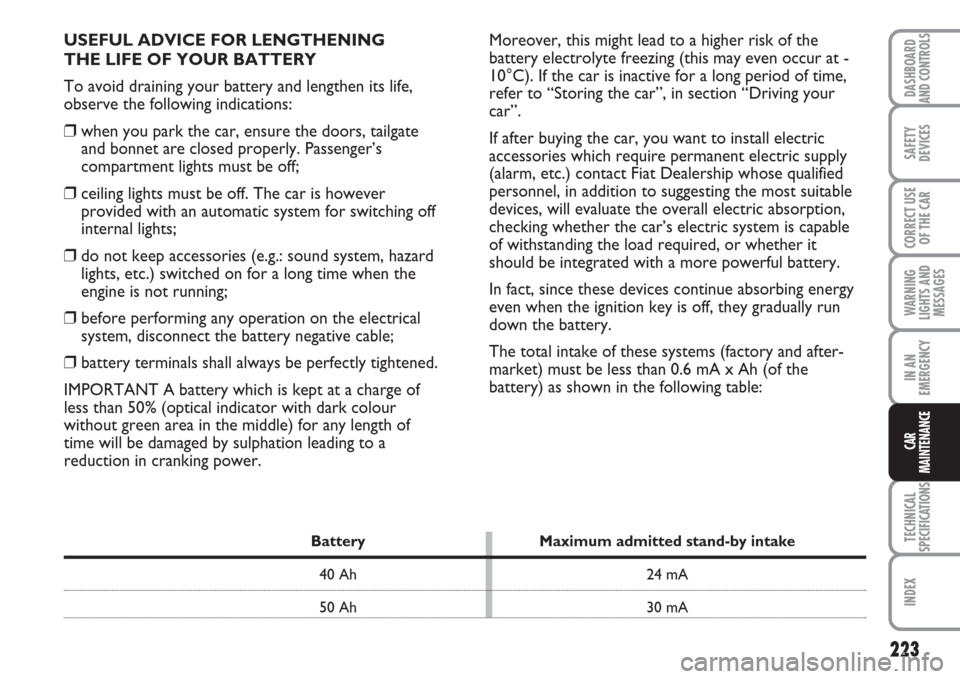
The total intake of these systems (factory and after-
market) must be less than 0.6 mA x Ah (of the
battery) as shown in the following table:
Battery Maximum admitted stand-by intake
40 Ah 24 mA
50 Ah 30 mA
Page 232 of 266
231
SAFETY
DEVICES
CORRECT USE
OF THE CAR
WARNING
LIGHTS AND
MESSAGES
TECHNICAL
SPECIFICATIONS
INDEX
DASHBOARD
AND CONTROLS
IN AN
EMERGENCY
CAR
MAINTENANCE
Windows
Use specific window cleaner products to clean cloths
to avoid scratching the glass or damaging the
transparency.
IMPORTANT The inside of the rear window should
be wiped gently with a cloth in the direction of the
filaments to avoid damaging the heating device.
Engine compartment
At the end of the winter the engine compartment
should be carefully washed, without directing the jet
against electronic control units. Contact a specialised
workshop to have this done.
IMPORTANT Wash with the engine cold and the
ignition key at STOP. After washing make sure that the
various protections (e.g. rubber caps and various
covers) have not been damaged or removed.
Front headlights
IMPORTANT Never use aromatic substances (e.g.:
petrol) or ketones (e.g.: acetone) for cleaning front
headlight plastic lens.
IMPORTANT Wash with the engine cold and the
ignition key at STOP. After washing make sure that the
various protections (e.g. rubber caps and various
covers) have not been damaged or removed.INTERIORS
Periodically check that water is not trapped under the
mats (due to water dripping off shoes, umbrellas, etc.)
which could cause oxidisation of the sheet metal.
CLEANING SEATS AND FABRIC/JERSEY
UPHOLSTERY
❒Use a soft brush or vacuum cleaner to remove dust.
❒Rub the seats with a sponge moistened with a
solution of water and neutral detergent.
PLASTIC PARTS INSIDE THE CAR
Clean the plastic parts inside the car with a cloth
moistened with a solution of water and non-abrasive
neutral detergent. To remove grease or hard stains,
use special solvent-free products designed not to alter
the appearance and colour of components.
IMPORTANT Do not use alcohol or petrol to clean
the instrument panel.
Detergents cause water pollution.
Therefore the engine compartment should
be washed in areas equipped for
collecting and purifying the liquid used in
the washing process.