air FIAT PALIO 2003 178 / 1.G India Version Owner's Manual
[x] Cancel search | Manufacturer: FIAT, Model Year: 2003, Model line: PALIO, Model: FIAT PALIO 2003 178 / 1.GPages: 156, PDF Size: 6.27 MB
Page 77 of 156
76
Climate control system
The climate control system is an ad-
ditional load which greatly effects the
engine leading to higher(up to +20%
in average) fuel consumption. When
the temperature outside allows, use
the air vents where possible.
Spoilers
The use of optional extras, which are
not certified for specific use on the car,
may reduce the aerodynamic pene-
tration of the car and increase con-
sumption.
DRIVING STYLE
Starting
Do not warm the engine when the
car is stationary or at high or low revs:
in this way the engine will warm up
gradually increasing consumption and
emissions. You should drive off slow-
ly straight away avoiding high revs so
that the engine will warm up more
quickly.
Unnecessary actions
Avoid revving the engine when
stopped at traffic lights or before
switching off the engine and avoid
doubling the clutch as these actions
serve no purpose in modern cars and
only increase consumption and pollu-
tion.
Gear selections
As soon as the traffic and road con-
ditions allow it, shift to a higher gear.
Using a lower gear to liven up accel-
eration greatly increases consumption.
In the same way, improper use of the
higher gears will increase consump-
tion, emissions and wear and tear on
the engine.
Top speed
Fuel consumption increases consid-
erably as speed increases. For exam-
ple, when accelerating from 90 to 120
km/h, fuel consumption increases up
to approximately +30%. Your speed should be kept as even
as possible and superfluous braking
and acceleration avoided as this in-
creases both consumption and emis-
sions. A “smooth” driving style should
be adopted by attempting to anticipate
manoeuvres to avoid imminent danger
and to keep a safe distance from the
vehicle in front to avoid braking
sharply.
Acceleration
Accelerating violently increasing the
revs will greatly effect consumption
and emission; acceleration should be
gradual and not exceed the maximum
torque.
CONDITIONS OF USE
Cold starting
Very short distances and frequent
cold starting will not enable the engine
to reach optimal running temperature.
It follows, therefore, that consumption
will be higher (from +15 to +30% in
towns) as will the production of toxic
emissions.
64-79 03/03/2003 06:45 PM Page 76
Page 83 of 156
82
BUMP STARTING IF A TYRE IS
PUNCTURED
Follow the instructions on this and
the following pages to use the jack and
spare wheel correctly.
Remember that until
the engine has started the
brake booster and power
steering systems will not work
and a greater effort will therefore
be required to depress the brake
pedal or turn the steering wheel.
An incorrectly posi-
tioned jack may cause the
car to fall.
Do not use the jack to lift loads
exceeding that indicated on the
label attached to the jack itself.
The jack should only be used to
change a wheel on the car for
which it is designed. It should not
be put to other uses or employed
to raise other models of cars. Un-
der no circumstances should it be
used when carrying out repairs
under the car.
Do not lubricate the bolt
threads before fitting them back:
they could come loose.
Never start the engine,
when the car is raised on
a jack. Never tamper with
the inflation valve. Never place
tools between the rim and tyre.
Check the tyre and spare wheel
pressure regularly. The tyre in-
flation pressure is shown in the
“Technical specifications” chap-
ter.
Never bump start the
engine (by pushing, tow-
ing or coasting downhill).
This could cause fuel to flow in-
to the catalytic exhaust system
and damage it beyond repair.
If the car is fitted with al-
loy rims, a specific spare
wheel is provided. It is dif-
ferent from the one provided for
the cars fitted with steel rims. In
the event of successive purchase
of alloy rims, replacing the steel
rims, we suggest you to keep at
disposal 4 genuine bolts, which
will be used only with the spare
wheel. Danger of damaging the
wheel hubs
80-103 03/03/2003 06:49 PM Page 82
Page 85 of 156
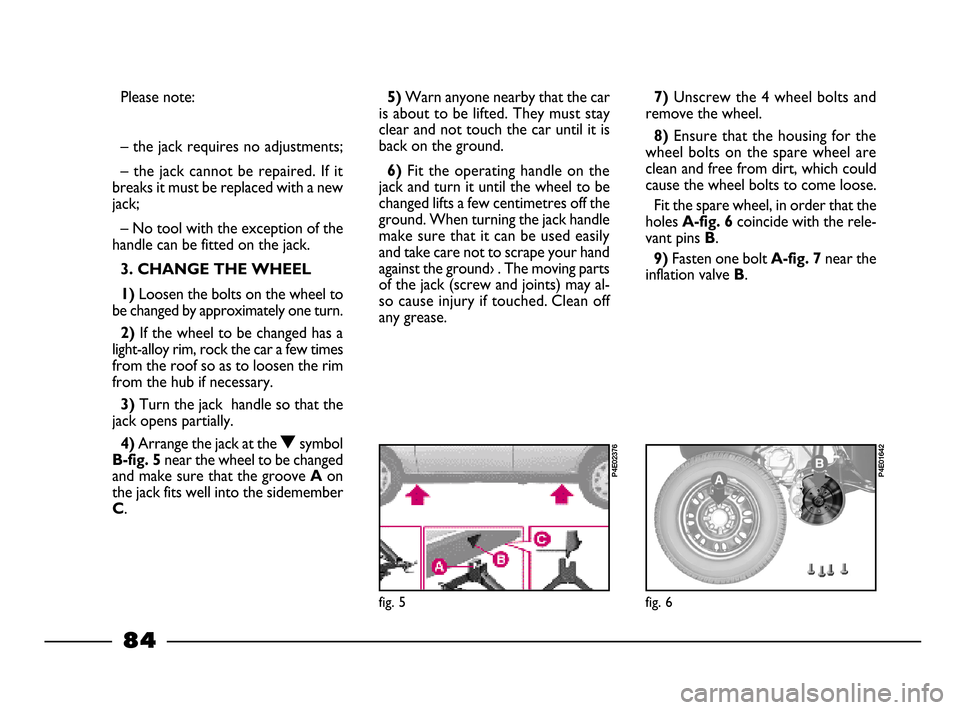
5) Warn anyone nearby that the car
is about to be lifted. They must stay
clear and not touch the car until it is
back on the ground.
6)Fit the operating handle on the
jack and turn it until the wheel to be
changed lifts a few centimetres off the
ground. When turning the jack handle
make sure that it can be used easily
and take care not to scrape your hand
against the ground› . The moving parts
of the jack (screw and joints) may al-
so cause injury if touched. Clean off
any grease.
7)Unscrew the 4 wheel bolts and
remove the wheel.
8) Ensure that the housing for the
wheel bolts on the spare wheel are
clean and free from dirt, which could
cause the wheel bolts to come loose.
Fit the spare wheel, in order that the
holes
A-fig. 6coincide with the rele-
vant pins
B.
9) Fasten one bolt A-fig. 7near the
inflation valve
B.
fig. 6
P4E01642
fig. 5
P4E02376
84
Please note:
– the jack weighs 2.900 kg;
– the jack requires no adjustments;
– the jack cannot be repaired. If it
breaks it must be replaced with a new
jack;
– No tool with the exception of the
handle can be fitted on the jack.
3. CHANGE THE WHEEL
1)
Loosen the bolts on the wheel to
be changed by approximately one turn.
2) If the wheel to be changed has a
light-alloy rim, rock the car a few times
from the roof so as to loosen the rim
from the hub if necessary.
3) Turn the jack handle so that the
jack opens partially.
4)Arrange the jack at the Osymbol
B-fig. 5 near the wheel to be changed
and make sure that the groove
Aon
the jack fits well into the sidemember
C.
80-103 03/03/2003 06:49 PM Page 84
Page 86 of 156
85
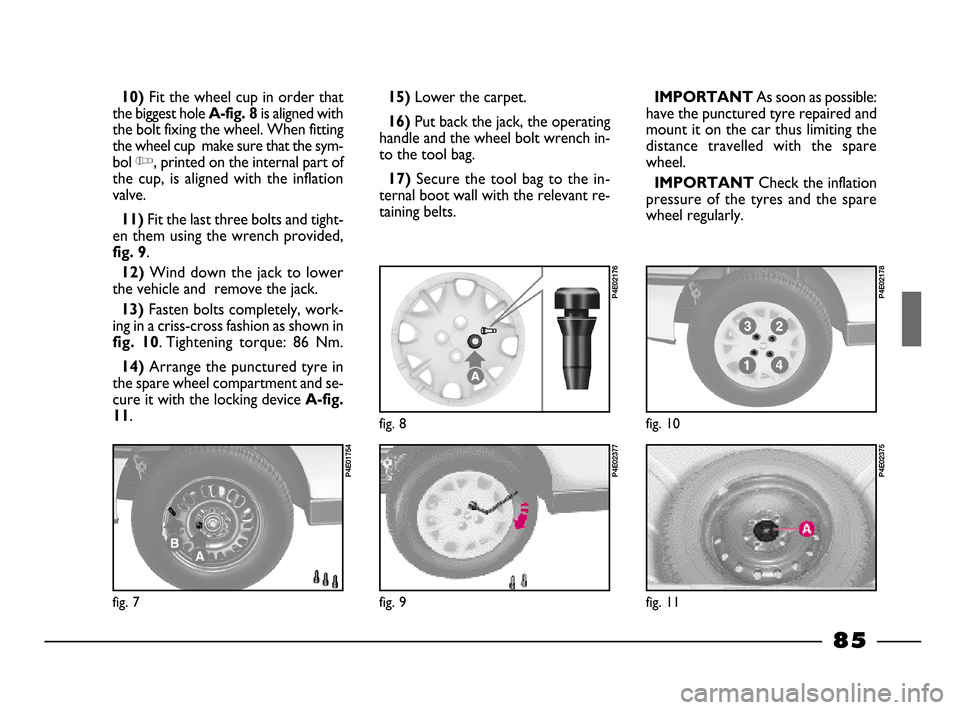
10)Fit the wheel cup in order that
the biggest hole
A-fig. 8is aligned with
the bolt fixing the wheel. When fitting
the wheel cup make sure that the sym-
bol
Y, printed on the internal part of
the cup, is aligned with the inflation
valve.
11)Fit the last three bolts and tight-
en them using the wrench provided,
fig. 9.
12)Wind down the jack to lower
the vehicle and remove the jack.
13)Fasten bolts completely, work-
ing in a criss-cross fashion as shown in
fig. 10. Tightening torque: 86 Nm.
14)Arrange the punctured tyre in
the spare wheel compartment and se-
cure it with the locking device
A-fig.
11
.
fig. 7
P4E01754
15)Lower the carpet.
16)Put back the jack, the operating
handle and the wheel bolt wrench in-
to the tool bag.
17)Secure the tool bag to the in-
ternal boot wall with the relevant re-
taining belts.
fig. 8
P4E02176
fig. 9
P4E02377
IMPORTANT As soon as possible:
have the punctured tyre repaired and
mount it on the car thus limiting the
distance travelled with the spare
wheel.
IMPORTANT Check the inflation
pressure of the tyres and the spare
wheel regularly.
fig. 10
P4E02178
fig. 11
P4E02375
80-103 03/03/2003 06:49 PM Page 85
Page 87 of 156
86
IF A BULB BURNS OUT
Modifications or repairs
to the electrical system
carried out incorrectly
and without bearing the features
of the system in mind can cause
malfunctions with the risk of fire.
You should have the
bulbs replaced at a Fiat
Dealership. The correct
operation and direction of the
headlights is essential for safety
and is governed by the highway
code.Only touch the metal
part when handling halo-
gen bulbs. If the transpar-
ent bulb is touched it reduces the
intensity of the light emitted and
can also reduce the life of the
bulb. If you touch the bulb acci-
dentally, rub it with a cloth moist-
ened with alcohol and leave it to
dry.
GENERAL INSTRUCTIONS
When a light is not working, check
that it has not fused before changing the
bulb.
For the location of the fuses, refer to
“If a fuse blows” in this chapter.
Before replacing a bulb that does not
work, check that the contacts are not
oxidised.
Halogen bulbs contain
pressurised gas which, if
broken, may cause small
fragments of glass to be project-
ed outwards.
Burnt-out bulbs must be replaced
with ones of the same type. Bulbs with
low power offer low illumination,
bulbs with too much power absorb
too much energy.
Always check the height of the head-
light beam after changing a bulb.
TYPES OF BULBS
Several types of bulbs are installed in
the car
fig. 12:
A. Glass bulbs
Clipped into position. Pull to remove.
B. Bayonet connection bulbs
Remove from the bulb holder by
pressing the bulb and rotating it anti-
clockwise.
C. Cylindrical bulbs
Remove by pulling away from termi-
nals.
D-E. Halogen bulbs
To remove bulb, loosen the fixing
spring from the relevant seat.
80-103 03/03/2003 06:49 PM Page 86
Page 95 of 156
94
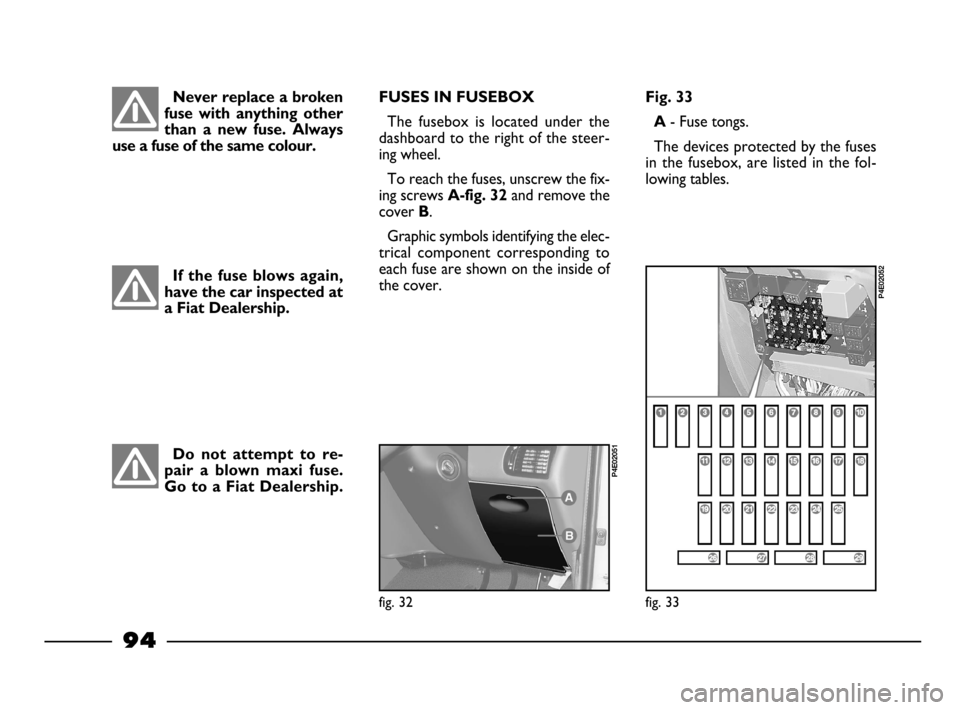
Fig. 33
A
- Fuse tongs.
The devices protected by the fuses
in the fusebox, are listed in the fol-
lowing tables.
fig. 33
P4E02052
Do not attempt to re-
pair a blown maxi fuse.
Go to a Fiat Dealership.If the fuse blows again,
have the car inspected at
a Fiat Dealership.Never replace a broken
fuse with anything other
than a new fuse. Always
use a fuse of the same colour.
FUSES IN FUSEBOX
The fusebox is located under the
dashboard to the right of the steer-
ing wheel.
To reach the fuses, unscrew the fix-
ing screws
A-fig. 32and remove the
cover
B.
Graphic symbols identifying the elec-
trical component corresponding to
each fuse are shown on the inside of
the cover.
fig. 32
P4E02051
80-103 03/03/2003 06:49 PM Page 94
Page 97 of 156
96
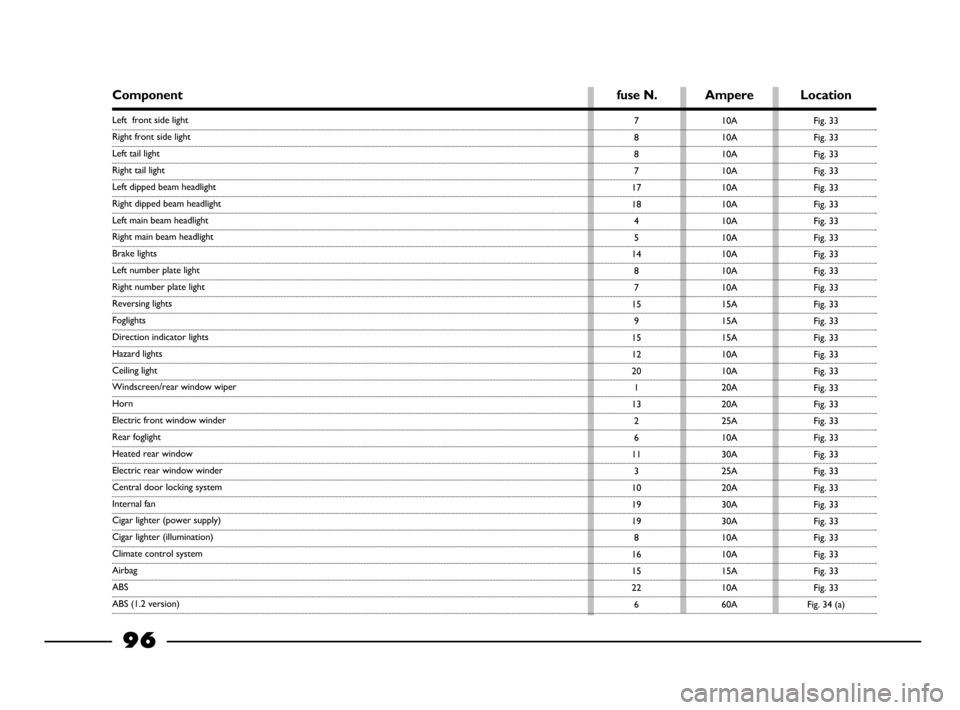
Componentfuse N. Ampere Location
7
8
8
7
17
18
4
5
14
8
7
15
9
15
12
20
1
13
2
6
11
3
10
19
19
8
16
15
22
610A
10A
10A
10A
10A
10A
10A
10A
10A
10A
10A
15A
15A
15A
10A
10A
20A
20A
25A
10A
30A
25A
20A
30A
30A
10A
10A
15A
10A
60AFig. 33
Fig. 33
Fig. 33
Fig. 33
Fig. 33
Fig. 33
Fig. 33
Fig. 33
Fig. 33
Fig. 33
Fig. 33
Fig. 33
Fig. 33
Fig. 33
Fig. 33
Fig. 33
Fig. 33
Fig. 33
Fig. 33
Fig. 33
Fig. 33
Fig. 33
Fig. 33
Fig. 33
Fig. 33
Fig. 33
Fig. 33
Fig. 33
Fig. 33
Fig. 34 (a)Left front side light
Right front side light
Left tail light
Right tail light
Left dipped beam headlight
Right dipped beam headlight
Left main beam headlight
Right main beam headlight
Brake lights
Left number plate light
Right number plate light
Reversing lights
Foglights
Direction indicator lights
Hazard lights
Ceiling light
Windscreen/rear window wiper
Horn
Electric front window winder
Rear foglight
Heated rear window
Electric rear window winder
Central door locking system
Internal fan
Cigar lighter (power supply)
Cigar lighter (illumination)
Climate control system
Airbag
ABS
ABS (1.2 version)
80-103 03/03/2003 06:49 PM Page 96
Page 100 of 156
99
Cars fitted with an en-
gine/gearbox guard cannot
be lifted from the front.
IF THE CAR
NEEDS TO BE
RAISED
WITH THE JACK
See “If a Tyre is Punctured”, in this
chapter.
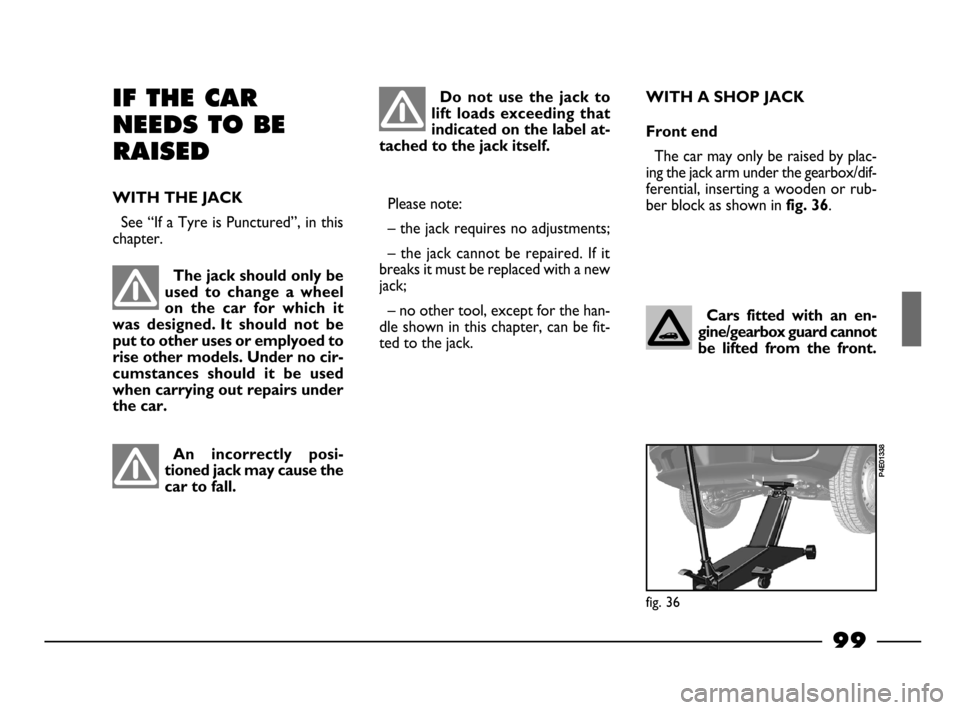
WITH A SHOP JACK
Front end
The car may only be raised by plac-
ing the jack arm under the gearbox/dif-
ferential, inserting a wooden or rub-
ber block as shown in
fig. 36.
The jack should only be
used to change a wheel
on the car for which it
was designed. It should not be
put to other uses or emplyoed to
rise other models. Under no cir-
cumstances should it be used
when carrying out repairs under
the car.
An incorrectly posi-
tioned jack may cause the
car to fall.
Do not use the jack to
lift loads exceeding that
indicated on the label at-
tached to the jack itself.
Please note:
– the jack requires no adjustments;
– the jack cannot be repaired. If it
breaks it must be replaced with a new
jack;
– no other tool, except for the han-
dle shown in this chapter, can be fit-
ted to the jack.
fig. 36
P4E01338
80-103 03/03/2003 06:49 PM Page 99
Page 104 of 156
103
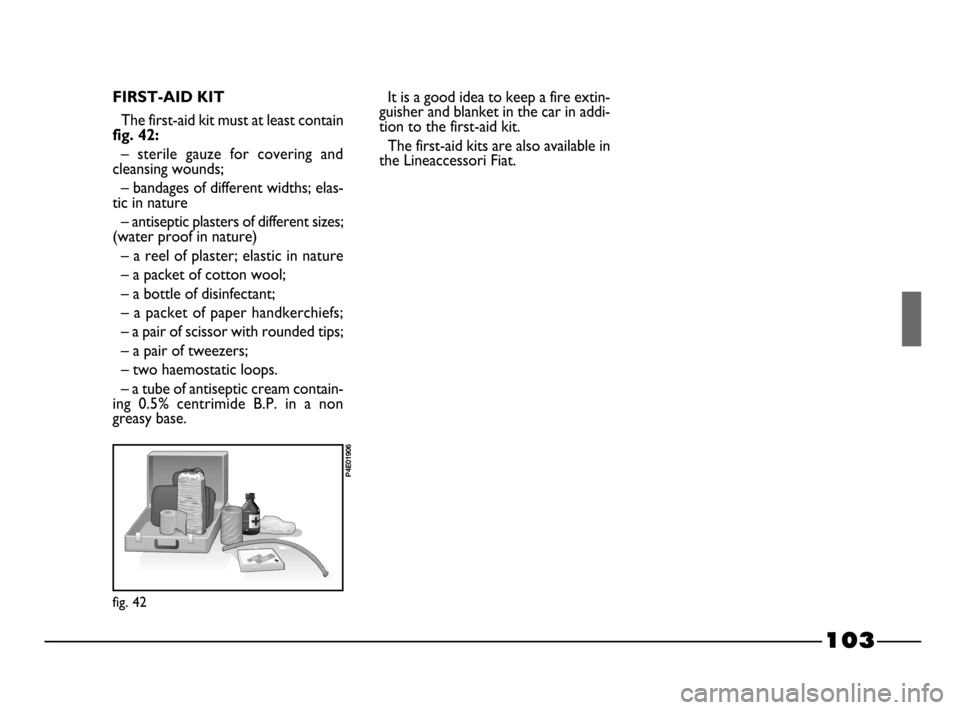
fig. 42
P4E01906
FIRST-AID KIT
The first-aid kit must at least containfig. 42:
– sterile gauze for covering and
cleansing wounds;
– bandages of different widths; elas-
tic in nature
– antiseptic plasters of different sizes;
(water proof in nature)
– a reel of plaster; elastic in nature
– a packet of cotton wool;
– a bottle of disinfectant;
– a packet of paper handkerchiefs;
– a pair of scissor with rounded tips;
– a pair of tweezers;
– two haemostatic loops.
– a tube of antiseptic cream contain-
ing 0.5% centrimide B.P. in a non
greasy base.It is a good idea to keep a fire extin-
guisher and blanket in the car in addi-
tion to the first-aid kit.
The first-aid kits are also available in
the Lineaccessori Fiat.
80-103 03/03/2003 06:49 PM Page 103
Page 105 of 156
CAR MAINTENANCE
The Fiat Palio is new throughout, even in its ser-
vicing schedule.
For instance: the first scheduled servicing coupon
is prescribed at 1,000-1,500 kms or 3 months
whichever is earlier from the date of sale of vehicle.
However, it is useful to remember that the car
needs always ordinary attentions such as systematic
control with possible fluid level refuelling, tyre pres-
sure restoration, etc.
You should nonetheless bear in mind that the
proper maintenance of your car is certainly the best
way to keep it in tip-top conditions for years to
come and safeguard its performance and safety fea-
tures, while respecting the environment and keeping
running costs down.
Remember that the scrupulous compliance with
the servicing rules marked by the symbol ∑
can
constitute the condition necessary for the mainte-
nance of the warranty.
SCHEDULED SERVICING .................................... PAGE 105
SCHEDULED SERVICING
PLAN ............................................................................ PAGE 106
ADDITIONAL INTERVENTIONS ....................... PAGE 108
LEVEL CHECK ........................................................... PAGE 110
AIR CLEANER ............................................................ PAGE 116
BATTERY .................................................................... PAGE 117
ELECTRONIC CONTROL UNITS ..................... PAGE 120
SPARK PLUGS ........................................................... PAGE 121
WHEELS AND TYRES ............................................ PAGE 121
RUBBER PIPES ........................................................... PAGE 123
WINDSCREEN/REAR WINDOW WIPER......... PAGE 123
MANUAL CLIMATE SYSTEM ............................... PAGE 125
BODYWORK ............................................................ PAGE 125
INTERIORS ................................................................. PAGE 127
104
104-127 03/03/2003 06:53 PM Page 104