air FIAT PALIO 2003 178 / 1.G India Version User Guide
[x] Cancel search | Manufacturer: FIAT, Model Year: 2003, Model line: PALIO, Model: FIAT PALIO 2003 178 / 1.GPages: 156, PDF Size: 6.27 MB
Page 54 of 156
53
If you want to carry a
can of petrol as a reserve,
adhere to the laws in
force. Not following precautions
increases the risk of fire in the
event of an accident. To remove the
parcel shelf
1)
Free the upper extremities A-fig.
61
of the two tie rods, withdrawing
the eyelets from the pins.
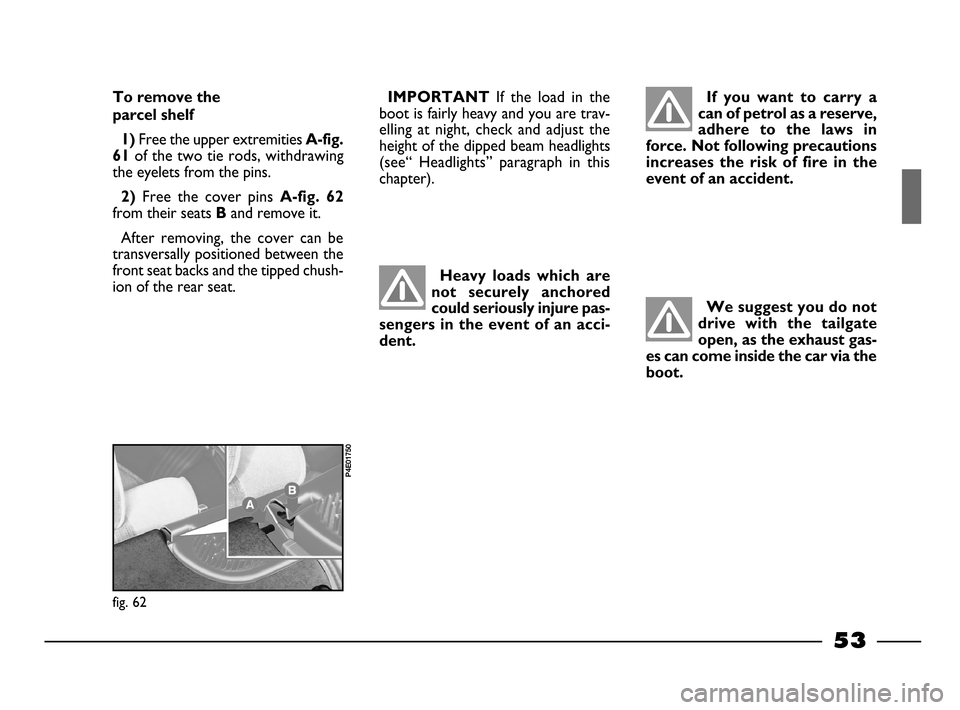
2)Free the cover pins A-fig. 62
from their seats Band remove it.
After removing, the cover can be
transversally positioned between the
front seat backs and the tipped chush-
ion of the rear seat.
IMPORTANT If the load in the
boot is fairly heavy and you are trav-
elling at night, check and adjust the
height of the dipped beam headlights
(see“ Headlights” paragraph in this
chapter).
Heavy loads which are
not securely anchored
could seriously injure pas-
sengers in the event of an acci-
dent.
We suggest you do not
drive with the tailgate
open, as the exhaust gas-
es can come inside the car via the
boot.
fig. 62
P4E01750
20-63 03/03/2003 06:03 PM Page 53
Page 59 of 156
58
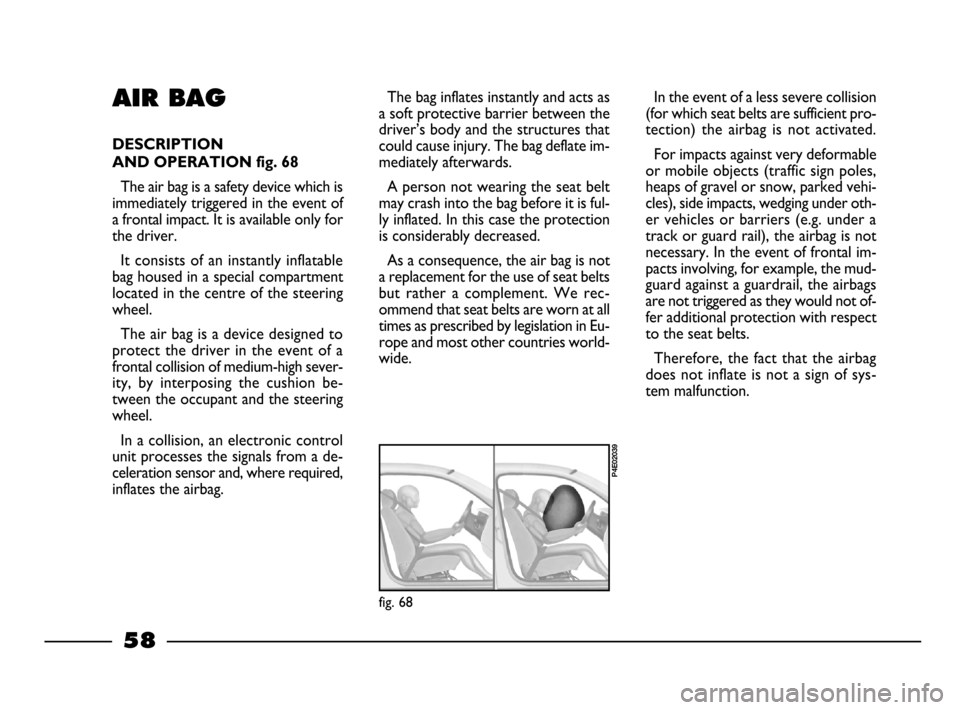
The bag inflates instantly and acts as
a soft protective barrier between the
driver’s body and the structures that
could cause injury. The bag deflate im-
mediately afterwards.
A person not wearing the seat belt
may crash into the bag before it is ful-
ly inflated. In this case the protection
is considerably decreased.
As a consequence, the air bag is not
a replacement for the use of seat belts
but rather a complement. We rec-
ommend that seat belts are worn at all
times as prescribed by legislation in Eu-
rope and most other countries world-
wide.In the event of a less severe collision
(for which seat belts are sufficient pro-
tection) the airbag is not activated.
For impacts against very deformable
or mobile objects (traffic sign poles,
heaps of gravel or snow, parked vehi-
cles), side impacts, wedging under oth-
er vehicles or barriers (e.g. under a
track or guard rail), the airbag is not
necessary. In the event of frontal im-
pacts involving, for example, the mud-
guard against a guardrail, the airbags
are not triggered as they would not of-
fer additional protection with respect
to the seat belts.
Therefore, the fact that the airbag
does not inflate is not a sign of sys-
tem malfunction.AIR BAG
DESCRIPTION
AND OPERATION fig. 68
The air bag is a safety device which is
immediately triggered in the event of
a frontal impact. It is available only for
the driver.
It consists of an instantly inflatable
bag housed in a special compartment
located in the centre of the steering
wheel.
The air bag is a device designed to
protect the driver in the event of a
frontal collision of medium-high sever-
ity, by interposing the cushion be-
tween the occupant and the steering
wheel.
In a collision, an electronic control
unit processes the signals from a de-
celeration sensor and, where required,
inflates the airbag.
fig. 68
P4E02039
20-63 03/03/2003 06:03 PM Page 58
Page 60 of 156
59
When the ignition key is
turned to MAR, the indi-
cator û
comes on after
about four seconds. If the warn-
ing light does not come on, or it
remains on while travelling go
immediately to a Fiat Dealership.
Do not apply stickers or
other objects on the
steering wheel. Do not
travel with items on your lap, in
front of you or with a pipe, pencil
etc. between your lips. In a colli-
sion where the airbag is triggerd
you could seriously hurt yourself
GENERAL WARNINGS
It may happen that the air bag
inflates if the car is involved in
hard impacts or collisions in the
area of the underbody, for exam-
ple hard knocks against steps,
kerbs or raised road bumps, or if
the car drops into large pot-holes
or road dips.
When the airbag inflates it
emits a small amount of dust and
smoke. This dust and smoke is
harmless and it is not the begin-
ning of a fire.
If the warning light
ûcomes on
while travelling (indication of a
fault) go as soon as possible to a
Fiat Dealership.
The air bag system is valid for 10
years. When the expiry date is
near, contact a Fiat Dealership.
Should an accident occur in
which the airbag is activated,
take the car to a Fiat Dealership
to have the whole device re-
placed (electronic control unit,
seat belts, pretensioners) and tohave the electrical system
checked.
Any diagnostic, repair or re-
placement operations concerning
the airbag system must exclu-
sively be carried out at a Fiat
Dealership.
If you are having the car
scrapped, have the airbag system
deactivated at a Fiat Dealership.
If the car changes hands, the
new owner must be made aware
of the indications given above and
be given this Owner’s Handbook.
Pretensioners (if electronically
controlled) and air bag are trig-
gered by the electronic control
unit according to different types
of impact. Therefore, if some de-
vices do not trigger this does not
indicate a fault in the system.
20-63 03/03/2003 06:03 PM Page 59
Page 61 of 156
60
Always drive with both
hands on the rim of the
steering wheel so that the
airbag is free to inflate and pro-
tect you from serious injury in a
collision. Do not drive with your
body bending toward the steer-
ing wheel, but sit in an upright po-
sition with your back resting
against the seat.
If the car has been stolen
or an attempt has been
made to steal it, or it has
been vandalised in any way, or
subjected to flooding, have the
airbag system checked at a Fiat
Dealership.The air bag does not
substitute seat belts, but
increases its efficiency.
Furthermore, since the airbag is
not inflated in frontal collisions at
low speed, side collisions, rear
end shunts or overturns, in such
cases the occupants are protect-
ed by the seat belts only and
therefore they should always be
fastened.Correct functioning of
airbag and pretensioners
is only guaranteed when
the car is not overloaded.SOUND SYSTEMRemember that airbag
can be triggered when
the ignition key is insert-
ed and set to MAR, even with the
car stationary, if another vehicle
crashes into it. On the other
hand, when the car is stationary
and the ignition key is removed,
the airbag does not trigger in the
event of an impact.
Visit the Fiat Dealership
if you want to fit a sound
system after purchasing
your car. Qualified, trained staff
will provide useful advice for safe-
guarding the battery. Excessive
intake when the engine is not
running will damage the battery
and may invalidate the battery
warranty.
Fiat recommends wide range of
music systems as Fiat acces-
sories, which are available with
Fiat dealerships.
20-63 03/03/2003 06:03 PM Page 60
Page 63 of 156
62
AT THE FILLING STATION
An inefficient catalytic
converter will allow
harmful gases to be re-
leased in the atmosphere.Never put even the tini-
est amount of leaded fu-
el into the tank, even in
an emergency; you would dam-
age the catalytic converter be-
yond repair.
The pollution prevention devices of
Fiat Palio mean only unleaded petrol
can be used.
Use petrol with a research octane
number (R.O.N.) equal to 87.
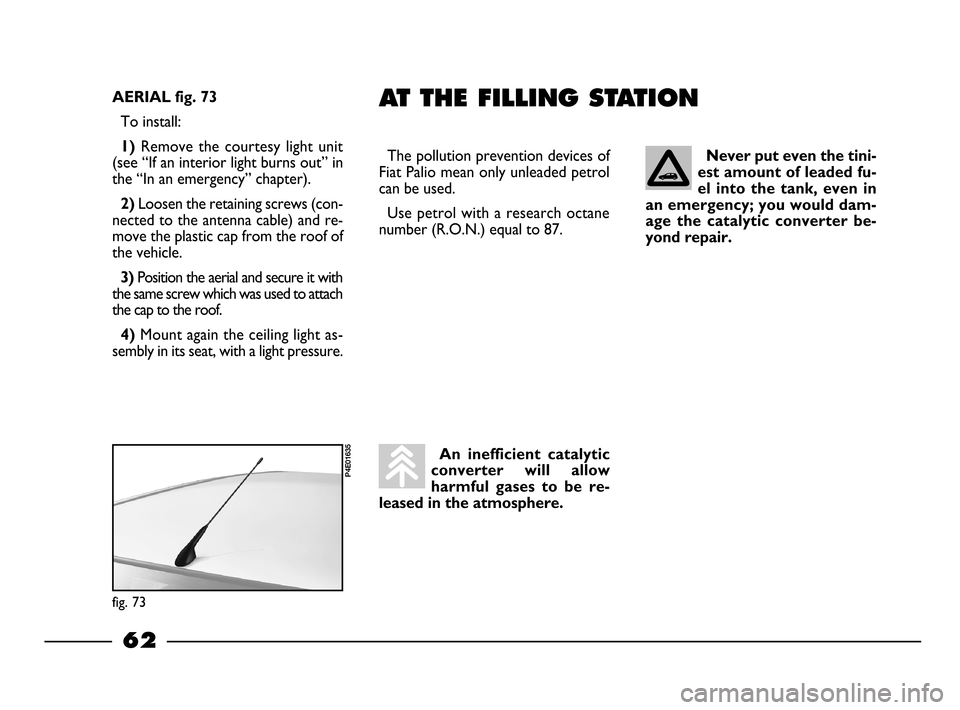
AERIAL fig. 73
To install:
1) Remove the courtesy light unit
(see “If an interior light burns out” in
the “In an emergency” chapter).
2) Loosen the retaining screws (con-
nected to the antenna cable) and re-
move the plastic cap from the roof of
the vehicle.
3) Position the aerial and secure it with
the same screw which was used to attach
the cap to the roof.
4) Mount again the ceiling light as-
sembly in its seat, with a light pressure.
fig. 73
P4E01635
20-63 03/03/2003 06:03 PM Page 62
Page 64 of 156
63
PROTECTING THE
ENVIRONMENT
Protecting the environment has been
the guiding principle in the design of the
Fiat Palio right from the start. The re-
sult is the use of materials and creation
of devices that can reduce or consid-
erably curtail harmful influences on the
environment.
The devices for curtailing emission
for petrol version are:
– a three-way catalytic converter;
– Lambda sensor;
– an anti evaporation system.
The devices for curtailing emission
for diesel version are:
– Catalytic converter;
– Exhaust gas recirculation.
As a consequence Fiat Palio is ready
to travel well ahead of the most strin-
gent international pollution control
standards.
fig. 74
P4E01945
IMPORTANT If required, replace
the fuel cap with another genuine cap
to avoid affecting the efficiency of the
fuel vapour recovery system.
NEVER go close to the
tank filler with naked
flames or lit cigarettes:
Also avoid going too close to
the fuel tank filler area, to avoid
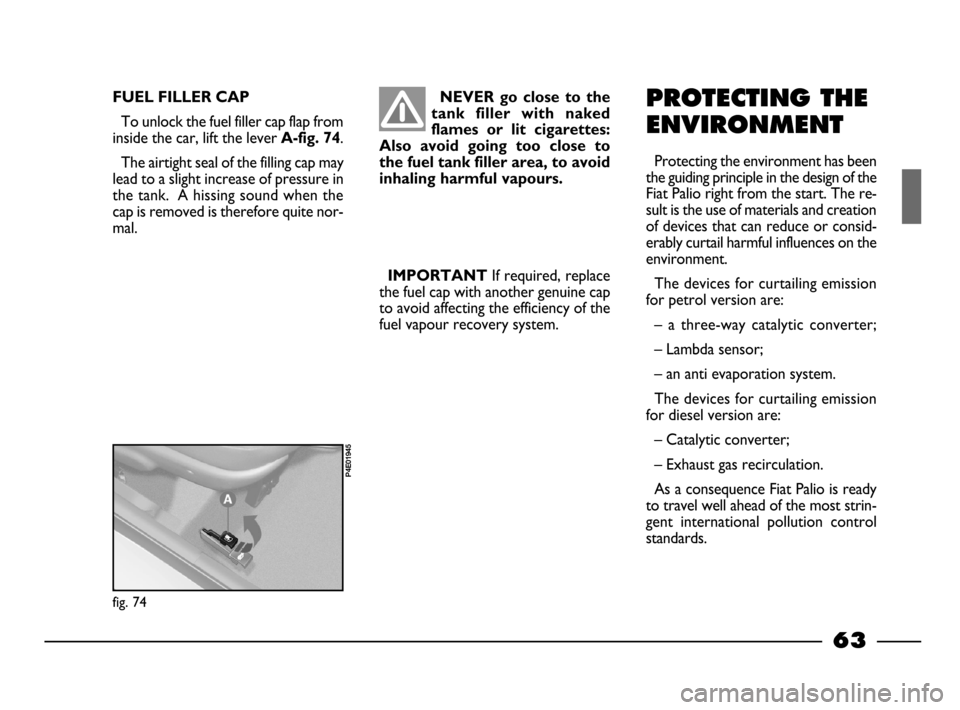
inhaling harmful vapours.FUEL FILLER CAP
To unlock the fuel filler cap flap from
inside the car, lift the lever
A-fig. 74.
The airtight seal of the filling cap may
lead to a slight increase of pressure in
the tank. A hissing sound when the
cap is removed is therefore quite nor-
mal.
20-63 03/03/2003 06:03 PM Page 63
Page 67 of 156
66
BUMP STARTING STOPPING THE ENGINE
Turn the ignition key to STOPwhile
the engine is idling.
HOW TO WARM UP THE
ENGINE AFTER IT HAS JUST
STARTED
– Begin to move forward slowly let-
ting the engine turn over at medium
revs. Do not accelerate abruptly.
– Do not push the engine to its lim-
its for the first few kilometers. You are
recommended to wait until the water
temperature achieves 50°C÷60°C.
Remember that until
the engine has started the
brake booster and hy-
draulic power steering systems
they will not work and a greater
effort will therefore be required
to depress the pedal or turn the
steering wheel.Never bump start the
engine (by pushing, tow-
ing or coasting downhill)
as this could cause fuel to flow in-
to the catalytic exhaust system
and damage it beyond repair.
A quick burst on the ac-
celerator before turning
off the engine serves ab-
solutely no practical purpose and
wastes fuel.
IMPORTANT
After a taxing drive
you should allow the engine to “catch
its breath” before turning it off by let-
ting it idle to allow the temperature in
the engine compartment to fall.
64-79 03/03/2003 06:45 PM Page 66
Page 71 of 156
70
WHEN TRAVELLING
– The first rule of safe driving is pru-
dence.
– Prudence also means putting your-
self into a position where you can pre-
dict wrong or imprudent behaviour
from other drivers.
– Stick closely to the rules of the
road in the particular country where
the car is being driven and, above all,
do not exceed speed limits.
– Ensure that, besides yourself, all the
other passengers in the car have their
seat belts fastened, that children are
sitting in the appropriate child seats
and any animals in the car are placed
in suitable compartments.
Driving under the influ-
ence of drugs or certain
medicines is dangerous
for both you and other road
users.
Always fasten both front
and back seat belts, in-
cluding the child restraint
systems. Travelling with the seat
belts unfastened increases the
risk of injury or death in an acci-
dent.
Do not drive with ob-
jects on the floor in front
of the driver’s seat: they
could get caught under the ped-
als making braking or accelerat-
ing impossible.
Pay attention to the
measurements of car-
pets. Any hinderance,
even modest, to the braking sys-
tem could necessiate a longer
than normal pedal run.
You should be physically fit and men-
tally alert before setting out on long
journeys.
– Do not drive too many hours at a
time but stop at intervals to stretch
your legs and recoup your energy.
– Constantly change the air in the
passenger compartment.
– Never coast downhill (i.e. with the
engine off): if you do, you lose the aid
of engine braking and the brake boost-
er so that braking requires greater ef-
fort.
64-79 03/03/2003 06:45 PM Page 70
Page 73 of 156
72
– Remember that fog also means the
tarmac is wet and therefore manoeu-
vres of all kinds are more difficult and
stopping distances are longer.
– Keep a good distance from the ve-
hicle in front of you.
– As far as possible, avoid spurts of
speed or sudden deceleration.
– Do not overtake other vehicles if
you can help it.
– If you are forced to stop your car
(breakdown, limited visibility etc.) try
to stop off the road. Turn on the haz-
ard lights and, if possible, the dipped
beam headlights. Rhythmically sound
the horn if you realize another car is
coming.MOUNTAIN DRIVING
– When driving downhill, use the en-
gine braking by engaging a low gear, so
as not to overheat the brakes.
– Under no circumstances should
you drive downhill with the engine off
or with the car in neutral, let alone
with the ignition key out.
– Drive at a moderate speed without
cutting corners.
– Remember that overtaking while
going uphill is slower and therefore re-
quires more free road. If you are be-
ing overtaken while driving uphill,
make it easier for the other vehicle
to pass.
DRIVING ON SNOW AND
ICE
Here are some tips for driving in
these conditions:
– Before starting off make sure that
the windscreen wiper blades are not
frozen to the windscreen.
– Remove the snow from the climate
control system air vent. – Keep your speed down.
– Use chains if the roads are covered
in snow: see paragraph “Snow chains”
in this chapter.
– Do not stay parked on high snow
for too long with engine running: the
snow could divert the carbon oxide
of the exhaust gases in the passenger
compartment.
– Mainly use the braking effect of the
engine and under all circumstances
avoid braking sharply.
– When braking in a car not fitted
with ABS, reduce the possibility of the
wheels locking by varying the pressure
you exert on the brake pedal.
– Do not accelerate suddenly and
avoid swerving.
– In the winter, even apparently dry
roads may have icy patches. Be care-
ful therefore when driving over patch-
es that do not get much exposure to
sun or are lined with trees or rocks
where ice may have not have melted.
– Keep a good distance from the ve-
hicles in front.
64-79 03/03/2003 06:45 PM Page 72
Page 76 of 156
75
CONTAINING RUNNING COSTS
AND POLLUTION
Tyres
Tyre pressure should be checked at
least once every four weeks: if the
pressure is too low fuel consumption
increases as the resistance to the
rolling movement of the tyre is
greater. In this state, tyre wear is in-
creased and handling suffers which will
effect safety.
Unnecessary loads
Do not travel with too much load in
the boot. The weight of the car (above
all in the urban traffic)and its trim
greatly effects consumption and sta-
bility.
Roof rack/ski rack
Remove roof racks and ski racks
from the roof of the car as soon as
they are no longer needed. These ac-
cessories reduce the aerodynamic
penetration of the car and will increase
consumption.
Electrical devices
Use electric devices for the neces-
sary time only. The heated rear win-
dow, additional lights, windscreen
wipers, heater, fan of the heating sys-
tem require large amounts of elec-
tricity and increasing the request for
power will also increase fuel con-
sumption (up to +25% when driving in
towns). Some suggestions which may help
you to keep the running costs of the
car down and lower the amount of
toxic emissions released into the at-
mosphere are given below.
GENERAL
CONSIDERATIONS
Car maintenance
The overall state of the car is an im-
portant factor which has a marked in-
fluence over fuel consumption and dri-
ving comfort and on the life span of
your car. For this reason care should
be taken to maintain your car by car-
rying out the necessary checks and
regulations in accordance with the
specifications given in the service
schedule (see sections: spark plugs,
idling, air cleaners, timing).
64-79 03/03/2003 06:45 PM Page 75