lock FIAT PALIO 2003 178 / 1.G India Version Owner's Manual
[x] Cancel search | Manufacturer: FIAT, Model Year: 2003, Model line: PALIO, Model: FIAT PALIO 2003 178 / 1.GPages: 156, PDF Size: 6.27 MB
Page 68 of 156
67
With handbrake engaged and igni-
tion key at
MAR, the instrument pan-
el warning light
x
comes on.
To disengage the handbrake:
1)Slightly lift the handbrake and
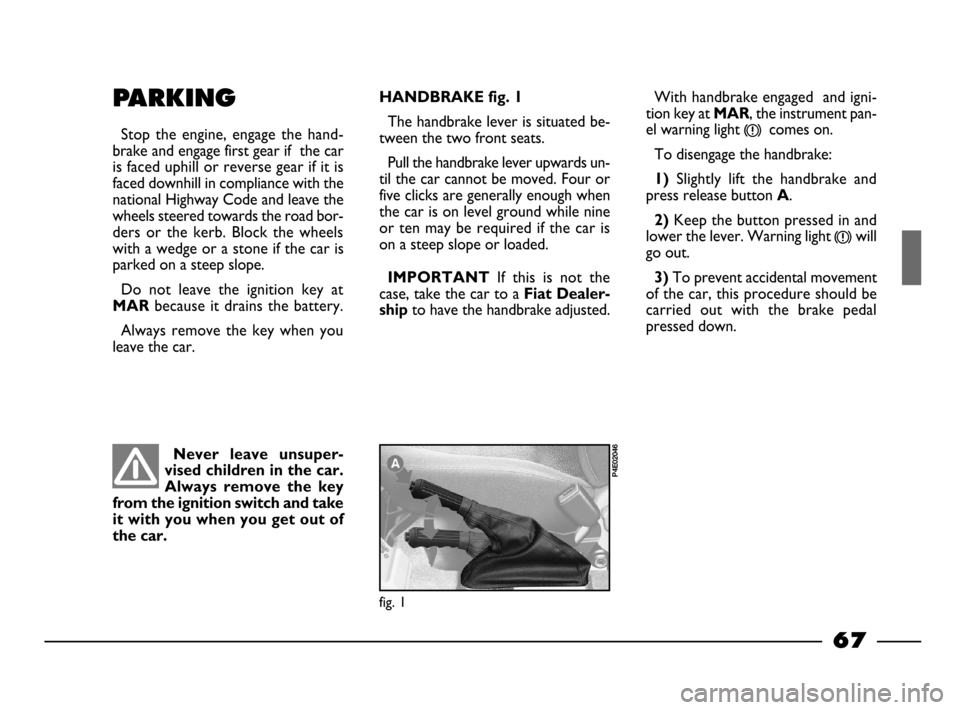
press release button
A.
2)Keep the button pressed in and
lower the lever. Warning light
x
will
go out.
3)To prevent accidental movement
of the car, this procedure should be
carried out with the brake pedal
pressed down.
HANDBRAKE fig. 1
The handbrake lever is situated be-
tween the two front seats.
Pull the handbrake lever upwards un-
til the car cannot be moved. Four or
five clicks are generally enough when
the car is on level ground while nine
or ten may be required if the car is
on a steep slope or loaded.
IMPORTANTIf this is not the
case, take the car to a
Fiat Dealer-
ship
to have the handbrake adjusted.
Never leave unsuper-
vised children in the car.
Always remove the key
from the ignition switch and take
it with you when you get out of
the car.
fig. 1
P4E02046
PARKING
Stop the engine, engage the hand-
brake and engage first gear if the car
is faced uphill or reverse gear if it is
faced downhill in compliance with the
national Highway Code and leave the
wheels steered towards the road bor-
ders or the kerb. Block the wheels
with a wedge or a stone if the car is
parked on a steep slope.
Do not leave the ignition key at
MARbecause it drains the battery.
Always remove the key when you
leave the car.
64-79 03/03/2003 06:45 PM Page 67
Page 73 of 156
72
– Remember that fog also means the
tarmac is wet and therefore manoeu-
vres of all kinds are more difficult and
stopping distances are longer.
– Keep a good distance from the ve-
hicle in front of you.
– As far as possible, avoid spurts of
speed or sudden deceleration.
– Do not overtake other vehicles if
you can help it.
– If you are forced to stop your car
(breakdown, limited visibility etc.) try
to stop off the road. Turn on the haz-
ard lights and, if possible, the dipped
beam headlights. Rhythmically sound
the horn if you realize another car is
coming.MOUNTAIN DRIVING
– When driving downhill, use the en-
gine braking by engaging a low gear, so
as not to overheat the brakes.
– Under no circumstances should
you drive downhill with the engine off
or with the car in neutral, let alone
with the ignition key out.
– Drive at a moderate speed without
cutting corners.
– Remember that overtaking while
going uphill is slower and therefore re-
quires more free road. If you are be-
ing overtaken while driving uphill,
make it easier for the other vehicle
to pass.
DRIVING ON SNOW AND
ICE
Here are some tips for driving in
these conditions:
– Before starting off make sure that
the windscreen wiper blades are not
frozen to the windscreen.
– Remove the snow from the climate
control system air vent. – Keep your speed down.
– Use chains if the roads are covered
in snow: see paragraph “Snow chains”
in this chapter.
– Do not stay parked on high snow
for too long with engine running: the
snow could divert the carbon oxide
of the exhaust gases in the passenger
compartment.
– Mainly use the braking effect of the
engine and under all circumstances
avoid braking sharply.
– When braking in a car not fitted
with ABS, reduce the possibility of the
wheels locking by varying the pressure
you exert on the brake pedal.
– Do not accelerate suddenly and
avoid swerving.
– In the winter, even apparently dry
roads may have icy patches. Be care-
ful therefore when driving over patch-
es that do not get much exposure to
sun or are lined with trees or rocks
where ice may have not have melted.
– Keep a good distance from the ve-
hicles in front.
64-79 03/03/2003 06:45 PM Page 72
Page 74 of 156
73
ECONOMICAL
RUNNING THAT
RESPECTS THE
ENVIRONMENT
Environmental protection has been
one of the guiding principles in the
production of the Fiat Palio.
It is no accident that its pollution
control equipment is much more ef-
fective than that required by current
legislation.
Nonetheless, the environment can-
not get by without a concerted effort
from everyone.
By following a few simple rules you
can avoid harming the environment
and often cut down fuel consumption
at the same time.
On this subject, a few useful tips have
been given below to supplement those
marked by symbol #
, at various points
of the handbook.
You are asked to read both the for-
mer and the latter carefully.
DRIVING WITH ABS
The ABS is a braking system that es-
sentially offers two advantages:
1)It prevents wheel lock and con-
sequent skidding in emergency stops,
particularly when the road does not
offer much grip.
2)It makes it possible to brake and
steer at the same time so you can
avoid unexpected obstacles and direct
the car where you want while braking.
The extent to which this can be done
will depend on the physical limits of
the tyre’s sideways grip.
To exploit the ABS at best:
– During emergency stops or when
grip conditions are poor, you will feel
a slight pulsation on the brake pedal.
This is the sign that the ABS is work-
ing. Do not release the brake pedal but
continue to press so as not to inter-
rupt the braking action.– ABS prevents the wheels from lock-
ing but it does not increase actual grip
conditions between tyre and road.
Therefore, even if your car is fitted
with ABS, respect the safety distance
from the car in front of you and keep
your speed down when driving into
bends.
The ABS serves to increase your
control over the car, not to enable
you to go faster.
Warning light >, with
the engine running, nor-
mally indicates a faulting
the ABS system only. In this case,
the braking system is still effi-
cient, though without the an-
tilocking device. You are advised
to go immediately to the nearest
Fiat Dealership, driving in a man-
ner to avoiding sharp braking and
get the system checked.
64-79 03/03/2003 06:45 PM Page 73
Page 86 of 156
85
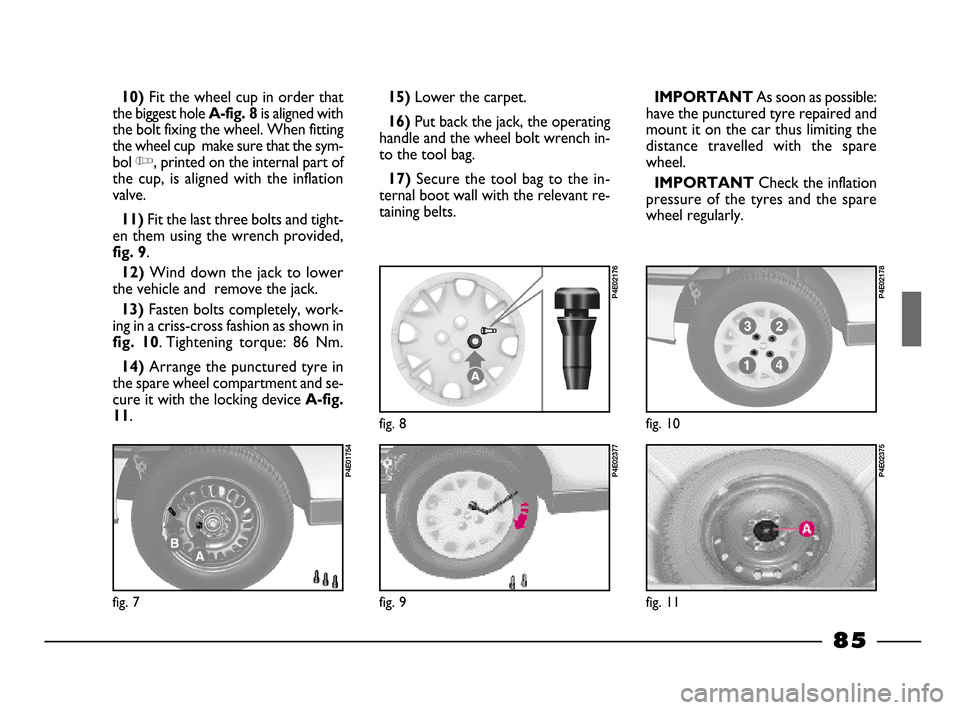
10)Fit the wheel cup in order that
the biggest hole
A-fig. 8is aligned with
the bolt fixing the wheel. When fitting
the wheel cup make sure that the sym-
bol
Y, printed on the internal part of
the cup, is aligned with the inflation
valve.
11)Fit the last three bolts and tight-
en them using the wrench provided,
fig. 9.
12)Wind down the jack to lower
the vehicle and remove the jack.
13)Fasten bolts completely, work-
ing in a criss-cross fashion as shown in
fig. 10. Tightening torque: 86 Nm.
14)Arrange the punctured tyre in
the spare wheel compartment and se-
cure it with the locking device
A-fig.
11
.
fig. 7
P4E01754
15)Lower the carpet.
16)Put back the jack, the operating
handle and the wheel bolt wrench in-
to the tool bag.
17)Secure the tool bag to the in-
ternal boot wall with the relevant re-
taining belts.
fig. 8
P4E02176
fig. 9
P4E02377
IMPORTANT As soon as possible:
have the punctured tyre repaired and
mount it on the car thus limiting the
distance travelled with the spare
wheel.
IMPORTANT Check the inflation
pressure of the tyres and the spare
wheel regularly.
fig. 10
P4E02178
fig. 11
P4E02375
80-103 03/03/2003 06:49 PM Page 85
Page 87 of 156
86
IF A BULB BURNS OUT
Modifications or repairs
to the electrical system
carried out incorrectly
and without bearing the features
of the system in mind can cause
malfunctions with the risk of fire.
You should have the
bulbs replaced at a Fiat
Dealership. The correct
operation and direction of the
headlights is essential for safety
and is governed by the highway
code.Only touch the metal
part when handling halo-
gen bulbs. If the transpar-
ent bulb is touched it reduces the
intensity of the light emitted and
can also reduce the life of the
bulb. If you touch the bulb acci-
dentally, rub it with a cloth moist-
ened with alcohol and leave it to
dry.
GENERAL INSTRUCTIONS
When a light is not working, check
that it has not fused before changing the
bulb.
For the location of the fuses, refer to
“If a fuse blows” in this chapter.
Before replacing a bulb that does not
work, check that the contacts are not
oxidised.
Halogen bulbs contain
pressurised gas which, if
broken, may cause small
fragments of glass to be project-
ed outwards.
Burnt-out bulbs must be replaced
with ones of the same type. Bulbs with
low power offer low illumination,
bulbs with too much power absorb
too much energy.
Always check the height of the head-
light beam after changing a bulb.
TYPES OF BULBS
Several types of bulbs are installed in
the car
fig. 12:
A. Glass bulbs
Clipped into position. Pull to remove.
B. Bayonet connection bulbs
Remove from the bulb holder by
pressing the bulb and rotating it anti-
clockwise.
C. Cylindrical bulbs
Remove by pulling away from termi-
nals.
D-E. Halogen bulbs
To remove bulb, loosen the fixing
spring from the relevant seat.
80-103 03/03/2003 06:49 PM Page 86
Page 90 of 156
89
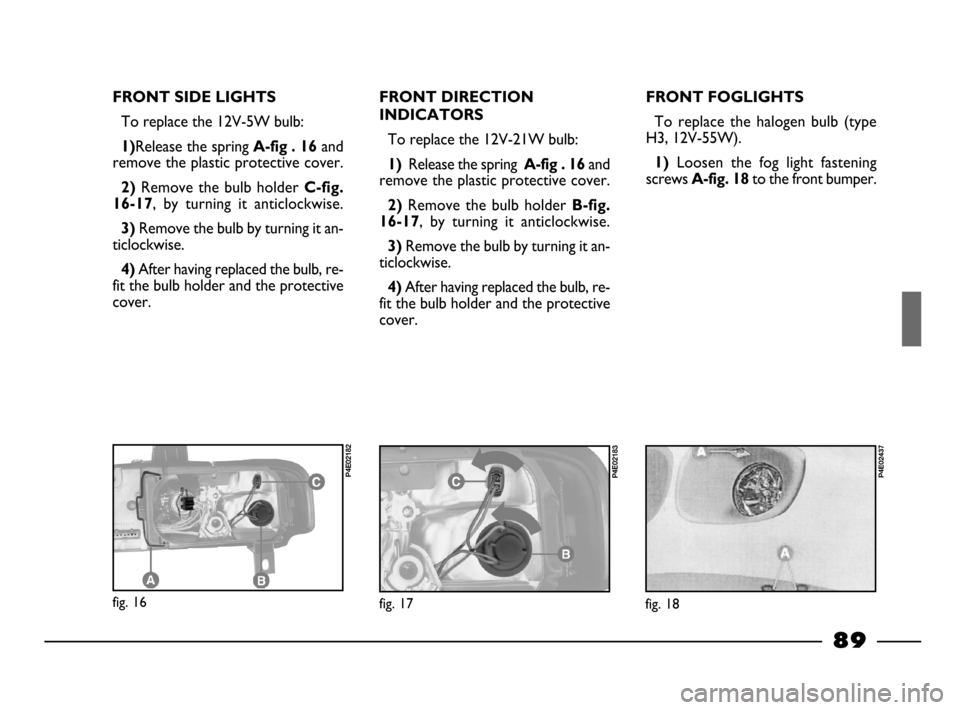
FRONT SIDE LIGHTS
To replace the 12V-5W bulb:
1)Release the spring A-fig . 16and
remove the plastic protective cover.
2)Remove the bulb holder C-fig.
16-17
, by turning it anticlockwise.
3) Remove the bulb by turning it an-
ticlockwise.
4) After having replaced the bulb, re-
fit the bulb holder and the protective
cover.
FRONT DIRECTION
INDICATORS
To replace the 12V-21W bulb:
1) Release the spring A-fig . 16and
remove the plastic protective cover.
2)Remove the bulb holder B-fig.
16-17
, by turning it anticlockwise.
3) Remove the bulb by turning it an-
ticlockwise.
4) After having replaced the bulb, re-
fit the bulb holder and the protective
cover.
FRONT FOGLIGHTS
To replace the halogen bulb (type
H3, 12V-55W).
1) Loosen the fog light fastening
screws
A-fig. 18to the front bumper.
fig. 16
P4E02182
fig. 17
P4E02183P4E02437
fig. 18
80-103 03/03/2003 06:49 PM Page 89
Page 91 of 156
90
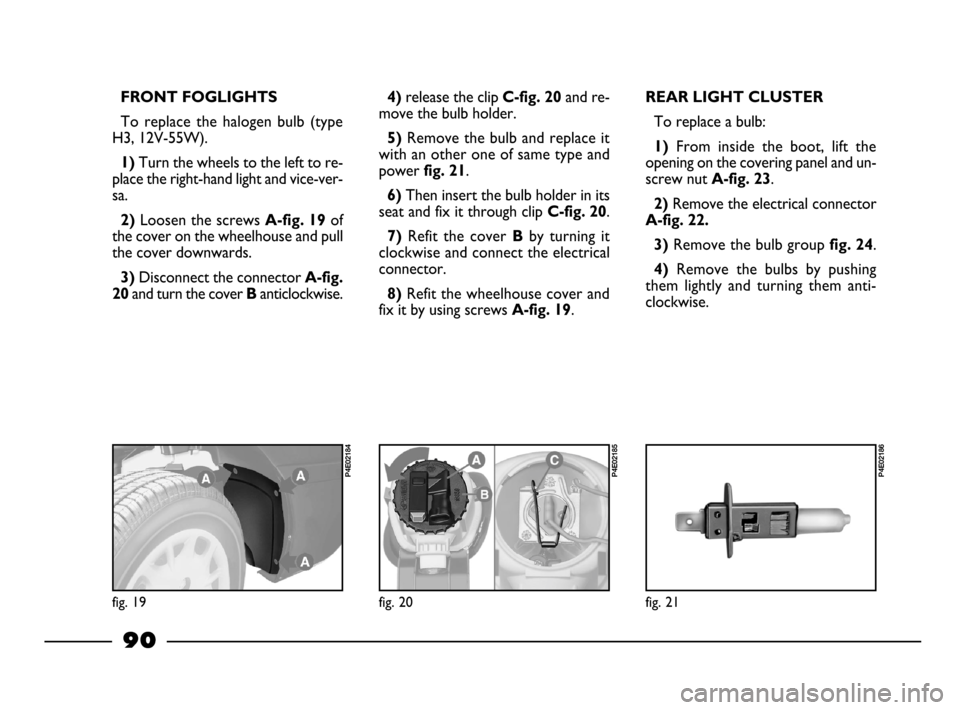
FRONT FOGLIGHTS
To replace the halogen bulb (type
H3, 12V-55W).
1) Turn the wheels to the left to re-
place the right-hand light and vice-ver-
sa.
2) Loosen the screws A-fig. 19of
the cover on the wheelhouse and pull
the cover downwards.
3) Disconnect the connectorA-fig.
20
and turn the cover B anticlockwise.
4)release the clip C-fig. 20and re-
move the bulb holder.
5)Remove the bulb and replace it
with an other one of same type and
power
fig. 21.
6)Then insert the bulb holder in its
seat and fix it through clip
C-fig. 20.
7)Refit the cover Bby turning it
clockwise and connect the electrical
connector.
8)Refit the wheelhouse cover and
fix it by using screws
A-fig. 19.
REAR LIGHT CLUSTER
To replace a bulb:
1) From inside the boot, lift the
opening on the covering panel and un-
screw nut
A-fig. 23.
2) Remove the electrical connector
A-fig. 22.
3)
Remove the bulb group fig. 24.
4)Remove the bulbs by pushing
them lightly and turning them anti-
clockwise.
fig. 20
P4E02185
fig. 21
P4E02186
fig. 19
P4E02184
80-103 03/03/2003 06:49 PM Page 90
Page 93 of 156
92
IF AN INTERIOR
LIGHT BURNS
OUT
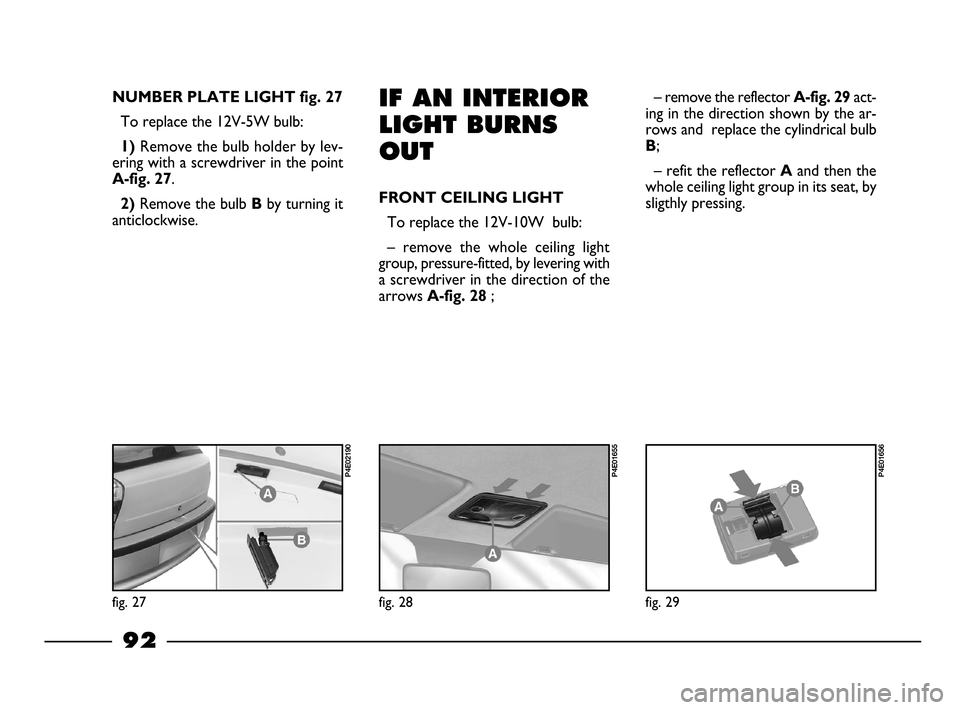
FRONT CEILING LIGHT
To replace the 12V-10W bulb:
– remove the whole ceiling light
group, pressure-fitted, by levering with
a screwdriver in the direction of the
arrows
A-fig. 28 ;– remove the reflector
A-fig. 29act-
ing in the direction shown by the ar-
rows and replace the cylindrical bulb
B;
– refit the reflector
Aand then the
whole ceiling light group in its seat, by
sligthly pressing.
fig. 29
P4E01656
NUMBER PLATE LIGHT fig. 27
To replace the 12V-5W bulb:
1) Remove the bulb holder by lev-
ering with a screwdriver in the point
A-fig. 27.
2)Remove the bulb Bby turning it
anticlockwise.
fig. 28
P4E01655
fig. 27
P4E02190
80-103 03/03/2003 06:49 PM Page 92
Page 97 of 156
96
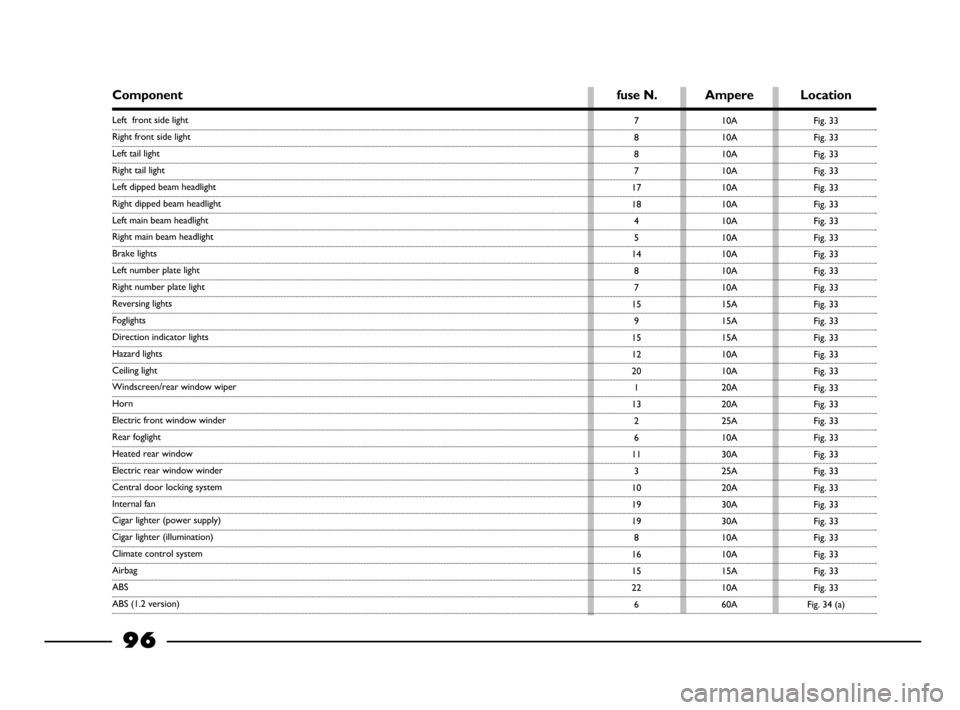
Componentfuse N. Ampere Location
7
8
8
7
17
18
4
5
14
8
7
15
9
15
12
20
1
13
2
6
11
3
10
19
19
8
16
15
22
610A
10A
10A
10A
10A
10A
10A
10A
10A
10A
10A
15A
15A
15A
10A
10A
20A
20A
25A
10A
30A
25A
20A
30A
30A
10A
10A
15A
10A
60AFig. 33
Fig. 33
Fig. 33
Fig. 33
Fig. 33
Fig. 33
Fig. 33
Fig. 33
Fig. 33
Fig. 33
Fig. 33
Fig. 33
Fig. 33
Fig. 33
Fig. 33
Fig. 33
Fig. 33
Fig. 33
Fig. 33
Fig. 33
Fig. 33
Fig. 33
Fig. 33
Fig. 33
Fig. 33
Fig. 33
Fig. 33
Fig. 33
Fig. 33
Fig. 34 (a)Left front side light
Right front side light
Left tail light
Right tail light
Left dipped beam headlight
Right dipped beam headlight
Left main beam headlight
Right main beam headlight
Brake lights
Left number plate light
Right number plate light
Reversing lights
Foglights
Direction indicator lights
Hazard lights
Ceiling light
Windscreen/rear window wiper
Horn
Electric front window winder
Rear foglight
Heated rear window
Electric rear window winder
Central door locking system
Internal fan
Cigar lighter (power supply)
Cigar lighter (illumination)
Climate control system
Airbag
ABS
ABS (1.2 version)
80-103 03/03/2003 06:49 PM Page 96
Page 98 of 156
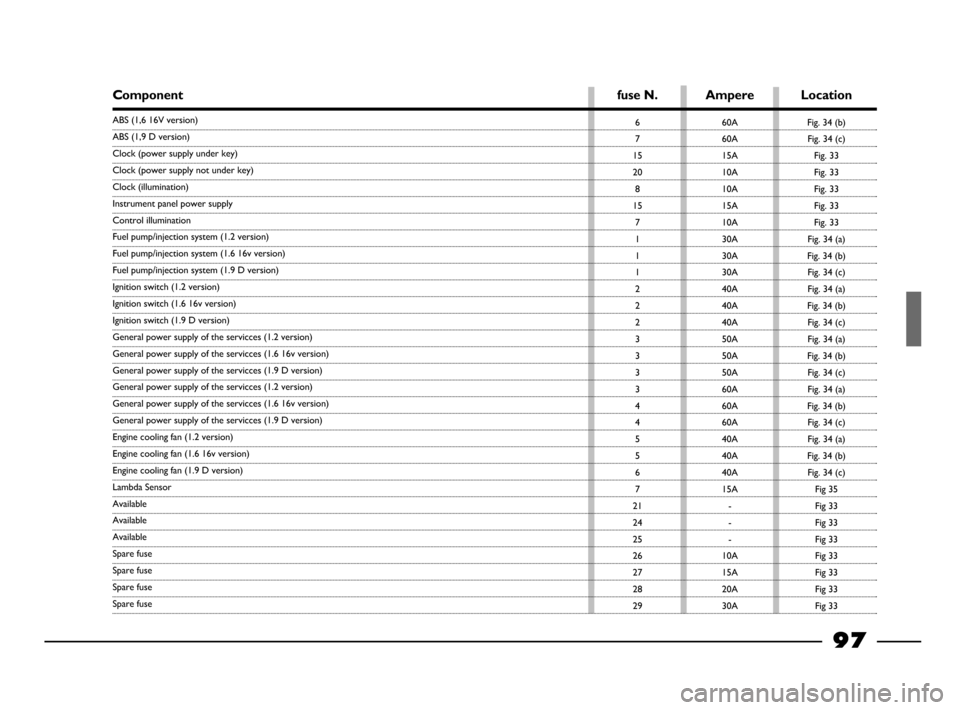
6
7
15
20
8
15
7
1
1
1
2
2
2
3
3
3
3
4
4
5
5
6
7
21
24
25
26
27
28
2960A
60A
15A
10A
10A
15A
10A
30A
30A
30A
40A
40A
40A
50A
50A
50A
60A
60A
60A
40A
40A
40A
15A
-
-
-
10A
15A
20A
30A
Componentfuse N. Ampere Location
Fig. 34 (b)
Fig. 34 (c)
Fig. 33
Fig. 33
Fig. 33
Fig. 33
Fig. 33
Fig. 34 (a)
Fig. 34 (b)
Fig. 34 (c)
Fig. 34 (a)
Fig. 34 (b)
Fig. 34 (c)
Fig. 34 (a)
Fig. 34 (b)
Fig. 34 (c)
Fig. 34 (a)
Fig. 34 (b)
Fig. 34 (c)
Fig. 34 (a)
Fig. 34 (b)
Fig. 34 (c)
Fig 35
Fig 33
Fig 33
Fig 33
Fig 33
Fig 33
Fig 33
Fig 33
97
C
ABS (1,6 16V version)
ABS (1,9 D version)
Clock (power supply under key)
Clock (power supply not under key)
Clock (illumination)
Instrument panel power supply
Control illumination
Fuel pump/injection system (1.2 version)
Fuel pump/injection system (1.6 16v version)
Fuel pump/injection system (1.9 D version)
Ignition switch (1.2 version)
Ignition switch (1.6 16v version)
Ignition switch (1.9 D version)
General power supply of the servicces (1.2 version)
General power supply of the servicces (1.6 16v version)
General power supply of the servicces (1.9 D version)
General power supply of the servicces (1.2 version)
General power supply of the servicces (1.6 16v version)
General power supply of the servicces (1.9 D version)
Engine cooling fan (1.2 version)
Engine cooling fan (1.6 16v version)
Engine cooling fan (1.9 D version)
Lambda Sensor
Available
Available
Available
Spare fuse
Spare fuse
Spare fuse
Spare fuse
80-103 03/03/2003 06:49 PM Page 97