lock FIAT PALIO 2003 178 / 1.G India Version Owner's Guide
[x] Cancel search | Manufacturer: FIAT, Model Year: 2003, Model line: PALIO, Model: FIAT PALIO 2003 178 / 1.GPages: 156, PDF Size: 6.27 MB
Page 100 of 156
99
Cars fitted with an en-
gine/gearbox guard cannot
be lifted from the front.
IF THE CAR
NEEDS TO BE
RAISED
WITH THE JACK
See “If a Tyre is Punctured”, in this
chapter.
WITH A SHOP JACK
Front end
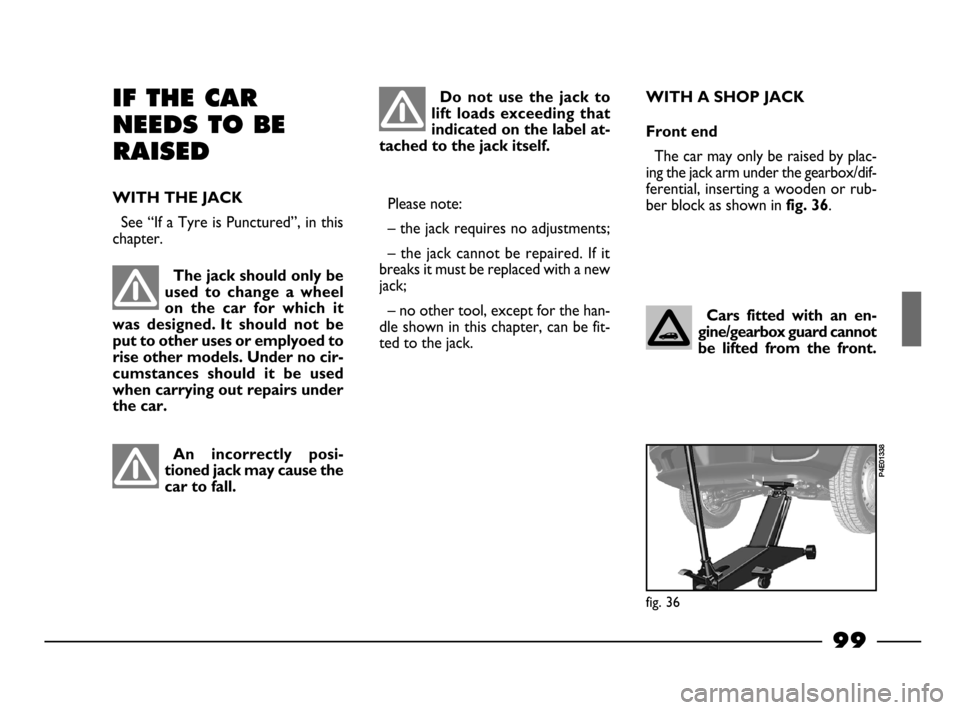
The car may only be raised by plac-
ing the jack arm under the gearbox/dif-
ferential, inserting a wooden or rub-
ber block as shown in
fig. 36.
The jack should only be
used to change a wheel
on the car for which it
was designed. It should not be
put to other uses or emplyoed to
rise other models. Under no cir-
cumstances should it be used
when carrying out repairs under
the car.
An incorrectly posi-
tioned jack may cause the
car to fall.
Do not use the jack to
lift loads exceeding that
indicated on the label at-
tached to the jack itself.
Please note:
– the jack requires no adjustments;
– the jack cannot be repaired. If it
breaks it must be replaced with a new
jack;
– no other tool, except for the han-
dle shown in this chapter, can be fit-
ted to the jack.
fig. 36
P4E01338
80-103 03/03/2003 06:49 PM Page 99
Page 101 of 156
100
WITH AN ARM-TYPE HOIST
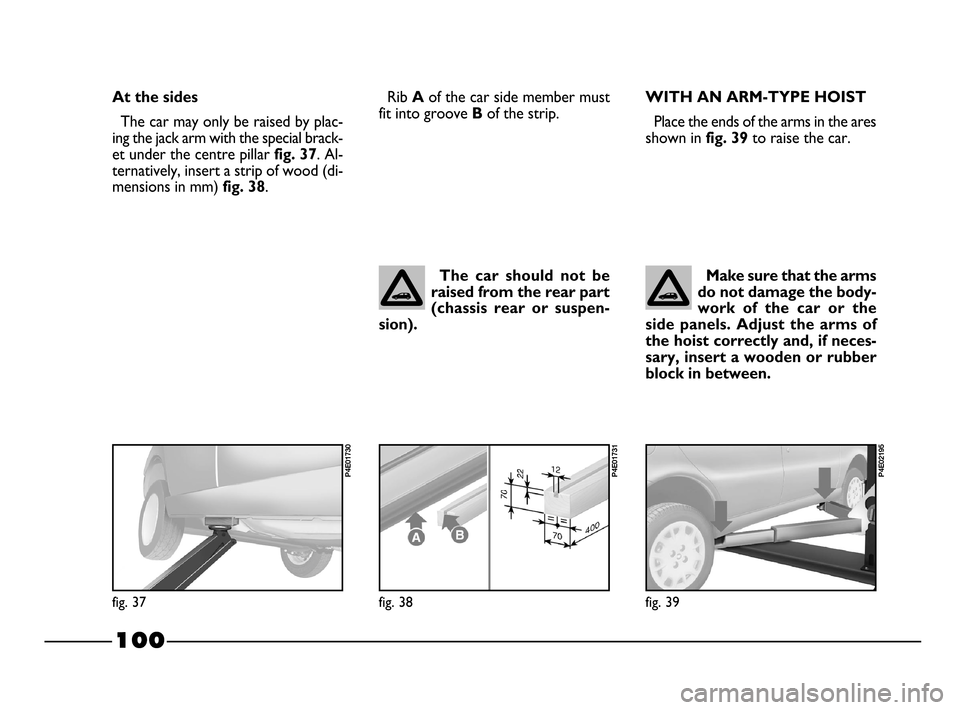
Place the ends of the arms in the ares
shown in
fig. 39to raise the car.
Make sure that the arms
do not damage the body-
work of the car or the
side panels. Adjust the arms of
the hoist correctly and, if neces-
sary, insert a wooden or rubber
block in between.
fig. 39
P4E02195
fig. 38
P4E01731
Rib Aof the car side member must
fit into groove
B of the strip.
The car should not be
raised from the rear part
(chassis rear or suspen-
sion).
fig. 37
P4E01730
At the sides
The car may only be raised by plac-
ing the jack arm with the special brack-
et under the centre pillar
fig. 37. Al-
ternatively, insert a strip of wood (di-
mensions in mm)
fig. 38.
80-103 03/03/2003 06:49 PM Page 100
Page 102 of 156
101
Do not tow the car by
using flexible elements
(metallic cables, ropes or
strings); only the use of a rigid
bar, with the ends supplied with
adequate joints, is allowed. Make
sure to fix the joint to the car in
order not to damage the near el-
ements.
Before starting to tow, turn the
ignition key to MAR and then to
STOP. Do not remove the key. If
the key is removed, the steering
lock engages automatically which
prevents the wheels being turned.
While the car is being towed
with the engine off, remember
that the brake pedal and steering
will require more effort as you no
longer have the benefit of the
brake booster and the power
steering.
The towing vehicle must be dri-
ven as evenly and softly as possi-
ble to prevent counterblows.IF THE CAR
NEEDS TO BE
TOWED
The tow hitch is supplied as standard
with the car. It is in the tool kit at-
tached to the spare wheel.
To fasten the tow hitch:
1)Take the tow ring.
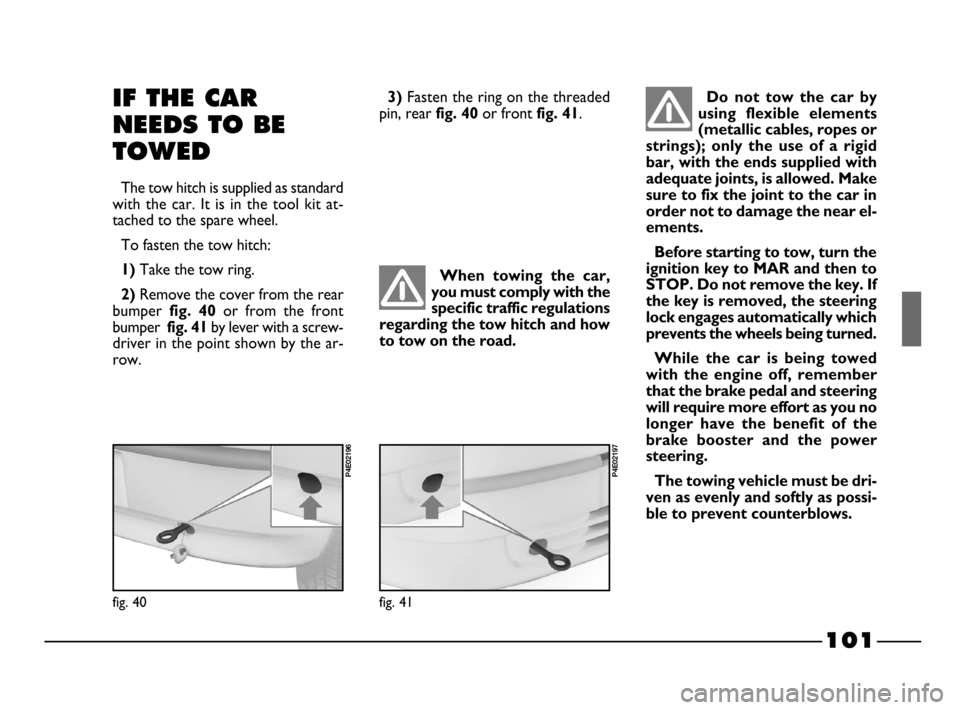
2) Remove the cover from the rear
bumper
fig. 40or from the front
bumper
fig. 41by lever with a screw-
driver in the point shown by the ar-
row.
fig. 40
P4E02196
fig. 41
P4E02197
When towing the car,
you must comply with the
specific traffic regulations
regarding the tow hitch and how
to tow on the road.
3)Fasten the ring on the threaded
pin, rear
fig. 40or front fig. 41.
80-103 03/03/2003 06:49 PM Page 101
Page 103 of 156
102
IF ANYONE IS INJURED
– Never leave the injured person
alone. The obligation to provide as-
sistance exists even for those not di-
rectly involved in the accident.
– Do not congregate around the in-
jured person.
– Reassure the injured person that
help is on its way and will arrive soon.
Stay close by to calm him/her down in
case of panic.
– Unfasten or cut seat belts holding
injured parties.
– Do not give an injured person any-
thing to drink.
– Do not move an injured person un-
less the following situation arise.
– Pull out the injured person from
the car only if there is a risk of it catch-
ing fire, sinking in water or is likely to
fall over a cliff or etc. Do not pull
his/her arms or legs, do not bend the
head and, as far as possible, keep the
body horizontal.
IF AN ACCIDENT
OCCURS
– It is important to keep calm.
– If you are not directly involved in
the accident, stop at least ten metres
away from the accident.
– If you are on a motorway, stop
without obstructing the emergency
lane with your car.
– Turn off the engine and turn on the
hazard lights.
– At night, illuminate the scene of the
accident with your headlights.
– Act carefully, you must not risk be-
ing run over.
– If the doors are blocked, do not at-
tempt to smash the windscreen to get
out of the car. It is made of layered
glass and is very hard. Side and rear
windows are much more easily bro-
ken.
– Mark the accident by putting the
red triangle at the regulatory distance
from the car where it can be clearly
seen. – Call for rescue making the infor-
mation you give as accurate as you
can. On the motorway use the special
column-mounted emergency phones.
– In pile-ups on the motorway, par-
ticularly when the visibility is bad,
there is a high risk of other vehicles
running into those already stopped.
Get out of the car immediately and
take refuge behind the guard-rail.
– Remove the ignition keys from the
vehicles involved.
– If you can smell petrol or other
chemicals, do not smoke and make
sure all cigarettes are extinguished.
– Use a fire extinguisher, blanket
sand or earth to put out fires, how-
ever small they may be. Never use wa-
ter
80-103 03/03/2003 06:49 PM Page 102
Page 124 of 156
123
RUBBER TUBING
Follow the Service Schedule to the
letter as concerns supply line, power
steering and brake system rubber tub-
ing. Ozone, high temperatures and
long absence of fluid in the system can
in fact cause the hardening and crack-
ing of the pipes with possible loss of
fluid. A careful check is therefore es-
sential.
WINDSCREEN/
REAR WINDOW
WIPER
BLADES
Periodically clean the rubber part
with suitable products.
Change the blades if the rubber edge
is warped or worn out. You should in
any case change them approximately
once a year.– Remove any snow that has settled
on the glass: besides saving the blades
you will avoid straining the electric
windscreen wiper motor and causing
it to overheat.
– Do not operate the wind-
screen/rear window wipers on dry
glass.
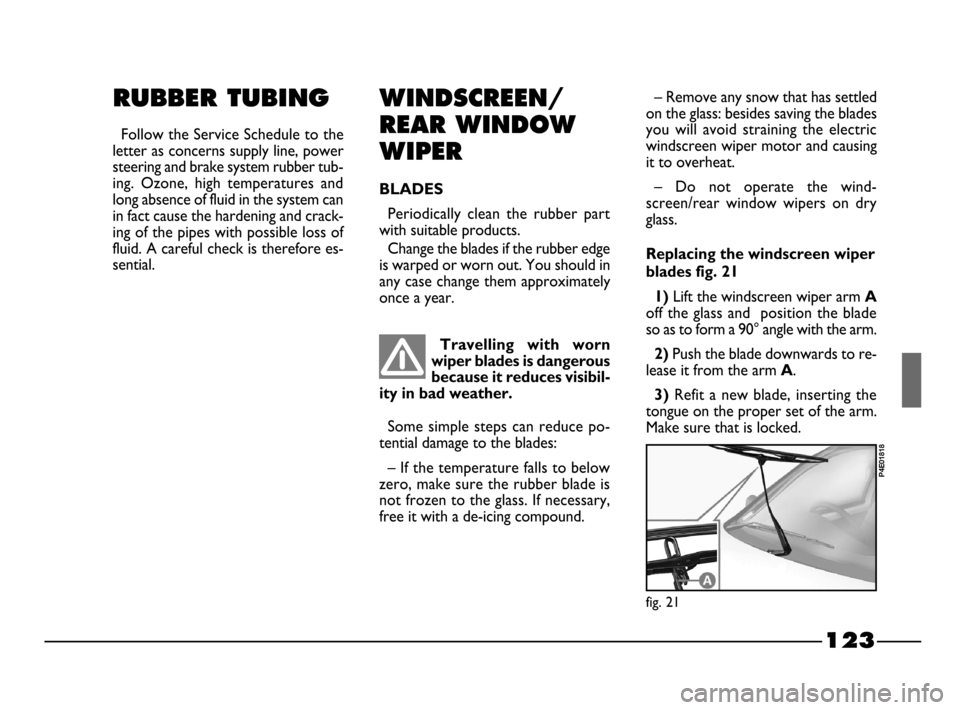
Replacing the windscreen wiper
blades fig. 21
1)
Lift the windscreen wiper arm A
off the glass and position the blade
so as to form a 90° angle with the arm.
2) Push the blade downwards to re-
lease it from the arm
A.
3) Refit a new blade, inserting the
tongue on the proper set of the arm.
Make sure that is locked.
Travelling with worn
wiper blades is dangerous
because it reduces visibil-
ity in bad weather.
Some simple steps can reduce po-
tential damage to the blades:
– If the temperature falls to below
zero, make sure the rubber blade is
not frozen to the glass. If necessary,
free it with a de-icing compound.
fig. 21
P4E01818
104-127 03/03/2003 06:53 PM Page 123
Page 130 of 156
129
CAR IDENTIFICATION DATA
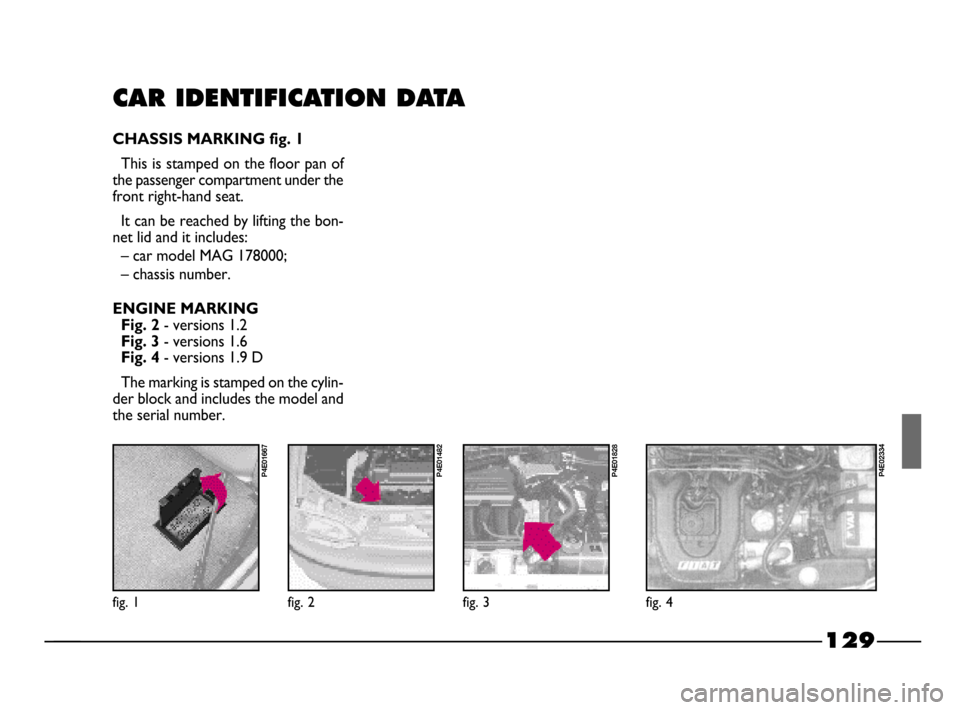
CHASSIS MARKING fig. 1
This is stamped on the floor pan of
the passenger compartment under the
front right-hand seat.
It can be reached by lifting the bon-
net lid and it includes:
– car model MAG 178000;
– chassis number.
ENGINE MARKING
Fig. 2
- versions 1.2
Fig. 3- versions 1.6
Fig. 4- versions 1.9 D
The marking is stamped on the cylin-
der block and includes the model and
the serial number.
fig. 1
P4E01667
fig. 2
P4E01482
fig. 3
P4E01828
MODEL PLATE fig. 4
This label is secured to the bonnet
and bears the following identification
data:
A - Manufacturer’s name
B - Homologation number
C - Vehicle type code
D - Chassis number
E - Maximum vehicle weight fully
loaded
F- Maximum vehicle weight fully
loaded plus trailer
G - Maximum vehicle weight on
front axle
H - Maximum vehicle weight on rear
axle
I - Engine type
L - Body version code
M- Number for spares
fig. 4
P4E02334
128-143 03/03/2003 07:39 PM Page 129
Page 136 of 156
135
STEERING
Energy absorbing steering wheel (air
bag, if provided).
Rake adjustable, jointed energy ab-
sorbing steering column.
Mechanical or hydraulic rack and pin-
ion command with permanent lubri-
cation.
Hydraulic power steering (as pro-
vided).
Permanent lubrication joints.
Minimum turning diameter:
10.2 metres.
Number of steering wheel turns lock
to lock:
3.69 turns for mechanical steering;
2.66 turns for hydraulic steering.
Do not push the power
steering to its limit while
the engine is running for
more than 15 seconds: this will
make a noise and could damage
the system.
128-143 03/03/2003 07:39 PM Page 135
Page 141 of 156
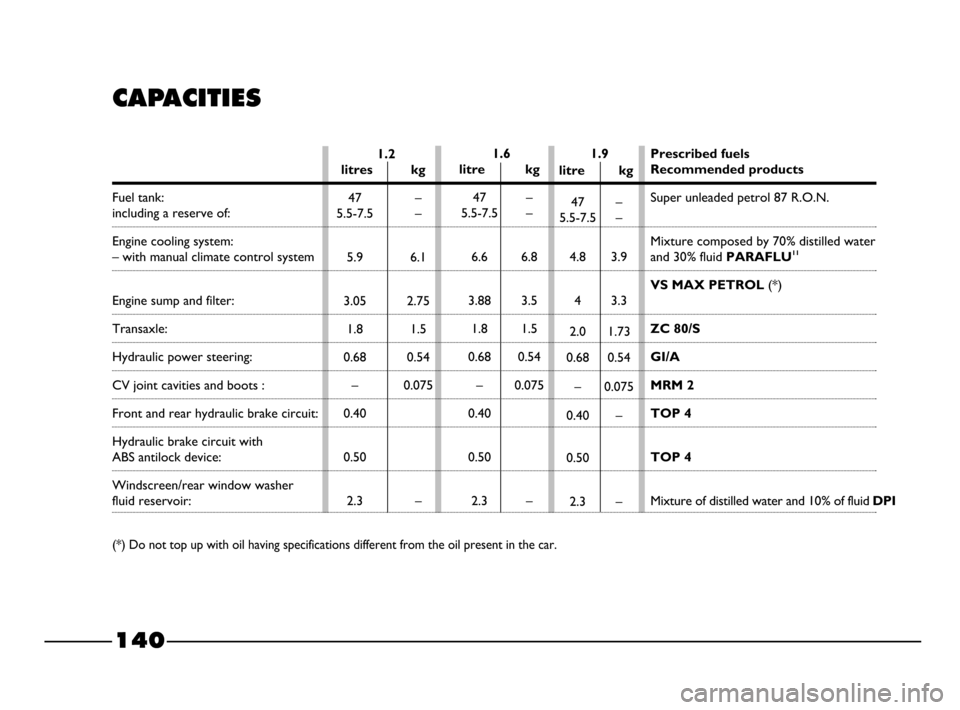
1.2
litres kg
47 –
5.5-7.5 –
5.9 6.1
3.05 2.75
1.8 1.5
0.68 0.54
– 0.075
0.40
0.50
2.3 –
1.6
litre kg
47 –
5.5-7.5 –
6.6 6.8
3.88 3.5
1.8 1.5
0.68 0.54
– 0.075
0.40
0.50
2.3 –
140
Prescribed fuels
Recommended products
Super unleaded petrol 87 R.O.N.
Mixture composed by 70% distilled water
and 30% fluid
PARAFLU11
VS MAX PETROL(*)
ZC 80/S
GI/A
MRM 2
TOP 4
TOP 4
Mixture of distilled water and 10% of fluid DPI
CAPACITIES
(*) Do not top up with oil having specifications different from the oil present in the car.
47 –
5.5-7.5 –
4.8 3.9
43.3
2.0 1.73
0.68 0.54
– 0.075
0.40 –
0.50
2.3 –
1.9
litre kg
Fuel tank:
including a reserve of:
Engine cooling system:
– with manual climate control system
ngine sump:
Engine sump and filter:
Transaxle:
Hydraulic power steering:
CV joint cavities and boots :
Front and rear hydraulic brake circuit:
Hydraulic brake circuit with
ABS antilock device:
Windscreen/rear window washer
fluid reservoir:
128-143 03/03/2003 07:39 PM Page 140
Page 145 of 156
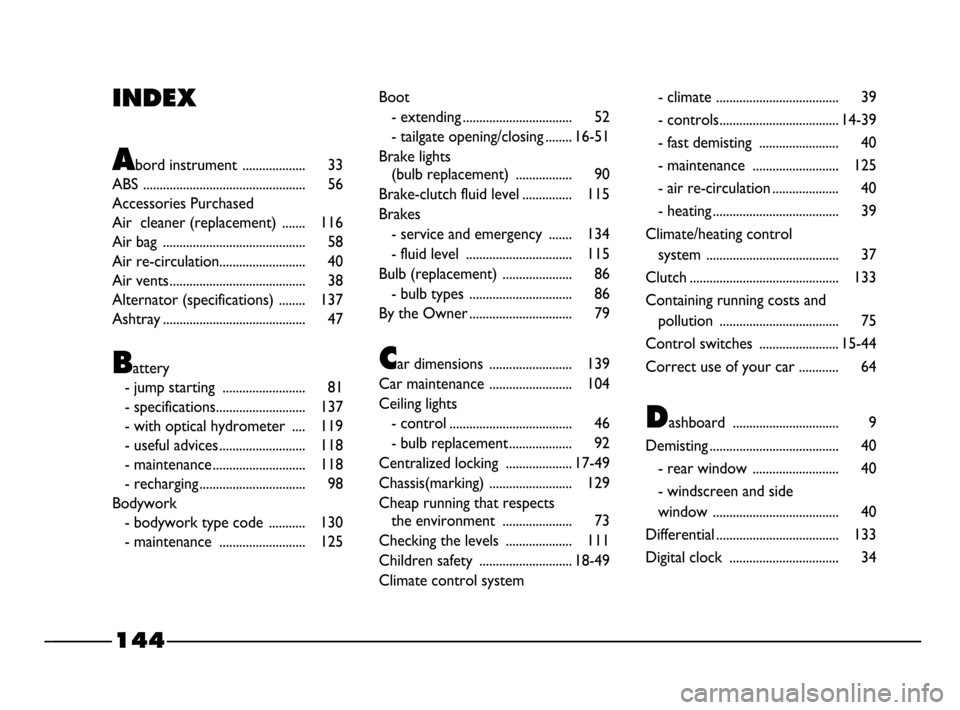
Abord instrument ................... 33
ABS ................................................. 56
Accessories Purchased
Air cleaner (replacement) ....... 116
Air bag ........................................... 58
Air re-circulation.......................... 40
Air vents......................................... 38
Alternator (specifications) ........ 137
Ashtray ........................................... 47
Battery
- jump starting ......................... 81
- specifications........................... 137
- with optical hydrometer .... 119
- useful advices .......................... 118
- maintenance ............................ 118
- recharging ................................ 98
Bodywork
- bodywork type code ........... 130
- maintenance .......................... 125Boot
- extending ................................. 52
- tailgate opening/closing ........ 16-51
Brake lights
(bulb replacement) ................. 90
Brake-clutch fluid level ............... 115
Brakes
- service and emergency ....... 134
- fluid level ................................ 115
Bulb (replacement) ..................... 86
- bulb types ............................... 86
By the Owner ............................... 79Car dimensions ......................... 139
Car maintenance ......................... 104
Ceiling lights
- control ..................................... 46
- bulb replacement ................... 92
Centralized locking .................... 17-49
Chassis(marking) ......................... 129
Cheap running that respects
the environment ..................... 73
Checking the levels .................... 111
Children safety ............................ 18-49
Climate control system- climate ..................................... 39
- controls.................................... 14-39
- fast demisting ........................ 40
- maintenance .......................... 125
- air re-circulation .................... 40
- heating ...................................... 39
Climate/heating control
system ........................................ 37
Clutch ............................................. 133
Containing running costs and
pollution .................................... 75
Control switches ........................ 15-44
Correct use of your car ............ 64
Dashboard ................................ 9
Demisting ....................................... 40
- rear window .......................... 40
- windscreen and side
window ...................................... 40
Differential ..................................... 133
Digital clock ................................. 34
INDEX
144
144-152 03/03/2003 07:30 PM Page 144
Page 146 of 156
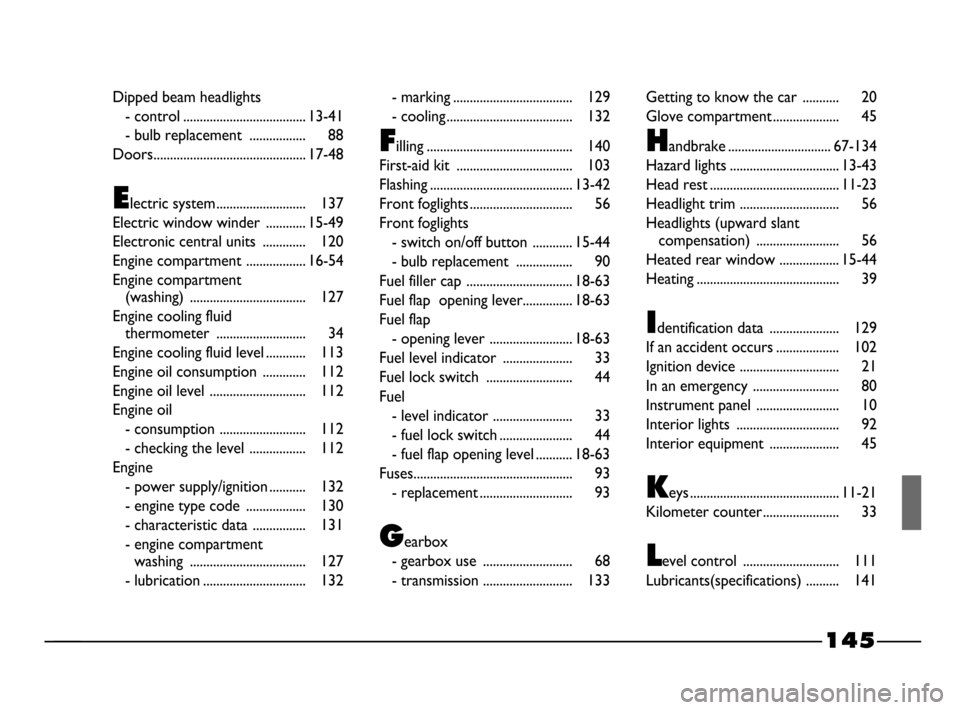
145
Dipped beam headlights
- control ..................................... 13-41
- bulb replacement ................. 88
Doors.............................................. 17-48
Electric system ........................... 137
Electric window winder ............ 15-49
Electronic central units ............. 120
Engine compartment .................. 16-54
Engine compartment
(washing) ................................... 127
Engine cooling fluid
thermometer ........................... 34
Engine cooling fluid level ............ 113
Engine oil consumption ............. 112
Engine oil level ............................. 112
Engine oil
- consumption .......................... 112
- checking the level ................. 112
Engine
- power supply/ignition ........... 132
- engine type code .................. 130
- characteristic data ................ 131
- engine compartment
washing ................................... 127
- lubrication ............................... 132- marking .................................... 129
- cooling ...................................... 132
Filling ............................................ 140
First-aid kit ................................... 103
Flashing ........................................... 13-42
Front foglights ............................... 56
Front foglights
- switch on/off button ............ 15-44
- bulb replacement ................. 90
Fuel filler cap ................................ 18-63
Fuel flap opening lever............... 18-63
Fuel flap
- opening lever ......................... 18-63
Fuel level indicator ..................... 33
Fuel lock switch .......................... 44
Fuel
- level indicator ........................ 33
- fuel lock switch ...................... 44
- fuel flap opening level ........... 18-63
Fuses................................................ 93
- replacement ............................ 93
Gearbox
- gearbox use ........................... 68
- transmission ........................... 133Getting to know the car ........... 20
Glove compartment .................... 45
Handbrake ............................... 67-134
Hazard lights ................................. 13-43
Head rest ....................................... 11-23
Headlight trim .............................. 56
Headlights (upward slant
compensation) ......................... 56
Heated rear window .................. 15-44
Heating ........................................... 39
Identification data ..................... 129
If an accident occurs ................... 102
Ignition device .............................. 21
In an emergency .......................... 80
Instrument panel ......................... 10
Interior lights ............................... 92
Interior equipment ..................... 45
Keys ............................................. 11-21
Kilometer counter ....................... 33
Level control ............................. 111
Lubricants(specifications) .......... 141
144-152 03/03/2003 07:30 PM Page 145