wheel FIAT PALIO 2003 178 / 1.G India Version Owner's Manual
[x] Cancel search | Manufacturer: FIAT, Model Year: 2003, Model line: PALIO, Model: FIAT PALIO 2003 178 / 1.GPages: 156, PDF Size: 6.27 MB
Page 74 of 156
73
ECONOMICAL
RUNNING THAT
RESPECTS THE
ENVIRONMENT
Environmental protection has been
one of the guiding principles in the
production of the Fiat Palio.
It is no accident that its pollution
control equipment is much more ef-
fective than that required by current
legislation.
Nonetheless, the environment can-
not get by without a concerted effort
from everyone.
By following a few simple rules you
can avoid harming the environment
and often cut down fuel consumption
at the same time.
On this subject, a few useful tips have
been given below to supplement those
marked by symbol #
, at various points
of the handbook.
You are asked to read both the for-
mer and the latter carefully.
DRIVING WITH ABS
The ABS is a braking system that es-
sentially offers two advantages:
1)It prevents wheel lock and con-
sequent skidding in emergency stops,
particularly when the road does not
offer much grip.
2)It makes it possible to brake and
steer at the same time so you can
avoid unexpected obstacles and direct
the car where you want while braking.
The extent to which this can be done
will depend on the physical limits of
the tyre’s sideways grip.
To exploit the ABS at best:
– During emergency stops or when
grip conditions are poor, you will feel
a slight pulsation on the brake pedal.
This is the sign that the ABS is work-
ing. Do not release the brake pedal but
continue to press so as not to inter-
rupt the braking action.– ABS prevents the wheels from lock-
ing but it does not increase actual grip
conditions between tyre and road.
Therefore, even if your car is fitted
with ABS, respect the safety distance
from the car in front of you and keep
your speed down when driving into
bends.
The ABS serves to increase your
control over the car, not to enable
you to go faster.
Warning light >, with
the engine running, nor-
mally indicates a faulting
the ABS system only. In this case,
the braking system is still effi-
cient, though without the an-
tilocking device. You are advised
to go immediately to the nearest
Fiat Dealership, driving in a man-
ner to avoiding sharp braking and
get the system checked.
64-79 03/03/2003 06:45 PM Page 73
Page 78 of 156
Type of snow chain
to be used
Reduced clearance snow
chains maximum projection off
wheel equal to 12 mm
Versions
1.2 EL-ELX-SPORT
1.6 16V GTX
1.9 EL-ELX
Tyres on which chains
can be fitted
165/80 R13
175/65 R14
165/80 R13
77
Traffic and road conditions
Heavy traffic and higher consumption
are synonymous: for example, when
driving slowly with frequent use of
lower gears or in towns where there
are numerous traffic lights.
Winding roads, mountain roads and
bumpy roads also have a negative effect
on consumption.
Enforced halts
During prolonged stops (traffic lights,
level crossings, etc.) the engine should
be switched off.
SNOW CHAINS
The use of snow chains is regulated
by the legislation in force in the coun-
try the car is driven in.
The chains may only be applied to
the drive wheel tyres (front wheels).
Refer to the following
table for information on
the wheels where snow
chains can be fitted. Follow the
prescriptions.
Check the tautness of the chains af-
ter driving some ten metres.
Keep your speed
down when snow
chains have been
fitted. Do not exceed 50 km/h.
Avoid potholes, do not mount
steps or kerbs and do not travel
long stretches on snow-free roads
otherwise you risk damaging
both your car and the tarmac.
64-79 03/03/2003 06:45 PM Page 77
Page 83 of 156
82
BUMP STARTING IF A TYRE IS
PUNCTURED
Follow the instructions on this and
the following pages to use the jack and
spare wheel correctly.
Remember that until
the engine has started the
brake booster and power
steering systems will not work
and a greater effort will therefore
be required to depress the brake
pedal or turn the steering wheel.
An incorrectly posi-
tioned jack may cause the
car to fall.
Do not use the jack to lift loads
exceeding that indicated on the
label attached to the jack itself.
The jack should only be used to
change a wheel on the car for
which it is designed. It should not
be put to other uses or employed
to raise other models of cars. Un-
der no circumstances should it be
used when carrying out repairs
under the car.
Do not lubricate the bolt
threads before fitting them back:
they could come loose.
Never start the engine,
when the car is raised on
a jack. Never tamper with
the inflation valve. Never place
tools between the rim and tyre.
Check the tyre and spare wheel
pressure regularly. The tyre in-
flation pressure is shown in the
“Technical specifications” chap-
ter.
Never bump start the
engine (by pushing, tow-
ing or coasting downhill).
This could cause fuel to flow in-
to the catalytic exhaust system
and damage it beyond repair.
If the car is fitted with al-
loy rims, a specific spare
wheel is provided. It is dif-
ferent from the one provided for
the cars fitted with steel rims. In
the event of successive purchase
of alloy rims, replacing the steel
rims, we suggest you to keep at
disposal 4 genuine bolts, which
will be used only with the spare
wheel. Danger of damaging the
wheel hubs
80-103 03/03/2003 06:49 PM Page 82
Page 84 of 156
83
1. STOP THE CAR
– Stop the car in a position that is not
dangerous for oncoming traffic where
you can change the wheel safely. The
ground should be flat and adequately
firm. If you have to change the wheel
at night, choose a lit area if possible.
– Turn the engine off and pull up the
handbrake.
– Engage first or reverse gear.
– Alert other drivers that the car is
stationary in compliance with local
regulations: hazard warning lights,
warning triangle etc.
Any passenger should get out and
wait as far away as possible from the
dangers of traffic.
If the road is sloping or bumpy, place
wedges or other suitable material un-
der the wheels to prevent the car from
moving.
2. TAKE OUT THE TOOLS,
JACK AND SPARE WHEEL
They are in the boot.
The tool bag is secured to the inter-
nal boot wall by proper belts,
fig. 2;
to take it out, lift the adhesive strip of
the belts. The bag contains: the jack
A-
fig. 3
, the jack operating handle B, the
wheel bolt wrench
C, the tow hitch D
and the screwdriver E.
fig. 2
P4E02373
fig. 4
P4E02375
fig. 3
P4E02374
– Lift the carpet covered flap.
– Loosen the fastener
A-fig. 4and
take the spare wheel.
80-103 03/03/2003 06:49 PM Page 83
Page 85 of 156
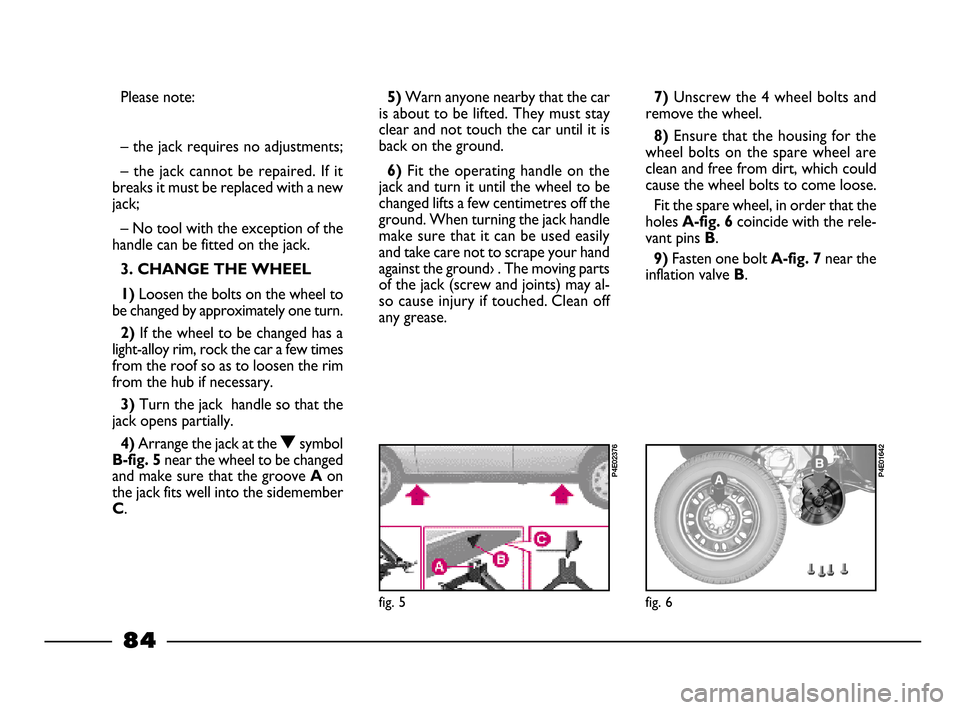
5) Warn anyone nearby that the car
is about to be lifted. They must stay
clear and not touch the car until it is
back on the ground.
6)Fit the operating handle on the
jack and turn it until the wheel to be
changed lifts a few centimetres off the
ground. When turning the jack handle
make sure that it can be used easily
and take care not to scrape your hand
against the ground› . The moving parts
of the jack (screw and joints) may al-
so cause injury if touched. Clean off
any grease.
7)Unscrew the 4 wheel bolts and
remove the wheel.
8) Ensure that the housing for the
wheel bolts on the spare wheel are
clean and free from dirt, which could
cause the wheel bolts to come loose.
Fit the spare wheel, in order that the
holes
A-fig. 6coincide with the rele-
vant pins
B.
9) Fasten one bolt A-fig. 7near the
inflation valve
B.
fig. 6
P4E01642
fig. 5
P4E02376
84
Please note:
– the jack weighs 2.900 kg;
– the jack requires no adjustments;
– the jack cannot be repaired. If it
breaks it must be replaced with a new
jack;
– No tool with the exception of the
handle can be fitted on the jack.
3. CHANGE THE WHEEL
1)
Loosen the bolts on the wheel to
be changed by approximately one turn.
2) If the wheel to be changed has a
light-alloy rim, rock the car a few times
from the roof so as to loosen the rim
from the hub if necessary.
3) Turn the jack handle so that the
jack opens partially.
4)Arrange the jack at the Osymbol
B-fig. 5 near the wheel to be changed
and make sure that the groove
Aon
the jack fits well into the sidemember
C.
80-103 03/03/2003 06:49 PM Page 84
Page 86 of 156
85
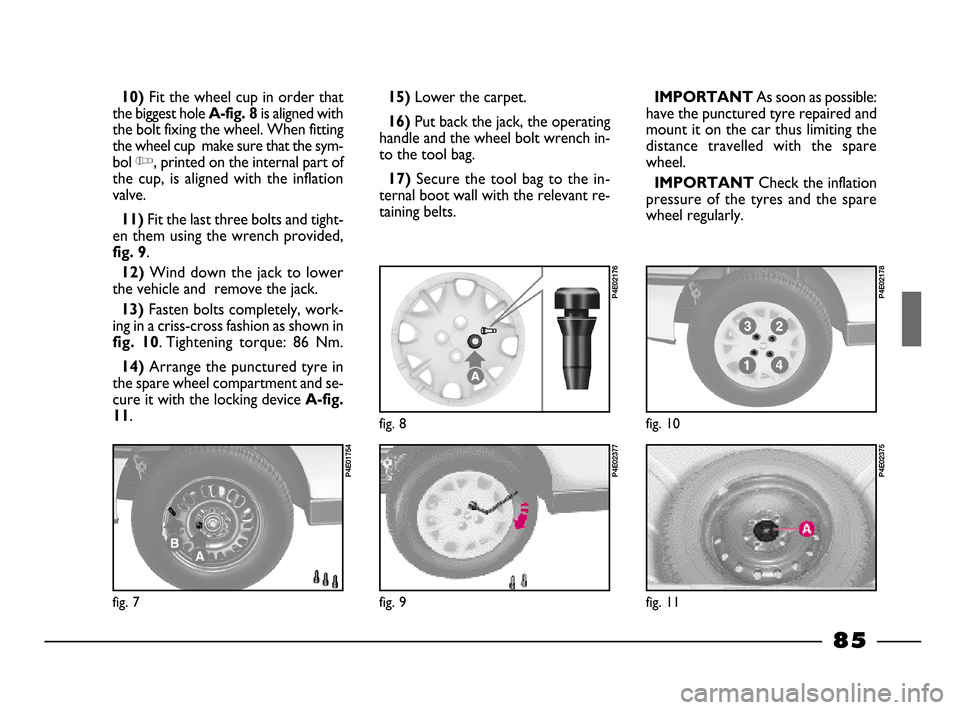
10)Fit the wheel cup in order that
the biggest hole
A-fig. 8is aligned with
the bolt fixing the wheel. When fitting
the wheel cup make sure that the sym-
bol
Y, printed on the internal part of
the cup, is aligned with the inflation
valve.
11)Fit the last three bolts and tight-
en them using the wrench provided,
fig. 9.
12)Wind down the jack to lower
the vehicle and remove the jack.
13)Fasten bolts completely, work-
ing in a criss-cross fashion as shown in
fig. 10. Tightening torque: 86 Nm.
14)Arrange the punctured tyre in
the spare wheel compartment and se-
cure it with the locking device
A-fig.
11
.
fig. 7
P4E01754
15)Lower the carpet.
16)Put back the jack, the operating
handle and the wheel bolt wrench in-
to the tool bag.
17)Secure the tool bag to the in-
ternal boot wall with the relevant re-
taining belts.
fig. 8
P4E02176
fig. 9
P4E02377
IMPORTANT As soon as possible:
have the punctured tyre repaired and
mount it on the car thus limiting the
distance travelled with the spare
wheel.
IMPORTANT Check the inflation
pressure of the tyres and the spare
wheel regularly.
fig. 10
P4E02178
fig. 11
P4E02375
80-103 03/03/2003 06:49 PM Page 85
Page 91 of 156
90
FRONT FOGLIGHTS
To replace the halogen bulb (type
H3, 12V-55W).
1) Turn the wheels to the left to re-
place the right-hand light and vice-ver-
sa.
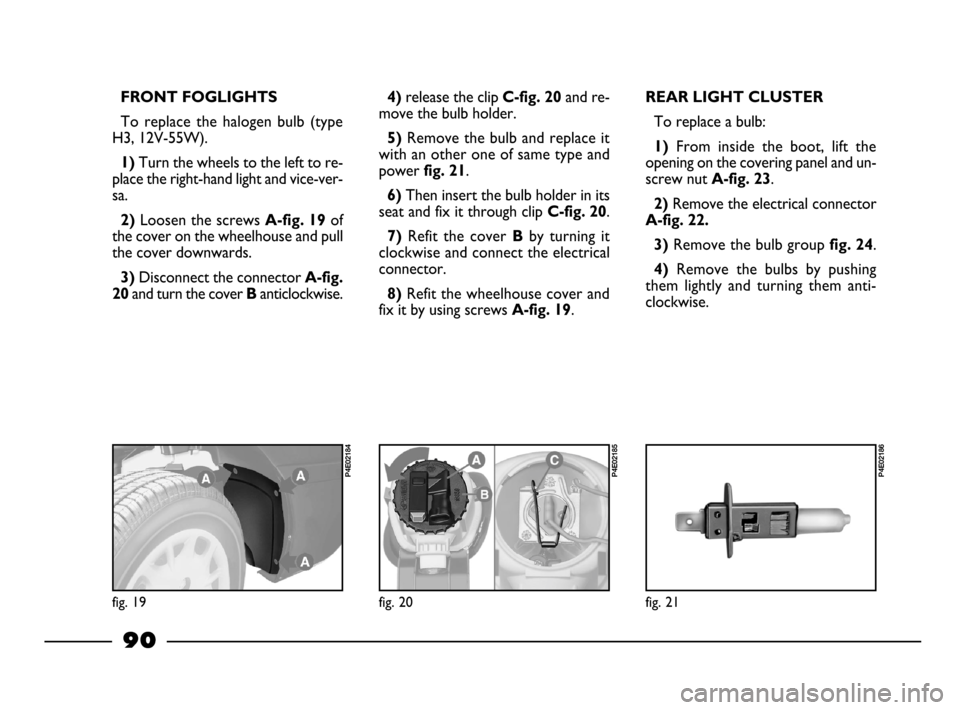
2) Loosen the screws A-fig. 19of
the cover on the wheelhouse and pull
the cover downwards.
3) Disconnect the connectorA-fig.
20
and turn the cover B anticlockwise.
4)release the clip C-fig. 20and re-
move the bulb holder.
5)Remove the bulb and replace it
with an other one of same type and
power
fig. 21.
6)Then insert the bulb holder in its
seat and fix it through clip
C-fig. 20.
7)Refit the cover Bby turning it
clockwise and connect the electrical
connector.
8)Refit the wheelhouse cover and
fix it by using screws
A-fig. 19.
REAR LIGHT CLUSTER
To replace a bulb:
1) From inside the boot, lift the
opening on the covering panel and un-
screw nut
A-fig. 23.
2) Remove the electrical connector
A-fig. 22.
3)
Remove the bulb group fig. 24.
4)Remove the bulbs by pushing
them lightly and turning them anti-
clockwise.
fig. 20
P4E02185
fig. 21
P4E02186
fig. 19
P4E02184
80-103 03/03/2003 06:49 PM Page 90
Page 95 of 156
94
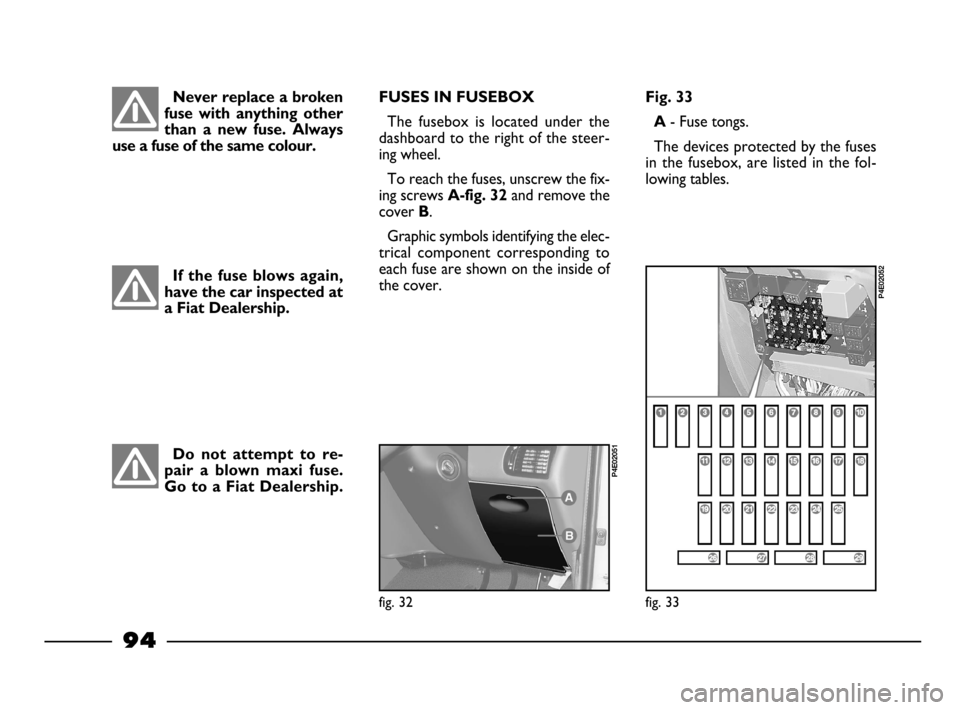
Fig. 33
A
- Fuse tongs.
The devices protected by the fuses
in the fusebox, are listed in the fol-
lowing tables.
fig. 33
P4E02052
Do not attempt to re-
pair a blown maxi fuse.
Go to a Fiat Dealership.If the fuse blows again,
have the car inspected at
a Fiat Dealership.Never replace a broken
fuse with anything other
than a new fuse. Always
use a fuse of the same colour.
FUSES IN FUSEBOX
The fusebox is located under the
dashboard to the right of the steer-
ing wheel.
To reach the fuses, unscrew the fix-
ing screws
A-fig. 32and remove the
cover
B.
Graphic symbols identifying the elec-
trical component corresponding to
each fuse are shown on the inside of
the cover.
fig. 32
P4E02051
80-103 03/03/2003 06:49 PM Page 94
Page 100 of 156
99
Cars fitted with an en-
gine/gearbox guard cannot
be lifted from the front.
IF THE CAR
NEEDS TO BE
RAISED
WITH THE JACK
See “If a Tyre is Punctured”, in this
chapter.
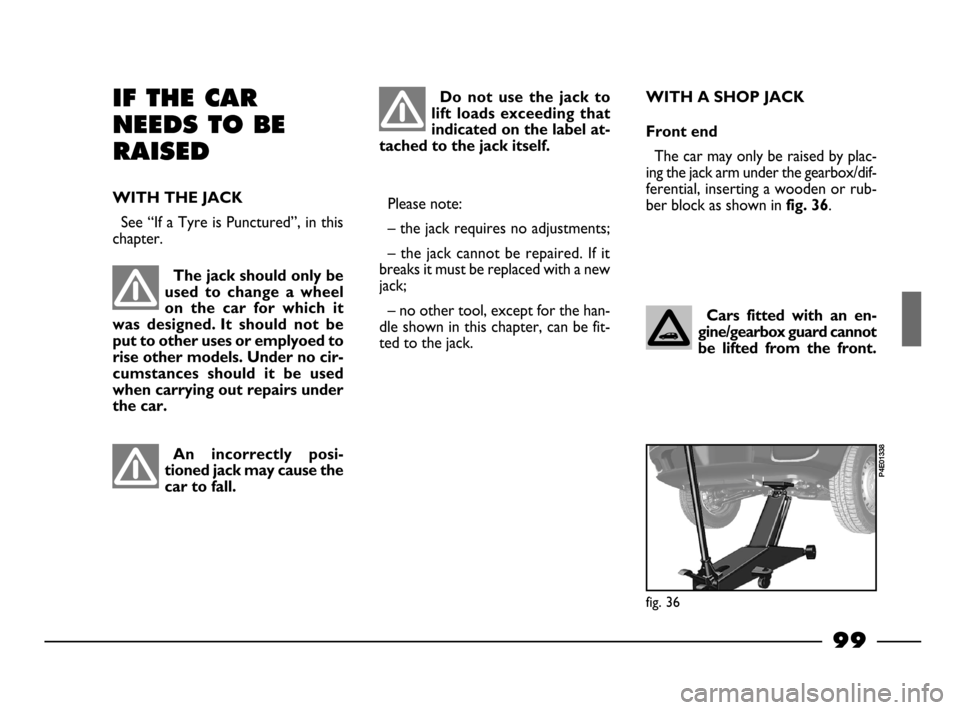
WITH A SHOP JACK
Front end
The car may only be raised by plac-
ing the jack arm under the gearbox/dif-
ferential, inserting a wooden or rub-
ber block as shown in
fig. 36.
The jack should only be
used to change a wheel
on the car for which it
was designed. It should not be
put to other uses or emplyoed to
rise other models. Under no cir-
cumstances should it be used
when carrying out repairs under
the car.
An incorrectly posi-
tioned jack may cause the
car to fall.
Do not use the jack to
lift loads exceeding that
indicated on the label at-
tached to the jack itself.
Please note:
– the jack requires no adjustments;
– the jack cannot be repaired. If it
breaks it must be replaced with a new
jack;
– no other tool, except for the han-
dle shown in this chapter, can be fit-
ted to the jack.
fig. 36
P4E01338
80-103 03/03/2003 06:49 PM Page 99
Page 102 of 156
101
Do not tow the car by
using flexible elements
(metallic cables, ropes or
strings); only the use of a rigid
bar, with the ends supplied with
adequate joints, is allowed. Make
sure to fix the joint to the car in
order not to damage the near el-
ements.
Before starting to tow, turn the
ignition key to MAR and then to
STOP. Do not remove the key. If
the key is removed, the steering
lock engages automatically which
prevents the wheels being turned.
While the car is being towed
with the engine off, remember
that the brake pedal and steering
will require more effort as you no
longer have the benefit of the
brake booster and the power
steering.
The towing vehicle must be dri-
ven as evenly and softly as possi-
ble to prevent counterblows.IF THE CAR
NEEDS TO BE
TOWED
The tow hitch is supplied as standard
with the car. It is in the tool kit at-
tached to the spare wheel.
To fasten the tow hitch:
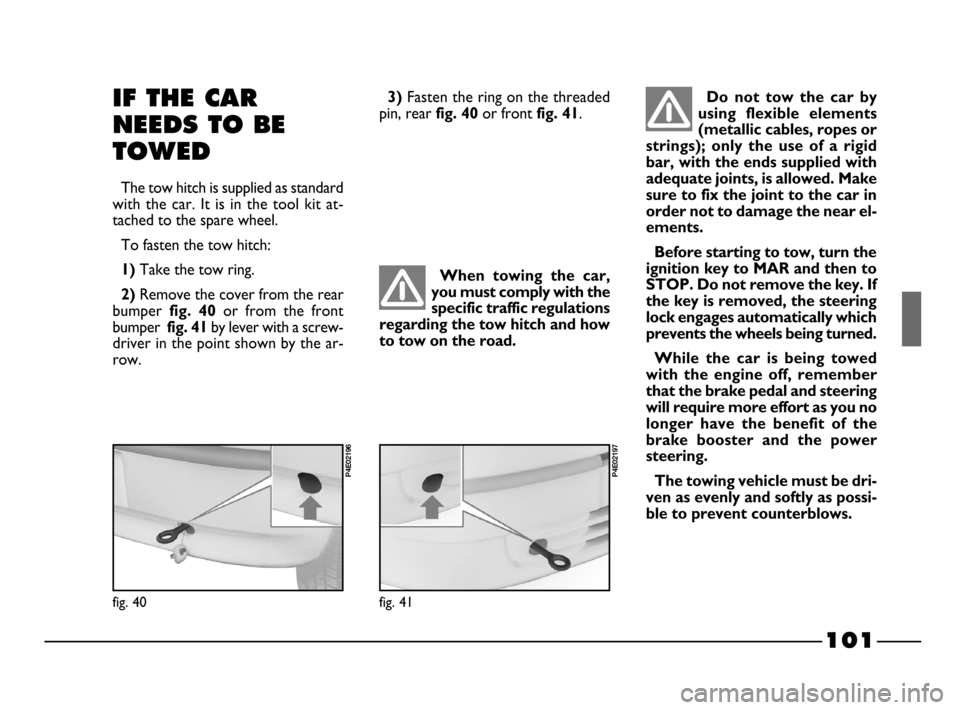
1)Take the tow ring.
2) Remove the cover from the rear
bumper
fig. 40or from the front
bumper
fig. 41by lever with a screw-
driver in the point shown by the ar-
row.
fig. 40
P4E02196
fig. 41
P4E02197
When towing the car,
you must comply with the
specific traffic regulations
regarding the tow hitch and how
to tow on the road.
3)Fasten the ring on the threaded
pin, rear
fig. 40or front fig. 41.
80-103 03/03/2003 06:49 PM Page 101