clutch FIAT PALIO 2003 178 / 1.G India Version Owners Manual
[x] Cancel search | Manufacturer: FIAT, Model Year: 2003, Model line: PALIO, Model: FIAT PALIO 2003 178 / 1.GPages: 156, PDF Size: 6.27 MB
Page 66 of 156
65
The key switch is equipped with a
safety device which obliges, in the
event of engine starting malfunction to
return the key at
STOP prior to re-
peating the starting operation.
At the same time, when the engine is
running, the device prevents to shift
from
MAR postion to AVV position.
In the first operational seconds,
above all after a long inactivity peri-
od, you can hear a higher noise level
of the engine. Such phenomenon,
which does not compromise the func-
tionality and reliability, is typical of the
hydraulic tappets: the distribution sys-
tem, chosen for the engine of 100
16V
version of your Fiat Palio to contribute
to the maintenance intervention re-
duction.
STARTING THE ENGINE
IMPORTANT
Do not press the
accelerator until the engine has start-
ed.
1) Ensure that the handbrake is up.
2) Put the gear lever into neutral.
3)Press the clutch pedal right down.
4) Turn the ignition key to AVVand
release it as soon as the engine starts.If the engine does not start at the
first attempt, return the ignition key
to
STOP before trying to start the
engine again.
IMPORTANT Press the accelera-
tor slightly only if the outside temper-
ature is lower than –10°C and the en-
gine does not start at the first attempt.
IMPORTANTNever leave the ig-
nition key at
MARwhen the engine is
off.
Never touch the high
voltage wires (spark plug
wires) when the engine is
running.
It is dangerous to let the
engine run in a garage of
other closed area. The en-
gine consumes oxygen and gives
off carbon dioxide, carbon monox-
ide and other poisonous fumes.
STARTING THE
ENGINE
We recommend not to
push the engine to its lim-
its for the first period of
use (e.g. abrupt accelerations, ex-
cessively prolonged distances at
max revs, hard braking, etc.).
64-79 03/03/2003 06:45 PM Page 65
Page 69 of 156
68
You must press the
clutch fully down to
change gear properly. It is
therefore essential that there is
nothing under the pedals. Make
sure that mats are lying flat and
do not get in the way of pedals.
SAFE DRIVING
In designing the Fiat Palio, Fiat made
every effort to offer a car able to pro-
vide driver and passengers with top
class levels of safety.
Nevertheless it is always the behav-
iour of the person at the wheel that
determines road safety.
Below you will find some simple tips
to help you travel in safety under dif-
ferent conditions.
You will no doubt be familiar with
many of them already but it will be
useful to read them all carefully.
USING THE
GEARBOX
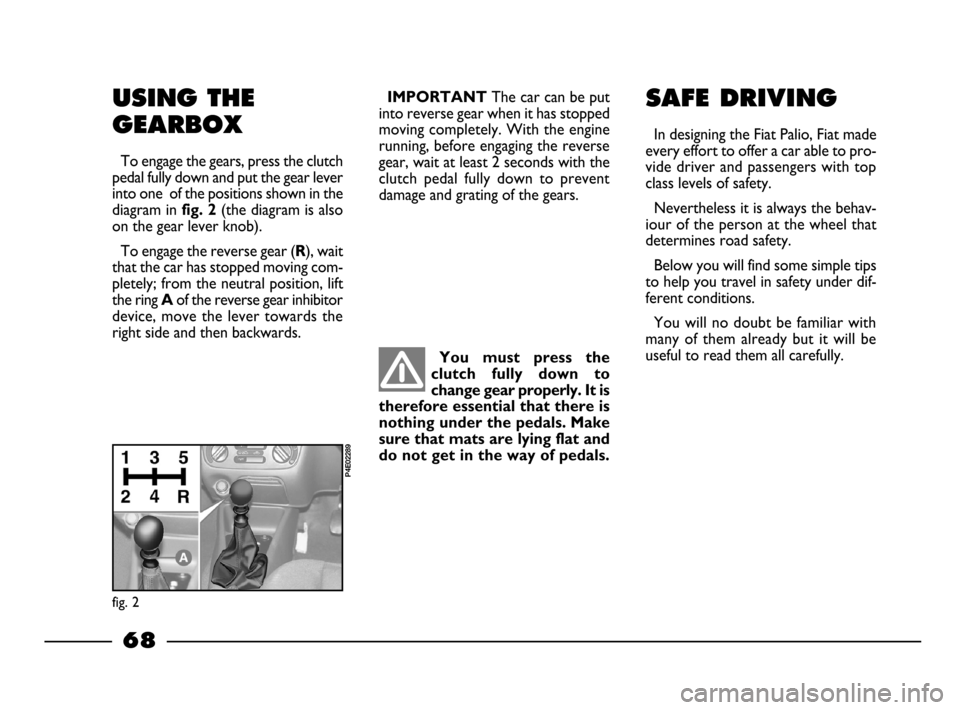
To engage the gears, press the clutch
pedal fully down and put the gear lever
into one of the positions shown in the
diagram in
fig. 2(the diagram is also
on the gear lever knob).
To engage the reverse gear (
R), wait
that the car has stopped moving com-
pletely; from the neutral position, lift
the ring
Aof the reverse gear inhibitor
device, move the lever towards the
right side and then backwards.
fig. 2
P4E02289
IMPORTANTThe car can be put
into reverse gear when it has stopped
moving completely. With the engine
running, before engaging the reverse
gear, wait at least 2 seconds with the
clutch pedal fully down to prevent
damage and grating of the gears.
64-79 03/03/2003 06:45 PM Page 68
Page 70 of 156
69
Water, ice or salt sprin-
kled on the road can de-
posit on the brake discs
and reduce efficiency of the first
braking.
Consider that fitting ex-
tra spoilers, alloy rims or
non standard wheel caps
can reduce ventilation of the
brakes and reduce their efficien-
cy under conditions of violent or
repeated braking or long down-
hill travel.
BEFORE GETTING BEHIND
THE WHEEL
– Make sure all lights including the
headlights are working properly.
– Adjust the position of the seats, the
steering wheel and the rearview mir-
rors properly for the best driving po-
sition.
– Carefully adjust the head restraints
so the back of the head and not the
nape of the neck is supported.
– Make sure that nothing (mats etc.)
gets in the way of the pedals when
they are pushed down.
– Do not drive using the clutch ped-
al as a foot rest. Such behaviour can
cause a premature wear of the clutch.
– Make sure that any child restraint
systems (child seats, carriers, etc.) are
properly fixed preferably on the back
seat. Follow the precautions listed in
the “Transporting children in safety”
paragraph in the “Getting to know the
car” chapter.
– Arrange the load in the boot in such
a way that it cannot be thrown for-
wards in the event of an accident.– Do not place clear objects or
sheets of paper on the dashboard that
reflect on the windscreen.
– Do not eat a heavy meal before
travelling. Light eating will help keep
your reflexes prompt. Above all, do
not have anything alcoholic to drink.
The use of some medicines can reduce
the driving capability: carefully read the
relevant use warnings.
Remember to periodically carry out
the checks specified in the “Repeated
checks before long trips” paragraph
given in this section.
64-79 03/03/2003 06:45 PM Page 69
Page 77 of 156
76
Climate control system
The climate control system is an ad-
ditional load which greatly effects the
engine leading to higher(up to +20%
in average) fuel consumption. When
the temperature outside allows, use
the air vents where possible.
Spoilers
The use of optional extras, which are
not certified for specific use on the car,
may reduce the aerodynamic pene-
tration of the car and increase con-
sumption.
DRIVING STYLE
Starting
Do not warm the engine when the
car is stationary or at high or low revs:
in this way the engine will warm up
gradually increasing consumption and
emissions. You should drive off slow-
ly straight away avoiding high revs so
that the engine will warm up more
quickly.
Unnecessary actions
Avoid revving the engine when
stopped at traffic lights or before
switching off the engine and avoid
doubling the clutch as these actions
serve no purpose in modern cars and
only increase consumption and pollu-
tion.
Gear selections
As soon as the traffic and road con-
ditions allow it, shift to a higher gear.
Using a lower gear to liven up accel-
eration greatly increases consumption.
In the same way, improper use of the
higher gears will increase consump-
tion, emissions and wear and tear on
the engine.
Top speed
Fuel consumption increases consid-
erably as speed increases. For exam-
ple, when accelerating from 90 to 120
km/h, fuel consumption increases up
to approximately +30%. Your speed should be kept as even
as possible and superfluous braking
and acceleration avoided as this in-
creases both consumption and emis-
sions. A “smooth” driving style should
be adopted by attempting to anticipate
manoeuvres to avoid imminent danger
and to keep a safe distance from the
vehicle in front to avoid braking
sharply.
Acceleration
Accelerating violently increasing the
revs will greatly effect consumption
and emission; acceleration should be
gradual and not exceed the maximum
torque.
CONDITIONS OF USE
Cold starting
Very short distances and frequent
cold starting will not enable the engine
to reach optimal running temperature.
It follows, therefore, that consumption
will be higher (from +15 to +30% in
towns) as will the production of toxic
emissions.
64-79 03/03/2003 06:45 PM Page 76
Page 109 of 156
108
ADDITIONAL
INTERVENTIONS
Every 1000 kmor prior to long
travels, check and possibly restore:
– engine coolant level
– brake - clutch fluid level
– Power steering fluid level
– battery fluid level
– windscreen washer fluid level
– pressure and condition of the tyres.
Every 3000 kmcheck and top up
as necessary: engine oil level.We suggest the use of
FL Group
product expressly recommended,
studied and realized for Fiat cars (see
the “Refuelling” table in the “Techni-
cal Specifications” chapter).
IMPORTANT - Engine oil
Replace the engine oil more fre-
quently than indicated in the Sched-
uled Servicing Plan, in the event that
the car is mainly used in one of the fol-
lowing particularly severe conditions:
– dusty, sandy or muddy roads;
– repeated and short distances (less
than 7-8 km) and with external tem-
perature less than zero;– with engine frequently idling or for
long distances at low speed (e.g. taxi,
door-to-door deliveries or for long
storage).
For any doubt on the engine oil re-
placement, in relation to how the car
is used, contact the
Fiat Dealership.
104-127 03/03/2003 06:53 PM Page 108
Page 111 of 156
The jack, with which the
car is equipped, is pre-
scribed only when the
wheel must be replaced. For ex-
igencies different from this latter,
the lifting of the car must re-
spect particular modalities.
Therefore, we recommend you
to perform the operation at Fiat
Dealership.
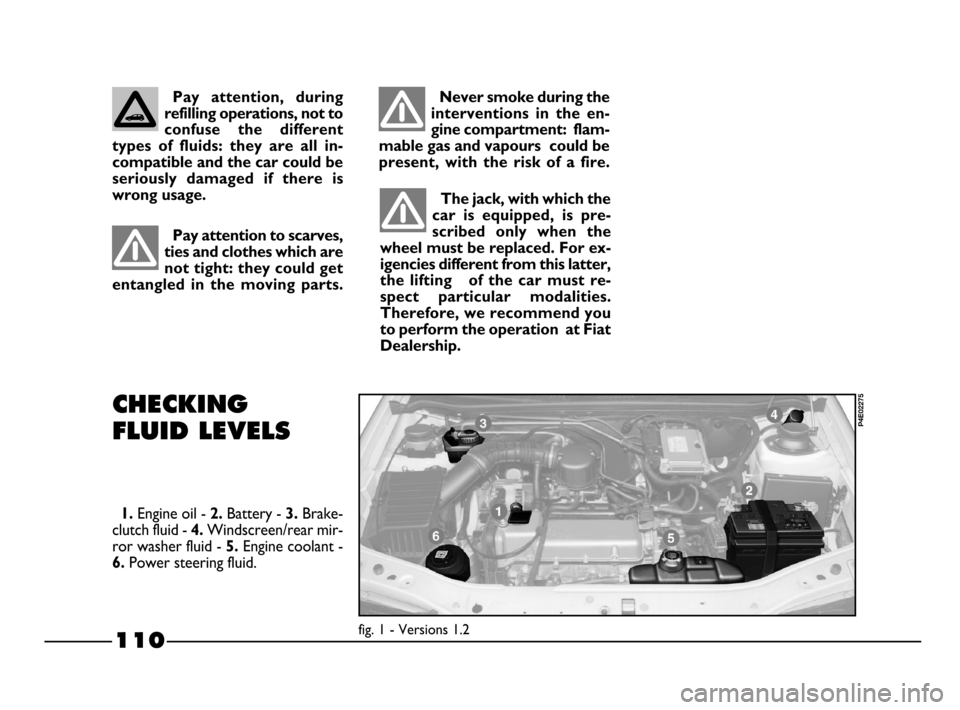
110fig. 1 - Versions 1.2
P4E02275CHECKING
FLUID LEVELS
1.Engine oil - 2.Battery -3. Brake-
clutch fluid -
4.Windscreen/rear mir-
ror washer fluid -
5. Engine coolant -
6.Power steering fluid.
Pay attention, during
refilling operations, not to
confuse the different
types of fluids: they are all in-
compatible and the car could be
seriously damaged if there is
wrong usage.
Pay attention to scarves,
ties and clothes which are
not tight: they could get
entangled in the moving parts.Never smoke during the
interventions in the en-
gine compartment: flam-
mable gas and vapours could be
present, with the risk of a fire.
104-127 03/03/2003 06:53 PM Page 110
Page 112 of 156
111
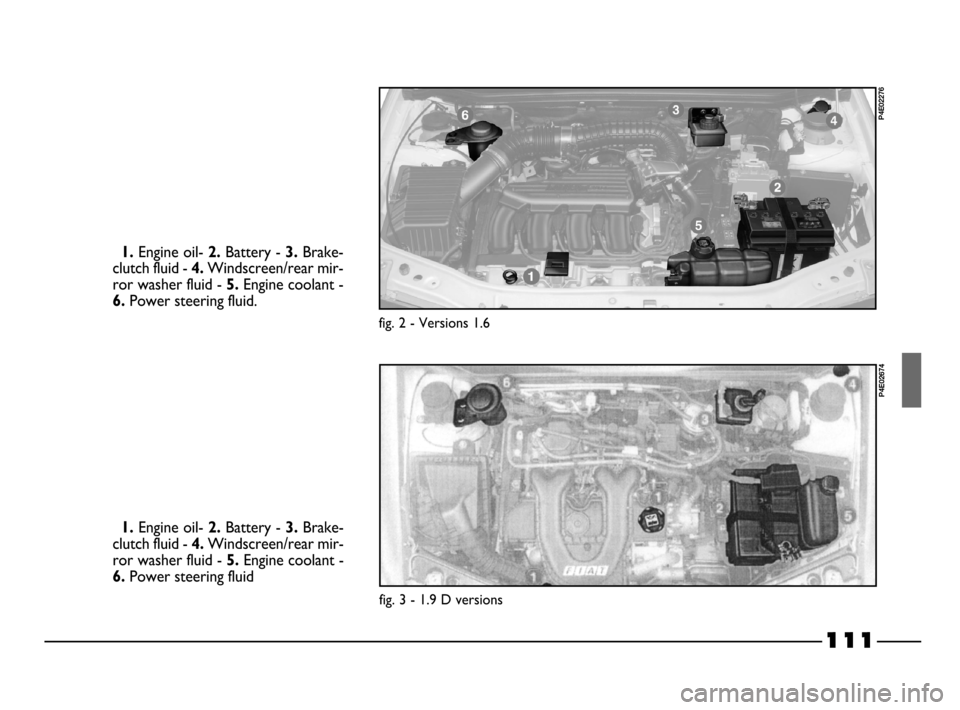
fig. 3 - 1.9 D versions
P4E02674
1.Engine oil- 2.Battery -3.Brake-
clutch fluid -
4.Windscreen/rear mir-
ror washer fluid -
5. Engine coolant -
6.Power steering fluid.
fig. 2 - Versions 1.6
P4E02276
1.Engine oil- 2.Battery -3.Brake-
clutch fluid -
4.Windscreen/rear mir-
ror washer fluid -
5. Engine coolant -
6.Power steering fluid
104-127 03/03/2003 06:53 PM Page 111
Page 116 of 156
115
Avoid that the highly
corrosive brake fluid drips
onto the paintwork. If it
does, wash immediately with wa-
ter.
fig. 13
P4E02074
With the engine run-
ning, do not push, at the
end of the power steering
stroke, for more than 15 con-
secutive seconds: noises are pro-
duced and the system could be
damaged.
The power steering flu-
id consumption is very
low; if it needs topping up
at short intervals, have the sys-
tem checked for leaks at a Fiat
Dealership.Make sure the power
steering fluid does not
come into contact with
the hot parts of the engine: it is
inflammable.
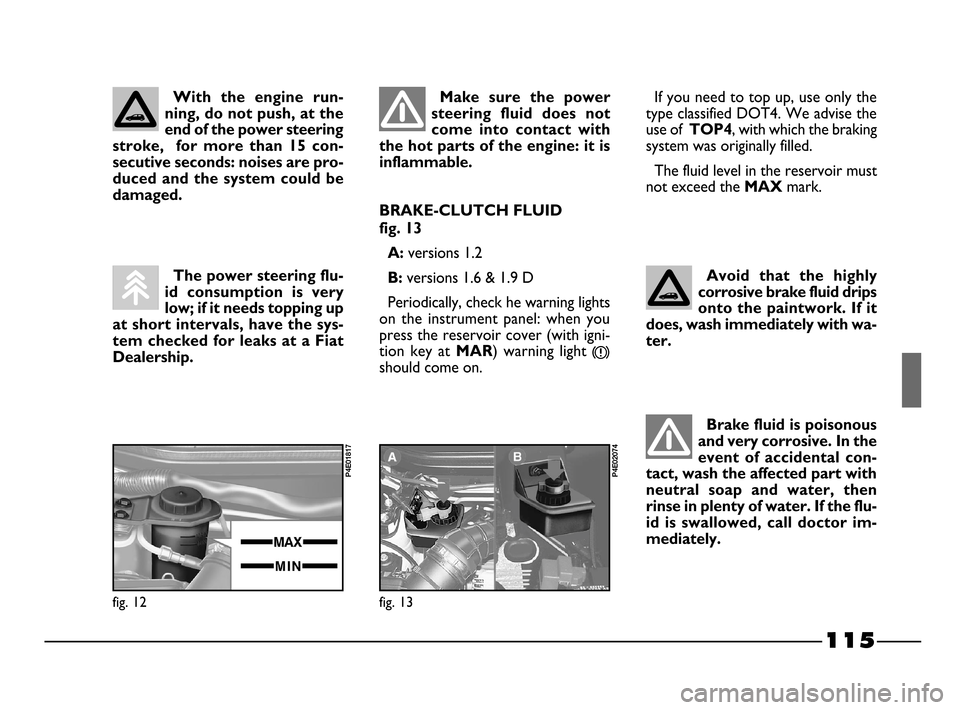
BRAKE-CLUTCH FLUID
fig. 13
A:
versions 1.2
B: versions 1.6 & 1.9 D
Periodically, check he warning lights
on the instrument panel: when you
press the reservoir cover (with igni-
tion key at
MAR) warning light
x
should come on.
Brake fluid is poisonous
and very corrosive. In the
event of accidental con-
tact, wash the affected part with
neutral soap and water, then
rinse in plenty of water. If the flu-
id is swallowed, call doctor im-
mediately.
If you need to top up, use only the
type classified DOT4. We advise the
use of
TOP4, with which the braking
system was originally filled.
The fluid level in the reservoir must
not exceed the
MAX mark.
fig. 12
P4E01817
104-127 03/03/2003 06:53 PM Page 115
Page 134 of 156
133
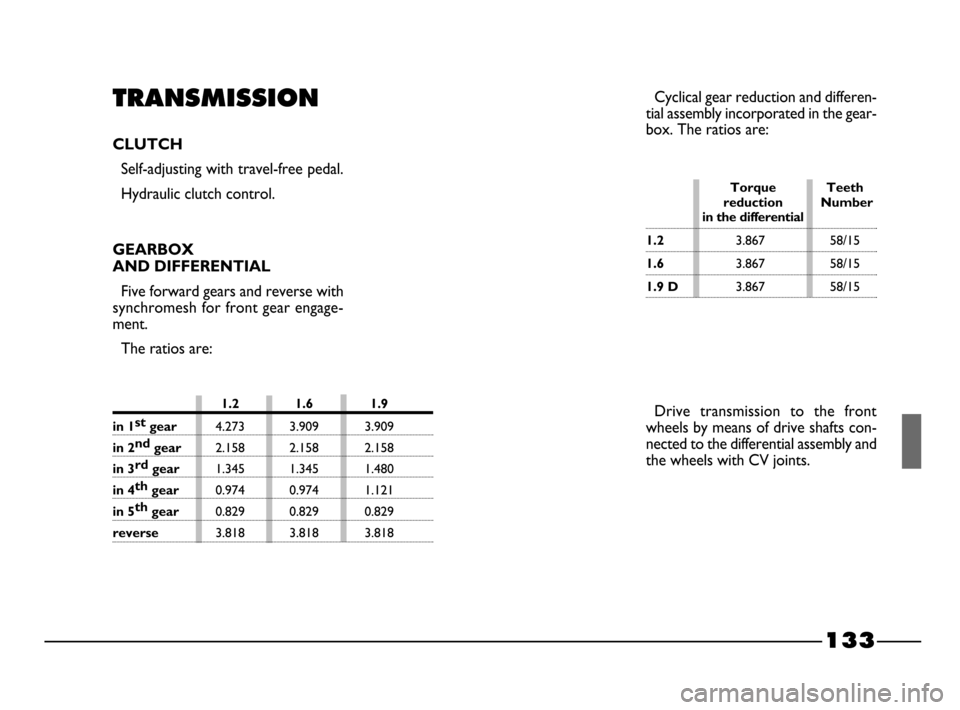
TRANSMISSION
CLUTCH
Self-adjusting with travel-free pedal.
Hydraulic clutch control.Cyclical gear reduction and differen-
tial assembly incorporated in the gear-
box. The ratios are:
Drive transmission to the front
wheels by means of drive shafts con-
nected to the differential assembly and
the wheels with CV joints.
GEARBOX
AND DIFFERENTIAL
Five forward gears and reverse with
synchromesh for front gear engage-
ment.
The ratios are:
1.2 1.6 1.9
in 1st
gear4.273 3.909 3.909
in 2nd
gear 2.158 2.158 2.158
in 3rd
gear 1.345 1.345 1.480
in 4th
gear0.974 0.974 1.121
in 5th
gear 0.829 0.829 0.829
reverse3.818 3.818 3.818
Torque Teeth
reduction Number
in the differential
1.23.867 58/15
1.63.867 58/15
1.9 D3.867 58/15
128-143 03/03/2003 07:39 PM Page 133
Page 143 of 156
142
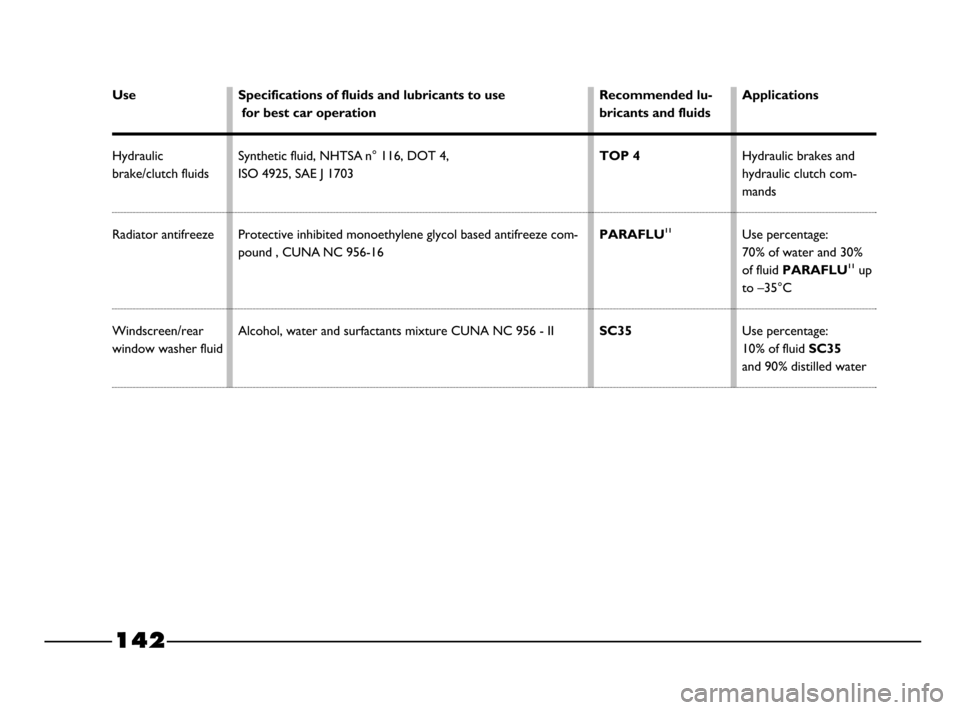
Use
Hydraulic
brake/clutch fluids
Radiator antifreeze
Windscreen/rear
window washer fluid
Specifications of fluids and lubricants to use
for best car operation
Synthetic fluid, NHTSA n° 116, DOT 4,
ISO 4925, SAE J 1703
Protective inhibited monoethylene glycol based antifreeze com-
pound , CUNA NC 956-16
Alcohol, water and surfactants mixture CUNA NC 956 - II
Recommended lu-
bricants and fluids
TOP 4
PARAFLU
11
SC35Applications
Hydraulic brakes and
hydraulic clutch com-
mands
Use percentage:
70% of water and 30%
of fluid
PARAFLU11up
to –35°C
Use percentage:
10% of fluid
SC35
and 90% distilled water
128-143 03/03/2003 07:39 PM Page 142