weight FIAT PANDA 2007 169 / 2.G Owners Manual
[x] Cancel search | Manufacturer: FIAT, Model Year: 2007, Model line: PANDA, Model: FIAT PANDA 2007 169 / 2.GPages: 206, PDF Size: 3.49 MB
Page 62 of 206
61
SAFETY
DEVICES
CORRECT USE
OF THE CAR
WARNING
LIGHTS AND
MESSAGES
IN AN
EMERGENCY
CAR
MAINTENANCE
TECHNICAL
SPECIFICATIONS
INDEX
DASHBOARD
AND CONTROLS
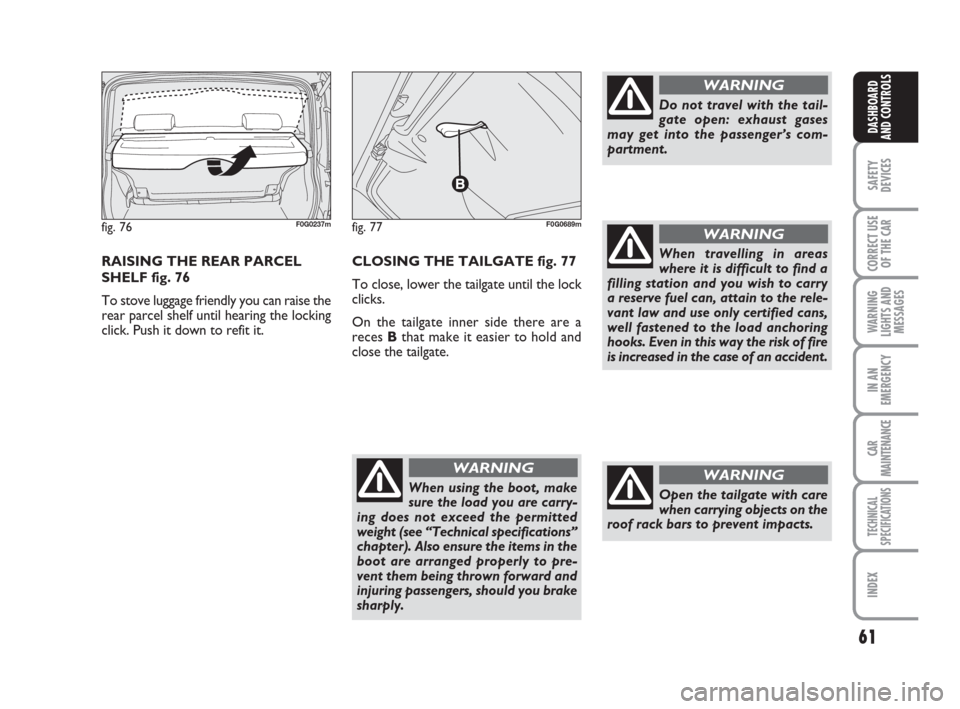
CLOSING THE TAILGATE fig. 77
To close, lower the tailgate until the lock
clicks.
On the tailgate inner side there are a
reces Bthat make it easier to hold and
close the tailgate. RAISING THE REAR PARCEL
SHELF fig. 76
To stove luggage friendly you can raise the
rear parcel shelf until hearing the locking
click. Push it down to refit it.
fig. 76F0G0237mfig. 77F0G0689m
When using the boot, make
sure the load you are carry-
ing does not exceed the permitted
weight (see “Technical specifications”
chapter). Also ensure the items in the
boot are arranged properly to pre-
vent them being thrown forward and
injuring passengers, should you brake
sharply.
WARNING
Do not travel with the tail-
gate open: exhaust gases
may get into the passenger’s com-
partment.
WARNING
When travelling in areas
where it is difficult to find a
filling station and you wish to carry
a reserve fuel can, attain to the rele-
vant law and use only certified cans,
well fastened to the load anchoring
hooks. Even in this way the risk of fire
is increased in the case of an accident.
WARNING
Open the tailgate with care
when carrying objects on the
roof rack bars to prevent impacts.
WARNING
060-080 Panda New GB 21-06-2007 13:48 Pagina 61
Page 66 of 206
65
SAFETY
DEVICES
CORRECT USE
OF THE CAR
WARNING
LIGHTS AND
MESSAGES
IN AN
EMERGENCY
CAR
MAINTENANCE
TECHNICAL
SPECIFICATIONS
INDEX
DASHBOARD
AND CONTROLS
HEADLIGHTS
ADJUSTING THE HEADLIGHT
BEAM
The correct positioning of the headlight
beams is very important for the comfort
and safety not only of the person driving
the car but also all other road users. This
also covered by a specific law.
To ensure you and other drivers have the
best visibility conditions when travelling
with the headlights on, the headlights must
be set properly.
Have the headlight positioning checked at
a Fiat Dealership and adjusted if necessary.
Check the positioning of the headlight
beams whenever the weight or the load
position is changed.
ROOF RACK/
SKI RACK
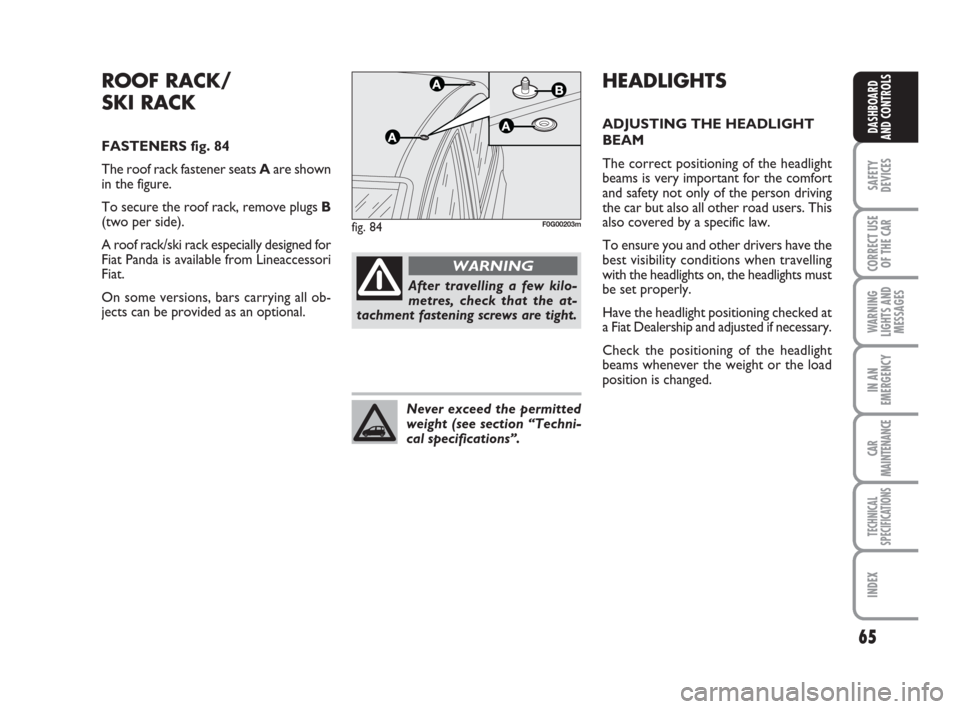
FASTENERS fig. 84
The roof rack fastener seats Aare shown
in the figure.
To secure the roof rack, remove plugs B
(two per side).
A roof rack/ski rack especially designed for
Fiat Panda is available from Lineaccessori
Fiat.
On some versions, bars carrying all ob-
jects can be provided as an optional.
fig. 84F0G00203m
After travelling a few kilo-
metres, check that the at-
tachment fastening screws are tight.
WARNING
Never exceed the permitted
weight (see section “Techni-
cal specifications”.
060-080 Panda New GB 21-06-2007 13:48 Pagina 65
Page 88 of 206
87
CORRECT USE
OF THE CAR
WARNING
LIGHTS AND
MESSAGES
IN AN
EMERGENCY
CAR
MAINTENANCE
TECHNICAL
SPECIFICATIONS
INDEX
DASHBOARD
AND CONTROLS
SAFETY
DEVICES
All restraint devices must bear the certi-
fication data, together with the control
brand, on a solidly fixed label which must
absolutely never be removed.
Over 1.50 m in height, from the point of
view of restraint systems, children are
considered as adults and wear the seat
belts normally.
Lineaccessori Fiat offers seats for each
weight group, which are the recommend-
ed choice, as they have been designed and
experimented specifically for Fiat cars.CARRYING CHILDREN
SAFELY
For optimal protection in the event of a
crash, all passengers must be seated and
wearing adequate restraint systems.
This is even more important for children.
This prescription is compulsory in all EC
countries according to EC Directive
2003/20/EC.
Compared with adults, their head is pro-
portionally larger and heavier than the rest
of the body, while the muscles and bone
structure are not completely developed.
Therefore, correct restraint systems are
necessary, other then adult seat belts.
The results of research on the best child
restraint systems are contained in the Eu-
ropean Standard ECE- R44. This Standard
enforces the use of restraint systems clas-
sified in five groups:
Group 0 0-10 kg in weight
Group 0+ 0-13 kg in weight
Group 1 9-18 kg in weight
Group 2 15-25 kg in weight
Group 3 weight 22 - 36 kg
SERIOUS DANGER: Never
place cradle child’s seats on
the front passenger seat of
cars fitted with passenger’s
air bag. The air bag activa-
tion could cause serious in-
juries, even mortal. You are advised
to carry children always on the rear
seats, as this is the most protected po-
sition in the case of a crash. In any
case, children’s seats must absolutely
not be fitted on the front seat of cars
with passenger’s air bag, which dur-
ing inflation could cause serious in-
jury, even mortal, regardless of the se-
riousness of the crash that triggered
it. Children may be placed on the
front seat of cars fitted with passen-
ger’s air bag deactivation. In this case,
it is absolutely necessary to check the
warning light
Fon the cluster to
make sure that deactivation has ac-
tually taken place (see paragraph
“Passenger’s front air bag” at item
“Front air bags”). The front passen-
ger’s seat shall be adjusted in the
most backward position to prevent
any contact between child’s seat and
dashboard.
WARNING
081-100 Panda New GB 21-06-2007 13:49 Pagina 87
Page 89 of 206
88
CORRECT USE
OF THE CAR
WARNING
LIGHTS AND
MESSAGES
IN AN
EMERGENCY
CAR
MAINTENANCE
TECHNICAL
SPECIFICATIONS
IINDEX
DASHBOARD
AND CONTROLS
SAFETY
DEVICES
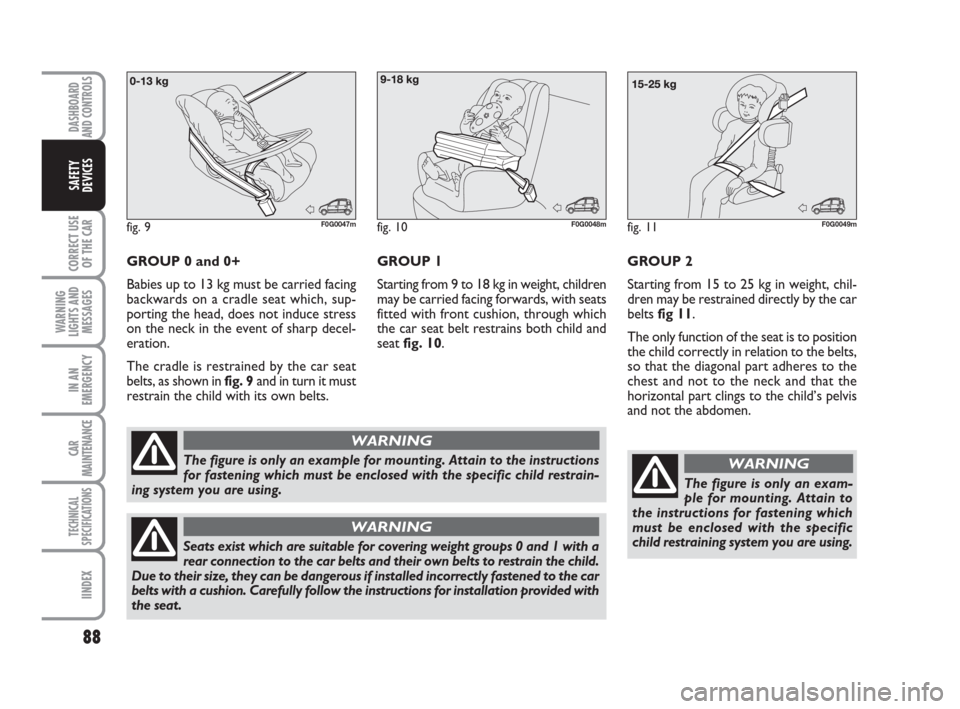
GROUP 2
Starting from 15 to 25 kg in weight, chil-
dren may be restrained directly by the car
belts fig 11.
The only function of the seat is to position
the child correctly in relation to the belts,
so that the diagonal part adheres to the
chest and not to the neck and that the
horizontal part clings to the child’s pelvis
and not the abdomen.
fig. 11F0G0049m
GROUP 1
Starting from 9 to 18 kg in weight, children
may be carried facing forwards, with seats
fitted with front cushion, through which
the car seat belt restrains both child and
seat fig. 10. GROUP 0 and 0+
Babies up to 13 kg must be carried facing
backwards on a cradle seat which, sup-
porting the head, does not induce stress
on the neck in the event of sharp decel-
eration.
The cradle is restrained by the car seat
belts, as shown in fig. 9and in turn it must
restrain the child with its own belts.
fig. 9F0G0047mfig. 10F0G0048m
The figure is only an example for mounting. Attain to the instructions
for fastening which must be enclosed with the specific child restrain-
ing system you are using.
WARNING
Seats exist which are suitable for covering weight groups 0 and 1 with a
rear connection to the car belts and their own belts to restrain the child.
Due to their size, they can be dangerous if installed incorrectly fastened to the car
belts with a cushion. Carefully follow the instructions for installation provided with
the seat.
WARNING
The figure is only an exam-
ple for mounting. Attain to
the instructions for fastening which
must be enclosed with the specific
child restraining system you are using.
WARNING
081-100 Panda New GB 21-06-2007 13:49 Pagina 88
Page 90 of 206
89
CORRECT USE
OF THE CAR
WARNING
LIGHTS AND
MESSAGES
IN AN
EMERGENCY
CAR
MAINTENANCE
TECHNICAL
SPECIFICATIONS
INDEX
DASHBOARD
AND CONTROLS
SAFETY
DEVICES
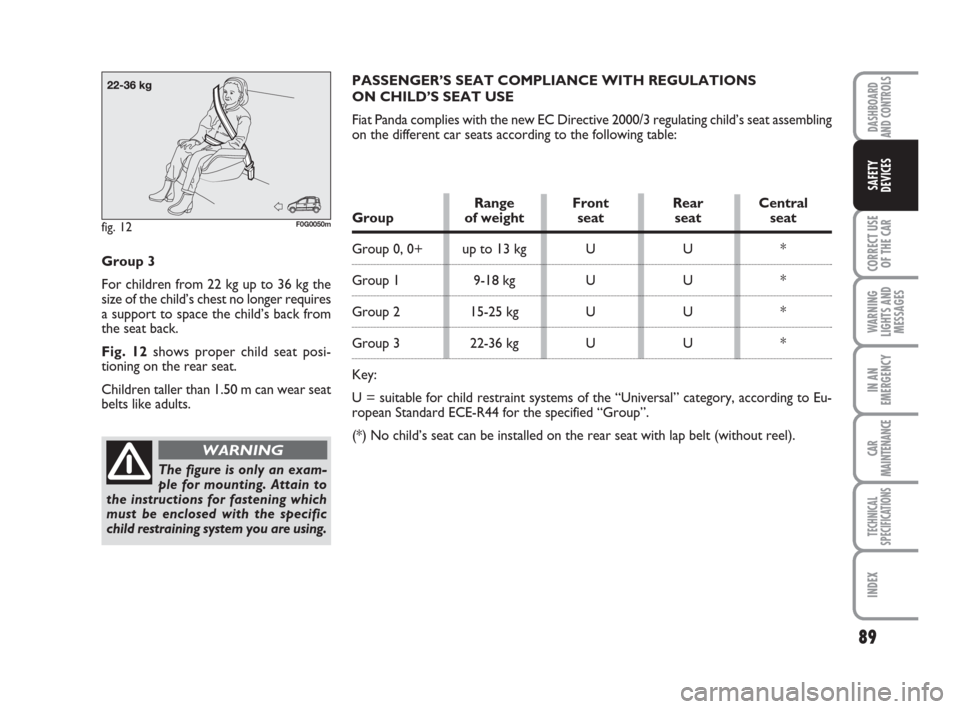
Group 3
For children from 22 kg up to 36 kg the
size of the child’s chest no longer requires
a support to space the child’s back from
the seat back.
Fig. 12shows proper child seat posi-
tioning on the rear seat.
Children taller than 1.50 m can wear seat
belts like adults.
fig. 12F0G0050m
The figure is only an exam-
ple for mounting. Attain to
the instructions for fastening which
must be enclosed with the specific
child restraining system you are using.
WARNING
PASSENGER’S SEAT COMPLIANCE WITH REGULATIONS
ON CHILD’S SEAT USE
Fiat Panda complies with the new EC Directive 2000/3 regulating child’s seat assembling
on the different car seats according to the following table:
Range Front Rear CentralGroup of weight seat seat seat
Group 0, 0+ up to 13 kg U U *
Group 1 9-18 kg U U *
Group 2 15-25 kg U U *
Group 3 22-36 kg U U *
Key:
U = suitable for child restraint systems of the “Universal” category, according to Eu-
ropean Standard ECE-R44 for the specified “Group”.
(*) No child’s seat can be installed on the rear seat with lap belt (without reel).
081-100 Panda New GB 21-06-2007 13:49 Pagina 89
Page 93 of 206
92
CORRECT USE
OF THE CAR
WARNING
LIGHTS AND
MESSAGES
IN AN
EMERGENCY
CAR
MAINTENANCE
TECHNICAL
SPECIFICATIONS
IINDEX
DASHBOARD
AND CONTROLS
SAFETY
DEVICES
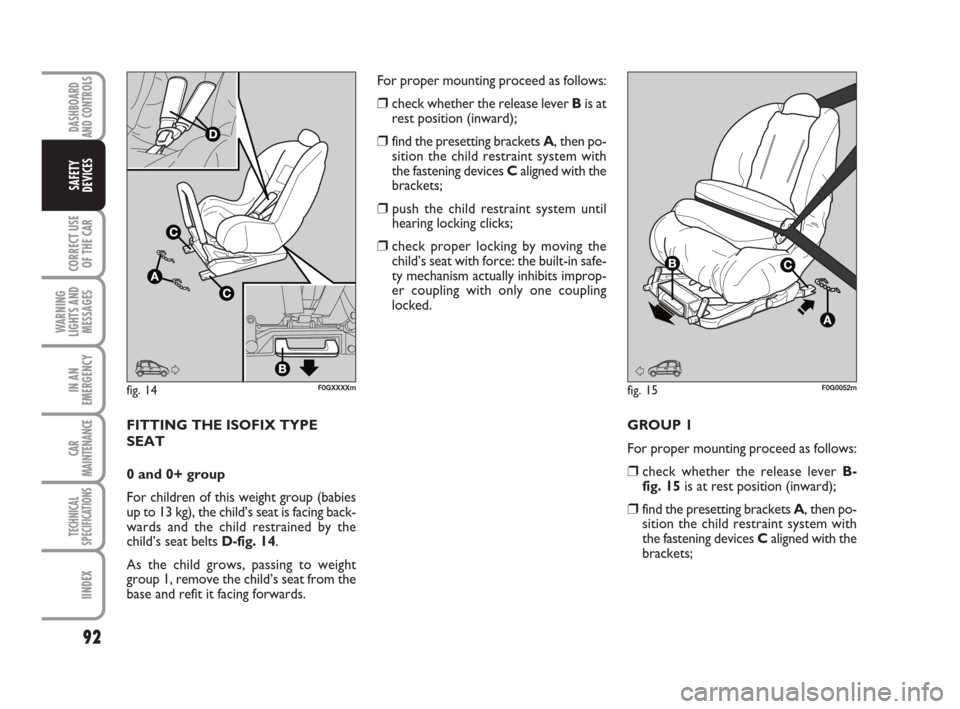
FITTING THE ISOFIX TYPE
SEAT
0 and 0+ group
For children of this weight group (babies
up to 13 kg), the child’s seat is facing back-
wards and the child restrained by the
child’s seat belts D-fig. 14.
As the child grows, passing to weight
group 1, remove the child’s seat from the
base and refit it facing forwards.For proper mounting proceed as follows:
❒check whether the release lever Bis at
rest position (inward);
❒find the presetting brackets A, then po-
sition the child restraint system with
the fastening devices Caligned with the
brackets;
❒ push the child restraint system until
hearing locking clicks;
❒check proper locking by moving the
child’s seat with force: the built-in safe-
ty mechanism actually inhibits improp-
er coupling with only one coupling
locked.
fig. 14F0GXXXXm
GROUP 1
For proper mounting proceed as follows:
❒check whether the release lever B-
fig. 15is at rest position (inward);
❒find the presetting brackets A, then po-
sition the child restraint system with
the fastening devices Caligned with the
brackets;
fig. 15F0G0052m
081-100 Panda New GB 21-06-2007 13:49 Pagina 92
Page 107 of 206
Accessories installed on
longitudinal bars
Remove accessories like: roof racks, ski
racks, luggage container, etc. from the roof
as soon as they are no longer used. These
accessories lower air penetration and ad-
versely affect consumption levels. When
needing to carry particularly voluminous
objects, preferably use a trailer.
Electric devices
Use electric devices only for the amount
of time needed. Rear heated window, ad-
ditional headlights, windscreen wipers and
heater fan need a considerable amount of
energy, therefore increasing the require-
ment of current increases fuel consump-
tion (up to +25% in the urban cycle).
Climate control
The air conditioner is an additional load
which greatly affects the engine leading to
higher consumption (on average up to
+20%). When the temperature outside
the car permits it, use the air vents where
possible.
Spoilers
The use of non-certified aerodynamic
items may adversely affect air drag and
consumption levels.DRIVING STYLE
Starting
Do not warm the engine with the car at
a standstill or at idle or high speed: under
these conditions the engine warms up
much more slowly, increasing electrical
consumption and emissions. It is therefore
advisable to move off immediately, slow-
ly, avoiding high speeds: this way the en-
gine will warm faster.
Unnecessary actions
Avoid accelerating when waiting at traffic
lights or before switching off the engine.
This and also double declutching is ab-
solutely pointless on modern cars and al-
so increases consumption and pollution.
Gear selection
As soon as the conditions of the traffic and
road allow, use a higher gear. Using a low
gear to obtain brilliant performance in-
creases consumption.
In the same way improper use of a high
gear increases consumption, emissions an
engine wear.CONTAINING
RUNNING COSTS
Some useful tips are given below for fuel
saving and reducing harmful emissions of
CO
2and other pollutants (nitrogen ox-
ides, unburnt hydrocarbons, Particulate
Matter (PM) etc.).
GENERAL CONSIDERATIONS
Car maintenance
Have checks and adjustments carried out
in accordance with the “Service schedule”.
Tyres
Check the pressure of the tyres routine-
ly at an interval of no more than 4 weeks:
if the pressure is too low, consumption
levels increase as resistance to rolling is
higher.
Unnecessary loads
Do not travel with too much luggage
stowed in the boot. The weight of the car
(especially when driving in town) and its
trim greatly affects consumption and sta-
bility.
106
WARNING
LIGHTS AND
MESSAGES
IN AN
EMERGENCY
CAR
MAINTENANCE
TECHNICAL
SPECIFICATIONS
INDEX
DASHBOARD
AND CONTROLS
SAFETY
DEVICES
CORRECT USE
OF THE CAR
101-112 Panda New GB 21-06-2007 13:50 Pagina 106
Page 108 of 206
CONDITIONS OF USE
Cold starting
Short journeys and frequent cold starts do
not allow the engine to reach optimum op-
erating temperature. This results in a sig-
nificant increase in consumption levels
(from +15 to +30% on the urban cycle)
and emission of harmful substances.
Traffic situations and road
conditions
Rather high consumption levels are tied to
situations with heavy traffic, for example
in queues with frequent use of the lower
gears or in cities with many traffic lights.
Also winding mountain roads and rough
road surfaces adversely affect consump-
tion.
Traffic hold-ups
During prolonged hold-ups (level crossings)
the engine should be switched off.TOWING TRAILERS
IMPORTANT NOTES
For towing caravans or trailers the car
must be fitted with a certified tow hook
and an adequate electric system. Installa-
tion should be carried out by specialised
personnel who release a special document
for circulation on the road.
Install any specific and/or additional rear-
view mirrors as specified by law.
Remember that when towing a trailer,
steep hills are harder to climb, the brak-
ing spaces increase and overtaking takes
longer depending on the overall weight.
Engage a low gear when driving downhill,
rather than constantly using the brake.
The weight the trailer exerts on the car
tow hook reduces by the same amount
the actual car loading capacity. To make
sure the maximum towable weight is not
exceeded (given in the log book) account
should be taken of the fully laden trailer,
including accessories and personal be-
longings. Top speed
Fuel consumption considerably increases
with speed. Avoid superfluous braking and
accelerating, which cost in terms of both
fuel and emissions.
Acceleration
Accelerating violently increasing the revs
will greatly affect consumption and emis-
sions: acceleration should be gradual.
107
WARNING
LIGHTS AND
MESSAGES
IN AN
EMERGENCY
CAR
MAINTENANCE
TECHNICAL
SPECIFICATIONS
INDEX
DASHBOARD
AND CONTROLS
SAFETY
DEVICES
CORRECT USE
OF THE CAR
101-112 Panda New GB 21-06-2007 13:50 Pagina 107
Page 109 of 206
INSTALLING THE TOW HOOK
The towing device should be fastened to
the body by specialised personnel accord-
ing to any additional and/or integrative in-
formation supplied by the Manufacturer of
the device.
The towing device must meet current reg-
ulations with reference to 94/20/CEE Di-
rective and subsequent amendments.
For any version the towing device used
must match the towable weight of the car
on which it is to be installed.
For the electric connection a unified con-
nector should be used which is generally
placed on a special bracket normally fas-
tened to the towing device, and a special
ECU for external trailer light control shall
be installed on the car.
For the electric connection, a 7 pin
12VDC connection is to be used (CU-
NA/UNI and ISO/DIN Standards). Follow
the instructions provided by the car man-
ufacturer and/or the tow hitch manufac-
turer.An electric brake should be supplied di-
rectly by the battery through a cable with
a cross section of no less than 2.5 mm
2.
IMPORTANT Electric brake or other de-
vice shall be used with running engine.
In addition to the electrical branches, the
car electric system can only be connect-
ed to the supply cable for an electric brake
and to the cable for an internal light,
though not above 15W.
For connections use a preset control unit
with battery cable no less than 2.5 mm
2. Do not exceed the speed limits of the
country you are driving in. In any case do
not exceed 100 km/h.
108
WARNING
LIGHTS AND
MESSAGES
IN AN
EMERGENCY
CAR
MAINTENANCE
TECHNICAL
SPECIFICATIONS
INDEX
DASHBOARD
AND CONTROLS
SAFETY
DEVICES
CORRECT USE
OF THE CAR
The ABS system with which
the car may be fitted does
not control the trailer braking system.
Therefore be cautious on slippery
roads.
WARNING
Under no circumstances
should the car brake system
be altered to control the trailer brake.
The trailer braking system must be
fully independent of the car’s hy-
draulic system.
WARNING
101-112 Panda New GB 21-06-2007 13:50 Pagina 108
Page 128 of 206
127
WARNING
LIGHTS AND
MESSAGES
CAR
MAINTENANCE
TECHNICAL
SPECIFICATIONS
INDEX
DASHBOARD
AND CONTROLS
SAFETY
DEVICES
CORRECT USE
OF THE CAR
IN AN
EMERGENCY
Alert other drivers that the
car is stationary in compli-
ance with local regulations: hazard
warning lights, warning triangle, etc.
Any passengers on board should leave
the car, especially if it is heavily laden.
Passengers should stay away from on-
coming traffic while the wheel is be-
ing changed. If parked on a slope or
rough surface, chock the wheels with
wedges or other suitable devices.
WARNING
When driving with a space-
saver spare wheel fitted, the
driving performance of the car
changes. Avoid accelerating or brak-
ing sharply, abrupt turns of fast cor-
nerings. The life of a spare wheel is
approx. 3000 km, after this distance
it should be replaced with another of
the same type. Never attempt to fit
a conventional tyre on a rim designed
for use as a space-saver spare wheel.
Have the punctured wheel repaired
and refitted as soon as possible. Two
or more space-saver spare wheels
should never be used together. Do not
grease the threads of bolts before in-
stalling them: they might slip out.
WARNING
The jack shall only be used
for changing wheels on the
car with which it is provided or on
cars of the same model. It must not
be used for other purposes such as for
instance raising cars of other models.
In no case should it be used for repairs
under the car. Incorrect positioning
of the jack may cause the jacked car
to fall. Do not use the jack for high-
er capacities than stated on its label.
Snow chains cannot be fitted to the
space-saver spare wheel. So, if a front
(drive) wheel is punctured and chains
are needed, a rear wheel should be
fitted to the front of the car and the
spare wheel should be fitted to the
rear. This way with two normal dri-
ve wheels, snow chains can be fitted
to them to solve an emergency.
WARNING
Fasten the wheel cap cor-
rectly to prevent the wheel
from coming free in motion. Never
tamper with the inflation valve. Nev-
er place tools between the rim and
tyre. Check and restore, if required,
the pressure of tyres and spare wheel
to the values given in section “Tech-
nical specifications”.
WARNING
Please note:
❒ the jack weight is 1,76 kg;
❒the jack requires no adjustment;
❒the jack cannot be repaired and in the
event of a fault it must be replaced by
another original one;
❒no tool other than its cranking device
may be fitted on the jack.
123-154 Panda New GB 21-06-2007 13:51 Pagina 127