ABS FIAT PANDA 2014 319 / 3.G User Guide
[x] Cancel search | Manufacturer: FIAT, Model Year: 2014, Model line: PANDA, Model: FIAT PANDA 2014 319 / 3.GPages: 284, PDF Size: 11.54 MB
Page 93 of 284
For correct operation, sensors must always
be clean from mud, dirt , snow or ice. Be
careful not to scratch or damage the
sensors while cleaning them. Avoid using dr y,
rough or hard cloths.The sensors should be
washed using clean water with the addition of car
shampoo if necessary.When using special
washing equipment such as high pressure jets or
steam cleaning, clean the sensors very quickly
keeping the jet more than 10 cm away.
GENERAL WARNINGS
❒When parking, take the utmost care over
obstacles that may be above or under the sensors.
❒Objects close to the car, are not detected under
certain circumstances and could therefore cause
damage to the car or be damaged.
Some of the conditions that could affect the
performance of the parking system are described
below:
❒Reduced sensor sensitivity and a reduction in the
parking assistance system performance could be
due to the presence on the surface of the sensor
of: ice, snow, mud, thick paint
❒The sensor may detect a non-existent obstacle
(echo interference) due to mechanical
interference, for example when washing the
vehicle, in rain, (strong wind), hail.❒The signals sent by the sensors can also be altered
by the presence of ultrasonic systems (e.g.
pneumatic brake systems or pneumatic drills) near
the vehicle.
❒Parking assistance system performance can also be
influenced by the position of the sensors, for
example due to a change in the ride setting
(caused by wear to the shock absorbers,
suspension), or by changing tyres, overloading the
car or carrying out specific tuning operations
that require the car to be lowered.
❒The presence of a tow hook without trailer
interferes with the correct operation of the
parking sensors. If a fixed tow hook is installed, the
sensors cannot be used. If the customer installs a
removable tow hook, this must always be
disconnected from the crossmember whenever
the trailer is not attached to prevent the activation
of the sensors.
WARNING
The responsibility for parking and other
dangerous manoeuvres always and in
every case lies with the driver.When making
these manoeuvres, always make sure that no
people (especially children) or animals are
present in your manoeuvering space.The parking
sensors serve to assist the driver, but must never
allow his attention to lapse during potentially
dangerous manoeuvres, even those executed at
low speeds.
89GETTING TO
KNOW YOUR CARSAFETY
STARTING AND
DRIVING
WARNING LIGHTS
AND MESSAGES
IN AN EMERGENCY
SERVICING AND
MAINTENANCE
TECHNICAL
SPECIFICATIONS
INDEX
Page 94 of 284
DUALDRIVE ELECTRIC POWER
STEERINGThis only operates with the key turned to MAR and
the engine started. The steering allows the force
required at the steering wheel to be adjusted to suit
driving conditions.
IMPORTANT When turning the ignition key quickly,
full power steering functionality can be achieved after
a few seconds.
CITY FUNCTION ACTIVATION/
DEACTIVATION
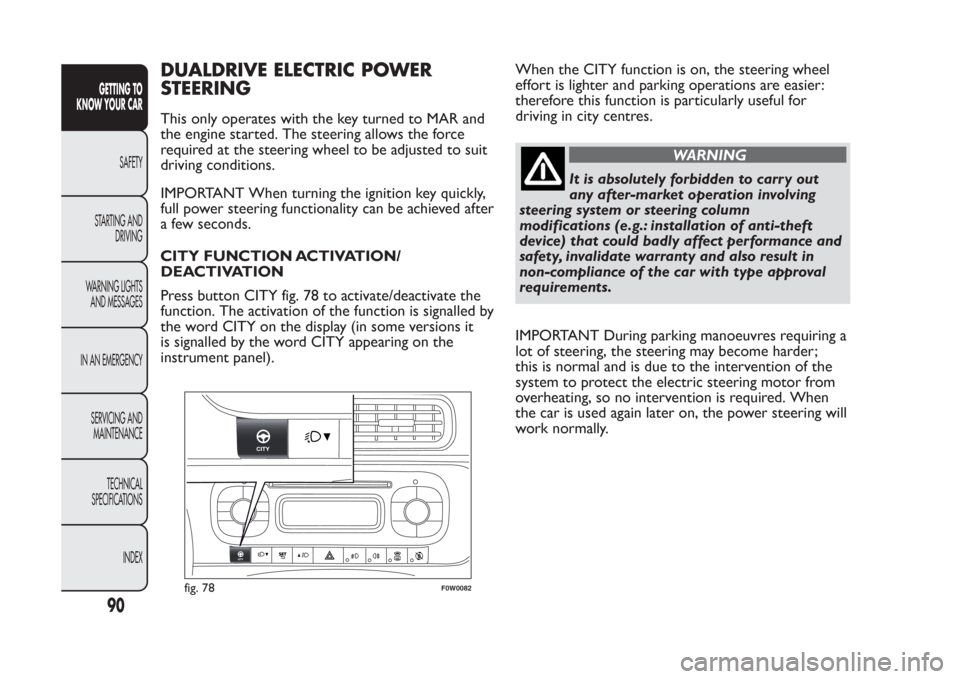
Press button CITY fig. 78 to activate/deactivate the
function. The activation of the function is signalled by
the word CITY on the display (in some versions it
is signalled by the word CITY appearing on the
instrument panel).When the CITY function is on, the steering wheel
effort is lighter and parking operations are easier:
therefore this function is particularly useful for
driving in city centres.
WARNING
It is absolutely forbidden to carr y out
any after-market operation involving
steering system or steering column
modifications (e.g.: installation of anti-theft
device) that could badly affect performance and
safety, invalidate warranty and also result in
non-compliance of the car with type approval
requirements.
IMPORTANT During parking manoeuvres requiring a
lot of steering, the steering may become harder;
this is normal and is due to the intervention of the
system to protect the electric steering motor from
overheating, so no intervention is required. When
the car is used again later on, the power steering will
work normally.
fig. 78
F0W0082
90GETTING TO
KNOW YOUR CAR
SAFETY
STARTING AND
DRIVING
WARNING LIGHTS
AND MESSAGES
IN AN EMERGENCY
SERVICING AND
MAINTENANCE
TECHNICAL
SPECIFICATIONS
INDEX
Page 95 of 284
WARNING
Before starting any servicing operation,
stop the engine and remove the key
from the ignition switch to operate the steering
lock, particularly when the wheels do not touch
the ground. If this is not possible (for example
if the key needs to be turned to MAR or the
engine must be running), remove the main fuse
that protects the electric power steering.
WIRING FOR RADIO SYSTEM(for versions/markets, where provided)
If no car radio was requested at the time of
purchase, the car is provided with a compartment on
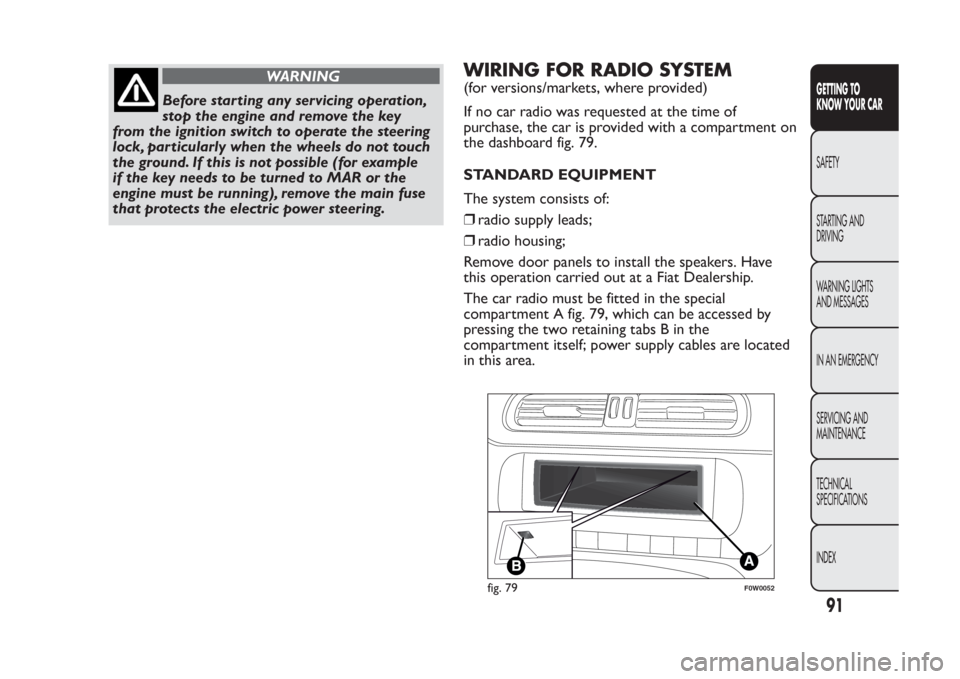
the dashboard fig. 79.
STANDARD EQUIPMENT
The system consists of:
❒radio supply leads;
❒radio housing;
Remove door panels to install the speakers. Have
this operation carried out at a Fiat Dealership.
The car radio must be fitted in the special
compartment A fig. 79, which can be accessed by
pressing the two retaining tabs B in the
compartment itself; power supply cables are located
in this area.
fig. 79
F0W0052
91GETTING TO
KNOW YOUR CARSAFETY
STARTING AND
DRIVING
WARNING LIGHTS
AND MESSAGES
IN AN EMERGENCY
SERVICING AND
MAINTENANCE
TECHNICAL
SPECIFICATIONS
INDEX
Page 127 of 284
When the engine is switched off never
leave the key turned to MAR-ON to
prevent useless current absorption from
draining the battery.Never jump start the engine by pushing,
towing or coasting downhill.This could
cause fuel to flow into the catalytic
conver ter and damage it beyond repair.
WARMING UP THE ENGINE JUST AFTER IT
HAS STARTED
Proceed as follows:
❒drive off slowly, letting the engine turn at medium
revs. Do not accelerate abruptly;
❒do not demand full performance at first. Wait until
the second bar on the engine coolant temperature
gauge switches on.STOPPING THE ENGINE
Turn the ignition key to STOP while the engine is
idling.
IMPORTANT After a demanding drive, before
turning the engine off you should allow it to idle to
allow the temperature in the engine compartment to
decrease.
A quick burst on the accelerator before
turning off the engine serves absolutely no
practical purpose, it wastes fuel and is
especially damaging to turbocharged engines.
123GETTING TO KNOW
YOUR CAR
SAFETYSTARTING AND
DRIVINGWARNING LIGHTS
AND MESSAGES
IN AN EMERGENCY
SERVICING AND
MAINTENANCE
TECHNICAL
SPECIFICATIONS
INDEX
Page 131 of 284
Unnecessary actions
Avoid revving up when at traffic lights or before
switching off the engine. This action and also double
declutching is absolutely pointless on modern cars
and also increases consumption and pollution.
Gear selection
Use a higher gear as soon as traffic and road
conditions allow. Using a low gear for faster
acceleration will increase consumption.
In the same way improper use of a high gear
increases consumption, emissions and engine wear.
Maximum speed
Fuel consumption increases considerably with speed.
Maintain a constant speed, avoiding unnecessary
braking and acceleration, which cost in terms of both
fuel and emissions.
Acceleration
Sudden acceleration has a very negative effect on fuel
consumption and emissions: accelerate gradually.CONDITIONS OF USE
Cold starting
Short distances and frequent cold start-ups will
prevent the engine from reaching optimal running
temperature.
Consequently, both consumption (from +15 to +30%
on urban cycle ) and emissions will increase.
Traffic and road conditions
Rather high fuel consumption is caused by heavy
traffic, for instance when travelling in a queue with
frequent use of low gears or in large towns with
many traffic lights. Winding mountain roads and
rough road surfaces also adversely affect
consumption.
Stops in traffic
During prolonged stops (e.g. level crossings) the
engine should be switched off.
127GETTING TO KNOW
YOUR CAR
SAFETYSTARTING AND
DRIVINGWARNING LIGHTS
AND MESSAGES
IN AN EMERGENCY
SERVICING AND
MAINTENANCE
TECHNICAL
SPECIFICATIONS
INDEX
Page 132 of 284
TOWING TRAILERSIMPORTANT NOTES
For towing caravans or trailers the car must be fitted
with a type-approved tow hook and an adequate
electrical system. Installation must be carried out by
a specialist.
Fit any specific and/or additional rear view mirrors as
specified by the Highway Code.
Remember that when towing a trailer, steep hills are
harder to climb, braking distances increase and
overtaking takes longer depending on the overall
weight of the trail.
Engage a low gear when driving downhill, rather than
constantly using the brake.
The weight of the trailer on the car's tow hook will
reduce the load capacity of the car by the same
amount. To make sure that the maximum towable
weight is not exceeded (given in the car registration
document) account should be taken of the fully
laden trailer, including accessories and luggage.
Respect the speed limits specific to each country for
vehicles towing trailers. In any case, the maximum
speed must not exceed 100 km/h.
An electric brake or winch must be powered directly
by the battery through a cable with a cross-section
of no less than 2.5 mm
2.In addition to the electrical branches, the vehicle's
electrical system can be connected only to the supply
cable for an electric brake and to the cable for an
internal trailer light, though not more than 15 W. For
connections, use the preset control unit with a
battery cable with section no less than 2.5 mm
2.
IMPORTANT The use of auxiliary loads other than
external lights (electric brake, winch, etc.) must
be used with engine running.
IMPORTANT To install a tow hook contact a Fiat
Dealership.
WARNING
The ABS with which the car may be
equipped will not control the braking
system of the trailer. Particular caution is
required on slippery roads.
WARNING
Never modify the braking system of the
car to control the trailer brake.The
trailer braking system must be fully
independent of the car ’s hydraulic system.
128
GETTING TO KNOW
YOUR CAR
SAFETYSTARTING AND
DRIVINGWARNING LIGHTS
AND MESSAGES
IN AN EMERGENCY
SERVICING AND
MAINTENANCE
TECHNICAL
SPECIFICATIONS
INDEX
Page 137 of 284
IMPORTANT If the warning light comes on when the
vehicle is in motion, check that the handbrake is
not engaged.
EBD FAILURE (red)
(amber)
The simultaneous switching on of the
(red),
(amber) and
(amber) warning lights with the
engine on, indicates either a failure of the EBD
system or that the system is not available. In this
case, the rear wheels may suddenly lock and the
vehicle may swerve when braking sharply. Drive very
carefully to the nearest Fiat Dealership to have the
system inspected immediately. On some versions the
display shows the dedicated message.
ABS FAILURE (amber)
Turning the key to MAR switches on the warning
light, but it should switch off after a few seconds.
The warning light switches on (on some versions,
with a message on the display and a symbol on
the display) when the system is not efficient. In this
case the braking system maintains its own efficiency
unaltered but without the advantage of the ABS
system. Drive carefully and contact a Fiat Dealership
as soon as possible.
AIRBAG FAILURE (red)
Turning the key to MAR switches on the warning
light, but it should switch off after a few seconds.
The warning light switches on constantly (on some
versions, with a message on the display and a symbol
on the display) to indicate an airbag system fault.
WARNING
If, when turning the key to MAR, the
warning light
does not switch on or
stays on whilst driving, a fault may be present in
the restraint systems. In this case the airbags
or pretensioners may not be deployed in an
impact or, in a lower number of cases, they may
be deployed accidentally. Before continuing,
contact a Fiat Dealership immediately to have
the system checked.
133GETTING TO KNOW
YOUR CAR
SAFETY
STARTING AND
DRIVINGWARNING LIGHTS
AND MESSAGESIN AN EMERGENCY
SERVICING AND
MAINTENANCE
TECHNICAL
SPECIFICATIONS
INDEX
Page 158 of 284
CHANGING A BULBGENERAL INSTRUCTIONS
❒Before changing a bulb check the contacts for
oxidation;
❒burnt bulbs must be replaced by others of the
same type and power;
❒after replacing a headlight bulb, always check its
alignment;
❒when a light is not working, check that the
corresponding fuse is intact before changing a bulb.
For the location of fuses, refer to the paragraph
“If a fuse blows” in this section;
WARNING
Modifications or repairs to the electric
system that are not carried out properly
or do not take the system technical
specifications into account can cause
malfunctions leading to the risk of fire.
WARNING
Halogen bulbs contain pressurised gas,
in the case of breakage they may burst
causing glass fragments to be projected
outwards.
Halogen bulbs must be handled holding
the metal part only.Touching the
transparent part of the bulb with your
fingers may reduce the intensity of the emitted
light and even reduce the lifespan of the bulb. In
case of accidental contact , wipe the bulb with
a cloth moistened with alcohol and let the bulb
dry.Where possible, it is advisable to have
bulbs changed at a Fiat Dealership.The
correct operation and direction of the
external lights are absolutely essential for the
safety of the car and of compliance with the law.
IMPORTANT When the weather is cold or damp
or after heavy rain or washing, the surface of
headlights or rear lights, may steam up and/or form
drops of condensation on the inside. This is a natural
phenomenon due to the difference in temperature
and humidity between the inside and the outside
of the glass which does not indicate a fault and does
not compromise the normal operation of lighting
devices. The mist disappears quickly when the lights
are turned on, starting from the centre of the
diffuser, extending progressively towards the edges.
154
GETTING TO KNOW
YOUR CAR
SAFETY
STARTING AND
DRIVING
WARNING LIGHTS
AND MESSAGES
IN AN
EMERGENCY
SERVICING AND
MAINTENANCE
TECHNICAL
SPECIFICATIONS
INDEX
Page 165 of 284
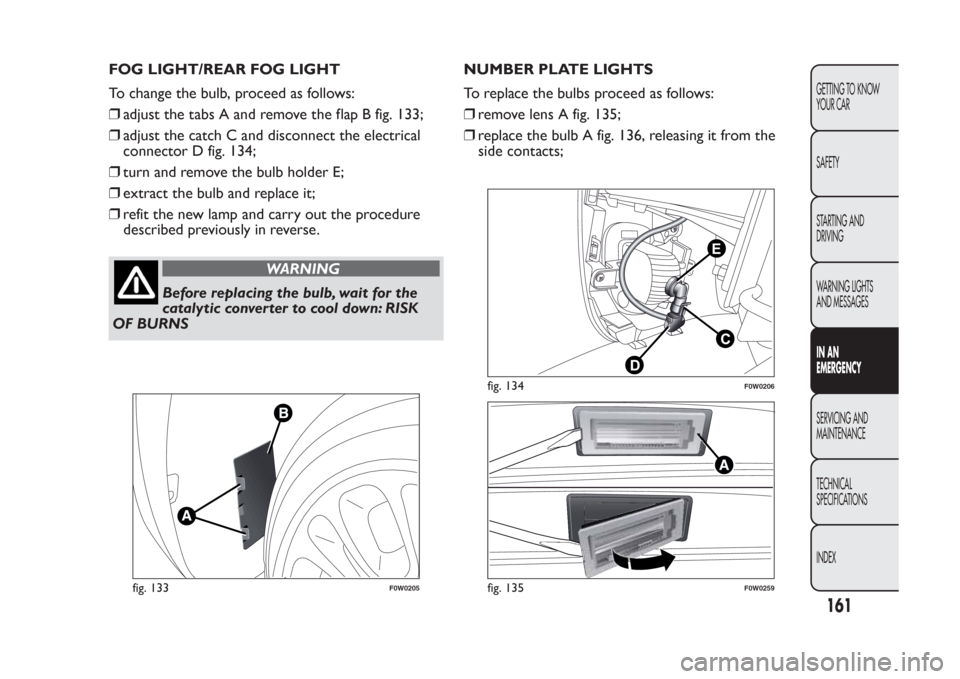
FOG LIGHT/REAR FOG LIGHT
To change the bulb, proceed as follows:
❒adjust the tabs A and remove the flap B fig. 133;
❒adjust the catch C and disconnect the electrical
connector D fig. 134;
❒turn and remove the bulb holder E;
❒extract the bulb and replace it;
❒refit the new lamp and carry out the procedure
described previously in reverse.
WARNING
Before replacing the bulb, wait for the
catalytic conver ter to cool down: RISK
OF BURNSNUMBER PLATE LIGHTS
To replace the bulbs proceed as follows:
❒remove lens A fig. 135;
❒replace the bulb A fig. 136, releasing it from the
side contacts;
fig. 133
F0W0205
fig. 134
F0W0206
fig. 135
F0W0259
161GETTING TO KNOW
YOUR CAR
SAFETY
STARTING AND
DRIVING
WARNING LIGHTS
AND MESSAGESIN AN
EMERGENCYSERVICING AND
MAINTENANCE
TECHNICAL
SPECIFICATIONS
INDEX
Page 192 of 284
PARAFLU
UP
anti-freeze is used in the
engine cooling system. Use the same fluid
as in the cooling system when topping
up. PARAFLU
UP
cannot be mixed with any other
type of fluid. If this happens, do not start the
engine and contact a Fiat Dealership.
WARNING
The cooling system is pressurised. If
necessary, only replace the cap with
another genuine one or the operation of the
system may be adversely affected. Do not
remove the reservoir cap when the engine is
hot : you risk scalding yourself.
WINDSCREEN/REAR WINDOW WASHING
FLUID
If the level is too low, raise reservoir cap D (see
previous pages) and add the fluid described in the
chapter "Technical Specifications".
WARNING
Do not travel if the windscreen washer
reservoir is empty: using the windscreen
washer is essential for improving visibility. Some
commercial windscreen washer additives are
flammable.The engine compartment contains
hot components which may set it on fire.BRAKE FLUID
Check that the liquid is at the maximum level (the
fluid level in the reservoir must not exceed the MAX
mark). If the fluid level in the tank is too low, undo
reservoir cap E (see previous pages) and add the fluid
described in the chapter "Technical Specifications".
NoteCarefully clean the cap of the reservoir E and
the surrounding surface.
When opening the cap, make sure that no dirt gets
into the reservoir.
For topping-up, always use a funnel with integrated
filter with mesh equal to or lower than 0.12 mm.
IMPORTANT Brake fluid is hygroscopic (i.e. it
absorbs moisture). For this reason, if the car is
mainly used in areas with a high degree of
atmospheric humidity, the fluid should be replaced at
more frequent intervals than specified in the
“Scheduled Servicing Plan”.
Prevent brake fluid, which is highly
corrosive, from coming into contact with
painted parts. Should it happen,
immediately wash with water.
188
GETTING TO KNOW
YOUR CAR
SAFETY
STARTING AND
DRIVING
WARNING LIGHTS
AND MESSAGES
IN AN EMERGENCYSERVICING AND
MAINTENANCE
TECHNICAL
SPECIFICATIONS
INDEX