ESP FIAT PANDA 2014 319 / 3.G User Guide
[x] Cancel search | Manufacturer: FIAT, Model Year: 2014, Model line: PANDA, Model: FIAT PANDA 2014 319 / 3.GPages: 284, PDF Size: 11.54 MB
Page 83 of 284
START&STOP SYSTEM(for versions/markets, where provided)
INTRODUCTION
The Start&Stop system automatically stops the
engine when the car is stationary and starts it again
when the driver wants to move off. This reduces
consumption, the emission of harmful gases and
noise pollution.
OPERATING MODES
Engine stopping mode
With the car stopped, the engine stops with gearbox
in neutral and clutch pedal released.
Restarting the engine
Press the clutch pedal to restart the engine.
NoteThe engine can only be stopped automatically
after driving at a speed of more than about 10 km/h,
to prevent the engine from being repeatedly stopped
when driving at walking pace.
The symbol
appears on the display when the
engine stops.
MANUAL SYSTEM ACTIVATION/
DEACTIVATION
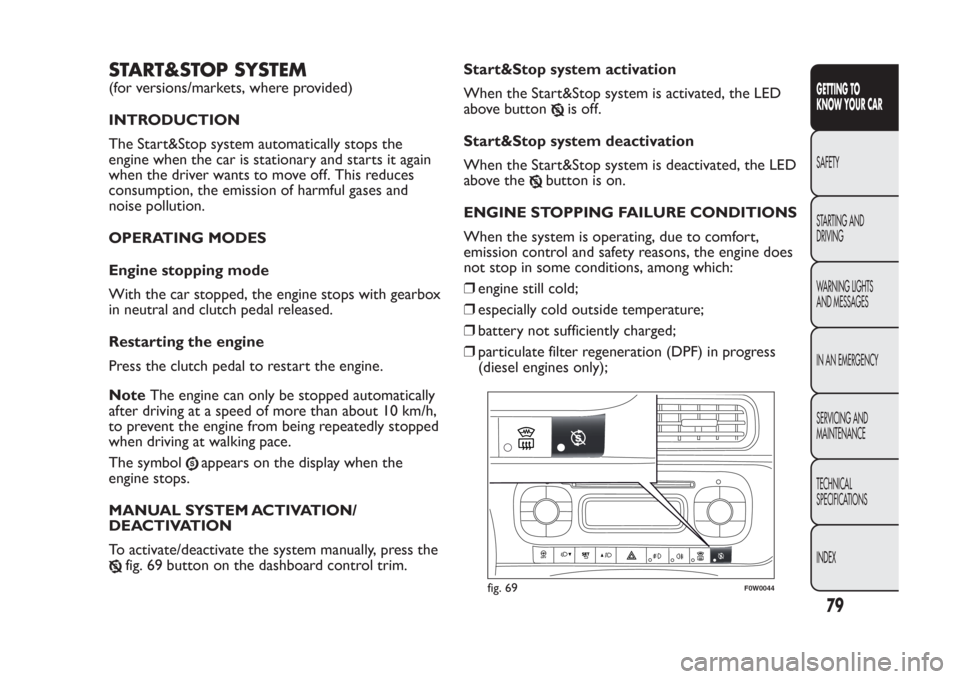
To activate/deactivate the system manually, press the
fig. 69 button on the dashboard control trim.Start&Stop system activation
When the Start&Stop system is activated, the LED
above button
is off.
Start&Stop system deactivation
When the Start&Stop system is deactivated, the LED
above the
button is on.
ENGINE STOPPING FAILURE CONDITIONS
When the system is operating, due to comfort,
emission control and safety reasons, the engine does
not stop in some conditions, among which:
❒engine still cold;
❒especially cold outside temperature;
❒battery not sufficiently charged;
❒particulate filter regeneration (DPF) in progress
(diesel engines only);
fig. 69
F0W0044
79GETTING TO
KNOW YOUR CARSAFETY
STARTING AND
DRIVING
WARNING LIGHTS
AND MESSAGES
IN AN EMERGENCY
SERVICING AND
MAINTENANCE
TECHNICAL
SPECIFICATIONS
INDEX
Page 89 of 284
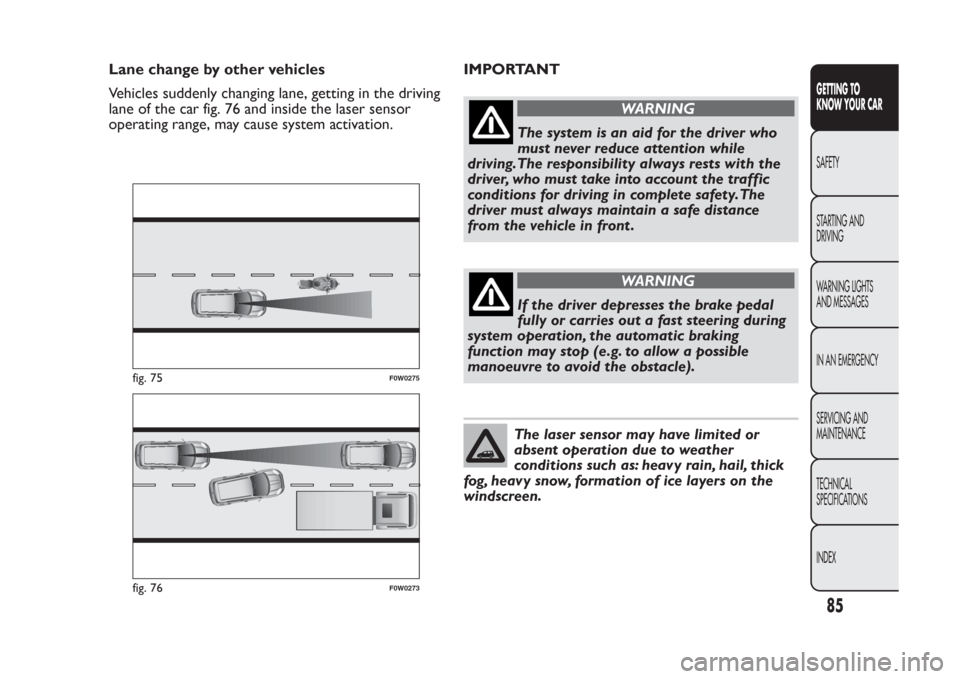
Lane change by other vehicles
Vehicles suddenly changing lane, getting in the driving
lane of the car fig. 76 and inside the laser sensor
operating range, may cause system activation.IMPORTANT
WARNING
The system is an aid for the driver who
must never reduce attention while
driving.The responsibility always rests with the
driver, who must take into account the traffic
conditions for driving in complete safety.The
driver must always maintain a safe distance
from the vehicle in front .
WARNING
If the driver depresses the brake pedal
fully or carries out a fast steering during
system operation, the automatic braking
function may stop (e.g. to allow a possible
manoeuvre to avoid the obstacle).The laser sensor may have limited or
absent operation due to weather
conditions such as: heavy rain, hail, thick
fog, heavy snow, formation of ice layers on the
windscreen.
fig. 75
F0W0275
fig. 76
F0W0273
85GETTING TO
KNOW YOUR CARSAFETY
STARTING AND
DRIVING
WARNING LIGHTS
AND MESSAGES
IN AN EMERGENCY
SERVICING AND
MAINTENANCE
TECHNICAL
SPECIFICATIONS
INDEX
Page 93 of 284
For correct operation, sensors must always
be clean from mud, dirt , snow or ice. Be
careful not to scratch or damage the
sensors while cleaning them. Avoid using dr y,
rough or hard cloths.The sensors should be
washed using clean water with the addition of car
shampoo if necessary.When using special
washing equipment such as high pressure jets or
steam cleaning, clean the sensors very quickly
keeping the jet more than 10 cm away.
GENERAL WARNINGS
❒When parking, take the utmost care over
obstacles that may be above or under the sensors.
❒Objects close to the car, are not detected under
certain circumstances and could therefore cause
damage to the car or be damaged.
Some of the conditions that could affect the
performance of the parking system are described
below:
❒Reduced sensor sensitivity and a reduction in the
parking assistance system performance could be
due to the presence on the surface of the sensor
of: ice, snow, mud, thick paint
❒The sensor may detect a non-existent obstacle
(echo interference) due to mechanical
interference, for example when washing the
vehicle, in rain, (strong wind), hail.❒The signals sent by the sensors can also be altered
by the presence of ultrasonic systems (e.g.
pneumatic brake systems or pneumatic drills) near
the vehicle.
❒Parking assistance system performance can also be
influenced by the position of the sensors, for
example due to a change in the ride setting
(caused by wear to the shock absorbers,
suspension), or by changing tyres, overloading the
car or carrying out specific tuning operations
that require the car to be lowered.
❒The presence of a tow hook without trailer
interferes with the correct operation of the
parking sensors. If a fixed tow hook is installed, the
sensors cannot be used. If the customer installs a
removable tow hook, this must always be
disconnected from the crossmember whenever
the trailer is not attached to prevent the activation
of the sensors.
WARNING
The responsibility for parking and other
dangerous manoeuvres always and in
every case lies with the driver.When making
these manoeuvres, always make sure that no
people (especially children) or animals are
present in your manoeuvering space.The parking
sensors serve to assist the driver, but must never
allow his attention to lapse during potentially
dangerous manoeuvres, even those executed at
low speeds.
89GETTING TO
KNOW YOUR CARSAFETY
STARTING AND
DRIVING
WARNING LIGHTS
AND MESSAGES
IN AN EMERGENCY
SERVICING AND
MAINTENANCE
TECHNICAL
SPECIFICATIONS
INDEX
Page 104 of 284
WARNING
Remember that in the event of a violent
collision, back seat passengers not
wearing seat belts also represent a serious
danger for the front seat passengers.
IMPORTANT When putting the back seats back to
their normal position, make sure the seat belts
are positioned so they are ready to use.
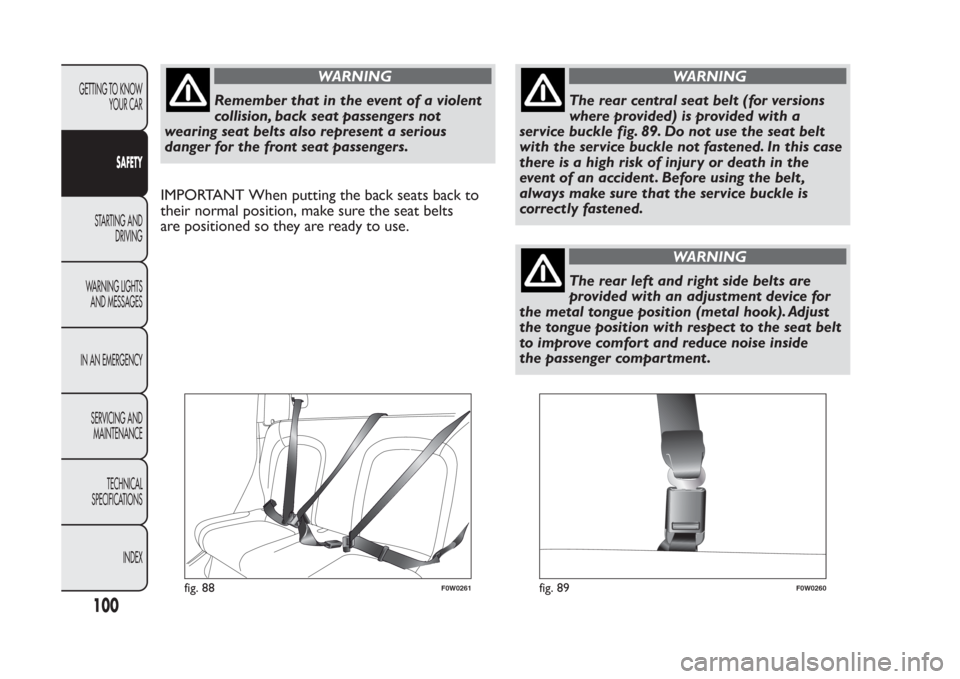
WARNING
The rear central seat belt (for versions
where provided) is provided with a
service buckle fig. 89. Do not use the seat belt
with the service buckle not fastened. In this case
there is a high risk of injury or death in the
event of an accident . Before using the belt ,
always make sure that the service buckle is
correctly fastened.
WARNING
The rear left and right side belts are
provided with an adjustment device for
the metal tongue position (metal hook). Adjust
the tongue position with respect to the seat belt
to improve comfor t and reduce noise inside
the passenger compar tment .
fig. 88
F0W0261
fig. 89
F0W0260
100
GETTING TO KNOW
YOUR CAR
SAFETY
STARTING AND
DRIVING
WARNING LIGHTS
AND MESSAGES
IN AN EMERGENCY
SERVICING AND
MAINTENANCE
TECHNICAL
SPECIFICATIONS
INDEX
Page 107 of 284
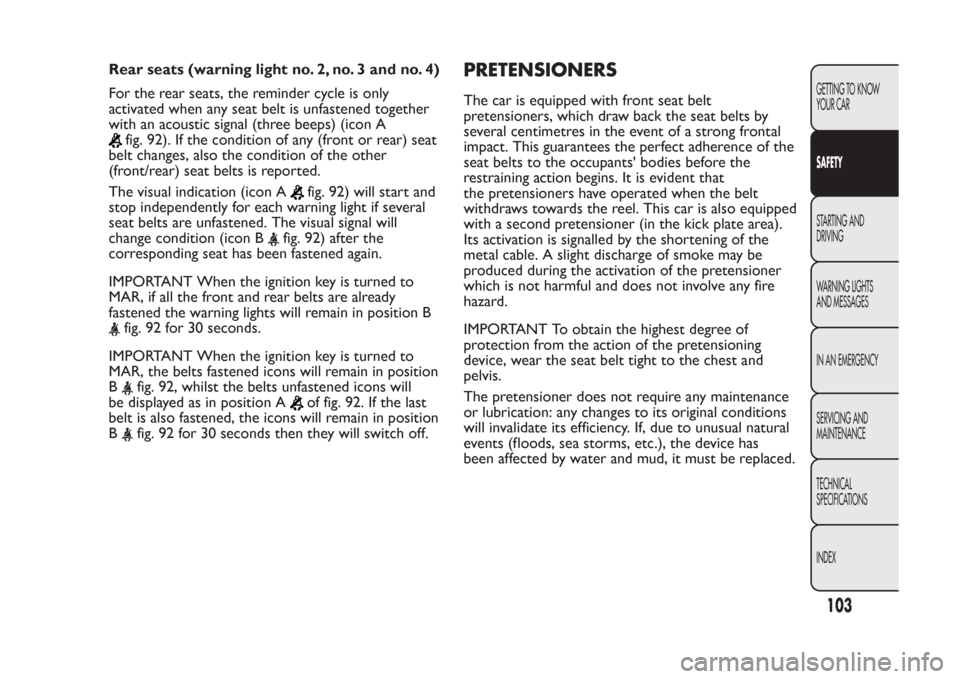
Rear seats (warning light no. 2, no. 3 and no. 4)
For the rear seats, the reminder cycle is only
activated when any seat belt is unfastened together
with an acoustic signal (three beeps) (icon A
fig. 92). If the condition of any (front or rear) seat
belt changes, also the condition of the other
(front/rear) seat belts is reported.
The visual indication (icon A
fig. 92) will start and
stop independently for each warning light if several
seat belts are unfastened. The visual signal will
change condition (icon B
fig. 92) after the
corresponding seat has been fastened again.
IMPORTANT When the ignition key is turned to
MAR, if all the front and rear belts are already
fastened the warning lights will remain in position B
fig. 92 for 30 seconds.
IMPORTANT When the ignition key is turned to
MAR, the belts fastened icons will remain in position
B
fig. 92, whilst the belts unfastened icons will
be displayed as in position A
of fig. 92. If the last
belt is also fastened, the icons will remain in position
B
fig. 92 for 30 seconds then they will switch off.
PRETENSIONERSThe car is equipped with front seat belt
pretensioners, which draw back the seat belts by
several centimetres in the event of a strong frontal
impact. This guarantees the perfect adherence of the
seat belts to the occupants' bodies before the
restraining action begins. It is evident that
the pretensioners have operated when the belt
withdraws towards the reel. This car is also equipped
with a second pretensioner (in the kick plate area).
Its activation is signalled by the shortening of the
metal cable. A slight discharge of smoke may be
produced during the activation of the pretensioner
which is not harmful and does not involve any fire
hazard.
IMPORTANT To obtain the highest degree of
protection from the action of the pretensioning
device, wear the seat belt tight to the chest and
pelvis.
The pretensioner does not require any maintenance
or lubrication: any changes to its original conditions
will invalidate its efficiency. If, due to unusual natural
events (floods, sea storms, etc.), the device has
been affected by water and mud, it must be replaced.
103GETTING TO KNOW
YOUR CARSAFETYSTARTING AND
DRIVING
WARNING LIGHTS
AND MESSAGES
IN AN EMERGENCY
SERVICING AND
MAINTENANCE
TECHNICAL
SPECIFICATIONS
INDEX
Page 108 of 284
WARNING
The pretensioner may be used only
once. After it is triggered, have it
replaced at a Fiat Dealership. Consult the data
plate in the passenger compar tment to check
the status of the device (on front door edge
panel or glove box). Go to a Fiat Dealership to
have the device replaced when the expiration
date approaches.Operations which lead to knocks,
vibrations or localised heating (over 100°C
for a maximum of 6 hours) in the area
around the pretensioners may cause damage or
trigger them.These devices are not affected by
vibrations caused by irregularities of the road
surface or low obstacles such as kerbs, etc .
Contact a Fiat Dealership for any assistance.
LOAD LIMITERS
To increase passenger safety, the front seat belt reels
contain a load limiter which allows controlled sag
in such a way as to dose the force acting on the
chest and shoulders during the belt restraining action
in the case of frontal collisions.GENERAL INSTRUCTIONS FOR USING
THE SEAT BELTS
The driver is responsible for respecting, and ensuring
that all the other occupants of the car also respect,
the local laws in force in relation to the use of the
seat belts. Always fasten the seat belts before
starting.
Seat belts must also be worn by expectant mothers:
the risk of injury in the event of an accident is greatly
reduced for them and the unborn child if they are
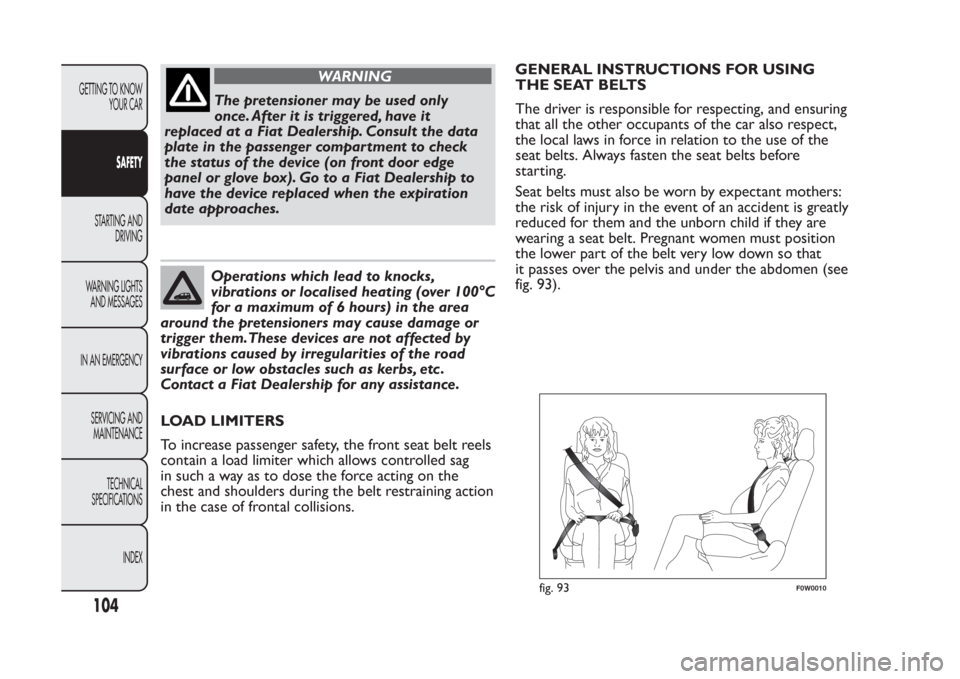
wearing a seat belt. Pregnant women must position
the lower part of the belt very low down so that
it passes over the pelvis and under the abdomen (see
fig. 93).
fig. 93
F0W0010
104
GETTING TO KNOW
YOUR CAR
SAFETY
STARTING AND
DRIVING
WARNING LIGHTS
AND MESSAGES
IN AN EMERGENCY
SERVICING AND
MAINTENANCE
TECHNICAL
SPECIFICATIONS
INDEX
Page 110 of 284
WARNING
If the belt has been sharply pulled, for
example as the result of an accident , the
safety belt , together with the anchoring devices,
the anchoring device mounting screws and the
pretensioner must be completely replaced. Even
if the belt does not present any exterior signs
of wear or damage, it may have lost its
restraining properties.
SEAT BELTS MAINTENANCE
Observe the following precautions for correct seat
belt maintenance:
❒always use the belt with the strap well stretched
and never twisted; make sure that it is free to
run without obstructions;
❒replace the belt after an accident of a certain
severity even if it does not appear to be damaged.
Always replace the belt if the pretensioners were
deployed;
❒to clean the belt, wash by hand with water and
neutral soap, rinse and leave to dry in the shade.
Never use strong detergents, bleach, paints or any
other substance which could damage the belt
fibres;
❒prevent the reels from getting wet: their correct
operation is only guaranteed if water does not
get inside
❒replace the seat belt when it shows wear or cuts.
WARNING
The front passenger belt (for versions
where provided) is provided with an
adjustment device for the metal tongue position
(metal hook). Adjust the tongue position with
respect to the seat belt to improve comfor t and
reduce noise inside the passenger compar tment .
106
GETTING TO KNOW
YOUR CAR
SAFETY
STARTING AND
DRIVING
WARNING LIGHTS
AND MESSAGES
IN AN EMERGENCY
SERVICING AND
MAINTENANCE
TECHNICAL
SPECIFICATIONS
INDEX
Page 113 of 284
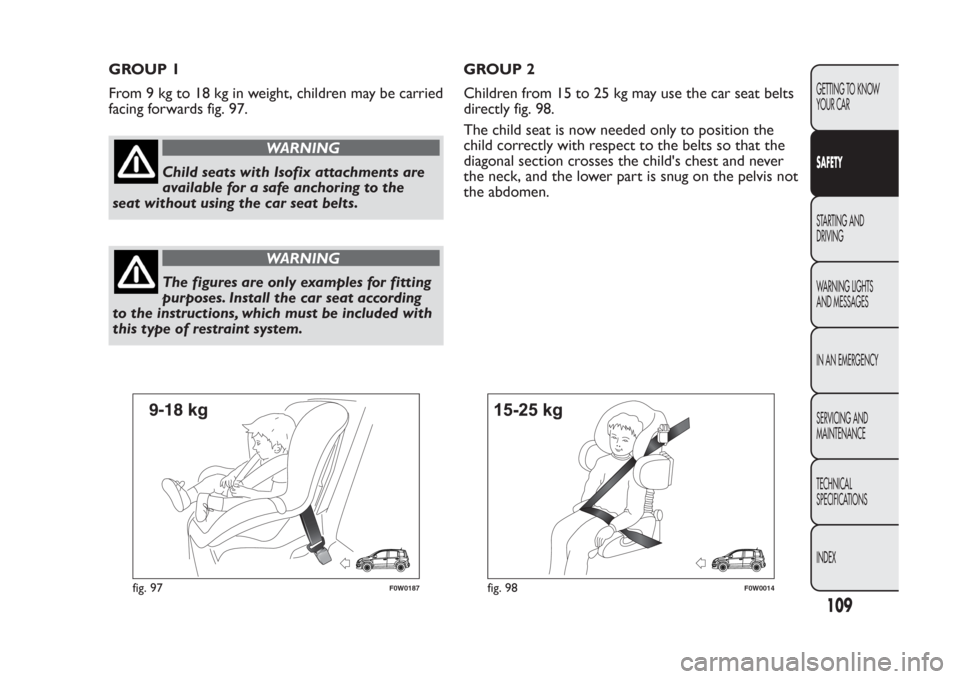
GROUP 1
From 9 kg to 18 kg in weight, children may be carried
facing forwards fig. 97.
WARNING
Child seats with Isofix attachments are
available for a safe anchoring to the
seat without using the car seat belts.
WARNING
The figures are only examples for fitting
purposes. Install the car seat according
to the instructions, which must be included with
this type of restraint system.GROUP 2
Children from 15 to 25 kg may use the car seat belts
directly fig. 98.
The child seat is now needed only to position the
child correctly with respect to the belts so that the
diagonal section crosses the child's chest and never
the neck, and the lower part is snug on the pelvis not
the abdomen.
fig. 97
F0W0187
fig. 98
F0W0014
109GETTING TO KNOW
YOUR CARSAFETYSTARTING AND
DRIVING
WARNING LIGHTS
AND MESSAGES
IN AN EMERGENCY
SERVICING AND
MAINTENANCE
TECHNICAL
SPECIFICATIONS
INDEX
Page 127 of 284
When the engine is switched off never
leave the key turned to MAR-ON to
prevent useless current absorption from
draining the battery.Never jump start the engine by pushing,
towing or coasting downhill.This could
cause fuel to flow into the catalytic
conver ter and damage it beyond repair.
WARMING UP THE ENGINE JUST AFTER IT
HAS STARTED
Proceed as follows:
❒drive off slowly, letting the engine turn at medium
revs. Do not accelerate abruptly;
❒do not demand full performance at first. Wait until
the second bar on the engine coolant temperature
gauge switches on.STOPPING THE ENGINE
Turn the ignition key to STOP while the engine is
idling.
IMPORTANT After a demanding drive, before
turning the engine off you should allow it to idle to
allow the temperature in the engine compartment to
decrease.
A quick burst on the accelerator before
turning off the engine serves absolutely no
practical purpose, it wastes fuel and is
especially damaging to turbocharged engines.
123GETTING TO KNOW
YOUR CAR
SAFETYSTARTING AND
DRIVINGWARNING LIGHTS
AND MESSAGES
IN AN EMERGENCY
SERVICING AND
MAINTENANCE
TECHNICAL
SPECIFICATIONS
INDEX
Page 132 of 284
TOWING TRAILERSIMPORTANT NOTES
For towing caravans or trailers the car must be fitted
with a type-approved tow hook and an adequate
electrical system. Installation must be carried out by
a specialist.
Fit any specific and/or additional rear view mirrors as
specified by the Highway Code.
Remember that when towing a trailer, steep hills are
harder to climb, braking distances increase and
overtaking takes longer depending on the overall
weight of the trail.
Engage a low gear when driving downhill, rather than
constantly using the brake.
The weight of the trailer on the car's tow hook will
reduce the load capacity of the car by the same
amount. To make sure that the maximum towable
weight is not exceeded (given in the car registration
document) account should be taken of the fully
laden trailer, including accessories and luggage.
Respect the speed limits specific to each country for
vehicles towing trailers. In any case, the maximum
speed must not exceed 100 km/h.
An electric brake or winch must be powered directly
by the battery through a cable with a cross-section
of no less than 2.5 mm
2.In addition to the electrical branches, the vehicle's
electrical system can be connected only to the supply
cable for an electric brake and to the cable for an
internal trailer light, though not more than 15 W. For
connections, use the preset control unit with a
battery cable with section no less than 2.5 mm
2.
IMPORTANT The use of auxiliary loads other than
external lights (electric brake, winch, etc.) must
be used with engine running.
IMPORTANT To install a tow hook contact a Fiat
Dealership.
WARNING
The ABS with which the car may be
equipped will not control the braking
system of the trailer. Particular caution is
required on slippery roads.
WARNING
Never modify the braking system of the
car to control the trailer brake.The
trailer braking system must be fully
independent of the car ’s hydraulic system.
128
GETTING TO KNOW
YOUR CAR
SAFETYSTARTING AND
DRIVINGWARNING LIGHTS
AND MESSAGES
IN AN EMERGENCY
SERVICING AND
MAINTENANCE
TECHNICAL
SPECIFICATIONS
INDEX