engine FIAT PANDA 2014 319 / 3.G User Guide
[x] Cancel search | Manufacturer: FIAT, Model Year: 2014, Model line: PANDA, Model: FIAT PANDA 2014 319 / 3.GPages: 284, PDF Size: 11.54 MB
Page 44 of 284
Manual selections always have higher priority over
automatic settings and are stored until the user
switches the system back to automatic control
except for cases in which the system intervenes for
particular safety-related reasons. You can adjust
one function manually without affecting the
automatic control of the others.
The amount of air introduced into the passenger
compartment is not affected by car speed; it is
regulated by the fan, which is controlled
electronically.
The temperature of the air supplied is always
controlled automatically, depending on the
temperature set in the driver’s display (except when
the system is off or in certain conditions when the
compressor is switched off ).
The system allows the following to be set or adjusted
manually:
❒air temperature;
❒fan speed (continuous variation);
❒air distribution with 5 positions;
❒compressor enablement;
❒rapid defrosting/demisting function;
❒air recirculation;
❒heated rear window, folding mirror/heated
windscreen (for versions/markets, where available);
❒system deactivation.SWITCHING ON THE CLIMATE CONTROL
SYSTEM
The system can be switched on in various ways; it is
however advisable to press the AUTO button and
set the desired temperature on the display.
The climate control system allows you to customise
the requested temperatures.
The climate control system compressor works only
with the engine running and with an outside
temperature of above 0°C.
AUTOMATIC CLIMATE CONTROL SYSTEM
OPERATION
Press the AUTO button; the system will
automatically adjust:
❒the amount of air introduced into the passenger
compartment;
❒the distribution of the air in the passenger
compartment;
cancelling all previous manual adjustments.
The LED on the AUTO button switches on during
automatic climate control operation.
During automatic operation it is still possible to
adjust the temperatures set and carry out one of the
following operations manually:
❒fan speed adjustment;
❒air distribution selection;
❒internal air recirculation activation/deactivation;
❒climate control compressor activation.
40GETTING TO
KNOW YOUR CAR
SAFETY
STARTING AND
DRIVING
WARNING LIGHTS
AND MESSAGES
IN AN EMERGENCY
SERVICING AND
MAINTENANCE
TECHNICAL
SPECIFICATIONS
INDEX
Page 45 of 284
WARNING
It is advisable not to use the air
recirculation function when the outside
temperature is low to prevent the windows from
rapidly misting up.
ADJUSTING THE FAN SPEED
Press the G fig. 30
or M
button to increase/
decrease the fan speed
.
The possible speeds are displayed through a
progression of individual bars which comprise the
symbol:
❒maximum fan speed = all bars lit
❒minimum fan speed = half a bar lit.
The fan can be disabled (no bars lit) only if the
climate control compressor has been switched off by
pressing the
button.
To restore automatic fan speed control after a
manual adjustment, press the AUTO button.RAPID FRONT WINDOW
DEMISTING/DEFROSTING (MAX-DEF
function)
Press the
button to automatically activate the
timed operation of all the functions required to
rapidly demist/defrost the windscreen and front side
windows (for versions/markets, where provided).
The functions are:
❒climate control compressor activation (with an
outside temperature of above 0°C);
❒deactivation, if previously activated, of the internal
air recirculation;
❒activation of heated rear window (LED on
button on) and door mirror heater coils (for
versions/markets, where provided);
❒setting maximum air temperature;
❒activation of air flow.
HEATED WINDSCREEN/HEATED REAR
WINDOW AND DOOR MIRROR
DEMISTING/DEFROSTING (for
versions/markets, where provided)
Press the
button to activate: when this function is
activated, the LED on the button switches on.
For versions/markets where provided, press the
button to activate also demisting/defrosting
of windscreen (with engine running only) and door
mirrors (for versions/markets, where provided).
41GETTING TO
KNOW YOUR CARSAFETY
STARTING AND
DRIVING
WARNING LIGHTS
AND MESSAGES
IN AN EMERGENCY
SERVICING AND
MAINTENANCE
TECHNICAL
SPECIFICATIONS
INDEX
Page 47 of 284
CLIMATE CONTROL COMPRESSOR
ACTIVATION/DEACTIVATION
Press the
button to switch on the climate control
compressor.
Compressor on:LED on
button on.
Compressor off:
❒LED on
button switches off;
❒internal air recirculation excluded;
With the climate control compressor switched off,
air cannot be introduced into the passenger
compartment that has a lower temperature than the
outside air; in this case the LED on the
button
will light up.
The deactivation of the climate control compressor
is memorised even after the engine has stopped.
To reactivate the climate control compressor, press
the
or AUTO button again: if you press AUTO,
the other manual settings will be cancelled.
AIR DISTRIBUTION SELECTION
Press one or more of buttons A fig. 30 to manually
select one of the possible air distribution settings for
the passenger compartment:
Air flow to the windscreen and front side
window diffusers to demist/defrost them.Air flow to the footwell diffusers. This air
distribution allows the passenger compartment
to be warmed up quickly.Air flow distribution to centre/side dashboard
diffusers (passenger's body).
+
Air flow distributed between footwell
diffusers and windscreen and front side
window defrosting/demisting diffusers. This
distribution setting allows the passenger
compartment to be warmed effectively and
prevents the windows from misting.
+
Air flow distribution between footwell
diffusers (hotter air) and centre/side
dashboard diffusers (cooler air).
IMPORTANT For the climate control system to
function, at least one of the buttons A must be
operated fig. 30. The system does not allow the
deactivation of all the buttons A.
IMPORTANT Push the
button to turn the climate
control system back on: in this way, all operating
conditions memorised before switching off are
restored.
To restore automatic control of the air distribution
after a manual selection, press the AUTO button.
SWITCHING OFF THE CLIMATE CONTROL
SYSTEM
Press the
button.
The LEDS next to the
symbol and internal air
recirculation indication on the control panel switch
off.
SYSTEM MAINTENANCE
In winter, the climate control system must be turned
on at least once a month for about 10 minutes.
43GETTING TO
KNOW YOUR CARSAFETY
STARTING AND
DRIVING
WARNING LIGHTS
AND MESSAGES
IN AN EMERGENCY
SERVICING AND
MAINTENANCE
TECHNICAL
SPECIFICATIONS
INDEX
Page 48 of 284
Have the system inspected at a Fiat Dealership
before the summer.
The system uses R134a coolant which
does not pollute the environment in the
event of accidental leakage. Never use
R12 fluid, which is not compatible with the
system components.
ADDITIONAL HEATER
(for versions/markets, where provided)
This allows the passenger compartment to be heated
more quickly in cold weather conditions. The heater
switches on automatically according to the
environmental conditions and with engine started
when the temperature of the engine coolant is low.
The additional heater turns off automatically after
the required comfort conditions are achieved.
The heater only operates if the outside temperature
and engine coolant temperature are low. The heater
will not activate if the battery voltage is too low.
Interaction of Automatic Climate Control
with START&STOP
(for versions/markets, where provided)
Automatic Climate Control
The automatic climate control manages the
Start&Stop function (engine off when the car speed
is zero) to guarantee adequate comfort inside the
passenger compartment.In particular, when the weather is extremely hot or
cold, the Start&Stop function is deactivated until
adequate passenger compartment comfort is
ensured. During these transitory stages the engine is
not stopped, even if the car speed is zero.
When the Start&Stop function is active (engine off at
zero car speed), the climate control system will
request the reactivation of the engine if the inside
temperature conditions rapidly deteriorate (or if the
user requests maximum cooling – LO – or quick
demisting – MAX DEF).
With Start&Stop function active (engine off at zero
car speed), the air flow rate (if managed
automatically) is reduced in order to maintain the
passenger compartment comfort conditions for
as long as possible.
The climate control system control unit manages the
decreased comfort caused by stopping the engine,
and consequently the compressor, as far as possible.
The operation of the climate control system can in
any case be favoured by deactivating the Start&Stop
function using the dedicated button on the
dashboard.
NOTE In particularly severe climate conditions it is
recommended to limit the use of the Start&Stop
function to prevent the compressor from
continuously switching on and off, with consequent
rapid misting of the windows and accumulation of
humidity with unpleasant smells in the passenger
compartment.
44GETTING TO
KNOW YOUR CAR
SAFETY
STARTING AND
DRIVING
WARNING LIGHTS
AND MESSAGES
IN AN EMERGENCY
SERVICING AND
MAINTENANCE
TECHNICAL
SPECIFICATIONS
INDEX
Page 50 of 284
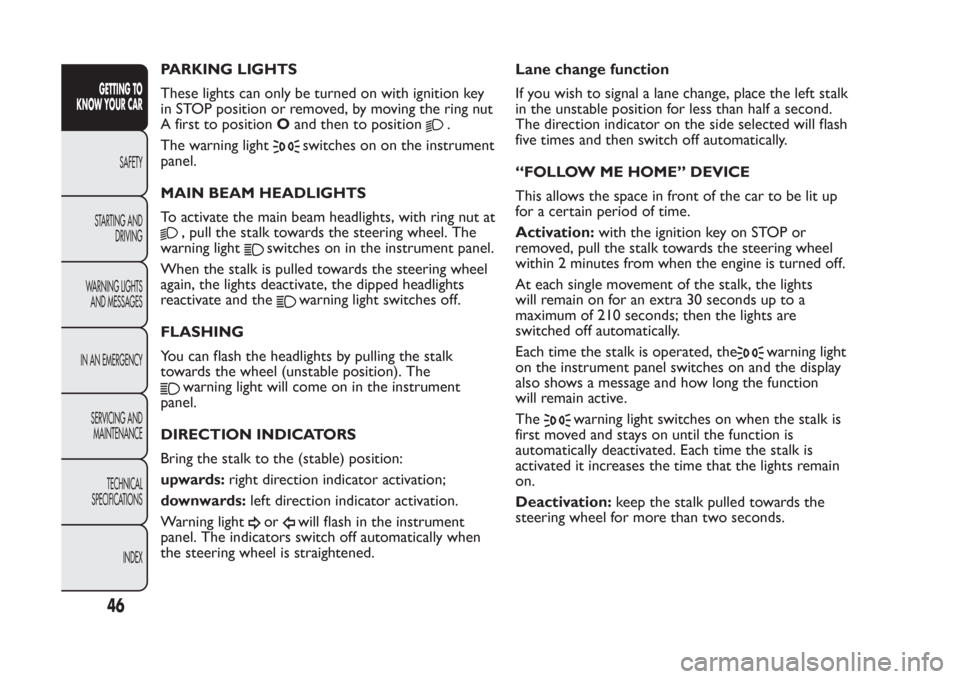
PARKING LIGHTS
These lights can only be turned on with ignition key
in STOP position or removed, by moving the ring nut
A first to positionOand then to position
.
The warning light
switches on on the instrument
panel.
MAIN BEAM HEADLIGHTS
To activate the main beam headlights, with ring nut at
, pull the stalk towards the steering wheel. The
warning light
switches on in the instrument panel.
When the stalk is pulled towards the steering wheel
again, the lights deactivate, the dipped headlights
reactivate and the
warning light switches off.
FLASHING
You can flash the headlights by pulling the stalk
towards the wheel (unstable position). The
warning light will come on in the instrument
panel.
DIRECTION INDICATORS
Bring the stalk to the (stable) position:
upwards:right direction indicator activation;
downwards:left direction indicator activation.
Warning light
or
will flash in the instrument
panel. The indicators switch off automatically when
the steering wheel is straightened.Lane change function
If you wish to signal a lane change, place the left stalk
in the unstable position for less than half a second.
The direction indicator on the side selected will flash
five times and then switch off automatically.
“FOLLOW ME HOME” DEVICE
This allows the space in front of the car to be lit up
for a certain period of time.
Activation:with the ignition key on STOP or
removed, pull the stalk towards the steering wheel
within 2 minutes from when the engine is turned off.
At each single movement of the stalk, the lights
will remain on for an extra 30 seconds up to a
maximum of 210 seconds; then the lights are
switched off automatically.
Each time the stalk is operated, the
warning light
on the instrument panel switches on and the display
also shows a message and how long the function
will remain active.
The
warning light switches on when the stalk is
first moved and stays on until the function is
automatically deactivated. Each time the stalk is
activated it increases the time that the lights remain
on.
Deactivation:keep the stalk pulled towards the
steering wheel for more than two seconds.
46GETTING TO
KNOW YOUR CAR
SAFETY
STARTING AND
DRIVING
WARNING LIGHTS
AND MESSAGES
IN AN EMERGENCY
SERVICING AND
MAINTENANCE
TECHNICAL
SPECIFICATIONS
INDEX
Page 51 of 284
WINDOW CLEANINGThe right stalk controls windscreen wiper/washer
and rear window wiper/washer operation.
WINDSCREEN WASHER/WIPER
It can be operated only with the ignition key turned
to MAR-ON.
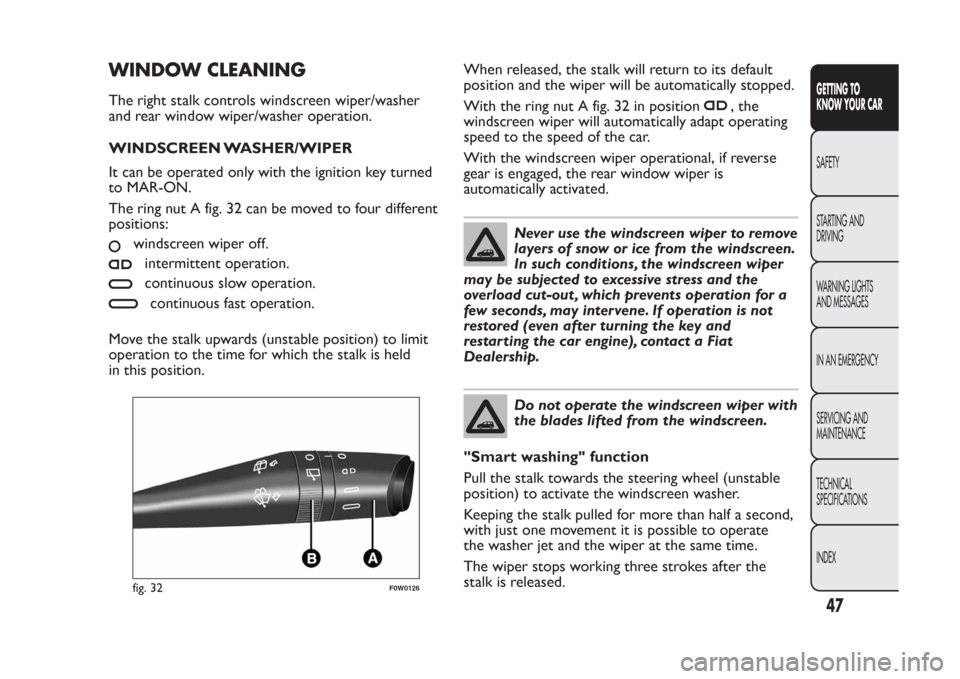
The ring nut A fig. 32 can be moved to four different
positions:
windscreen wiper off.intermittent operation.continuous slow operation.continuous fast operation.
Move the stalk upwards (unstable position) to limit
operation to the time for which the stalk is held
in this position.When released, the stalk will return to its default
position and the wiper will be automatically stopped.
With the ring nut A fig. 32 in position
, the
windscreen wiper will automatically adapt operating
speed to the speed of the car.
With the windscreen wiper operational, if reverse
gear is engaged, the rear window wiper is
automatically activated.
Never use the windscreen wiper to remove
layers of snow or ice from the windscreen.
In such conditions, the windscreen wiper
may be subjected to excessive stress and the
overload cut-out , which prevents operation for a
few seconds, may intervene. If operation is not
restored (even after turning the key and
restarting the car engine), contact a Fiat
Dealership.Do not operate the windscreen wiper with
the blades lifted from the windscreen.
"Smart washing" function
Pull the stalk towards the steering wheel (unstable
position) to activate the windscreen washer.
Keeping the stalk pulled for more than half a second,
with just one movement it is possible to operate
the washer jet and the wiper at the same time.
The wiper stops working three strokes after the
stalk is released.
fig. 32
F0W0126
47GETTING TO
KNOW YOUR CARSAFETY
STARTING AND
DRIVING
WARNING LIGHTS
AND MESSAGES
IN AN EMERGENCY
SERVICING AND
MAINTENANCE
TECHNICAL
SPECIFICATIONS
INDEX
Page 54 of 284
IMPORTANT Before getting out of the car, make
sure that both switches are in the central position:
when the doors are closed the lights will switch
off to avoid draining the battery. In any case, if the
switch is left in the on position, the roof light
switches off automatically about 15 minutes after the
engine has been switched off.
ROOF LIGHT TIMING
On certain versions, to facilitate getting into/out of
the car, especially at night or in poorly-lit areas,
two timed modes have been provided.
Timing when getting into the car
The roof lights switch on according to the following
modes:
❒for about 10 seconds when the doors are
unlocked;
❒for about 3 minutes when one of the doors is
opened;
❒for about 10 seconds when the doors are closed.
The timing is interrupted when the ignition key is
turned to MAR.
Three modes are provided for switching off:
❒when all doors are closed, the 3-minute timer will
stop and a 10-second one will start. This timer will
stop when the key is turned to MAR;❒when doors are locked (either with remote
control or with key on driver side door), the roof
light switches off.
❒the courtesy lights are switched off in any case
after 15 minutes to preserve battery charge
Timing when getting out of the car
After removing the key from the ignition switch, the
roof lights switch on as follows:
❒if the ignition key is removed within 3 minutes
from the engine stopping, the roof lights switch on
for 10 seconds;
❒for about 3 minutes when one of the doors is
opened;
❒for about 10 seconds when one of the doors is
closed.
The timing stops automatically when the doors are
locked.
LUGGAGE COMPARTMENT ROOF LIGHT
(for versions/markets, where provided)
The roof light is located on the left side of the
luggage compartment. This switches on automatically
when the luggage compartment is opened and
switches off when it is closed. The light switches
on/off regardless of the ignition key position.
50GETTING TO
KNOW YOUR CAR
SAFETY
STARTING AND
DRIVING
WARNING LIGHTS
AND MESSAGES
IN AN EMERGENCY
SERVICING AND
MAINTENANCE
TECHNICAL
SPECIFICATIONS
INDEX
Page 56 of 284
DUALDRIVE ELECTRIC POWER STEERING
(for versions/markets, where provided)
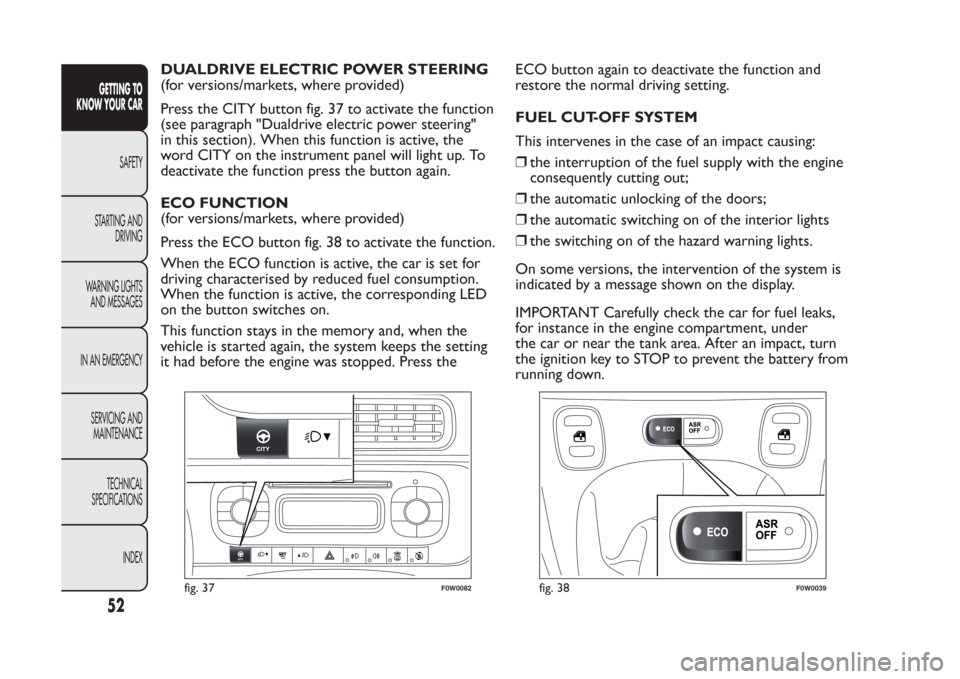
Press the CITY button fig. 37 to activate the function
(see paragraph "Dualdrive electric power steering"
in this section). When this function is active, the
word CITY on the instrument panel will light up. To
deactivate the function press the button again.
ECO FUNCTION
(for versions/markets, where provided)
Press the ECO button fig. 38 to activate the function.
When the ECO function is active, the car is set for
driving characterised by reduced fuel consumption.
When the function is active, the corresponding LED
on the button switches on.
This function stays in the memory and, when the
vehicle is started again, the system keeps the setting
it had before the engine was stopped. Press theECO button again to deactivate the function and
restore the normal driving setting.
FUEL CUT-OFF SYSTEM
This intervenes in the case of an impact causing:
❒the interruption of the fuel supply with the engine
consequently cutting out;
❒the automatic unlocking of the doors;
❒the automatic switching on of the interior lights
❒the switching on of the hazard warning lights.
On some versions, the intervention of the system is
indicated by a message shown on the display.
IMPORTANT Carefully check the car for fuel leaks,
for instance in the engine compartment, under
the car or near the tank area. After an impact, turn
the ignition key to STOP to prevent the battery from
running down.
fig. 37
F0W0082
fig. 38
F0W0039
52GETTING TO
KNOW YOUR CAR
SAFETY
STARTING AND
DRIVING
WARNING LIGHTS
AND MESSAGES
IN AN EMERGENCY
SERVICING AND
MAINTENANCE
TECHNICAL
SPECIFICATIONS
INDEX
Page 73 of 284
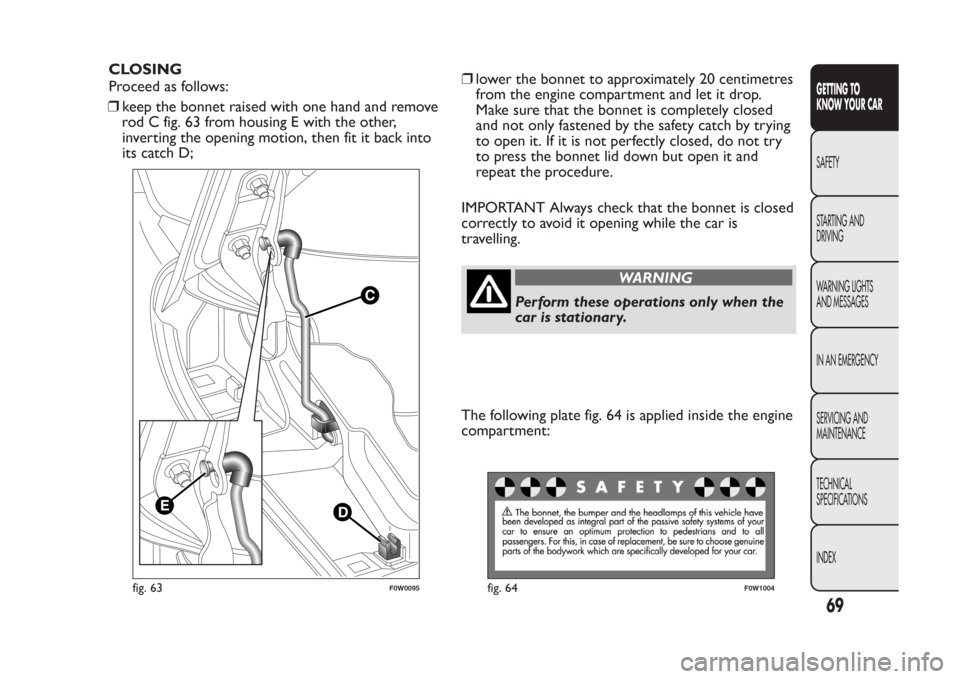
CLOSING
Proceed as follows:
❒keep the bonnet raised with one hand and remove
rod C fig. 63 from housing E with the other,
inverting the opening motion, then fit it back into
its catch D;❒lower the bonnet to approximately 20 centimetres
from the engine compartment and let it drop.
Make sure that the bonnet is completely closed
and not only fastened by the safety catch by trying
to open it. If it is not perfectly closed, do not try
to press the bonnet lid down but open it and
repeat the procedure.
IMPORTANT Always check that the bonnet is closed
correctly to avoid it opening while the car is
travelling.
WARNING
Perform these operations only when the
car is stationary.
The following plate fig. 64 is applied inside the engine
compartment:
fig. 63
F0W0095
fig. 64
F0W1004
69GETTING TO
KNOW YOUR CARSAFETY
STARTING AND
DRIVING
WARNING LIGHTS
AND MESSAGES
IN AN EMERGENCY
SERVICING AND
MAINTENANCE
TECHNICAL
SPECIFICATIONS
INDEX
Page 77 of 284
WARNING
When the ABS cuts in and you feel the
brake pedal pulsating, do not raise
your foot , but keep it pressed; in doing so you
will stop in the shortest amount of space
possible depending on the current road
conditions.
WARNING
If the ABS system intervenes, this
indicates that the traction of the tyres
on the road is nearing its limit .You must slow
down to a speed compatible with the available
traction.
MSR SYSTEM
(Motor Schleppmoment Regelung)
This system is an integral part of the ABS, that
intervenes, if there is sudden downshifting, restoring
torque to the engine, thereby preventing excessive
drive at the drive wheels which, especially in poor
grip conditions, could lead to a loss in stability of the
car.MECHANICAL BRAKE ASSIST (emergency
braking assistance)
(for versions/markets, where provided)
This system, which cannot be deactivated, recognises
emergency braking conditions (according to the
brake pedal operation speed) and provides an
additional hydraulic braking pressure to support that
provided by the driver. This allows faster and more
powerful operation of the braking system.
WARNING
When the Mechanical Brake Assist
intervenes, noises may be heard from
the system.This is normal. In any case, keep the
brake pedal firmly depressed while braking.
73GETTING TO
KNOW YOUR CARSAFETY
STARTING AND
DRIVING
WARNING LIGHTS
AND MESSAGES
IN AN EMERGENCY
SERVICING AND
MAINTENANCE
TECHNICAL
SPECIFICATIONS
INDEX