tow FIAT PANDA 2014 319 / 3.G User Guide
[x] Cancel search | Manufacturer: FIAT, Model Year: 2014, Model line: PANDA, Model: FIAT PANDA 2014 319 / 3.GPages: 284, PDF Size: 11.54 MB
Page 91 of 284
WARNING
The system intervenes on vehicles
travelling in the same lane. Small sized
vehicles (e.g. bicycles or motorbikes) or people,
animals and things (e.g. pushchairs) and more in
general all those obstacles with a low reflection
of the light emitted by the laser (e.g. vehicles
soiled with mud) are not taken into
consideration.If a trailer or a car is towed the system
must be deactivated with the display
Setup Menu (see paragraph "Menu
items" in this chapter).
WARNING
If the car must be placed on a roller
bench (at a speed within 5 and 30 km/h)
for maintenance interventions or if it is washed
in an automatic roller washing tunnel with an
obstacle in the front part (e.g. another car, a
wall or another obstacle), the system may
detect its presence and activate. In this case the
system must be deactivated with the display
setup menu (see paragraph “Menu items”
in this chapter).
EOBD SYSTEMThe EOBD system (European On Board Diagnosis)
carries out a continuous diagnosis of the
components of the car related to emissions. It also
alerts the driver about component deterioration
by switching on the warning light on the instrument
panel and the displaying of a relevant message (for
versions/markets, where provided) (see the chapter
“Warning lights and messages”).
The aim of the EOBD system (European On Board
Diagnosis) is to:
❒monitor the system efficiency;
❒indicate an increase in emissions;
❒indicate the need to replace damaged components.
The system also has a diagnosis connector that can
be interfaced to suitable instruments, to read the
error codes stored in the control unit together with
a series of specific parameters for engine operation
and diagnosis.
IMPORTANT After eliminating the failure, to check
the system completely, Fiat Dealerships run a bench
test and, if necessary, road tests which may also
call for a long journey.
87GETTING TO
KNOW YOUR CARSAFETY
STARTING AND
DRIVING
WARNING LIGHTS
AND MESSAGES
IN AN EMERGENCY
SERVICING AND
MAINTENANCE
TECHNICAL
SPECIFICATIONS
INDEX
Page 92 of 284
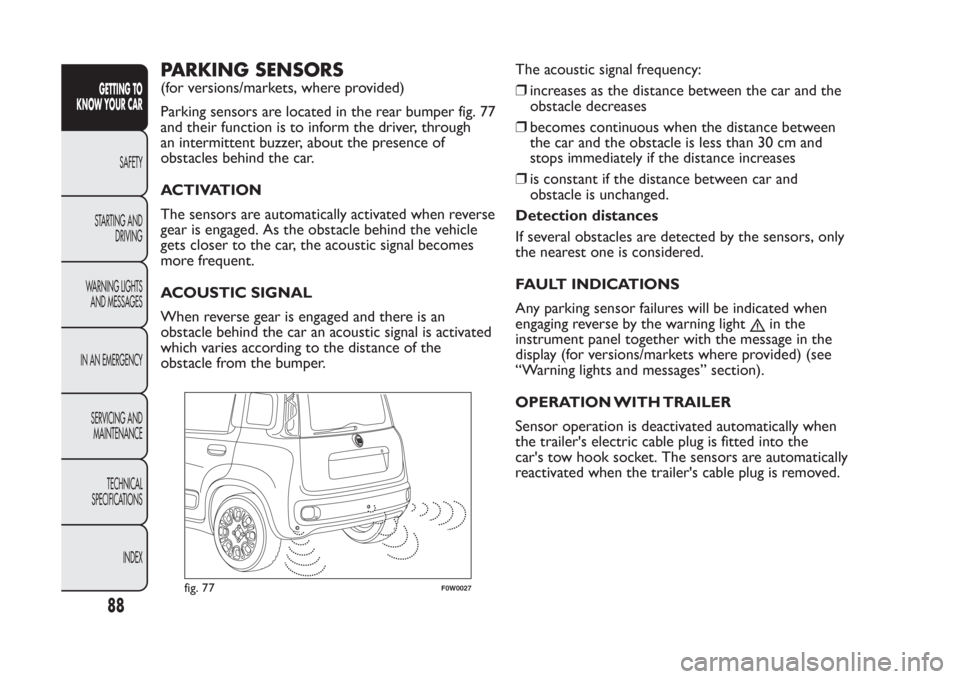
PARKING SENSORS(for versions/markets, where provided)
Parking sensors are located in the rear bumper fig. 77
and their function is to inform the driver, through
an intermittent buzzer, about the presence of
obstacles behind the car.
ACTIVATION
The sensors are automatically activated when reverse
gear is engaged. As the obstacle behind the vehicle
gets closer to the car, the acoustic signal becomes
more frequent.
ACOUSTIC SIGNAL
When reverse gear is engaged and there is an
obstacle behind the car an acoustic signal is activated
which varies according to the distance of the
obstacle from the bumper.The acoustic signal frequency:
❒increases as the distance between the car and the
obstacle decreases
❒becomes continuous when the distance between
the car and the obstacle is less than 30 cm and
stops immediately if the distance increases
❒is constant if the distance between car and
obstacle is unchanged.
Detection distances
If several obstacles are detected by the sensors, only
the nearest one is considered.
FAULT INDICATIONS
Any parking sensor failures will be indicated when
engaging reverse by the warning light
in the
instrument panel together with the message in the
display (for versions/markets where provided) (see
“Warning lights and messages” section).
OPERATION WITH TRAILER
Sensor operation is deactivated automatically when
the trailer's electric cable plug is fitted into the
car's tow hook socket. The sensors are automatically
reactivated when the trailer's cable plug is removed.
fig. 77
F0W0027
88GETTING TO
KNOW YOUR CAR
SAFETY
STARTING AND
DRIVING
WARNING LIGHTS
AND MESSAGES
IN AN EMERGENCY
SERVICING AND
MAINTENANCE
TECHNICAL
SPECIFICATIONS
INDEX
Page 93 of 284
For correct operation, sensors must always
be clean from mud, dirt , snow or ice. Be
careful not to scratch or damage the
sensors while cleaning them. Avoid using dr y,
rough or hard cloths.The sensors should be
washed using clean water with the addition of car
shampoo if necessary.When using special
washing equipment such as high pressure jets or
steam cleaning, clean the sensors very quickly
keeping the jet more than 10 cm away.
GENERAL WARNINGS
❒When parking, take the utmost care over
obstacles that may be above or under the sensors.
❒Objects close to the car, are not detected under
certain circumstances and could therefore cause
damage to the car or be damaged.
Some of the conditions that could affect the
performance of the parking system are described
below:
❒Reduced sensor sensitivity and a reduction in the
parking assistance system performance could be
due to the presence on the surface of the sensor
of: ice, snow, mud, thick paint
❒The sensor may detect a non-existent obstacle
(echo interference) due to mechanical
interference, for example when washing the
vehicle, in rain, (strong wind), hail.❒The signals sent by the sensors can also be altered
by the presence of ultrasonic systems (e.g.
pneumatic brake systems or pneumatic drills) near
the vehicle.
❒Parking assistance system performance can also be
influenced by the position of the sensors, for
example due to a change in the ride setting
(caused by wear to the shock absorbers,
suspension), or by changing tyres, overloading the
car or carrying out specific tuning operations
that require the car to be lowered.
❒The presence of a tow hook without trailer
interferes with the correct operation of the
parking sensors. If a fixed tow hook is installed, the
sensors cannot be used. If the customer installs a
removable tow hook, this must always be
disconnected from the crossmember whenever
the trailer is not attached to prevent the activation
of the sensors.
WARNING
The responsibility for parking and other
dangerous manoeuvres always and in
every case lies with the driver.When making
these manoeuvres, always make sure that no
people (especially children) or animals are
present in your manoeuvering space.The parking
sensors serve to assist the driver, but must never
allow his attention to lapse during potentially
dangerous manoeuvres, even those executed at
low speeds.
89GETTING TO
KNOW YOUR CARSAFETY
STARTING AND
DRIVING
WARNING LIGHTS
AND MESSAGES
IN AN EMERGENCY
SERVICING AND
MAINTENANCE
TECHNICAL
SPECIFICATIONS
INDEX
Page 107 of 284
Rear seats (warning light no. 2, no. 3 and no. 4)
For the rear seats, the reminder cycle is only
activated when any seat belt is unfastened together
with an acoustic signal (three beeps) (icon A
fig. 92). If the condition of any (front or rear) seat
belt changes, also the condition of the other
(front/rear) seat belts is reported.
The visual indication (icon A
fig. 92) will start and
stop independently for each warning light if several
seat belts are unfastened. The visual signal will
change condition (icon B
fig. 92) after the
corresponding seat has been fastened again.
IMPORTANT When the ignition key is turned to
MAR, if all the front and rear belts are already
fastened the warning lights will remain in position B
fig. 92 for 30 seconds.
IMPORTANT When the ignition key is turned to
MAR, the belts fastened icons will remain in position
B
fig. 92, whilst the belts unfastened icons will
be displayed as in position A
of fig. 92. If the last
belt is also fastened, the icons will remain in position
B
fig. 92 for 30 seconds then they will switch off.
PRETENSIONERSThe car is equipped with front seat belt
pretensioners, which draw back the seat belts by
several centimetres in the event of a strong frontal
impact. This guarantees the perfect adherence of the
seat belts to the occupants' bodies before the
restraining action begins. It is evident that
the pretensioners have operated when the belt
withdraws towards the reel. This car is also equipped
with a second pretensioner (in the kick plate area).
Its activation is signalled by the shortening of the
metal cable. A slight discharge of smoke may be
produced during the activation of the pretensioner
which is not harmful and does not involve any fire
hazard.
IMPORTANT To obtain the highest degree of
protection from the action of the pretensioning
device, wear the seat belt tight to the chest and
pelvis.
The pretensioner does not require any maintenance
or lubrication: any changes to its original conditions
will invalidate its efficiency. If, due to unusual natural
events (floods, sea storms, etc.), the device has
been affected by water and mud, it must be replaced.
103GETTING TO KNOW
YOUR CARSAFETYSTARTING AND
DRIVING
WARNING LIGHTS
AND MESSAGES
IN AN EMERGENCY
SERVICING AND
MAINTENANCE
TECHNICAL
SPECIFICATIONS
INDEX
Page 127 of 284
When the engine is switched off never
leave the key turned to MAR-ON to
prevent useless current absorption from
draining the battery.Never jump start the engine by pushing,
towing or coasting downhill.This could
cause fuel to flow into the catalytic
conver ter and damage it beyond repair.
WARMING UP THE ENGINE JUST AFTER IT
HAS STARTED
Proceed as follows:
❒drive off slowly, letting the engine turn at medium
revs. Do not accelerate abruptly;
❒do not demand full performance at first. Wait until
the second bar on the engine coolant temperature
gauge switches on.STOPPING THE ENGINE
Turn the ignition key to STOP while the engine is
idling.
IMPORTANT After a demanding drive, before
turning the engine off you should allow it to idle to
allow the temperature in the engine compartment to
decrease.
A quick burst on the accelerator before
turning off the engine serves absolutely no
practical purpose, it wastes fuel and is
especially damaging to turbocharged engines.
123GETTING TO KNOW
YOUR CAR
SAFETYSTARTING AND
DRIVINGWARNING LIGHTS
AND MESSAGES
IN AN EMERGENCY
SERVICING AND
MAINTENANCE
TECHNICAL
SPECIFICATIONS
INDEX
Page 131 of 284
Unnecessary actions
Avoid revving up when at traffic lights or before
switching off the engine. This action and also double
declutching is absolutely pointless on modern cars
and also increases consumption and pollution.
Gear selection
Use a higher gear as soon as traffic and road
conditions allow. Using a low gear for faster
acceleration will increase consumption.
In the same way improper use of a high gear
increases consumption, emissions and engine wear.
Maximum speed
Fuel consumption increases considerably with speed.
Maintain a constant speed, avoiding unnecessary
braking and acceleration, which cost in terms of both
fuel and emissions.
Acceleration
Sudden acceleration has a very negative effect on fuel
consumption and emissions: accelerate gradually.CONDITIONS OF USE
Cold starting
Short distances and frequent cold start-ups will
prevent the engine from reaching optimal running
temperature.
Consequently, both consumption (from +15 to +30%
on urban cycle ) and emissions will increase.
Traffic and road conditions
Rather high fuel consumption is caused by heavy
traffic, for instance when travelling in a queue with
frequent use of low gears or in large towns with
many traffic lights. Winding mountain roads and
rough road surfaces also adversely affect
consumption.
Stops in traffic
During prolonged stops (e.g. level crossings) the
engine should be switched off.
127GETTING TO KNOW
YOUR CAR
SAFETYSTARTING AND
DRIVINGWARNING LIGHTS
AND MESSAGES
IN AN EMERGENCY
SERVICING AND
MAINTENANCE
TECHNICAL
SPECIFICATIONS
INDEX
Page 132 of 284
TOWING TRAILERSIMPORTANT NOTES
For towing caravans or trailers the car must be fitted
with a type-approved tow hook and an adequate
electrical system. Installation must be carried out by
a specialist.
Fit any specific and/or additional rear view mirrors as
specified by the Highway Code.
Remember that when towing a trailer, steep hills are
harder to climb, braking distances increase and
overtaking takes longer depending on the overall
weight of the trail.
Engage a low gear when driving downhill, rather than
constantly using the brake.
The weight of the trailer on the car's tow hook will
reduce the load capacity of the car by the same
amount. To make sure that the maximum towable
weight is not exceeded (given in the car registration
document) account should be taken of the fully
laden trailer, including accessories and luggage.
Respect the speed limits specific to each country for
vehicles towing trailers. In any case, the maximum
speed must not exceed 100 km/h.
An electric brake or winch must be powered directly
by the battery through a cable with a cross-section
of no less than 2.5 mm
2.In addition to the electrical branches, the vehicle's
electrical system can be connected only to the supply
cable for an electric brake and to the cable for an
internal trailer light, though not more than 15 W. For
connections, use the preset control unit with a
battery cable with section no less than 2.5 mm
2.
IMPORTANT The use of auxiliary loads other than
external lights (electric brake, winch, etc.) must
be used with engine running.
IMPORTANT To install a tow hook contact a Fiat
Dealership.
WARNING
The ABS with which the car may be
equipped will not control the braking
system of the trailer. Particular caution is
required on slippery roads.
WARNING
Never modify the braking system of the
car to control the trailer brake.The
trailer braking system must be fully
independent of the car ’s hydraulic system.
128
GETTING TO KNOW
YOUR CAR
SAFETYSTARTING AND
DRIVINGWARNING LIGHTS
AND MESSAGES
IN AN EMERGENCY
SERVICING AND
MAINTENANCE
TECHNICAL
SPECIFICATIONS
INDEX
Page 139 of 284
LOW BATTERY CHARGE (red)
(for versions/markets, where provided)
When the ignition key is turned to MAR, the warning
light switches on but should switch off as soon as
the engine is started (with the engine idling, a brief
delay is acceptable).
If the warning light (or, on some versions, a message
and a symbol on the display) remains on constantly
or flashing, contact a Fiat Dealership.ON CONSTANTLY: LOW ENGINE
OIL PRESSURE (red)
ON FLASHING: ENGINE OIL
DETERIORATED
(only Diesel versions with DPF - red)
When the ignition key is turned to MAR, the warning
light switches on but should switch off as soon as
the engine is started.
1. Low engine oil pressure
The warning light switches on constantly together
(for versions/markets, where provided) with a
message on the display when the system detects that
the engine oil pressure is too low.
WARNING
If the
warning light switches on
when driving (on certain versions
together with the message on the display) stop
the engine immediately and contact a Fiat
Dealership.
2. Engine oil deteriorated
(only Diesel versions with DPF)
The warning light will flash and a specific message will
appear on the display (in versions/markets, where
provided). The warning light flashes for 3 minute
cycles with the warning light off for intervals of
5 seconds until oil is changed.
After the first indication, at each engine start-up the
warning light will continue flashing as described
above until the oil is changed. The display shows a
dedicated message (for versions/markets, where
provided) together with the warning light.
The flashing of this warning light should not be
considered as a fault; it informs the customer that
the oil needs to be changed following normal car use.
Remember that the deterioration of the engine oil
is accelerated by:
❒mainly town use of the car which makes the DPF
regeneration process more frequent;
135GETTING TO KNOW
YOUR CAR
SAFETY
STARTING AND
DRIVINGWARNING LIGHTS
AND MESSAGESIN AN EMERGENCY
SERVICING AND
MAINTENANCE
TECHNICAL
SPECIFICATIONS
INDEX
Page 140 of 284
❒use of the car for short drives, in which the engine
does not have time to reach its regular operating
temperature;
❒repeated interruption of the regeneration process,
signalled by the DPF warning light switching on.
WARNING
If the warning light switches on, the
deteriorated engine oil must be changed
as soon as possible, and never more than 500
km from the first time that the warning light
switches on. Failure to observe the above may
result in severe damage to the engine and
invalidate the warranty. Remember that the
operation of this warning light is not related to
the amount of oil in the engine.Therefore,
never top up with oil when the light starts
flashing.EXCESSIVE ENGINE COOLANT
TEMPERATURE (red)
Turning the key to MAR switches on the warning
light, but it should switch off after a few seconds.
The warning light switches on (on some versions,
with a message on the display and a symbol on
the display) when the engine is overheated.If the warning light comes on when driving, proceed
as follows:
❒when driving normally:stop the car, stop the
engine and check that the water level in the
reservoir is not below the MIN mark. If it is, wait
for a few minutes for the engine to cool down
then slowly and carefully open the cap, top up with
coolant and check that the level is between the
MIN and MAX marks. Also check visually for any
fluid leaks. If, when restarting, the warning light
should switch on again, contact a Fiat Dealership;
❒if the car is used under demanding
conditions(e.g. towing trailers uphill or fully
loaded): slow down and, if the light stays on, stop
the car. Wait for 2 or 3 minutes with the engine
running and slightly accelerated to further favour
the coolant circulation. Then stop the engine.
Check the correct liquid level as described above.
IMPORTANT On demanding routes, it is advisable to
keep the engine on and slightly accelerated for a
few minutes before stopping it.
FUEL RESERVE - LIMITED RANGE
(amber)
This warning light comes on when about 5 to 7 litres
of fuel are left in the tank. When the remaining
range is lower than approx. 50 km (or equivalent
value in miles), on some versions, the display will
show a warning message.
136
GETTING TO KNOW
YOUR CAR
SAFETY
STARTING AND
DRIVINGWARNING LIGHTS
AND MESSAGESIN AN EMERGENCY
SERVICING AND
MAINTENANCE
TECHNICAL
SPECIFICATIONS
INDEX
Page 148 of 284
Never use a fast batter y-charger to star t
the engine as this could damage the
electronic systems of your car, par ticularly
the ignition and fuel supply control units.
WARNING
This procedure must be performed by
exper t personnel because incorrect
actions could cause electrical discharge of
considerable intensity. Furthermore, battery
fluid is poisonous and corrosive: avoid contact
with skin and eyes. Keep naked flames and
lighted cigarettes away from the battery and do
not cause sparks.
BUMP STARTING
Never bump start the engine by pushing, towing or
coasting downhill.
IMPORTANT Remember that the brake servo and
electrical power steering system are not active until
the engine is started. A much greater effort will
therefore be required to use the brake pedal or turn
the steering wheel.
CHANGING A WHEELGENERAL INSTRUCTIONS
The car is equipped with the “FIX&GO Automatic
Kit”: see the paragraph “FIX&GO Automatic Kit” for
how to use this device. As an alternative to the
“FIX&GO Automatic Kit” the car may be equipped
with a space-saver wheel: see the instructions on the
following pages for changing the tyre.
WARNING
The space-saver wheel (for versions/
markets where provided) is specific to
your car, do not use it on other models, or use
the space-saver wheel of other models on your
car.The space-saver wheel must only be used
in case of emergency. It must only be used
for the distance necessary to reach a service
point and the car speed must not exceed 80
km/h.The space-saver wheel has an orange
sticker that summarises the main cautions for
use and limitations. Never remove or cover
the label.The following information is provided
in four languages on the label: "Important!
For temporar y use only! 80 km/h max! Replace
with a standard tire as soon as possible. Never
cover this indication." Never apply a wheel
cap on a space-saver wheel.
144
GETTING TO KNOW
YOUR CAR
SAFETY
STARTING AND
DRIVING
WARNING LIGHTS
AND MESSAGES
IN AN
EMERGENCY
SERVICING AND
MAINTENANCE
TECHNICAL
SPECIFICATIONS
INDEX