tow FIAT PANDA 2014 319 / 3.G Owner's Manual
[x] Cancel search | Manufacturer: FIAT, Model Year: 2014, Model line: PANDA, Model: FIAT PANDA 2014 319 / 3.GPages: 284, PDF Size: 11.54 MB
Page 152 of 284
Restore the standard wheel as soon as possible,
because, once placed in the associated compartment,
the luggage compartment load platform is rendered
uneven as the standard wheel is larger than the
space-saver wheel.
REFITTING THE STANDARD WHEEL
Following the procedure described previously, raise
the car and remove the space-saver wheel.
Versions with steel rims
Proceed as follows:
❒make sure the contact surfaces between standard
wheel and hub are clean so that the fastening
bolts will not come loose;
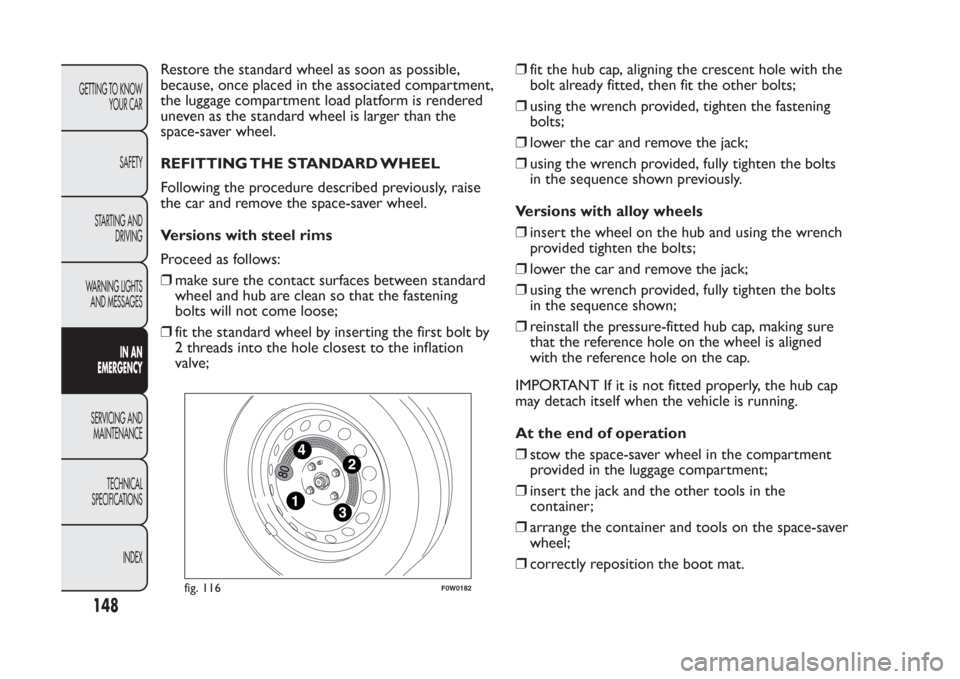
❒fit the standard wheel by inserting the first bolt by
2 threads into the hole closest to the inflation
valve;❒fit the hub cap, aligning the crescent hole with the
bolt already fitted, then fit the other bolts;
❒using the wrench provided, tighten the fastening
bolts;
❒lower the car and remove the jack;
❒using the wrench provided, fully tighten the bolts
in the sequence shown previously.
Versions with alloy wheels
❒insert the wheel on the hub and using the wrench
provided tighten the bolts;
❒lower the car and remove the jack;
❒using the wrench provided, fully tighten the bolts
in the sequence shown;
❒reinstall the pressure-fitted hub cap, making sure
that the reference hole on the wheel is aligned
with the reference hole on the cap.
IMPORTANT If it is not fitted properly, the hub cap
may detach itself when the vehicle is running.
At the end of operation
❒stow the space-saver wheel in the compartment
provided in the luggage compartment;
❒insert the jack and the other tools in the
container;
❒arrange the container and tools on the space-saver
wheel;
❒correctly reposition the boot mat.
fig. 116
F0W0182
148
GETTING TO KNOW
YOUR CAR
SAFETY
STARTING AND
DRIVING
WARNING LIGHTS
AND MESSAGES
IN AN
EMERGENCY
SERVICING AND
MAINTENANCE
TECHNICAL
SPECIFICATIONS
INDEX
Page 153 of 284
"FIX&GO automatic" KITIt is located in a special container in the luggage
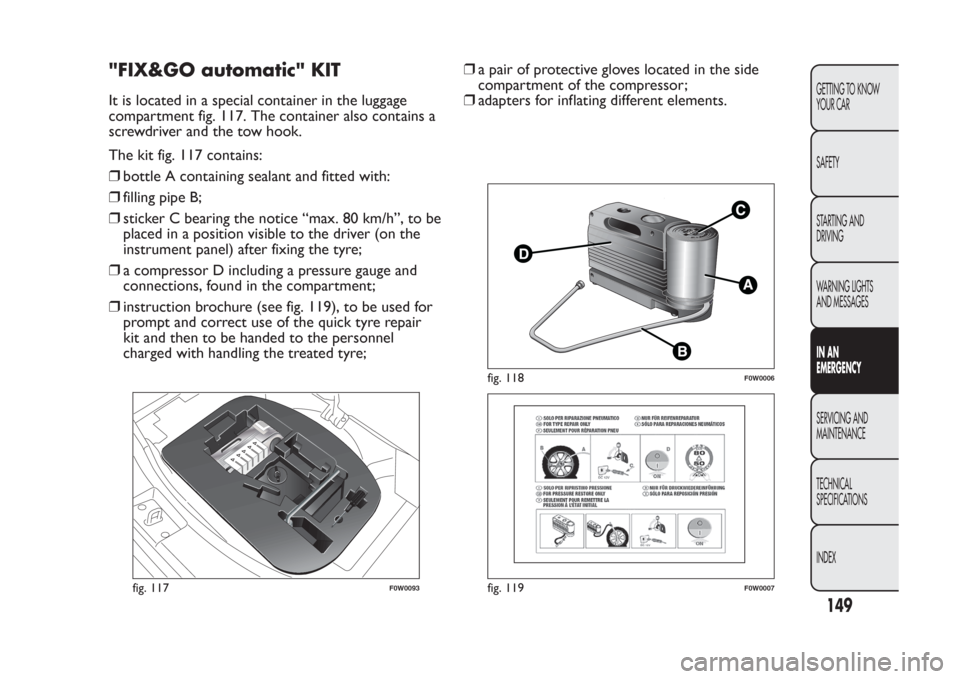
compartment fig. 117. The container also contains a
screwdriver and the tow hook.
The kit fig. 117 contains:
❒bottle A containing sealant and fitted with:
❒filling pipe B;
❒sticker C bearing the notice “max. 80 km/h”, to be
placed in a position visible to the driver (on the
instrument panel) after fixing the tyre;
❒a compressor D including a pressure gauge and
connections, found in the compartment;
❒instruction brochure (see fig. 119), to be used for
prompt and correct use of the quick tyre repair
kit and then to be handed to the personnel
charged with handling the treated tyre;❒a pair of protective gloves located in the side
compartment of the compressor;
❒adapters for inflating different elements.
fig. 117
F0W0093
fig. 118
F0W0006
fig. 119
F0W0007
149GETTING TO KNOW
YOUR CAR
SAFETY
STARTING AND
DRIVING
WARNING LIGHTS
AND MESSAGESIN AN
EMERGENCYSERVICING AND
MAINTENANCE
TECHNICAL
SPECIFICATIONS
INDEX
Page 158 of 284
CHANGING A BULBGENERAL INSTRUCTIONS
❒Before changing a bulb check the contacts for
oxidation;
❒burnt bulbs must be replaced by others of the
same type and power;
❒after replacing a headlight bulb, always check its
alignment;
❒when a light is not working, check that the
corresponding fuse is intact before changing a bulb.
For the location of fuses, refer to the paragraph
“If a fuse blows” in this section;
WARNING
Modifications or repairs to the electric
system that are not carried out properly
or do not take the system technical
specifications into account can cause
malfunctions leading to the risk of fire.
WARNING
Halogen bulbs contain pressurised gas,
in the case of breakage they may burst
causing glass fragments to be projected
outwards.
Halogen bulbs must be handled holding
the metal part only.Touching the
transparent part of the bulb with your
fingers may reduce the intensity of the emitted
light and even reduce the lifespan of the bulb. In
case of accidental contact , wipe the bulb with
a cloth moistened with alcohol and let the bulb
dry.Where possible, it is advisable to have
bulbs changed at a Fiat Dealership.The
correct operation and direction of the
external lights are absolutely essential for the
safety of the car and of compliance with the law.
IMPORTANT When the weather is cold or damp
or after heavy rain or washing, the surface of
headlights or rear lights, may steam up and/or form
drops of condensation on the inside. This is a natural
phenomenon due to the difference in temperature
and humidity between the inside and the outside
of the glass which does not indicate a fault and does
not compromise the normal operation of lighting
devices. The mist disappears quickly when the lights
are turned on, starting from the centre of the
diffuser, extending progressively towards the edges.
154
GETTING TO KNOW
YOUR CAR
SAFETY
STARTING AND
DRIVING
WARNING LIGHTS
AND MESSAGES
IN AN
EMERGENCY
SERVICING AND
MAINTENANCE
TECHNICAL
SPECIFICATIONS
INDEX
Page 177 of 284
TOWING THE CARThe tow hook, which is supplied with the car, is
housed in the tool box, under the carpet in the
luggage compartment.
ATTACHING THE TOW HOOK
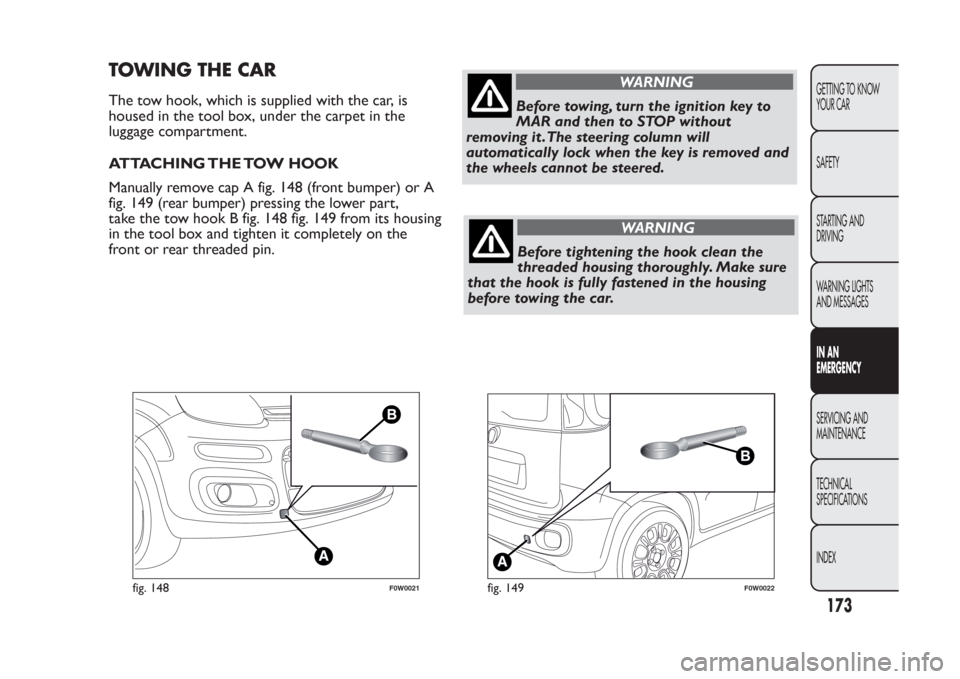
Manually remove cap A fig. 148 (front bumper) or A
fig. 149 (rear bumper) pressing the lower part,
take the tow hook B fig. 148 fig. 149 from its housing
in the tool box and tighten it completely on the
front or rear threaded pin.
WARNING
Before towing, turn the ignition key to
MAR and then to STOP without
removing it .The steering column will
automatically lock when the key is removed and
the wheels cannot be steered.
WARNING
Before tightening the hook clean the
threaded housing thoroughly. Make sure
that the hook is fully fastened in the housing
before towing the car.
fig. 148
F0W0021
fig. 149
F0W0022
173GETTING TO KNOW
YOUR CAR
SAFETY
STARTING AND
DRIVING
WARNING LIGHTS
AND MESSAGESIN AN
EMERGENCYSERVICING AND
MAINTENANCE
TECHNICAL
SPECIFICATIONS
INDEX
Page 178 of 284
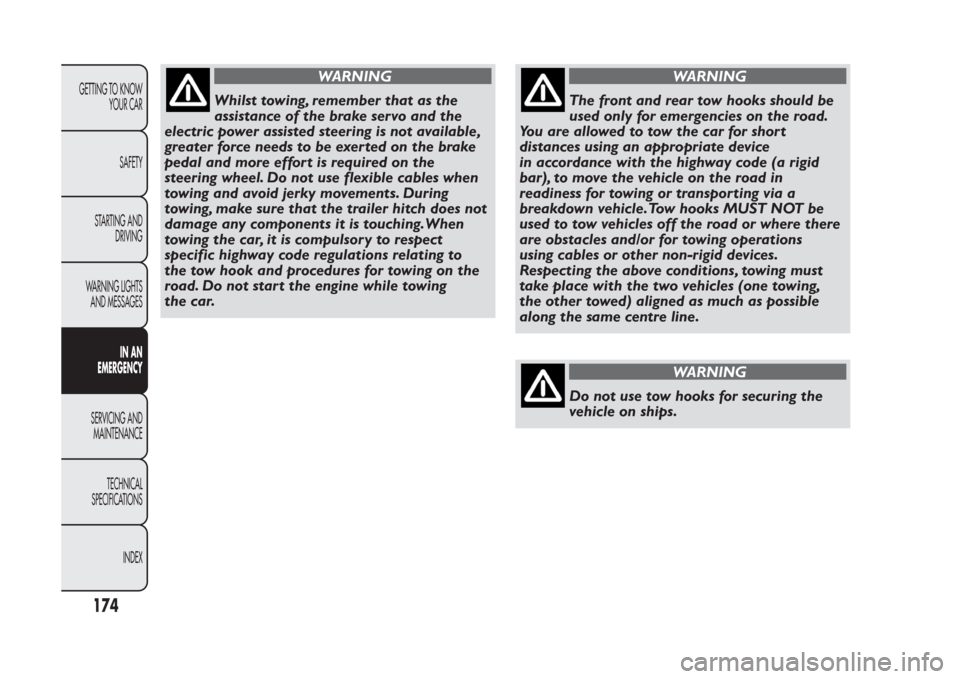
WARNING
Whilst towing, remember that as the
assistance of the brake servo and the
electric power assisted steering is not available,
greater force needs to be exerted on the brake
pedal and more effort is required on the
steering wheel. Do not use flexible cables when
towing and avoid jerky movements. During
towing, make sure that the trailer hitch does not
damage any components it is touching.When
towing the car, it is compulsor y to respect
specific highway code regulations relating to
the tow hook and procedures for towing on the
road. Do not star t the engine while towing
the car.
WARNING
The front and rear tow hooks should be
used only for emergencies on the road.
You are allowed to tow the car for short
distances using an appropriate device
in accordance with the highway code (a rigid
bar), to move the vehicle on the road in
readiness for towing or transporting via a
breakdown vehicle.Tow hooks MUST NOT be
used to tow vehicles off the road or where there
are obstacles and/or for towing operations
using cables or other non-rigid devices.
Respecting the above conditions, towing must
take place with the two vehicles (one towing,
the other towed) aligned as much as possible
along the same centre line.
WARNING
Do not use tow hooks for securing the
vehicle on ships.
174
GETTING TO KNOW
YOUR CAR
SAFETY
STARTING AND
DRIVING
WARNING LIGHTS
AND MESSAGES
IN AN
EMERGENCY
SERVICING AND
MAINTENANCE
TECHNICAL
SPECIFICATIONS
INDEX
Page 179 of 284
SERVICING AND MAINTENANCE
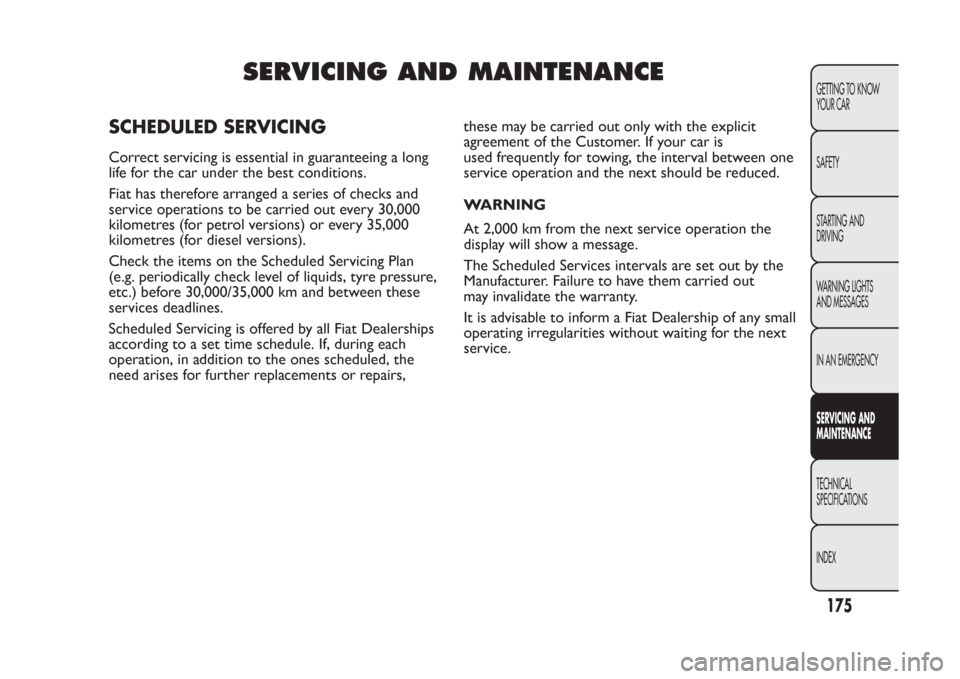
SCHEDULED SERVICINGCorrect servicing is essential in guaranteeing a long
life for the car under the best conditions.
Fiat has therefore arranged a series of checks and
service operations to be carried out every 30,000
kilometres (for petrol versions) or every 35,000
kilometres (for diesel versions).
Check the items on the Scheduled Servicing Plan
(e.g. periodically check level of liquids, tyre pressure,
etc.) before 30,000/35,000 km and between these
services deadlines.
Scheduled Servicing is offered by all Fiat Dealerships
according to a set time schedule. If, during each
operation, in addition to the ones scheduled, the
need arises for further replacements or repairs,these may be carried out only with the explicit
agreement of the Customer. If your car is
used frequently for towing, the interval between one
service operation and the next should be reduced.
WARNING
At 2,000 km from the next service operation the
display will show a message.
The Scheduled Services intervals are set out by the
Manufacturer. Failure to have them carried out
may invalidate the warranty.
It is advisable to inform a Fiat Dealership of any small
operating irregularities without waiting for the next
service.
175GETTING TO KNOW
YOUR CAR
SAFETY
STARTING AND
DRIVING
WARNING LIGHTS
AND MESSAGES
IN AN EMERGENCYSERVICING AND
MAINTENANCETECHNICAL
SPECIFICATIONS
INDEX
Page 182 of 284
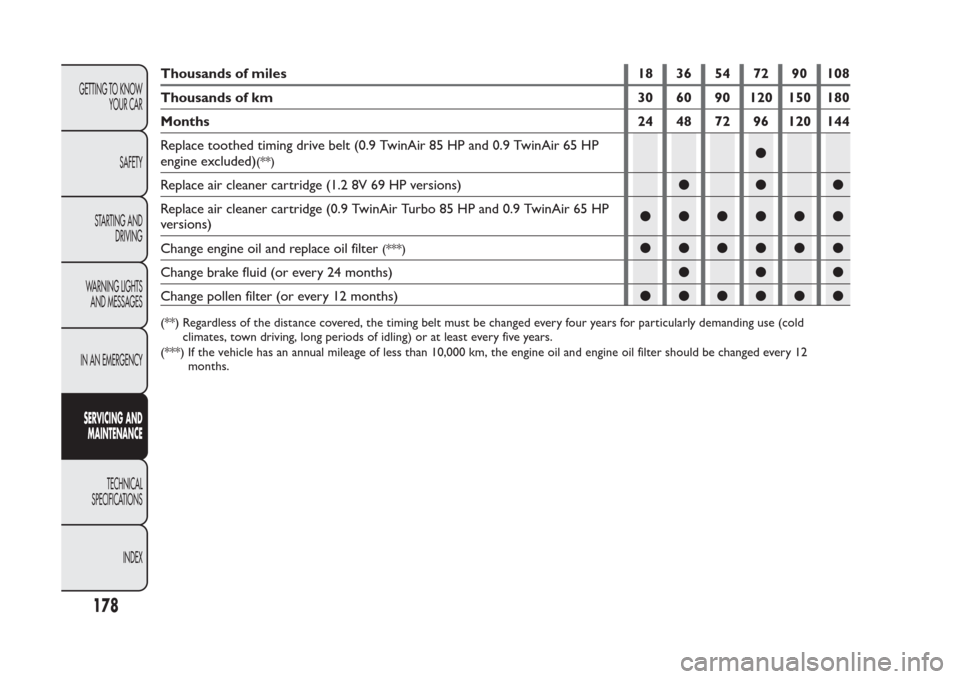
Thousands of miles 18 36 54 72 90 108
Thousands of km 30 60 90 120 150 180
Months 24 48 72 96 120 144
Replace toothed timing drive belt (0.9 TwinAir 85 HP and 0.9 TwinAir 65 HP
engine excluded)
(**)
●
Replace air cleaner cartridge (1.2 8V 69 HP versions)●●●
Replace air cleaner cartridge (0.9 TwinAir Turbo 85 HP and 0.9 TwinAir 65 HP
versions)●●●●●●
Change engine oil and replace oil filter
(***)
●●●●●●
Change brake fluid (or every 24 months)●●●
Change pollen filter (or every 12 months)●●●●●●
(**) Regardless of the distance covered, the timing belt must be changed every four years for particularly demanding use (cold
climates, town driving, long periods of idling) or at least every five years.
(***) If the vehicle has an annual mileage of less than 10,000 km, the engine oil and engine oil filter should be changed every 12
months.
178
GETTING TO KNOW
YOUR CAR
SAFETY
STARTING AND
DRIVING
WARNING LIGHTS
AND MESSAGES
IN AN EMERGENCYSERVICING AND
MAINTENANCE
TECHNICAL
SPECIFICATIONS
INDEX
Page 184 of 284
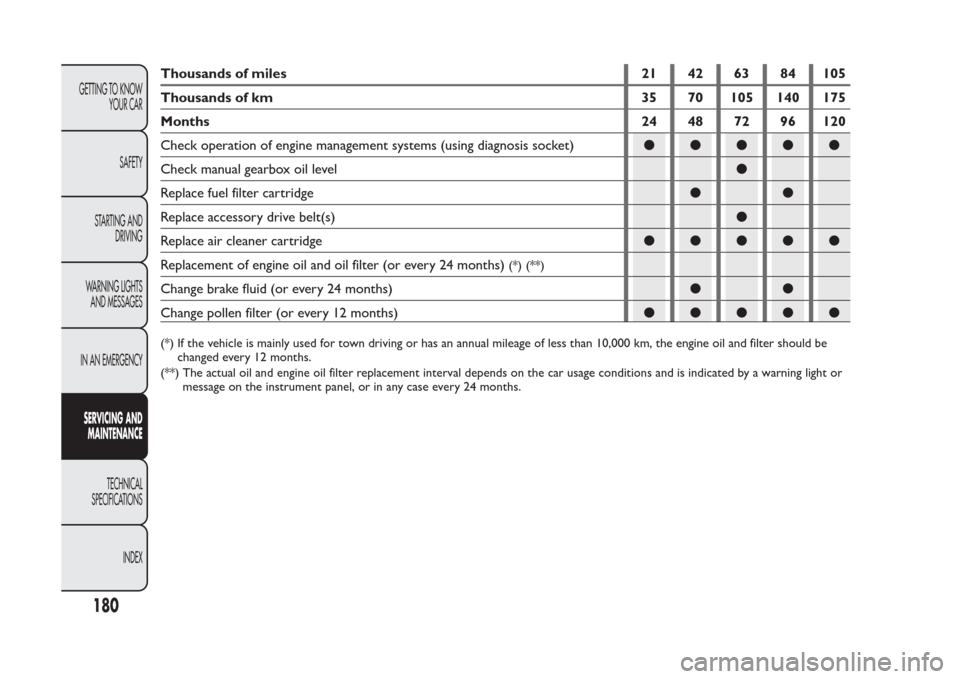
Thousands of miles 21 42 63 84 105
Thousands of km 35 70 105 140 175
Months 24 48 72 96 120
Check operation of engine management systems (using diagnosis socket)●●●●●
Check manual gearbox oil level●
Replace fuel filter cartridge●●
Replace accessory drive belt(s)●
Replace air cleaner cartridge●●●●●
Replacement of engine oil and oil filter (or every 24 months)
(*) (**)
Change brake fluid (or every 24 months)●●
Change pollen filter (or every 12 months)●●●●●(*) If the vehicle is mainly used for town driving or has an annual mileage of less than 10,000 km, the engine oil and filter should be
changed every 12 months.
(**) The actual oil and engine oil filter replacement interval depends on the car usage conditions and is indicated by a warning light or
message on the instrument panel, or in any case every 24 months.
180
GETTING TO KNOW
YOUR CAR
SAFETY
STARTING AND
DRIVING
WARNING LIGHTS
AND MESSAGES
IN AN EMERGENCYSERVICING AND
MAINTENANCE
TECHNICAL
SPECIFICATIONS
INDEX
Page 185 of 284
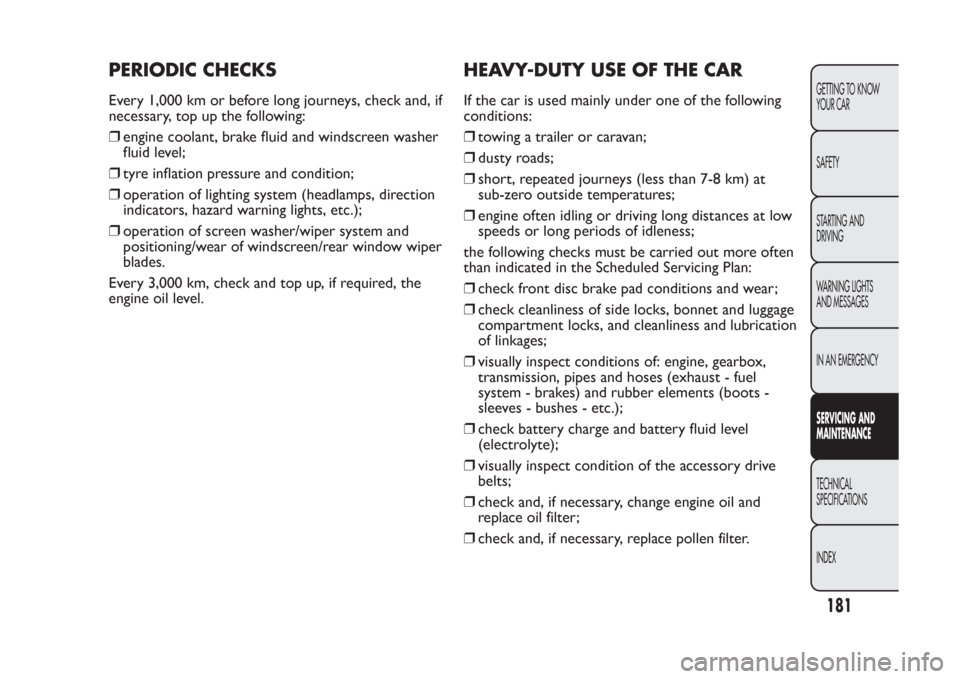
PERIODIC CHECKSEvery 1,000 km or before long journeys, check and, if
necessary, top up the following:
❒engine coolant, brake fluid and windscreen washer
fluid level;
❒tyre inflation pressure and condition;
❒operation of lighting system (headlamps, direction
indicators, hazard warning lights, etc.);
❒operation of screen washer/wiper system and
positioning/wear of windscreen/rear window wiper
blades.
Every 3,000 km, check and top up, if required, the
engine oil level.
HEAVY-DUTY USE OF THE CARIf the car is used mainly under one of the following
conditions:
❒towing a trailer or caravan;
❒dusty roads;
❒short, repeated journeys (less than 7-8 km) at
sub-zero outside temperatures;
❒engine often idling or driving long distances at low
speeds or long periods of idleness;
the following checks must be carried out more often
than indicated in the Scheduled Servicing Plan:
❒check front disc brake pad conditions and wear;
❒check cleanliness of side locks, bonnet and luggage
compartment locks, and cleanliness and lubrication
of linkages;
❒visually inspect conditions of: engine, gearbox,
transmission, pipes and hoses (exhaust - fuel
system - brakes) and rubber elements (boots -
sleeves - bushes - etc.);
❒check battery charge and battery fluid level
(electrolyte);
❒visually inspect condition of the accessory drive
belts;
❒check and, if necessary, change engine oil and
replace oil filter;
❒check and, if necessary, replace pollen filter.
181GETTING TO KNOW
YOUR CAR
SAFETY
STARTING AND
DRIVING
WARNING LIGHTS
AND MESSAGES
IN AN EMERGENCYSERVICING AND
MAINTENANCETECHNICAL
SPECIFICATIONS
INDEX
Page 222 of 284
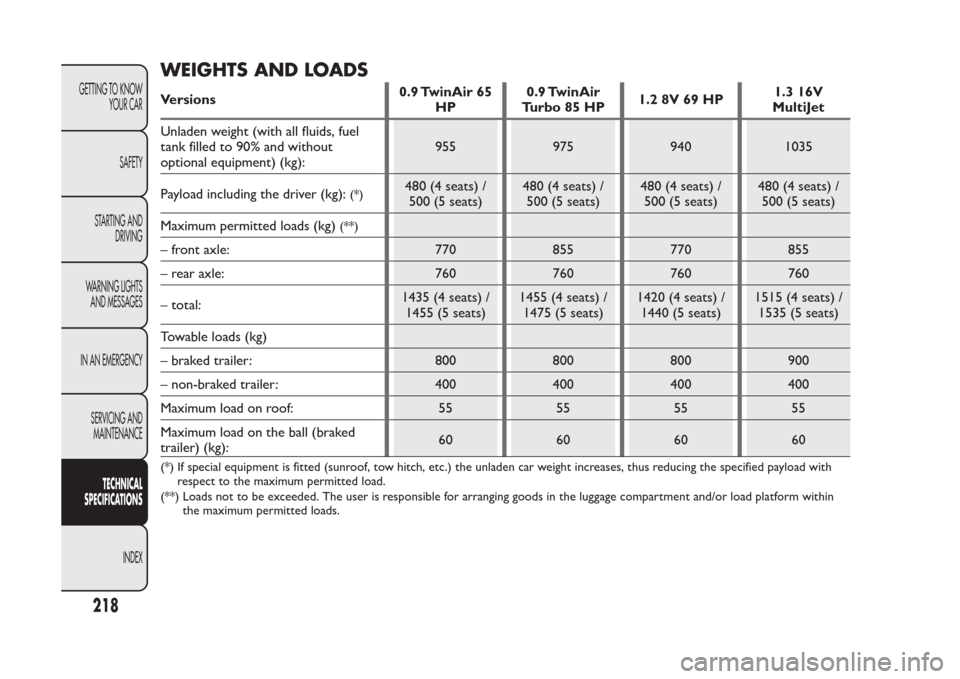
WEIGHTS AND LOADSVersions0.9 TwinAir 65
HP0.9 TwinAir
Turbo 85 HP1.2 8V 69 HP1.3 16V
MultiJet
Unladen weight (with all fluids, fuel
tank filled to 90% and without
optional equipment) (kg):955 975 940 1035
Payload including the driver (kg):
(*)
480 (4 seats) /
500 (5 seats)480 (4 seats) /
500 (5 seats)480 (4 seats) /
500 (5 seats)480 (4 seats) /
500 (5 seats)
Maximum permitted loads (kg)
(**)
– front axle: 770 855 770 855
– rear axle: 760 760 760 760
– total:1435 (4 seats) /
1455 (5 seats)1455 (4 seats) /
1475 (5 seats)1420 (4 seats) /
1440 (5 seats)1515 (4 seats) /
1535 (5 seats)
Towable loads (kg)
– braked trailer: 800 800 800 900
– non-braked trailer: 400 400 400 400
Maximum load on roof: 55 55 55 55
Maximum load on the ball (braked
trailer) (kg):60 60 60 60(*) If special equipment is fitted (sunroof, tow hitch, etc.) the unladen car weight increases, thus reducing the specified payload with
respect to the maximum permitted load.
(**) Loads not to be exceeded. The user is responsible for arranging goods in the luggage compartment and/or load platform within
the maximum permitted loads.
218
GETTING TO KNOW
YOUR CAR
SAFETY
STARTING AND
DRIVING
WARNING LIGHTS
AND MESSAGES
IN AN EMERGENCY
SERVICING AND
MAINTENANCE
TECHNICAL
SPECIFICATIONS
INDEX