elect FIAT PANDA 2014 319 / 3.G Owner's Manual
[x] Cancel search | Manufacturer: FIAT, Model Year: 2014, Model line: PANDA, Model: FIAT PANDA 2014 319 / 3.GPages: 284, PDF Size: 11.54 MB
Page 43 of 284
IMPORTANT It is inadvisable to use air recirculation
when the outside temperature is low, since the
windows could mist rapidly.
Button E
- Climate control on/off
Pressing thebutton switches the system on/off.
With the system off, the climate control system
conditions are as follows:
❒all LEDs are off;
❒set temperature display is off;
❒air recirculation is off;
❒compressor is off;
❒fan is off.
Button F- Heated rear window, folding
mirror/heated windscreen (for versions/
markets, where available) activation/
deactivation
Pressing thebutton switches on the LED on the
button.
Buttons G/M
/
- Fan speed adjustment
Use buttons G
or M
to increase or decrease the
air flow.
Button H (AUTO) - AUTO function activation
(automatic climate control operation)
When the AUTO button is pressed and the required
temperature is set, the system adjusts thetemperature, quantity and distribution of air entering
the passenger compartment and controls
compressor operation.
Button I - Air temperature increase
When the button is pressed, the passenger
compartment air temperature increases.
Button L - Air temperature decrease
When the button is pressed, the passenger
compartment air temperature decreases.
DESCRIPTION
The automatically controlled parameters and
functions are:
❒air temperature at the vents;
❒air distribution at the vents;
❒fan speed (continuous variation of the air flow);
❒compressor activation (for cooling/dehumidifying
the air);
❒air recirculation.
All functions may be changed manually. In other
words, you may select one or more functions and
change the parameters as required. Automatic
control of the manually changed functions will be
suspended: the system will only override your
settings for safety-related reasons (e.g. risk
of misting).
39GETTING TO
KNOW YOUR CARSAFETY
STARTING AND
DRIVING
WARNING LIGHTS
AND MESSAGES
IN AN EMERGENCY
SERVICING AND
MAINTENANCE
TECHNICAL
SPECIFICATIONS
INDEX
Page 44 of 284
Manual selections always have higher priority over
automatic settings and are stored until the user
switches the system back to automatic control
except for cases in which the system intervenes for
particular safety-related reasons. You can adjust
one function manually without affecting the
automatic control of the others.
The amount of air introduced into the passenger
compartment is not affected by car speed; it is
regulated by the fan, which is controlled
electronically.
The temperature of the air supplied is always
controlled automatically, depending on the
temperature set in the driver’s display (except when
the system is off or in certain conditions when the
compressor is switched off ).
The system allows the following to be set or adjusted
manually:
❒air temperature;
❒fan speed (continuous variation);
❒air distribution with 5 positions;
❒compressor enablement;
❒rapid defrosting/demisting function;
❒air recirculation;
❒heated rear window, folding mirror/heated
windscreen (for versions/markets, where available);
❒system deactivation.SWITCHING ON THE CLIMATE CONTROL
SYSTEM
The system can be switched on in various ways; it is
however advisable to press the AUTO button and
set the desired temperature on the display.
The climate control system allows you to customise
the requested temperatures.
The climate control system compressor works only
with the engine running and with an outside
temperature of above 0°C.
AUTOMATIC CLIMATE CONTROL SYSTEM
OPERATION
Press the AUTO button; the system will
automatically adjust:
❒the amount of air introduced into the passenger
compartment;
❒the distribution of the air in the passenger
compartment;
cancelling all previous manual adjustments.
The LED on the AUTO button switches on during
automatic climate control operation.
During automatic operation it is still possible to
adjust the temperatures set and carry out one of the
following operations manually:
❒fan speed adjustment;
❒air distribution selection;
❒internal air recirculation activation/deactivation;
❒climate control compressor activation.
40GETTING TO
KNOW YOUR CAR
SAFETY
STARTING AND
DRIVING
WARNING LIGHTS
AND MESSAGES
IN AN EMERGENCY
SERVICING AND
MAINTENANCE
TECHNICAL
SPECIFICATIONS
INDEX
Page 46 of 284
This function is timed and switches off automatically
after 4 minutes for the windscreen and 20 minutes
for the rear window and door mirrors.
Press the
button again to switch the function off
in advance.
To activate the heated windscreen again press the
button
:
❒twice with LED on the button still on;
❒once with LED on the button off.
When the button
is pressed, the heated
windscreen activates if it has not been activated
already by button.
IMPORTANT Do not apply stickers on the inside of
the rear window over the heating filaments to avoid
damage.
IMPORTANT To draw in air from the outside, press
the
button. The LED next to the button
switches off.
INTERNAL AIR RECIRCULATION
ACTIVATION
Air recirculation is carried out according to two
possible operating modes:
❒forced deactivation (air recirculation always
deactivated, air taken from the outside);
❒forced activation (internal air circulation always
activated).
To activate internal air recirculation, press button D
.❒LED on button on: internal air recirculation on;
❒LED on button off: internal air recirculation off, air
drawn in from outside.
When the
button is pressed, the climate control
system automatically activates internal air
recirculation. External air recirculation can always be
activated by pressing the
button (LED off )
and vice versa.
Automatic recirculation operation is activated by
pressing the AUTO button.
IMPORTANT Internal air recirculation makes it
possible to reach the required heating or cooling
conditions more quickly depending on the mode
selected. It is not advisable to switch the air
recirculation on when it is rainy/cold to prevent the
windows from misting up, especially if the climate
control is not turned on. It is advisable to switch the
internal air recirculation on whilst queuing or in
tunnels, or whilst driving on dusty roads, to prevent
the introduction of polluted air. Do not use the
function for a long time, particularly if there are
several passengers on board, to prevent the windows
from misting up.
42GETTING TO
KNOW YOUR CAR
SAFETY
STARTING AND
DRIVING
WARNING LIGHTS
AND MESSAGES
IN AN EMERGENCY
SERVICING AND
MAINTENANCE
TECHNICAL
SPECIFICATIONS
INDEX
Page 47 of 284
CLIMATE CONTROL COMPRESSOR
ACTIVATION/DEACTIVATION
Press the
button to switch on the climate control
compressor.
Compressor on:LED on
button on.
Compressor off:
❒LED on
button switches off;
❒internal air recirculation excluded;
With the climate control compressor switched off,
air cannot be introduced into the passenger
compartment that has a lower temperature than the
outside air; in this case the LED on the
button
will light up.
The deactivation of the climate control compressor
is memorised even after the engine has stopped.
To reactivate the climate control compressor, press
the
or AUTO button again: if you press AUTO,
the other manual settings will be cancelled.
AIR DISTRIBUTION SELECTION
Press one or more of buttons A fig. 30 to manually
select one of the possible air distribution settings for
the passenger compartment:
Air flow to the windscreen and front side
window diffusers to demist/defrost them.Air flow to the footwell diffusers. This air
distribution allows the passenger compartment
to be warmed up quickly.Air flow distribution to centre/side dashboard
diffusers (passenger's body).
+
Air flow distributed between footwell
diffusers and windscreen and front side
window defrosting/demisting diffusers. This
distribution setting allows the passenger
compartment to be warmed effectively and
prevents the windows from misting.
+
Air flow distribution between footwell
diffusers (hotter air) and centre/side
dashboard diffusers (cooler air).
IMPORTANT For the climate control system to
function, at least one of the buttons A must be
operated fig. 30. The system does not allow the
deactivation of all the buttons A.
IMPORTANT Push the
button to turn the climate
control system back on: in this way, all operating
conditions memorised before switching off are
restored.
To restore automatic control of the air distribution
after a manual selection, press the AUTO button.
SWITCHING OFF THE CLIMATE CONTROL
SYSTEM
Press the
button.
The LEDS next to the
symbol and internal air
recirculation indication on the control panel switch
off.
SYSTEM MAINTENANCE
In winter, the climate control system must be turned
on at least once a month for about 10 minutes.
43GETTING TO
KNOW YOUR CARSAFETY
STARTING AND
DRIVING
WARNING LIGHTS
AND MESSAGES
IN AN EMERGENCY
SERVICING AND
MAINTENANCE
TECHNICAL
SPECIFICATIONS
INDEX
Page 50 of 284
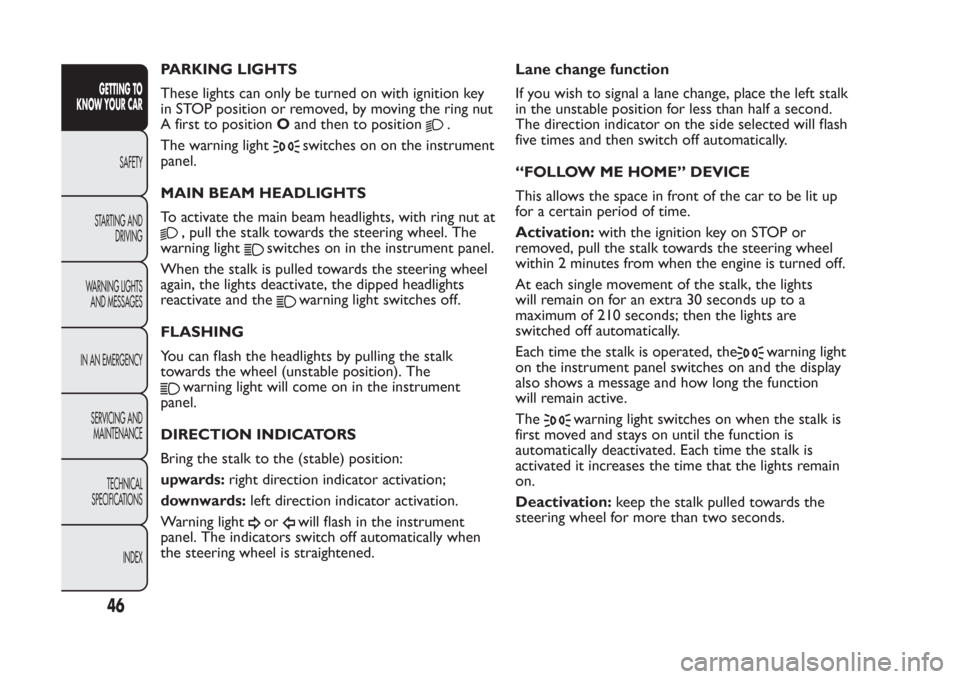
PARKING LIGHTS
These lights can only be turned on with ignition key
in STOP position or removed, by moving the ring nut
A first to positionOand then to position
.
The warning light
switches on on the instrument
panel.
MAIN BEAM HEADLIGHTS
To activate the main beam headlights, with ring nut at
, pull the stalk towards the steering wheel. The
warning light
switches on in the instrument panel.
When the stalk is pulled towards the steering wheel
again, the lights deactivate, the dipped headlights
reactivate and the
warning light switches off.
FLASHING
You can flash the headlights by pulling the stalk
towards the wheel (unstable position). The
warning light will come on in the instrument
panel.
DIRECTION INDICATORS
Bring the stalk to the (stable) position:
upwards:right direction indicator activation;
downwards:left direction indicator activation.
Warning light
or
will flash in the instrument
panel. The indicators switch off automatically when
the steering wheel is straightened.Lane change function
If you wish to signal a lane change, place the left stalk
in the unstable position for less than half a second.
The direction indicator on the side selected will flash
five times and then switch off automatically.
“FOLLOW ME HOME” DEVICE
This allows the space in front of the car to be lit up
for a certain period of time.
Activation:with the ignition key on STOP or
removed, pull the stalk towards the steering wheel
within 2 minutes from when the engine is turned off.
At each single movement of the stalk, the lights
will remain on for an extra 30 seconds up to a
maximum of 210 seconds; then the lights are
switched off automatically.
Each time the stalk is operated, the
warning light
on the instrument panel switches on and the display
also shows a message and how long the function
will remain active.
The
warning light switches on when the stalk is
first moved and stays on until the function is
automatically deactivated. Each time the stalk is
activated it increases the time that the lights remain
on.
Deactivation:keep the stalk pulled towards the
steering wheel for more than two seconds.
46GETTING TO
KNOW YOUR CAR
SAFETY
STARTING AND
DRIVING
WARNING LIGHTS
AND MESSAGES
IN AN EMERGENCY
SERVICING AND
MAINTENANCE
TECHNICAL
SPECIFICATIONS
INDEX
Page 56 of 284
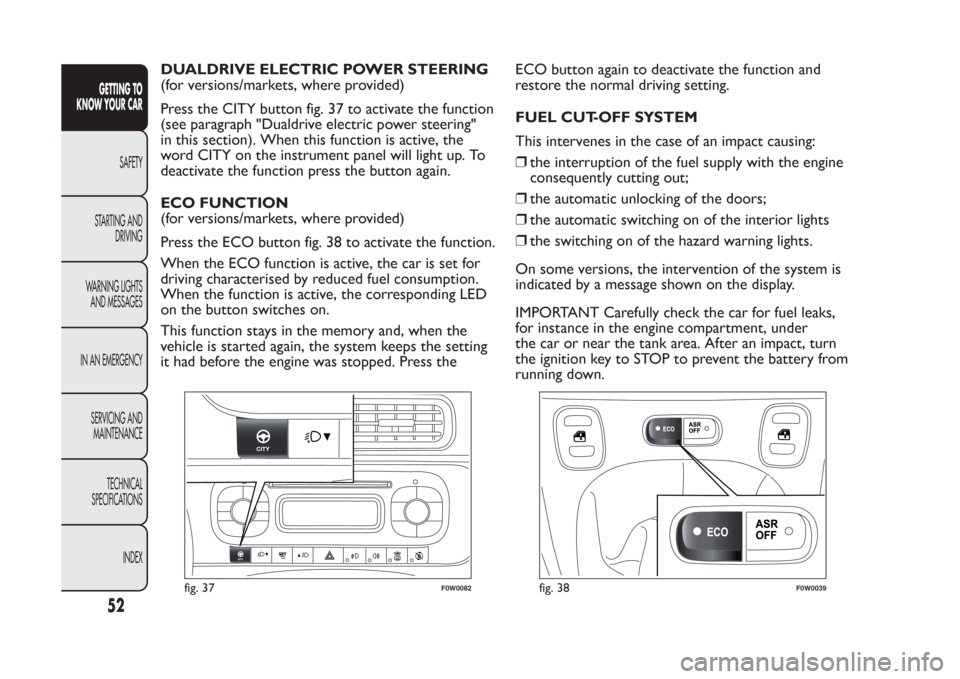
DUALDRIVE ELECTRIC POWER STEERING
(for versions/markets, where provided)
Press the CITY button fig. 37 to activate the function
(see paragraph "Dualdrive electric power steering"
in this section). When this function is active, the
word CITY on the instrument panel will light up. To
deactivate the function press the button again.
ECO FUNCTION
(for versions/markets, where provided)
Press the ECO button fig. 38 to activate the function.
When the ECO function is active, the car is set for
driving characterised by reduced fuel consumption.
When the function is active, the corresponding LED
on the button switches on.
This function stays in the memory and, when the
vehicle is started again, the system keeps the setting
it had before the engine was stopped. Press theECO button again to deactivate the function and
restore the normal driving setting.
FUEL CUT-OFF SYSTEM
This intervenes in the case of an impact causing:
❒the interruption of the fuel supply with the engine
consequently cutting out;
❒the automatic unlocking of the doors;
❒the automatic switching on of the interior lights
❒the switching on of the hazard warning lights.
On some versions, the intervention of the system is
indicated by a message shown on the display.
IMPORTANT Carefully check the car for fuel leaks,
for instance in the engine compartment, under
the car or near the tank area. After an impact, turn
the ignition key to STOP to prevent the battery from
running down.
fig. 37
F0W0082
fig. 38
F0W0039
52GETTING TO
KNOW YOUR CAR
SAFETY
STARTING AND
DRIVING
WARNING LIGHTS
AND MESSAGES
IN AN EMERGENCY
SERVICING AND
MAINTENANCE
TECHNICAL
SPECIFICATIONS
INDEX
Page 60 of 284
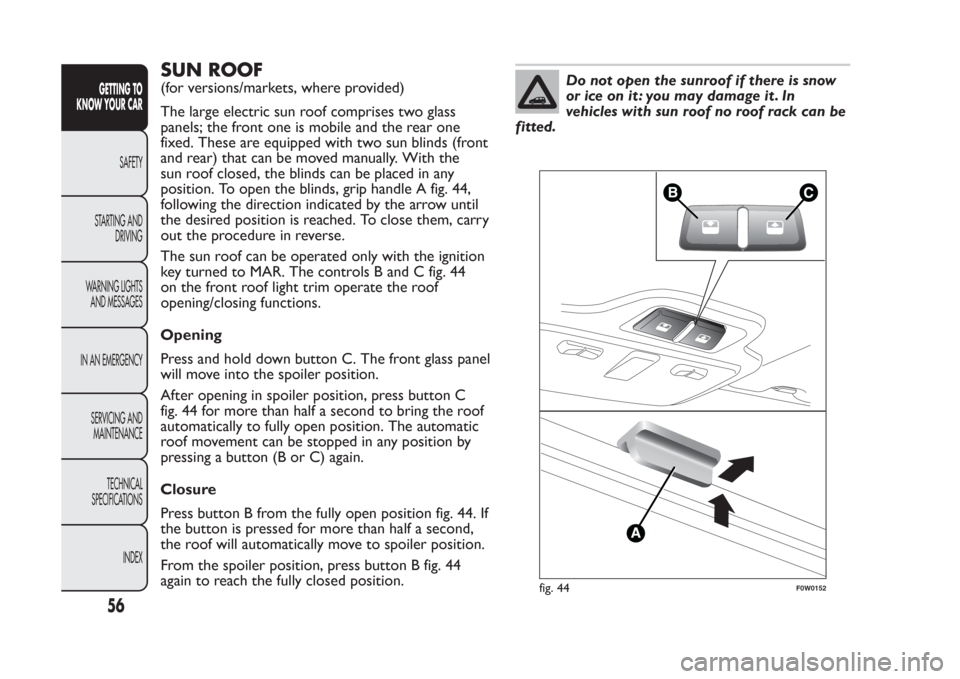
SUN ROOF(for versions/markets, where provided)
The large electric sun roof comprises two glass
panels; the front one is mobile and the rear one
fixed. These are equipped with two sun blinds (front
and rear) that can be moved manually. With the
sun roof closed, the blinds can be placed in any
position. To open the blinds, grip handle A fig. 44,
following the direction indicated by the arrow until
the desired position is reached. To close them, carry
out the procedure in reverse.
The sun roof can be operated only with the ignition
key turned to MAR. The controls B and C fig. 44
on the front roof light trim operate the roof
opening/closing functions.
Opening
Press and hold down button C. The front glass panel
will move into the spoiler position.
After opening in spoiler position, press button C
fig. 44 for more than half a second to bring the roof
automatically to fully open position. The automatic
roof movement can be stopped in any position by
pressing a button (B or C) again.
Closure
Press button B from the fully open position fig. 44. If
the button is pressed for more than half a second,
the roof will automatically move to spoiler position.
From the spoiler position, press button B fig. 44
again to reach the fully closed position.
Do not open the sunroof if there is snow
or ice on it : you may damage it . In
vehicles with sun roof no roof rack can be
fitted.
fig. 44
F0W0152
56GETTING TO
KNOW YOUR CAR
SAFETY
STARTING AND
DRIVING
WARNING LIGHTS
AND MESSAGES
IN AN EMERGENCY
SERVICING AND
MAINTENANCE
TECHNICAL
SPECIFICATIONS
INDEX
Page 61 of 284
WARNING
When leaving the car, always remove the
key from the ignition to avoid the risk
of injur y to those still inside the car due to
accidental operation of the sunroof. Improper
use of the roof may be dangerous. Before and
during operation, always check that no-one
is exposed to the risk of being injured by the
moving sunroof or by objects getting caught or
hitbyit.
ANTI-PINCH SAFETY DEVICE
For versions/markets where provided, the sun roof
has an anti-pinch safety system capable of detecting
the presence of an obstacle whilst the roof is closing;
if this happens, the system intervenes and the
movement of the glass is immediately reversed.
EMERGENCY OPERATION
If the electric device for moving the roof fails, the
sun roof can be moved manually proceeding as
described below:
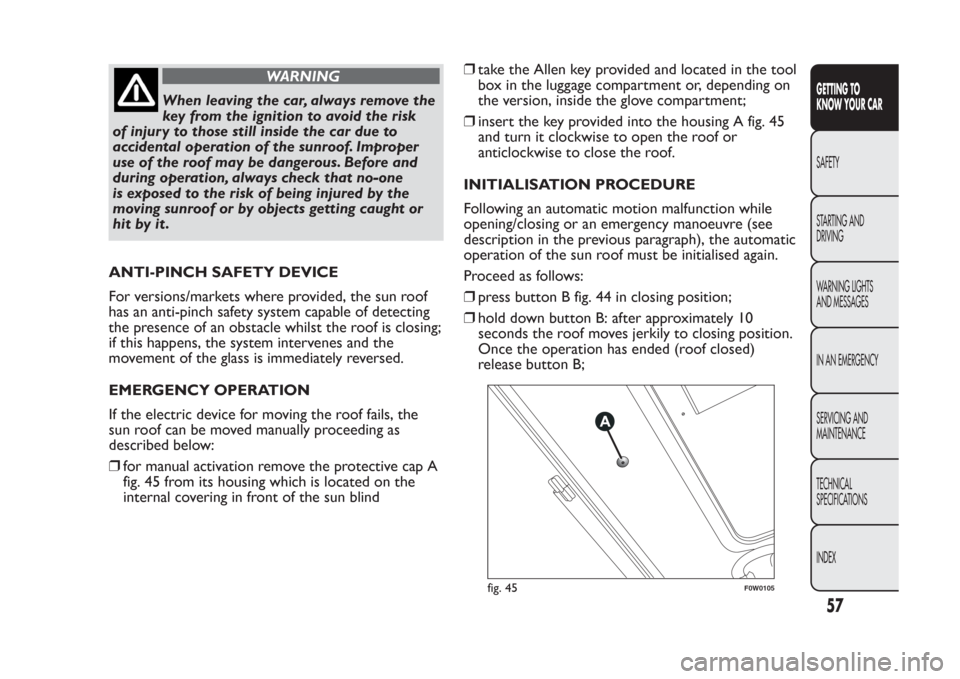
❒for manual activation remove the protective cap A
fig. 45 from its housing which is located on the
internal covering in front of the sun blind❒take the Allen key provided and located in the tool
box in the luggage compartment or, depending on
the version, inside the glove compartment;
❒insert the key provided into the housing A fig. 45
and turn it clockwise to open the roof or
anticlockwise to close the roof.
INITIALISATION PROCEDURE
Following an automatic motion malfunction while
opening/closing or an emergency manoeuvre (see
description in the previous paragraph), the automatic
operation of the sun roof must be initialised again.
Proceed as follows:
❒press button B fig. 44 in closing position;
❒hold down button B: after approximately 10
seconds the roof moves jerkily to closing position.
Once the operation has ended (roof closed)
release button B;
fig. 45
F0W0105
57GETTING TO
KNOW YOUR CARSAFETY
STARTING AND
DRIVING
WARNING LIGHTS
AND MESSAGES
IN AN EMERGENCY
SERVICING AND
MAINTENANCE
TECHNICAL
SPECIFICATIONS
INDEX
Page 64 of 284
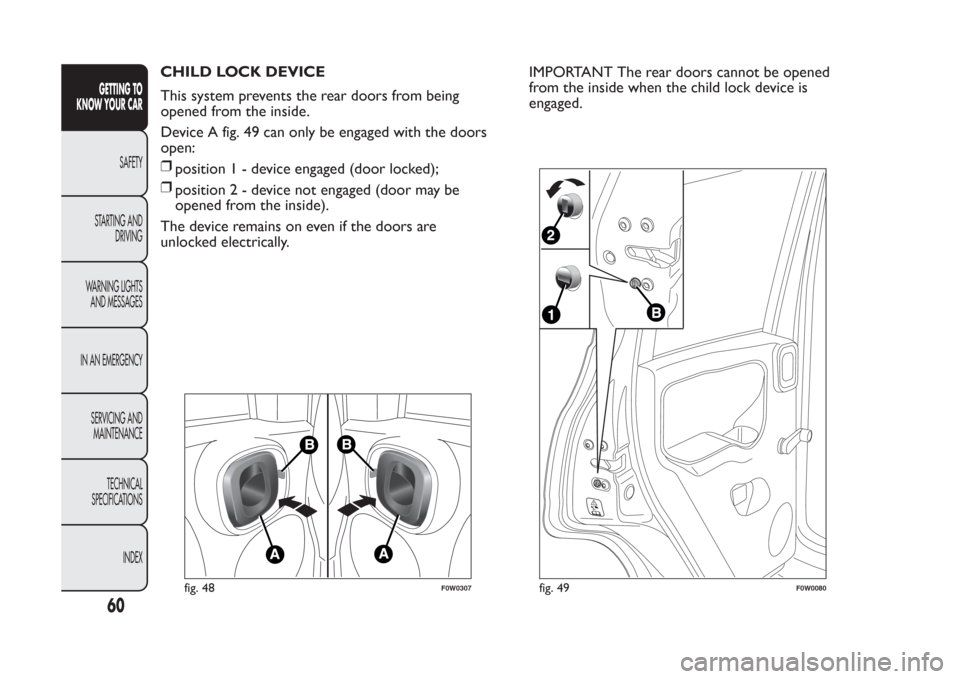
CHILD LOCK DEVICE
This system prevents the rear doors from being
opened from the inside.
Device A fig. 49 can only be engaged with the doors
open:
❒
position1-device engaged (door locked);
❒
position2-device not engaged (door may be
opened from the inside).
The device remains on even if the doors are
unlocked electrically.IMPORTANT The rear doors cannot be opened
from the inside when the child lock device is
engaged.
fig. 48
F0W0307
fig. 49
F0W0080
60GETTING TO
KNOW YOUR CAR
SAFETY
STARTING AND
DRIVING
WARNING LIGHTS
AND MESSAGES
IN AN EMERGENCY
SERVICING AND
MAINTENANCE
TECHNICAL
SPECIFICATIONS
INDEX
Page 66 of 284
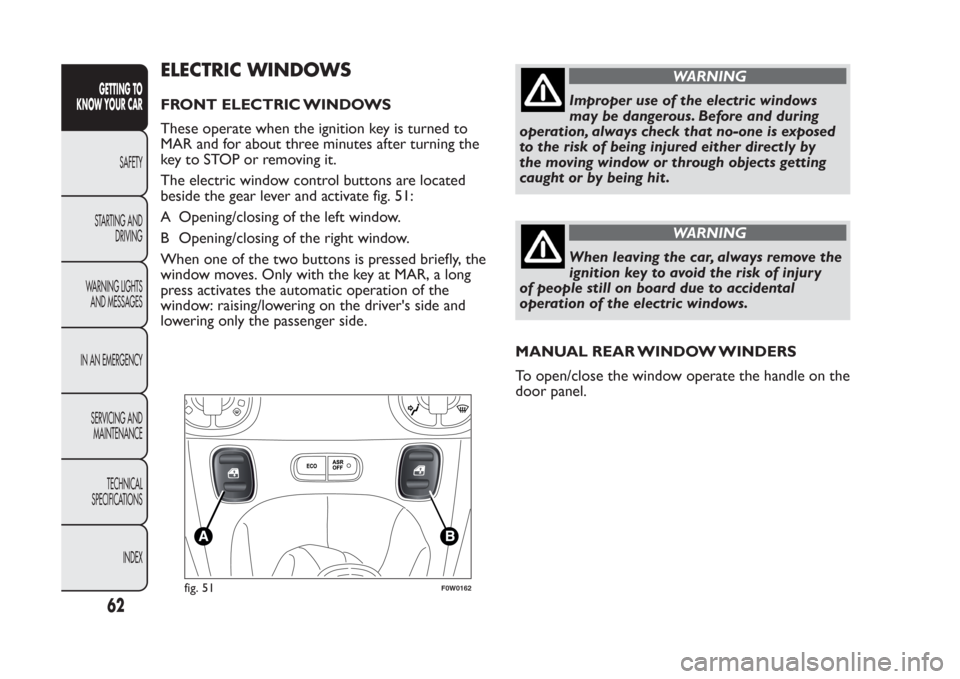
ELECTRIC WINDOWSFRONT ELECTRIC WINDOWS
These operate when the ignition key is turned to
MAR and for about three minutes after turning the
key to STOP or removing it.
The electric window control buttons are located
beside the gear lever and activate fig. 51:
A Opening/closing of the left window.
B Opening/closing of the right window.
When one of the two buttons is pressed briefly, the
window moves. Only with the key at MAR, a long
press activates the automatic operation of the
window: raising/lowering on the driver's side and
lowering only the passenger side.
WARNING
Improper use of the electric windows
may be dangerous. Before and during
operation, always check that no-one is exposed
to the risk of being injured either directly by
the moving window or through objects getting
caught or by being hit .
WARNING
When leaving the car, always remove the
ignition key to avoid the risk of injury
of people still on board due to accidental
operation of the electric windows.
MANUAL REAR WINDOW WINDERS
To open/close the window operate the handle on the
door panel.
fig. 51
F0W0162
62GETTING TO
KNOW YOUR CAR
SAFETY
STARTING AND
DRIVING
WARNING LIGHTS
AND MESSAGES
IN AN EMERGENCY
SERVICING AND
MAINTENANCE
TECHNICAL
SPECIFICATIONS
INDEX